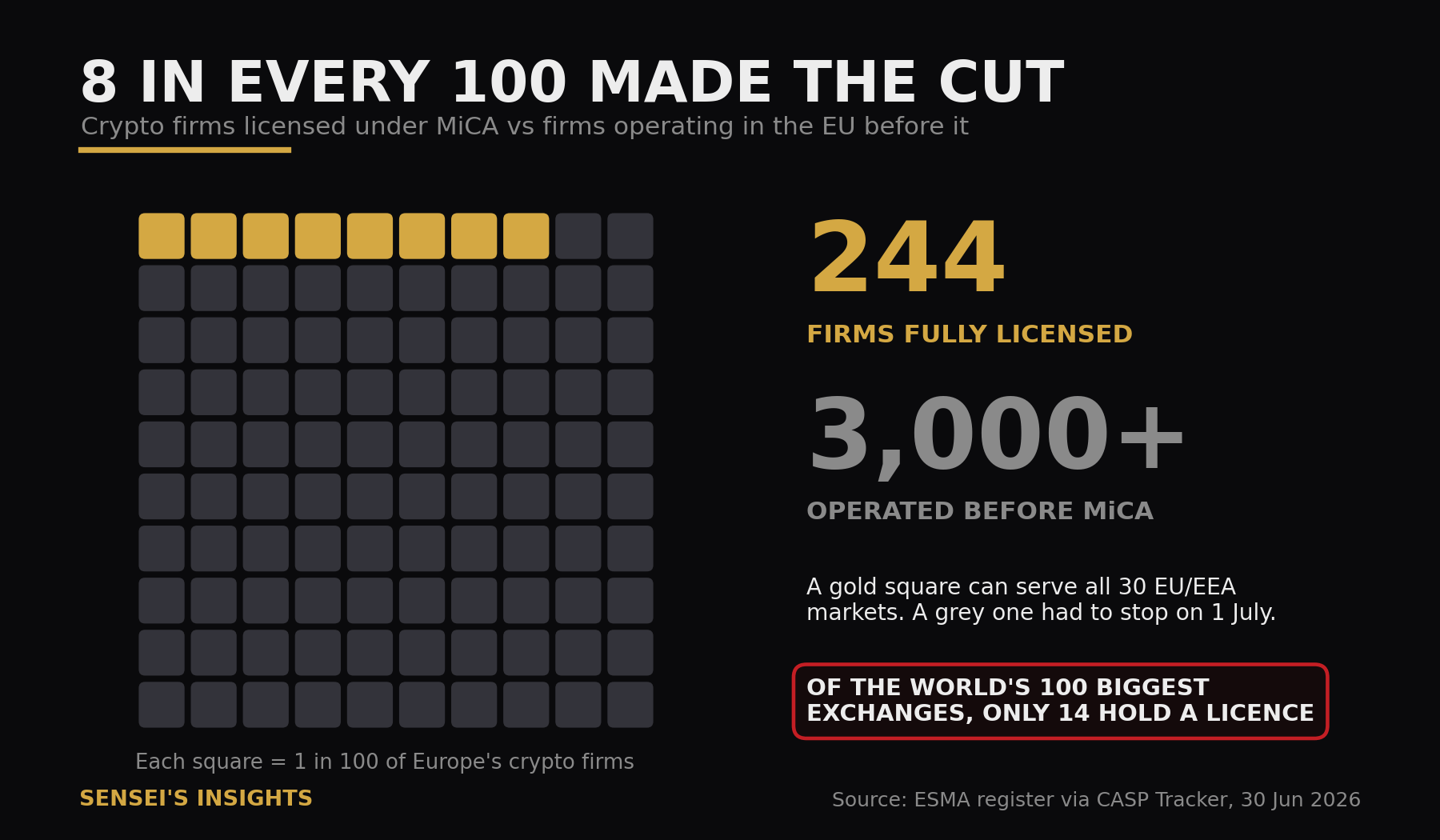
The first full day of crypto’s new European era is in the books. MiCA, the EU’s giant crypto rulebook, hit its final deadline on Tuesday night, and through the whole of yesterday any firm serving EU customers without a licence was breaking the law. Day one’s scoreboard: 244 licensed survivors out of more than 3,000 firms, the world’s largest exchange locked outside, and a market that barely blinked. Here is everything you need to know, in plain English.
❓ Your Questions, Answered First
What just happened?
The EU’s crypto law, MiCA, gave existing firms a grace period to get licensed. That grace period expired on Tuesday night, and yesterday was the first full trading day under the complete rulebook. No licence now means no EU customers, and regulators have ordered the rest to wind down.
What actually is MiCA?
It stands for Markets in Crypto-Assets, and it is the first complete crypto rulebook passed by any major economy. One set of rules for all 27 EU countries covering exchanges, brokers, wallets and stablecoins. Think of it as crypto’s version of the rules your bank and stockbroker already live under, minus one big protection I cover below.
Is my money frozen if my exchange missed the cut?
No. Unlicensed firms must stop taking new business, but regulators have told them to let customers sell, transfer out and close positions in an orderly way. Binance, for example, has stopped new deposits and spot orders for EU users, but withdrawals stay open and it says assets remain accessible at all times.
I’m in the UK. Does this affect me?
Not directly, MiCA is EU law and the UK left the EU, so nothing changed on FCA-registered platforms yesterday. The catch: if your account was opened while living in the EU, or sits with an exchange’s European entity, you may get the same wind-down emails, and when exchanges retrench they often bundle the UK in, which is exactly how Gemini’s April exit worked. Check which legal entity serves you in your account settings. The UK is building its own version of these rules, in force from October 2027.
Is USDT banned in Europe now?
Not banned, but licensed exchanges can no longer offer it because Tether never got the required stablecoin authorisation. You can still hold USDT in your own wallet and use it on DEXs. On regulated venues, USDC and EURC are the compliant replacements.
I hold XRP. Does anything change?
Not for the token. MiCA licenses firms, not coins, so XRP trades on every licensed venue exactly as before. Ripple itself came out of deadline week ahead: it secured a preliminary MiCA licence from Luxembourg’s regulator on 23 June, eight days before the cutoff, which paired with its existing EU e-money licence puts its payments and custody business on a path to all 30 EEA markets (CoinDesk). One gap: RLUSD, Ripple’s stablecoin, is not yet MiCA-authorised, so it sits out of regulated EU venues for now.
Does MiCA touch my hardware wallet or DeFi?
No. Holding your own keys needs no licence, and fully decentralised protocols sit outside MiCA, for now. The rules bite intermediaries, the firms that hold your money for you.
Isn’t this what America’s GENIUS and CLARITY Acts do?
Same goal, split in two. Europe wrote one law and Washington divided the job. The GENIUS Act is the stablecoin half (1:1 reserves, licensed issuers, no interest), signed last July but not in force until its final rules land, January 2027 at the latest. The CLARITY Act is everything else, deciding who regulates exchanges and tokens, and it is still stuck in the Senate. So nothing in America yet matches what Europe switched on this week: MiCA does both jobs in one law, and it is already being enforced. More at the bottom.
Does a licence mean my exchange is safe now?
Safer, not safe. Licensed firms must keep your assets separate from their own, handle complaints properly and answer to a regulator. But there is no compensation scheme behind crypto. If a licensed firm collapses and your coins vanish, no fund makes you whole. That protection still does not exist anywhere in crypto.
Will prices crash because of this?
History said no, and day one agreed: Bitcoin barely moved yesterday. The selling pressure this week comes from elsewhere. More below.
How do I check my exchange?
ESMA, the EU’s markets watchdog, publishes the official register of licensed firms, updated weekly. Search your exchange’s name before you trust it with new money (ESMA).
📜 What MiCA Actually Is
For crypto’s entire life, the rules depended on where you stood. Germany had one regime, France another, and plenty of countries had barely any. Firms shopped for the softest regulator, set up shop, and sold to the whole continent.
MiCA ends that. Passed in 2023, it created one rulebook for the entire EU and rolled out in stages: stablecoin rules in June 2024, licensing for exchanges and brokers in December 2024, and a grace period that let existing firms keep operating while their applications were processed. That grace period is what died on Tuesday night.
The licence works like a passport. Win approval in any one member state and you can serve all 30 countries of the EU and EEA, around 450 million people. Coinbase picked Luxembourg, Kraken picked Ireland, OKX and Crypto.com picked Malta. One approval, whole continent. The same door swings both ways, though: losing one licence now means losing 30 markets at once, which is why serious firms spent millions to comply and why missing the deadline costs so much.
The rulebook in one minute:
Licence to operate. Hold, trade or manage crypto for EU customers and you need one regulator’s approval. That single licence covers all 30 EU/EEA markets.
Vetted owners. Managers and owners must pass a “fit and proper” test, and firms need minimum capital behind them. This is the test that caught Binance.
Protected customers. Client assets kept separate from company money, honest marketing, proper complaints handling, an orderly wind-down plan. But no compensation fund if a firm collapses.
Proven stablecoins. Issuers need authorisation, 1:1 reserves partly held in banks, and redemption at face value any time. Tether never applied, so USDT is out.
No market abuse. Insider trading, wash trading and price manipulation are formally banned, and new tokens need an honest white paper with legal liability if it lies.
Breaking them: fines up to €15 million or 12.5% of global turnover.
Outside the rules entirely: your own wallet, self-custody, fully decentralised DeFi and most NFTs.
⏰ What Changed on Day One
Two things, and they matter for different reasons.
First, the door closed. ESMA and national regulators spent June telling unlicensed firms to stop onboarding EU customers, stop marketing, and run “credible and immediately executable wind-down plans”: let customers sell, move assets to a licensed rival or to their own wallets, then exit (AMF).
Second, the field shrank. Dramatically. As the deadline arrived, register data showed 244 fully licensed firms, out of more than 3,000 that operated across Europe before MiCA. Of the world’s 100 biggest exchanges, just 14 hold a licence. OKX’s Europe boss expects 80% of crypto firms not to survive the transition.
Even 244 flatters your actual choice, because most licences sit with banks, brokers and custodians rather than places to trade. And the map has holes: Italy, a G7 economy, entered July with zero home-grown licences, while Estonia, which once handed out 641 crypto registrations, now hosts a single licensed firm. Passporting is what keeps users in those countries connected.