

This content is for informational and educational purposes only and does not constitute financial advice. Always do your own research. Not financial advice (NFA).
👀 Today’s Stories at a Glance
📉 Yields at the edge of 5%: the US 10-year touched 4.96%, its highest since 2023, before August inflation figures land later today.
🛢️ The war takes a second chokepoint: Houthi forces seized Mokha, 75km from a strait carrying roughly 10% of the world’s oil.
☁️ Oracle books $30bn of AI work: backlog reached $664 billion and the shares rose more than 5% before the US open.
🇬🇧 Britain grew when nobody expected it: July GDP rose 0.4% against forecasts of no growth at all, days before the Bank decides.
🇪🇺 Lagarde’s “no brainer” rate rise: the ECB lifted its deposit rate to 2.50% and raised its inflation forecasts for 2027 and 2028.
🌏 Tokyo takes the oil hit: the Nikkei fell 1.93% after sinking as much as 3.16%, and Korea’s Kospi dropped 2.52%.
🥇 Gold holdings hit a record: investors put $18 billion into gold funds in August, lifting holdings to 4,189 tonnes.
₿ Crypto drifts before the Senate clock: bitcoin traded near $77,400 and XRP near $1.35, with a procedural vote due on 15 September.
🛒 America’s biggest grocer reports: Kroger publishes quarterly figures before the US open, with fuel costs running through every aisle.
📄 The last inflation print before the Fed votes: the Cheat Sheet has the core ladder and what each rung has done to markets.
📈 XRP is 20% down from where I sold at $1.69: Chart of the Day covers $1.31, the $1.04 and $1.00 shelf, and $0.93.
🧠 One Big Thing
So. The price of borrowing money went up almost everywhere at once this week. The US 10-year Treasury yield touched 4.96% on Friday, the highest since 2023. Japan’s 10-year reached 3%, a level last seen in 1996. German yields are the highest since 2011, British ones the highest since 2008. That yield sets what governments and large companies pay to borrow for a decade, so it reaches a long way past bond desks. August consumer prices land at 1:30pm UK, 8:30am in New York, and the Federal Reserve votes on 16 September.
⚖️ Fear & Greed

📉 The Number That Matters
24.1%
Wholesale diesel prices jumped 24.1% in August, more than a third of the entire rise in American goods prices that month, and diesel is the fuel that moves everything else.
⚔️ Winners vs Losers
Winners
ACVA 0.00%↑ : 43.91% ACV Auctions Inc. shares rocketed after Copart agreed to acquire the online vehicle marketplace for $10.50 a share in an all-cash deal worth roughly $1.9 billion, a premium of about 45% to the previous close.
AENT 0.00%↑ : 38.66% Alliance Entertainment Holding Corp. surged after reporting fiscal 2026 revenue up 8% to $1.15 billion, with gross margin expanding 80 basis points to 13.3% and EPS up 24% as physical media demand held firm.
FEIM 0.00%↑ : 30.04% Frequency Electronics, Inc. jumped on record fiscal Q1 2027 results, with revenue up 70% year on year to an all-time high of $23.5 million and adjusted EPS of $0.41 against a $0.29 consensus. Funded backlog hit a record $129 million on a 1.76:1 book-to-bill, and a military communications customer requested a more than 50% increase in monthly output.
PCLA 0.00%↑ : 26.13% PicoCELA Inc. extended a multi-day run in pre-market with no specific catalyst identified, following a 31% gain in the prior session.
ORCL 0.00%↑ : 7.41% Oracle Corporation climbed after fiscal Q1 2027 results showed cloud infrastructure revenue more than doubling, up 121% to $7.4 billion, with remaining performance obligations swelling to $664 billion and management guiding to over $90 billion.
Losers
ADBE 0.00%↑ : 3.69% Adobe Inc. fell despite beating on Q3 with adjusted EPS of $6.13 on revenue of $6.76 billion, as Q4 revenue guidance came in no better than the $6.85 billion consensus.
📊 Market Snapshot
Cryptocurrencies:
Bitcoin (BTC): $76,991 (▲0.58%)
Ethereum (ETH): $2,462 (▲1.02%)
XRP: $1.33 (▼0.06%)
Equity Indices (Futures):
S&P 500: 7,639 (▲0.53%)
NASDAQ 100: 29,308 (▲0.59%)
FTSE 100: 10,670 (▲0.68%)
Commodities & Bonds:
10-Year US Treasury Yield: 4.95% (▼0.30%)
Oil (WTI): $99 (▼4.78%)
Gold: $4,338 (▲0.39%)
Silver: $63.82 (▲0.31%)
Data as of: UK: 11:58 am BST / US: 6:58 am EDT / Asia (Tokyo): 7:58 pm JST
✅ 5 Things to Know
📉 Bond markets moved before the inflation number arrived

4.96%. That is where the yield on the 10-year US Treasury note traded on Friday morning, the highest since 2023 and within touching distance of 5%. It did not get there alone. Japan’s 10-year government bond yield reached 3%, the highest since 1996. German long yields are at their highest since 2011, French ones since 2008, and British gilts broke above 5.2% to levels last seen in 2008. Bloomberg described the move as a global selloff driven by heavy government borrowing, an oil shock and the expectation that central banks stay tight for longer (Bloomberg).
5 government bond markets, 5 separate domestic borrowing stories, and every one of them moved the same way this week.
Here is what that does to today. August consumer prices publish at 1:30pm UK, 8:30am in New York, and economists expect 3.4% on the year with 0.4% on the month. Traders have already moved. Wholesale prices on Thursday rose 5.4% over 12 months, up from 4.8% in the year to July, and on that print the odds of a quarter-point rise at the Federal Reserve’s 16 September vote went from the mid-fifties to about 2 in 3, with the 2-year yield up 13 basis points in the session. So the print no longer informs the decision, because the decision has largely been priced. It either confirms what the bond market did this week or forces an unwind of it (Yahoo Finance).
Sensei’s Insight: The bond market has stopped waiting to be told. It has priced the rise, priced the oil, and priced a Fed that blinks first on inflation rather than on growth. That is my read, and today’s number tests it rather than sets it.
🛢️ The war just acquired a second chokepoint

For 6 months the oil market has watched one stretch of water. Hormuz. On Thursday Houthi forces took the Yemeni port city of Mokha on the Red Sea coast, confirmed to Reuters by 3 Yemeni government sources, after weeks of missile and drone attacks that shut the port to commercial traffic in mid-August. Mokha sits about 75km north of the Bab el-Mandeb strait, the passage linking the Red Sea to the Gulf of Aden, through which roughly 10% of the world’s oil moves. Residents left for Aden in large numbers, and Yemeni government forces withdrew overnight from Hays district in southern Hodeidah (The New Arab).
The market read it immediately. WTI crude settled at $102.48 on Thursday, up 6.7% on the day and the first time the American benchmark has settled above $100 in this conflict, while Brent settled at $105.37, a 4-month high. The reason a second chokepoint matters more than a bigger number at the first one is a matter of routing: a cargo that avoids Hormuz can still be sailing towards Suez, and Suez is reached through Bab el-Mandeb. American retail diesel passed $6 a gallon, the highest ever recorded. OPEC+ next meets on 4 October (The National).
Sensei’s Insight: A blockade at one strait is a detour. Threats at both ends of the same voyage are a tax on every barrel that moves, whichever way it goes. That is why Thursday finally cleared $100 when July and August kept failing.
☁️ Oracle answered the question its bondholders were asking

Oracle signed more than $30 billion of new AI cloud contracts in a single quarter. Its remaining performance obligations line, which is work customers have contracted and paid for but not yet received, rose to $664 billion, up $209 billion from a year ago and comfortably above the $639.89 billion analysts had modelled. Revenue came in at $19.35 billion against $19.14 billion expected, adjusted earnings at $1.92 a share against $1.74, cloud infrastructure revenue up 121% to $7.4 billion and total cloud up 62% to $11.6 billion. The shares rose more than 5% before the US open (Reuters via AOL).
The 24 hours around the result ran in both directions. Oracle closed Thursday’s regular session at $152.94, down 5.38%, as the bond selloff hit anything carrying debt, and then jumped on the numbers hours later. That is the whole AI financing argument in one day: the company borrows to build data centres it has already sold, so a rising cost of debt and a rising order book pull in opposite directions on the same balance sheet. Yesterday’s edition noted that AI-linked borrowers now make up close to 30% of net new American investment-grade issuance, which is how this lands in ordinary bond funds (Investing.com).
Sensei’s Insight: The demand side of the AI trade answered clearly and the financing side got harder on the same day. Backlog tells you the customers are real. It says nothing about what the money costs by the time the concrete is poured.
🇬🇧 Did anyone expect Britain to grow? Nobody did

July was supposed to be a flat month for the British economy, because the consensus forecast was 0.0% growth. It grew 0.4% instead, its fastest since the spring, with services output up 0.4%, production up 0.2% and construction up 0.1%. Over the year to July the economy was 1.6% larger, against the 1.2% economists had pencilled in. Professional and technical activities rose 2.1%, information and communication 2.5%, administrative and support services 1.3%. Across the 3 months to July, growth was 0.4% compared with the 3 months to April, an eighth consecutive 3-month period of expansion (Office for National Statistics).
The timing is what gives it weight. The Bank of England decides on 17 September with Bank Rate at 3.75%, and the gilt market has spent 2 weeks selling: the 10-year reached 5.29% on Wednesday, above 5.2% for the first time since 2008, and a 30-year sale on Tuesday cleared at 5.82%, the highest since the Debt Management Office was created in 1998. Markets now fully price a quarter-point rise by December and 2 more through 2027. A weak economy was the strongest argument for sitting still, and July removed it. Sterling firmed against both the euro and the dollar on the release (Exchange Rates UK).
Sensei’s Insight: Every gilt story for a month has been about debt the country cannot afford. July says the economy underneath it is growing at 1.6% a year. Those are the same bond market, and only one of them is priced.
🇪🇺 “A no brainer”, said Lagarde, and then changed the forecasts
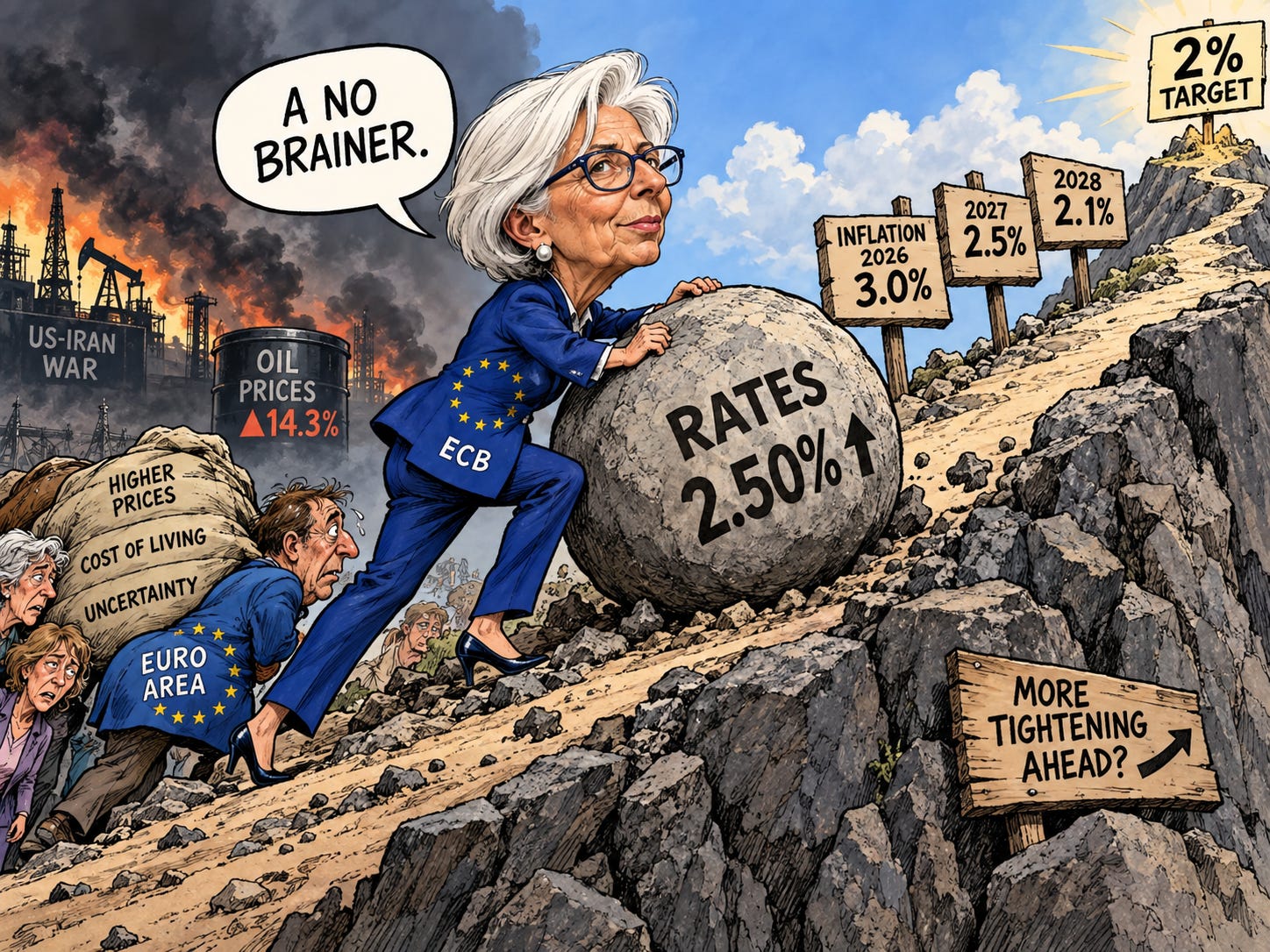
Christine Lagarde used those 3 words to describe Thursday’s quarter-point rise, which took the European Central Bank’s deposit rate to 2.50% and was agreed unanimously. She added that the decision was “robust” against all 3 scenarios the bank has mapped for the euro area economy. It is the second rise since the US-Iran war began, and it came days after euro area inflation hit 3.3%, the highest since September 2023, on an energy index up 14.3% over 12 months (Bloomberg).
The vote was expected by all 65 economists Reuters surveyed, so the new information was in the projections that published alongside it. The bank held its 2026 inflation forecast at 3.0% and revised 2027 up to 2.5% and 2028 up to 2.1%. Growth was revised up too, to 0.9% this year and 1.4% next. A 2028 forecast still above the 2% target is the ECB’s own model saying the oil shock does not wash out inside its forecast horizon, which is why traders finished the day pricing more tightening rather than an end to it. The main refinancing rate went to 2.65% and the marginal lending rate to 2.90%, all 3 effective from 16 September, and the next decision is on 29 October (European Central Bank).
Sensei’s Insight: Nobody who watches the ECB learned anything from the vote itself. The 2028 number is where the news was, because a central bank that cannot forecast its way back to target has not finished raising, whatever it declines to promise at the press conference.
Stories You Might Have Missed
🌏 Tokyo and Seoul take the oil hit
Asian equity markets absorbed Thursday’s American session and Thursday’s oil move together, and the result was ugly. Japan’s Nikkei 225 closed down 1.93% at 64,011.34 after sinking as much as 3.16% during the day, leaving it 0.4% lower on the week, while the broader Topix slipped 0.65% to 4,028.30. South Korea’s Kospi fell 2.52%. India’s Sensex dropped 593 points. The combination doing the damage is familiar: crude above $100 lifts import bills across an energy-importing region, and higher US yields lift the cost of the dollar funding that region runs on. The Bank of Japan votes on 18 September, the day after the Bank of England and 2 days after the Federal Reserve (Investing.com).
🥇 Gold funds own more metal than ever
Investors put $18 billion into gold-backed ETFs during August, and holdings rose 121 tonnes to 4,189 tonnes, the highest on record. Assets under management climbed 16% to $615 billion. European-listed funds took $7.9 billion, their biggest month ever, and North American funds $7.7 billion, their third largest. The World Gold Council attributed the flows to economic uncertainty, inflation and government debt levels, which is the same list driving the bond selloff in the lead story. Gold traded around $4,383 an ounce on Thursday, below the record $5,589.38 set on 28 January 2026 (World Gold Council).
₿ Crypto drifts into a Senate date
Bitcoin traded near $77,385 on Friday morning, down 0.90% over 24 hours, with ethereum around $2,435 after a 3% fall and XRP near $1.35, down 2.47%. Bitcoin’s market value sits close to $1.55 trillion. The dated thing ahead is procedural: the Senate is scheduled to vote on 15 September on cloture on the motion to proceed to the CLARITY Act, the market structure bill that would settle which American regulator supervises spot digital asset trading. That vote needs 60 senators and it opens debate. It enacts nothing, changes no rule, and a failure to reach 60 would leave the bill where it has sat since August (CoinMarketCap).
🛒 The American shopper reports before the bell
Kroger publishes second-quarter figures before the US market opens today, which makes it the first large read on the American grocery basket since crude went through $100. Analysts expect about $1.06 a share on revenue near $34.65 billion, growth of roughly 1.9% and 2.2% over the year, and the company has guided full-year identical sales excluding fuel to 1% to 2% with earnings of $5.10 to $5.30 a share. Identical sales excluding fuel is the retail measure that strips out new store openings and petrol forecourts, so it shows whether shoppers are buying more or simply paying more. Diesel costs run through every distribution centre and lorry the company operates (Alphastreet).