This content is for informational and educational purposes only and does not constitute financial advice. Always do your own research. Not financial advice (NFA).
👀 Today’s Stories at a Glance
🏗️ Trump Team Trims Metals Tariffs: Officials are exempting finished goods from duties to lower domestic inflation and fix operational messes.
📉 Coinbase swings to loss as crypto slows: Q4 losses hit $667 million as retail trading vanished, though subscription revenue provided some stability.
🚙 Rivian’s R2 Gamble: Growth Over Gaps: Shares jumped 15% as investors prioritized software profitability and future R2 SUV deliveries over losses.
🚀 Double-Carrier Diplomacy Hits the Gulf: The USS Gerald R. Ford joins regional forces to increase pressure on Tehran during negotiations.
🚚 Trucking Stocks Hit by AI Fears: Logistics shares plummeted as investors worry that AI-driven automation will soon replace traditional freight brokers.
🔍 Deep Dive CPI Cheat Sheet: The latest guide breaks down consensus numbers and market levels to watch following Tuesday’s jobs report and today’s CPI.
🧠 One Big Thing
The Inflation Tie-Breaker
Today’s inflation report serves as the final arbiter for a market struggling to reconcile contradictory labor data. While the consensus forecasts a decline to 2.5%, historical revisions and seasonal factors introduce significant volatility. For investors, the print will either validate a dovish shift or reinforce restrictive policy through the summer. A cooling trend would likely ignite a recovery across tech and digital assets after intense selling. Conversely, a stubborn reading would confirm that tariffs and service costs are keeping prices high. This data ultimately decides if the central bank can justify lowering rates by midyear.
⚖️ Fear & Greed
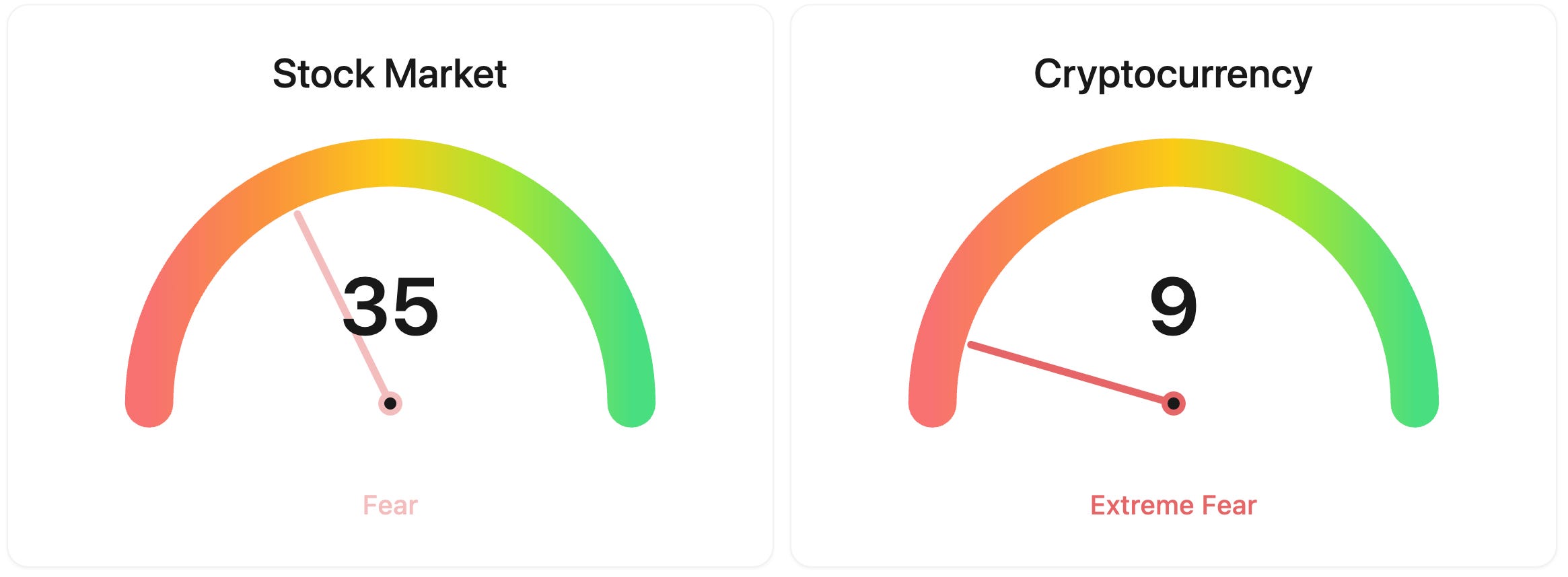
📉 The Number That Matters
2.5%
Wall Street expects today’s headline and core CPI to cool to 2.5 percent year-over-year. This 2.5 percent reading would be the lowest in five years, serving as the ultimate make-or-break data point for near-term interest rate cut expectations.
⚔️ Winners vs Losers
Winners
CRSR 0.00%↑: Corsair Gaming Inc. shares surged after the company reported a Q4 2025 EPS beat and guided toward improving demand for gaming peripherals.
TPH 0.00%↑: +26.36%: Tri Pointe Homes Inc. shares surged after Japan’s Sumitomo Forestry announced a definitive agreement to acquire the homebuilder for approximately $4.5 billion in cash.
RIVN 0.00%↑: Rivian Automotive Inc. rallied after reporting a fourth-quarter earnings beat and providing 2026 vehicle delivery guidance that significantly exceeded Wall Street expectations.
ROKU 0.00%↑: Roku Inc. shares jumped after the company forecasted upbeat annual revenue driven by sustained platform strength and significant expansion in its digital advertising business.
BROS 0.00%↑: Dutch Bros Inc. shares climbed following a Q4 2025 earnings report that featured a constructive 2026 revenue outlook and durable unit growth.
PCOR 0.00%↑: Procore Technologies Inc. gained after delivering a Q4 2025 beat and raise, supported by strong renewals and construction-focused software demand.
AMAT 0.00%↑ : Applied Materials Inc. rallied after reporting Q1 FY2026 results that beat estimates, driven by accelerating AI-related equipment orders.
Losers
PINS 0.00%↑: Pinterest Inc. shares plummeted after the company reported a Q4 earnings miss and issued a weak Q1 outlook, citing ad spending pullbacks due to tariff pressures.
DKNG 0.00%↑: DraftKings Inc. shares plunged after the company issued FY 2026 EBITDA guidance that missed analyst estimates, primarily due to planned investments in prediction markets.
BIO 0.00%↑: Bio-Rad Laboratories Inc. shares fell after reporting fourth-quarter earnings of $2.51 per share, missing consensus estimates due to a challenging biotech funding environment.
📊 Market Snapshot
Cryptocurrencies:
Bitcoin (BTC): $66,902 (▲ 1.03%)
Ethereum (ETH): $1,955 (▲ 0.41%)
XRP: $1.36 (▼ -0.07%)
Equity Indices (Futures):
S&P 500: $6,815 (▼ -0.40%)
NASDAQ 100: $24,669 (▼ -0.40%)
FTSE 100: £10,393 (▼ -0.28%)
Commodities & Bonds:
10-Year US Treasury Yield: 4.11% (▲ 0.41%)
Oil (WTI): $63 (▼ -0.33%)
Gold: $4,943 (▲ 0.44%)
Silver: $76.82 (▲ 2.12%)
Data as of UK (GMT): 11:40 AM / US (EST): 6:40 AM / Asia (Tokyo): 8:40 PM
✅ 5 Things to Know Today
🏗️ Trump Team Trims Metals Tariffs
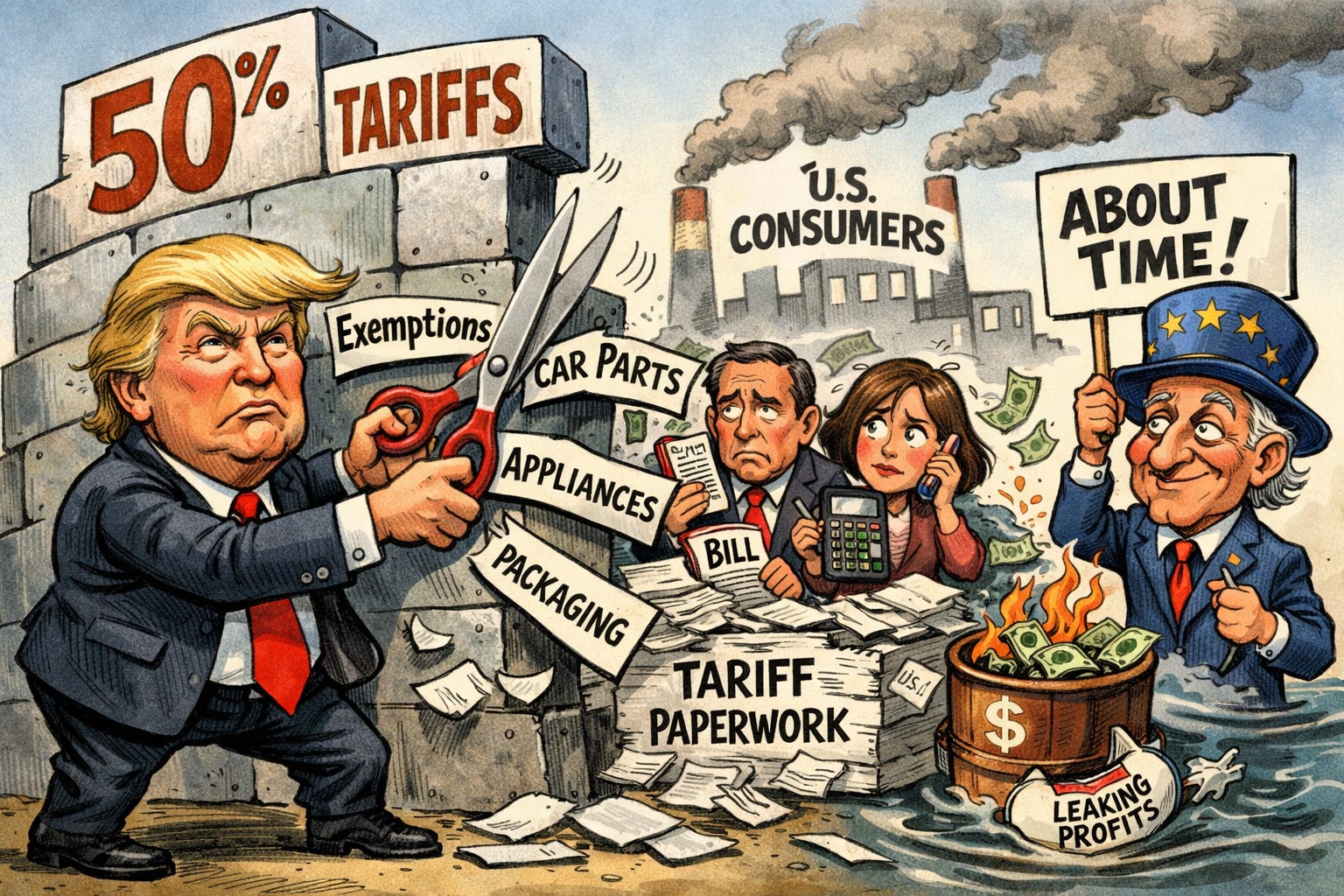
The Trump administration is reportedly preparing to narrow the scope of its 50% “derivative” metals tariffs, signaling a tactical retreat from one of its most complex trade policies. While the core 50% duties on raw steel and aluminum imports remain, officials at the USTR and Commerce Department are scrambling to exempt hundreds of finished goods, like car parts, appliances, and food packaging, that were caught in last year’s rushed expansion. The move follows a bruising New York Fed study revealing that U.S. firms and consumers are footing nearly 90% of the bill for these tariffs, debunking claims that foreign exporters are paying the cost (Bloomberg).
This isn’t a total surrender on protectionism, but it’s a major admission of “operational mess.” Importers have been drowning in paperwork trying to calculate the exact metal value in complex products just to satisfy customs. Markets reacted immediately: LME aluminum futures slipped 1.3% to roughly $3,058.50 per ton, and Alcoa shares fell over 4% as investors realized the “tariff moat” around U.S. producers might be leaking. By shifting toward “targeted probes” instead of broad categories, the White House is trying to cool domestic inflation and appease EU allies who argued these 50% duties violated their trade agreements.
Sensei’s Insight: Watch the official HTS code exclusion list. If beverage cans and auto stampings drop off, it’s a win for consumer staples and carmakers, but a sign that the “fortress America” pricing power for U.S. steelmakers is peaking.
📉 Coinbase swings to loss as crypto slows

Coinbase just posted a $667 million net loss for Q4 2025, a sharp reversal from the $1.3 billion profit it saw a year ago. Revenue fell about 20% to $1.78 billion, missing the $1.83 billion analysts were looking for. The pain came largely from a 45% drop in consumer transaction revenue as retail traders vanished during the recent market slump. Bitcoin’s roughly 50% retreat from its October high of $126,000 forced the company to take $718 million in unrealized losses on its own crypto holdings. Despite the messy quarter, the stock managed a 3% bounce in after-hours trading as investors looked past the headline miss (Bloomberg).
The big picture here is diversification. While trading fees are drying up, subscription and services revenue hit $2.8 billion for the full year, now acting as a critical stabilizer. Stablecoin income from USDC was a standout, rising to $364 million this quarter despite the broader market carnage. Coinbase is essentially betting that it can survive the “cyclical” nature of crypto by capturing more market share, which actually doubled to 6.4% in 2025. For retail investors, the story isn’t just about trading volume anymore: it’s about whether their non-trading business can grow fast enough to offset the next “crypto winter.”
Sensei’s Insight: Watch the $550–$630 million guidance for Q1 subscription revenue. If that slips, it signals that even Coinbase’s “stable” income is more tethered to token prices than management admits.
🚙 Rivian’s R2 Gamble: Growth Over Gaps
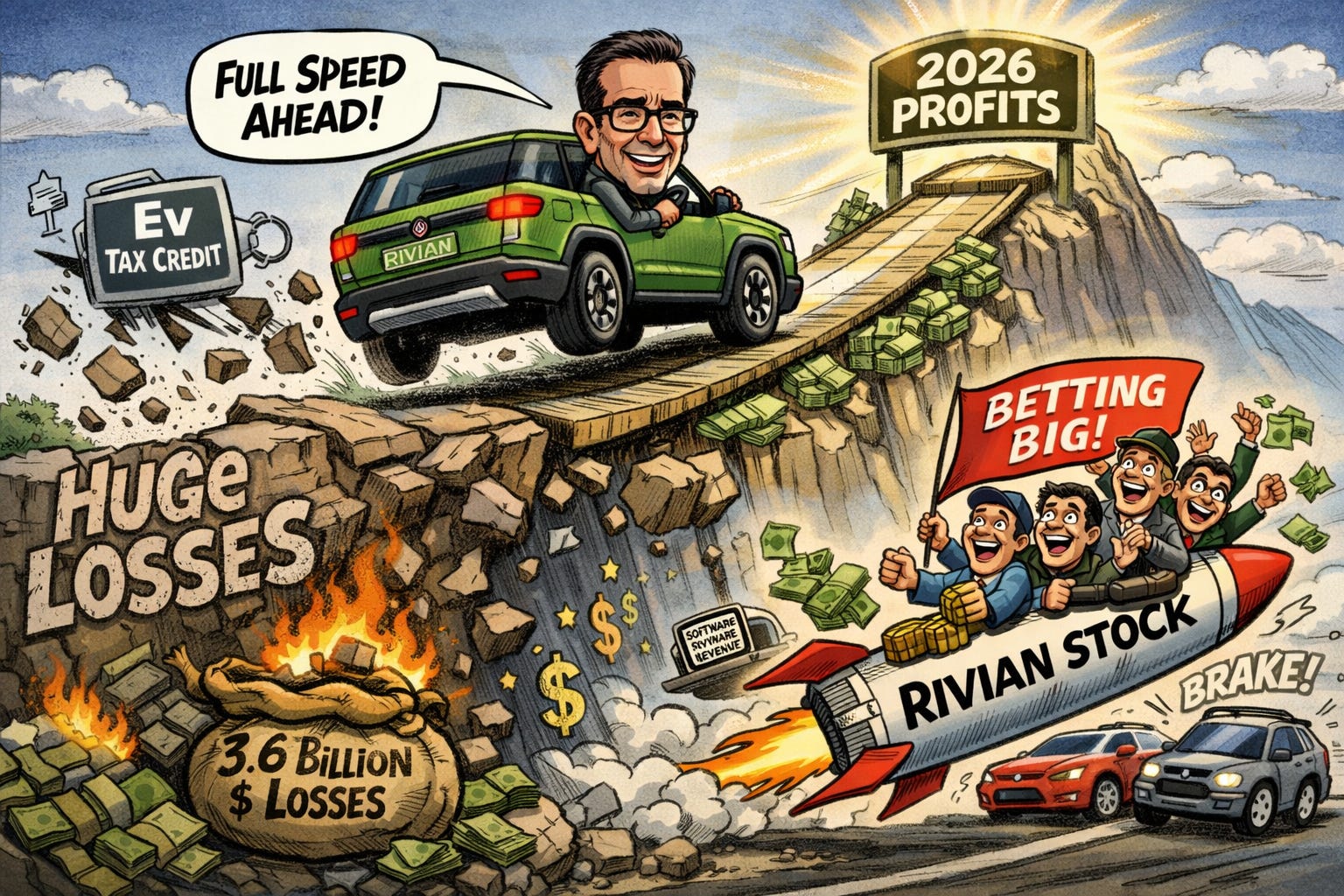
Rivian just reported its Q4 2025 results, and the numbers tell two very different stories. On one hand, automotive revenue took a hit, sliding to the mid-$800 million range as the expiration of U.S. EV tax credits and a sharp drop in regulatory credit sales bit into the top line. On the other hand, the company finally turned the corner on profitability at the ground level, posting a consolidated gross profit of $120 million for the quarter. This is a massive swing from the deep gross losses of 2024. Despite a full-year net loss of roughly $3.6 billion, investors sent the stock up over 15% in after-hours trading, clearly choosing to look past the current burn and toward the 62,000 to 67,000 vehicle deliveries guided for 2026 (Yahoo Finance).
The market is effectively betting that 2026 will be the “inflection point” CEO RJ Scaringe promised. The real hero of this earnings report wasn’t the trucks, it was the software. Revenue from software and services doubled in 2025, fueled largely by the Volkswagen joint venture and the new Autonomy+ subscription. By pricing its hands-free driving package at $2,500 upfront or $49.99 a month, Rivian is undercutting Tesla’s pricing and building a high-margin recurring revenue stream that doesn’t depend on factory throughput. With $2 billion in capex planned for 2026 to tool up for the more affordable R2 SUV, the company is leaning into expansion just as legacy peers like GM and Stellantis are tapping the brakes on their EV ambitions (MarketWatch).
Sensei’s Insight: Watch the March 12 event for R2 pricing specifics. The market has forgiven the $3.6 billion loss for now, but that grace depends entirely on the R2 SUV hitting its Q2 2026 delivery target.
🚀 Double-Carrier Diplomacy Hits the Gulf

The Pentagon is moving the world’s largest warship, the USS Gerald R. Ford, from the Caribbean to the Middle East. It’s a massive shift in naval air power, joining the USS Abraham Lincoln and nine other warships already in theatre. This move comes as President Trump ramps up pressure on Tehran, explicitly stating that while he’s open to a nuclear deal, the “consequences are very steep” if talks fail. The Ford brings dozens of additional fighter jets and advanced surveillance tech to the region, effectively doubling the U.S. strike capacity as negotiators try to find a path forward following last week’s initial round of indirect talks in Oman (Wall Street Journal).
For those watching the tape, this is a textbook example of coercive diplomacy. We’ve seen oil prices tick up about 1% on these headlines as the market balances a growing global supply glut against the very real risk of a flare-up in the Strait of Hormuz. For months, the Ford was busy with tanker seizures and operations in the Caribbean, but its redeployment suggests Washington is moving past regional sideshows to focus on the big board. Retail investors should keep an eye on energy volatility, as any breakdown in the current diplomatic channel could quickly turn this military “show of force” into a catalyst for a sustained geopolitical risk premium in crude.
Sensei’s Insight: Watch the “on-again, off-again” talk cycle. The two-carrier presence signals that Washington isn’t bluffing about military options, making any headline about stalled negotiations a high-probability trigger for oil spikes.
🚚 Trucking Stocks Hit by AI Fears
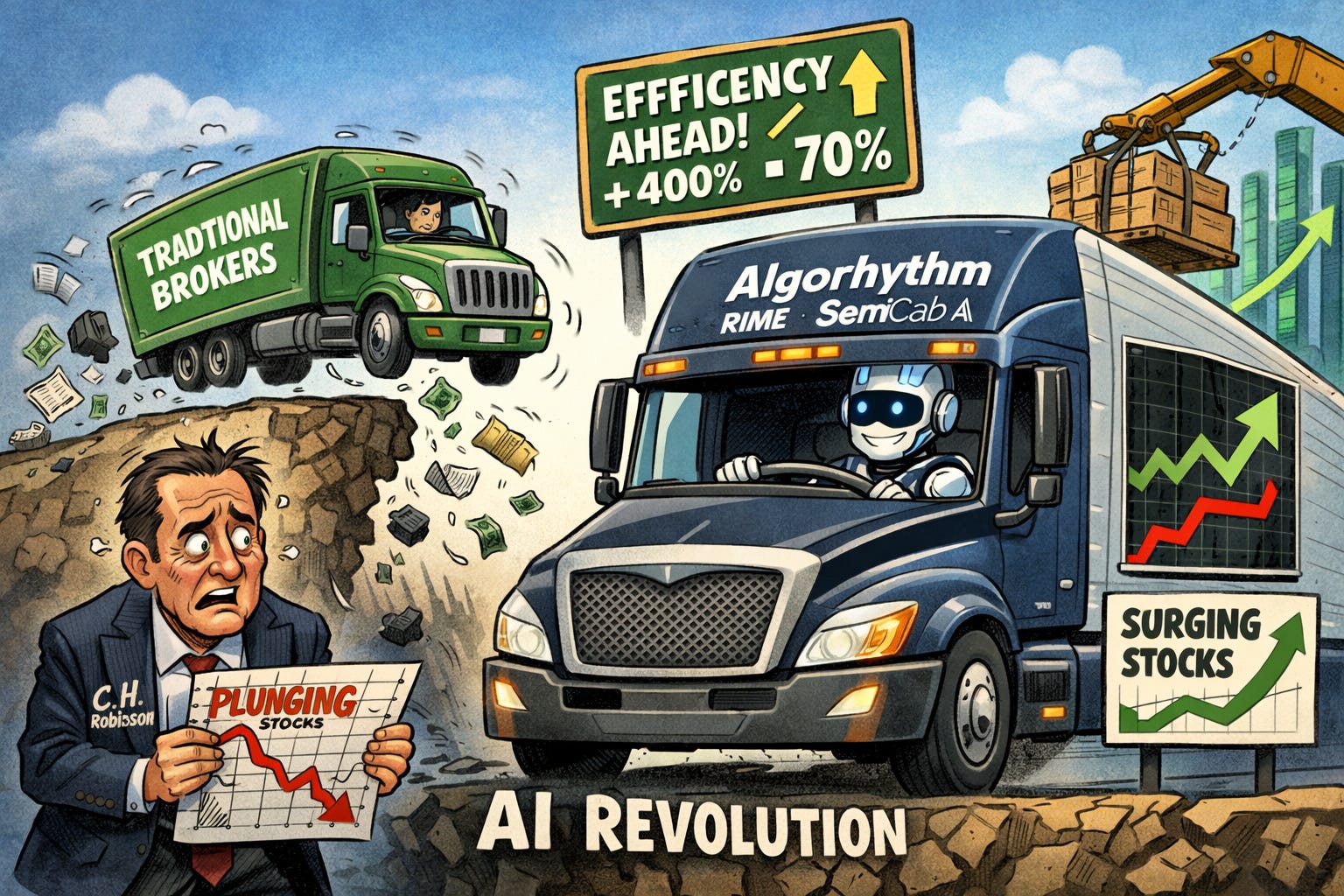
C.H. Robinson (CHRW) shares plummeted roughly 14.5% on Thursday, marking the stock’s steepest one-day decline in over six years. The selloff, which erased billions in market value, was triggered by rising investor anxiety that AI-driven automation could displace traditional freight brokers. The spark was a white paper from Algorhythm Holdings (RIME) claiming its SemiCab AI platform can reduce “empty miles” by 70% and allow internal teams to scale freight volumes by up to 400% without new hires. While Algorhythm’s stock surged 30%, the Dow Jones Transportation Average sank 4% as peers like RXO and Expeditors (EXPD) fell 20% and 13%, respectively (MarketWatch).
This isn’t about physical trucks being replaced; it’s about the “knowledge-based” middleman. Analysts suggest markets are now hunting for sectors with high-fee, labor-intensive models that AI can optimize away. C.H. Robinson, which hit a record high just days earlier on February 6, was vulnerable to this sentiment shift. The company countered that it has used AI for a decade to widen its “competitive moat” and remains confident in its strategy. However, the speed of this rotation shows how quickly an AI-native competitor’s performance claims can reprice an entire industry regardless of its current fundamentals.
Sensei’s Insight: Watch if this “AI casualty” narrative spreads to other logistics-heavy sectors. If SemiCab’s efficiency claims hold up in larger deployments, traditional brokers must prove their data scale offers a real advantage.
🔗 Connect with Us
Stay plugged in across platforms:
Sensei on X: sensei_live_
Martyn Lucas on X: MartynInvestor
Vaz on X: eVTOLHUB
📺 YouTube Channel (Live & Replays): Martyn Lucas Investor