

This content is for informational and educational purposes only and does not constitute financial advice. Always do your own research. Not financial advice (NFA).
👀 Today’s Stories at a Glance
⛽ Oil Prices Surpass $100: Brent hit $100 while Goldman Sachs delayed rate cut forecasts until September.
🪖 Iran Conflict Escalates Further: Trump prioritizes nuclear prevention as Iran threatens to keep maritime chokepoints closed.
🛡️ US Redeploys Asian Defenses: THAAD systems are moving to the Middle East, sparking regional security concerns.
✈️ US Tanker Crashes in Iraq: Four crew members confirmed dead and two still missing after a mid-air collision during intensive aerial operations.
💼 Adobe CEO Narayen Resigns: Shantanu Narayen will resign as Adobe faces fears regarding artificial intelligence disruption.
🔍 Major Economic Data Release: Critical inflation data arrives today, setting the stage for next week’s FOMC meeting.
🧠 One Big Thing
Inflation Re-acceleration Precedes Energy Shock
January economic data reveals a structural re-acceleration of inflation that began prior to the current Middle East oil spike and global tariff implementation. Core Personal Consumption Expenditures is projected to rise 0.4 percent, signaling that underlying price pressures remain stubborn. This trend has forced a repricing of monetary policy, with consensus for the first interest rate cut shifting from June to September. Markets now face a nearly 45 percent probability that the Federal Reserve will not lower rates at all in 2026. For investors, the focus has moved from timing liquidity relief to assessing if corporate earnings can withstand a high-rate, high-cost environment. These figures establish a fragile baseline for an economy now facing significant new supply-side shocks.
⚖️ Fear & Greed
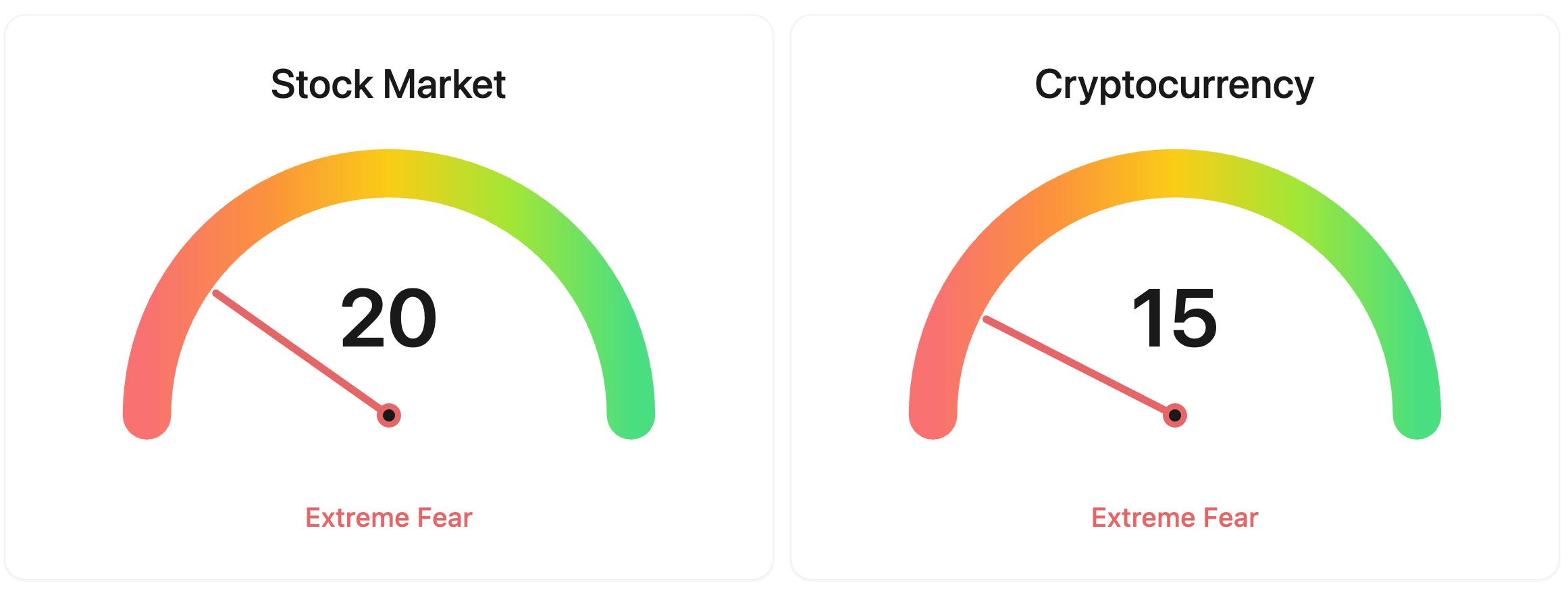
📉 The Number That Matters
46.8%
CME FedWatch data shows a 46.8% probability that the Federal Reserve will not cut interest rates at all in 2026, as markets reprice for a "higher for longer" regime amid surging energy prices and new tariffs.
⚔️ Winners vs Losers
Winners
CIA 0.00%↑: Citizens, Inc. surged after reporting record Q4 revenue and a record $5.43 billion in total direct insurance in force, with pretax income more than doubling year over year to $7.9 million and its producing agent network up 22%.
LXU 0.00%↑: LSB Industries, Inc. extended its rally to a fresh 52-week high, riding momentum from a Q4 earnings beat that saw revenue of $165 million top estimates by 7% and adjusted EBITDA jump 42% year over year on record production volumes.
LWLG 0.00%↑: Lightwave Logic, Inc. added to a multi-day surge following its announcement of a development agreement with Tower Semiconductor to integrate its electro-optic polymer modulators into Tower’s PH18 silicon photonics platform, targeting AI data center interconnects at 400G per lane.
Losers
IMMP 0.00%↑: Immutep Limited collapsed after the independent data monitoring committee for its pivotal Phase III TACTI-004 trial of eftilagimod alfa in first-line lung cancer recommended discontinuation for futility, effectively gutting the company’s lead pipeline asset.
KLC 0.00%↑: KinderCare Learning Companies cratered after reporting Q4 results that included $204 million in impairment charges, a $178 million goodwill writedown tied to its deteriorating market cap, and persistent enrollment declines that prompted a weak fiscal 2026 outlook.
EVCM 0.00%↑: EverCommerce Inc. slid after missing Q4 EPS estimates by a penny at $0.03 versus $0.04 expected and issuing Q1 2026 revenue guidance of $145.5 million to $148.5 million, well below the prior consensus of roughly $151 million.
PAR 0.00%↑: PAR Technology Corporation continued its steep decline amid the broader SaaS selloff, compounded by Goldman Sachs slashing its price target to $18 and both the CEO and CFO selling shares in early March, even as activist Voss Capital pushes the board to explore a sale.
PD 0.00%↑: PagerDuty, Inc. fell after Q4 results showed annual recurring revenue grew just 1% to $498.7 million and FY2027 revenue guidance of $488.5 million to $496.5 million implied a potential year-over-year decline, overshadowing the company’s first full fiscal year of GAAP profitability.
ADBE 0.00%↑: Adobe Inc. sold off despite beating Q1 estimates on both revenue ($6.40 billion, +12% YoY) and EPS ($6.06 adjusted), as investors focused on a steeper-than-expected decline in its legacy Stock content business and lingering concerns about AI disruption to creative software.
AU 0.00%↑: AngloGold Ashanti PLC traded lower as today’s ex-dividend date for its $1.73 per share payout accounted for a portion of the drop, with additional pressure from recent profit-taking across gold miners after the sector’s strong run.
📊 Market Snapshot
Cryptocurrencies:
Bitcoin (BTC): $72,163 (▲ 2.30%)
Ethereum (ETH): $2,122 (▲ 2.29%)
XRP: $1.43 (▲ 3.38%)
Equity Indices (Futures):
S&P 500: $6,676 (▼ -0.03%)
NASDAQ 100: $24,531 (▼ -0.12%)
FTSE 100: £10,275 (▼ -0.11%)
Commodities & Bonds:
10-Year US Treasury Yield: 4.27% (▲ 0.28%)
Oil (WTI): $95 (▼ -1.07%)
Gold: $5,091 (▲ 0.26%)
Silver: $82.96 (▼ -1.07%)
Data as of: UK (GMT) 11:06 / US (ET): 06:06 / Asia (Tokyo): 20:06
✅ 5 Things to Know Today
⛽ Oil Smashes Through $100 as Goldman Warns the Worst Isn’t Over
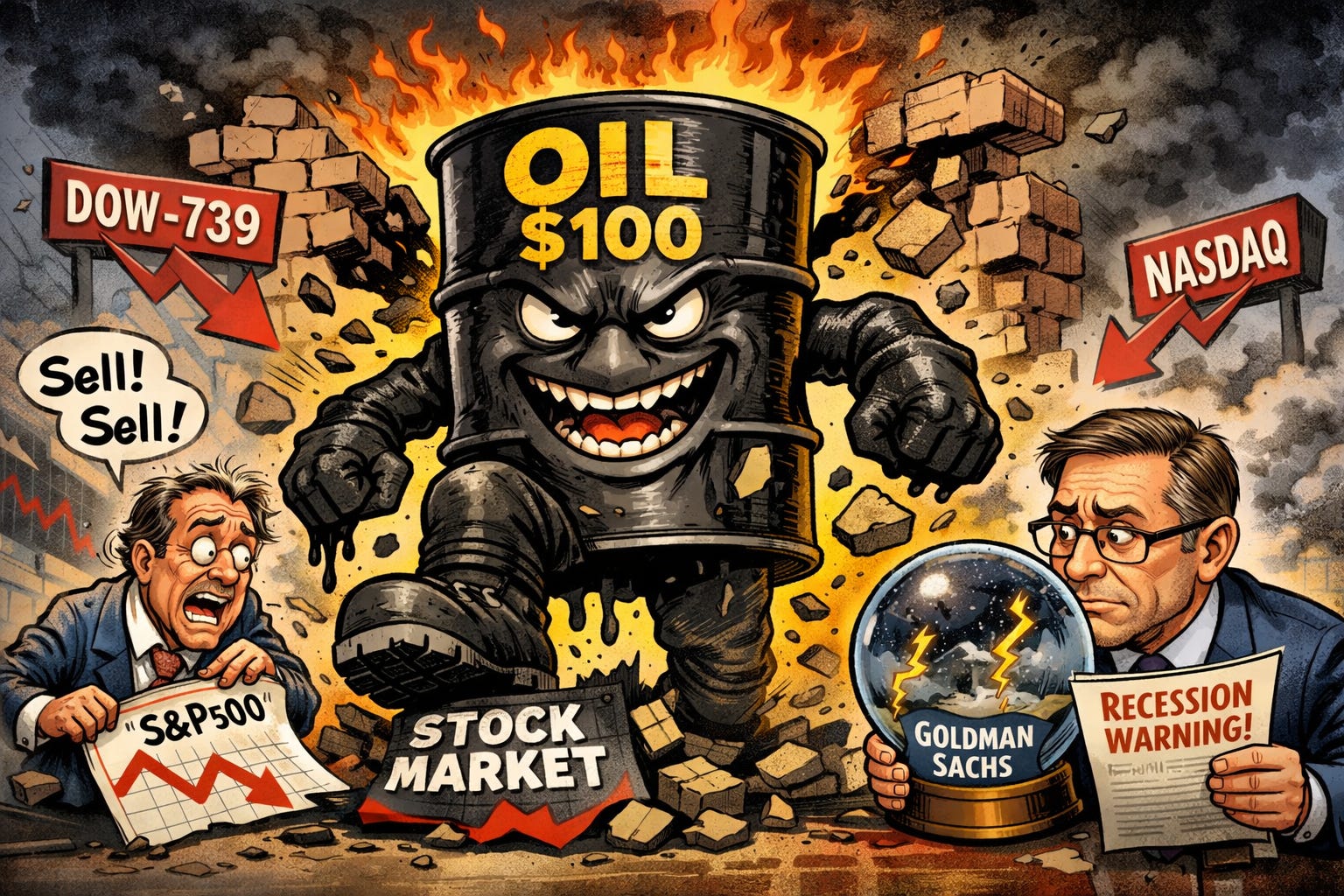
Brent crude settled at $100.46 per barrel yesterday, up 9.2% on the day, the first time the global benchmark has closed above $100 since August 2022. West Texas Intermediate (WTI), the US benchmark, settled at $95.73, up 9.7%, its highest level in nearly four years. WTI traded in a range of roughly $43 over the course of the week, the widest since the pandemic chaos of 2020. All three major US stock indexes hit their lowest closing levels of 2026: the S&P 500 fell 1.52%, the Dow dropped 739 points, and the Nasdaq shed 1.78%. More than 72% of all US-listed stocks declined on the day. The International Energy Agency (IEA) published its March Oil Market Report, formally declaring this the largest oil supply disruption in the history of the global market, with at least 10 million barrels per day of crude and other oil products curtailed, a volume equal to roughly 10% of total world demand (Reuters).
Goldman Sachs published a major revision to its macroeconomic outlook this week, raising its December 2026 headline Personal Consumption Expenditures (PCE) inflation forecast, the measure the Federal Reserve watches most closely, by 0.8 percentage points to 2.9%. Full-year gross domestic product (GDP) growth was cut by 0.3 points to 2.2%. Most critically for equity investors, Goldman pushed its forecast for the Fed’s first rate cut from June to September, with a second cut in December to a terminal rate of 3.0% to 3.25%. The bank raised its 12-month recession probability by five percentage points to 25%. In an upside oil scenario where the Strait of Hormuz stays shut for a full month, Goldman sees headline PCE peaking at 4.5% in spring. The record 400-million-barrel strategic reserve release announced earlier this week has done almost nothing to ease prices: analysts at ING estimate the release provides roughly 3.3 million barrels per day over several months, against actual supply losses running at around 15 million barrels per day. The IEA itself described the release as a “stop-gap measure” (CNN).
Sensei’s Insight: Watch the Fed meeting next Wednesday closely. Goldman’s pushed rate cut timeline, from June to September, compresses the window in which markets had been expecting monetary relief. CME FedWatch data now shows a 44.7% probability that the Fed does not cut rates at all in 2026. The conversation has shifted from “when will the Fed cut?” to “will the Fed be forced to hold all year?” That repricing has barely started in equities.
🪖 Into Week Three: Khamenei Breaks Silence, Trump Signals Major Escalation
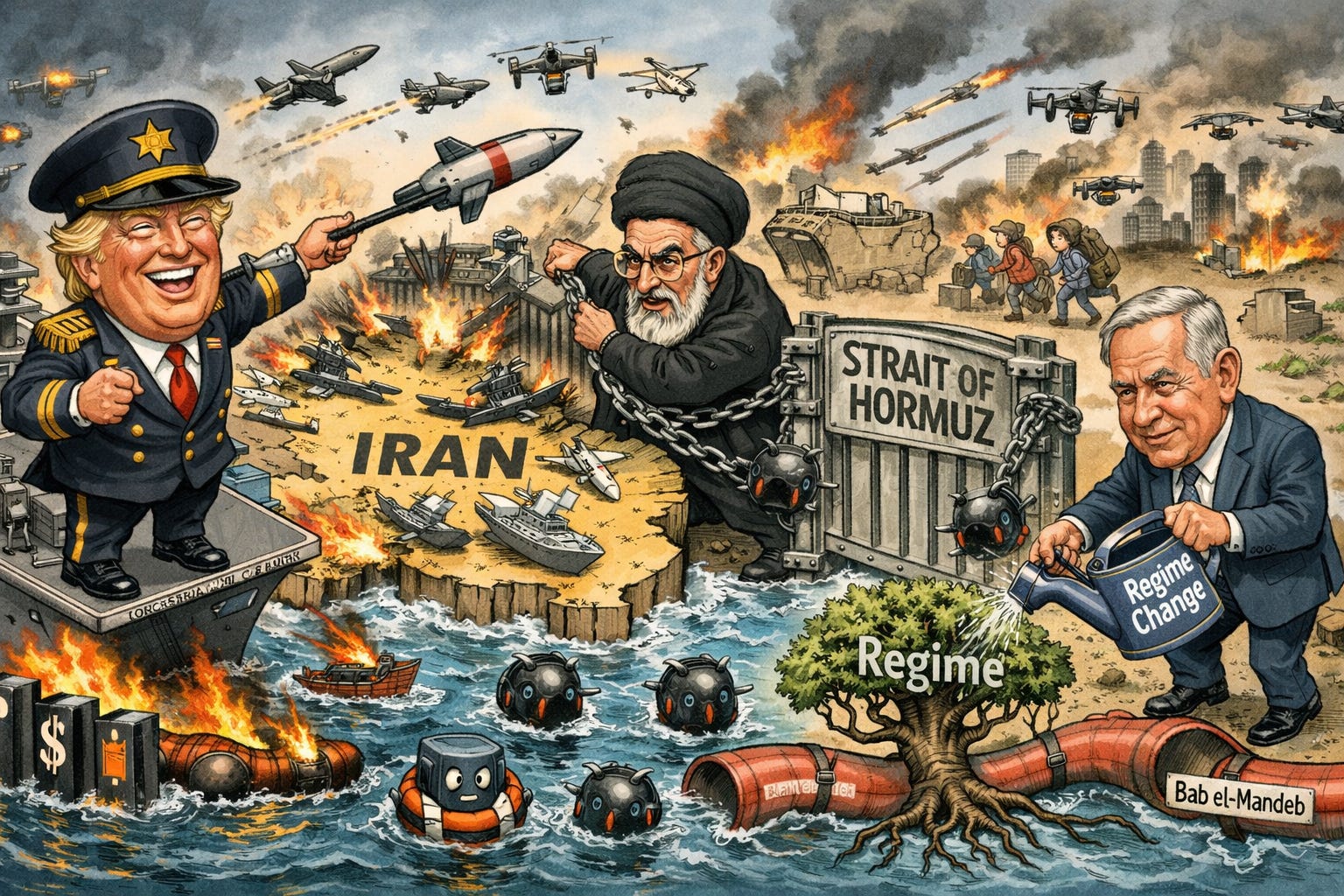
President Trump posted on social media yesterday that preventing Iran from having nuclear weapons is “of far greater interest and importance to me” than the cost of oil. It was a blunt signal to markets that the US will not scale back military operations to relieve energy prices. Hours earlier, Mojtaba Khamenei, Iran’s new 56-year-old supreme leader, made his first public comments since being appointed after his father was killed in the opening strikes on 28 February. Speaking through state television, he said Iran would keep the Strait of Hormuz “shut” as a tool to pressure the enemy, threatened to open “new fronts where the enemy has little experience,” and demanded that all US military bases in the Middle East close immediately (AP).
Israeli Prime Minister Benjamin Netanyahu held his first press briefing since the war began, making a significant admission: the campaign has “significantly weakened” Iran but regime change cannot be guaranteed without an internal uprising. “We are creating the optimal conditions for a toppling of the regime,” he said, “but a regime is ultimately brought down from within.” On the ground, the war continued to widen rather than wind down. At least three separate drone incidents hit Dubai yesterday, striking buildings in Creek Harbour, the Al Bada’a district, and on Sheikh Zayed Road. Kuwait reported drones fired at its international airport. Three commercial vessels were struck in the Persian Gulf in 24 hours, and a foreign tanker carrying Iraqi fuel oil was ablaze in Iraqi waters, killing one crew member. The UK confirmed Iran has likely begun laying sea mines in the Strait of Hormuz. Hezbollah fired over 200 rockets, missiles, and drones at Israeli communities in a single day, prompting Israel to strike over 70 targets in Beirut over the past week. Back-channel talks between Tehran and US allies are “nowhere close” to finding a way to reopen the strait (CNN).
The human and financial toll is mounting. At least 1,825 Iranians have been killed, 3.2 million temporarily displaced, and roughly 2,500 people have died across the broader Middle East. Eight US service members have died during the campaign and approximately 140 have been wounded. US Central Command has struck around 6,000 targets since operations began. The first six days of the campaign cost more than $11.3 billion. Energy Secretary Chris Wright admitted on CNBC that the Navy is “simply not ready” to begin escorting commercial tankers through the strait, saying all military assets are focused on destroying Iran’s offensive capabilities, though escorts should be possible “by the end of this month.” Overnight, the conflict escalated further: Trump posted that he was “totally destroying” Iran and warned to “watch what happens today,” Israel launched what it called a new “wide-scale wave of strikes” across Tehran this morning, Iran fired a barrage of missiles at Israel and dozens of drones at Saudi Arabia, and two people were killed in Oman by debris from a downed drone, drawing yet another country into the war’s orbit.
Sensei’s Insight: Watch for two things now. First, the mine-laying in Hormuz: mines are cheap, effective, and extremely difficult to clear during active combat, meaning the strait could stay commercially unusable for weeks after fighting stops. Second, Khamenei’s “new fronts” threat: the Houthis already control the Bab el-Mandeb Strait at the southern entrance to the Red Sea. If that chokepoint closes too, the last viable bypass route for Gulf oil disappears. The war premium in energy has no catalyst for compression until at least one of these dynamics changes.
🛡️ US Pulls Missile Defences From South Korea, Exposing Asia’s Security Gap
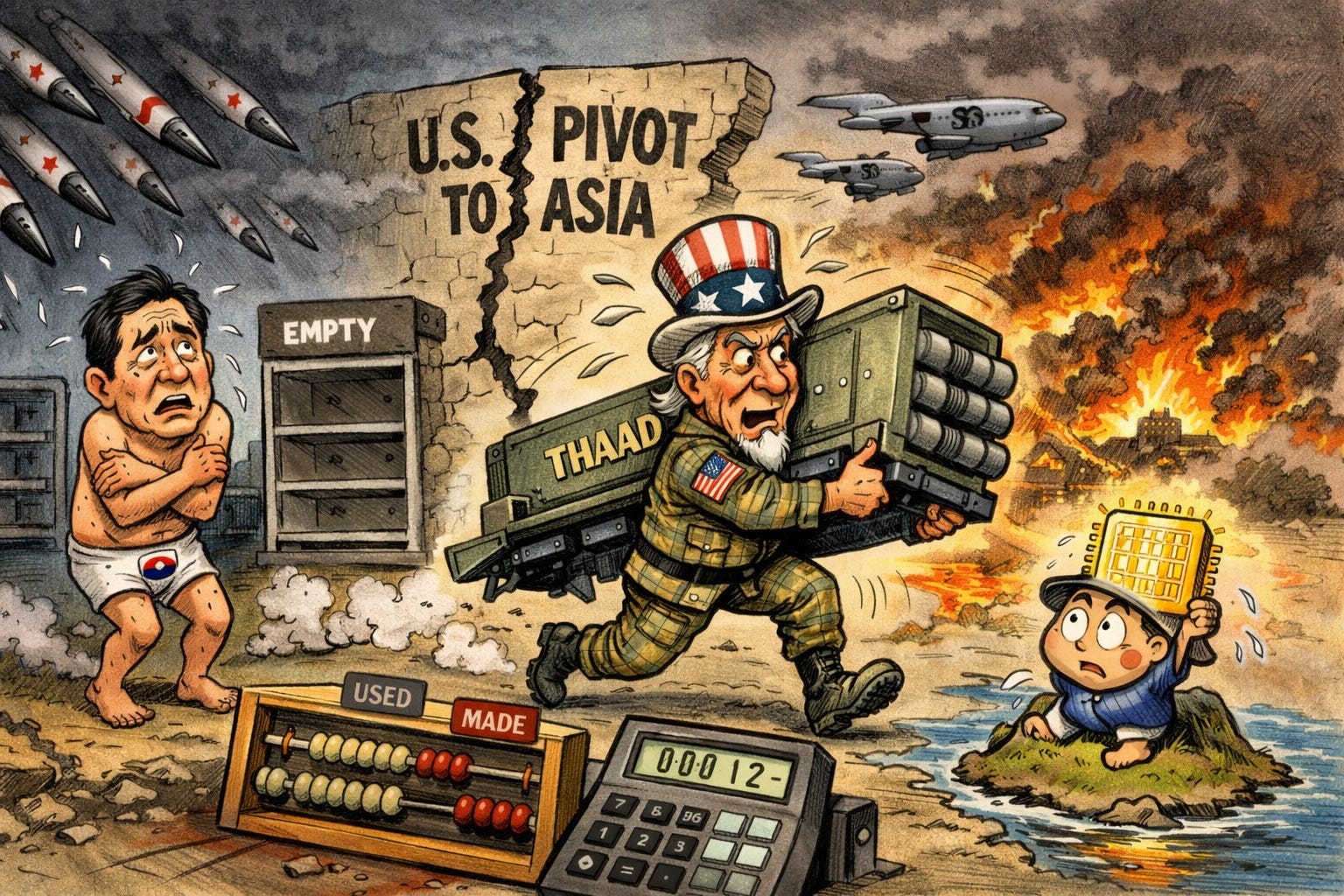
The US military has begun removing its Terminal High Altitude Area Defence (THAAD) missile system from South Korea and redeploying it to the Middle East, according to the Washington Post. All six THAAD launchers are reportedly being transferred from the US base at Seongju, each capable of carrying up to eight interceptor missiles, meaning as many as 48 interceptors may have been moved. THAAD is designed to intercept ballistic missiles at altitudes of 40 to 150 kilometres, far higher than the Patriot systems that complement it. Its deployment to South Korea in 2017 was a landmark strategic move, installed specifically to defend against North Korean ballistic missiles over fierce objections from both China and North Korea. The US Army operates fewer than 10 THAAD batteries globally, making any single redeployment a strategically significant event (Washington Post).
South Korean President Lee Jae Myung publicly acknowledged the move at a cabinet meeting this week, admitting Seoul had “expressed opposition” but conceding “the reality is that we cannot fully impose our position.” He sought to reassure the public that South Korea’s own capabilities are “undeniably overwhelming,” but the statement was itself a remarkable admission of limited leverage over its primary security ally. The transfer is being supported by major airlift operations: flight-tracking data shows two C-5 Galaxy strategic airlifters and eleven C-17 cargo aircraft departing Osan Air Base since 28 February. The Iran conflict has already consumed a significant share of US missile defence inventory. One estimate suggested the US used approximately 14% of its THAAD stockpile in just the first phase of operations, and around 25% defending Israel from Iranian missiles during a prior 12-day conflict last summer. Lockheed Martin, which manufactures THAAD, agreed in January to quadruple interceptor production, but replenishment takes years, not months (Stars and Stripes).
Sensei’s Insight: The deeper story here is about Taiwan. THAAD was the centrepiece of America’s “pivot to Asia,” and it is being pulled out to fight a war in the Middle East. Taiwan produces over 90% of the world’s most advanced semiconductors. Any perception that US deterrence in the Indo-Pacific has weakened could ripple through tech supply chain sentiment. Watch Lockheed Martin’s production capacity as a proxy: the US burned through a quarter of its THAAD stockpile in a 12-day conflict last summer, and now faces an open-ended war. The maths between consumption and replenishment does not add up, and Asian allies know it.
✈️ US Refuelling Plane Crashes in Iraq With Six Crew Aboard
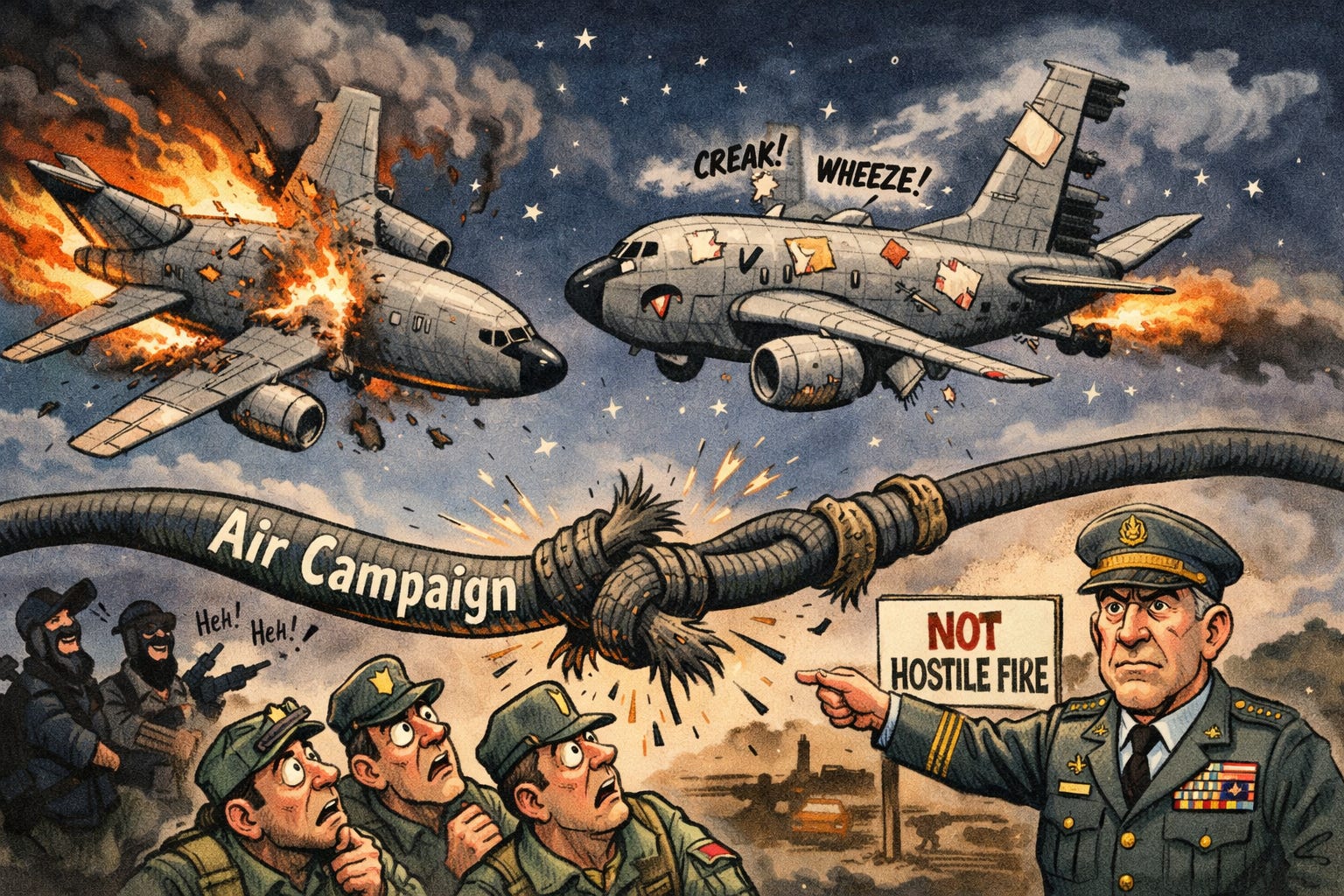
A US Air Force KC-135 Stratotanker crashed in western Iraq yesterday evening near Turaibil, along the Iraqi-Jordanian border, after what appears to have been a mid-air collision with a second KC-135. US Central Command confirmed the crash occurred "in friendly airspace" and was "not due to hostile fire or friendly fire." However, the Islamic Resistance in Iraq, an umbrella group of Iranian-backed militias, claimed responsibility, saying it shot down the aircraft "with the appropriate weapon." CENTCOM has directly contradicted that claim. The second tanker, identified through flight-tracking data as aircraft 63-8017 (a 62-year-old airframe), declared an in-flight emergency and landed at Ben Gurion Airport in Tel Aviv. Photographs taken on the ground show the aircraft missing nearly half of its vertical stabilizer, damage consistent with a mid-air collision. Six service members were aboard the crashed aircraft. The KC-135 does not have ejection seats, making any crash significantly more dangerous than a fighter jet loss. CENTCOM confirmed early Friday morning that four of the six crew members have been confirmed dead, with rescue efforts still underway for the remaining two. The identities of the service members are being withheld until 24 hours after next of kin have been notified. Prior to this crash, eight US service members had died during the campaign, seven killed in action and one from a health-related incident in Kuwait, with approximately 140 wounded, eight of them severely (CNBC).
This is the fourth crewed US aircraft lost during Operation Epic Fury, following three F-15E Strike Eagles downed in the friendly-fire incident over Kuwait on 1 March. At least 10 MQ-9 Reaper drones have also been lost. The KC-135 normally carries a crew of three (two pilots and a boom operator); the role of the additional crew members has not been explained. The fleet's age is a critical factor: the average KC-135 is more than 66 years old, and the Air Force operates 376 in total across active duty, National Guard, and Reserve units. Aerial refuelling is the backbone of the entire air campaign, and the loss of a tanker to apparent congestion rather than enemy action speaks to the sheer density of air operations being sustained across the theatre.
Sensei’s Insight: The KC-135 fleet is one of the oldest in the US military and has no near-term replacement at scale. Boeing's KC-46 programme has been plagued by delays and defects for years. If high-tempo operations continue degrading the tanker fleet, it becomes a hard ceiling on how long the air campaign can sustain its current pace, regardless of political will. Watch for any Pentagon commentary on sortie rate adjustments in the coming days.
💼 Adobe CEO Steps Down After 18 Years as AI Reshapes the Creative Industry
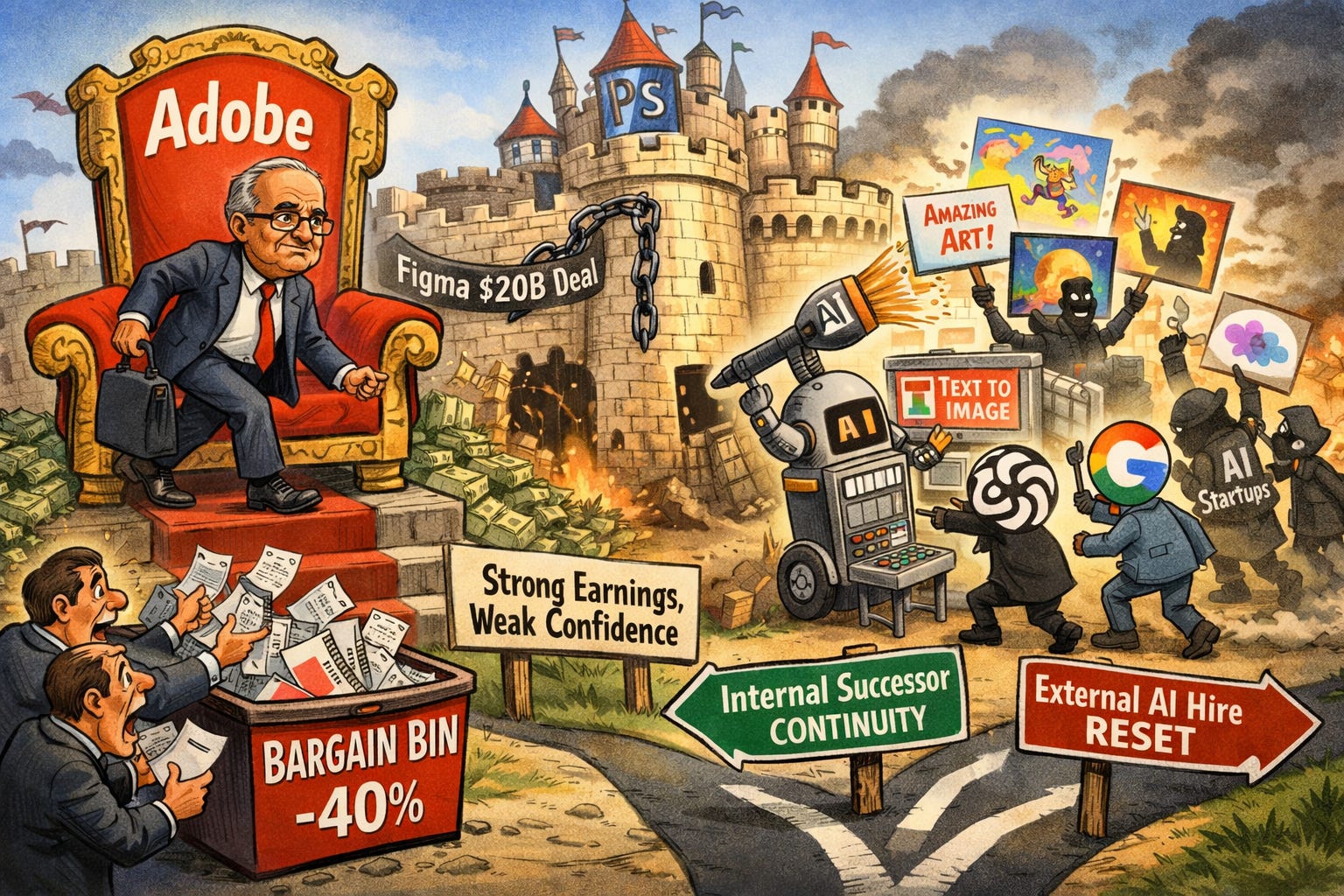
Adobe announced yesterday evening that chief executive Shantanu Narayen will step down after 18 years leading the company. Narayen, 62, will remain as CEO until a successor has been appointed and will then transition to the role of board chairman. The board has appointed lead independent director Frank Calderoni to oversee the search, which will consider both internal and external candidates. Narayen joined Adobe in 1998 and became CEO in 2007, overseeing one of the software industry’s most significant transformations: annual revenue grew roughly six times to approximately $24 billion, and the workforce expanded from about 7,000 to over 30,000. He is widely credited with pioneering one of the first successful transitions from one-time software licences to recurring subscription bundles, a model that has since been adopted across the industry (CNBC).
The announcement came alongside strong fiscal first-quarter earnings: revenue increased 12% year-on-year to $6.4 billion, beating the $6.28 billion consensus estimate. Adjusted earnings per share came in at $6.06, above the $5.88 average estimate, with record operating cash flow of $2.96 billion. Revenue from AI-first products more than tripled year-on-year. Despite the beat, shares fell approximately 7% in after-hours trading and continued sliding into today’s session, trading near $249, the stock’s lowest level in over three years. TD Cowen cut its price target from $400 to $325. Bloomberg Intelligence analyst Anurag Rana captured the core tension: “Adobe’s financial metrics have shown little noticeable change since early last year, yet the stock is down almost 40%, likely a key reason for the planned CEO transition.” The issue is not current performance but future positioning. Generative AI tools from Google, OpenAI, and numerous startups are making it possible to create visual content without expensive professional software, and the failed $20 billion Figma acquisition in 2022, blocked by regulators, still haunts the company’s strategic narrative (Bloomberg).
Sensei’s Insight: Adobe is now the highest-profile case study in the “will incumbents survive AI?” debate. The stock is down 40% from its peaks despite delivering 12% revenue growth and tripling AI product revenue, which tells you the market is not pricing the present but repricing the future. Watch who gets the CEO job: an internal pick signals continuity, an external hire from the AI world signals the board thinks the strategy needs a fundamental reset. The broader SaaS sector, from Salesforce to Atlassian, is watching closely because the same repricing logic applies to any software company whose core product could be commoditised by generative AI.
🔗 Connect with Us
Stay plugged in across platforms:
Sensei on X: sensei_live_
Martyn Lucas on X: MartynInvestor
Vaz on X: eVTOLHUB
📺 YouTube Channel (Live & Replays): Martyn Lucas Investor

🔍Deep Dive: The Data Mega-Drop: Your Cheat Sheet for Today's Release
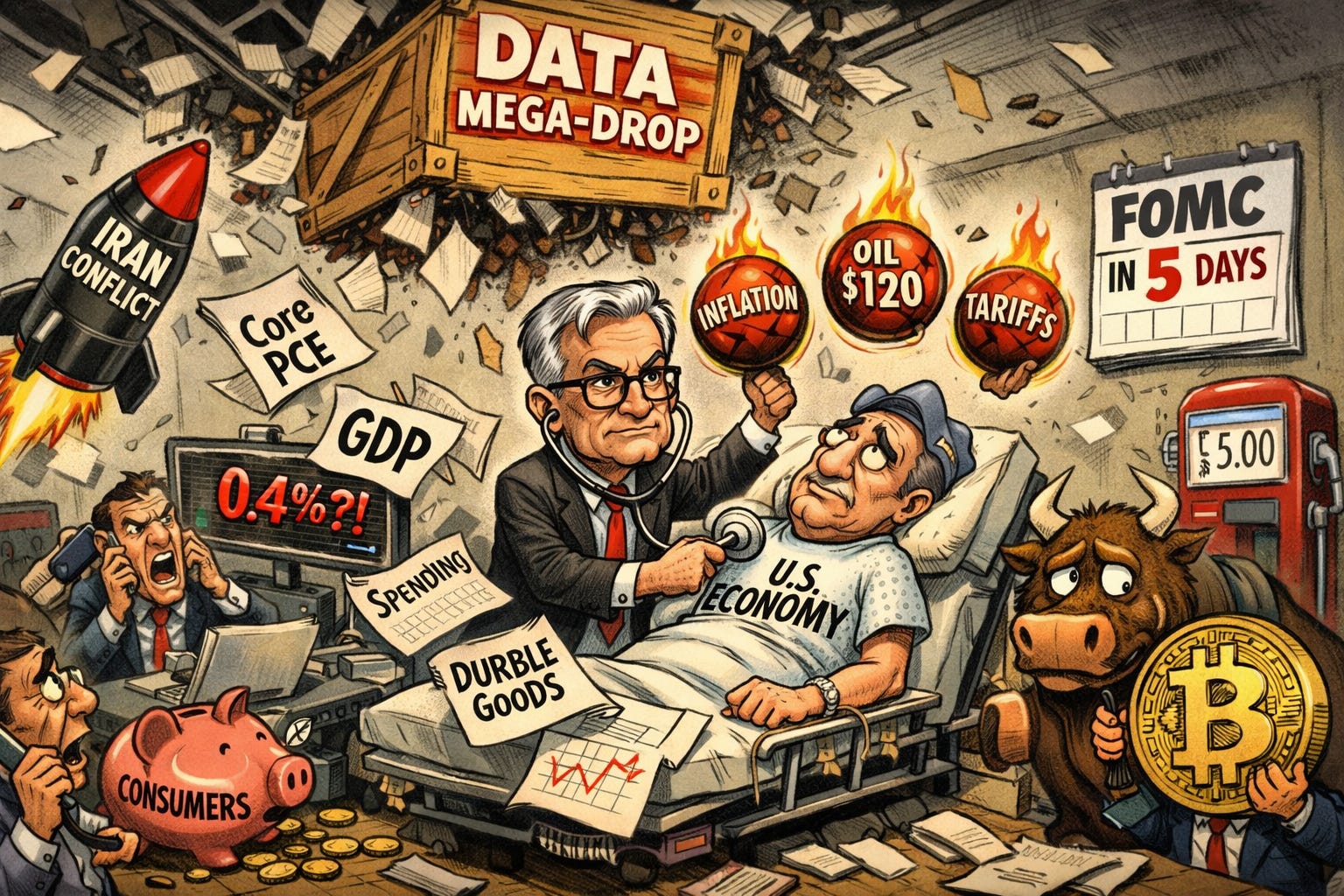
Friday, March 13, 2026 | 8:30 AM ET / 12:30 PM GMT