This content is for informational and educational purposes only and does not constitute financial advice. Always do your own research. Not financial advice (NFA).
👀 Today’s Stories at a Glance
🪙 CLARITY Act Clears Senate Hurdle: Bipartisan 15-9 committee vote sends crypto market structure bill toward the floor.
🇨🇳 Xi Frames Boeing Deal Around Taiwan: Beijing summit delivers $250 billion in pledges but markets price the deals cheap.
📈 Yields Pin Stocks at Records: Ten-year Treasury yield hits one-year high as 2026 rate cut bets vanish.
🎨 Figma Disarms Displacement Trade: Forty-six percent revenue growth and 139% retention reframe the artificial intelligence (AI) software debate.
📋 Trump’s 3,642 Trades Draw Scrutiny: First-quarter disclosure reveals Nvidia and Coinbase buys around major policy announcements.
🚗 Vehicle Emission Rules Pushed Back: Environmental Protection Agency (EPA) delays Biden tailpipe deadlines to 2029, saving automakers $1.7 billion.
💼 JPMorgan Topples Goldman in Tech: Bank captures 16.7% of global technology investment banking fees, edging out the longtime leader.
🏙️ New York Targets All-Cash Buyers: State plans 1% tax on cash home purchases over $1 million, raising $160 million annually.
🔬 Applied Materials Signals Capex Surge: Chip equipment maker lifts industry growth forecast above 30% on memory demand.
🧠 One Big Thing
The CLARITY Act, the bill that would write US crypto rules into federal law for the first time by splitting oversight cleanly between the SEC and the CFTC, took its biggest step forward in over a year yesterday. The Senate Banking Committee voted 15-9 to advance it, with two Democrats crossing the aisle against Warren's wishes to back the bill. That bipartisan signal is what matters: the full Senate vote ahead needs 60 votes and therefore needs Democratic support, and yesterday was the first hard evidence that support exists. Markets reacted accordingly. Bitcoin pushed above $81,000, XRP rallied 7% to briefly break $1.50, Coinbase finished up more than 8%, and spot XRP ETFs took $25.8 million on Monday alone, the biggest single-day inflow since January. Passage would lock the existing SEC and CFTC framework into statute, end years of regulation-by-enforcement, and crucially give institutions the legal cover they have been waiting for to deploy at scale. The path is real, the ethics provision is the next pressure point, and the White House is still working toward a 4 July signing.
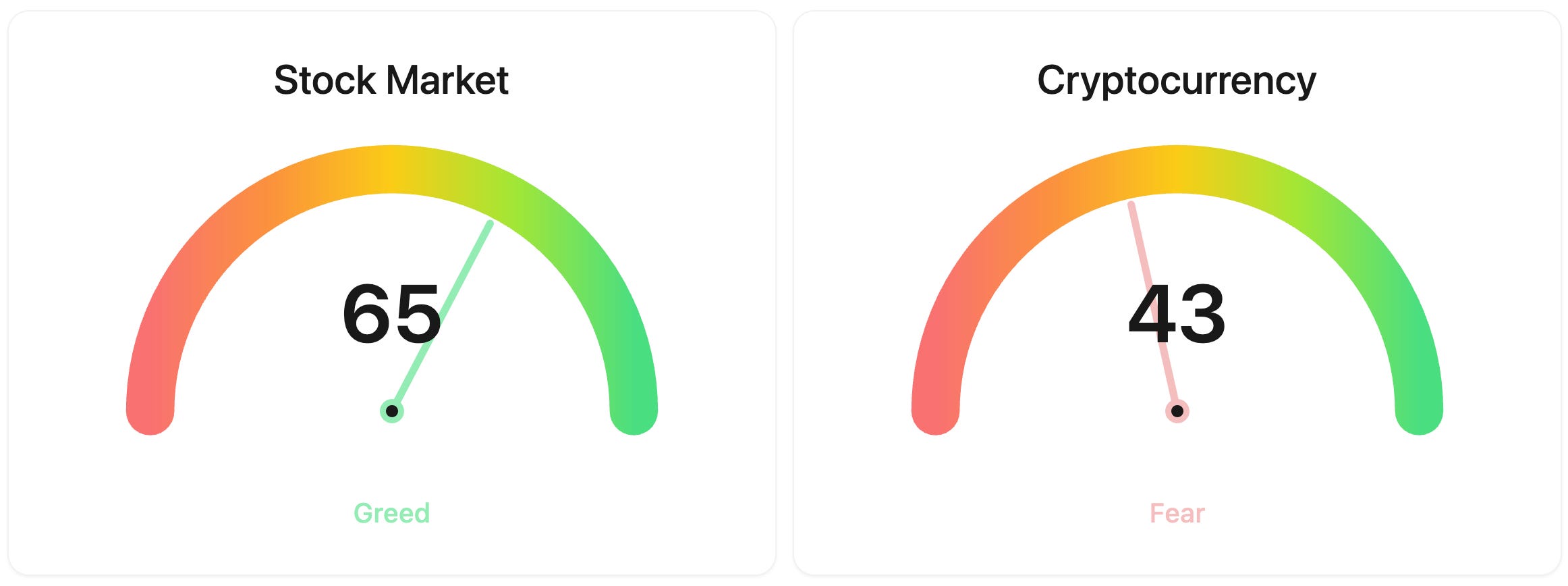
⚖️ Fear & Greed
📉 The Number That Matters
28%
Futures now imply a 28% probability of a Federal Reserve rate hike by December after this week's wholesale inflation surged 1.4% against 0.4% consensus. That 28% sits where rate cut probability sat at the start of the year.
⚔️ Winners vs Losers
Winners
GEMI 0.00%↑: Gemini Space Station Inc. shares surged after the Winklevoss-backed crypto exchange beat first-quarter revenue expectations and disclosed a $100 million strategic investment from Winklevoss Capital Fund.
FIG 0.00%↑: Figma Inc. shares jumped after the design software company posted its biggest earnings beat since going public, raised full-year revenue guidance to $1.42 billion to $1.43 billion, and pointed to accelerating AI monetization and 54% growth in paid customers.
PZZA 0.00%↑: Papa John’s International Inc. shares climbed on a Reuters report that the chain’s largest franchisee is joining Qatari-backed Irth Capital in a takeover bid for the company.
RDW 0.00%↑: Redwire Corporation extended its post-earnings rally after a Wall Street Journal report that Alphabet is in talks with SpaceX on a launch agreement tied to orbital data centers, lifting space infrastructure names ahead of a potential SpaceX IPO.
Losers
AARD 0.00%↑: Aardvark Therapeutics Inc. shares collapsed after the FDA placed a full clinical hold on its ARD-101 program for Prader-Willi Syndrome, covering both the Phase 3 HERO and open-label extension trials.
GAMB 0.00%↑: Gambling.com Group Limited shares tumbled after the affiliate marketer swung to a Q1 net loss, cut 2026 revenue and EBITDA guidance, and announced an AI-led restructuring that will eliminate roughly 25% of its workforce.
ZTEK 0.00%↑: Zentek Ltd. shares dropped after the graphene technology company announced a brokered private placement for up to C$15 million in units priced at C$1.00, a steep discount that introduces significant dilution.
COHR 0.00%↑: Coherent Corp. shares slipped as profit-taking continued following an 88% year-to-date rally, with a director and the CFO disclosing recent open-market stock sales above $340 per share.
MRVL 0.00%↑: Marvell Technology Inc. pulled back after hitting an all-time high on Thursday on reports it may develop custom AI chips for Alphabet, with semiconductor names broadly retreating after a ferocious rally.
AU 0.00%↑: AngloGold Ashanti PLC shares fell as gold dropped to roughly $4,650 an ounce, with hot CPI and PPI prints pricing out U.S. rate cuts for 2026 and weighing on the precious metals complex.
INTC 0.00%↑: Intel Corporation shares retreated alongside the broader semiconductor complex on profit-taking after a sharp rally, with no specific company catalyst identified.
📊 Market Snapshot
Cryptocurrencies:
Bitcoin (BTC): $80,581 (▼ -0.59%)
Ethereum (ETH): $2,258 (▼ -1.08%)
XRP: $1.47 (▼ -0.89%)
Equity Indices (Futures):
S&P 500: $7,436 (▼ -0.84%)
NASDAQ 100: $29,318 (▼ -1.25%)
FTSE 100: £10,207 (▼ -1.44%)
Commodities & Bonds:
10-Year US Treasury Yield: 4.54% (▲ 1.23%)
Oil (WTI): $100 (▼ -2.38%)
Gold: $4,561 (▼ -1.90%)
Silver: $78.52 (▼ -5.87%)
Data as of: UK 12:26 BST / US 07:26 EDT / Asia (Tokyo): 20:26
✅ 5 Things to Know
🪙 XRP Pops 7% as CLARITY Act Clears First Senate Test, 15-9
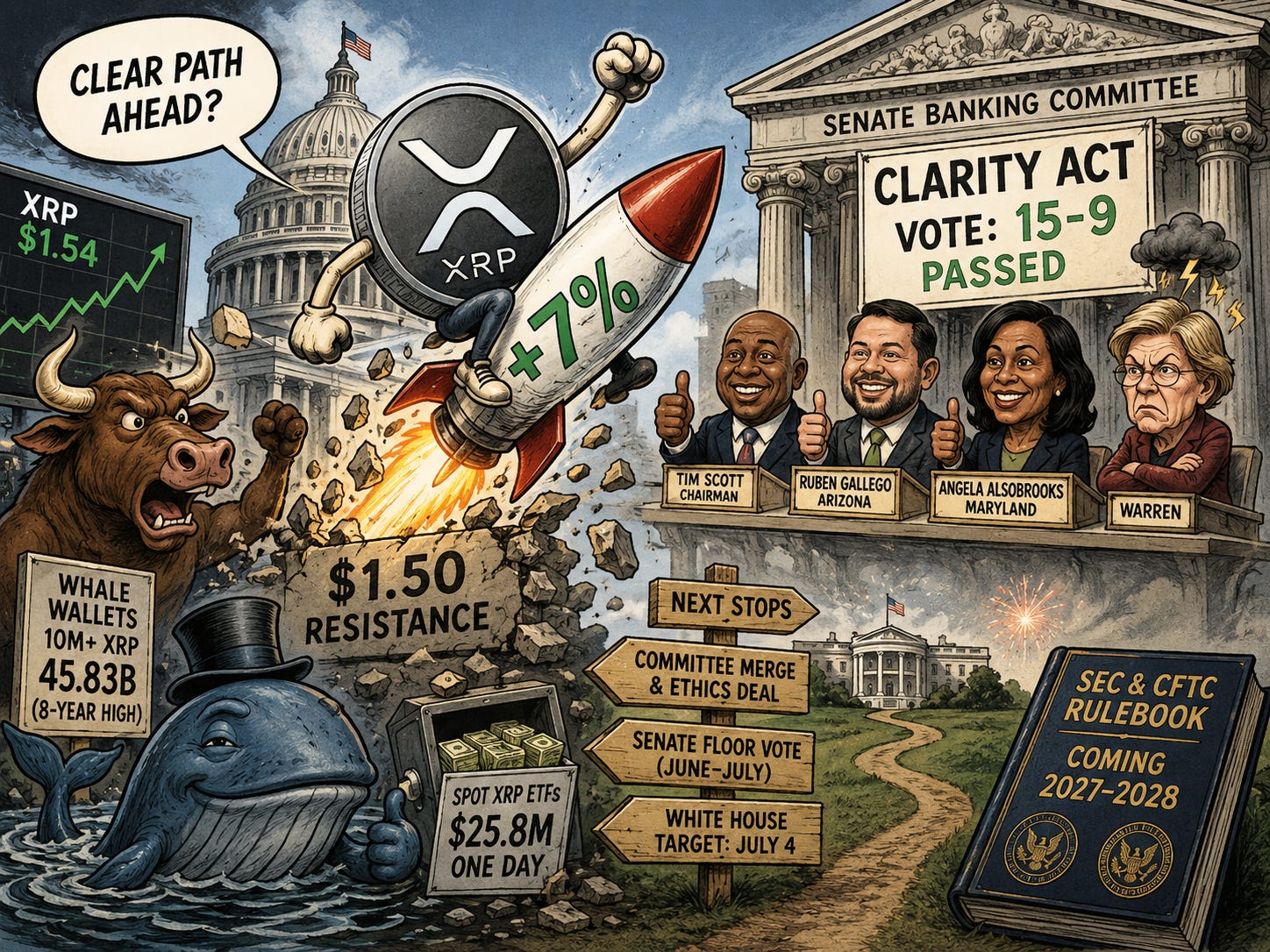
XRP rallied as much as 7% on Thursday to a session high of $1.54, briefly piercing the $1.50 resistance that has rejected every rally since February, after the Senate Banking Committee voted 15-9 to advance the CLARITY Act. Bitcoin pushed above $81,000 during the session, Coinbase (COIN) finished up more than 8%, and crypto equities were green across the board. Spot XRP ETFs took $25.8 million on Monday alone, the largest single-day total since January, and whale wallets holding 10 million+ XRP now sit at an 8-year high of 45.83 billion coins. The chart was coiled inside a symmetrical triangle going into the vote, exactly as we set out in yesterday’s deep dive, and the committee result is the trigger we were watching for. (The Crypto Times)
The 15-9 margin is the part that matters beyond price. We came in expecting a 13-11 party-line vote. Instead, two Democrats, Ruben Gallego of Arizona and Angela Alsobrooks of Maryland, crossed over against Warren’s wishes after Chairman Tim Scott reopened the floor mid-markup to extra bipartisan amendments covering investor protection, bank activity, and Senator Warner’s DeFi control test. The bank-backed Reed-Smith amendment to gut the stablecoin compromise failed. The core text advanced intact. A crossover is the first hard evidence the bill can survive the full Senate floor, where 60 votes are required and Democratic support is therefore essential. Alsobrooks and Gallego both said plainly that their yes in committee does not translate to yes on the floor unless the law enforcement gaps and the ethics provision get resolved. (CoinDesk)
Here is the calendar from here. Banking and Agriculture Committee negotiators now meet to merge their two bills into one text and try to find a compromise on the ethics provision. 21 May, the Memorial Day recess, was the soft deadline for clearing committee and that goal is now met. The full Senate floor vote is expected in June into July, needing roughly 7 more Democrats beyond yesterday’s two. By August is the realistic outer limit, per Senator Gillibrand and the Digital Chamber. The White House is still targeting 4 July for a presidential signature, which is ambitious. And even after a signature, the SEC and CFTC have to write the actual rulebook, so the live regulatory regime is 2027 into 2028. (The Hill)
Sensei’s Insight: Yesterday was the easiest gate this bill had to clear and it cleared it stronger than expected. A 15-9 with crossovers is a firmer launchpad into the floor fight than anyone predicted, and XRP’s break above $1.50 was the market saying the same thing. The honest read is that the path is real but not finished. The ethics deal is the next pressure point, and it is what unlocks the 7 Democrats. Watch the close above $1.50 on XRP and watch Gillibrand’s calendar.
🇨🇳 Xi’s Taiwan Warning Frames a Summit Long on Deals, Short on Breakthroughs
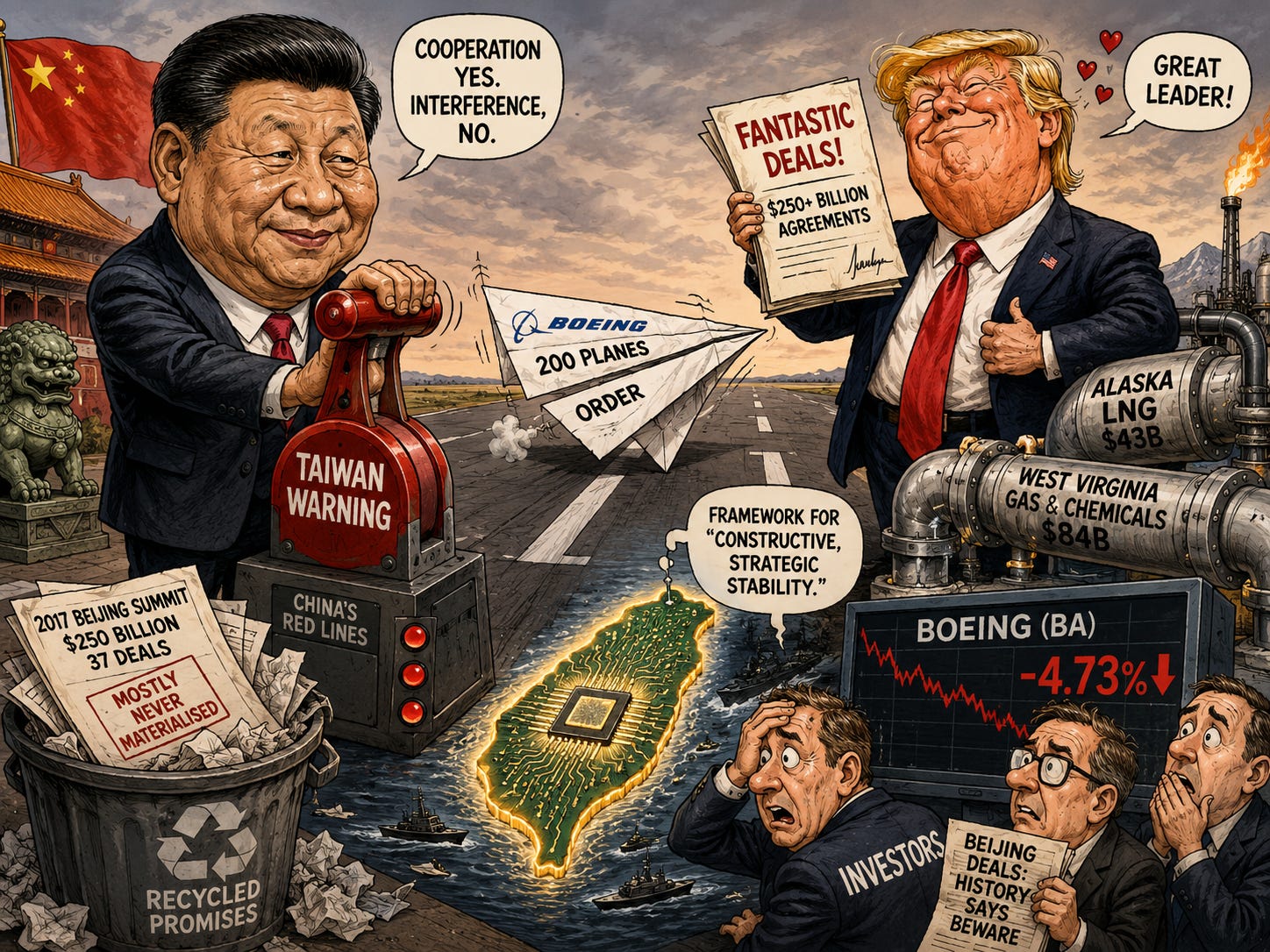
The headline coming out of Beijing is a 200-plane Boeing order. The headline that matters is the Taiwan warning. The Trump-Xi summit wrapped today with Trump declaring “fantastic” results, but the market’s verdict on the Boeing deal told the cleaner story: Boeing shares fell 4.73% on Thursday even as Trump told Fox News that Xi had agreed to buy 200 aircraft, topping the 150 that “Boeing wanted.” Beyond aviation, the two sides announced more than $250 billion in commercial agreements, including an $84 billion Chinese investment in West Virginia gas and chemical projects and a $43 billion commitment to LNG infrastructure in Alaska. Trump departed Beijing calling Xi a “great leader” and inviting him to the White House in September; Xi said the two sides had agreed on a framework for “constructive, strategic stability.” (NBC News)
The skepticism around the Boeing deal carries a historical footnote: Trump’s 2017 Beijing summit produced $250 billion in 37 deals that largely never materialised, a parallel Capital Economics noted in a Friday research note. Analysts at Jefferies had estimated China could order up to 500 aircraft; the 200-plane figure landed short, and the absence of confirmed written contracts kept the rally muted. The more durable market signal from the summit is strategic. Xi front-loaded the Taiwan warning on Day 1 rather than raising it privately - a deliberate move that positions China’s commercial cooperation as contingent on US restraint. Secretary Rubio confirmed on the margins that Trump did not formally ask Xi to help end the Iran war, even as both sides agreed the Strait of Hormuz must stay open. For investors in Taiwan-exposed semiconductor names, energy, and Boeing itself, the next signal to watch is whether the US proceeds with the $14 billion Taiwan arms package sitting on Trump’s desk. (CNN)
Sensei’s Insight: The summit’s real tell was Boeing falling on its own order announcement. Markets have learned to price China’s presidential-visit commitments at a steep discount - the 2017 deals were mostly recycled. Xi securing Trump’s warm public language on Taiwan without making explicit concessions is the strategic win Beijing came for. The commercial wins, if they materialise, are the bonus.
📈 Yields Hit One-Year High as Inflation Roars Back
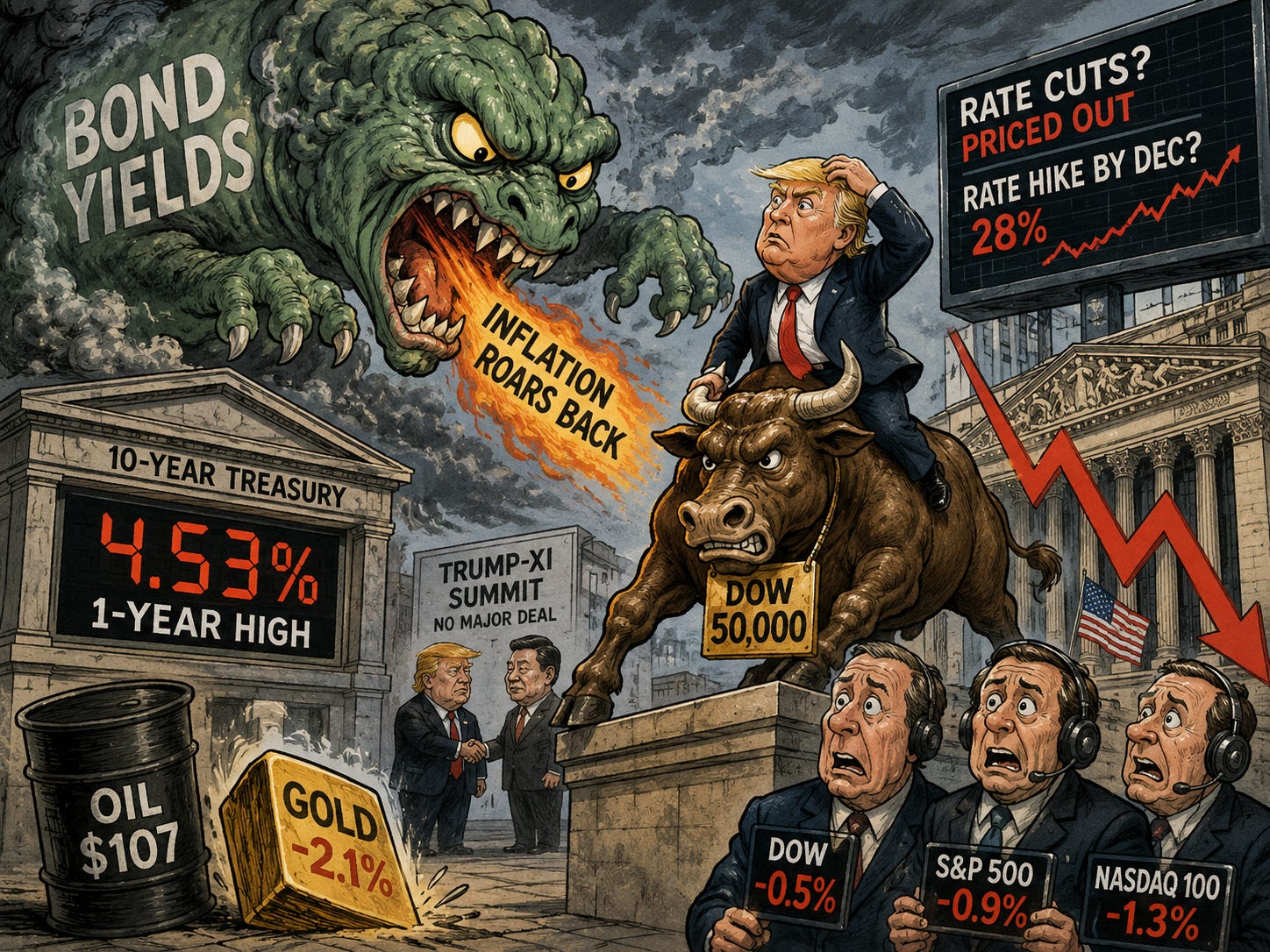
The Trump rally has met its first real test from the bond market. The yield on the 10-year Treasury note hit 4.53% today, its highest level in nearly a year, after this week’s wholesale inflation reading surged 1.4% month-over-month against a 0.4% consensus. Markets have now fully priced out any chance of a Federal Reserve rate cut this year and are pricing in roughly a 28% probability of a rate hike by December. Stock futures pulled back hard from yesterday’s record highs: Dow Jones Industrial Average futures slid 265 points or 0.5%, S&P 500 futures dropped 0.9%, and Nasdaq 100 futures fell 1.3%. (Barron’s)
For retail investors, the mechanics matter. Higher Treasury yields make stocks less attractive by offering safer returns elsewhere, and they raise borrowing costs across the economy, from mortgages to corporate debt. The Dow closed above 50,000 yesterday for the first time since February, a milestone the rally now has to defend without the cheap-money tailwind that got it there. Oil at $107 a barrel on the Iran war is keeping inflation pressure on, gold sold off 2.1%, and the Trump-Xi summit ended today with no major trade deal to give markets a lift. The next number to watch is the 30-year Treasury yield approaching 5%.
Sensei’s Insight: The Dow at 50,000 may have just hit a ceiling. Without rate cuts to lean on and yields climbing fast, the next leg has to come from earnings, not multiple expansion. Today’s open will tell whether 50,000 was a milestone or a peak.
🎨 Figma’s Fastest Growth in Years Puts AI Displacement Fears to Rest
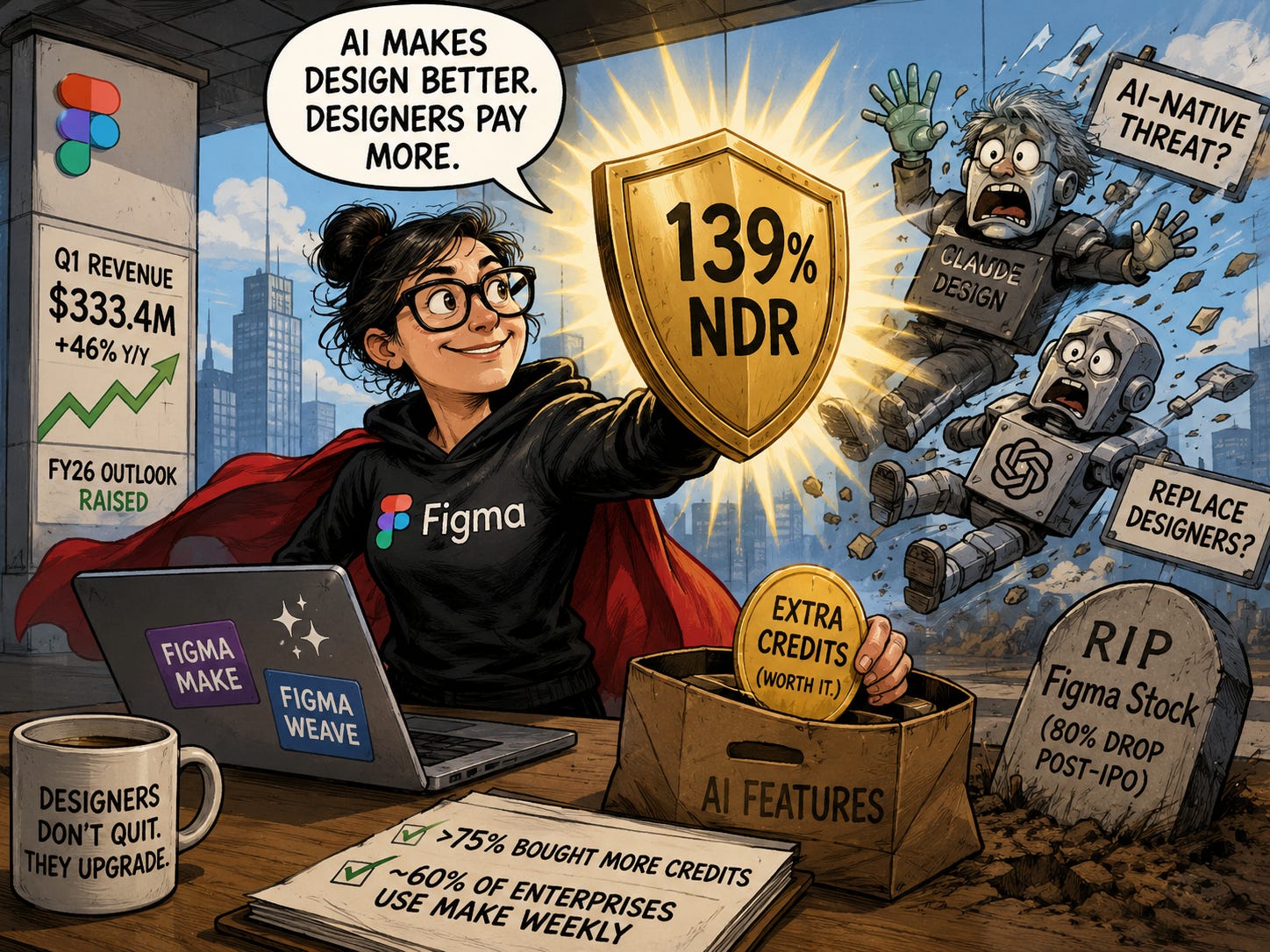
Figma (FIG) told a clean story Thursday: AI is making designers more productive and more willing to pay, not replacing them. The company reported Q1 revenue of $333.4 million, up 46% year-over-year - its third consecutive quarter of growth acceleration, from 38% to 40% to 46% - and beat the analyst consensus of roughly $315 million. Non-GAAP earnings per share of $0.10 nearly doubled the $0.06 estimate. Figma raised its full-year 2026 revenue forecast by $55 million to a $1.422-$1.428 billion range. Shares jumped as much as 15% in after-hours trading. (Reuters)
The number that most directly answers the question Figma has been carrying since its 80% post-IPO decline is net dollar retention of 139% - its highest in more than two years - meaning existing customers grew their spending by 39% on average over the past year. When Anthropic launched Claude Design in April, Figma’s stock cratered roughly 40% in two months on fear that AI-native tools would render its platform redundant. Figma’s bet was integration rather than competition: it launched its own AI tools (Figma Make for prototyping, Figma Weave for imagery), partnered with Anthropic and OpenAI, and in March began charging customers credit-based fees for AI features used beyond a monthly limit. More than 75% of higher-tier customers who hit that limit chose to buy more credits rather than cancel - the first real-money test of the AI monetization thesis - and about 60% of large enterprise customers are now using Figma Make weekly. The direct read-through lands on Adobe (ADBE) as Figma’s closest publicly-traded peer, and more broadly on the SaaS sector, where investors have been debating whether AI is a tailwind or a displacement threat. (BusinessWire via Figma)
Sensei’s Insight: The 139% NDR against the backdrop of a direct AI competitive threat is the most important data point in enterprise software this quarter. Most SaaS companies pointing to “AI tailwinds” are extrapolating from usage metrics; Figma is pointing to a cohort that was presented with the option to leave and paid more to stay. That is a different quality of evidence.
📋 Trump’s 3,642 Stock Trades Included Nvidia and Coinbase Around Key Policy Moments
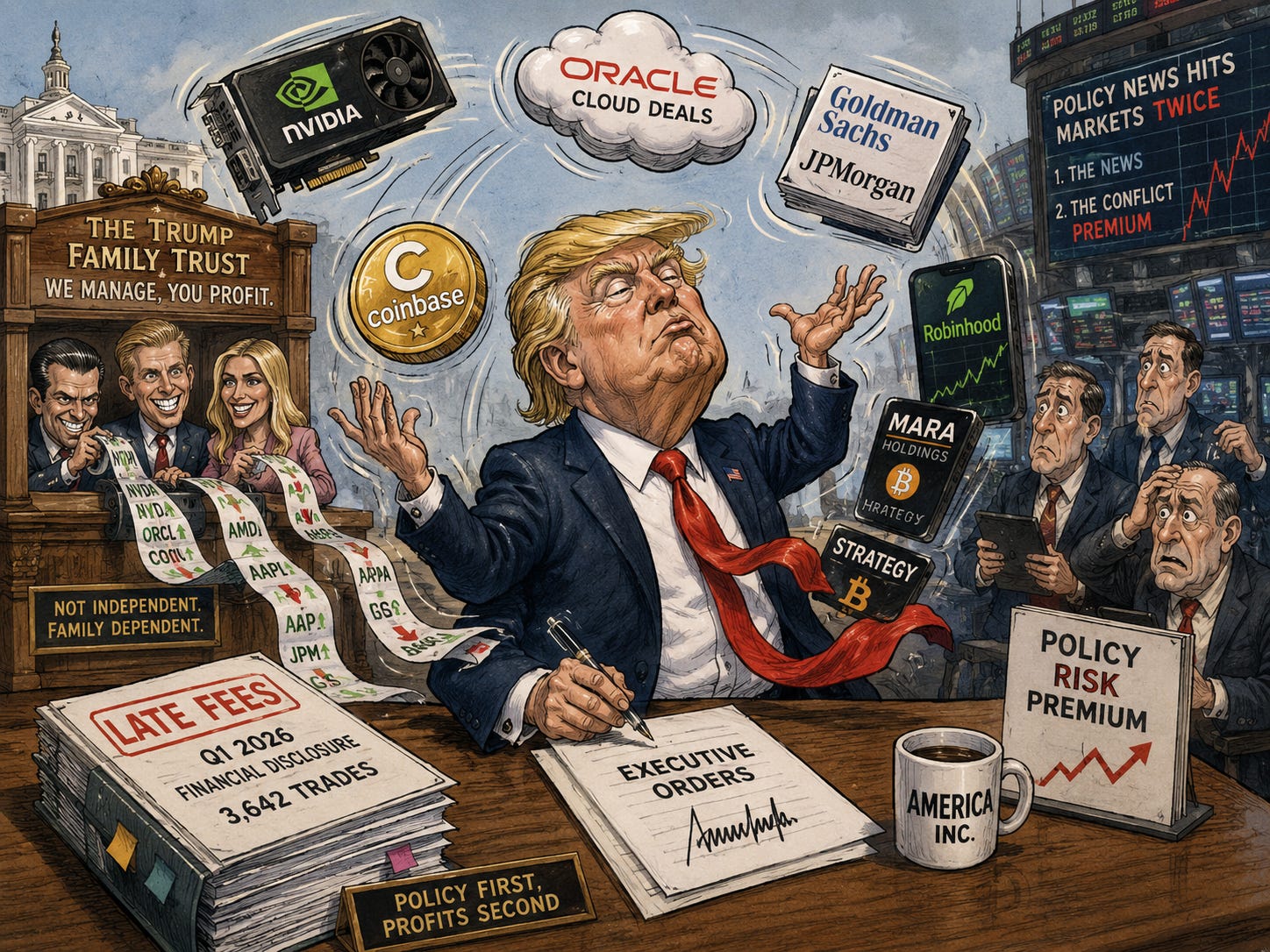
On Thursday, the US Office of Government Ethics published Trump’s Q1 2026 financial disclosure showing 3,642 individual securities transactions over January through March, roughly 58 trades per US trading day. The 113-page filing - marked “Filer paid late fees” on the cover - disclosed a notable shift from bonds to individual corporate stocks, with cumulative transaction values falling between $220 million and approximately $750 million under the broad bands that federal disclosure rules require. The portfolio included Nvidia, AMD, Apple, Microsoft, Oracle, Goldman Sachs, JPMorgan, Coinbase, Robinhood, MARA Holdings, Strategy Inc., Boeing, and an S&P 500 index fund, among others. The White House said all investment decisions are made by independent third-party managers through automated processes. (Reuters via US News)
The timing overlaps are the detail retail investors should not skip. Trump purchased Nvidia stock on February 10, approximately a week before Nvidia announced a major compute deal with Meta; subsequent administration decisions about Nvidia’s ability to sell H20 chips in China directly affected the company’s market position. Oracle purchases in early 2026 came while the administration was facilitating Oracle’s role in TikTok’s US sale. The disclosed crypto purchases - Coinbase, Robinhood, MARA, Strategy - parallel an administration that has signed a crypto-reserve executive order and is now championing the CLARITY Act through Congress. Recent presidents including Biden used blind trusts that place assets under fully independent control to avoid this pattern; Trump’s structure involves a trust managed by his children rather than a genuinely independent third party. The practical market implication runs in two directions: companies in the filing now carry heightened political scrutiny, and the disclosure is accelerating momentum for legislation extending STOCK Act-style trading restrictions to the executive branch. (NBC News)
Sensei’s Insight: The market risk here is not that the trades themselves move prices - they’re historical. The risk is structural: every future policy announcement touching Nvidia, Oracle, Coinbase, or the major banks now arrives with an additional layer of conflict-of-interest scrutiny that could add noise to how markets process the news. For traders, that means elevated political risk premium on policy-sensitive names.
Stories You Might Have Missed
🚗 EPA Proposes Two-Year Delay on Biden’s Vehicle Emissions Standards
The EPA formally proposed Thursday pushing compliance deadlines for Biden-era vehicle tailpipe pollution rules from the 2027 model year to 2029, a move it estimated would save automakers about $1.7 billion. The original standards required roughly a 50% reduction in nitrogen oxides, particulate matter, and ozone precursors for light- and medium-duty vehicles by 2032. The Alliance for Automotive Innovation, representing GM, Ford, Toyota, Volkswagen, and Stellantis, endorsed the delay, with CEO John Bozzella saying the original targets were unachievable without significantly stronger EV adoption. Tesla separately opposes the rollback, noting in an EPA submission that the existing framework provided regulatory stability for its production investments. The most direct trading implication: the rollback reduces the value of zero-emission vehicle credits that Tesla and Rivian sell to ICE-heavy manufacturers - a revenue headwind for pure-play EV names that will reprice in Friday’s session. (Reuters)
🦅 Ackman takes a new Microsoft stake
Bill Ackman’s hedge fund Pershing Square will disclose a new position in Microsoft in its 13F filing today, with the billionaire calling the software giant “a company we have followed for many years now offered at a highly compelling valuation” in a morning post on social-media platform X. The fund began acquiring shares in February after Microsoft fell on its December-quarter earnings, and the position has also become a core holding of Pershing Square USA, his closed-end fund that debuted on the New York Stock Exchange last month. Ackman argued the decline was driven by overblown fears about Microsoft 365 competing with Anthropic’s Claude Cowork and about Azure’s growth given Microsoft’s evolving relationship with OpenAI. Microsoft closed yesterday at a fresh record high. (CNBC)
💼 JPMorgan Dethrones Goldman Sachs as World’s Top Tech Investment Bank
JPMorgan Chase captured 16.7% of global technology investment banking fees in Q1 2026, edging out Goldman Sachs for the top spot for the first time, according to Dealogic data. The bank built its lead through an “Innovation Economy” banking strategy formalised about a decade ago, which accelerated aggressively after Silicon Valley Bank’s 2023 collapse handed JPMorgan a ready-made client acquisition opportunity. The firm now employs more than 550 bankers covering 11,000 startups and high-growth companies across 40 countries. JPMorgan’s investment banking revenues rose 28% year-over-year in Q1, with technology deals accounting for roughly 22% of its $3.2 billion total fee revenue for the quarter - its best-performing sector. Goldman retains the lead in tech M&A by deal value, but JPMorgan dominated equity underwriting, debt, and lending. For investors comparing the large-cap bank complex, the structural shift in fee mix is one reason JPMorgan’s investment bank now generates materially higher technology-driven revenue than its bulge-bracket peers. (Reuters via Investing.com)
🏙️ New York Plans 1% Tax on All-Cash Home Purchases Over $1 Million
New York state lawmakers confirmed Thursday they will include a 1% tax on all-cash purchases of New York City homes priced at $1 million or more in the state budget, expected to raise roughly $160 million annually toward the city’s deficit. Assembly Speaker Carl Heastie publicly confirmed the “non-mortgage tax” is part of an $8 billion state aid package for New York City; lawmakers are also weighing extending the levy statewide. Governor Hochul simultaneously released details of a separate pied-a-terre tax on luxury second homes worth $5 million or more, projected to raise $500 million annually. The combined measures target a narrow but concentrated slice of the market: roughly 90% of Manhattan home purchases over $3 million were all-cash in the first half of 2025, meaning the effective tax base is significant even if the absolute deal count is small. NYC-focused real estate brokers and luxury developers face modest transaction-volume pressure at the top end; mortgage REITs are largely unaffected since the policy structurally pushes buyers toward financing to avoid the levy. (Bloomberg)
🔬 Applied Materials Signals AI Capex Is Just Getting Started
Applied Materials (AMAT) gave the semiconductor sector a jolt after Thursday’s close, posting fiscal Q2 revenue of $7.91 billion against a $7.68 billion consensus and lifting its full-year industry growth forecast from “over 20%” to “more than 30%.” Shares hit $468 in after-hours, up roughly 5%. The standout detail was DRAM revenue of $1.7 billion, up 18% year-over-year on high-bandwidth memory demand, the specialty memory that sits alongside Nvidia’s AI processors. That signals the AI buildout has broadened from a GPU race into a memory and packaging arms race, with read-throughs to Lam Research (LRCX), KLA Corp (KLAC), ASML, and Micron (MU). CEO Gary Dickerson said customer visibility now extends into 2027 and 2028. (Bloomberg)
🔗 Connect with Us
Stay plugged in across platforms:
Sensei on X: sensei_live_
Martyn Lucas on X: MartynInvestor
Vaz on X: eVTOLHUB
📺 YouTube Channel (Live & Replays): Martyn Lucas Investor

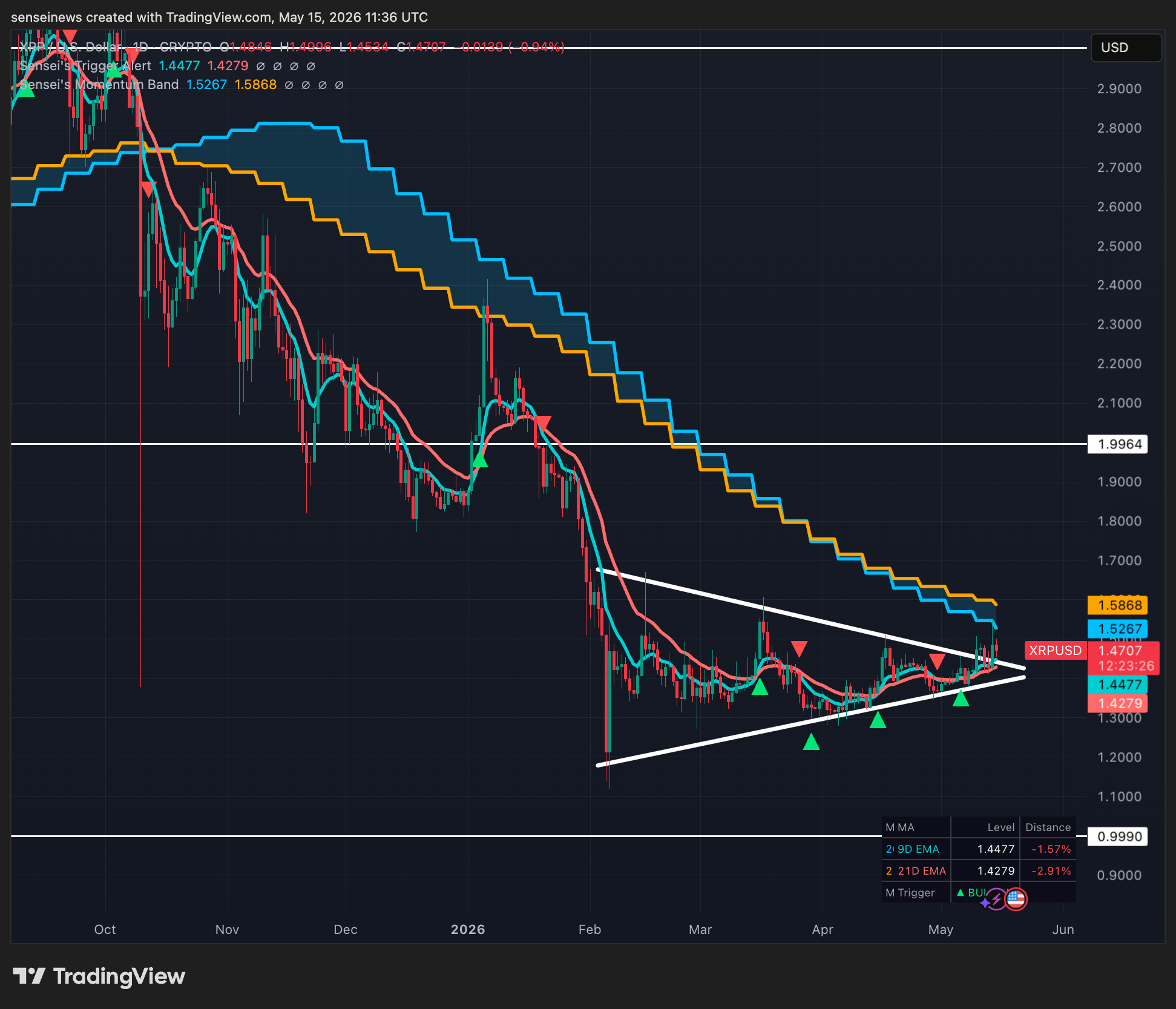
📈 Chart of the Day: XRP (XRP/USD)
XRP is the crypto most directly exposed to yesterday’s CLARITY vote, trading around $1.47 after a sharp run into the Momentum Band.
Look at the chart and you’ll see price pushed straight up into the band on the news, tagged it, and got rejected back inside the symmetrical triangle it’s been coiling in since February. The Trigger Alert is still bullish and we’re now right at the apex, which is usually where these patterns resolve. A clean break above the Momentum Band would open the path toward $2, the level that capped the last attempt in January. A rejection here keeps us trapped inside the same range.
Keep it in proportion. XRP is still trading below its Momentum Band, so the longer trend is still down, same as Bitcoin. Yesterday’s reaction was a test of resistance, not a confirmed breakout. We need to see price close above the band, not just wick into it.
CLARITY matters for XRP because it puts the token’s status into statute rather than leaving it to agency interpretation. Standard Chartered projects $4–8 billion flowing into XRP ETFs ow the bill has cleared its first Senate hurdle.