

This content is for informational and educational purposes only and does not constitute financial advice. Always do your own research. Not financial advice (NFA).
👀 Today’s Stories at a Glance
🏭 Wholesale prices jump 1.3%: US producer prices had their biggest monthly rise since March 2022, and over 80% of it was energy.
🏛️ Warsh gives nothing away: The Fed chair called AI the most consequential change of his lifetime and gave no signal for 28 October.
🇮🇩 Indonesia’s worst day since 1998: Shares fell about 11% after MSCI proposed dropping Indonesia from its emerging-market indexes.
🔌 CoreWeave’s default gauge hits record: Insurance against a CoreWeave default hit a record on Thursday, even as Nvidia’s boss defended the company.
🏦 UK banks slip on tax report: Lloyds fell 2.3% after a report that the 28 October budget will raise the tax on bank profits.
🇹🇼 Taiwan targets chip smuggling: Taiwan plans to make unlicensed AI chip shipments to China a crime, under its trade deal with the US.
🚗 Tesla’s Roadster takes flight: Tesla’s new Roadster hovered over parked cars using thrusters, with production promised for 2028 and no price yet.
🥤 KFC picks Coca-Cola: KFC’s 3,718 US restaurants will switch from PepsiCo to Coca-Cola by spring 2027, ending about 40 years.
🪙 Bitcoin ETF flows stall: US bitcoin ETFs took in just $5.06 million on Thursday, with bitcoin near $82,000 on Friday morning.
📈 Lululemon could drop to $83 first: Chart of the Day covers the $83.20 shelf below and the $119.04 and $164 levels above.
🧠 One Big Thing
Thursday brought the hottest US wholesale inflation figure since 2022, and bond yields fell anyway. Producer prices rose 1.3% in September, more than double the forecast. Over 80% of that rise was energy, which is the war. The pieces that feed the Fed’s own inflation gauge were calmer, apart from airfares. Fed chair Kevin Warsh then spoke in Bangkok overnight and gave nothing away on 28 October. So what is the Fed deciding? Whether fuel costs spread into everything else. The number that settles it, September PCE, lands on 29 October, the day after the decision.
⚖️ Fear & Greed
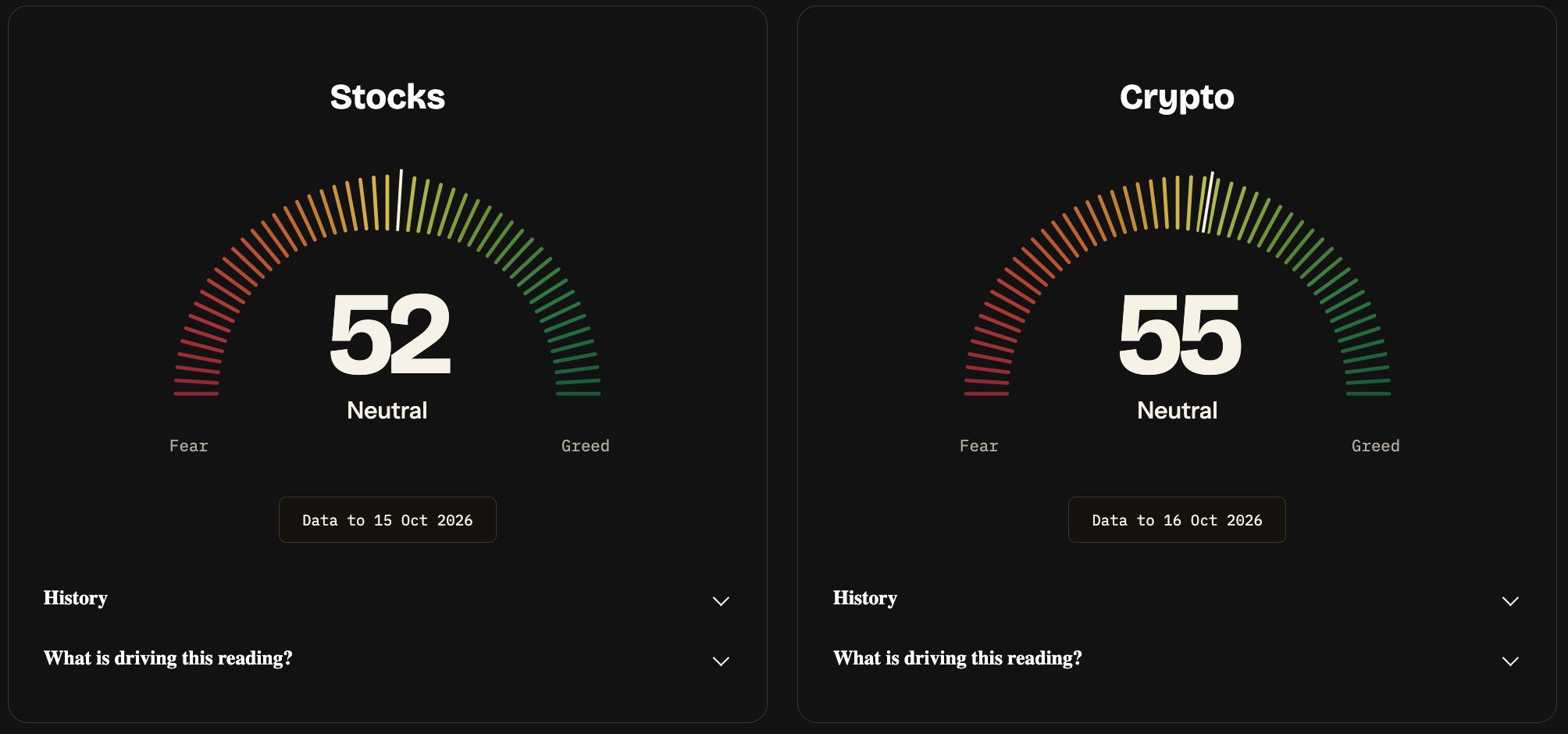
📉 The Number That Matters
80%
Over 80% of September’s 1.3% jump in US producer prices came from energy, the Bureau of Labor Statistics said. Petrol prices alone rose 20.3% in the month.
⚔️ Winners vs Losers
🟢 Top Gainers
SITC 0.00%↑ : +17.61% SITE Centers Corp. jumped after its board declared a special cash distribution worth almost the entire share price, funded by asset sales including its stake in the Dividend Trust Portfolio joint venture. The shopping centre REIT also announced plans to voluntarily delist from the NYSE before 4 December.
RGC 0.00%↑ : +7.77% Regencell Bioscience Holdings extended a momentum run that has lifted the shares about 65% in a month, after Thursday’s 17% surge came on volume more than six times its 10-day average.
Losers
No major losers today.
✅ 5 Things to Know
🏭 Producer prices jumped 1.3% and bond yields fell
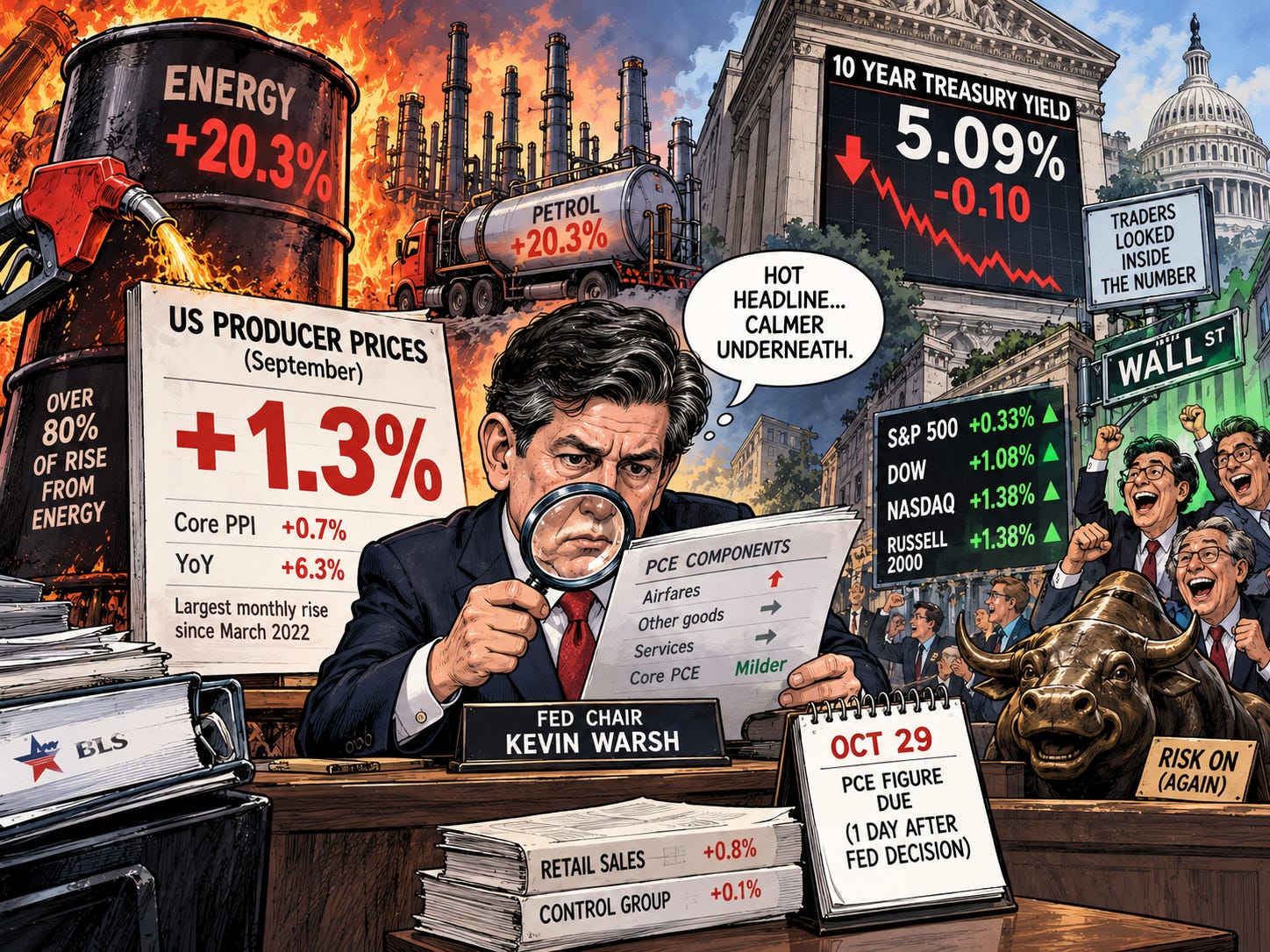
US producer prices rose 1.3% in September, the Bureau of Labor Statistics said on Thursday 15 October. Forecasts sat between 0.5% and 0.6%. That is the largest monthly rise since March 2022. On the year, prices were up 6.3%, the biggest increase since December 2022. Core producer prices, which strip out food and energy, rose 0.7% against 0.3% expected. Energy did most of the lifting. The BLS said over 80% of the rise came from energy, and petrol prices alone jumped 20.3%. Bureau of Labor Statistics
So why did bond yields fall on a number that hot? Traders looked inside it. The pieces that feed PCE, the Fed’s own inflation gauge, were milder than the headline, with airfares the one hot spot. Employ America nudged its estimate for September core PCE to 3.09% on the year. The 10-year Treasury yield fell about 10 basis points to 5.09%. Retail sales rose 0.8% against 0.3% expected, though the control group, the slice that feeds GDP, rose only 0.1%. The official PCE figure lands on 29 October, a day after the Fed decides. Employ America Investrade
Stocks made the same turn inside one session. At Thursday’s open the S&P 500 was down 0.49%, the Nasdaq 1.34% and the Russell 2000 of smaller companies 1.93%. By the close the S&P 500 was up 0.33% at 7,744.06, the Dow up 1.08% and the Russell 2000 up 1.38%. So what flipped it? 3 things landed during the day. Bond yields kept falling as traders digested how much of the number was fuel. Nvidia’s Jensen Huang defended CoreWeave, which took the edge off the chip sell-off. And money moved out of technology and energy and into almost everything else. TheStreet
Sensei’s Insight: Over 80% of the jump was energy, and energy is the war. The bond market read the inside of the number, and the inside was calmer than the headline. That’s my read. What I am watching is the 29 October PCE figure.
🏛️ Warsh named AI as a price pressure and stayed quiet
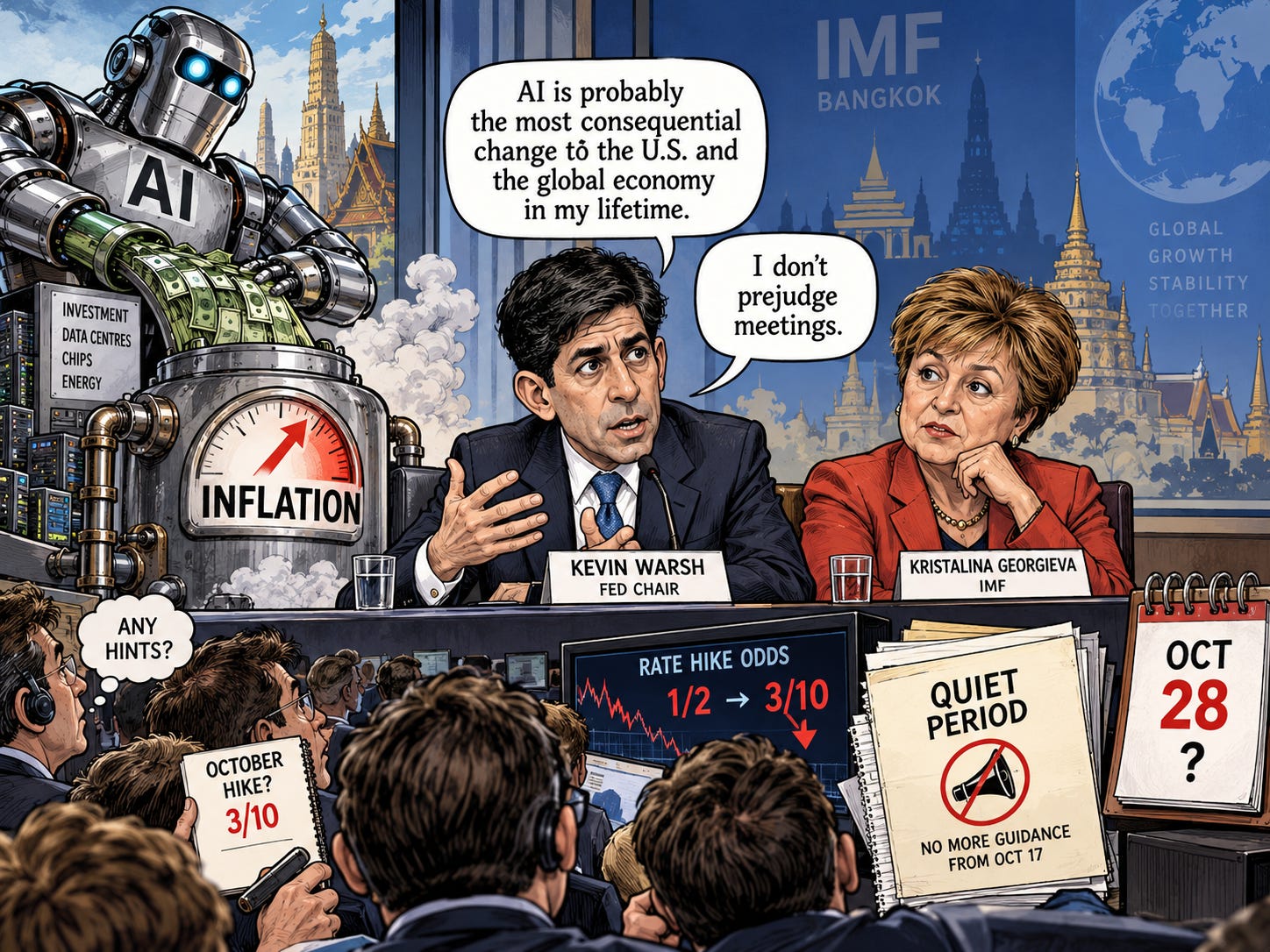
“I don’t prejudge meetings.” That was Fed chair Kevin Warsh in Bangkok, speaking alongside IMF chief Kristalina Georgieva at 4:30am UK on Friday, which was 11:30pm New York on Thursday. He gave no hint on the 28 October decision. He called AI “probably the most consequential change to the U.S. and the global economy in my lifetime to this point”. He also named the surge in AI investment as one of the forces behind higher inflation, before it expands what the economy can produce over time. AP via WSLS
Warsh said central banks had tightened together in most places, “and that means there’s no free riders.” Traders had already pulled back their bets. The odds of an October rise fell from about 1 in 2 after Wednesday’s CPI to about 3 in 10 by Thursday’s close, Newsquawk reported. Reuters said markets still expect the Fed to wait until December after his comments. Fed officials enter their quiet period on Saturday 17 October, so there is no more guidance before the decision. Korea Times via Reuters Newsquawk
Sensei’s Insight: The chair said AI spending pushes prices up now and should pay off later. That puts the AI boom on both sides of the rate decision. He gave nothing away on October. What I am watching is whether December pricing holds through the quiet period.
🇮🇩 Indonesia had its worst day since 1998
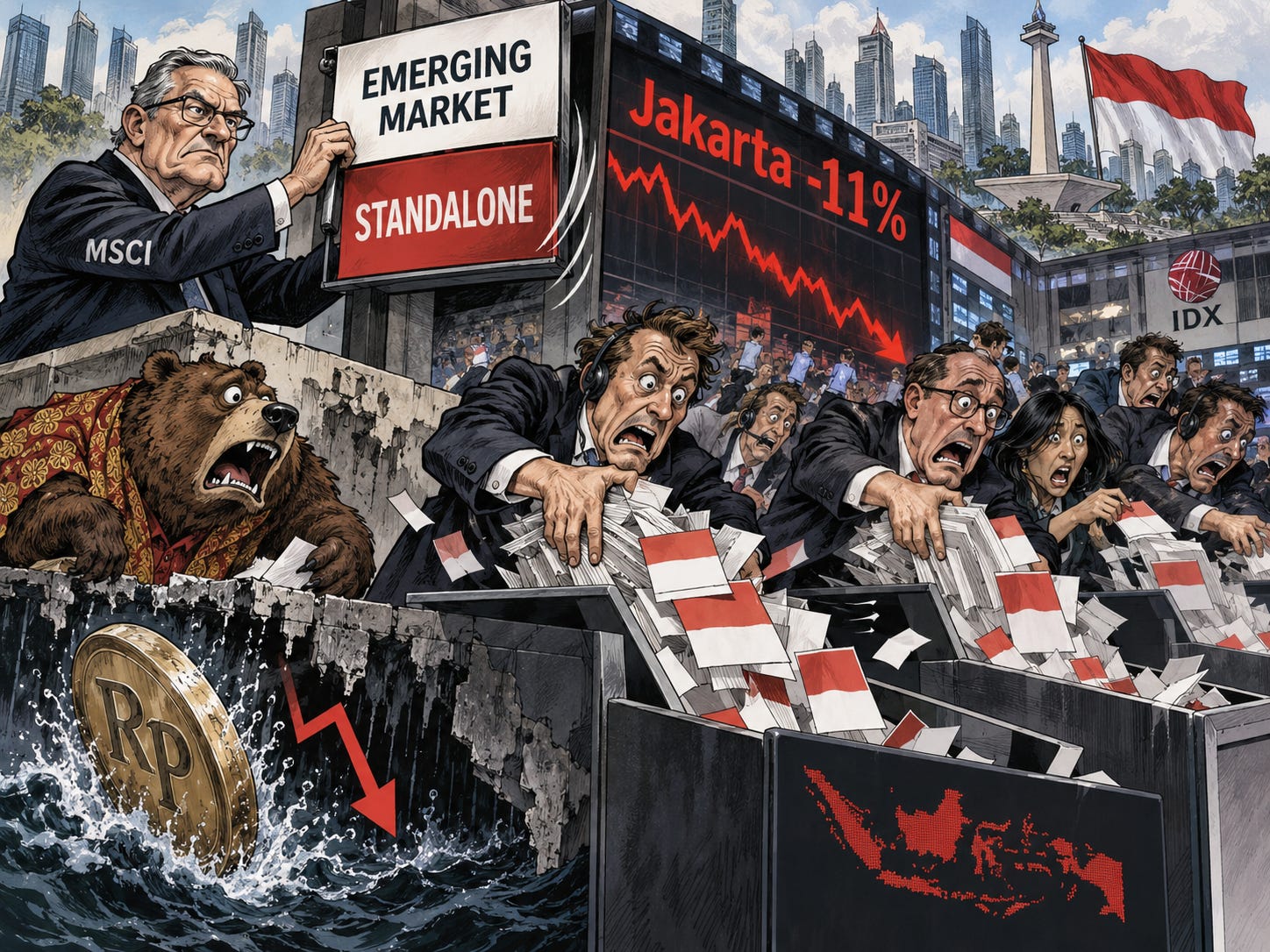
Indonesian shares fell about 11% on Friday 16 October, their steepest one-day drop since January 1998. Trading stopped for 30 minutes after an 8% fall at the open, Reuters reported. The trigger was MSCI, the company whose indexes decide what many global funds hold. It said Indonesia’s emerging-market status was “no longer appropriate” and opened a consultation on moving it to “Standalone Market” status. That would skip frontier status entirely and put Indonesia alongside Jamaica and Panama. Euronews
Why does a label matter this much? Funds that track MSCI’s emerging-market index hold what the index holds. If Indonesia leaves it, those funds have to sell. MSCI cited unclear shareholding structures and suspected coordinated trading. It said it expects to go ahead “unless the consultation identifies clear evidence of material improvements”, with a final decision due by the end of June 2027. The benchmark is down nearly 40% this year. The rupiah traded at 18,070 to the dollar, close to its record low of 18,190. MarketScreener via Reuters
Sensei’s Insight: This is a rule change, and a rule change forces selling whatever the companies earn. The decision is not due until June 2027, so Jakarta has time to answer. What I am watching is whether it brings MSCI the evidence it asked for.
🔌 CoreWeave’s default gauge hit a record as shares bounced
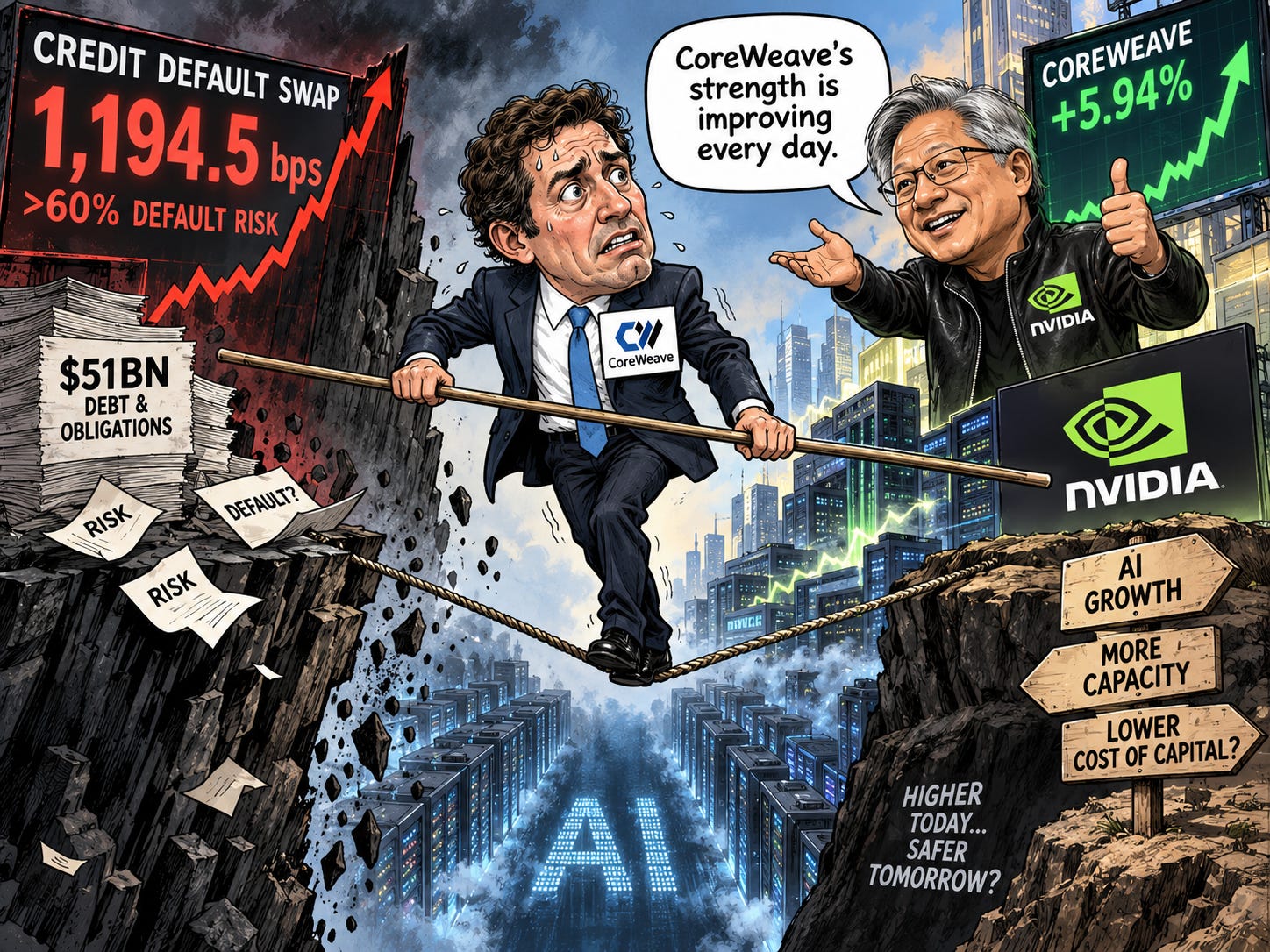
CoreWeave’s 5-year credit default swap hit a record 1,194.5 basis points on Thursday 15 October, according to ICE Data Services. A credit default swap works like insurance on a company’s debt. That price implied a more than 60% chance of default over 5 years. The shares went the other way. They fell as much as 9.5% early, then turned higher after Nvidia boss Jensen Huang spoke to Bloomberg in Stockholm. “CoreWeave’s strength is improving every day,” he said. “I’m optimistic. Their cost of capital is actually decreasing.” Nvidia owns about 10% of CoreWeave. Yahoo Finance via Investing.com
The shares closed 5.94% higher at $69.69, Bloomberg data showed, after a 15% fall to $65.78 on Wednesday. CoreWeave carries more than $51 billion of debt and obligations. The relief reached Seoul overnight. The Kospi rose 2.05% to 5,668.05 on Friday, its first gain in 8 sessions, a day after its 7.57% fall. Benzinga SBS
Sensei’s Insight: The shares and the credit market gave opposite answers on Thursday. The shares bounced on Huang’s words. The default insurance hit a record. The lenders price the debt, and the debt pays for the chips. What I am watching is whether that 1,194.5 level eases next week.
🏦 UK banks fell on a budget tax report
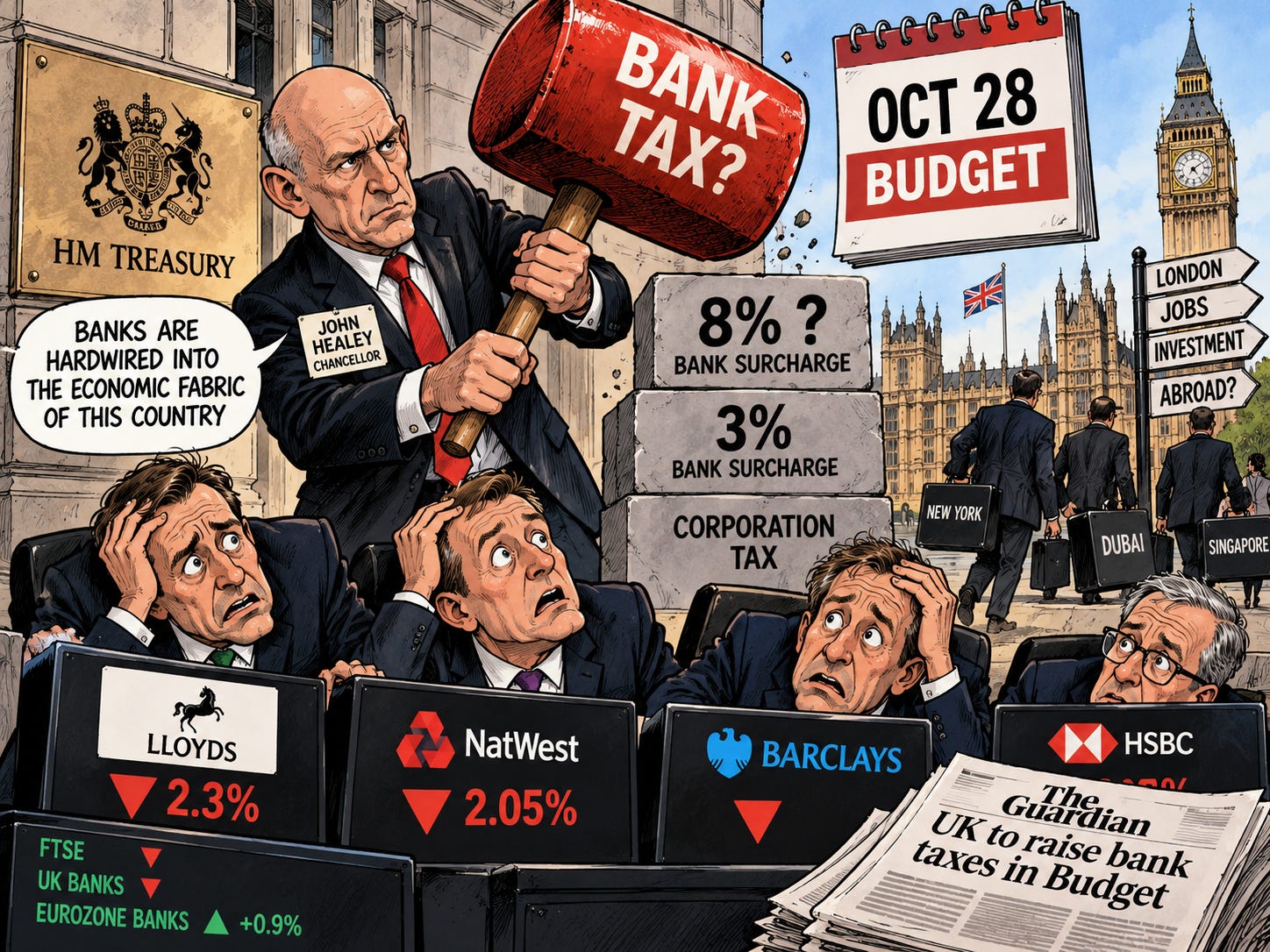
Lloyds fell 2.3% and NatWest 2.05% by 9:40am UK on Friday (4:40am New York), after The Guardian reported that Chancellor John Healey plans to raise taxes on banks in his 28 October budget. The likely tool is the bank surcharge, an extra 3% tax on bank profits that sits on top of corporation tax. Industry figures expect it to rise to 8%. Reversing earlier cuts to the surcharge would raise more than £2 billion a year. Investing.com
Healey told reporters in Bangkok that banks are “hardwired into the economic fabric of this country and our future prospects.” HSBC, NatWest, Barclays and Lloyds made £200 billion in pre-tax profit over the past 5 years. UK Finance and TheCityUK have written to Healey warning that banks could move staff and business abroad. Eurozone banks rose 0.9% in early trade, Reuters reported. The budget lands on 28 October, the same day as the Fed decision. AOL via Reuters
Sensei’s Insight: This is a newspaper report, and nothing is settled until 28 October. The 2 most UK-focused lenders fell hardest, which tells you who the market thinks pays. What I am watching is the surcharge rate in the budget itself.
Stories You Might Have Missed
🇹🇼 Taiwan plans to make AI chip smuggling a crime
Taiwan plans to add AI servers and advanced chips to its list of controlled exports, Economic Affairs Minister Kung Ming-hsin told Bloomberg, in a report on Friday 16 October. Once the rules take effect, shipping restricted AI hardware to China without permission would become a criminal offence under Taiwan’s Foreign Trade Act. No start date was given. The curbs would cover all Chinese buyers, where earlier rules applied only to blacklisted names such as Huawei, and they form part of Taiwan’s trade deal with the United States. Bloomberg has reported that Nvidia chips still reach Chinese buyers through alleged smuggling networks in Southeast Asia. Yahoo Finance via Stocktwits Crypto Briefing
🚗 Tesla’s new Roadster hovered over parked cars
Tesla showed its new Roadster on Thursday 15 October at a SpaceX site in Texas, 9 years after the first version was unveiled in 2017. Using 10 thrusters fed by compressed air, the remote-operated car jumped and briefly hovered over a Cybertruck, a Tesla Semi and other parked vehicles. Tesla showed 0 to 60mph in about 1 second. Elon Musk said production starts in 2028 and gave no price. Reservations cost $50,000 for the base version and $250,000 for the Thrust version. Musk said he is “not sure it moves the needle massively from a revenue standpoint.” TechCrunch
🥤 KFC is swapping Pepsi for Coca-Cola
KFC signed Coca-Cola as its US drinks partner on Thursday 15 October, ending a PepsiCo relationship of about 4 decades that began when PepsiCo owned the chain. Coca-Cola products will be in KFC’s 3,718 US restaurants by spring 2027. Terms were not disclosed. PepsiCo said it had just renewed its deals for Taco Bell and KFC’s international restaurants, with the Taco Bell deal running 10 years. PepsiCo, which has the activist investor Elliott on its share register, said this month that its recovery is taking longer than planned. “It is just a bad look for PepsiCo,” said Jay Woods, chief market strategist at Freedom Capital Markets. Investing.com via Reuters
🪙 Bitcoin ETF flows stalled
US spot bitcoin ETFs took in a net $5.06 million on Thursday 15 October, according to Farside data, after losing $261.5 million on Wednesday. BlackRock’s IBIT took in $16.79 million and Grayscale’s Bitcoin Mini Trust lost $7.64 million. October flows stand at minus $539.8 million so far. Bitcoin traded at $81,963 at 7:26am UK on Friday (2:26am New York), after touching $79,814 on Thursday afternoon. CryptoTicker