

This content is for informational and educational purposes only and does not constitute financial advice. Always do your own research. Not financial advice (NFA).
👀 Today’s Stories at a Glance
🇯🇵 Japan hikes, yen hits 158: The Bank of Japan took rates to a 31-year high of 1.25% and the yen fell 1.3% anyway.
📉 $2 trillion expires today: More than $2 trillion of options expire at once, and the S&P 500 rebalances before Monday’s open.
🛢️ Crude ignores the war: Brent fell 2.2% to $102.57 and WTI dropped toward $96 while the fighting around Saudi oil intensified.
💾 Memory gets worse in 2027: Intel’s chief executive says memory prices have risen up to 7 times and next year is tighter still.
🇬🇧 Shoppers beat the forecast: British retail sales rose 0.5% in August when economists had expected a fall of 0.2%.
⛽ Diesel sets another record: American diesel hit $6.39 a gallon on Thursday even as crude fell for a third session.
🪙 Crypto goes to the agencies: Coinbase’s chief executive says the SEC and CFTC should write the rules Congress declined to pass.
🔌 Amazon books $8bn of generators: Generac rose 19.1% after Amazon agreed to buy up to $8 billion of backup power.
🥇 Gold and silver both rose: Gold reached $4,386 by midday UK time, up 1.05%, with silver up 2.95% at $67.10.
📈 A bounce can happen inside a downtrend: Chart of the Day covers Adobe at $256.26, $283.88 and the $206.88 shelf below.
🧠 One Big Thing
Today is a mechanical day. More than $2 trillion of options expire at once, and the index funds that track the S&P 500 have to trade into the close because the quarterly rebalance takes effect before Monday’s open. That flow carries no view on anything. Whatever the market does between now and tonight tells you less about what investors actually think than an ordinary Tuesday would, so a big move today is worth a lot less than it looks, and Monday is when it starts meaning something again.
⚖️ Fear & Greed
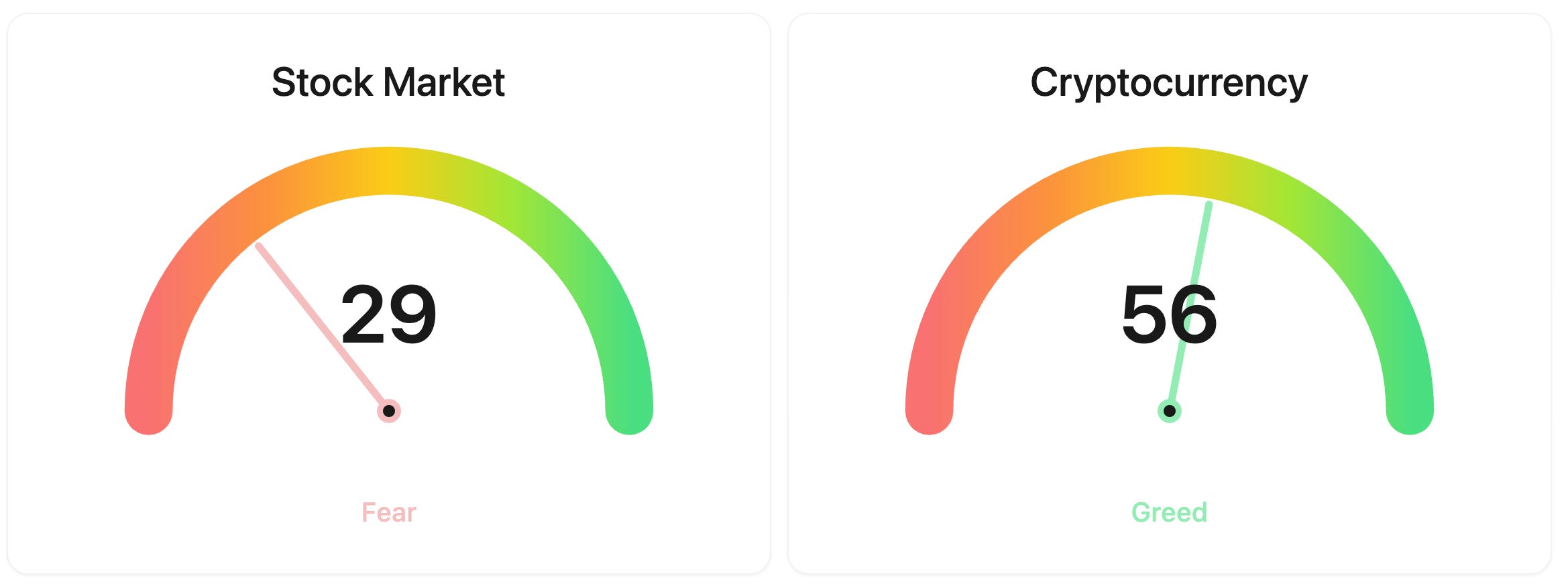
📉 The Number That Matters
$1.3 to $1.7 trillion
That is the range the Bank for International Settlements puts on money borrowed in yen and invested elsewhere, most of it in American shares, on the day Japan raised rates and the yen fell anyway.
⚔️ Winners vs Losers
Winners
USDE 0.00%↑ : +15.82% StablecoinX Inc. extended Thursday’s 24% surge after the Ethena Foundation agreed to permanently lift the 48-month lock-up on its treasury of roughly 3 billion ENA tokens from 5 October. The treasury is about a fifth of the total ENA supply, and the company now has far more flexibility over it, although sales still need the foundation’s consent.
PURR 0.00%↑ : +6.47% Hyperliquid Strategies Inc extended its gains after the SEC approved a five-year Innovation Exemption that lets tokenised US stocks trade on public blockchains for the first time. Investors see the framework as a direct fit for Hyperliquid’s on-chain trading infrastructure.
ARM 0.00%↑ : +1.40% Arm Holdings plc added to Thursday’s 6% rally after CEO Rene Haas said demand is “off the charts.” He added that easing wafer and packaging bottlenecks should let Arm convert over two billion dollars of AGI CPU demand into revenue.
Losers
XENE 0.00%↑ : -25.91% Xenon Pharmaceuticals Inc. plunged after pausing new patient enrollment in its Phase 3 depression and bipolar trials because of neuropsychiatric side effects that did not show up in earlier studies. The safety setback overshadowed its FDA filing for the epilepsy drug azetukalner.
NFLX 0.00%↑ : -3.13% Netflix, Inc. slipped after Wells Fargo downgraded the stock to Underweight, the first sell rating on it on Wall Street. The bank cut its price target to 57 dollars from 80, citing weaker user engagement and rising content costs.
📊 Market Snapshot
Cryptocurrencies:
Bitcoin (BTC): $78,110 (▲2.29%)
Ethereum (ETH): $2,503 (▲2.37%)
XRP: $1.32 (▲1.95%)
Equity Indices (Futures):
S&P 500: 7,721 (▲0.17%)
NASDAQ 100: 29,880 (▲0.46%)
FTSE 100: 10,724 (▼0.81%)
Commodities & Bonds:
10-Year US Treasury Yield: 4.95% (▲0.28%)
Oil (WTI): $96 (▼5.25%)
Gold: $4,386 (▲1.05%)
Silver: $67.10 (▲2.95%)
Data as of: UK: 12:10 BST / US: 07:10 EDT / Asia (Tokyo): 20:10 JST
✅ 5 Things to Know
🇯🇵 Japan raised rates and the yen fell anyway
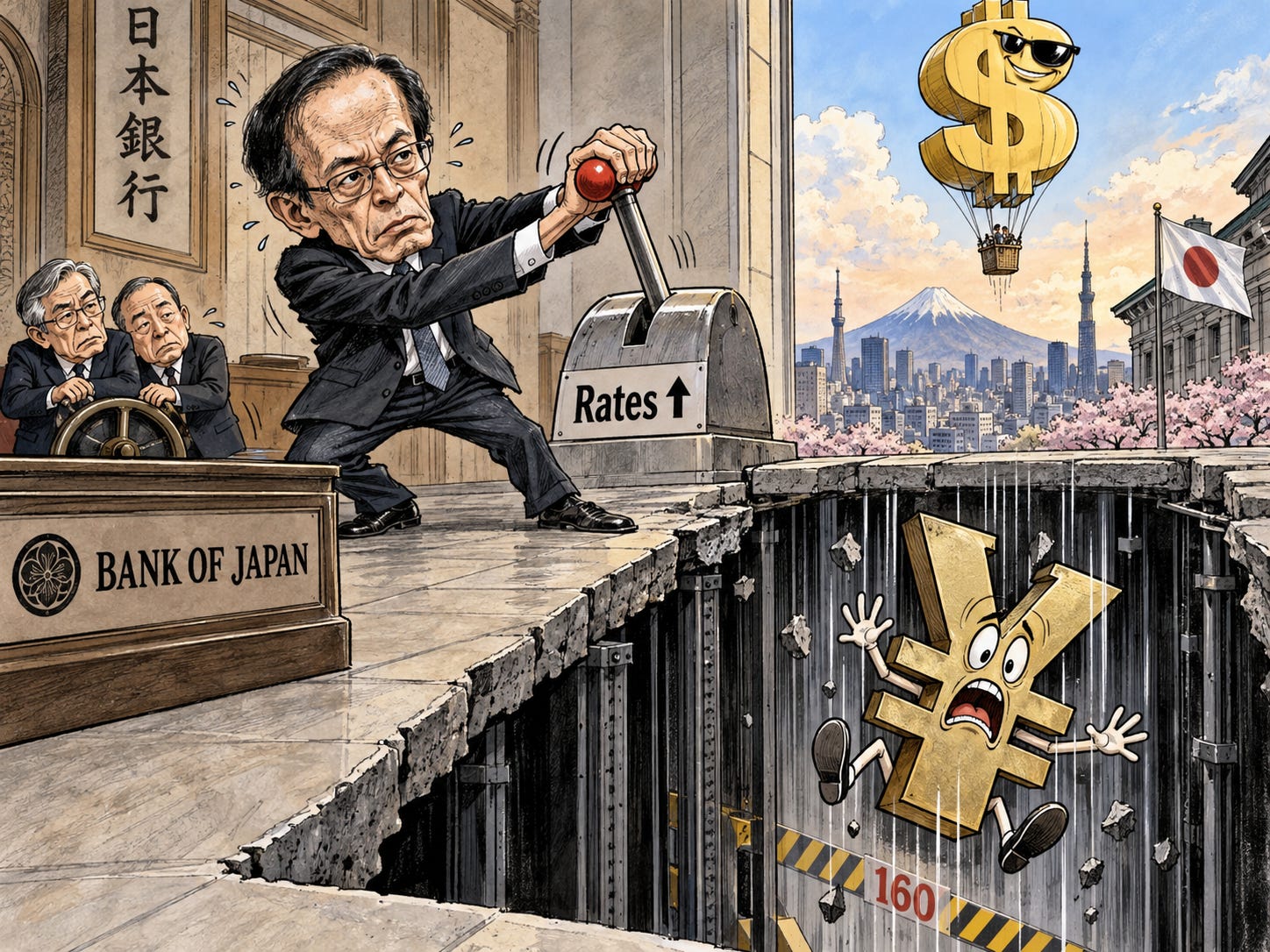
The Bank of Japan raised its policy rate by 0.25 percentage points to 1.25% on Friday, a 31-year high, exactly as every economist surveyed by Bloomberg had predicted. The vote was 7 to 2, with Toichiro Asada and Ayano Sato against. That makes it the third rise from a major central bank in 8 days, after the European Central Bank and the Federal Reserve, with the Bank of England the only one of the 4 to hold. Bloomberg
Then the market did the opposite of what a rate rise is supposed to do, and it kept doing it. The dollar bought about 156.85 yen in the minutes after the decision, against about 156.25 before it, and by late morning UK time the yen had fallen as much as 1.3% to 158.05. The 10-year Japanese government bond yield fell 4.9 basis points to 2.95%, with yields slipping across the whole curve. The Nikkei 225 closed 1.4% higher at just over 65,000, which takes its 6-month gain to around 18%.
Governor Kazuo Ueda did most of that, 30 minutes after the decision, at 7:30am UK time, which is 2:30am in New York. He said the stage for policy setting has shifted, and that if the risk of underlying inflation overshooting 2% materialises it could hurt the economy. Asked whether back-to-back rises or larger moves were possible, he declined to rule anything out ahead of a meeting. That is the language of keeping every meeting live, and traders had positioned for something firmer. “Ueda’s press conference showed snippets of hawkishness, but they were insufficient to support the market’s aggressively hawkish expectations,” said Chidu Narayanan, chief APAC strategist at Wells Fargo.
The two dissenters are the other half of it, because both are Prime Minister Sanae Takaichi’s own appointees to the board. “The dissent from Asada and Sato points to resistance against the fastest pace of rate increases in more than three decades and suggests they may increasingly act as a brake on further tightening,” said Frantisek Taborsky, FX and fixed income strategist at ING. He put a move back towards 160 yen as possible in the coming weeks if oil stays elevated and the Fed raises again as early as October.
160 is not an ordinary number. Japan and the United States ran their first coordinated yen-buying operation since 1998 this summer, led by US Treasury Secretary Scott Bessent, who had also pressed Tokyo to raise rates in the first place. Japan spent a record ¥15.4 trillion, about $98.3 billion, on intervention in the month to 26 August, according to Finance Ministry data. Here is the part that reaches an American portfolio: to buy yen, Japan needs dollars, and one way to raise them is selling US Treasuries, which pushes American bond yields up at a moment when they are already at multiyear and in some cases multidecade highs. Barron’s
The other route is quieter and much larger. Japan has been the cheapest place in the world to borrow for 30 years, and investors borrow yen, convert to dollars and buy assets elsewhere. Bank for International Settlements data puts that trade at somewhere between $1.3 trillion and $1.7 trillion, with the bulk of it sitting in American shares. A weaker yen on the day of a rate rise says that trade is still running.
Sensei’s Insight: Look at what a falling yen on hike day is actually telling you. Nobody believes Japan has stopped being cheap. 160 is the number I am watching now, because that is where Tokyo and Washington last stepped in together, and we are less than 2 yen away from it.
📉 $2 trillion expires today, then the index reshuffles
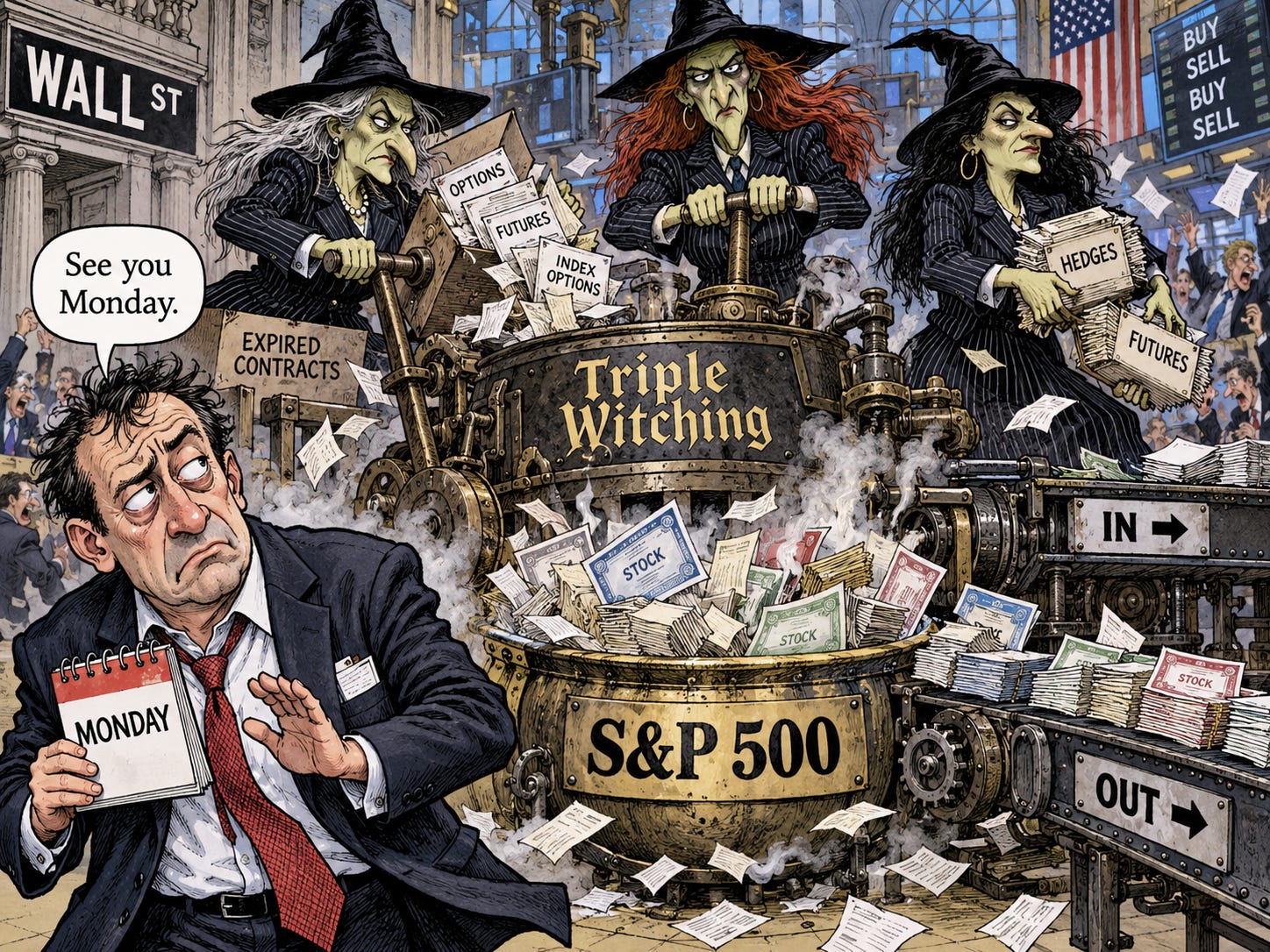
More than $2 trillion of options expire at once on Friday. Stock options, index options and index futures all settle in the same session, which is what triple witching means and why volume on these days runs well above normal. The traders and dealers who hedged those contracts have to roll or unwind them, and that buying and selling is machinery rather than judgement. The base rate is unkind: the S&P 500 has closed lower on triple witching day in 12 of the 14 years since 2012. The 2 exceptions were 2017 and 2025, at gains of 0.2% and 0.5%. Yahoo Finance
The rebalance sits directly behind it. S&P Dow Jones Indices adds Bloom Energy, Illumina and Everpure to the S&P 500 and drops Molson Coors, The Trade Desk and Builders FirstSource before trading opens on Monday 21 September, so every fund that tracks the index has to own the new names and sell the old ones, and most of that happens into Friday’s close.
Forced flow of that size moves prices without saying a word about the companies. A 12-of-14 record rests on 14 observations, which is a thin sample, and it describes the day rather than predicting this one. September is historically the weakest month of the year for American shares, and the S&P went into this week up 0.3% for the month. S&P Global
Sensei’s Insight: I treat today’s move as noise until Monday proves otherwise. If the weakness carries into next week once the contracts are gone, that is real. If it reverses on Monday, all you watched was hedges being unwound by people with no view at all.
🛢️ Crude fell again while the war got worse

Debris from an intercepted Houthi drone killed a person inside Saudi Arabia on Thursday. Crude fell for a third straight session anyway. Brent dropped 2.2% to $102.57 on Friday and West Texas Intermediate broke under $100, trading near $96 by midday UK time and down 5.25% on the day, which leaves both benchmarks well off the 4-month highs they set last week. Supply news did the work. Saudi Arabia expects about half the capacity of its damaged East-West pipeline back within days and full operation in roughly 6 weeks, and US Energy Secretary Chris Wright said 18 million barrels of crude and products moved through the Strait of Hormuz earlier in the week, at a 7-day average of 11 million barrels a day. CNBC
On the ground it has gone the other way. Yemen’s Houthi forces hold the Red Sea port of Mokha and several islands near the Bab el-Mandeb strait, through which roughly 12% of world trade passes in peacetime, and they now sit 32 kilometres, or 20 miles, from Djibouti, where the United States keeps a military base. About 125,000 Yemenis have fled their homes in a week. The shipping numbers explain the price better than the map does. The analytics firm Windward counted daily transits through Bab el-Mandeb dropping from 35 before the Houthi advance to 25 after it, then climbing to 45 on Sunday, which is more traffic than the strait carried before any of this started. NPR
Sensei’s Insight: Traders stopped pricing headlines and started pricing barrels, and that is a meaningful shift after 5 weeks of the opposite. It also cuts both ways, because a market that has priced in the repair has further to fall if the repair slips.
💾 Memory prices up 7 times, and 2027 looks tighter

“Next year it’s going to be even worse.” That is Intel chief executive Lip-Bu Tan on memory chips, speaking at an industry event this week. He also said capacity is very constrained, that a lot of business has slowed because buyers cannot get enough memory, and that prices have gone up “five, six, seven times”. Micron shares rose more than 5% on Thursday on the remarks, with Nvidia, Broadcom and SK hynix higher alongside them. SK hynix chief executive Kwak Noh-jung told Reuters in July that 2027 would be the worst year in the industry’s history for supply, so the people who make the stuff and the people who fit it into products now agree on the direction. Yahoo Finance
Expensive memory is revenue for the companies that make it and a cost for everyone who buys it, and the market has spent a year rewarding only the first half of that sentence. Barclays strategist Venu Krishna warned on Thursday that memory costs are a live earnings risk for chip buyers in 2027. He pointed out that Apple attributed all of its recent gross margin compression to higher memory costs and expects that to continue in the near term, and that Samsung, which both manufactures memory and buys it, sees pre-booked demand implying a wider supply gap in 2027 than in 2026. That is one of the largest companies in the world saying the cost has already reached its margins. Yahoo Finance
Sensei’s Insight: My read is that this is the first AI cost story with a real margin line attached to it. Everything until now was capital spending promises. Apple naming memory as the reason its gross margin fell is a number an investor can actually check.
🇬🇧 British shoppers came back the day after the hold
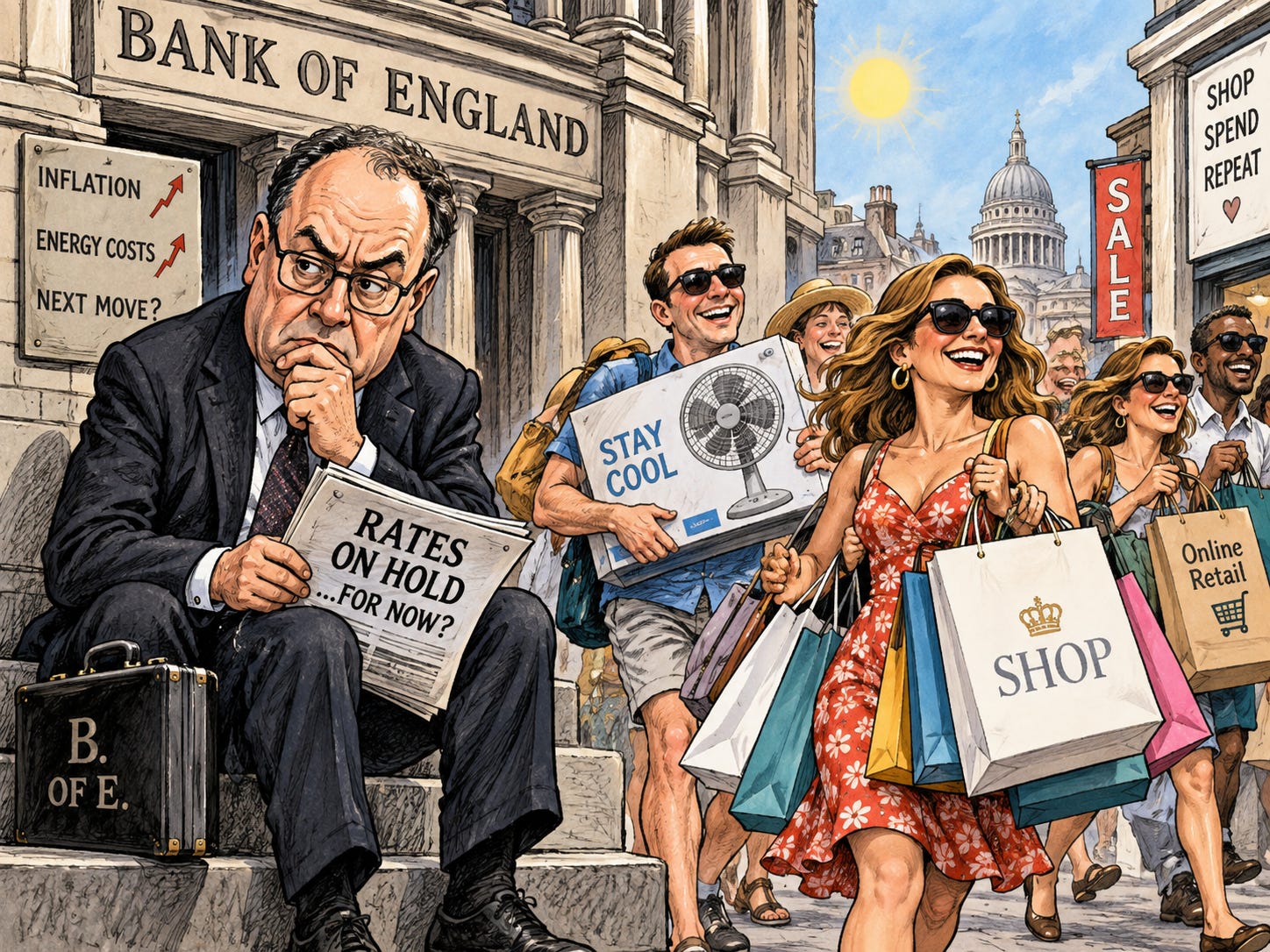
Has the British shopper given up? Not in August. Retail sales volumes rose 0.5% on the month, when economists surveyed by Bloomberg had expected a fall of 0.2%, and that follows a 0.5% decline in July. The Office for National Statistics put the rebound down to online retailers and department stores recovering from a weak July, when promotions had been pulled forward into June, with clothing and food stores adding to it. Warm weather sold fans and air conditioning units. Retail Bulletin
The 3-month figure is the steadier read, and sales over the 3 months to August rose 0.9% against the previous 3 months and sat 2.4% above the same period a year earlier. Fuel was the one category going backwards, down 1.3% on the month as pump prices climbed. The timing is what makes the release interesting, because the number landed the morning after the Bank of England held Bank Rate at 3.75% on a 6 to 3 vote, with Andrew Bailey warning that the longer high global energy costs persist, the more likely a rise becomes. A household sector that keeps spending while inflation runs at 3.1% takes one argument for waiting off the table. The next decision is on 5 November, 8 days after the Budget on 28 October. Bloomberg
Sensei’s Insight: 3 of the 9 voters already wanted a rise before this number existed, and nothing in it helps the other 6. That is my read on why 5 November is the date in my diary, and the Budget 8 days ahead of it is what could still change the arithmetic.
Stories You Might Have Missed
⛽ Diesel set another record while crude was falling
The national average price of diesel in the United States hit $6.39 a gallon on Thursday, a record, according to AAA. Petrol averaged $4.43. In California, diesel has jumped more than $1 a gallon in a month to above $8.34. GasBuddy’s Patrick De Haan said the national average could reach $6.60 within days, which would pass the inflation-adjusted peak set in 2022. Crude fell on the same day, which points at refining and distribution rather than at the barrel. Liz Thomas, chief market strategist at SoFi, wrote this week that the odds of a diesel export ban being announced before the midterms are high. Yahoo Finance
🪙 Coinbase went to the regulators instead of Congress
Brian Armstrong gave his first public response to Tuesday’s failed CLARITY Act vote, calling the outcome an abdication of responsibility and saying the bill fell to politics. Coinbase will now pursue rules through the SEC and the CFTC rather than through Congress. He also made an unusually candid commercial point, that a law would have been good for America and awkward for Coinbase, because every major financial services firm would have started integrating crypto and competition would have multiplied. CFTC chair Mike Selig said his agency is ready to ship its rules. Coinbase rose 4% on Thursday, Robinhood 3% and Strategy 4%, and bitcoin was at $78,110 by midday UK time on Friday, up 2.29%. Yahoo Finance
🔌 Amazon bought $8 billion of backup generators
Generac shares jumped 19.1% to $208.48 by late Thursday morning, after opening as much as 27.8% higher, on a long-term agreement to supply Amazon with up to $8 billion of backup generators for its data centres. Deliveries of $2.4 billion are expected across 2027 and 2028. Amazon also received warrants over 1,693,745 Generac shares at $200.93 each, with about 308,000 exercisable on signing and the rest unlocking as Amazon pays for generators. A home generator company has become an AI infrastructure supplier, which is what happens when power is the bottleneck. Benzinga
🥇 Gold and silver both climbed as yields eased
Gold reached $4,386 an ounce by midday UK time on Friday, up 1.05% and extending Thursday’s gain, helped by falling oil prices that took some pressure off the inflation outlook and by lower bond yields behind them. Silver did better still, up 2.95% at $67.10. The 10-year US Treasury yield fell 5 basis points to 4.94% on Thursday as investors worked through the Fed’s first rate rise in 3 years and Chairman Kevin Warsh’s hawkish tone. American shares recovered in the same session, with the S&P 500 up 1.1%, the Nasdaq Composite up 1.7% and the Dow Jones Industrial Average up 0.6%. Trading Economics Yahoo Finance