

This content is for informational and educational purposes only and does not constitute financial advice. Always do your own research. Not financial advice (NFA).
👀 Today’s Stories at a Glance
🛒 The trade-down is real: Walmart fell 9% on its slowest US sales in six years while Ross Stores posted 10% and raised its guidance.
⛽ Brent heads toward $94: Oil is up more than 5% this week and Walmart named fuel costs as the reason shoppers cut back.
₿ Bitcoin clears $77,000: The best week since 2023 pulled XRP up another 9% to $1.39, with $606 million of ETF inflows behind it.
📊 The last number before Wyoming: US flash PMI lands at 2:45pm UK, 9:45am ET, a week before Warsh speaks at Jackson Hole.
🇬🇧 Britain splits in two: July retail sales fell 0.5% while August business surveys reached a four-month high and confidence a two-year high.
💉 Moderna gives it back: Shares fell 23.5% on Thursday, one day after the largest single-session gain in company history, with no new data.
🇯🇵 Japan inflation reaches 2.0%: Prices rose for a third straight month, which strengthens the case for the Bank of Japan to raise rates.
🇪🇺 Europe’s factories speed up: Eurozone manufacturing output hit a 54-month high and export orders grew for the first time since early 2022.
🚜 Deere posts its first profit rise in three years: Construction profit jumped 84% and the company lifted its full-year forecast to as much as $5 billion.
📈 A short squeeze, and I expect a lower high: Chart of the Day covers XRP at 1.30, 1.50 and 1.71, and the dollar line below.
🧠 One Big Thing
Walmart told you exactly why its shoppers spent less last quarter. Fuel. The company said customers are making trade-offs because petrol costs more, and its US sales grew 2.6%, the slowest in over six years. Brent crude is heading for a second straight weekly gain near $94, up more than 5% since Monday, because Washington and Tehran are still deadlocked over the Strait of Hormuz. A standoff in the Gulf is now showing up in the checkout total of the world’s largest retailer. That chain, from the strait to the pump to the till, runs through most of what you own.
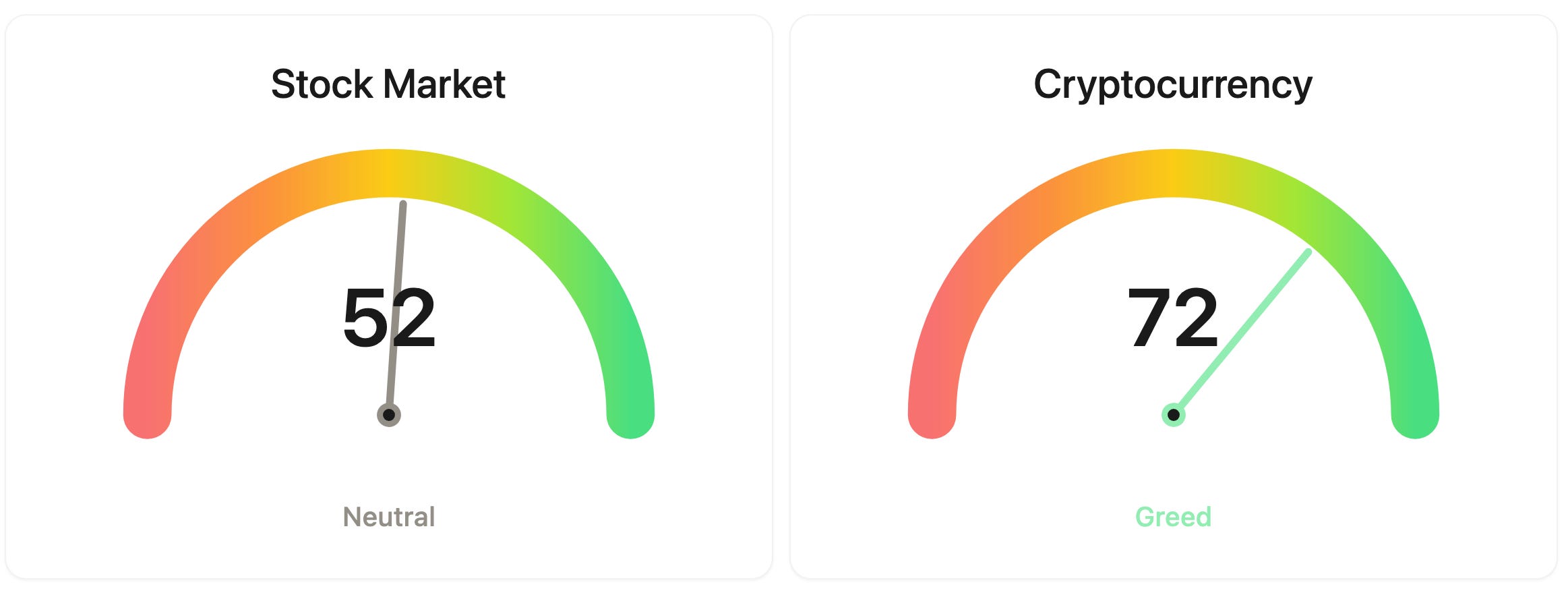
⚖️ Fear & Greed
📉 The Number That Matters
2.6%
Walmart’s US comparable sales grew 2.6% last quarter, its slowest in more than six years and short of the 3.7% analysts expected. Ross Stores reported 10% the same afternoon.
⚔️ Winners vs Losers
Winners
MSTR 0.00%↑ : +9.53% Strategy Inc. rallied with the broader crypto complex as bitcoin broke above $70,000 overnight to its highest level since early June, swinging the company’s 840,447 coin position back to an unrealized gain of roughly $1.4 billion. Strive (ASST, +9.49%) climbed on the same move.
ROST 0.00%↑ : +7.98% Ross Stores surged after second quarter earnings of $2.66 per share crushed the $1.94 consensus on 10% comparable store sales growth and a 13% revenue rise to $6.26 billion, its widest beat in at least two years. Management raised full year EPS guidance to $8.61 to $8.77 and lifted the 2026 store opening plan to 115 locations.
FCX 0.00%↑ : +8.07% Freeport-McMoRan advanced as the metals complex caught a strong bid, with gold pushing above $4,500 an ounce and copper holding near the record $6.77 per pound struck earlier this month on persistent supply tightness. Southern Copper (SCCO, +3.41%) rose on the same tape.
Losers
OSIS 0.00%↑ : -13.60% OSI Systems dropped after fiscal fourth quarter revenue fell 4.1% to $484.1 million against a $529 million consensus and full year guidance came in about 2% light. Record adjusted EPS of $3.78, up 17%, was overshadowed by deferred Security division deliveries and a cautious outlook.
📊 Market Snapshot
Cryptocurrencies:
Bitcoin (BTC): $77,610 (▲ 6.34%)
Ethereum (ETH): $2,386 (▲ 2.58%)
XRP: $1.39 (▲ 9.59%)
Equity Indices (Futures):
S&P 500: 7,687 (▲ 0.32%)
NASDAQ 100: 29,461 (▲ 0.55%)
FTSE 100: 10,757 (▲ 0.26%)
Commodities & Bonds:
10-Year US Treasury Yield: 4.70% (▼ 0.17%)
Oil (WTI): $87 (▲ 0.81%)
Gold: $4,597 (▲ 1.73%)
Silver: $69.93 (▲ 2.76%)
Data as of: UK: 12:23pm BST / US: 7:23am EDT / Asia (Tokyo): 8:23pm JST
✅ 5 Things to Know
🛒 Walmart falls 9% and Ross Stores answers it
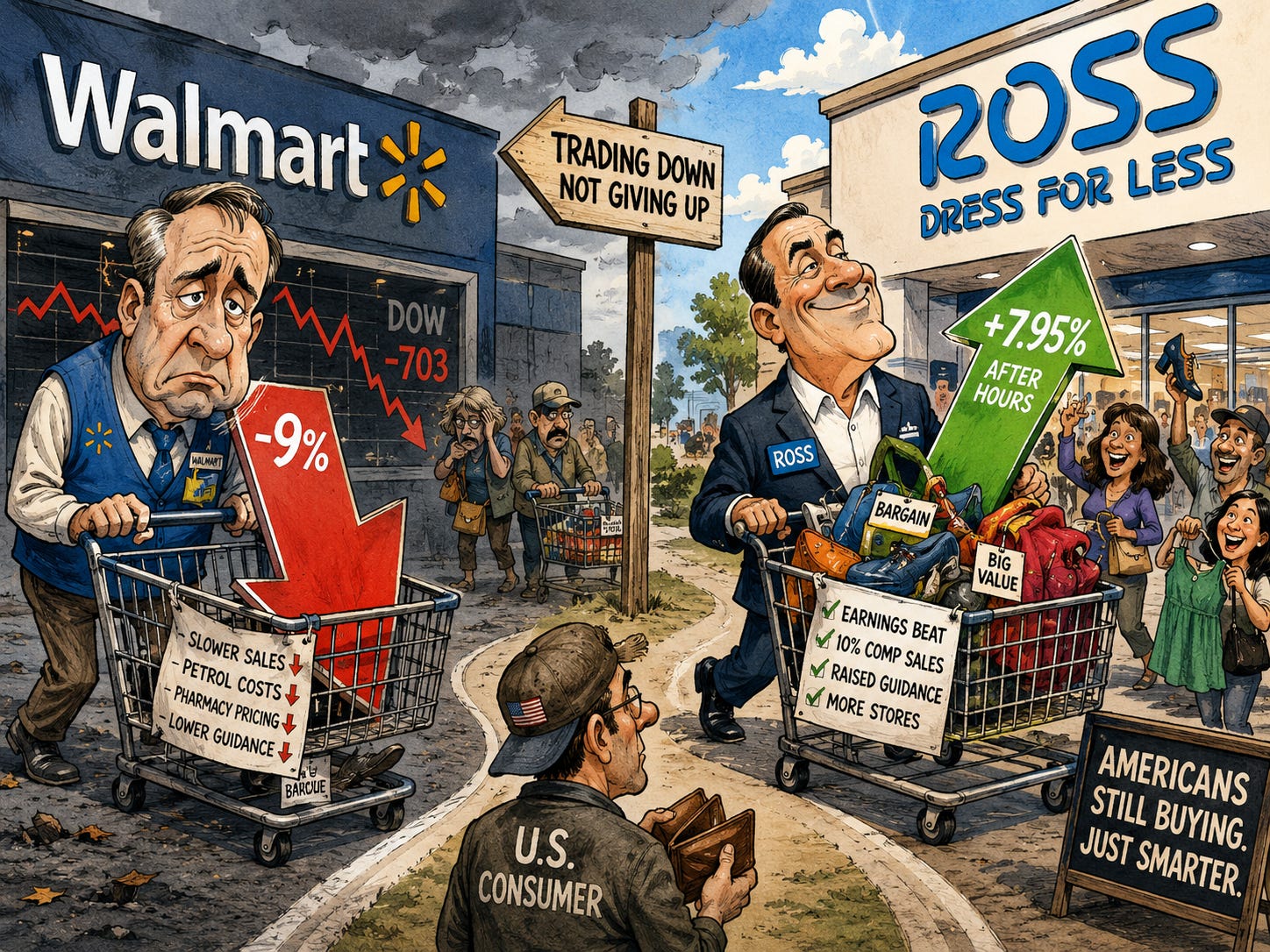
$114.30 on Wednesday. $103.84 on Thursday. Walmart lost about 9% in a single session and dragged the Dow down 703 points with it. The headline quarter was fine: adjusted earnings beat and full-year guidance went up. US comparable sales grew 2.6%, the slowest pace in more than six years and well short of the 3.7% analysts had modelled. Management said shoppers are making trade-offs as petrol costs rise. Third-quarter earnings were guided to 62 to 64 cents against the 68 cents expected. (Yahoo Finance)
Six hours later, Ross Stores told the other side of the same story. Earnings of $2.66 a share against $1.94 expected. Revenue of $6.3 billion against $6.15 billion. Comparable sales up 10% on higher traffic and higher spending, a second consecutive quarter of double-digit growth. The off-price chain raised its full-year earnings guidance to $8.61 to $8.77. Shares had closed down 2.43% before the numbers, then rose 7.95% to $247.20 after hours. (PR Newswire)
People are still buying. They are buying at cheaper shops, and Ross running 10% comps against Walmart’s 2.6% is what trading down looks like in the numbers rather than in the commentary. The next reads come on 27 August, when Dollar General, Dollar Tree and Best Buy all report.
Sensei’s Insight: Walmart is the world’s biggest retailer and it grew US sales slower than inflation, and the reason it gave was petrol. Ross at 10% says the money did not disappear. It moved down the price ladder.
⛽ Oil heads for $94 with sanctions still to land
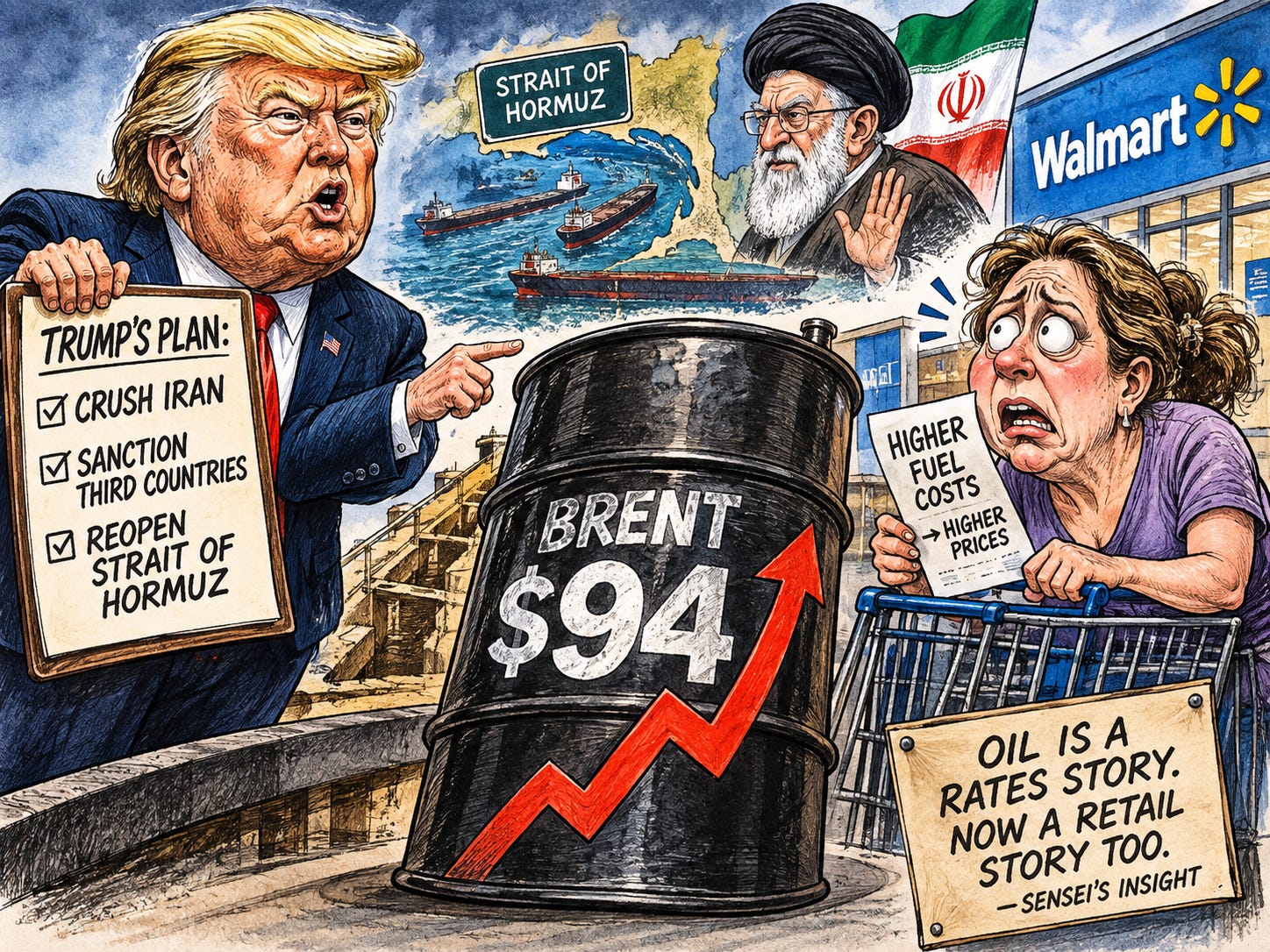
The plan Trump promised on Wednesday still has not been published, and the oil market has already started pricing it. Brent traded near $93.46 on Friday morning, on course for a weekly gain of more than 5% and a second consecutive weekly rise, with West Texas Intermediate around $87. The Truth Social post threatened the “most crushing economic operation ever taken against any country”, with penalties on any nation whose banks, businesses or airports give Tehran a lifeline. (Bloomberg)
Iran has lived under sanctions for most of two decades, which is why the detail matters more than the volume. The campaign extends Operation Economic Fury, running since April, and the new element is secondary pressure on third countries rather than on Iran itself. Trump has also said oil continues to flow through the waterway and that he would be open to talks at some point. Both statements are true and they point opposite ways for the price. (The Washington Post)
The consumer link got sharper this week. Walmart named higher fuel costs as a drag on what its customers could spend, which is the largest retailer in America confirming the transmission from the Gulf to the till.
Sensei’s Insight: I have been saying all week that oil is a rates story. Thursday it became a retail story too. When Walmart blames the pump for its comps, the barrel price stops being a commodity chart and starts being an earnings input for everyone who sells to households.
₿ Bitcoin clears $77,000 and XRP runs to $1.39
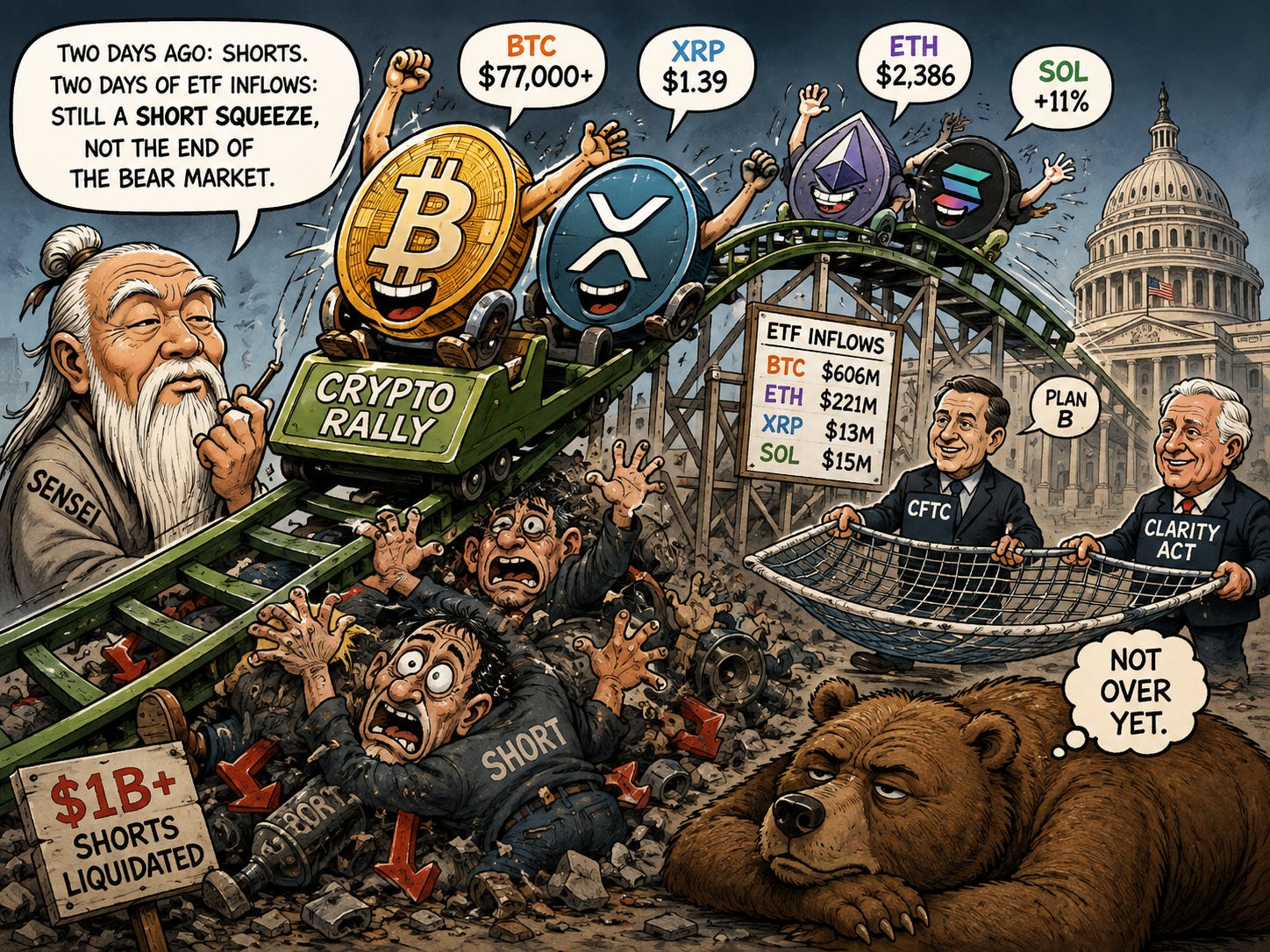
Was Wednesday’s move real buying or shorts being run over? Thursday’s flows argue for buying. US spot bitcoin funds took in $606 million on 20 August, up from $517 million the day before, and every listed crypto fund drew money on the same day. That is a different signature from a one-session liquidation spike. Bitcoin passed $77,000 on Friday for the first time since May, its best week since 2023. (CoinDesk)
XRP has run hardest of the majors. It cleared $1.30 for the first time in months after gaining 18% on Thursday, then added close to 10% again on Friday to trade around $1.39. That is roughly 40% above the 99 cents it printed on 11 August, when a 635-day run above a dollar ended. Ether reached roughly $2,386 and Solana added about 11%. (CryptoPotato)
Leverage is still doing part of the work, with roughly $1 billion of short positions liquidated in the latest 24 hours. Two supports hold this up at once: Treasury yields staying down after the buyback announcement, and Washington keeping the CLARITY Act alive into the 15 September vote. On Thursday, CFTC chairman Michael Selig ordered staff to draft a backup crypto rulebook if that bill stalls. (CoinDesk)
A rulemaking does not need 60 senators, which makes Selig’s fallback the more durable of the two Washington routes.
Sensei’s Insight: Two days ago I said the crypto move was shorts. Two sessions of accelerating ETF inflows changes that a little, and only a little. I still read this as a short squeeze, and I put a very low probability on it being the end of the bear market.
📊 The last big American number before Jackson Hole
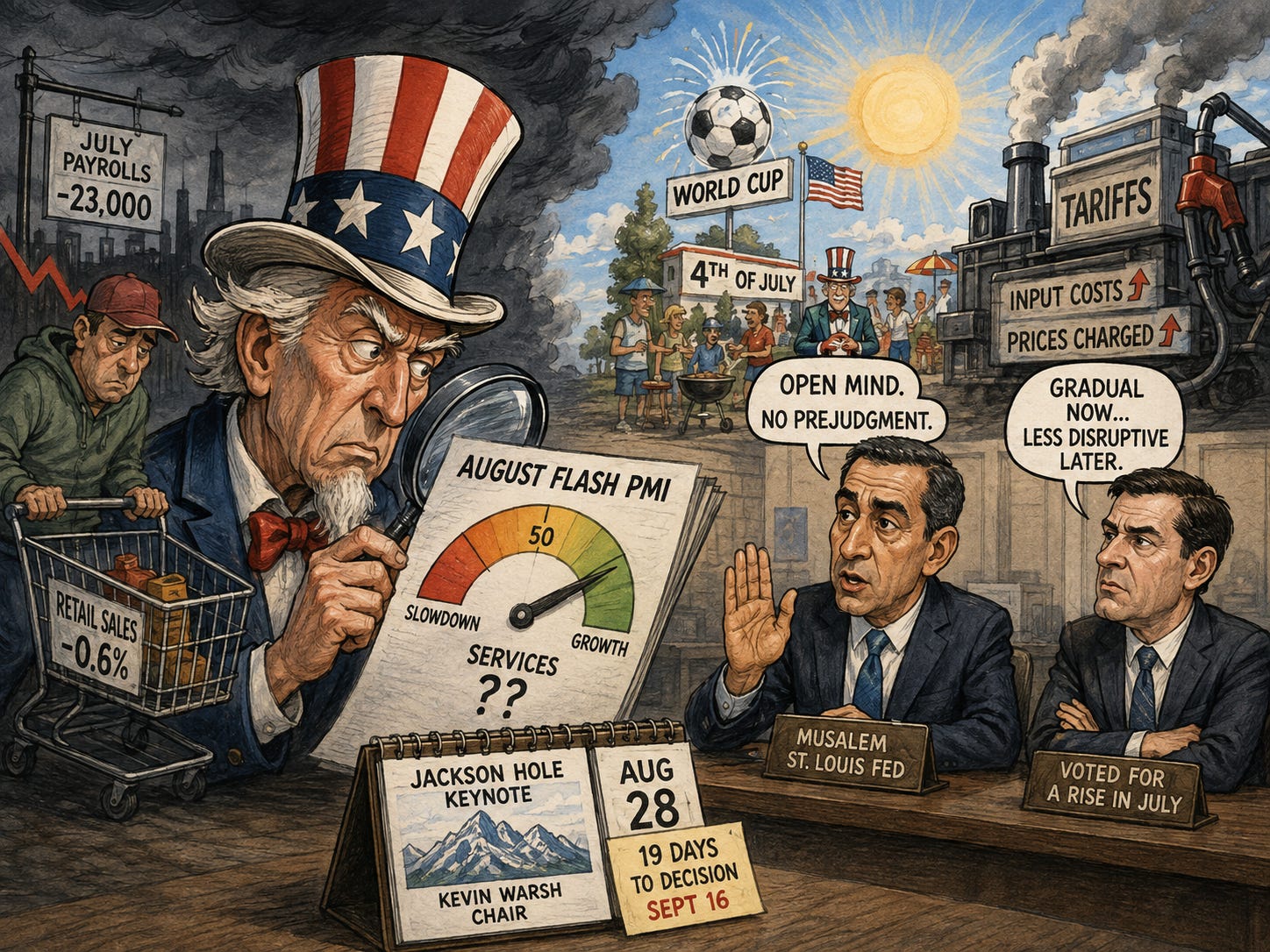
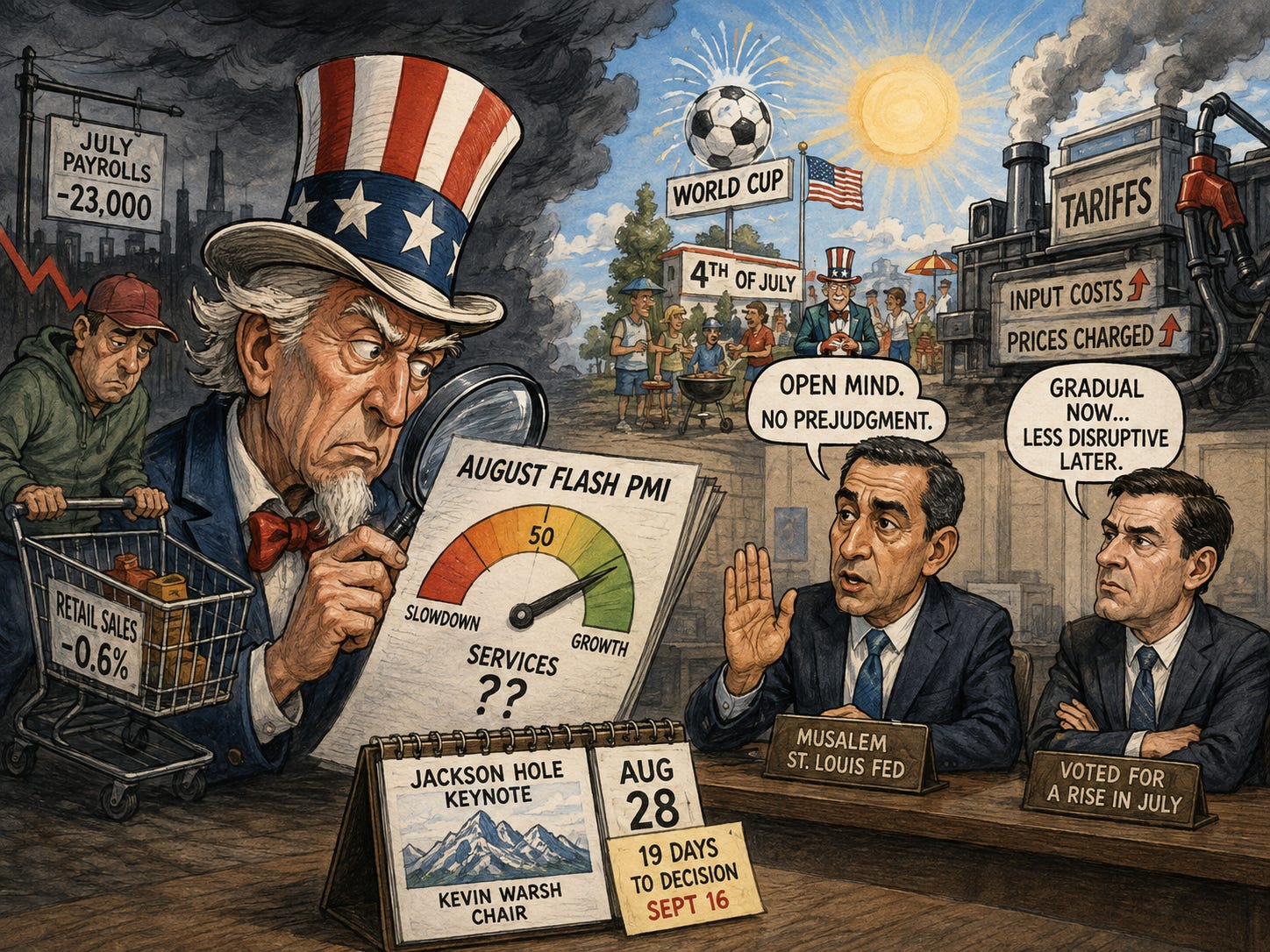
At 2:45pm UK, 9:45am ET, S&P Global publishes its flash reading of the American economy for August. It is the earliest look at the month everyone is actually living in, drawn from purchasing managers who see orders before they reach official statistics. July was strong: the composite index came in at 54.5, its highest since October 2025, and services finished at 54.6, a nine-month high. (Quartz)
Two caveats sit under that. The strongest demand came from consumer-facing services tied to the World Cup and Independence Day, both of which have passed. Input cost inflation hit its highest level since May 2025 on tariffs and energy. Against July payrolls at minus 23,000, retail sales down 0.6% and a Walmart print blaming fuel, today’s survey is where the soft data either confirms the slowdown or refuses to. Kevin Warsh gives his first Jackson Hole keynote as Fed chair next Friday, 28 August, 19 days before the 16 September rate decision.
Alberto Musalem of the St Louis Fed told CNBC on Thursday that he will not prejudge September. He voted for a rise in July, and he repeated that underlying inflation is running between 2.5% and 3% against a 2% target. (Reuters)
Sensei’s Insight: Every number this week looked backwards. This one looks at August. If services holds above 54 while households cut back, the slowdown is a consumer story and the hawks keep their argument. A drop toward 50 changes what Warsh has to say in Wyoming.
🇬🇧 Britain’s shops fell, Britain’s businesses rose
Britain published two readings on itself this morning and they disagreed. Retail sales volumes fell 0.5% in July, the first decline since April, partly reversing a downwardly revised 0.7% rise in June. Core sales excluding fuel dropped 0.9% against forecasts for a 0.5% fall. Online sales values fell 3.9%. The Office for National Statistics pointed to hot weather and thinner discounting, with June’s promotional boost fading. (ONS)
Two and a half hours later the picture flipped. The flash composite index for August rose to 52.5 from 52.2, a four-month high, against a Reuters poll expecting a fall to 51.6. Services climbed to 52.8, a six-month high, and beat every forecast in that poll. Manufacturing cooled to 51.5. Consumer confidence this month reached its best level since August 2024. (Reuters)
One set is July. The other is August. Retail sales measure what was spent in shops last month, and the survey measures what companies say is happening now, which is why the Bank of England is likely to weight the newer one more heavily. UK inflation came in at 2.9% on Wednesday, so the rate-cut case was already thin.
Sensei’s Insight: British households cut back in July and British businesses feel better in August. Both are real. The one that decides the next Bank of England vote is the survey, because it is the more current read, and it points away from a cut.
Stories You Might Have Missed
💉 Moderna gives back a quarter of its record day
Moderna fell 23.5% on Thursday, closing near $131, one day after the 177% gain that gave it the largest single session in its history. No new data arrived to justify the reversal, and roughly $18 billion of market value came off. The Phase 3 melanoma result stands: its personalised mRNA vaccine given alongside Merck’s Keytruda extended the time before high-risk melanoma returned. What changed was the price attached to it. The company reported a net loss of $782 million for the second quarter, so holders were balancing an oncology pipeline against present-day losses. Merck and BioNTech also gave back part of Wednesday’s gains. (Forbes)
🇯🇵 Japan’s inflation reaches 2.0%
Japanese consumer prices rose 2.0% in the year to July, up from 1.7% in June and a third consecutive monthly increase. Core inflation excluding fresh food came in at 1.8%, and the measure stripping out fresh food and energy rose to 1.9% from 1.7%. Businesses are passing on higher energy and raw material costs, though government fuel subsidies are still absorbing part of the oil move. Core inflation has now sat below the Bank of Japan’s 2% target for a seventh straight month. A firmer inflation run alongside July exports up 23.2% strengthens the argument for the next rate rise. (The Japan Times)
🇪🇺 Eurozone factories hit a four-and-a-half year high
The flash eurozone composite index rose to 52.1 in August from 52.0, a nine-month high, with manufacturing output at 53.4 from 52.9, the strongest in 54 months. Services were unchanged at 51.7. New orders grew for a second month and at the fastest pace in 40 months, and new export orders increased for the first time in four and a half years, ending a run of falling overseas demand that has dogged European industry since early 2022. A weaker dollar is part of that, since the greenback sits at a three-month low after the Treasury buyback announcement. (ADVFN)
🚜 Deere posts its first profit rise in three years
Deere reported third-quarter net income of $1.379 billion and earnings of $5.10 a share, up from $4.75 a year earlier, its first year-on-year profit increase in roughly three years. Total net sales and revenues rose 5% to $12.61 billion. Construction and forestry carried it: segment sales climbed 18% to $3.62 billion and operating profit jumped 84% to $436 million. Large farm machinery stayed weak. A $110 million tariff refund helped the quarter, making Deere the third company this week to lean on one. Deere raised its full-year net income forecast to between $4.75 billion and $5 billion, and the shares rose 6.94% to $620.94. (RTÉ)