

This content is for informational and educational purposes only and does not constitute financial advice. Always do your own research. Not financial advice (NFA).
👀 Today’s Stories at a Glance
🛢️ Iran Uranium Demand Blocks Oil Deal: New Supreme Leader orders enriched stockpile stays inside Iran, keeping war premium pinned into Brent.
💸 $149 Billion Tariff Refund Looms: Supreme Court ruling forces Washington to return import duties, handing retailers and automakers one-time cash.
💻 Workday Beat Cheers Software Bulls: Subscription backlog growing faster than revenue gives Salesforce and ServiceNow a cleaner read into next week.
🔧 Amkor Lands AMD, Stock Still Slips: AI packaging deal expands Arizona customer list, but soft 2028 revenue target undercuts the win.
⛏️ Rare-Earth Stocks Ride Pentagon Cash: MP Materials and peers rally as Deal Team Six deploys equity stakes, though conflict questions mount.
⚖️ Meta Settles First School Mental-Health Suit: Kentucky bellwether terms undisclosed, with over 1,500 similar cases from districts and states still pending.
🚀 Lockheed Doubles Alabama Missile Output: New 87,000 square-foot plant lifts THAAD and Patriot production as Washington underwrites factory build-out.
🚀 SpaceX Files for Record IPO: Filing targets $1.75 to $2 trillion valuation at roughly 100 times sales, with Nasdaq-100 fast entry looming.
🧠 One Big Thing
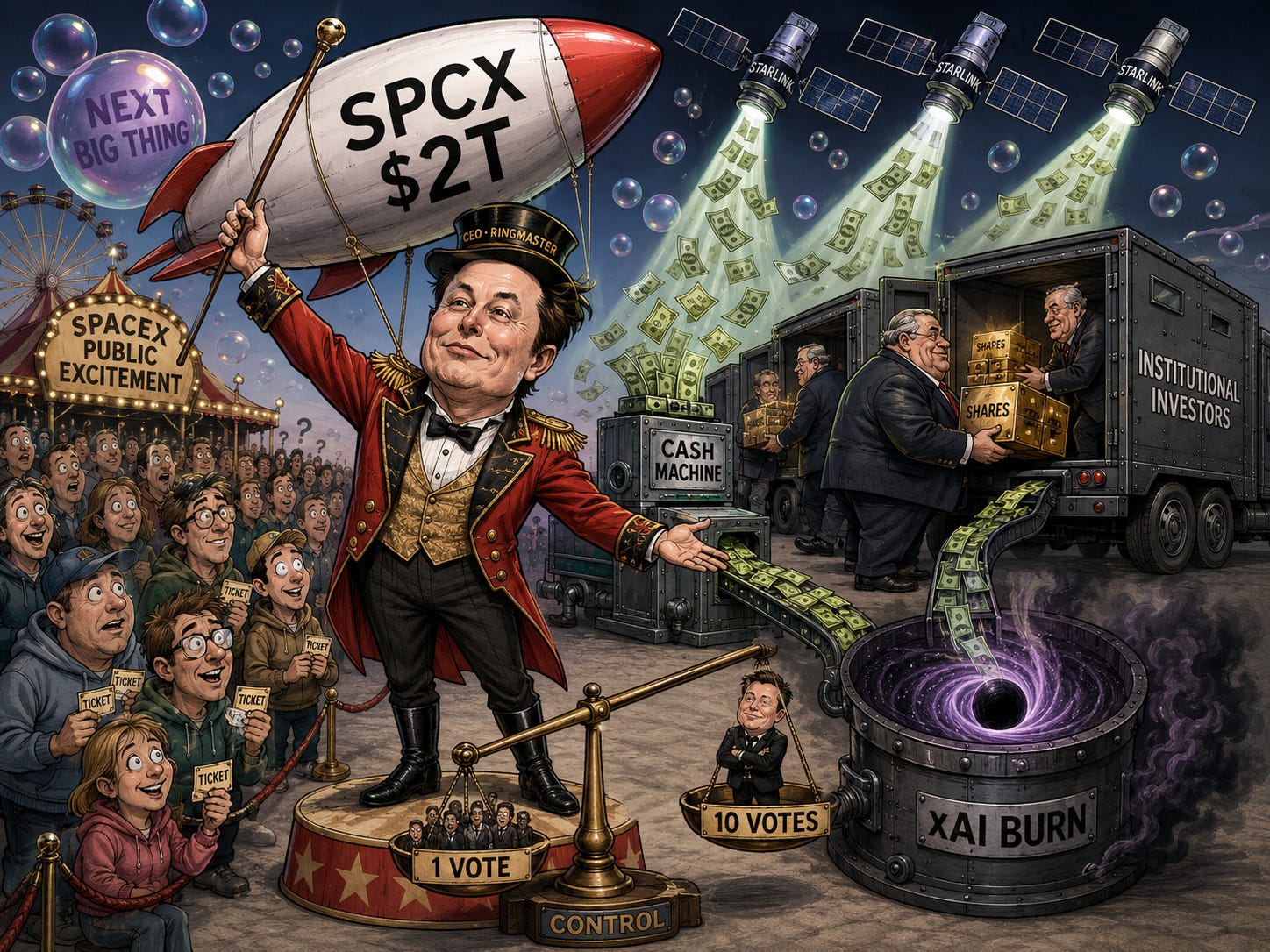
The biggest story today isn’t in the usual five. SpaceX filed its S-1, targeting a $1.75 to $2 trillion valuation, a raise of up to $75 billion, and a Nasdaq debut as early as 12 June. That is roughly 100 times sales on a company losing $4 billion a quarter, with Musk holding 85.1% of voting power and mandatory Nasdaq-100 inclusion forcing index buyers in within 15 trading days.
Scroll down. Today’s deep dive has everything retail needs before this prices: the valuation math, the xAI problem, the Tesla read-through, the lockup calendar, and how the 2025 crypto IPO cohort may rhyme. Read it before you decide.
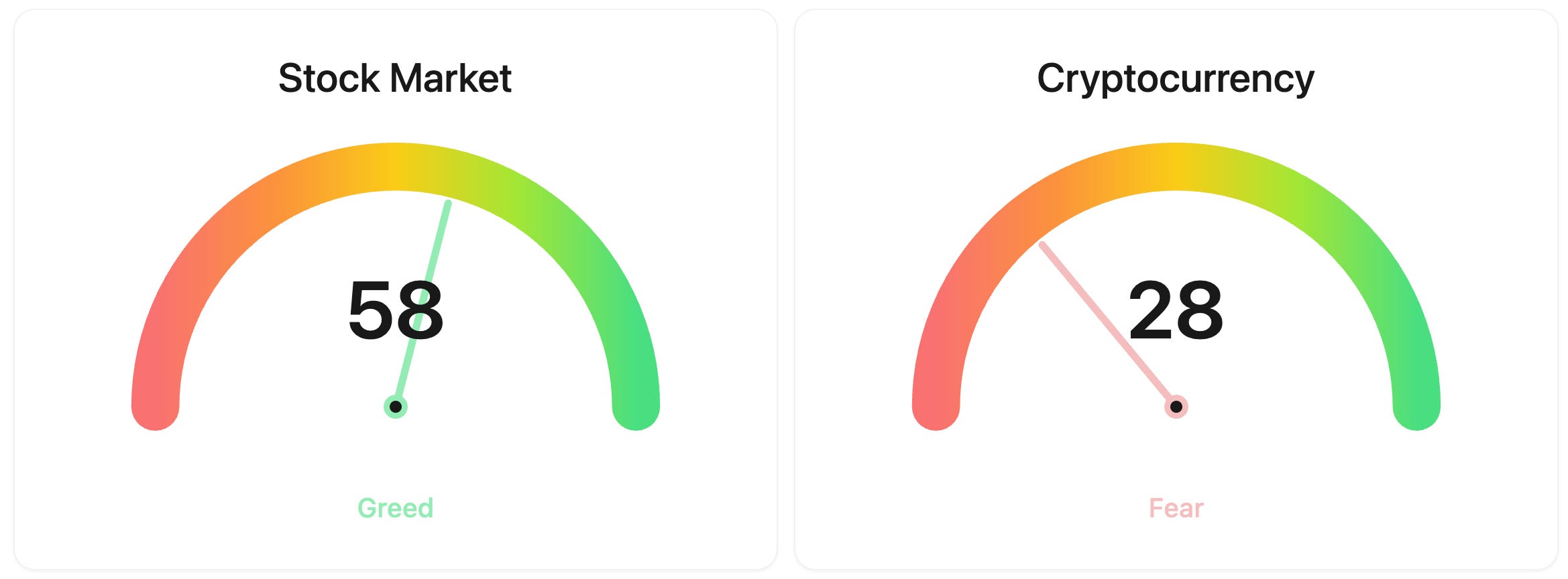
⚖️ Fear & Greed
📉 The Number That Matters
100 X
SpaceX is being priced at roughly 100 times sales at the $2 trillion valuation target, against Apple near 11 times and Nvidia near 25 times. That 100 times multiple sits on a company that lost $4.9 billion in 2025 and $4.3 billion in Q1 2026 alone.
⚔️ Winners vs Losers
Winners
ROST 0.00%↑: Ross Stores Inc. rallied after reporting Q1 EPS of $2.02 versus the $1.70 consensus on revenue of $6.01 billion, with comparable store sales up a robust 17% and full-year guidance raised meaningfully.
BE 0.00%↑: Bloom Energy Corporation continued its rally after Wednesday’s announcement of a $2.6 billion, 10-year fuel cell capacity agreement with Nebius Group to power AI data center infrastructure.
MRK 0.00%↑: Merck & Company Inc. firmed after Monday’s announcement that the Phase 3 TroFuse-005 trial of sac-TMT met both overall survival and progression-free survival endpoints in advanced endometrial cancer, ahead of further oncology data presentations at ASCO starting May 29.
VRT 0.00%↑: Vertiv Holdings LLC extended gains after its May 19-20 investor day, where management unveiled 2030 targets including 20-22% organic revenue CAGR and over $17 in EPS, triggering price target raises from RBC to $435, Citi to $414, TD Cowen to $387 and Mizuho to $380.
Losers
FUTU 0.00%↑: Futu Holdings Limited collapsed after China’s Securities Regulatory Commission opened formal administrative penalty cases against the firm for operating brokerage services in mainland China without a license, with regulators planning to confiscate all “illegal gains” from both domestic and overseas entities.
TIGR 0.00%↑: UP Fintech Holding Limited (Tiger Brokers) was caught in the same CSRC enforcement action targeting unlicensed cross-border brokerages, with the regulator pledging severe penalties and a two-year grace period for existing investors to wind down positions.
NGEN 0.00%↑: NervGen Pharma Corp. tumbled after pricing a $60 million underwritten public offering at $2.50 per share, a steep discount to Thursday’s close, with proceeds earmarked for the Phase 3 RESTORE trial of NVG-291 in chronic tetraplegia.
BABA 0.00%↑: Alibaba Group Holding Limited slid in sympathy with the China ADR selloff, with its Hong Kong shares closing down roughly 4.5% as investors continued digesting last week’s near-collapse in quarterly adjusted profit tied to its quick-commerce price war.
📊 Market Snapshot
Cryptocurrencies:
Bitcoin (BTC): $77,351 (▼ -0.24%)
Ethereum (ETH): $2,128 (▼ -0.15%)
XRP: $1.36 (▼ -0.92%)
Equity Indices (Futures):
S&P 500: 7,464 (▲ 0.24%)
NASDAQ 100: 29,509 (▲ 0.21%)
FTSE 100: £10,466 (▼ -0.27%)
Commodities & Bonds:
10-Year US Treasury Yield: 4.48% (▼ -0.52%)
Oil (WTI): $98 (▼ -0.47%)
Gold: $4,521 (▼ -0.48%)
Silver: $75.78 (▼ -1.17%)
Data as of: UK (BST) 1:00pm BST / US (EDT): 8:00am EDT / Asia (Tokyo): 9:00pm
✅ 5 Things to Know
🛢️ Iran’s Uranium Red Line Keeps Oil’s War Premium Alive
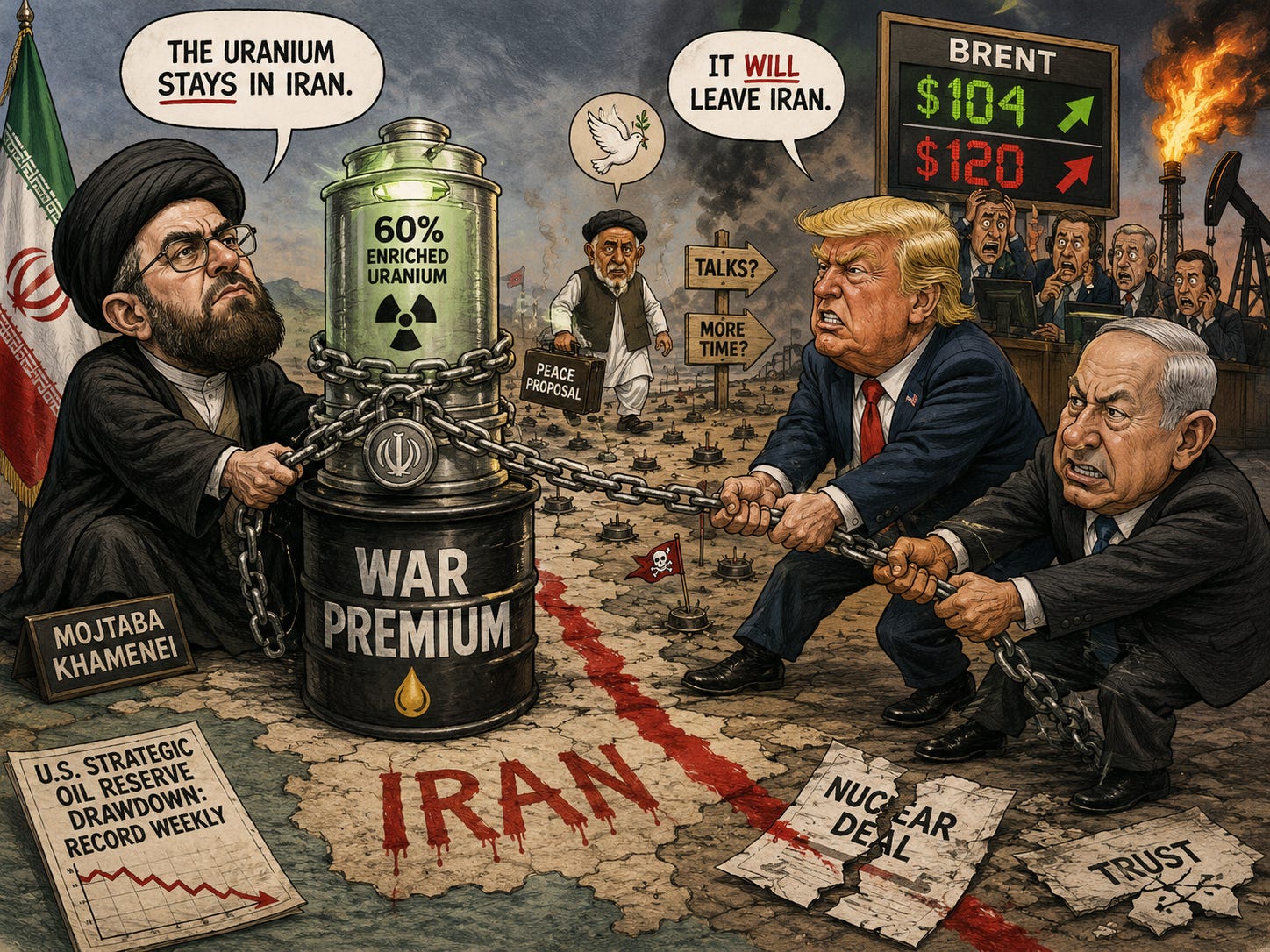
Iran’s new Supreme Leader, Mojtaba Khamenei, has ordered that the country’s stockpile of uranium enriched to 60% must stay inside Iran, two senior Iranian officials said yesterday, hardening Tehran’s position on a central US demand in talks to end the US-Israeli war. The order collides directly with a commitment Trump made to Israel that the material, which sits only a short technical step from the roughly 90% purity needed for a weapon, would be shipped out. Both sides have narrowed some gaps but remain split on the stockpile and Iran’s demand to keep enriching. (Reuters)
For retail investors this is the single biggest swing factor for oil, and the standoff is keeping a war premium in the price. Brent crude traded near $104.52 this morning, up about 1.9% and still roughly 50% above pre-war levels, after whipsawing all week on conflicting signals. Secretary of State Marco Rubio struck a more hopeful tone, saying Pakistani mediators will travel to Iran while Tehran reviews Washington’s latest proposal, and Trump said he could wait a few days for the right answers. A confirmed deal could knock $10 to $20 off Brent fast; a collapse points back toward the March peak near $120. (CNBC)
Sensei’s Insight: The whole deal hangs on one question: does the uranium leave Iran. Trump promised Netanyahu it will; Khamenei just ordered it won’t. Until that gap closes, the record weekly drawdown from the US emergency oil reserve says Washington is already bracing for a longer fight.
💸 $149 Billion Tariff Refund Hands Importers a Windfall
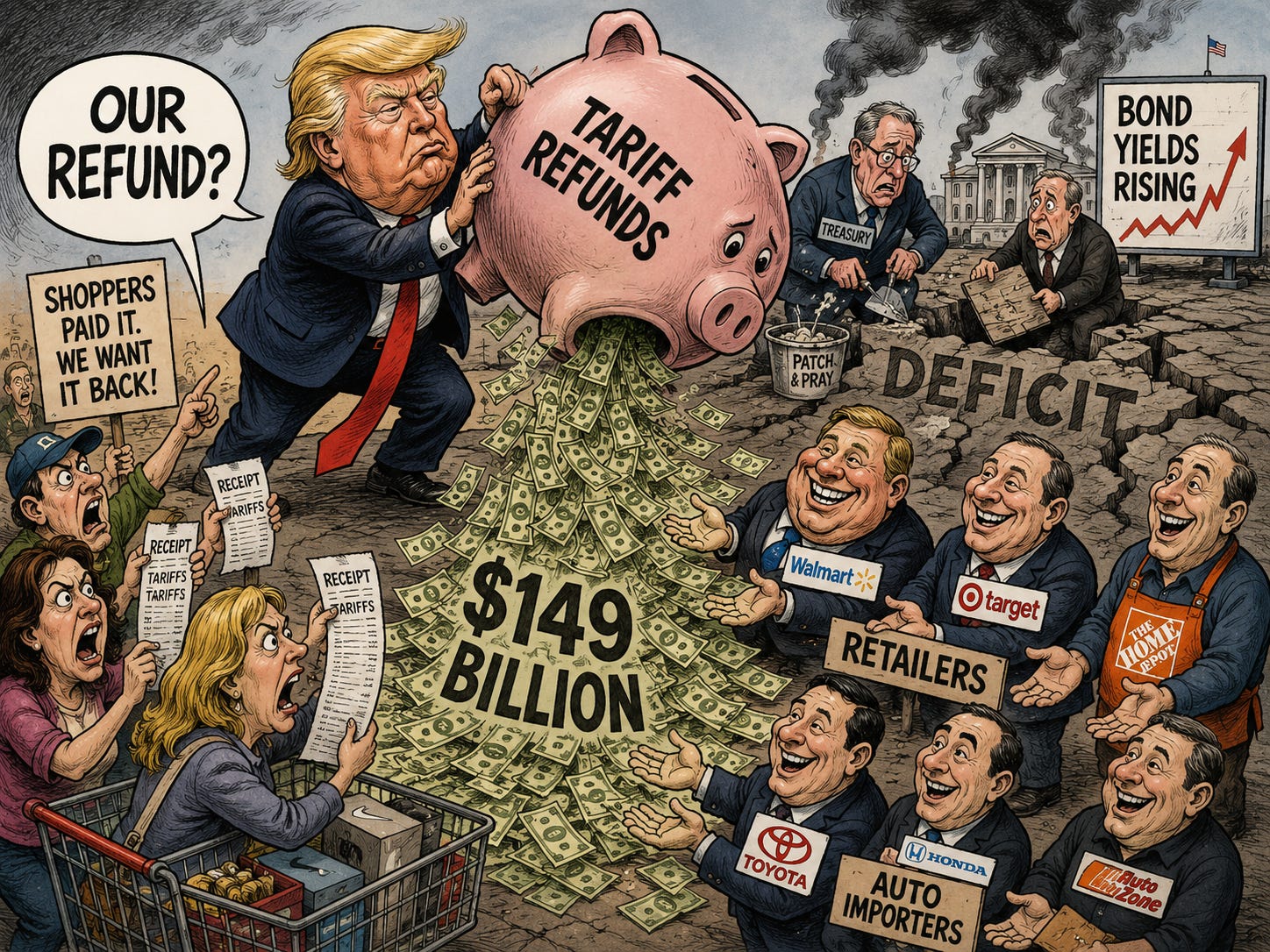
Trump said the US will likely have to refund about $149 billion in tariff revenue, comments from a Fortune interview that ran through yesterday’s news cycle. The refunds stem from a 6-to-3 Supreme Court ruling in February that struck down roughly half of the “Liberation Day” tariffs he imposed last year under the International Emergency Economic Powers Act, a 1977 law the court said did not authorize them. Tariffs are paid by the US company importing the goods, not the foreign exporter, so those importers can now claim the money back. The administration is already paying out $35.5 billion. (Fortune)
This cuts two ways for the market. It worsens an already-strained federal deficit, with roughly $300 billion in annual tariff revenue now gone and a one-time bill on top, which has weakened the dollar and pushed long-term bond yields higher. It also drops cash onto the books of import-heavy companies that absorbed the tariff costs: big-box retailers like Walmart, Target and Home Depot, parts seller AutoZone, and auto importers such as Toyota and Honda, all of which can file claims. Expect the payouts to land as one-time gains in coming quarters, even as the administration rebuilds tariffs under other legal authorities. (Reuters)
Sensei’s Insight: The refunds land as one-time cash on importers’ books, enough to flatter a quarter for retailers and auto sellers. The next fight is already here: shoppers suing Amazon, Costco and Nike, arguing they paid the tariffs at the checkout and should get the money back.
💻 Workday Beat Lifts Hopes for the Software Group
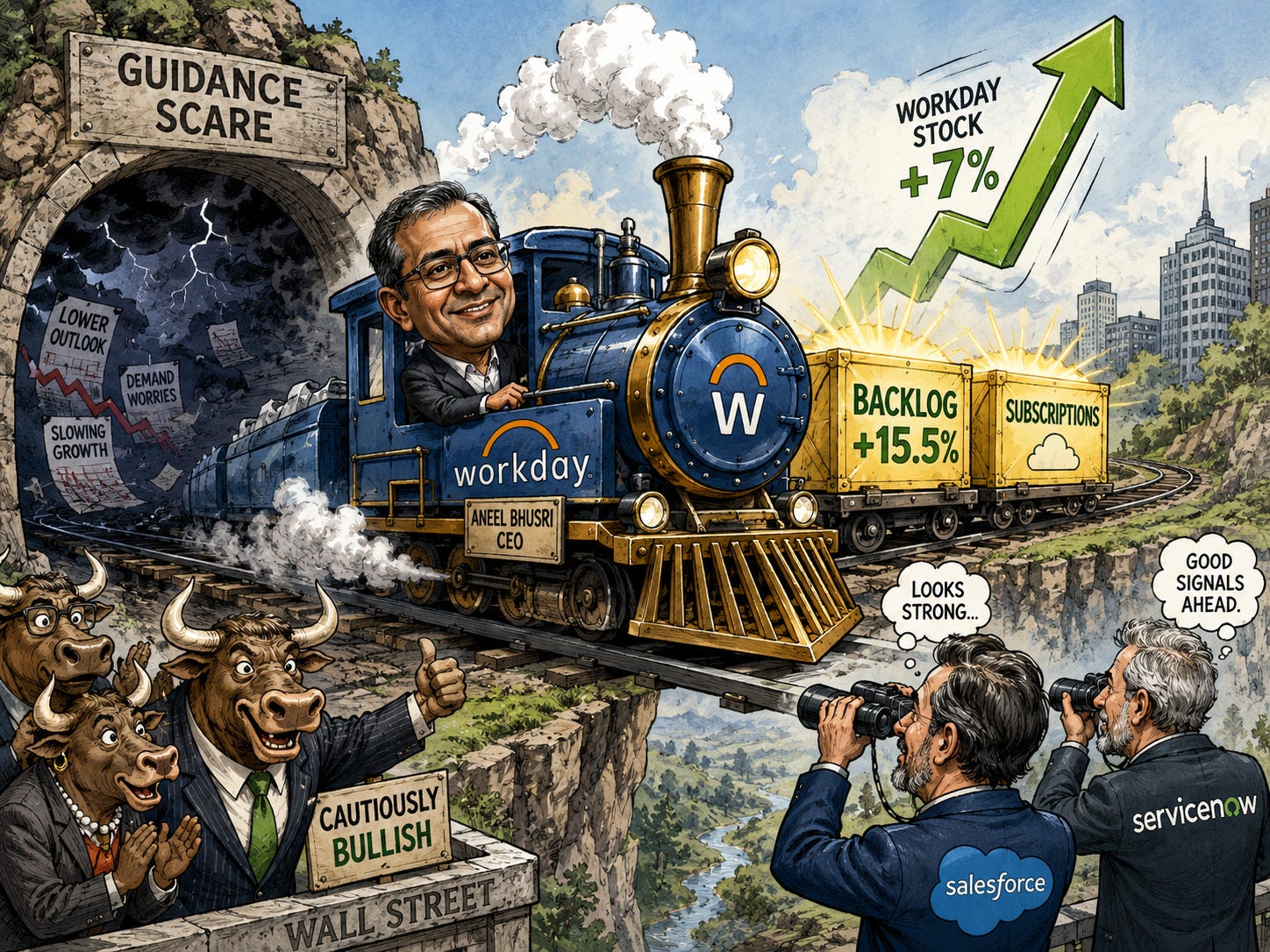
Workday beat Wall Street after the close yesterday, sending the stock up about 7% in late trading. Revenue rose 13.5% from a year earlier to $2.54 billion, ahead of the $2.52 billion analysts expected, while subscription revenue, the recurring sales software investors watch most closely, climbed 14.3% to $2.35 billion. Adjusted earnings of $2.66 a share also cleared the $2.52 consensus. It was the first full quarter under returning co-founder and chief executive Aneel Bhusri, who took back the top job earlier this year, and the company held its full-year subscription forecast. (Reuters)
Workday matters beyond its own print because it is one of the first big enterprise-software names to report, and it sells the human-resources and finance systems companies rarely rip out. The cleaner signal sits in the backlog: subscription revenue already booked for the next 12 months reached $8.81 billion, up 15.5% and growing faster than current sales. That points to a pipeline still building, not stalling. The read-through lands just before Salesforce reports next week, and supports peers like ServiceNow heading into a season that opened with high expectations.
Sensei’s Insight: Backlog growing faster than current revenue is the number that matters here: demand booked for future quarters is still climbing. That is the encouraging sign for Salesforce’s report next week and the rest of enterprise software, after a guidance scare earlier this year.
🔧 Amkor Wins AMD, but Soft Forecast Sinks Shares
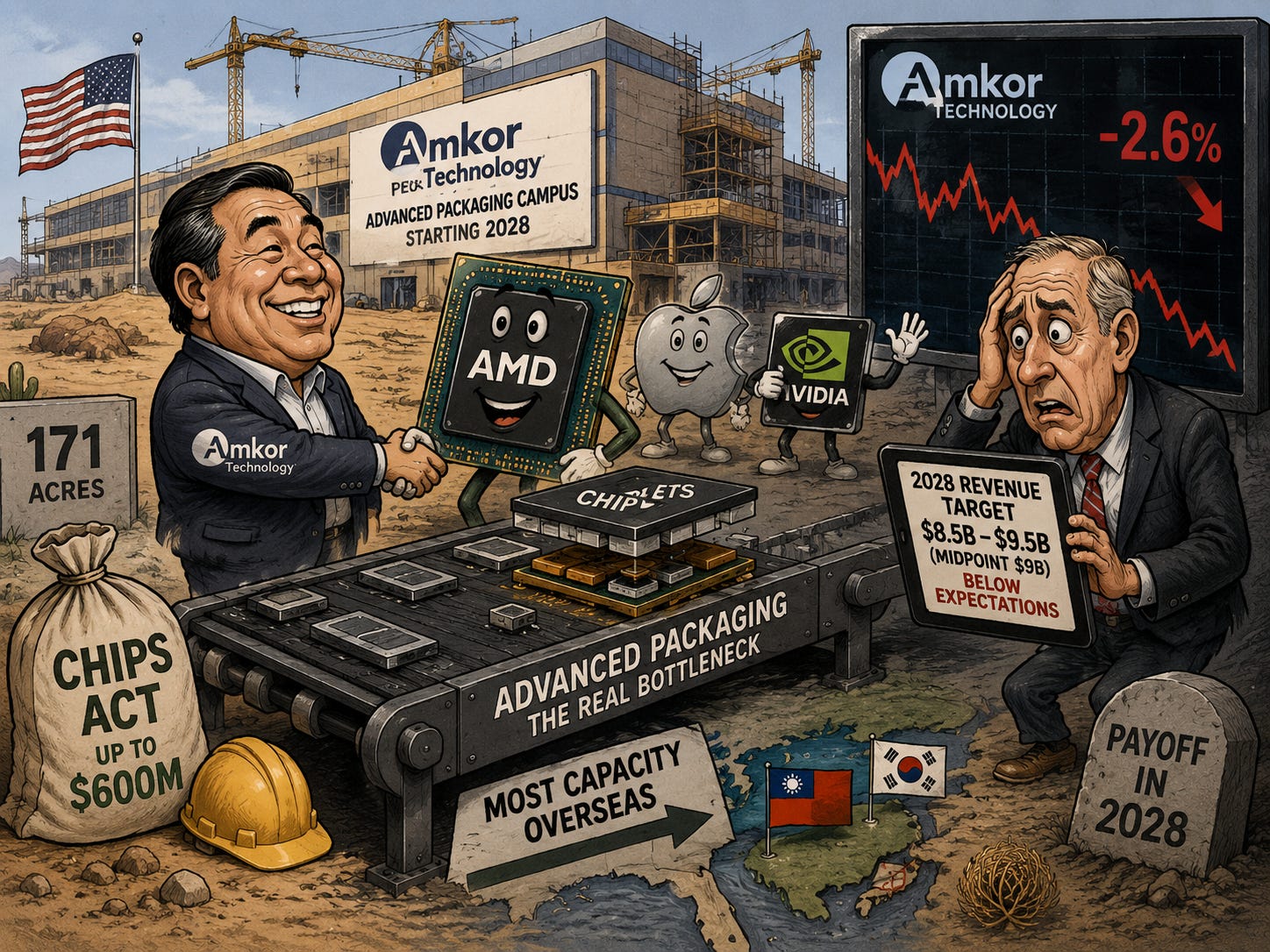
Amkor Technology said it is working with AMD on advanced chip packaging at its $7 billion campus in Peoria, Arizona, a disclosure that landed at the company’s investor day yesterday and added AMD to a customer list that already included Apple and Nvidia. Days earlier Amkor bought another 67 acres next door, taking the site to 171 acres, with production due to start in 2028. The stock still fell 2.6%, because Amkor’s new revenue target for 2028 of $8.5 billion to $9.5 billion, a $9 billion midpoint, came in just below the roughly $9.1 billion analysts wanted. (Reuters)
The strategic point is bigger than one customer. Advanced packaging, the step that bonds separate “chiplets” into a single high-performance processor, has become the real bottleneck in making AI chips, and almost all of that capacity sits in Taiwan and South Korea. Amkor’s plant is set to be the first high-volume advanced-packaging site in the US, filling a gap the new TSMC fabs in Arizona cannot close on their own, backed by up to $600 million in CHIPS Act funding. The complication for traders is timing: that revenue does not arrive until 2028, which is why a soft long-range forecast outweighed the AMD news.
Sensei’s Insight: Packaging, not wafer fabrication, now decides how many AI chips reach the market, and the US has had almost none of it. Landing AMD alongside Apple and Nvidia shows the demand to fill a domestic plant is real. The payoff just sits out in 2028.
⛏️ Federal Cash Lifts Rare-Earth Stocks, but Conflict Questions Grow
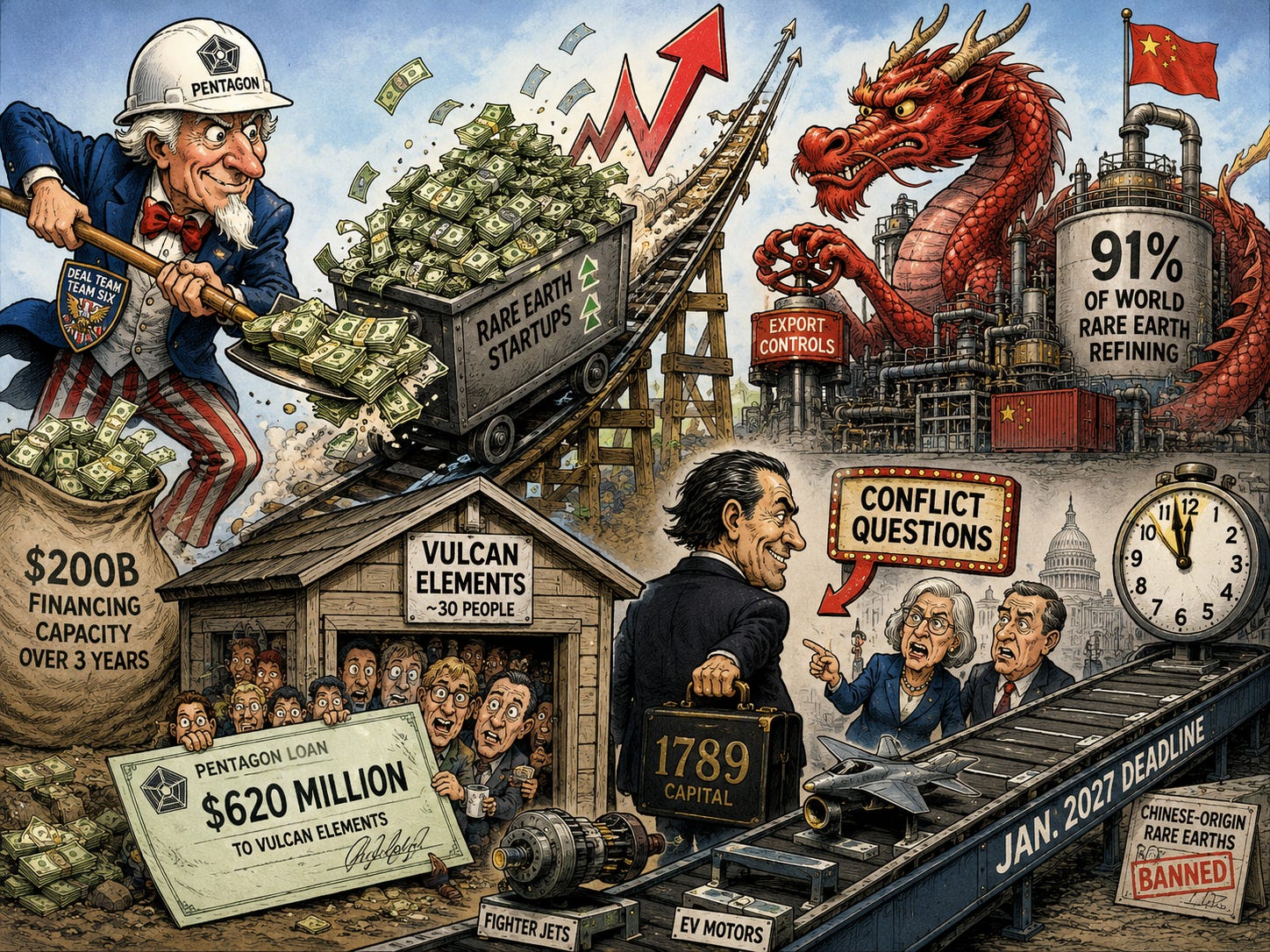
Federal money is pouring into rare-earth companies, and the stocks moved with it yesterday, as MP Materials, USA Rare Earth and Critical Metals all rose. The Pentagon unit driving the push, nicknamed “Deal Team Six,” has about $200 billion in financing capacity over three years and has already taken equity stakes in MP Materials ($400 million), USA Rare Earth (part of a $1.6 billion package) and others. Rare earths are 17 elements used to make the high-strength magnets inside fighter jets, electric-vehicle motors and missiles, and China refines roughly 91% of the world’s supply. (Bloomberg)
The reason this now carries political risk is the program’s largest loan: $620 million to Vulcan Elements, a roughly 30-person North Carolina startup whose backers include 1789 Capital, a venture firm where Donald Trump Jr. is a named partner. That has drawn conflict-of-interest questions and scrutiny from lawmakers in both parties over the legal basis for the government taking equity stakes at all. China, meanwhile, tightened enforcement of its export controls this week. The hard part for investors is the clock: a Pentagon rule taking effect in January 2027 bans Chinese-origin rare earths from US weapons, but domestic output will not scale meaningfully until late this decade. (Reuters)
Sensei’s Insight: China still refines about 90% of the world’s rare earths, and US production will not close that gap until late this decade, well past the Pentagon’s January 2027 deadline to purge Chinese material from weapons. For now, the money is moving far faster than the mines.
Stories You Might Have Missed
⚖️ Meta Settles First School Mental-Health Case
Meta settled the first US case in which a school district sought to recover the cost of dealing with student mental-health problems tied to social media, according to a court filing yesterday. Breathitt County, Kentucky, a 1,600-student district, was a bellwether whose outcome tends to set the value for similar claims; terms were not disclosed, and the trial had been set for next month. More than 1,500 suits from schools, cities and states are pending. By settling rather than testing a jury, Meta appears keen to avoid creating a precedent that larger districts, some seeking billions, could follow. (Reuters)
🚀 Lockheed Breaks Ground on Alabama Missile Plant
Lockheed Martin broke ground yesterday on an 87,000-square-foot munitions plant in Troy, Alabama, built to roughly double its missile output there for THAAD interceptors, the Terminal High Altitude Area Defense system, and the new Next Generation Interceptor. It is part of framework deals with the Pentagon meant to lift THAAD production from 96 to 400 interceptors a year and Patriot PAC-3 missiles from about 600 to 2,000. The signal for investors is that Washington is now underwriting the factory build-out itself, not just ordering more weapons, with defense stocks already trading at multi-year highs. (Reuters)
🔗 Connect with Us
Stay plugged in across platforms:
Sensei on X: sensei_live_
Martyn Lucas on X: MartynInvestor
Vaz on X: eVTOLHUB
📺 YouTube Channel (Live & Replays): Martyn Lucas Investor

The SpaceX IPO: Everything Retail Investors Need to Know
SpaceX is going public, and it is set to be the largest stock market debut in history. Here is what is happening, what analysts are saying, and what institutional desks already know that most retail traders do not.
The Basics
SpaceX filed its S-1 with the SEC on 20 May 2026. The plan: list on Nasdaq under the ticker SPCX, run the roadshow around 4 June, price the offering around 11 June, and begin trading as early as 12 June. Targeted valuation is $1.75 trillion to $2 trillion, with a raise of up to $75 billion (Morningstar). Goldman Sachs and Morgan Stanley are the lead underwriters, with 23 banks involved.
The Scale
If priced at $75 billion, SpaceX would more than double the previous IPO record (Saudi Aramco, $29.4 billion in 2019) and dwarf Alibaba’s $25 billion in 2014. At a $2 trillion valuation, it would list at roughly what Aramco is worth today while generating under 15% of Aramco’s revenue, immediately becoming the eighth-largest public company in the world, ahead of Tesla.
The Business
SpaceX operates three segments: Connectivity (Starlink), Space (rockets, Dragon, Starship, launch), and AI (xAI, folded in via an all-stock merger in February 2026). Total revenue was $18.7 billion in 2025, up 33% year over year. The company lost $4.9 billion that year, swinging from a $791 million profit in 2024. Q1 2026 was worse: a $4.3 billion loss on $4.7 billion of revenue (Fortune). At $2 trillion, that prices SpaceX at roughly 100 times sales. Apple trades around 11 times revenue. Nvidia trades around 25 times.