This content is for informational and educational purposes only and does not constitute financial advice. Always do your own research. Not financial advice (NFA).
👀 Today’s Stories at a Glance
🛢️ Hormuz sealed, Brent tops $107: Navy told to strike mine-layers as a third US carrier arrives and the strait stays sealed.
💾 Intel clears its 2000 high: First-quarter revenue of $13.58 billion finally lifts shares above the $75.81 dot-com peak.
📉 Meta cuts 10% of workforce: Roughly 8,000 roles go on May 20 as Zuckerberg shifts spend toward artificial intelligence pods.
🏢 Microsoft opens first-ever buyouts: Rule of 70 targets long-tenured staff days before Microsoft’s fiscal third-quarter earnings print.
🌙 Nasdaq readies near-24-hour trading: New data feeds and products prepare for the 23-hour-a-day session targeting early third quarter.
📈 Texas Instruments’ biggest day: Shares jumped roughly 19%, the largest single-day move since 2000, on data centre strength.
🤖 OpenAI ships GPT-5.5: Seven-week cadence after GPT-5.4 signals an accelerating model cycle across frontier artificial intelligence labs.
🎫 Gold Card has one approval: Five months in, exactly one $1 million visa has been granted despite launch hype.
🧠 One Big Thing
Intel reported first-quarter adjusted earnings of 29 cents per share against a penny consensus, with revenue of $13.58 billion versus the $12.42 billion forecast. Shares jumped roughly 20% after-hours and finally cleared the $75.81 dot-com peak from 2000, a quarter-century wait. Data Center and artificial intelligence revenue grew 22% to $5.05 billion as inference workloads pulled spend back toward central processing units (CPUs) and advanced packaging. The foundry margin loss narrowed as the 18A process node moved toward commercial ramp. Second-quarter guidance of up to $14.8 billion cleared consensus. The rerate could depend on 18A yields holding through the next print.
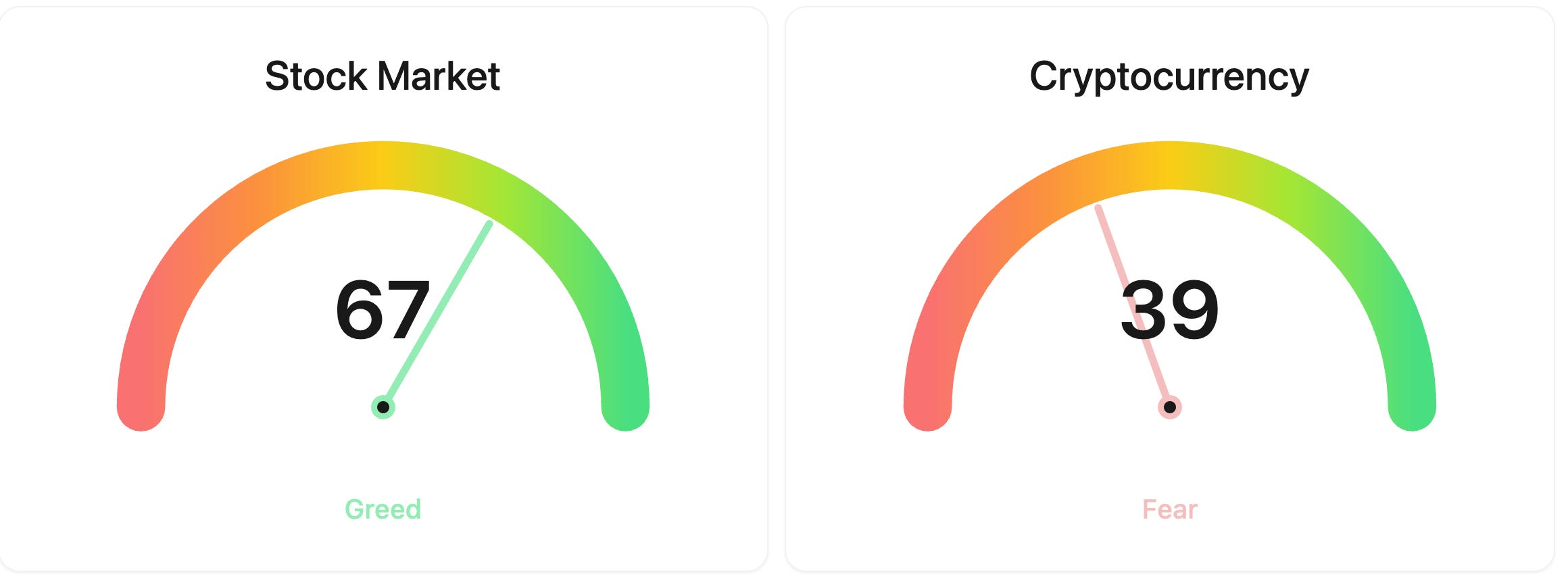
⚖️ Fear & Greed
📉 The Number That Matters
17 SESSIONS
The iShares Semiconductor exchange-traded fund (ETF) has risen for 17 consecutive sessions, up 23% in a month. That 17-session streak, paired with Intel's 20% surge and Texas Instruments' best day since 2000, signals a chip melt-up.
⚔️ Winners vs Losers
Winners
MXL 0.00%↑: MaxLinear, Inc. soared after reporting Q1 adjusted EPS of $0.22 versus $0.18 expected and issuing Q2 revenue guidance of $160-170 million, well above the $137 million consensus, as its optical data center business ramped with hyperscale AI customers.
INTC 0.00%↑: Intel Corporation rocketed higher after a blowout Q1 with adjusted EPS of $0.29 crushing the $0.01 consensus on revenue of $13.58 billion, paired with Q2 guidance of $13.8-14.8 billion that blew past the $13.03 billion estimate on strong data center demand.
PDFS 0.00%↑: PDF Solutions, Inc. jumped in sympathy with Intel’s blowout print, as the semiconductor data analytics firm is a longstanding Intel Foundry ecosystem partner tied to 18A and 14A node ramps.
WKC 0.00%↑: World Kinect Corporation surged after Q1 adjusted EPS of $0.75 more than doubled the $0.31 consensus on a marine segment surge, prompting management to raise full-year adjusted EPS guidance to $2.65-$2.85 from $2.20-$2.40.
AMD 0.00%↑: Advanced Micro Devices, Inc. caught a strong sympathy bid from Intel’s blowout quarter, which signaled broad strength in AI chip and data center demand across the semiconductor space.
ARM 0.00%↑: Arm Holdings plc also rallied in sympathy with Intel, with semiconductor sentiment lifted further by confirmation of the Terafab partnership between Intel, Tesla, SpaceX and xAI on 14A.
FIX 0.00%↑: Comfort Systems USA, Inc. rose after Q1 EPS of $10.51 crushed the $6.81 consensus and revenue grew 56.5% to $2.87 billion, with backlog climbing to a record $12.45 billion on continued data center construction momentum.
Losers
STNE 0.00%↑: StoneCo Ltd. is trading down primarily on mechanics, with today marking the ex-dividend date for a $2.53 per share extraordinary dividend tied to the Linx divestiture, accounting for most of the pre-market decline.
COUR 0.00%↑: Coursera, Inc. tumbled after Q1 adjusted EPS of $0.07 missed the $0.08 consensus and Q2 revenue guidance of $198 million came in below the $201 million estimate, overshadowing in-line top-line results.
📊 Market Snapshot
Cryptocurrencies:
Bitcoin (BTC): $77950 (▼ -0.43%)
Ethereum (ETH): $2320 (▼ -0.48%)
XRP: $1.43 (▼ -0.42%)
Equity Indices (Futures):
S&P 500: $7122 (▲ 0.33%)
NASDAQ 100: $27173 (▲ 0.89%)
FTSE 100: £10396 (▼ -0.08%)
Commodities & Bonds:
10-Year US Treasury Yield: 4.33% (▲ 0.18%)
Oil (WTI): $97 (▼ -0.49%)
Gold: $4682 (▼ -0.47%)
Silver: $74.96 (▼ -0.59%)
Data as of: UK (BST) 12:00 / US (EDT): 07:00 / Asia (Tokyo): 21:00
✅ 5 Things to Know Today
🛢️ Trump issues shoot-to-kill order as oil tops $107

Trump ordered the US Navy yesterday morning to “shoot and kill” any boat laying mines in the Strait of Hormuz, with “no hesitation.” The Truth Social directive came after briefings on fresh Iranian mine deployments by Revolutionary Guard Corps vessels. Trump also tripled minesweeping operations and declared the strait “sealed up tight.” The USS George H.W. Bush strike group arrived in the region, the third US carrier on station. Brent crude climbed 2.2% this morning to above $107 a barrel, with West Texas Intermediate near $97, a fifth straight session of gains. Roughly 20% of the world’s seaborne oil used to flow through the waterway. (CNBC)
The ceasefire covers missiles, not the economic standoff. Iran has said talks cannot resume while the US naval blockade on Iranian ports continues, and on Wednesday the Revolutionary Guard Corps seized two container ships, the MSC Francesca and Epaminondas. Only eight vessels transited Hormuz that day, versus more than 100 in peacetime. American Airlines cut its 2026 profit guidance yesterday to a range of a 40-cent loss to $1.10 in earnings per share, down sharply from the $1.70 to $2.70 forecast it issued in January, citing the fuel shock. The International Energy Agency now calls this the largest supply disruption in oil-market history. (Axios)
Sensei’s Insight: The shoot-to-kill order looks like an escalation, but the real pressure point is time. A third carrier now sits in theater and the strait stays sealed. Every week the blockade holds, the oil premium compounds and more earnings guidance gets rewritten lower.
💾 Intel stock clears its 2000 dot-com peak
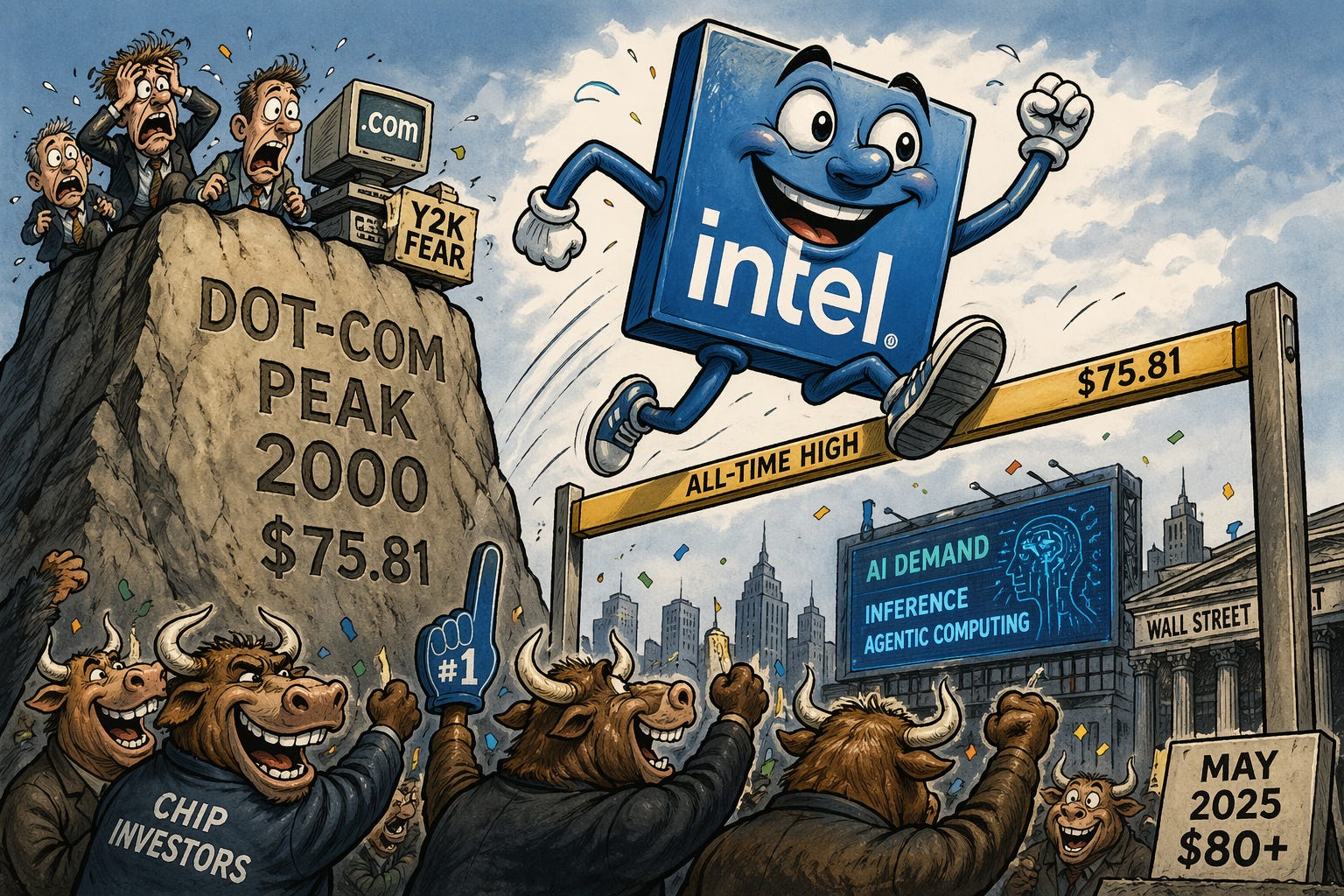
Intel reported first-quarter results after yesterday’s close that obliterated Wall Street expectations. Adjusted earnings per share came in at 29 cents against forecasts of a penny. Revenue hit $13.58 billion versus the $12.42 billion estimate, up 7% year on year. Data Center and AI revenue jumped 22% to $5.05 billion, well above the $4.41 billion expected. The chipmaker guided second-quarter revenue to $13.8 billion to $14.8 billion, above consensus. Shares surged roughly 20% in after-hours trading, climbing above $80 and finally clearing the all-time high of $75.81 set during the 2000 tech bubble. The stock is up more than 100% year to date. (CNBC)
This is the sixth straight quarter Intel has beaten guidance, and it lands as chip investors are already in full melt-up mode. The iShares Semiconductor ETF has risen for 17 consecutive sessions, up 23% in a month, and Texas Instruments just posted its best single-day performance since 2000 with a 19% jump. CEO Lip-Bu Tan attributed the demand to AI moving from foundational models toward inference and agentic computing, which shifts spending back toward CPUs and advanced packaging. Intel’s foundry business, still loss-making, narrowed its margin loss meaningfully as the 18A process node moves from promise to commercial ramp. (Bloomberg)
Sensei’s Insight: A quarter-century wait for a new all-time high. Intel’s trade is no longer speculation about a turnaround, it’s about how fast the foundry ramp translates into profits. Watch the Q2 guidance. If 18A yields hold, this rerates. If they wobble, it rolls over hard.
📉 Meta cuts 10% of staff, doubles down on AI
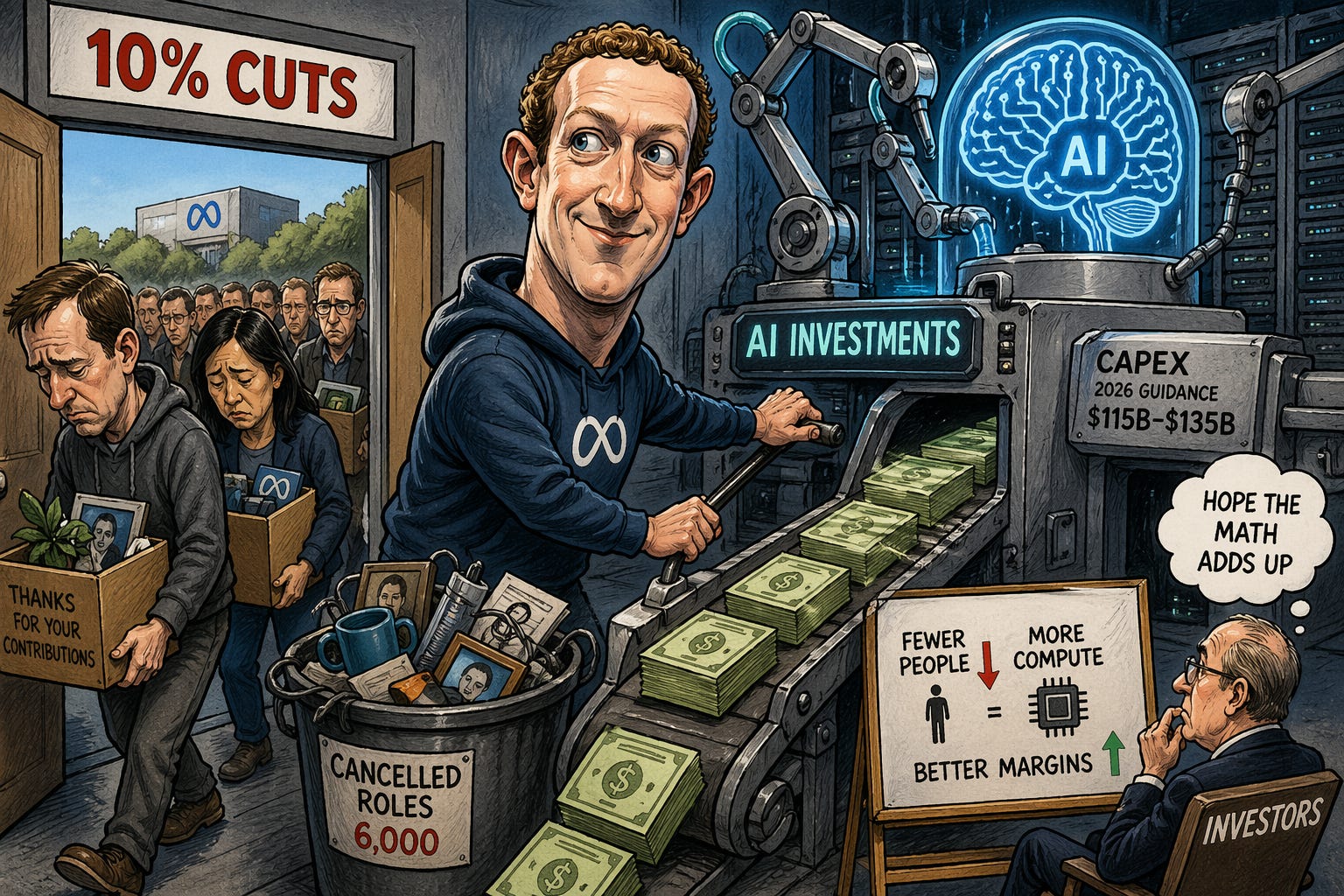
Meta told staff yesterday it will lay off about 8,000 people on May 20, roughly 10% of its 78,865-strong workforce, while cancelling 6,000 open roles. That takes the combined headcount impact to around 14,000 positions. Chief People Officer Janelle Gale’s memo framed the cuts as a structural reorganisation around AI-focused “pods” and a new Applied AI engineering group. US severance runs 16 weeks of base pay plus two weeks per year of service, with 18 months of healthcare. Meta generated $201 billion in revenue last year and guided 2026 capital expenditure to $115 billion to $135 billion, nearly double the $72 billion spent in 2025. (Bloomberg)
This is the third wave of cuts at Meta in 2026, after roughly 1,500 Reality Labs jobs went in January and another 700 across multiple divisions in March. Reuters has reported additional rounds are being discussed for the second half of the year. Bank of America estimates $7 billion to $8 billion in annualised savings from the restructuring. Jefferies called the move a broader signal for software valuations, noting that if Meta can shrink payroll while accelerating AI spending, the traditional link between headcount and growth breaks. Shares slipped about 2% yesterday to around $659 ahead of Meta’s April 29 earnings report. (CNBC)
Sensei’s Insight: Zuckerberg is asking investors to accept one equation: fewer people plus more compute equals better margins. That works if AI tools deliver productivity gains fast. If they don’t, Meta will have paid severance to the institutional knowledge it needs most. Next week’s Q1 print is the first test.
🏢 Microsoft offers historic first-ever buyouts
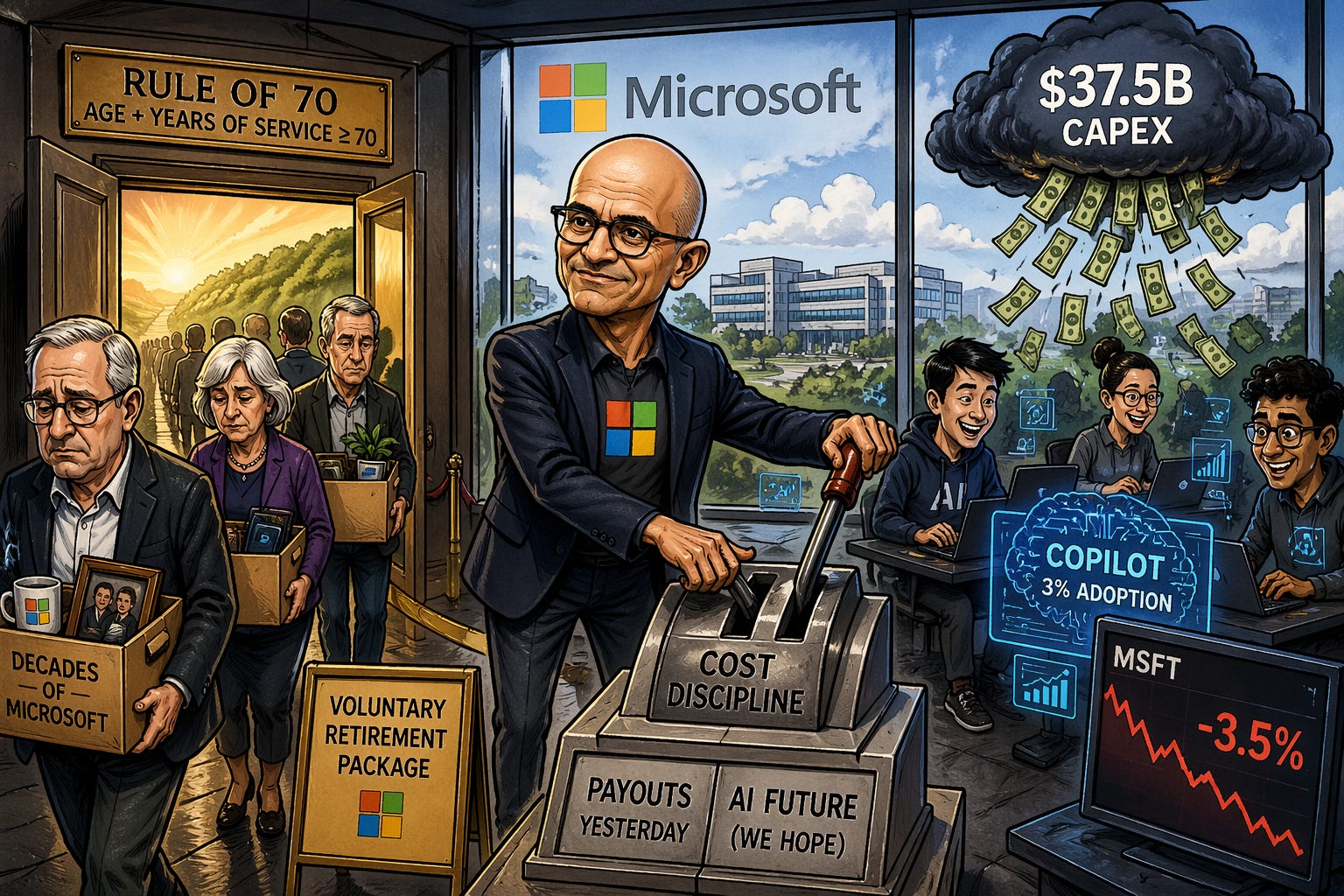
Microsoft launched the first voluntary retirement programme in its 51-year history yesterday, making roughly 7% of its US workforce eligible to exit with a package. The memo from Chief People Officer Amy Coleman covers US staff at senior director level and below, excluding sales incentive plans. Eligibility runs on a “rule of 70,” where age plus years of service must total at least 70. That targets mid-to-late career workers with deep institutional memory and upper-end pay. Of Microsoft’s 125,000 US employees as of June 2025, roughly 8,750 qualify. Notifications go out May 7, with 30 days to decide. Shares fell 3.5% yesterday. (CNBC)
Buyouts typically precede broader restructuring. They cut legal exposure, preserve morale among remaining teams, and frame cost cuts as respectful of long tenure. Microsoft let go of roughly 9,000 jobs involuntarily last summer and has frozen hiring across major cloud and sales divisions. Copilot adoption sits at just over 3% of the company’s 450 million Microsoft 365 customers, which is why investors are growing restless about whether AI revenue can absorb $37.5 billion of fiscal-Q2 capital expenditure. Microsoft reports fiscal Q3 earnings on April 29. The timing of this memo, days before that print, reads as a pre-emptive signal that cost discipline is intact. (Bloomberg)
Sensei’s Insight: The rule of 70 is surgical. It removes the highest-paid long-tenured staff while protecting the junior AI talent Microsoft wants to build with. Legal risk around age discrimination is real, but the bigger market question is whether Copilot revenue can fill the hole.
🌙 Nasdaq preps products for 23-hour trading launch
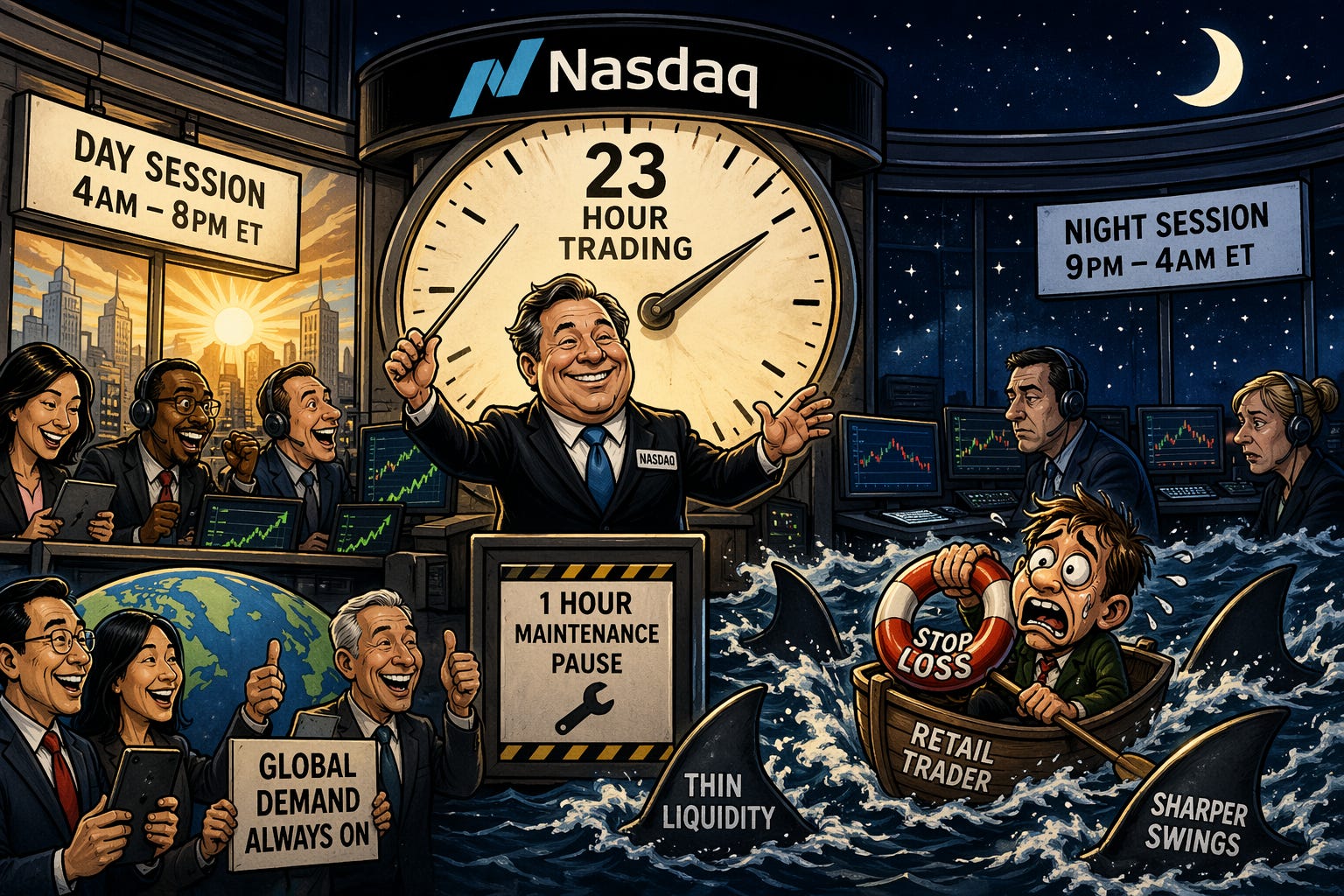
Nasdaq said yesterday it will roll out new data feeds, analytics tools, and exchange-traded products ahead of its move to 23-hour-a-day, five-day-a-week trading. The SEC approved the plan on April 10. Under the new structure, a Day Session will run from 4:00 AM to 8:00 PM Eastern time, with a one-hour maintenance pause, then a Night Session from 9:00 PM to 4:00 AM. The week opens Sunday night and closes Friday at 8:00 PM. All National Market System-listed stocks and ETFs will trade overnight. Nasdaq is targeting early Q3, with a December 6 backstop pending industry infrastructure readiness. (Reuters)
This is a response to global demand. Foreign holdings of US equities have climbed 97% since 2019 to roughly $17 trillion, and investors in Asia and Europe want a regulated way to trade US stocks during their own business hours. It also answers the always-on trading culture that cryptocurrency markets built over the last decade. The tradeoff is liquidity. Overnight volumes tend to be thin, spreads wider, and price swings sharper. Wells Fargo’s market structure team warned that most daily volume still clusters around the open and close, and that the new window could deliver worse fills for retail traders active when few institutional market makers are. (CNBC)
Sensei’s Insight: For active retail traders, this is useful optionality. For everyone else, it’s a warning sign. Thin overnight books mean stop losses trigger on noise, not news. The exchanges will sell this as accessibility. The smart use is restraint.
Stories You Might Have Missed
📈 Texas Instruments has its best day since 2000
Texas Instruments jumped roughly 19% yesterday, its largest single-day move since October 2000, after first-quarter results that cleared estimates by a wide margin. Revenue came in at $4.83 billion, up 19% year on year and about $300 million above consensus. Earnings per share reached $1.68, roughly 23% above the $1.36 expected. Free cash flow surged 611% to $1.40 billion. Second-quarter guidance of $5.0 billion to $5.4 billion in revenue also topped forecasts. Data centre revenue grew about 90% and now makes up 9% of the company’s total. The print confirms AI capital spending is rippling from GPU makers into the analog chips powering data centres, with read-across to Analog Devices, Microchip, and ON Semiconductor. (CNBC)
🤖 OpenAI releases GPT-5.5, accelerates model cycle
OpenAI rolled out GPT-5.5 to paid subscribers yesterday across ChatGPT and its Codex coding assistant, seven weeks after GPT-5.4 and days after Anthropic released Claude Opus 4.7. OpenAI calls it its most intuitive model to date, built for multi-step agentic tasks that plan, browse, code, and complete workflows without supervision. On the Terminal-Bench 2.0 command-line benchmark, GPT-5.5 reportedly scores 82.7%, ahead of Claude Opus 4.7 at 69.4% and Google’s Gemini 3.1 Pro at 68.5%. On SWE-Bench Pro for real-world coding, it lands at 58.6%, below Claude’s 64.3%. API pricing is $5 per million input tokens and $30 per million output, double the GPT-5.4 rate. The cadence puts fresh pressure on competitors and cloud providers hosting them. (CNBC)
🎫 Trump’s $1 million Gold Card has approved one person
Commerce Secretary Howard Lutnick told a House committee yesterday that Trump’s Gold Card visa programme has approved exactly one applicant in the five months since it opened in December 2025. The programme charges a $15,000 Department of Homeland Security fee plus a $1 million contribution for US permanent residency. Lutnick said “hundreds” of applications remain under review and defended the pace as careful vetting. At launch, he had claimed $1.3 billion “worth” of cards were sold within days, and that the programme would eventually raise $1 trillion, a figure roughly half the projected 2026 federal deficit. One approval against that backdrop is a useful data point on how administration revenue claims convert into reality. (Bloomberg)
🔗 Connect with Us
Stay plugged in across platforms:
Sensei on X: sensei_live_
Martyn Lucas on X: MartynInvestor
Vaz on X: eVTOLHUB
📺 YouTube Channel (Live & Replays): Martyn Lucas Investor