

🚀 Sensei Desk is now open to all premium members!
Before we get into today’s newsletter, I have something exciting to share: Sensei Desk is now open to all our premium newsletter members.
Tens of thousands of dollars and countless hours have gone into building a place where you can research investments, follow the markets and organise your finances. I’m incredibly proud to share it with you.
Here’s a taste of what’s inside:
Company research, financials, charts and comparisons.
Dedicated fund and ETF views, including fees and performance.
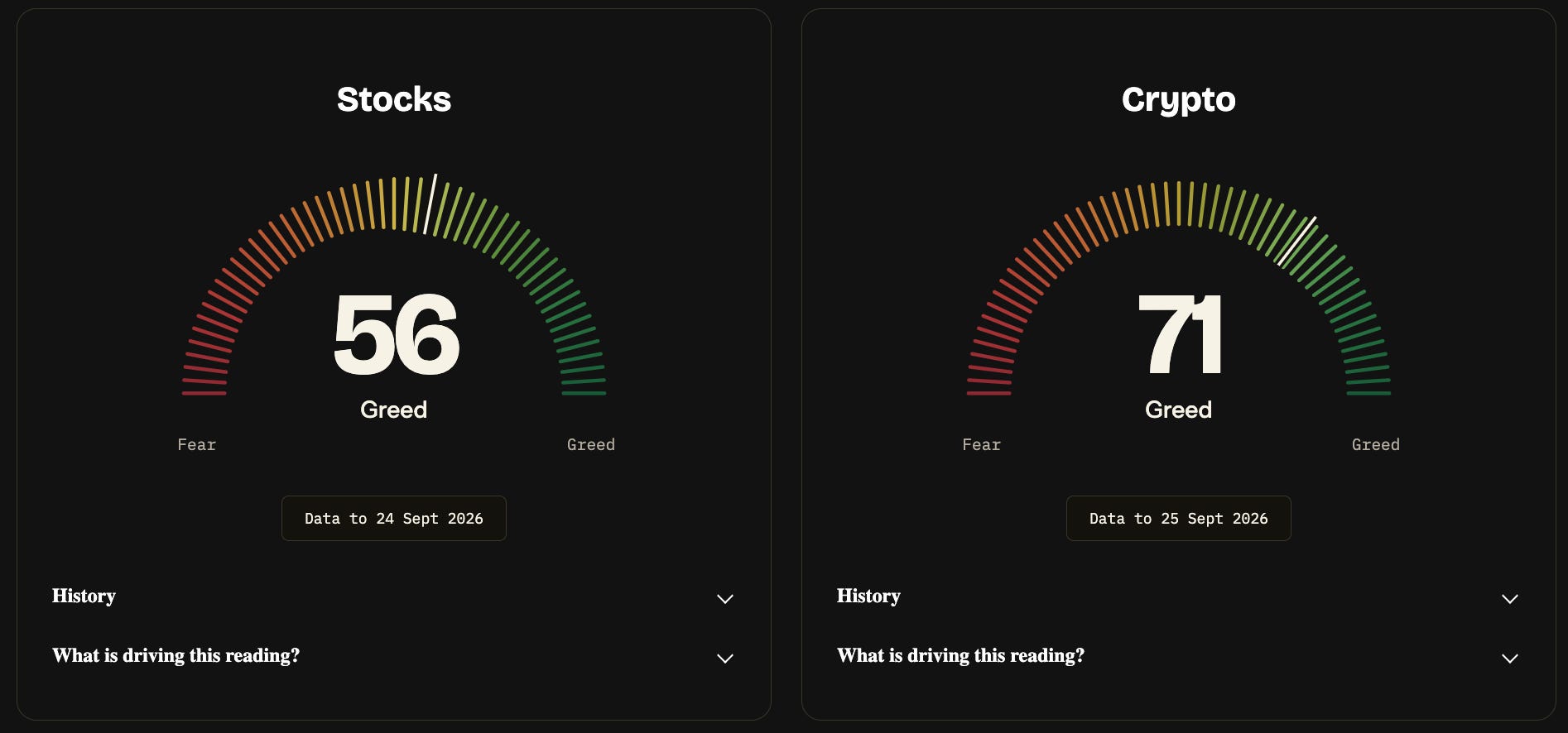
Our Sensei Fear and Greed gauges for stocks and crypto.
Earnings and economic calendars to help you plan your week.
A Net Worth Tracker to bring your assets, liabilities and bigger financial picture together.
Your watchlist, market dashboards, investor education and the Today page.
Take a look at desk.sensei.news
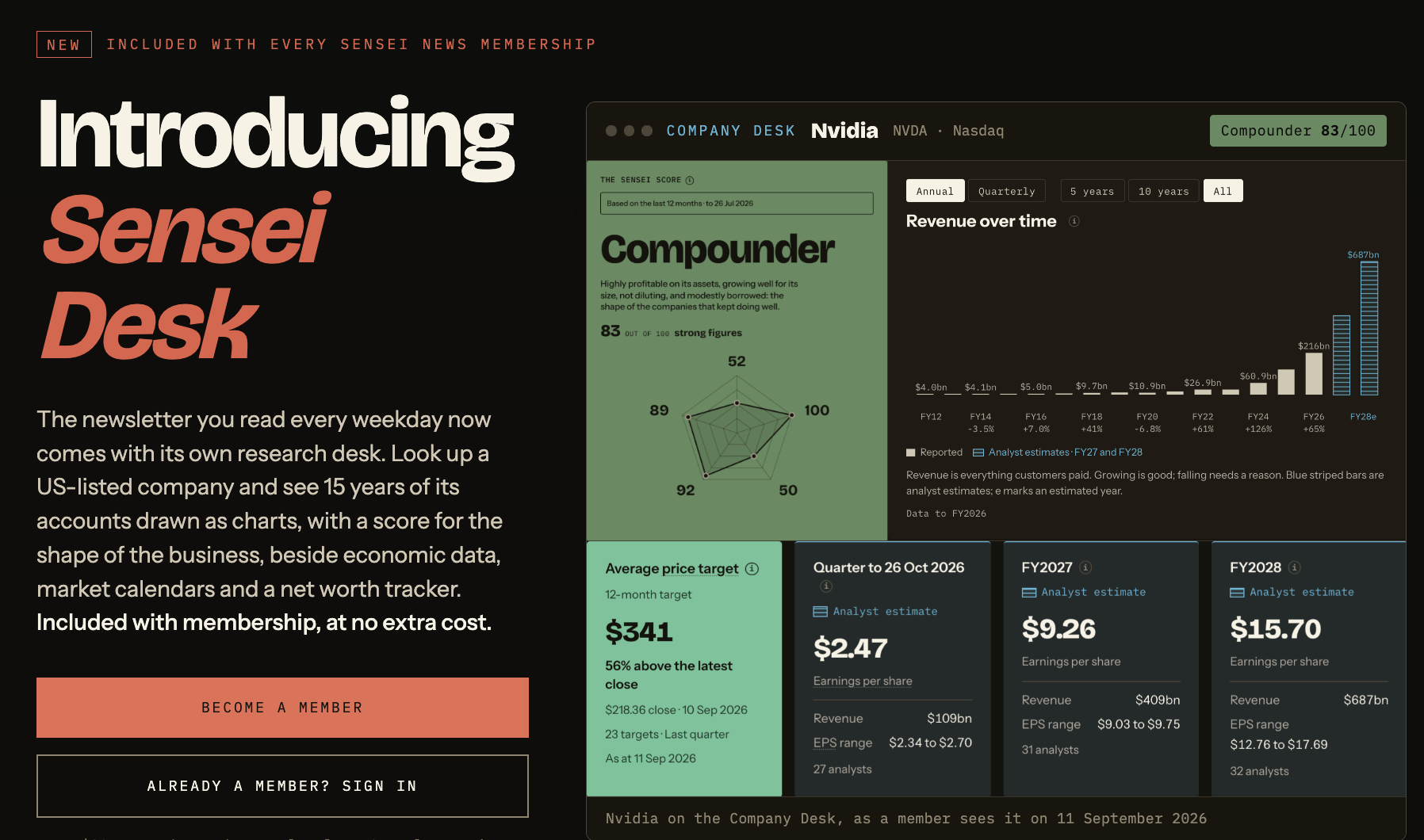
Click Sign in, enter the email address you use for your newsletter membership, and follow the link sent to your inbox. No password needed.
The feedback so far has been fantastic. Thank you to everyone who has tried it, shared suggestions and supported the launch. If you run into any problems, use the report button in the bottom-right corner once you’re signed in, or open a Discord ticket.
Go and explore. I can’t wait to hear what you think!
Now, on to today’s newsletter.
This content is for informational and educational purposes only and does not constitute financial advice. Always do your own research. Not financial advice (NFA).
👀 Today’s Stories at a Glance
📉 The 30-year hit a 2004 high: US long-term borrowing costs settled at 5.47% after a weak 7-year sale and a Treasury buyback that fell short.
🛢️ Iran floated a deal in stages: Brent settled at $106.60 as talk of a phased Hormuz reopening met Houthi missiles aimed at Saudi oil.
⚡ Oracle stalled, Akamai signed: Oracle sent a force majeure notice on a New Mexico data centre, hours before Akamai’s $11.6 billion Anthropic deal.
🛒 Costco’s beat had a refund in it: sales rose 11.2%, and 15 cents of its $6.75 a share came from tariff refunds.
🪙 Bitcoin funds slowed down: US bitcoin ETFs took in $190.7 million on Thursday, a sixth straight inflow and the third straight smaller one.
🇨🇳 Xi’s visit brought pandas: Trump called it a “great meeting”, China is sending 2 pandas to Atlanta, and the trade truce runs to 10 January.
🇬🇧 British shoppers cheered up: GfK’s confidence index rose to -13 in September, its highest since August 2024, when economists expected -16.
✈️ Airbus found a fuselage defect: a corrosion-protection defect may affect more than 500 A321neo jets, and Airbus says it is not a safety risk.
☕ Starbucks is shutting 250 cafes: about 1% of its North American stores will close, the second round of closures under Brian Niccol.
📈 The 10-year left its 1988 downtrend behind: Chart of the Day covers the 5.23% monthly high, the 5.02% line and the 2007 highs.
🧠 One Big Thing
Lending to the US government for 30 years now pays 5.47%, the most since 2004, and buyers are still asking for more. On Thursday a $44 billion sale of 7-year notes drew weak demand, and the 10-year settled at 5.18%. Long-term yields are the base price for mortgages, company loans and government debt. When they climb this fast, shares that depend on profits far in the future usually feel it first. The next test is the PCE inflation figure on Wednesday 30 September.
⚖️ Fear & Greed
📉 The Number That Matters
$12.68
The gap between Brent, the global oil price, and West Texas crude, the US price, reached $12.68 a barrel on Friday, the widest since May, with Brent up about 2% on the week and WTI down about 7%.
⚔️ Winners vs Losers
Winners
AKAM 0.00%↑ : +21.09% Akamai Technologies, Inc. shares jumped after it signed a seven-year, 11.6 billion dollar agreement to supply CPU computing capacity to Anthropic from its distributed network, with room to add up to 9 billion dollars more. The deal was announced after Thursday’s close, reversing a 6.78% fall earlier in the session.
GLND 0.00%↑ : +95.51% Greenland Energy Company is extending its rally after changing its Jameson Land farm-out agreement with 80 Mile plc so both exploration wells now have until the end of 2028. The shares rose 84% on Thursday, with the planned all-share merger with 80 Mile and the new US security pact keeping Greenland resource stocks in focus.
Losers
No major losers today.
📊 Market Snapshot
Cryptocurrencies:
Bitcoin (BTC): $84,670 (▲ 0.33%)
Ethereum (ETH): $2,710 (▲ 0.84%)
XRP: $1.55 (▲ 1.29%)
Equity Indices (Futures):
S&P 500: 7,789 (▲ 0.29%)
NASDAQ 100: 30,932 (▲ 0.54%)
FTSE 100: 10,707 (▼ 0.04%)
Commodities & Bonds:
10-Year US Treasury Yield: 5.17% (▼ 0.71%)
Oil (WTI): $93 (▼ 1.99%)
Gold: $4,306 (▲ 0.70%)
Silver: $64.90 (▲ 1.68%)
Data as of: UK: 11:36 BST / US: 06:36 EDT / Asia (Tokyo): 19:36 JST
✅ 5 Things to Know
📉 The 30-year yield hit its highest since 2004
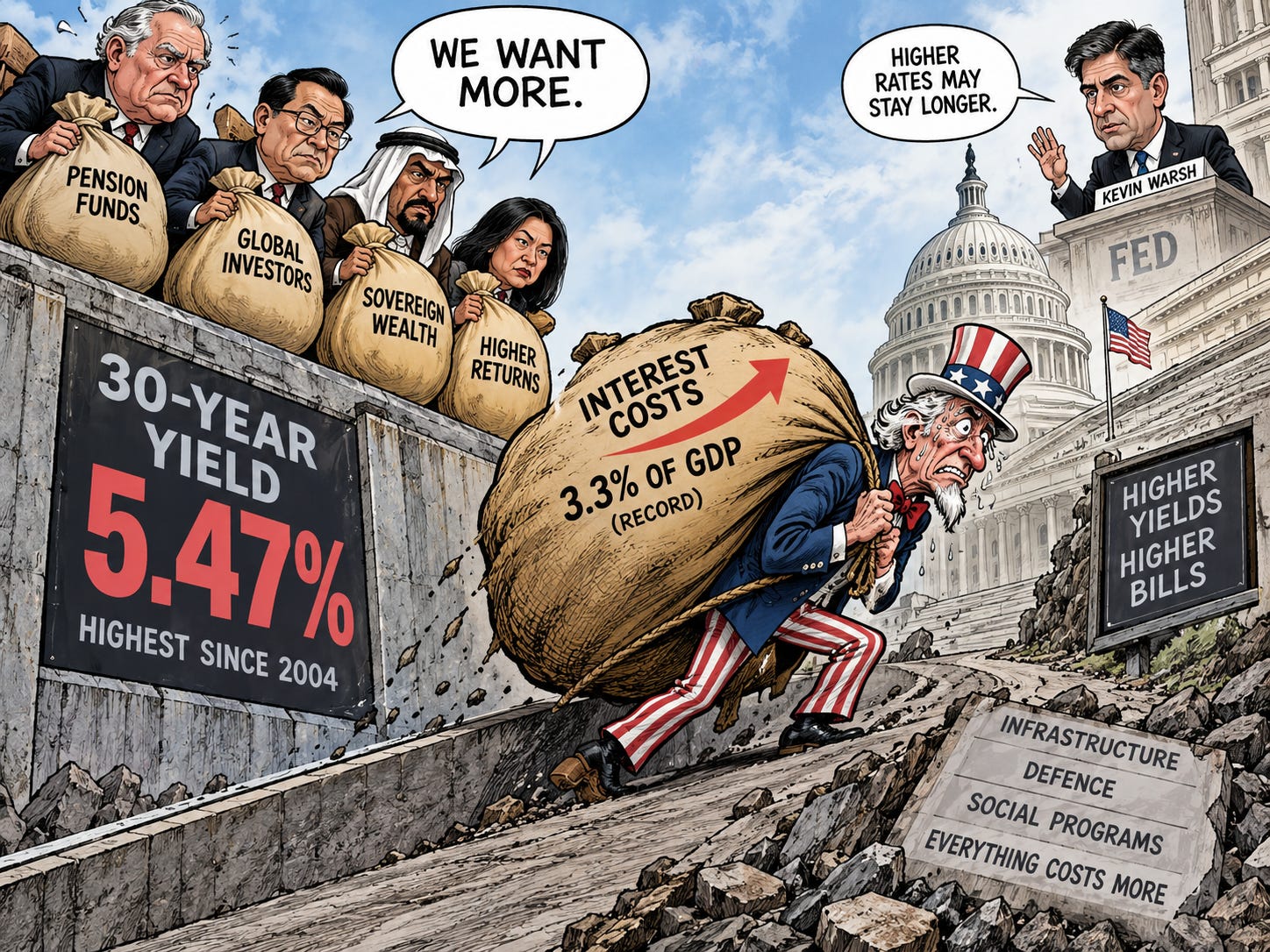
America’s 30-year Treasury yield settled at 5.47% on Thursday, its highest since 2004. The 10-year added another 0.07 percentage points to settle at 5.18%, a day after it closed at a 2007 high. The selling was heaviest in the longest bonds. A $44 billion sale of 7-year notes had its largest tail since March. A tail means the notes only sold at a higher yield than the market expected. The Treasury’s own buyback of 20 to 30-year bonds accepted $4.08 billion, against a $6 billion maximum. Newsquawk
Why are lenders asking for more? They want a bigger return after inflation. New York Fed President John Williams said on Thursday that expectations for real rates are a large part of the rise, and that nobody knows whether higher yields will last. A real yield is the return left after expected inflation. In plain terms, investors want more reward for lending to Washington for decades, on top of any cover for inflation. Japan’s 30-year yield hit its highest since the bond first sold in 1999. Futures now price about 71% odds of another Fed rise on 28 October.
The bill lands on the Treasury too. Bank of America analysts said US government net interest costs reached a record 3.3% of GDP in the second quarter of 2026. When the 10-year last sat near 5%, in 2007, those costs were 1.7% of GDP. The 10-year’s weekly candle closes later today, and the next inflation reading is the PCE figure on Wednesday 30 September. Yahoo Finance
Sensei’s Insight: The 30-year is where the pressure sits this week. A bond sale drew weak demand and the Treasury’s own buyback came up short. What I am watching is the next set of long-bond auctions, because each one tests who will still lend at these rates.
🛢️ Iran floated a Hormuz deal, Houthis fired at Yanbu
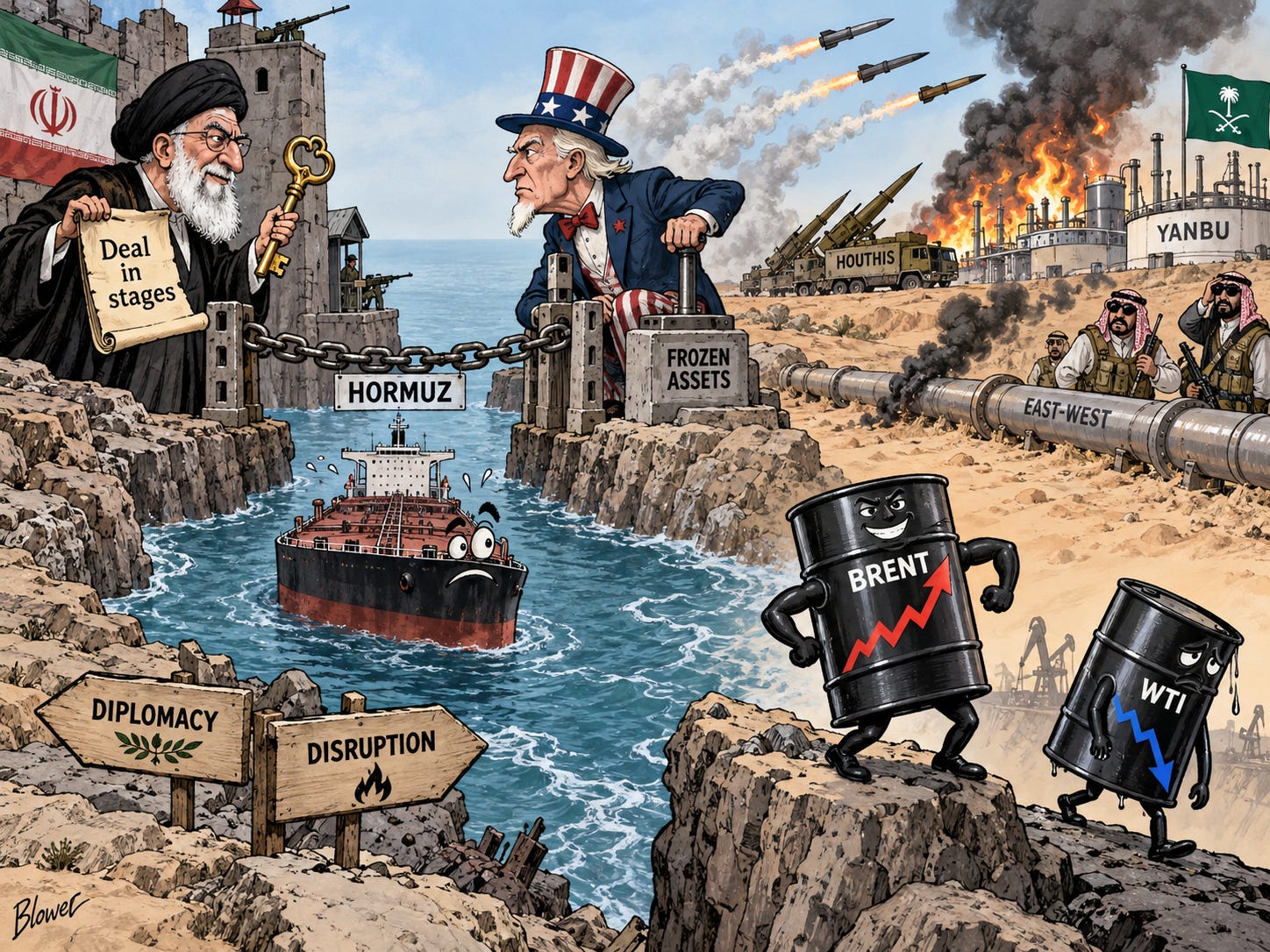
“One way forward would be to solve the crisis in stages. The first would be to end the blockade and reopen Hormuz.” A senior Iranian official told Reuters that on Thursday, as negotiators in New York explored a phased way out of the war. Iran would let ships through Hormuz, the US would lift its blockade, and Tehran might regain frozen assets. Regional sources said Iran was willing to move its demand for Hormuz transit fees into a side attachment. The same official still put the chances of diplomacy at “extremely low”, blaming America’s “excessive demands”. Al-Monitor
Brent crude still settled at $106.60 on Thursday, after touching $108. Saudi Arabia said it had intercepted Houthi missiles fired towards Taif and the Yanbu area. The Houthis later claimed strikes on Saudi Aramco facilities in Yanbu and a “sensitive target” in Riyadh, with no Saudi confirmation of damage. Yanbu is the Red Sea port at the end of the East-West pipeline, the route Saudi crude uses to avoid Hormuz. That pipeline was shut by drone attacks on 10 September. Kpler counted just 13 crossings of Hormuz on Thursday.
The 2 main oil prices are pulling apart. Brent, the global benchmark, was heading for a weekly gain of about 2% on Friday, at around $105. West Texas crude, the US benchmark, was heading for a fall of about 7%. The gap between them reached $12.68, the widest since May. The National put part of that down to a possible US ban on diesel exports, which could leave more fuel inside America and weigh on US crude. The National
Sensei’s Insight: A deal in stages gets around the problem the 23 September issue set out, each side waiting for the other to move first. Brent rose anyway, with the Red Sea exit under fire. What I am watching is whether Yanbu’s tanker loadings restart.
⚡ Oracle hit a power problem, Akamai landed $11.6 billion
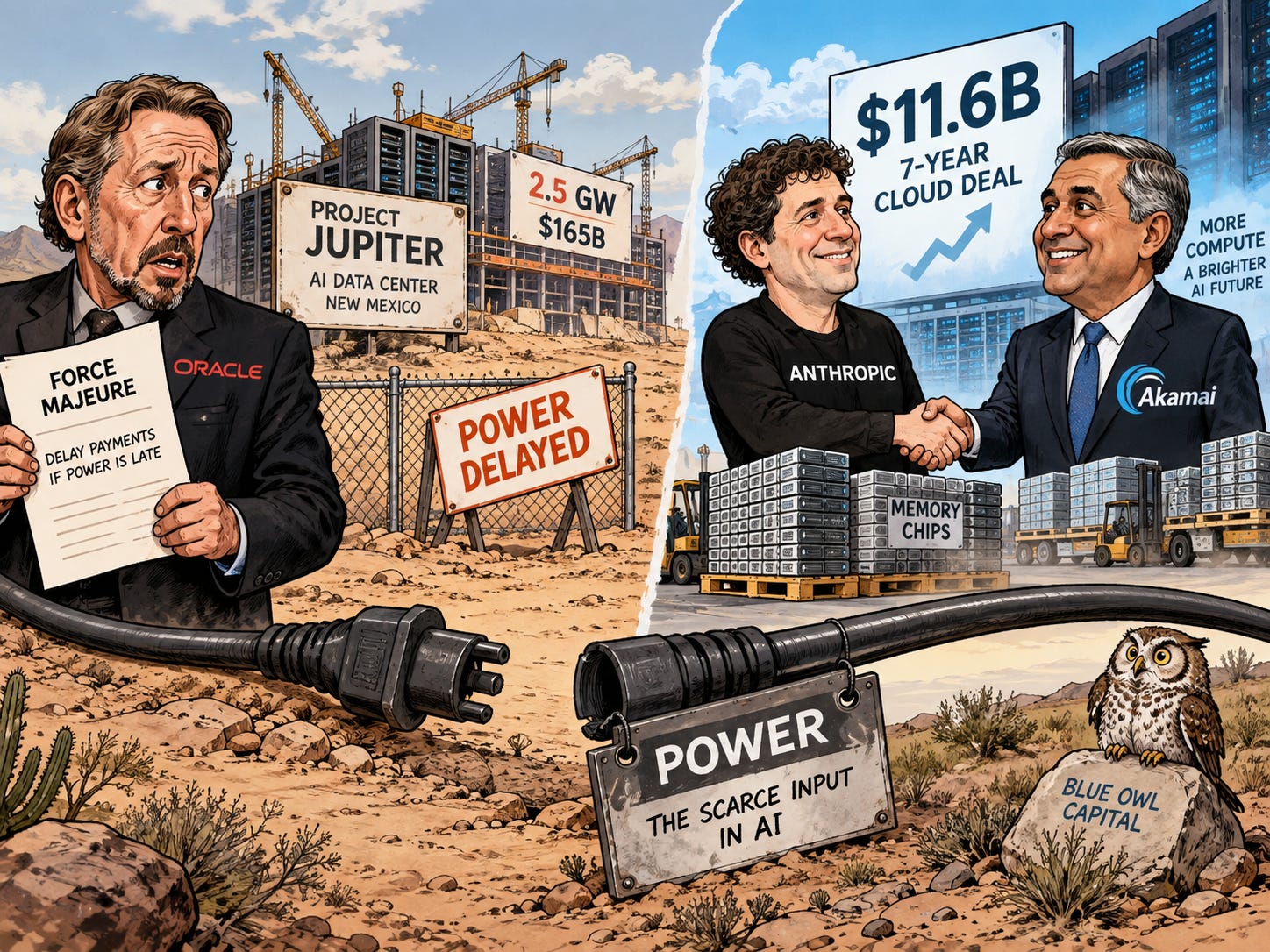
Hours apart on Thursday, 2 AI infrastructure headlines landed. The first was Oracle sending a force majeure notice to Blue Owl Capital, the developer behind Project Jupiter, Bloomberg reported. Force majeure is a contract clause that excuses a party when events outside its control get in the way. Project Jupiter is a New Mexico data centre campus of about 2.5 gigawatts, due online in 2028, with up to $165 billion of planned investment. Oracle wants to delay its payments if the site is late, and it is keeping its tenancy. State officials rejected a gas pipeline extension to feed the campus in July. Oracle said the project “remains on our planned schedule”. DatacenterDynamics
Oracle’s shares closed down about 3%, and Blue Owl and Bloom Energy fell with it. The second headline came after the close. Akamai signed a 7-year, $11.6 billion cloud deal with Anthropic, which can grow by up to $9 billion more. Anthropic gets a warrant for up to about 5% of Akamai at $111.33 a share, with about 2% vesting now. A warrant is the right to acquire shares later at a set price. Akamai expects about $5.5 billion of spending tied to the deal, including $1.7 billion in 2026 to pre-purchase parts such as memory. Its shares, down 6.78% in the regular session, rose 16.66% to $128.80 after hours. Benzinga
Both stories point at the same limit. Money for AI computing is still arriving, and Anthropic’s commitment is the latest proof. The physical inputs are what is scarce: electricity for Oracle’s site, and memory chips that Akamai is paying for years ahead.
Sensei’s Insight: Power is now the scarce input in AI. Oracle has the customers and the plan, and it is still protecting itself against the electricity arriving late. What I am watching is who carries the cost of a late site, the tenant or the landlord that built it.
🛒 Costco beat, helped by a 15-cent tariff refund
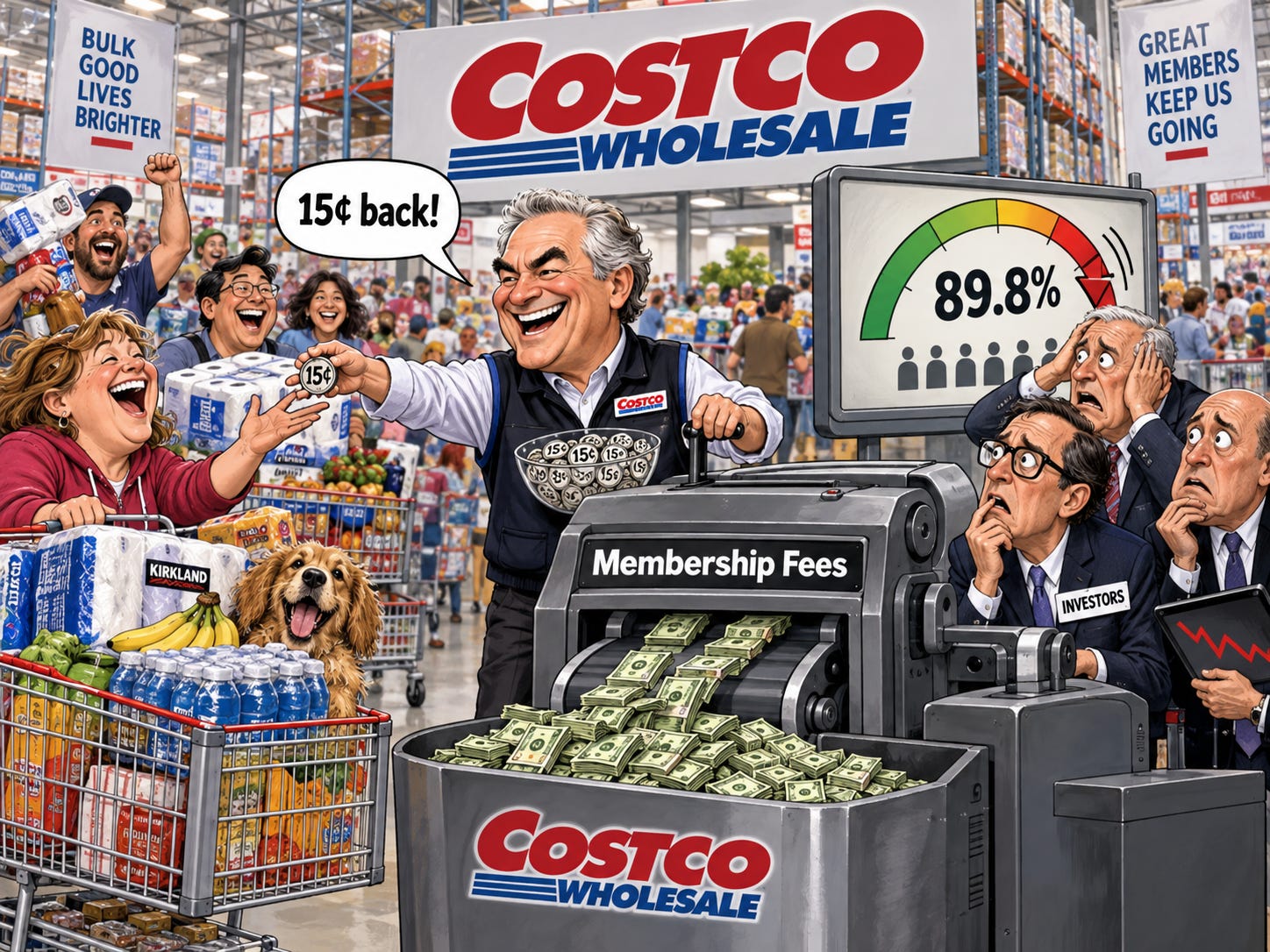
$93.9 billion. That was Costco’s net sales for the quarter to 30 August, up 11.2% on a year earlier. Profit came to $6.75 a share, against $5.87 a year ago and roughly $6.52 expected. Costco said 15 cents of that was a one-off benefit from refunds of tariffs it had paid under IEEPA, the emergency-powers law behind many recent US tariffs. It passed part of the refund back to members as lower prices. Without it, earnings would have been about $6.60 a share, still above forecasts. FinanceFeeds
Membership fees rose 7.3% to $1.85 billion in the quarter, slower than sales. Costco has 150.4 million cardholders, and its worldwide renewal rate slipped to 89.8%. Those fees came to $5.91 billion for the full year, against $9.23 billion of net income. Comparable sales rose 9.4%, or 6.7% with fuel and currency stripped out. The shares closed at $904.70 on Thursday and were quoted near $896 after the results, about 40 times forward earnings.
Sensei’s Insight: Costco sells groceries and earns on memberships. That is why I care more about 89.8% than about $6.75. What I am watching is whether the renewal rate slips again next quarter, now that the 2024 fee rise has mostly worked through.
🪙 Bitcoin funds slowed into the big expiry
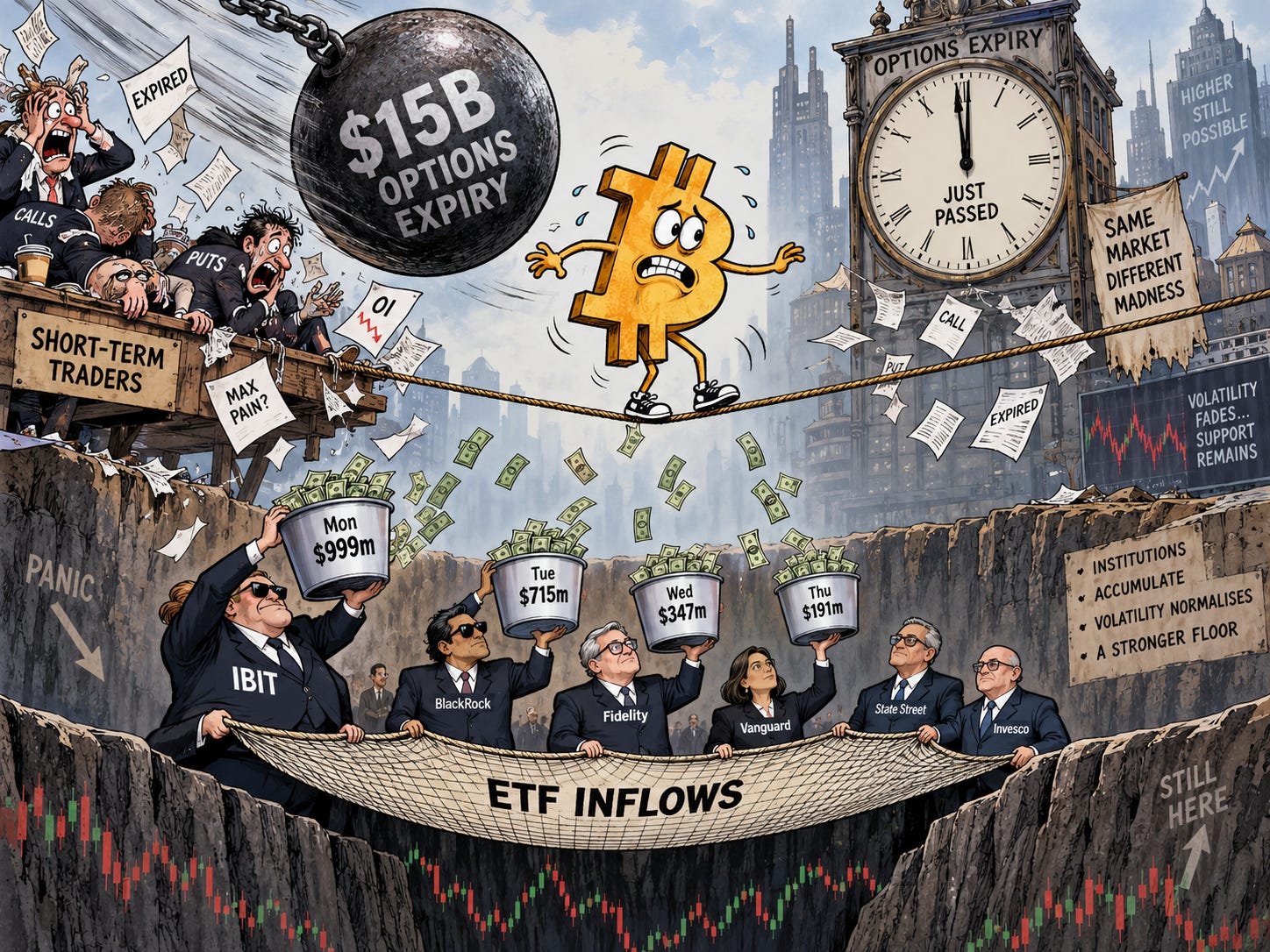
Did the fund buyers hold through the week? They kept buying, in smaller amounts each day. US spot bitcoin ETFs took in $190.7 million on Thursday, according to Farside Investors. That was a sixth straight day of inflows. It was also the third day in a row that the total shrank, from $999 million on Monday to $714.7 million, then $346.9 million, then $190.7 million. BlackRock’s IBIT took $162.6 million of Thursday’s total. Farside Investors
The quarter’s big options date passed at 9am UK on Friday, which is 4am in New York. Estimates of its size ranged from $14.4 billion to $15.9 billion of bitcoin options, because positions kept changing into the deadline, and about $2.13 billion of ether options expired alongside. Bitcoin traded a couple of hundred dollars above $84,000 going in. That left it about 10% up on the week, after it was turned back from above $87,000 on Wednesday. CryptoPotato
Sensei’s Insight: The 24 September issue called the fund money the steady side of this market. It is still coming in, at about a fifth of Monday’s pace. What I am watching is whether the inflows stay positive now that the expiry is out of the way.
Stories You Might Have Missed
🇨🇳 Xi’s visit brought pandas and a longer truce
“We had a great meeting,” President Trump said on Thursday after his Oval Office talks with Xi Jinping, without giving details. Xi announced that 2 pandas will go to Atlanta’s zoo, and Treasury Secretary Scott Bessent’s extension of the trade truce to 10 January stands. No breakthrough on Iran was reported. Xi said he supported the US and Iran returning to the understanding they reached in June, and Xinhua said he urged Trump to oppose Taiwanese independence. Hong Kong’s Hang Seng fell on Friday. Tea at the White House and a National Archives visit close the trip, from 3:35pm UK, 10:35am in Washington. Al Jazeera
🇬🇧 British consumers were the most upbeat since 2024
GfK’s consumer confidence index rose 1 point to -13 in September, its highest since August 2024. Economists polled by Reuters had expected a fall to -16. It was the third monthly rise in a row, the first such run since summer 2024. The biggest gains came in how people rated the economy and their own finances over the past year. GfK’s Neil Bellamy still warned about the months ahead: “With inflation, energy and fuel prices rising, could we soon see consumer sentiment falter?” NIQ
✈️ Airbus found a fuselage defect on 500 jets
Airbus said on Thursday it had found a quality defect that could reduce corrosion resistance inside the fuselage structure of its A321neo. The Air Current reported that it could affect more than 500 aircraft, roughly 250 of them still in production. Airbus said the planes can keep flying because the defect is a quality issue with no safety risk, and that the source has been contained and a fix is available. The Air Current reported that Airbus does not currently expect to change its 2026 delivery guidance, although inspections and rework could weigh on deliveries. Investing.com
☕ Starbucks will close about 250 cafes
Starbucks said on Thursday it will close about 250 underperforming cafes, roughly 1% of its more than 18,000 North American locations. It is the second round of North American closures under chief executive Brian Niccol, who has spent 2 years reworking the US business around in-store service. Chief operating officer Mike Grams told staff the company does not see “a path to acceptable financial performance” at some sites. It has not said where the closures will be. The shares were down 0.59% at $94.70 before the opening bell. TheStreet