This content is for informational and educational purposes only and does not constitute financial advice. Always do your own research. Not financial advice (NFA).
👀 Today’s Stories at a Glance
🎬 Netflix Abandons Warner Bid: Paramount wins WBD for $111 billion; Netflix exits citing financial discipline and investor relief.
📉 WBD Reports Mixed Earnings: Streaming grows to 131 million users while legacy TV revenue and advertising sharpy decline.
⚔️ Anthropic Rejects Pentagon Deal: The AI firm refuses mass surveillance contracts; a 5:01 PM deadline triggers potential sanctions.
🛢️ Iran Nuclear Talks Stall: Negotiations end without agreement as the U.S. mobilizes massive naval and air power nearby.
🤖 Nvidia Slumps Despite Beat: Shares fell 5% after record earnings as investors question if AI buyers can sustain spending.
🔍 PPI Report Impacts Markets: Today’s producer price data serves as a critical inflation signal for Fed interest rate decisions.
🧠 One Big Thing
Paramount Skydance is set to acquire Warner Bros. Discovery for $111 billion after Netflix abandoned the bidding war to maintain fiscal discipline. This massive consolidation creates a media powerhouse controlling HBO, CBS, and CNN, yet the deal is one of the most leveraged in history. The acquisition is heavily dependent on billions in debt and equity from private backers and sovereign wealth funds. Investors are now weighing whether the growth of the Max streaming service can outpace the rapid collapse of traditional cable television revenue. While Netflix shares jumped on the news of its withdrawal, the success of this new entity hinges on its ability to manage a massive debt load while legacy advertising income fails. This shift fundamentally alters the competitive landscape of the entertainment industry and tests the limits of corporate leverage.
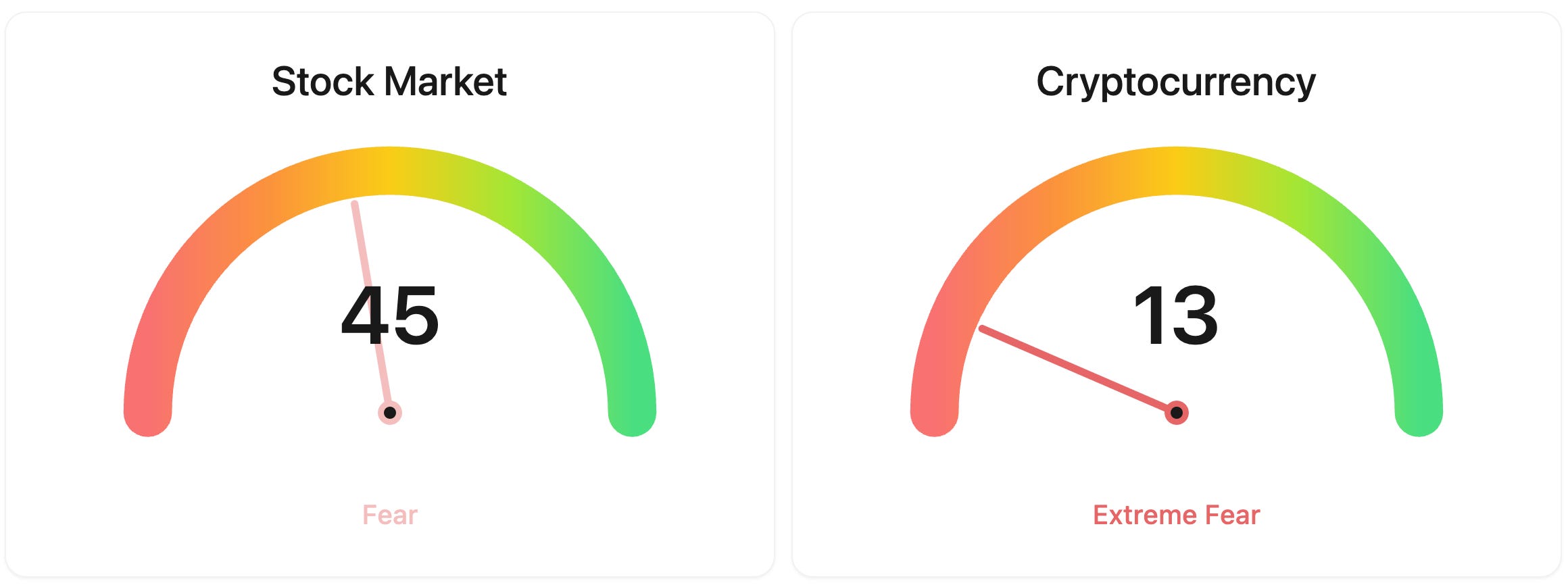
⚖️ Fear & Greed
📉 The Number That Matters
+0.7%
Economists are monitoring today's PPI release to see if December’s +0.7% core inflation spike was an outlier. The data serves as a vital signal for the Federal Reserve’s March interest rate decision and upcoming Personal Consumption Expenditures report.
⚔️ Winners vs Losers
Winners
CAI 0.00%↑ Caris Life Sciences surged after reporting Q4 earnings of $0.28 per share, crushing the $0.01 consensus estimate, while revenue jumped 125% year over year to $293 million and the company guided for over $1 billion in 2026 revenue.
XYZ 0.00%↑ Block soared after CEO Jack Dorsey announced plans to cut roughly 40% of the workforce, over 4,000 jobs, as part of a sweeping pivot to an AI-native operating model, while simultaneously raising its full-year 2026 gross profit outlook to $12.2 billion.
AAOI 0.00%↑ Applied Optoelectronics beat Q4 estimates and guided for over $1 billion in 2026 revenue, with management suggesting demand could support roughly $378 million in monthly revenue by mid-2027 as AI-driven appetite for optical networking components far outpaces production capacity.
NATL 0.00%↑ NCR Atleos jumped after Brink’s announced a definitive agreement to acquire the company in a cash-and-stock deal valued at approximately $6.6 billion, creating a combined $10 billion-revenue ATM and cash-technology platform.
MARA 0.00%↑MARA Holdings rallied after announcing a partnership with Starwood Capital Group to convert power-rich bitcoin mining sites into next-generation AI and hyperscale data centers, with plans for about 1 gigawatt of near-term IT capacity.
DELL 0.00%↑ Dell Technologies posted record fiscal 2026 results with $113.5 billion in annual revenue, up 19% year over year, and guided fiscal 2027 revenue to $140 billion at the midpoint, fueled by a $43 billion AI server backlog and $64 billion in cumulative AI orders.
REAL 0.00%↑ The RealReal beat Q4 estimates with GMV up 22% to $616 million and delivered its first full year of positive adjusted EBITDA in every quarter, while guiding for continued double-digit GMV growth in 2026.
PSKY 0.00%↑ Paramount Skydance rallied after Netflix declined to match its $31-per-share, all-cash bid for Warner Bros. Discovery, effectively clearing the path for Paramount to clinch the $111 billion deal.
NFLX 0.00%↑ Netflix shares climbed after the company walked away from its bidding war for Warner Bros. Discovery, with investors cheering the capital discipline and the company announcing it would restart its share buyback program.
Losers
DUOL 0.00%↑Duolingo plunged after issuing 2026 bookings guidance of just 10–12% growth, well below the roughly 20% it said it could have delivered, as the company pivots to prioritize user growth and AI investment over near-term monetization, prompting Morgan Stanley to downgrade the stock and slash its price target from $245 to $100.
AIV 0.00%↑ Apartment Investment and Management dropped as shares went ex-dividend on a $1.45-per-share special liquidating distribution tied to the company’s shareholder-approved plan to sell its remaining properties and wind down operations.
EBS 0.00%↑ Emergent BioSolutions tumbled after guiding full-year 2026 revenue to $720–$760 million, well below the $809 million consensus, while Q4 revenue of $148.7 million missed the $217.5 million estimate and naloxone product sales fell 41% on rising generic competition.
DNA 0.00%↑ Ginkgo Bioworks fell after reporting Q4 revenue of $33 million, down 24% year over year and below estimates, while announcing plans to divest its biosecurity business and refocus on autonomous lab technology amid continued cash burn.
CRWV 0.00%↑ CoreWeave slid after posting a wider-than-expected Q4 loss of $0.89 per share and guiding Q1 2026 revenue to $1.9–$2.0 billion, roughly $290 million below Wall Street’s $2.29 billion estimate, while projecting $30–$35 billion in capital expenditures for 2026.
📊 Market Snapshot
Cryptocurrencies:
Bitcoin (BTC): $66,064 (▼ -2.11%)
Ethereum (ETH): $1,961 (▼ -3.30%)
XRP: $1.38 (▼ -1.42%)
Equity Indices (Futures):
S&P 500: $6,870 (▼ -0.29%)
NASDAQ 100: $24,988 (▼ -0.37%)
FTSE 100: £10,876 (▲ 0.22%)
Commodities & Bonds:
10-Year US Treasury Yield: 3.99% (▼ -0.47%)
Oil (WTI): $67 (▲ 2.00%)
Gold: $5,177 (▼ -0.07%)
Silver: $89.67 (▲ 1.62%)
Data as of UK (GMT): 11:42 a.m. / US (EST): 06:42 a.m. / Asia (Tokyo): 20:42
✅ 5 Things to Know Today
🎬 Netflix Walks Away From Warner Bros. as Paramount’s $111 Billion Bid Wins
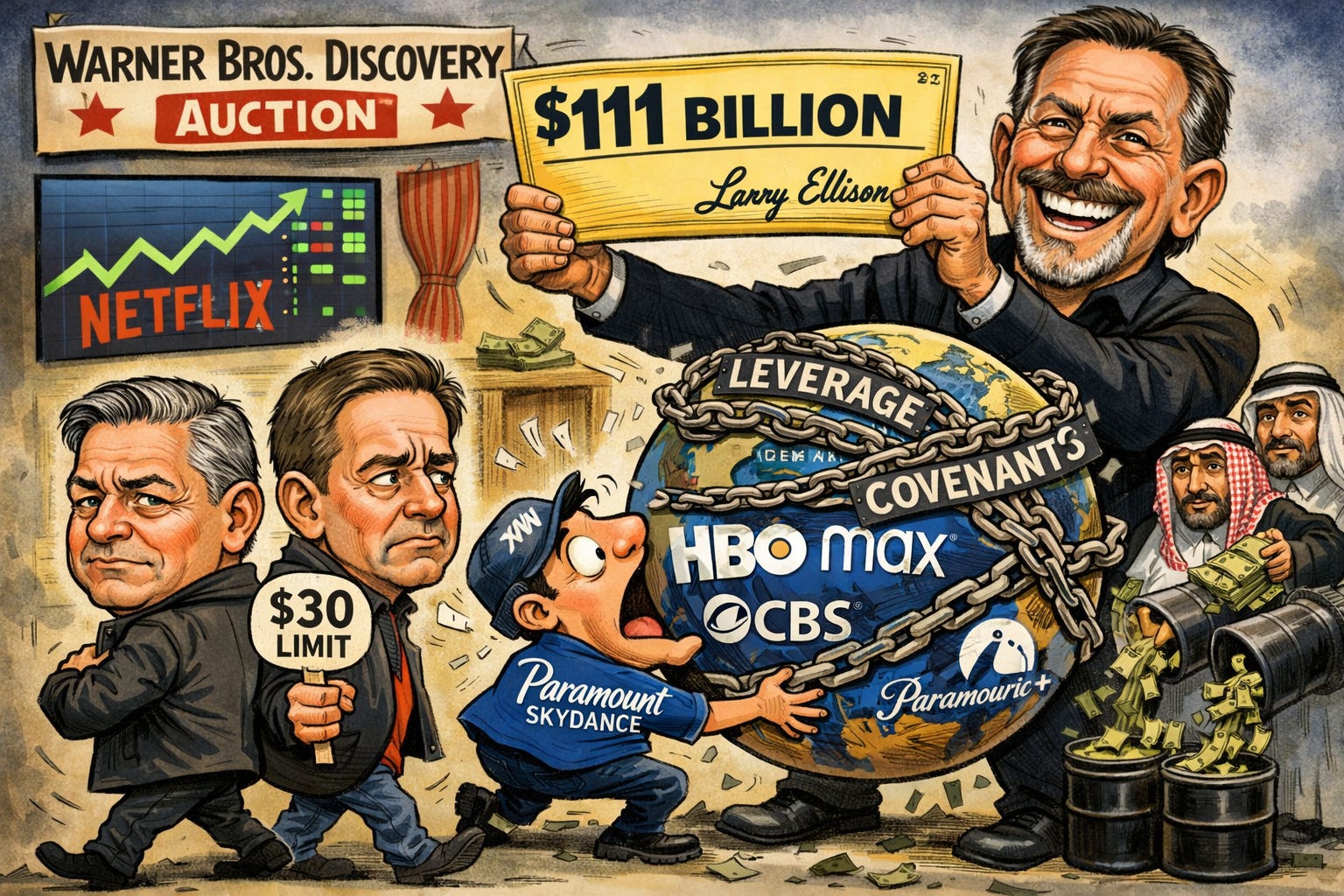
Netflix pulled out of the bidding war for Warner Bros. Discovery yesterday evening, just 90 minutes after WBD’s board declared Paramount Skydance’s $31-per-share all-cash offer the superior proposal. The withdrawal ends a five-month saga that saw eight price increases and a 63% jump in value from Paramount’s original $19-per-share bid back in September. Co-CEOs Ted Sarandos and Greg Peters called WBD “a nice to have at the right price, not a must have at any price,” citing financial discipline after MoffettNathanson warned that anything above $30 per share would dilute Netflix’s 2028 earnings. Netflix shares had already fallen roughly 30% since announcing its own WBD deal in December, a clear signal investors hated the acquisition strategy (Bloomberg).
The deal reshapes Hollywood’s power map. Paramount Skydance, a company with just $12 billion in market cap, is swallowing all of WBD for $111 billion in enterprise value, making it one of the most leveraged megadeals in corporate history. The combined company would control CBS, Paramount+, HBO Max, CNN, two legacy film studios, and a massive content library. Financing is backed by Bank of America, Citigroup, Apollo Global Management, and equity commitments from the Ellison family trust, RedBird Capital, and sovereign wealth funds from Qatar, Saudi Arabia, and the UAE. Larry Ellison has put up a personal guarantee on a $45.7 billion equity backstop. For Netflix investors, the withdrawal sparked a 13% after-hours surge to nearly $96, reflecting pure relief. For WBD holders, $31 cash represents roughly four times the stock’s 52-week low. The deal still faces DOJ antitrust review, European and UK regulatory clearance, and FCC license transfers, with Paramount expecting 10 to 12 months to close (Reuters).
Sensei’s Insight: A $12 billion company absorbing a $111 billion target backed by Gulf sovereign wealth money and a personal guarantee from the world’s fourth-richest man. Watch who actually controls the board when the debt covenants start biting. Leverage like this always comes with strings.
📉 WBD’s Q4 Tells Two Stories: Streaming Grows, Legacy TV Falls Off a Cliff
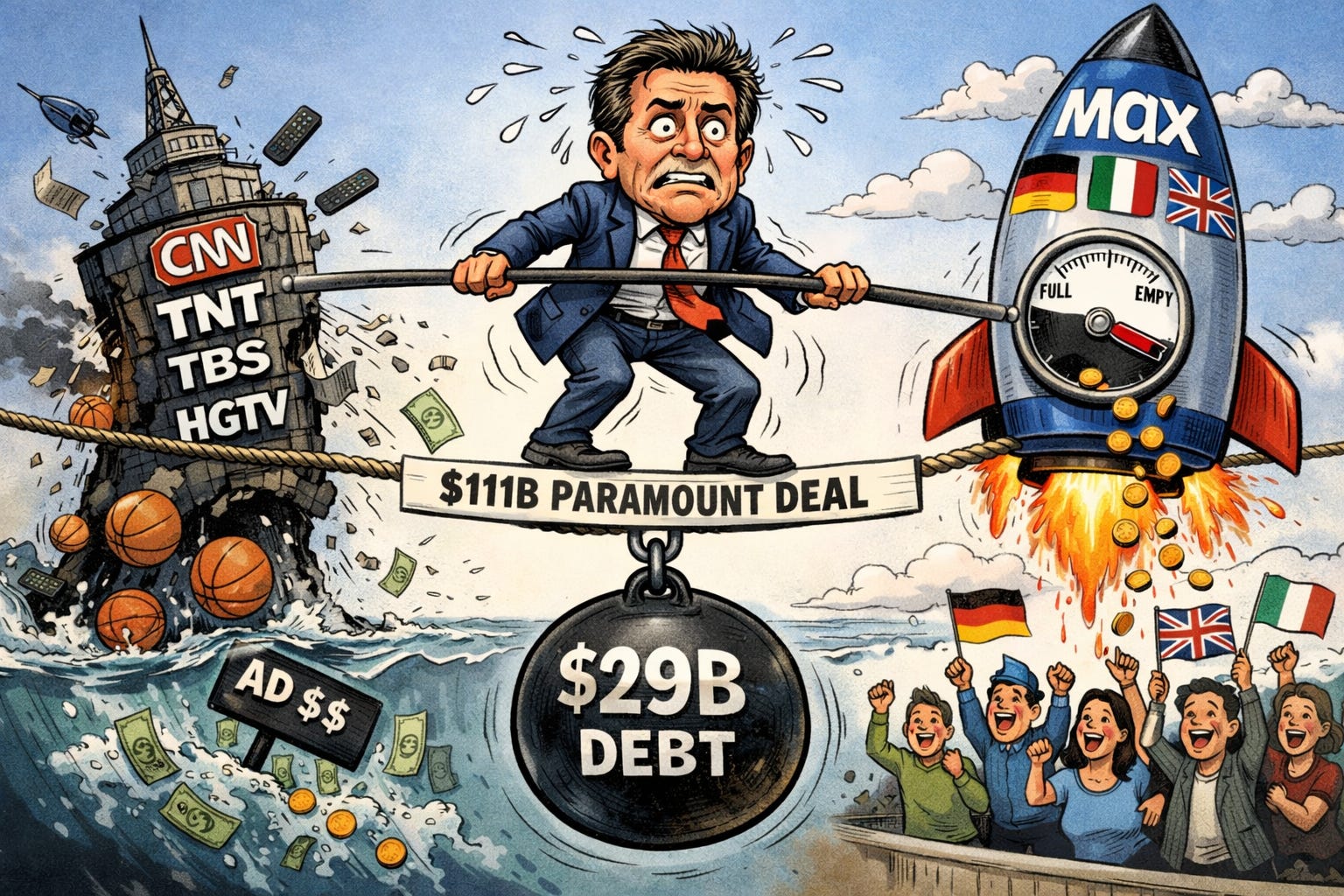
Warner Bros. Discovery posted fourth-quarter results yesterday morning showing total revenue down 6% to $9.46 billion, with the pain concentrated in its traditional television and studio businesses. The Global Linear Networks segment, home to CNN, TNT, TBS, and HGTV, saw revenue drop 13% to $4.20 billion as advertising fell 14% and domestic audiences shrank 22%. Roughly half the ad decline came from losing NBA broadcasting rights. Studios revenue slid 13% to $3.18 billion on a thin theatrical slate and a 34% collapse in gaming revenue. The company posted a net loss of $252 million, an improvement on last year’s $494 million loss, but adjusted EBITDA (earnings before interest, taxes, depreciation, and amortisation) fell 19% to $2.22 billion (CNBC).
The streaming side told a different story. Max pulled in $2.79 billion in revenue, up 5%, with advertising within the platform climbing 17% and global subscribers reaching 131.6 million. International growth did the heavy lifting, with overseas subscribers up 21% year-over-year to 72.4 million, boosted by recent launches in Germany and Italy. Full-year streaming EBITDA more than doubled to $1.37 billion. But there is a catch buried in the numbers: global average revenue per user (ARPU) fell 9% to $6.80, with domestic ARPU dropping from $11.77 to $10.45 after a distribution deal renewal. WBD also announced it will stop reporting subscriber and ARPU figures after this quarter, a move companies typically make when they expect those metrics to become less flattering. Max is set to launch in the UK and Ireland on March 26, and management is targeting 150 million subscribers by year-end 2026.
Sensei’s Insight: These are the fundamentals Paramount is inheriting for $111 billion. Linear TV in freefall, streaming profitable but with shrinking revenue per user, and $29 billion in net debt. The deal math needs Max to scale fast enough to replace what cable is losing. That is a very tight race.
⚔️ Anthropic Rejects Pentagon’s Final Offer With Today’s 5:01 PM Deadline Looming

Anthropic, the $380 billion AI company behind Claude, formally rejected the Pentagon’s “best and final” contract offer yesterday, with a hard deadline of 5:01 PM ET today set to determine whether the partnership survives. The dispute comes down to two lines the company refuses to cross: no AI-powered mass surveillance of American citizens, and no fully autonomous lethal weapons without a human making the final call. CEO Dario Amodei argued that frontier AI can assemble scattered, individually harmless data “into a comprehensive picture of any person’s life, automatically and at massive scale.” The Pentagon’s revised offer, delivered overnight on February 25, made what Amodei described as “virtually no progress” on either concern, with compromise language “paired with legalese that would allow those safeguards to be disregarded at will” (Bloomberg).
The stakes stretch far beyond the $200 million contract itself, which is a small fraction of Anthropic’s estimated $14 billion in annual revenue. If the deadline passes without agreement, the Pentagon has threatened a supply-chain-risk designation, a label normally reserved for foreign adversaries like Huawei. Eight of the ten largest US companies use Claude. That designation would force every firm with Pentagon contracts to certify it does not use Claude in any military-related work, potentially triggering enterprise-wide migrations away from Anthropic’s technology across the defence-industrial base and beyond. Bipartisan pushback has been sharp. Senator Mark Kelly called it an attempt to “strong-arm Anthropic into providing every tool they have to surveil US citizens,” while Republican Senator Thom Tillis called the Pentagon’s public handling of the dispute “unprofessional.” Meanwhile, Elon Musk’s xAI signed a deal on February 23 to put Grok on classified networks with no restrictions, though defence officials privately acknowledge Grok is not considered as capable as Claude (Reuters).
Sensei’s Insight: While Anthropic stands its ground, xAI and OpenAI are quietly filling the gap on classified networks. Expect a face-saving compromise after the deadline passes, but the real story is bigger: the Pentagon is testing whether it can dictate terms to AI companies on safety. Every firm building frontier models should be watching closely.
🛢️ Iran Talks End Without a Deal as the Largest US Military Buildup Since 2003 Grows

The third round of US-Iran nuclear negotiations wrapped up in Geneva yesterday with no agreement, though both sides agreed to send technical teams to Vienna next week for continued discussions at International Atomic Energy Agency (IAEA) headquarters. Iran presented a draft proposal offering to reduce its roughly 10,000 kg stockpile of enriched uranium to low enrichment levels under IAEA supervision, halt high-level enrichment, and accept surprise inspections. It refused to permanently abandon enrichment, dismantle its nuclear facilities, or ship the stockpile out of the country. The US position remains fundamentally incompatible: zero enrichment permanently, destruction of key sites at Fordow, Natanz, and Isfahan, no expiration dates, and ballistic missile restrictions. Omani Foreign Minister Badr Albusaidi, the mediator, said there had been “significant progress,” while US envoys Steve Witkoff and Jared Kushner declined to comment (Reuters).
The diplomatic language stands in stark contrast to what is happening on the water and in the air. The USS Gerald R. Ford, the world’s largest aircraft carrier, left Crete yesterday heading for the Persian Gulf to join the USS Abraham Lincoln strike group already in the Arabian Sea. In total, 17 US warships, more than 150 aircraft including F-22 Raptors and F-35 stealth fighters, and the first-ever deployment of offensive US weapons to Israeli soil (12 F-22s at Ovda Airbase) now form what University of Chicago professor Robert Pape estimated at 40 to 50% of America’s deployable air power worldwide. Trump gave Iran “10 to 15 days at most” on February 20, a window that closes around early March, roughly when the IAEA Board of Governors convenes on March 6. Oil markets are already pricing the tension: Brent crude sits around $70 per barrel with an estimated $7 to $10 per barrel geopolitical risk premium baked in, according to Goldman Sachs and Barclays. If conflict disrupts traffic through the Strait of Hormuz, where roughly 20 million barrels per day flow (about 20% of global petroleum consumption), Goldman projects Brent could spike above $100 (Bloomberg).
Sensei’s Insight: Diplomats are talking about “significant progress” while half of America’s deployable air power sits in the Gulf. That gap between words and military positioning rarely closes peacefully. If the early March window passes without a deal, watch energy, defence, and gold for sharp moves. VLCC tanker rates have already tripled since January.
🤖 Nvidia Beats Every Estimate, Loses $259 Billion in a Day Anyway
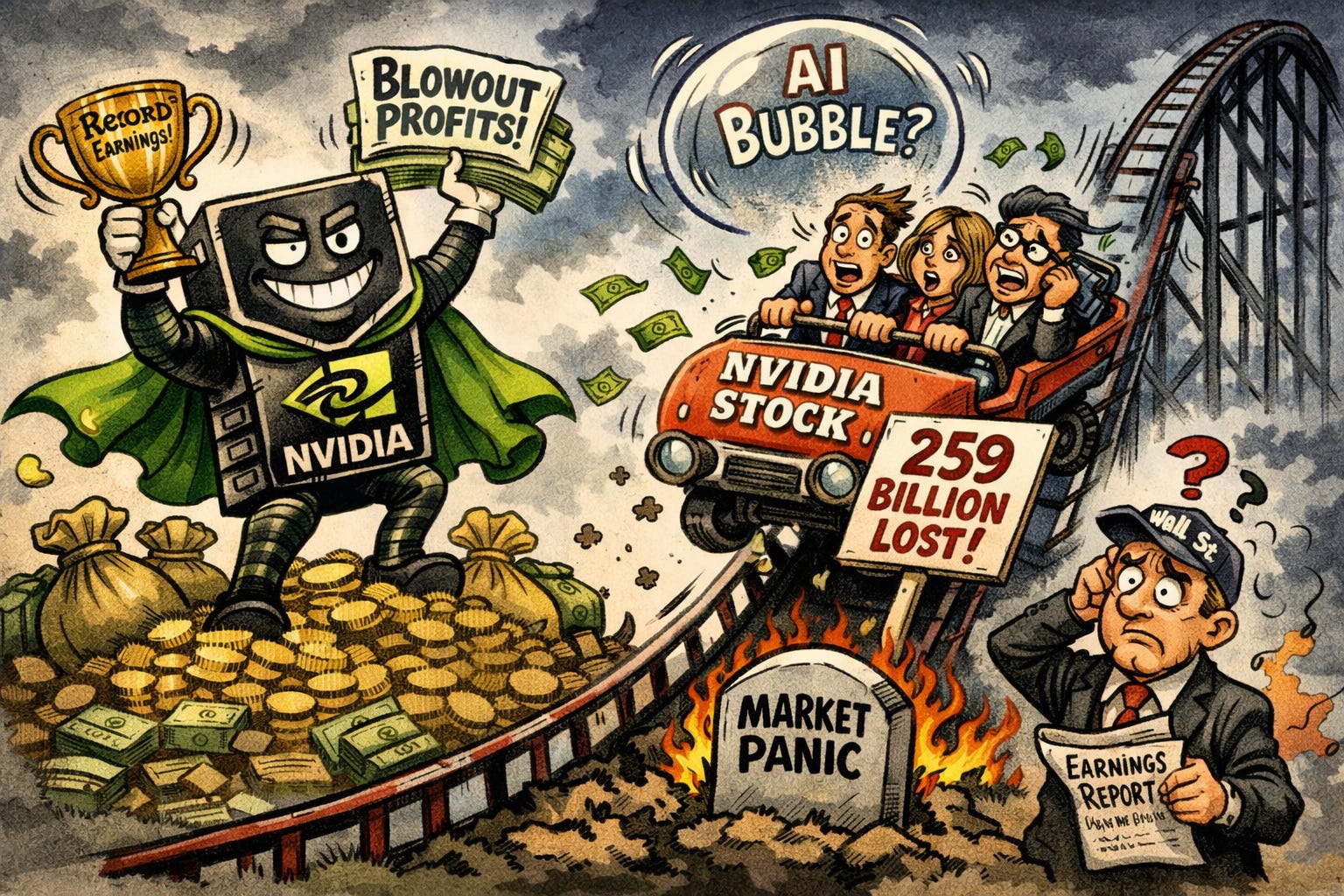
Nvidia posted fiscal fourth-quarter results on Tuesday evening that crushed expectations across the board, then watched its stock drop 5.55% yesterday, wiping out roughly $259 billion in market value in a single session. Revenue hit $68.13 billion, up 73% year-over-year and nearly $2 billion above consensus. Adjusted earnings per share came in at $1.62, beating the $1.53 estimate by 6%. Net income reached $42.96 billion and free cash flow hit $34.9 billion, up 125% from a year ago. The data centre segment generated $62.3 billion alone, up 75% and now accounting for 91% of total revenue. Even the guidance was a blowout: Nvidia projected $78 billion in first-quarter revenue, beating the Street’s $72.6 billion estimate by $5.4 billion. Morgan Stanley analyst Joseph Moore called it “the largest, cleanest beat and raise in the history of the semis industry” (CNBC).
So why did the stock fall? The sell-off was not about Nvidia’s execution. It was about whether the companies buying its chips can justify the spending. Alphabet, Amazon, Meta, and Microsoft are collectively expected to spend $650 to $700 billion on AI infrastructure in 2026. Amazon is projected to have negative free cash flow this year, and Alphabet’s is forecast to drop 64%. That raises uncomfortable questions about whether the AI buildout is creating a bubble even as Nvidia’s own numbers remain impeccable. The stock now trades at roughly 25 times projected fiscal 2027 earnings, the cheapest forward multiple among the Magnificent Seven relative to its growth rate. AMD, with a data centre business 11 times smaller, trades at a higher multiple. Analysts remain overwhelmingly bullish, with an average 12-month price target around $255 to $272, implying roughly 40% upside. But the market has moved past rewarding revenue beats and is now demanding proof that the AI infrastructure wave will generate real returns for the companies writing the cheques (Bloomberg).
Sensei’s Insight: Here is the paradox: Nvidia trades at roughly 25 times forward earnings, the cheapest of the Magnificent Seven on a growth-adjusted basis, yet gets punished the hardest on a blowout quarter. Either the market is handing patient investors a gift, or it is pricing in something the analysts have not caught yet. The answer depends entirely on whether you trust the companies buying the chips, not the company making them.
🔗 Connect with Us
Stay plugged in across platforms:
Sensei on X: sensei_live_
Martyn Lucas on X: MartynInvestor
Vaz on X: eVTOLHUB
📺 YouTube Channel (Live & Replays): Martyn Lucas Investor