

This content is for informational and educational purposes only and does not constitute financial advice. Always do your own research. Not financial advice (NFA).
👀 Today’s Stories at a Glance
📦 Amazon’s cloud reaccelerates: AWS grew 37%, its fastest in 18 quarters, and the shares jumped about 12% before the opening bell in New York.
🍎 Apple falls despite a record: Its best June quarter ever was not enough, with services missing and the shares down about 7%.
💻 Microsoft’s $450 billion day: The biggest one-day gain in stock market history, beating the record Nvidia set in April 2025 by $9 billion.
🇯🇵 Tokyo buys the yen back: The dollar fell 3% against the yen, the Bank of Japan held at 1%, and the move faded.
📉 Growth slows as inflation cools: The economy grew 1.5% last quarter against 1.8% expected, and the Fed’s headline gauge fell to 3.7% from 4.1%.
🪙 Coinbase sinks on a revenue miss: Trading revenue fell 21% in three months, and the shares dropped 5% after the numbers landed.
🛢️ Oil eases as Hormuz reopens: Fourteen ships crossed the strait midweek against single digits last week, and Brent slipped to $87.78 a barrel.
🇪🇺 Europe’s inflation climbs again: Euro-area prices rose 2.9% over the year as energy costs jumped 10%, and traders now expect a September rise.
🇬🇧 The FTSE keeps setting records: London’s blue-chip index touched 10,979.24 this week, its highest ever, helped by a run of strong company results.
📈 Where I would start nibbling Apple: Chart of the Day covers the $305 first order, the $290 limit and the Deep Trend rising underneath.
🧠 One Big Thing
Japan spent real money defending its currency and the market handed most of it back inside a day. The dollar fell as much as 3% against the yen, its sharpest drop in years, in a move nobody in Tokyo has claimed, and it was back above 160 this morning after the Bank of Japan held its rate at 1%. The Ministry of Finance already used a record 11.73 trillion yen, around $73 billion, in April and May. Intervention buys time. It does not close the gap between a Fed at 3.5% to 3.75% and a central bank at 1%, and that gap is what prices the yen. Watch 164, because cheap yen funding sits underneath a lot of US tech and crypto.
⚖️ Fear & Greed
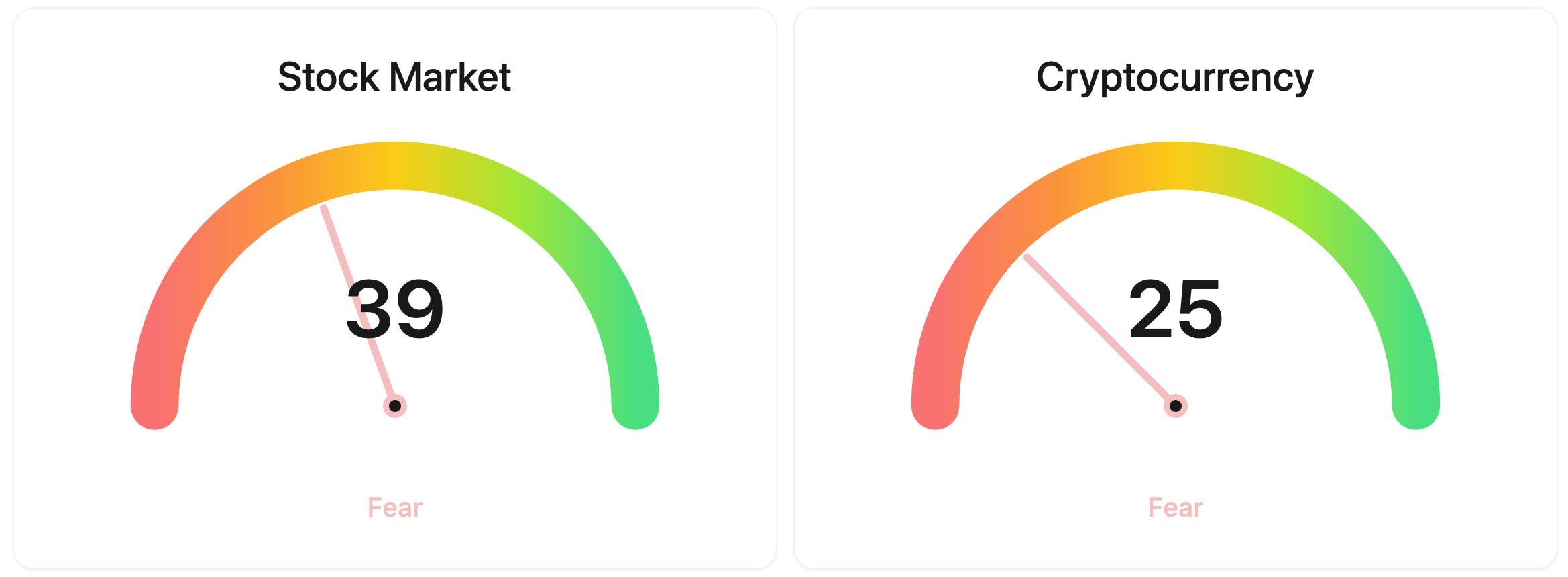
📉 The Number That Matters
$450 billion
Microsoft added $450 billion of market value in a single session, the largest one-day gain any company has ever recorded, beating Nvidia’s $441 billion in April 2025.
⚔️ Winners vs Losers
Winners
REPL 0.00%↑ : 132.16% Replimune Group exploded higher after an FDA advisory committee voted 10 to 3 that data from the IGNYTE trial of its melanoma therapy RP1 were reliable and clinically meaningful. The vote clears a path for a regulatory decision expected by August 2 following two prior rejections.
AXTI 0.00%↑ : 30.04% AXT Inc rocketed after record second quarter revenue of 47.6 million, up 164% year over year, and adjusted earnings of 19 cents against a 7 cent estimate. Management guided third quarter sales roughly 70% above consensus on surging indium phosphide demand from AI data centre optics.
COHU 0.00%↑ : 23.94% Cohu surged after second quarter revenue rose 38% year over year to 149 million with adjusted earnings of 26 cents nearly doubling the 14 cent consensus, and the company lifted its full year high performance computing revenue outlook.
AMZN 0.00%↑ : 11.15% Amazon.com jumped after second quarter revenue of 200.61 billion and earnings of 5.75 per share both cleared consensus, with AWS growing 36.7% year over year, its fastest pace in eighteen quarters.
MPWR 0.00%↑ : 10.87% Monolithic Power Systems climbed after posting record quarterly revenue of 980.6 million, up 47.6% year over year, alongside a 500 million expansion of its buyback authorisation.
ETN 0.00%↑ : 7.01% Eaton Corporation gained after second quarter adjusted earnings of 3.15 per share and revenue of 8.53 billion both topped Wall Street forecasts on continued data centre demand.
SNDK 0.00%↑ : 6.25% Sandisk added to Thursday’s 26% surge as Samsung warned the memory shortage could persist into 2028 and both Amazon and Apple flagged rising memory costs on their earnings calls. SK hynix rose 6.99% on the same supply crunch story.
Losers
KPTI 0.00%↑ : -67.33% Karyopharm Therapeutics collapsed after topline results from its Phase 3 XPORT-EC-042 trial failed to meet the primary endpoint of progression free survival.
MYGN 0.00%↑ : -36.69% Myriad Genetics cratered after second quarter revenue fell 10.5% to 190.7 million and missed estimates, with management cutting full year revenue guidance to roughly 780 million from 870 million.
DFNS 0.00%↑ : -35.87% T3 Defense reversed sharply as traders unwound the low float squeeze that followed a 1 for 125 reverse split, which cut shares outstanding from about 139.8 million to roughly 1.12 million.
RBLX 0.00%↑ : -20.38% Roblox tumbled after second quarter revenue of 1.47 billion missed consensus and a soft third quarter outlook overshadowed a narrower than expected loss, with age verification still weighing on user growth.
MTZ 0.00%↑ : -15.24% MasTec slid after adjusted earnings of 2.22 per share landed merely in line, disappointing investors despite a revenue beat, raised full year guidance and a record 21.4 billion backlog.
AAPL 0.00%↑ : -7.54% Apple fell despite its strongest June quarter on record, as services revenue of 30.74 billion missed the 31.22 billion expected and iPad also came up short, with the company flagging rising memory costs on the call.
📊 Market Snapshot
Cryptocurrencies:
Bitcoin (BTC): $63,951 (▼ 1.15%)
Ethereum (ETH): $1,888 (▼ 1.46%)
XRP: $1.07 (▼ 0.62%)
Equity Indices (Futures):
S&P 500: 7,507 (▲ 0.46%)
NASDAQ 100: 28,570 (▲ 1.18%)
FTSE 100: 10,917 (▼ 0.09%)
Commodities & Bonds:
10-Year US Treasury Yield: 4.68% (▲ 0.04%)
Oil (WTI): $84 (▲ 0.62%)
Gold: $4,054 (▼ 1.18%)
Silver: $57.81 (▼ 2.01%)
Data as of: UK: 12:06 BST / US: 07:06 EDT / Asia (Tokyo): 20:06 JST
✅ 5 Things to Know
📦 Amazon’s cloud grows 37% and the shares take off
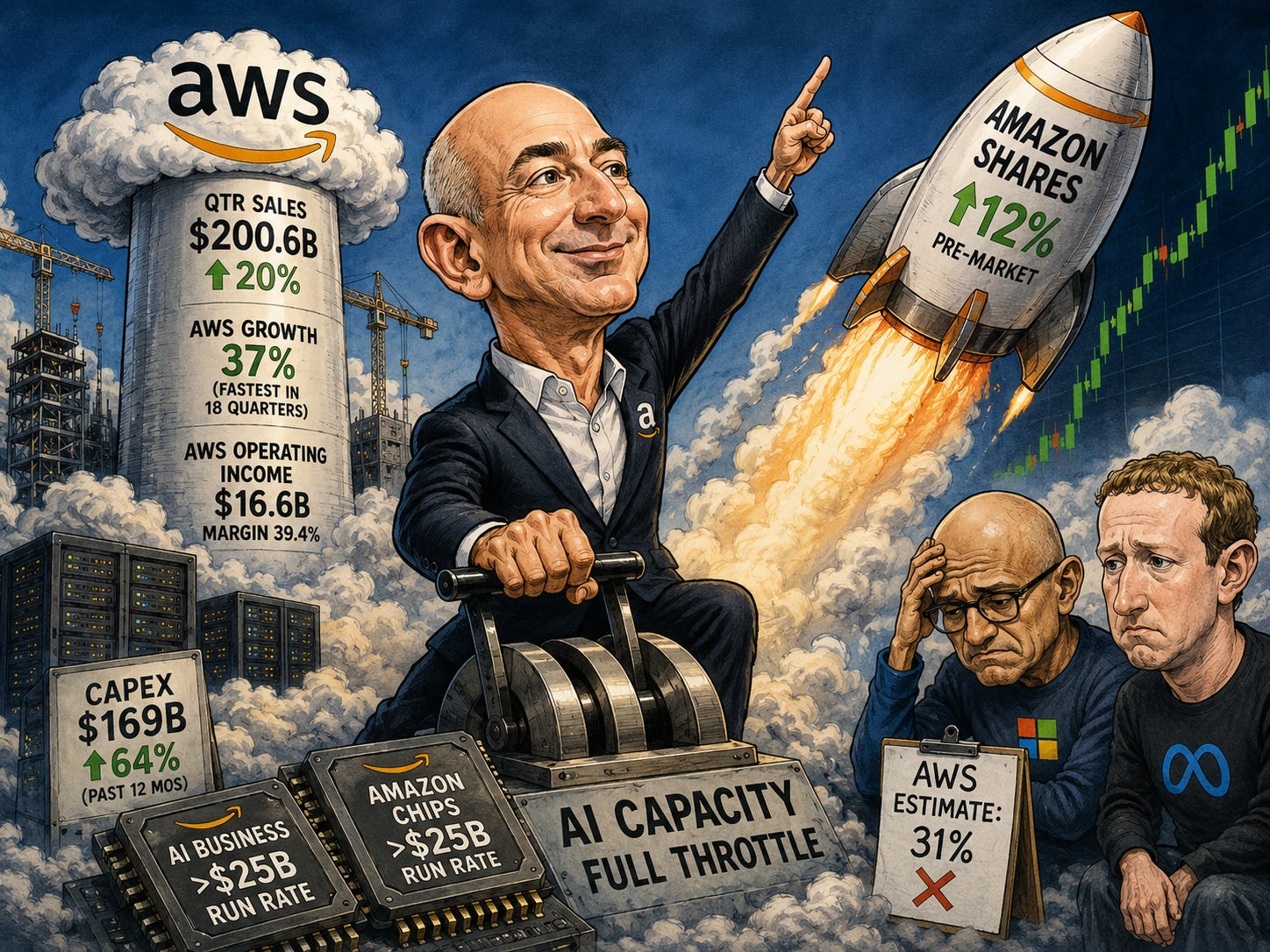
Amazon became the first company to sell more than $200 billion of goods and services in a single quarter, with net sales of $200.6 billion, up 20% from $167.7 billion a year earlier. Operating income rose 43% to $27.5 billion. The number investors had circled was Amazon Web Services, and it grew 37% to $42.2 billion, the fastest rate in eighteen quarters and well ahead of the 31% analysts had modelled, giving the division an annual run rate of $169 billion. AWS operating income reached $16.6 billion against $10.2 billion a year earlier, at a margin of 39.4% (CNBC).
The shares jumped about 12% before the open. What separates this from an ordinary beat is that the cloud margin went up while the bill went up with it: property and equipment purchases over the past twelve months hit $169 billion, a rise of 64%, almost all of it artificial-intelligence capacity. Amazon also said its AI business and its own chip business each now run above $25 billion a year, which is the first time the company has put a size on either. That is the same test Microsoft passed at midweek and Meta failed twenty minutes later (CNBC).
Sensei’s Insight: Analysts modelled 31% growth for AWS. It came in at 37%, the fastest in eighteen quarters, and the division’s margin went up rather than down while capital spending rose 64%. That is the argument for AI spending, and Amazon just made it best.
🍎 Apple’s best June quarter ever ends with a 7% fall
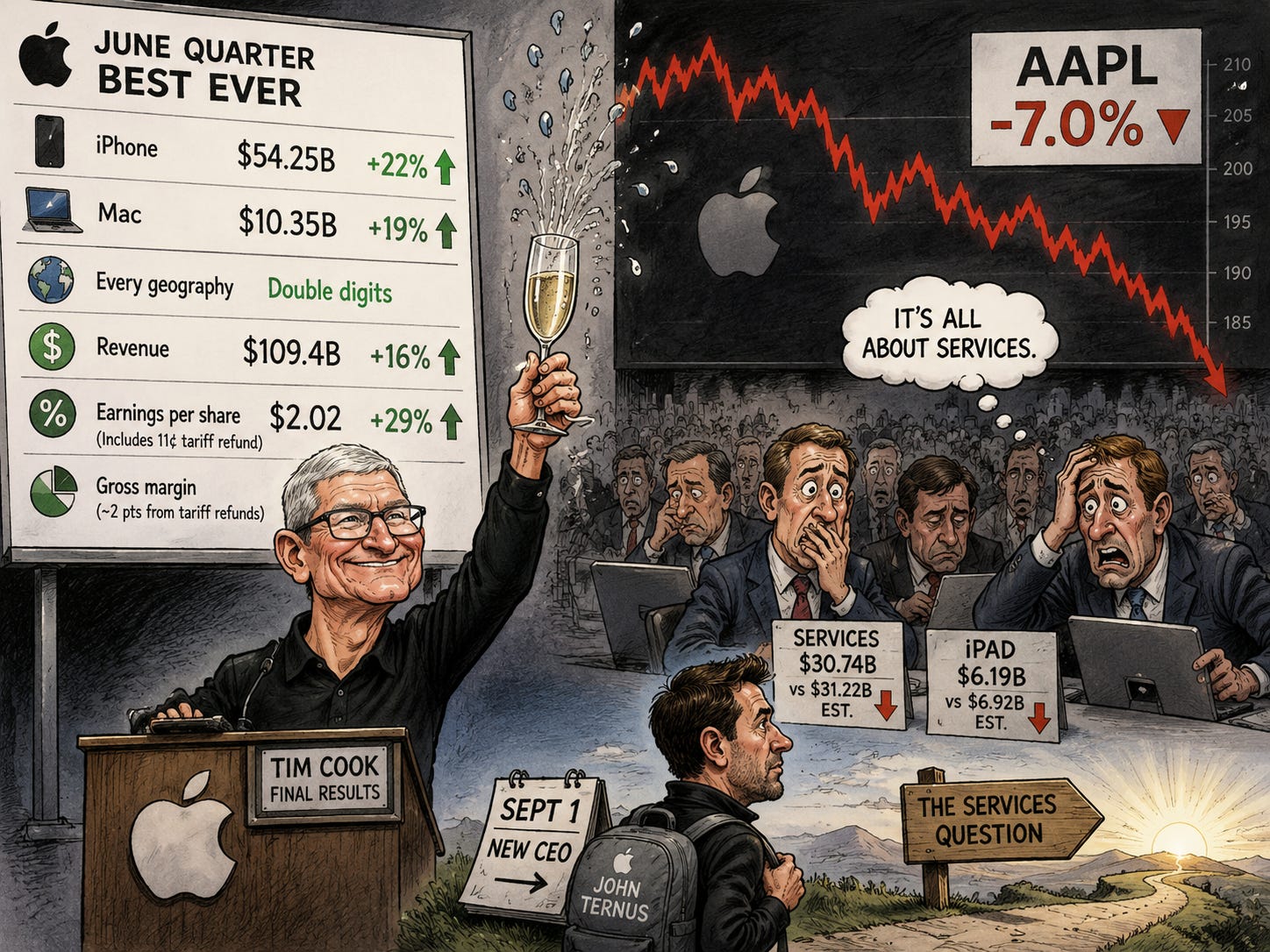
Apple reported revenue of $109.4 billion, up 16%, its strongest June quarter on record, with diluted earnings of $2.02 a share, up 29% and including 11 cents of help from tariff refunds. iPhone revenue of $54.25 billion beat the $53.86 billion expected and grew 22% on the year. Mac revenue of $10.35 billion crushed an $8.74 billion estimate. Gross margin came in at 50.1%, roughly two percentage points of that from the same tariff refunds. Every geography and almost every product line grew by double digits (CNBC).
The shares fell about 7% anyway, because services revenue of $30.74 billion came in under the $31.22 billion analysts wanted, and iPad at $6.19 billion missed a $6.92 billion forecast. Services is the reason Apple trades where it does: it carries the fattest margin in the company and it is supposed to keep compounding whatever the hardware cycle does. A miss of under $500 million on a $109 billion quarter would be a rounding error anywhere else. Here it is the one line that cannot wobble. This was also Tim Cook’s final set of results, with John Ternus taking over as chief executive on 1 September (Yahoo Finance).
Sensei’s Insight: Apple sold more iPhones than anyone expected and still lost 7%. Services is the line the valuation rests on, because it carries the margin and it is meant to grow through a slow hardware year. Ternus inherits that question on 1 September.
💻 Microsoft’s $450 billion day is the biggest in market history
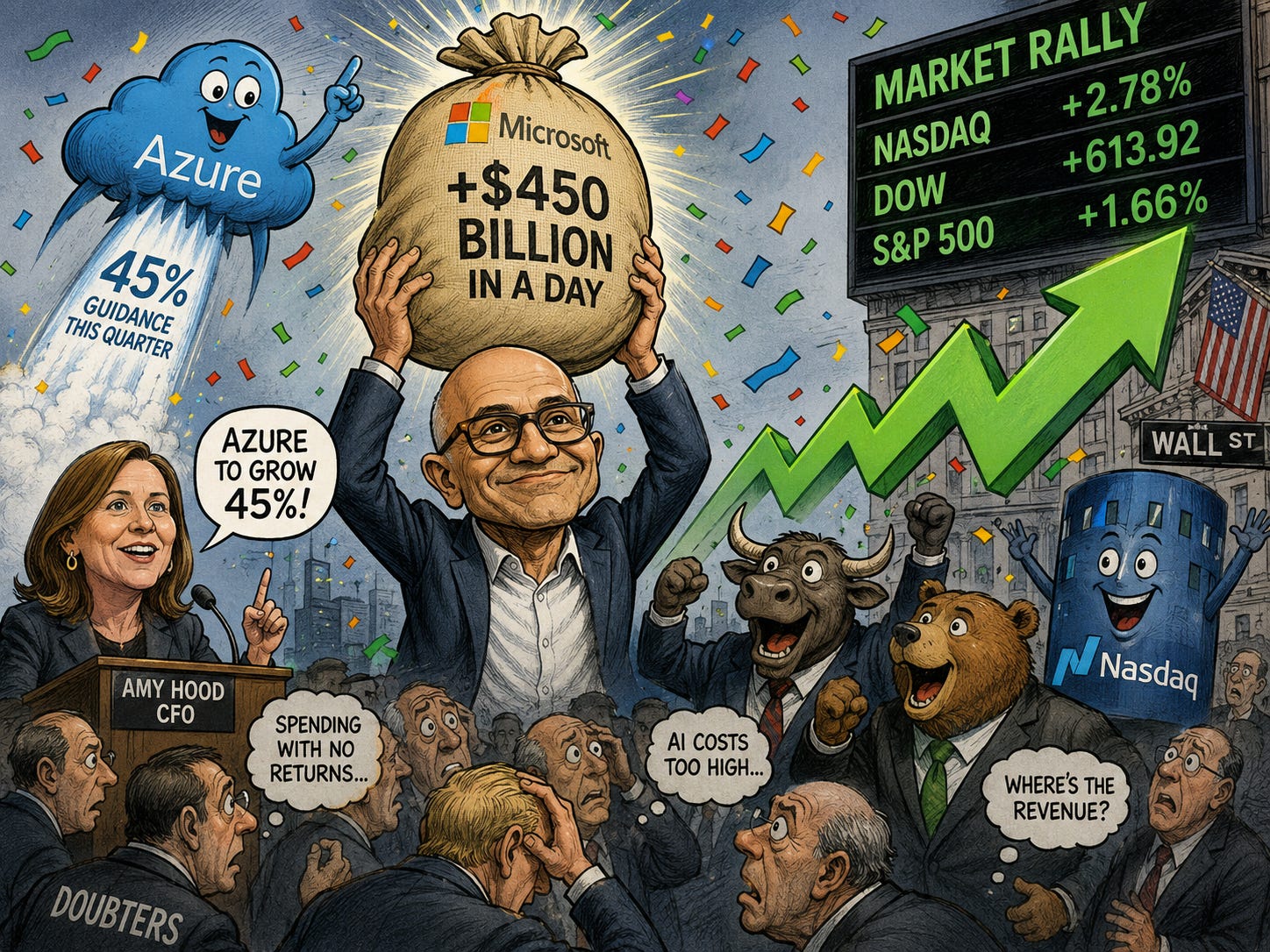
Microsoft closed up more than 15% yesterday, adding close to $450 billion of market value in a single session and taking its market capitalisation to $3.35 trillion. That is the largest one-day gain any company has ever recorded, beating the $441 billion Nvidia added on 9 April 2025. The trigger was guidance rather than the quarter itself: finance chief Amy Hood told investors Azure should grow 45% in constant currency this quarter, against the 40.9% analysts had pencilled in, after growing 43% in the quarter just reported, its fastest since early 2022 (Yahoo Finance).
The rest of the market came with it. The Nasdaq Composite rose 2.78% to 25,122.18, ending a six-day losing streak, the Dow gained 613.92 points to 52,208.06 and the S&P 500 added 1.66% to 7,437.63, a full recovery of the ground lost on the Fed’s split decision two sessions earlier. What changed is narrow and specific. For most of this year the megacaps have been marked down for spending on artificial intelligence, because the spending was visible and the revenue was not. Microsoft put a number on the revenue and the market repriced the whole complex in an afternoon (CNBC).
Sensei’s Insight: A $450 billion day tells you how much doubt was priced in beforehand. Microsoft is worth $3.35 trillion again on a single guidance line about Azure. The Nasdaq ended a six-day losing run on it. Watch whether that holds into August.
🇯🇵 Tokyo buys the yen back, then the Bank of Japan sits still
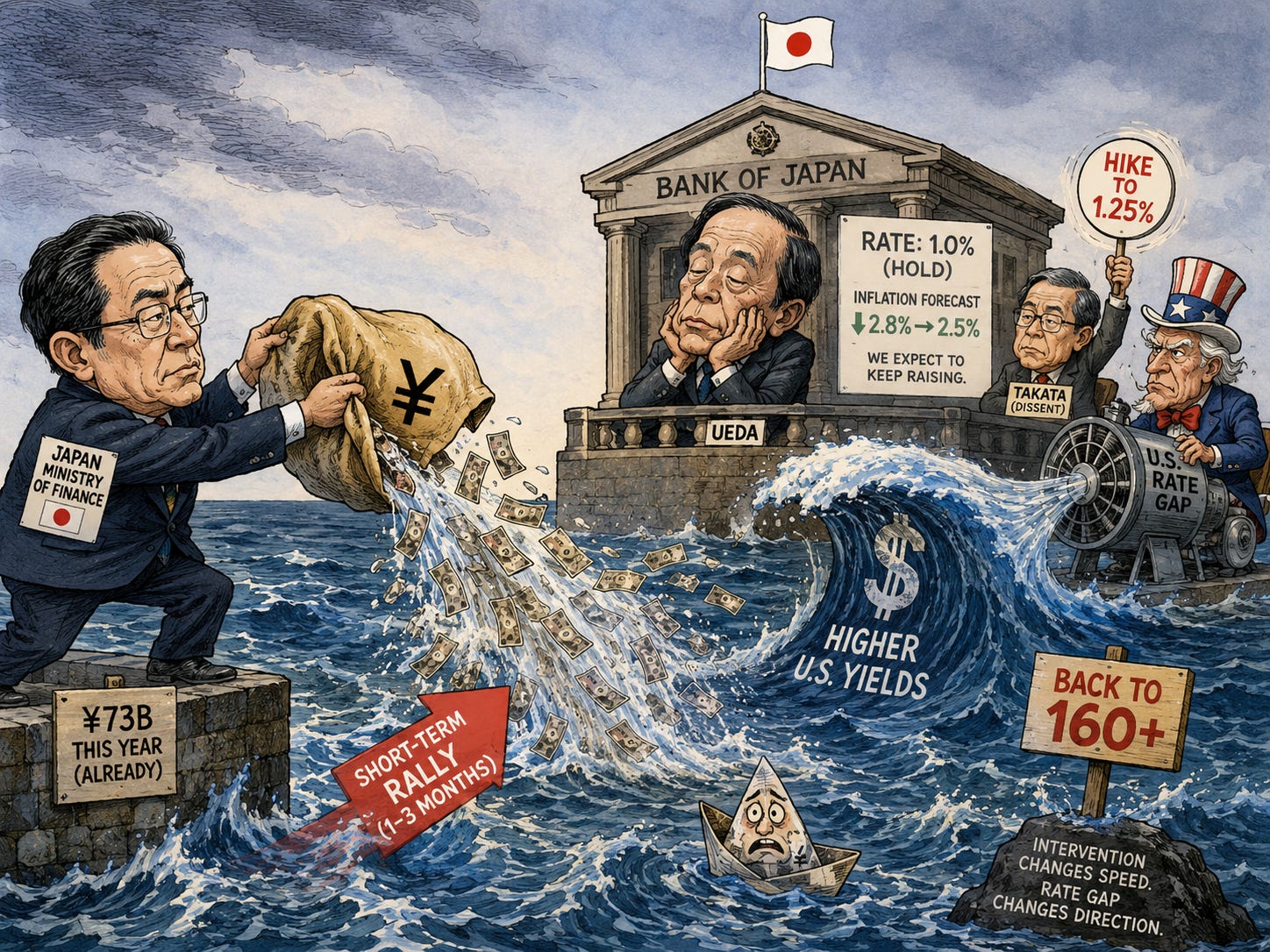
The dollar fell as much as 3% against the yen yesterday, to 158.34 from 40-year highs near 164 earlier in the week, in a move fast enough and large enough that traders read it immediately as official Japanese buying. The Ministry of Finance has said nothing, which is its standard practice. Japan has already spent heavily this year: a record 11.73 trillion yen, around $73 billion, went into supporting the currency across April and May, close to double its largest previous effort. A weak yen makes Japan’s energy imports dearer at exactly the moment oil is elevated (Yahoo Finance).
This morning the Bank of Japan held its policy rate at 1% on an eight-to-one vote, with Hajime Takata dissenting in favour of a rise to 1.25%. The board cut its core inflation forecast for this fiscal year to 2.5% from 2.8%, nudged the following year up to 2.4%, and Governor Kazuo Ueda said members’ forecasts are high with risks tilted to the upside and that the bank still expects to keep raising rates. The dollar recovered as much as 0.8% to 160.69 in early trading. That is the shape of the problem: the intervention moves the price for a session, and the rate gap between Tokyo and Washington moves it back (CNBC).
So does it work? Japan has now stepped into this market four times since 2022, and the pattern has been the same every time. The first operation, in September 2022, was the first yen buying since 1998. The following month took 6.35 trillion yen. April 2024 came at 160.03 to the dollar. This April and May took the record 11.73 trillion. Each one produced a sharp yen rally lasting somewhere between one and three months, and each time the currency then drifted back to where it had been heading. The one occasion the effect held was when the buying arrived alongside an actual rate rise and softening US data, which is the point: intervention works when the rate gap is already narrowing, and fades when it is not.
Can Japan keep going? On paper, easily. Foreign reserves sit near $1.4 trillion. In practice it is more awkward than that headline suggests, because most of those reserves sit in US Treasuries and only a slice is cash. The readily deployable foreign-currency deposits are closer to $150 billion to $180 billion. Fund a large operation and you have to sell the bonds. Japan’s holdings of foreign securities fell $50.4 billion in May, immediately after the record spend. Selling Treasuries pushes US yields up, and higher US yields widen the very gap that is pushing the yen down in the first place. It is a fire hose pointed at the wrong end of the problem.
Which leaves the rate. Ueda said this morning the bank expects to keep raising, and a Reuters poll of 87 economists last week found 86% looking for 1.25% by December, with just over half treating 1.5% as the end of the cycle. That is the only thing that changes the direction. Everything else changes the speed. Intervention buys Tokyo the weeks in between.
Sensei’s Insight: Japan has spent a record amount defending the yen this year, and the currency was back where it started within a day. Four operations since 2022, four rallies of one to three months, and the trend intact after each. Only the rate gap changes the direction. Watch 164.
📉 Growth slows to 1.5% as the Fed’s inflation gauge cools
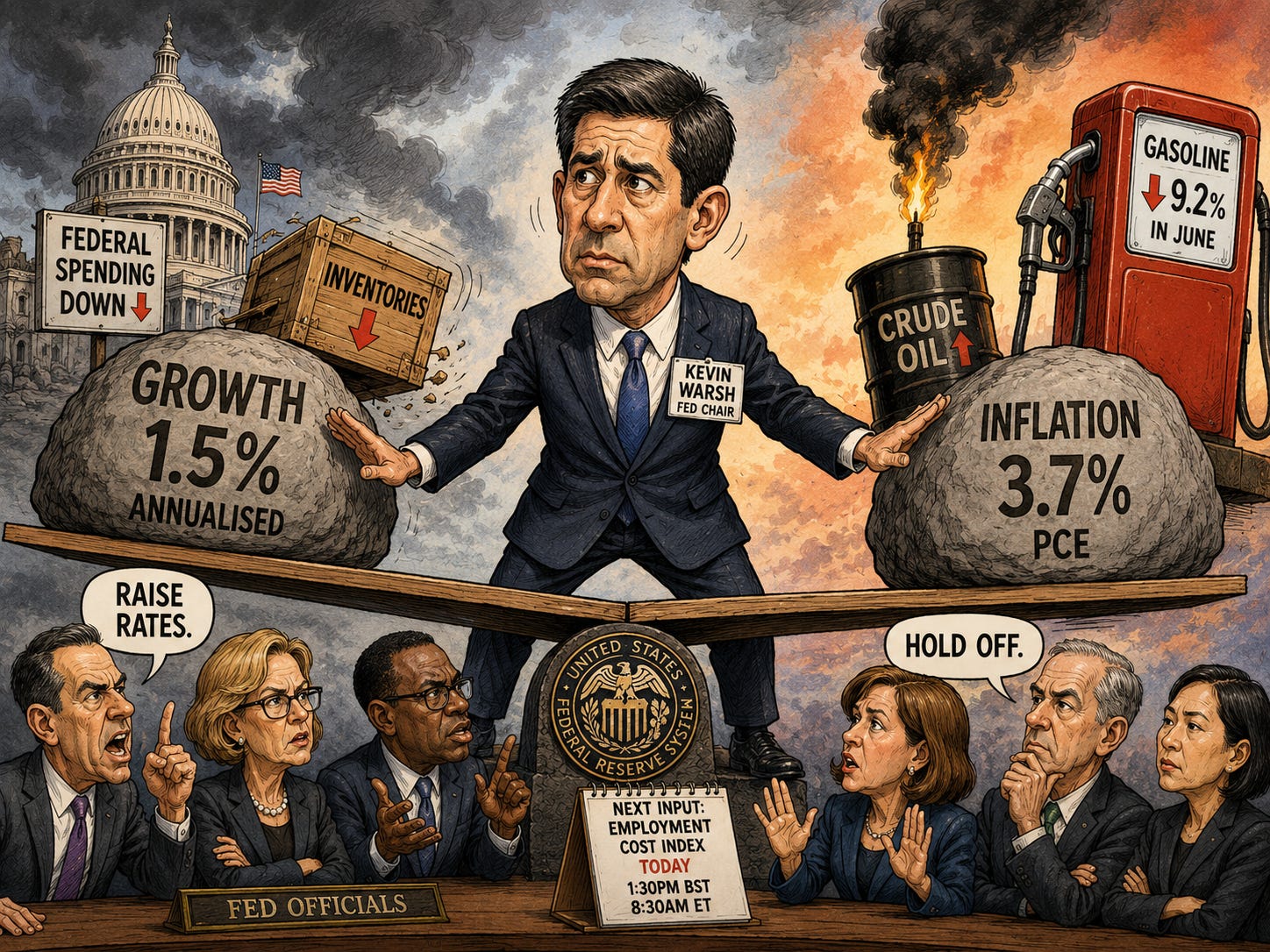
The US economy grew at a 1.5% annualised rate in the second quarter, down from 2.1% in the first and short of the 1.8% economists expected, with the shortfall coming from a fall in federal government spending and a drawdown in inventories. In the same release, the personal consumption expenditures price index, the gauge the Fed actually targets, fell to 3.7% on the year from 4.1% in May. Core PCE eased to 3.3% from 3.4%. Energy goods and services prices dropped 5.9% in the month and petrol fell 9.2%, which did most of the work (CNBC).
Both halves of that come with a warning. The energy relief reflects the brief pause in the fighting around the Strait of Hormuz in June, and crude has since gone back up and stayed up, so the July figure is unlikely to look this friendly. Growth slowing while inflation sits at nearly double the target is the combination that produces exactly the argument three Fed officials had in public two sessions ago. Futures now put the odds of a rise by September at around two in three, down from about four in five before the release. The Employment Cost Index, the Fed’s preferred read on wage pressure, lands today at 1:30pm BST, 8:30am ET (Yahoo Finance).
Sensei’s Insight: Growth at 1.5% with inflation at 3.7% is the combination that splits a central bank, which is exactly what happened in public this week. A September rise is still the base case. The Employment Cost Index at 1:30pm BST, 8:30am ET, is the next input.
Stories You Might Have Missed
🪙 Coinbase misses and the shares drop 5%
Coinbase reported second-quarter revenue of $1.22 billion against expectations closer to $1.30 billion, and a net loss of $359.5 million, or $1.36 a share. Transaction revenue fell 21% over three months to $599 million, while subscriptions and services held up at $555 million, or 48% of net revenue, with stablecoin income of $292 million on a record $20 billion average USDC balance held in Coinbase products. The backdrop was ugly for anyone charging by the trade: market-wide spot volumes fell 25%, crypto prices fell 11% and volatility hit multi-year lows. The exchange still took a record 10.3% share of global trading volume and posted its fourteenth straight quarter of positive adjusted earnings. The shares fell 5% (CoinDesk).
🛢️ Oil slips as ships start crossing Hormuz again
Brent crude fell 1.4% to $87.78 a barrel and US West Texas Intermediate dropped 1.6% to $82.27, extending a decline that began when Saudi Arabia proposed a naval coalition to protect shipping in the Red Sea and the Strait of Hormuz, a meeting more than 40 countries attended. The harder evidence came from the water: the cargo tracking firm Kpler counted fourteen commodity vessels crossing the strait in both directions midweek, against single-digit daily crossings the week before. That matters more than any communiqué, because a war premium drains away when the barrels physically move. Even after the slide, both benchmarks are set to finish the month around 20% higher (CNBC).
🇪🇺 Euro-area inflation climbs to 2.9% and traders price a rise
Consumer prices across the euro area rose 2.9% over the year to July, up from 2.8% in June and in line with forecasts, with core inflation stripping out food and energy ticking up to 2.5% from 2.4%. Energy was the driver by a distance, up 10% on the year, followed by services at 3.3%. German inflation accelerated to 2.8% and Italy matched the bloc at 2.9%. The European Central Bank held its deposit rate at 2.25% last week and President Christine Lagarde has already flagged renewed Middle East hostilities as an upside risk to prices. Traders are now positioned for a quarter-point rise in September, a striking turn for a bank that spent the spring debating cuts (Yahoo Finance).
🇬🇧 The FTSE 100 keeps making record highs through a war
London’s blue-chip index touched an intraday record of 10,979.24 yesterday, the second consecutive session in which it set a new high, before losing momentum late and closing at 10,897.27, down 11.14 points. It is trading higher again this morning. The run is coming from the results themselves, with a string of FTSE 100 names beating expectations, and from the index’s own composition: heavy weightings in energy and mining mean an oil price up around 20% on the month flatters the whole benchmark. The FTSE has now added roughly 4% in a month and around 19% over a year, which is a considerable stretch for an index that spent a decade being written off (Yahoo Finance).