

This content is for informational and educational purposes only and does not constitute financial advice. Always do your own research. Not financial advice (NFA).
👀 Today’s Stories at a Glance
📉 The jobs number lands today: forecasts run from 53,000 to 65,000 August jobs, after July lost 23,000.
🏦 The Fed is a coin flip again: Waller cut the odds of a September rate rise to about 50% from about 63%.
🤖 Nvidia buys Hugging Face: $12.9bn for the platform where 18 million developers publish and download AI models.
🛢️ Oil’s biggest week since July: Brent flirted with $96 and 6 vessels crossed Hormuz on Wednesday against an average near 13.
🇬🇧 The Bank of England splits in public: the chief economist wants 4% and the Governor sees little sign of it spreading.
💻 Broadcom split Wall Street: one broker took its target to $600, another cut to $460, on the same numbers.
₿ Bitcoin back above $81,000: US spot bitcoin funds took $101m on Tuesday after $237m left the day before.
📊 Beat the numbers, sold anyway: Guidewire fell 15% after hours and Ciena lost 10% after raising its forecasts.
🇯🇵 The yen is the week’s winner: it gained more than 2% on Thursday as the Bank of Japan talked up September.
🔍 My biggest single stock buy yet: the deep dive has the balance sheet, the numbers and the reason I bought it.
📈 One chart before you go: the Chart of the Day carries the levels I am watching on that position and why.
🧠 One Big Thing
Markets spent a fortnight pricing a US rate rise, and on Thursday one Fed governor talked them out of half of it. Christopher Waller said he could support holding rates where they are if inflation keeps improving, and the odds of a rise on 16 September fell from about 63% to about 50%. Shares had their best day in a month on that sentence. No number changed. At 1:30pm UK, which is 8:30am in New York, the August jobs report lands, and it is the first hard test of a rally built on a speech.
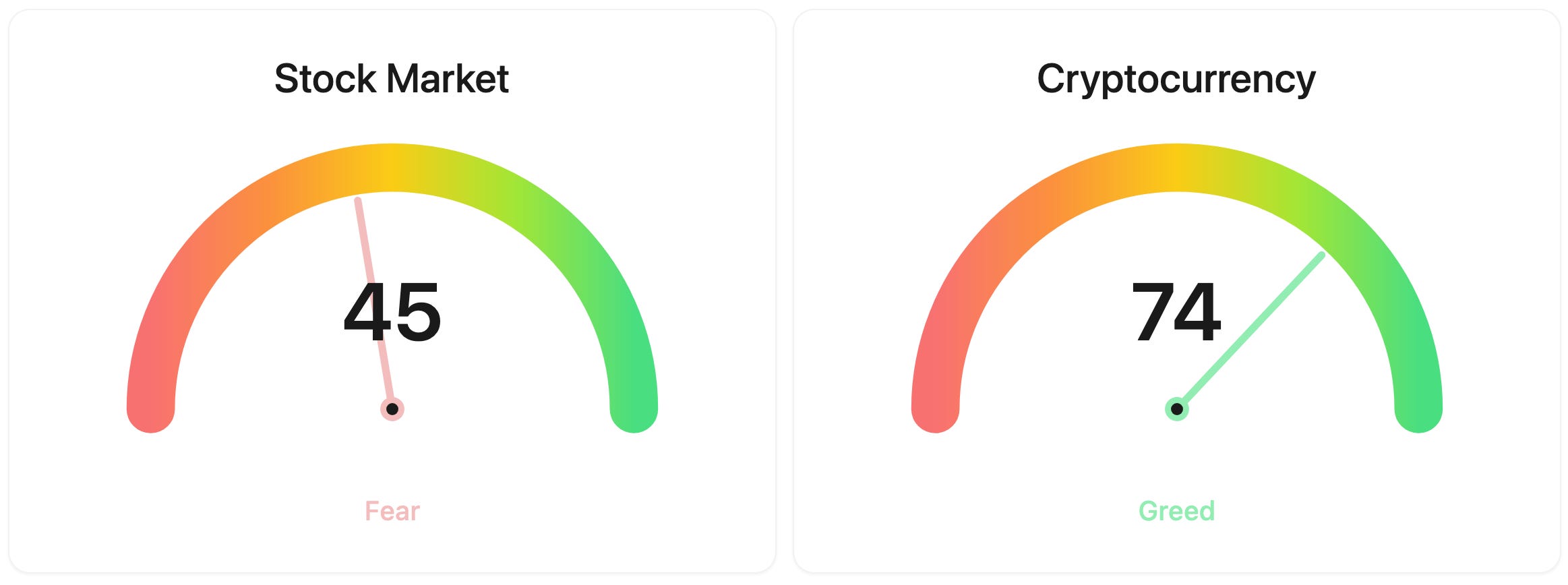
⚖️ Fear & Greed
📉 The Number That Matters
50%
The market puts the odds of a US rate rise on 16 September at about 50%, down from about 63% earlier in the week. One governor’s speech moved that number further than a fortnight of data did.
⚔️ Winners vs Losers
Winners
IOT 0.00%↑ : 13.29% Samsara Inc. surged after posting Q2 revenue of $508.4m against $483.3m expected and adjusted EPS of 20 cents versus 16 cents, crossing $2.1bn in annual recurring revenue with net new ARR up 28%.
Losers
LULU 0.00%↑ : 20.88% lululemon athletica inc. collapsed after cutting full-year revenue guidance to a decline of 5% to 7% from flat to down 1% and slashing EPS guidance to $9.48 to $9.73 from $10.95 to $11.15. Q2 revenue of $2.4bn missed and comparable sales fell 9%, with the headline EPS beat flattered by an $0.86 one-time tariff refund benefit.
OXM 0.00%↑ : 17.06% Oxford Industries, Inc. sank after guiding Q3 revenue to $280m to $300m, around 7.5% below consensus, and cutting full-year EPS to $1.60 to $2.00 against $2.47 expected. CEO Tom Chubb blamed ongoing weakness at Lilly Pulitzer alongside softer consumer sentiment and elevated travel costs.
GWRE 0.00%↑ : 15.46% Guidewire Software, Inc. dropped after guiding next-quarter revenue to $375m versus $387.6m expected, overshadowing a quarter that beat with revenue of $411.1m, up 15.3% year on year, and adjusted EPS of $0.99.
📊 Market Snapshot
Cryptocurrencies:
Bitcoin (BTC): $81,164 (▼0.09%)
Ethereum (ETH): $2,522 (▲0.61%)
XRP: $1.45 (▼0.14%)
Equity Indices (Futures):
S&P 500: 7,762 (▲0.09%)
NASDAQ 100: 29,679 (▲0.52%)
FTSE 100: 10,824 (▼0.09%)
Commodities & Bonds:
10-Year US Treasury Yield: 4.77% (▼0.08%)
Oil (WTI): $91 (▼1.00%)
Gold: $4,465 (▼0.16%)
Silver: $66.90 (▼0.06%)
Data as of: UK: 1:00 pm BST / US: 8:00 am EDT / Asia (Tokyo): 9:00 pm JST
✅ 5 Things to Know
📉 The jobs number lands within the hour
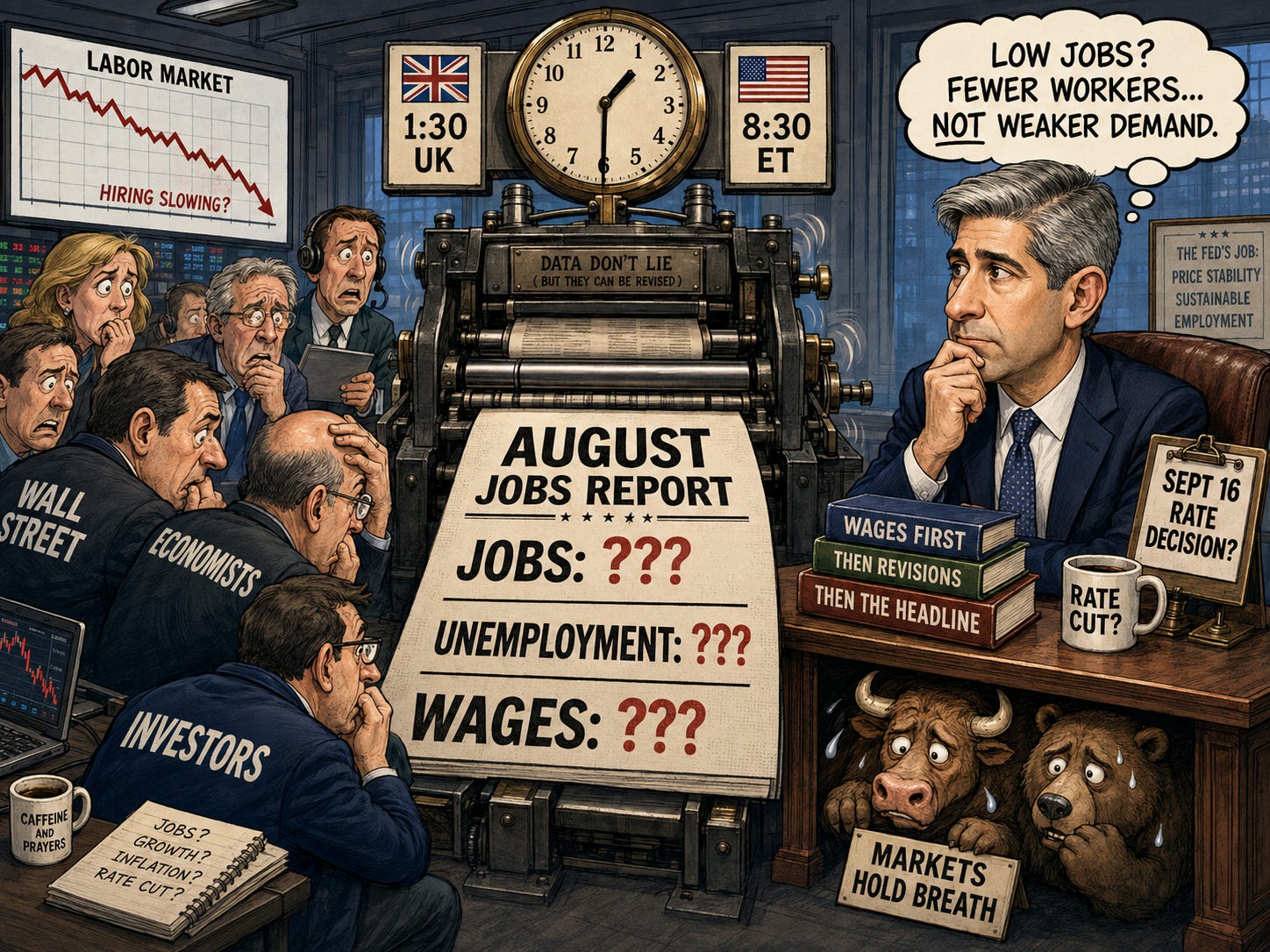
The August employment report is published at 1:30pm UK, 8:30am ET. Economists surveyed by FactSet expect 65,000 jobs and the unemployment rate rising to 4.2%, after July’s first estimate showed 23,000 jobs lost. Those polled by Dow Jones expect 53,000 and 4.1%, so the bar you are measuring against depends on which desk you read. The full range of forecasts runs from a fall of 25,000 to a gain of 121,000, and Bank of America, Barclays, Citi, Goldman Sachs, Nationwide, RBC and Vanguard all sit at 40,000 or below. The Chicago Fed’s real-time estimate has unemployment holding at 4.1%. (Barron’s)
The evidence going in is soft. ADP counted 38,000 private jobs in August against 47,000 expected, Challenger counted 52,881 announced job cuts against 33,429 the month before, and the employment index inside Thursday’s ISM services survey was 47.8 and contracted for a second month. Jobless claims were 206,000 in the week to 29 August, up from 204,000. Underneath the monthly noise, 2 forces are shrinking what counts as a normal number: baby boomers retiring and tighter immigration. The end of temporary protected status for about 200,000 Haitian nationals may drag on this month specifically. 22V Research puts the odds of any given payrolls report printing negative from here at about 40%. (Barron’s)
Sensei’s Insight: Wages first, then the revisions, then the headline. Kevin Warsh reads a low print as fewer workers available rather than weaker demand, so a soft count with hot wages keeps 16 September live and almost nobody is positioned for that. August has also undershot the forecast in each of the last 2 years.
🏦 One speech turned the Fed back into a coin flip
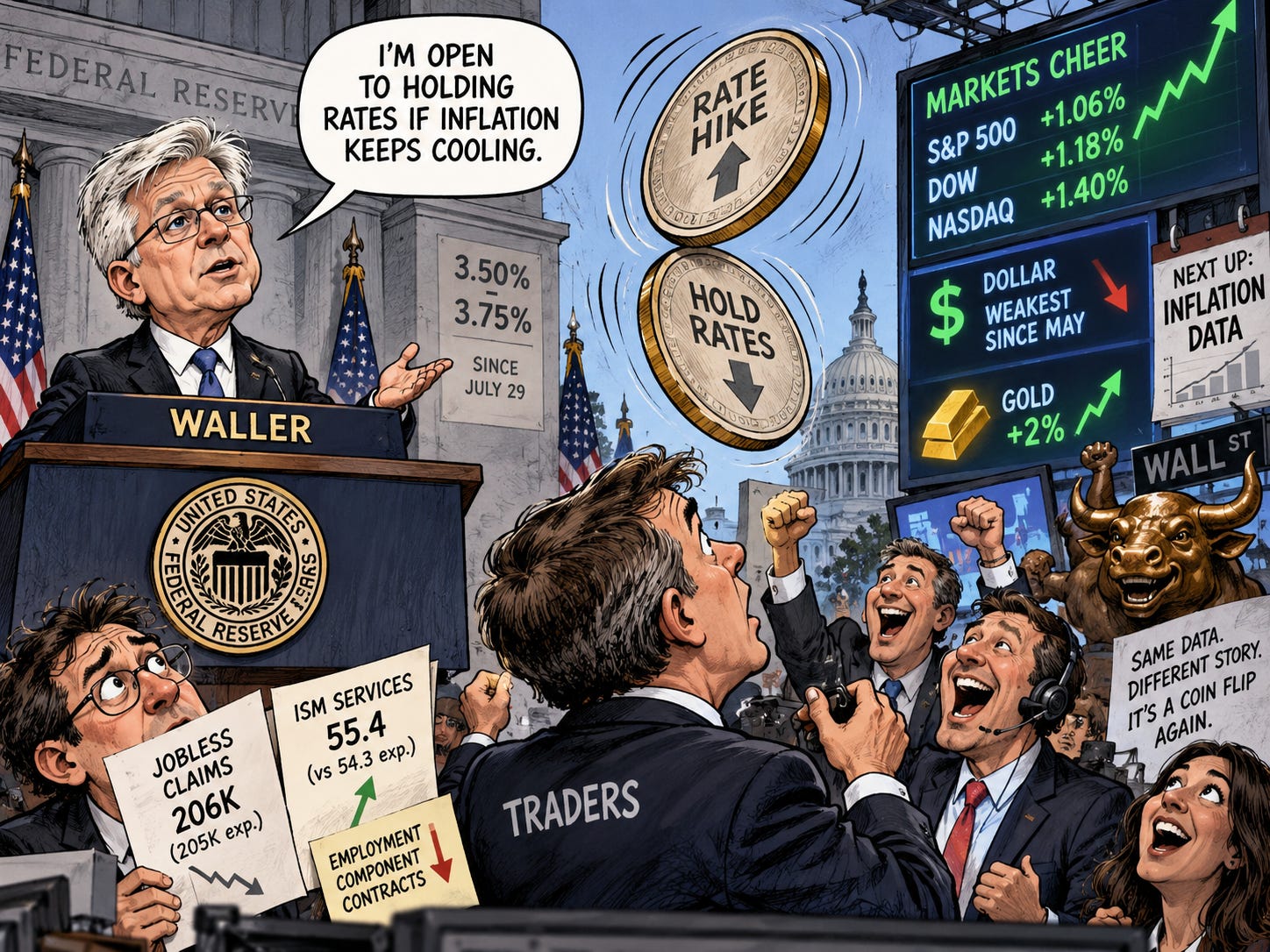
Fed Governor Christopher Waller said on Thursday that he is willing to support holding the policy rate where it is if there is continued progress toward 2% inflation. Traders repriced within the hour. The probability of a rise at the 16 September meeting fell to 50% on CME FedWatch by Thursday, from 63% on Wednesday. American shares had their best day in about a month: the S&P 500 closed up 1.06% at 7,747.71, the Dow up 1.18% at 53,686.11 and the Nasdaq Composite up 1.40% at 26,584.06. The dollar touched its weakest since May and gold rose about 2%. (PBS News)
Thursday’s data pulled in 2 directions underneath all that. Jobless claims came in at 206,000 against 205,000 expected, and the ISM services index jumped to 55.4 from 54.1, well above the 54.3 forecast, while the employment component inside it contracted. So the activity side of the American economy is firm and the hiring side is not, and the man who moved the market pointed past both of them at next week’s inflation print. The committee has held its target range at 3.50% to 3.75% since 29 July, on a 9-3 vote. (FXStreet)
Sensei’s Insight: A speech moved the odds 13 points and a week of data moved them barely at all. That tells you how much of this market is positioning rather than economics. I am still working on the basis that a rise comes in September or October.
🤖 Nvidia pays $12.9bn for the place AI developers actually work

Nvidia confirmed on Thursday that it will buy Hugging Face for $12.93 billion, made up of $11.9 billion to shareholders and $1 billion of equity to retain employees joining Nvidia, with the deal expected to close in the first half of 2027. Hugging Face hosts 3 million models, 1 million applications and half a million datasets, used by more than 18 million developers, and Nvidia says the platform will stay open and keep supporting open-source and open-weight models. Nvidia closed up 1.80% at $228.45, valuing the company at $5.52 trillion. (TechCrunch)
Nvidia already sells the chips almost everybody trains on. What it did not own until Thursday was the default place open models get published, found and downloaded, which is where a developer’s habits form long before any hardware is bought. Hugging Face’s chief executive approached Jensen Huang weeks before the deal, according to CNBC. A purchase closing in 2027 gives competition regulators on both sides of the Atlantic plenty of time to look at what it means for a company that already supplies most of the industry’s compute. (NVIDIA)
Sensei’s Insight: $12.9 billion is roughly 2 days of Nvidia’s market value moving, and it buys the front door of open-source AI. That is a cheap toll booth if it stays open and a very awkward one if it does not. Watch what the regulators say.
🛢️ Oil heads for its biggest week since July and the tanker owners see no end this year
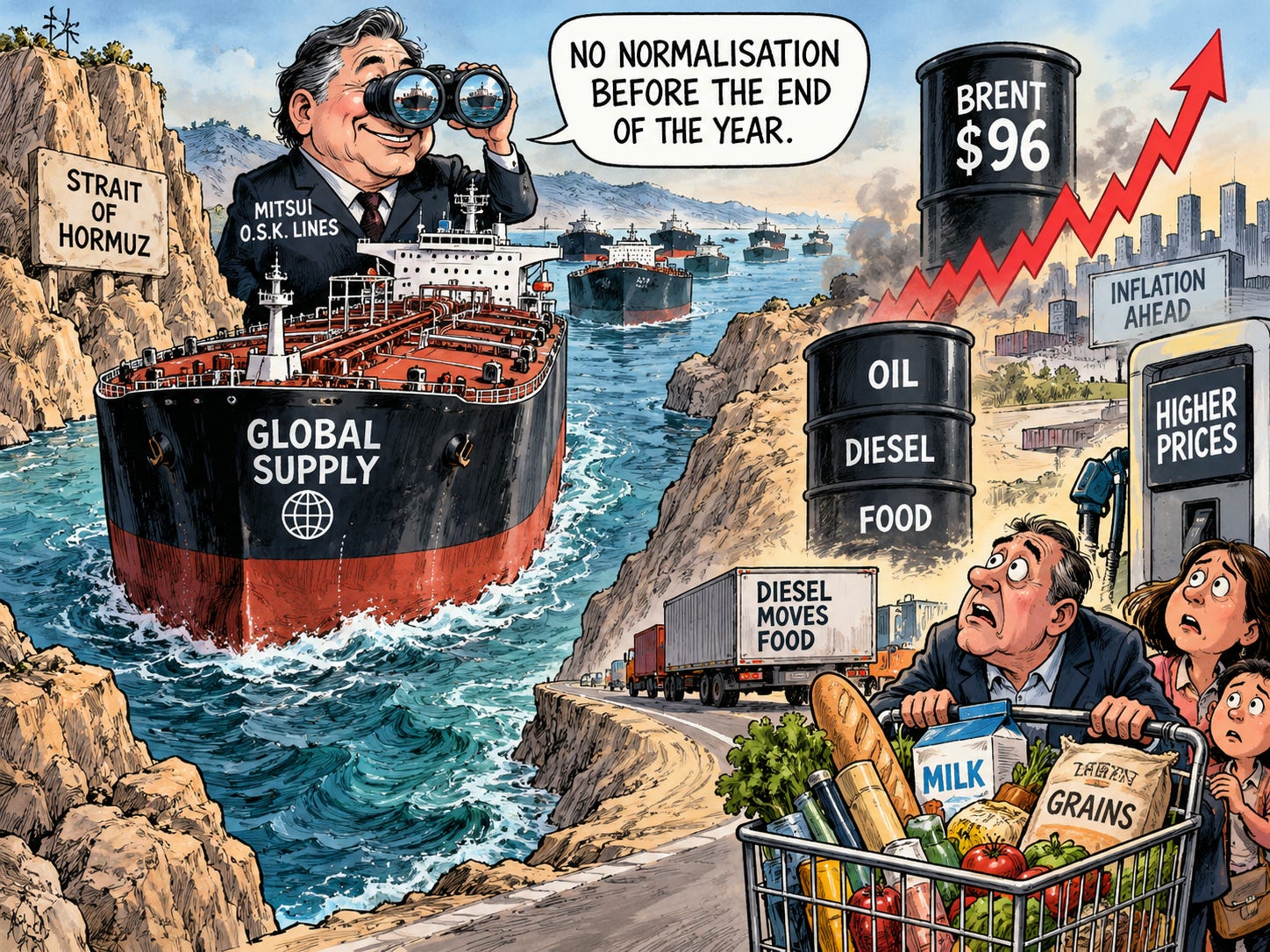
Brent crude flirted with $96 a barrel before easing back on Friday, and it is on course for its biggest weekly rise since July, up 19.71% in a month and 45.21% over a year. WTI is at $91, down 1.00% on the session. Reuters shipping data counted 6 commodity vessels crossing the Strait of Hormuz on Wednesday, down from 11 on Tuesday and against a 10-day average of nearly 13. Mitsui O.S.K. Lines, the world’s largest tanker operator, said this week it expects the disruption to continue with no normalisation before the end of the year. (Trading Economics)
The squeeze is showing up hardest away from crude. US diesel prices are at their highest since mid-2022 and European inventories sit well below seasonal norms, with damaged refineries in both the Middle East and Russia and little spare capacity elsewhere. Food is moving too: the UN’s index of global food prices rose 1.9% in August to its highest since late 2022, led by grains, sugar and dairy, and the Bloomberg Agricultural Spot Index rose more than 13% in the month, the most since 2012. Diesel moves freight and freight moves food, and both of them land inside the inflation prints that central banks have said decide September. (Bloomberg)
Sensei’s Insight: The crude price gets the headlines and the diesel price does the damage. A tanker operator saying no normalisation this year is a company putting its own planning behind the view that this is structural, and food at a 4-year high is the part that reaches everybody’s weekly shop.
🇬🇧 The Bank of England is arguing with itself in public
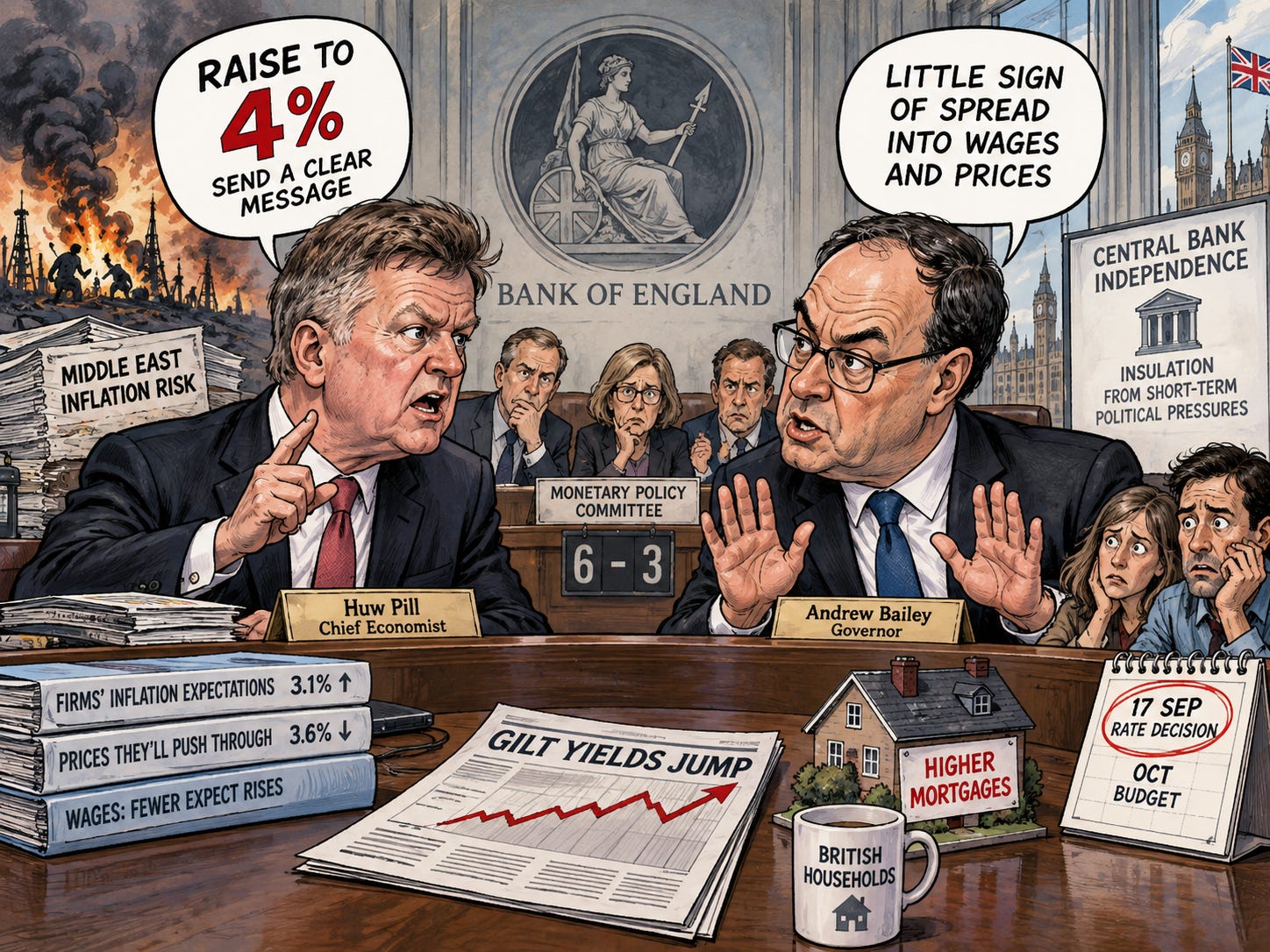
Chief Economist Huw Pill made the case on Thursday for taking Bank Rate to 4% from 3.75%, saying higher rates would send a clear message about the inflation risk coming out of the Middle East, while adding that such a move “need not be the start of a prolonged and aggressive series of increases”. Governor Andrew Bailey has said he sees little sign of those pressures spreading into wages and prices. The July committee held on a 6-3 vote with 3 members already preferring 4%, so the argument does not need to convert many people. (Bank of England)
Friday’s Decision Maker Panel gave both sides something. Firms put inflation over the next year at 3.1%, up from 3.0%, while the price rises they expect to push through themselves fell again to 3.6% from a peak of 4.4% in April, and just under a fifth expect wages to rise against 17% who expect them to fall. Markets now price around 30 basis points of increases by the end of the year, with a quarter-point by November at about 64%, and short-dated gilt yields are heading for their biggest weekly jump since May. Bailey used a separate speech at the LSE to defend central bank independence, calling it “insulation from short-term political pressures” rather than “detachment from democracy”. The decision is on 17 September, with the Budget in October behind it. (Bloomberg)
Sensei’s Insight: The Governor and his own chief economist are saying opposite things in public in the same week, and the gilt market has picked a side. Mortgage pricing follows swaps and swaps follow that curve, so this argument reaches British households faster than most Bank speeches do.
Stories You Might Have Missed
💻 The same Broadcom numbers produced a $140 gap in price targets
Broadcom fell as low as $342.33 on Thursday, about 6.3% down, then clawed back half of it to close at $357.16, a fall of 2.74%. Revenue was $29.59 billion against $29.36 billion expected, up 86% on the year, and AI semiconductor revenue was $16.7 billion, up 221%, while guidance of about $34.8 billion for the current quarter against a $35.03 billion consensus did the damage. Then the analysts filed and could not agree. Cantor Fitzgerald raised its target to $600 from $525 and BMO to $575 from $455, while Bank of America cut to $460 from $530 and TD Cowen to $475 from $500. Macquarie upgraded the stock outright with a $490 target, arguing the risk of Google building its own chips is priced in. (Benzinga)
₿ Bitcoin reclaims $80,000 as fund flows turn again
Bitcoin is at $81,164 this afternoon, having pushed back above $80,000 on Thursday for the first time since it lost the level in August, with ether at $2,522 and XRP at $1.45. US spot bitcoin ETFs took net inflows of $101.15 million on Tuesday, a day after $236.5 million left them, with BlackRock’s IBIT taking $115.45 million and Grayscale’s GBTC losing $56.21 million. Ether funds went the other way with $48.08 million of outflows, ending a 12-session run of inflows, and XRP funds lost $7.2 million after 11 straight sessions of buying. In the UK, Hargreaves Lansdown began offering bitcoin and ether exchange traded notes to retail clients this week. (The Crypto Times)
📊 Guidewire and Ciena beat the numbers and got sold anyway
Guidewire reported fourth-quarter adjusted earnings of 99 cents a share against 94 cents expected, on revenue of $411.1 million against $402.81 million, then fell 15.16% after hours to $172.10 as first-quarter revenue guidance of $372 million to $378 million came in below the $387 million analysts wanted. Ciena did something similar in daylight: third-quarter earnings of $2.11 a share on revenue of $1.67 billion, sales up 37% on the year, a raised full-year outlook, and a 10.36% fall to $317.46 by the close. Software and networking names are now being marked against expectations rather than results. (TipRanks)
🇯🇵 The yen is the week’s strongest major currency
The yen gained more than 2% against the dollar on Thursday to touch 155.28, a one-month high, before easing back above 156 on Friday, leaving it up around 2.4% on the week. Governor Kazuo Ueda said after the G20 meeting that with underlying inflation approaching 2% the Bank of Japan must pay greater attention than before to upside risks, and board member Hajime Takata described 2026 as a regime change in which rate rises are nimble and data-dependent. Markets now fully price a quarter-point rise to 1.25% on 18 September. Traders have stopped short of calling Thursday’s move an intervention by Japanese authorities. (CNBC)