

This content is for informational and educational purposes only and does not constitute financial advice. Always do your own research. Not financial advice (NFA).
👀 Today’s Stories at a Glance
📊 Jobs Report Decides Fed Path: May payrolls land today and could reset rate-cut bets ahead of the Fed meeting.
🔒 CrowdStrike Beats, Splits, Still Falls: Revenue rose 26% and a four-for-one split was announced, yet slowing billings sank shares.
⚡ Innio Surges in Nasdaq Debut: The gas-engine maker closed up 23% as investors chased AI power infrastructure beyond chips.
🪨 Trump Funds Coal Revival: Roughly $700 million in federal money targets coal as backup power for AI data centers.
🛢️ Hezbollah Rejection Keeps Oil Risk: Hezbollah refused the US-brokered ceasefire, dimming odds the Strait of Hormuz reopens soon.
⚛️ Quantinuum Debuts, Closes Flat: The quantum firm popped 13% then gave it back as early excitement met profit-taking.
⚖️ Blanche Tapped for Attorney General: Trump nominated his former lawyer to lead Justice, with antitrust enforcement hanging on confirmation.
🔍 Jobs Report Deep Dive: How to trade today’s payrolls live, why wages matter more than the headline, and what each outcome signals.
🧠 One Big Thing
Today the usual logic is inverted, but only halfway. Hot jobs is risk-off, full stop, because the market's whole question is whether the Fed can cut, and a strong print answers no. The weak side is where people get caught: soft jobs only helps risk if wages cool too. A weak headline paired with hot wages near 0.4%, against oil near triple digits, is not the dovish dream. It is stagflation, and that reads risk-off as well. The wage line is the tiebreaker, so read it before celebrating any soft number. The deep dive below breaks down each scenario and what it signals.
⚖️ Fear & Greed
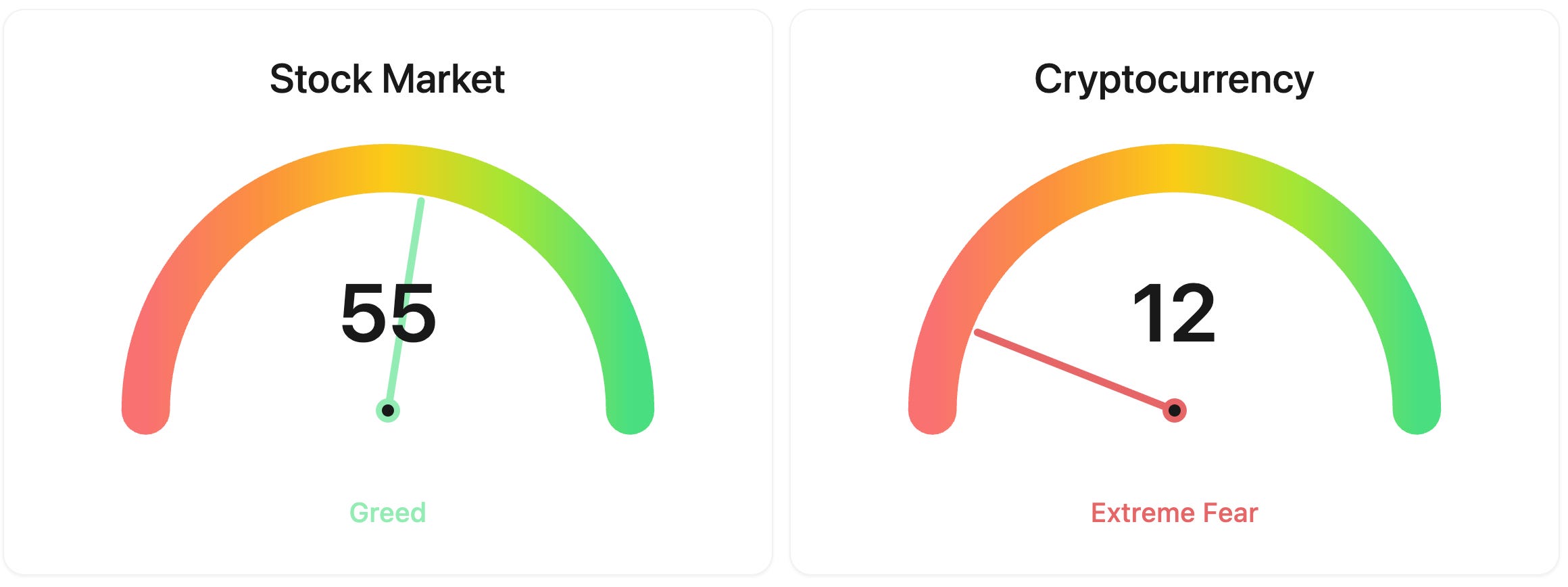
📉 The Number That Matters
11
The Crypto Fear and Greed Index fell to 11 this week, its lowest reading of 2026, leaving sentiment so bearish that a soft jobs print today could spark a violent short-covering rally.
⚔️ Winners vs Losers
Winners
MRLN 0.00%↑: Merlin, Inc. surged after announcing it completed the Critical Design Review for its C-130J autonomy program with US Special Operations Command, advancing the program from design into aircraft integration. The news broke after Thursday’s close, which explains the gap against the flat regular session.
BBCP 0.00%↑: Concrete Pumping Holdings, Inc. jumped after Q2 fiscal 2026 revenue rose 14% to $106.8 million and earnings of $0.04 beat the $0.01 estimate, prompting the company to raise its full-year outlook.
TTAN 0.00%↑: ServiceTitan, Inc. rose after fiscal Q1 2027 revenue climbed 25% to $268.8 million and the company lifted full-year revenue and operating income guidance on accelerating adoption of its Max and AI agent products.
AGX 0.00%↑: Argan, Inc. climbed after posting record fiscal Q1 2027 revenue of $291 million with diluted EPS doubling to $3.24 and backlog reaching $2.8 billion.
Losers
CYPH 0.00%↑: Cypherpunk Technologies Inc. plunged as its Zcash treasury was hit by a roughly 45% crash in ZEC after Shielded Labs disclosed a critical counterfeiting vulnerability in Zcash’s Orchard shielded pool.
GWRE 0.00%↑: Guidewire Software, Inc. fell after fiscal Q3 results beat on revenue and earnings but annual recurring revenue guidance came in slightly below Wall Street targets, overshadowing the beat.
LULU 0.00%↑: lululemon athletica inc. dropped after cutting its full-year sales and earnings guidance and issuing a weak current-quarter outlook, with management blaming negative media commentary and underwhelming product launches.
ARM 0.00%↑: Arm Holdings plc declined in sympathy with a broad semiconductor sell-off sparked by Broadcom’s disappointing AI chip outlook, with no fresh company-specific catalyst.
📊 Market Snapshot
Cryptocurrencies:
Bitcoin (BTC): $62,832 (▼ -1.52%)
Ethereum (ETH): $1,681 (▼ -4.94%)
XRP: $1.13 (▼ -2.85%)
Equity Indices (Futures):
S&P 500: 7,565 (▼ -0.47%)
NASDAQ 100: 30,187 (▼ -0.99%)
FTSE 100: 10,400 (▲ 0.06%)
Commodities & Bonds:
10-Year US Treasury Yield: 4.67% (▼ -0.13%)
Oil (WTI): $93 (▼ -0.20%)
Gold: $4,465 (▼ -0.24%)
Silver: $72.75 (▼ -1.56%)
Data as of: UK (BST) 10:55 / US (EDT): 05:55 / Asia (Tokyo): 18:55
✅ 5 Things to Know
📊 May Jobs Number Could Reset Rate-Cut Bets
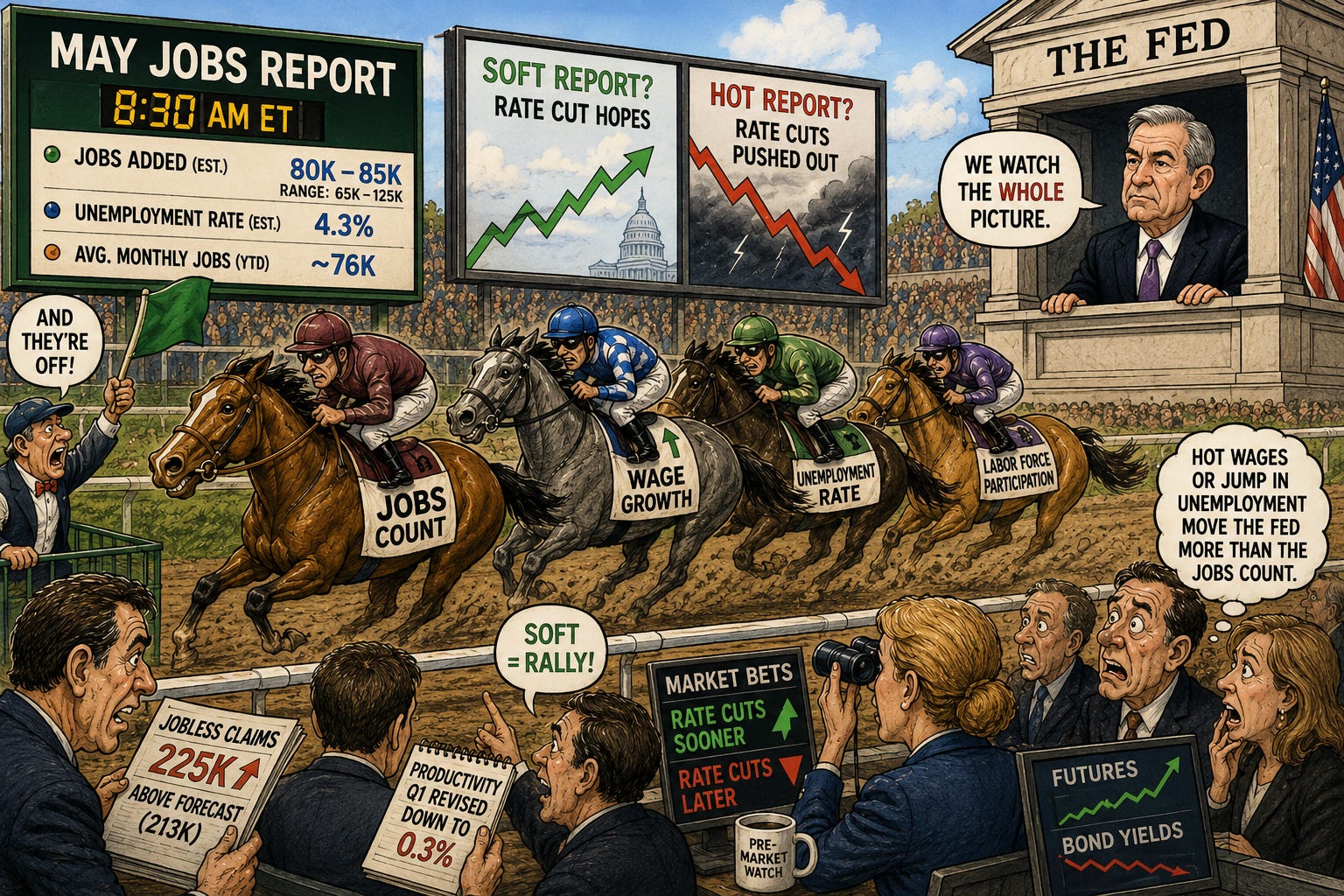
The Bureau of Labor Statistics releases the May employment report at 8:30 a.m. Eastern this morning, the single biggest scheduled event of the day. Economists expect roughly 80,000 to 85,000 jobs added, with forecasts spanning a wide 65,000 to 125,000, and the unemployment rate holding at 4.3%. The bar is low for a reason: April surprised with 115,000 jobs, nearly double the 62,000 expected, and hiring this year has averaged about 76,000 a month. The lead-up data leaned soft. Weekly jobless claims rose to 225,000, above the 213,000 forecast, and first-quarter productivity was revised down to 0.3%. (Kiplinger)
That count feeds straight into the Federal Reserve’s interest-rate path ahead of its June meeting, which is why every market is positioned around it. A soft number could revive hopes for rate cuts, a tailwind for rate-sensitive corners like real estate, utilities and small caps, and fuel for the rotation into value stocks that drove markets yesterday. A hot wage figure could push cuts further out and pressure the high-priced tech names already wobbling. Because the report lands at 8:30, pre-market futures and bond yields will give the first read. Watch the unemployment rate and wage growth as closely as the headline jobs figure.
Sensei’s Insight: The payroll headline isn’t the whole story. Unemployment has held near 4.3% partly because fewer people are looking for work, which flatters the rate. Hot wages or a jump in unemployment would move the Fed more than the jobs count itself.
🔒 CrowdStrike Beats and Splits, but Shares Still Slide
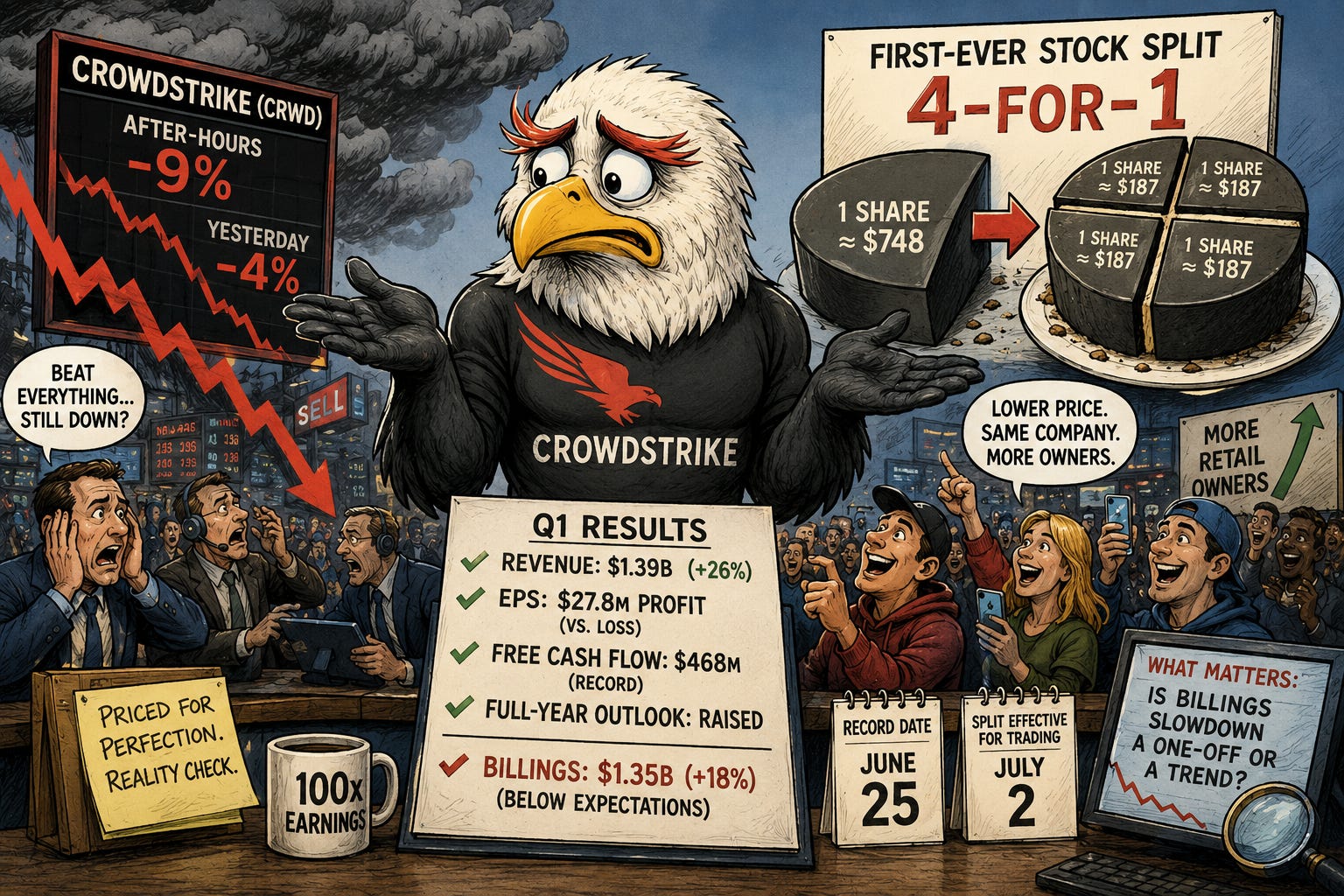
CrowdStrike (CRWD) reported quarterly results this week that beat across the board, and the stock fell anyway, dropping about 9% after hours and another 4% in yesterday’s session. Revenue rose 26% from a year earlier to $1.39 billion, ahead of the $1.36 billion expected. The company swung to a $27.8 million profit from a year-earlier loss, posted record free cash flow of about $468 million, raised its full-year outlook, and announced its first-ever stock split, four-for-one. The trigger for the selloff was billings, a measure of new business booked, which grew just 18% to $1.35 billion, below hopes and a hint that deal momentum may be cooling. (SEC filing)
This was a strong quarter from a stock priced for perfection: shares had run more than 70% in three months and traded above 100 times earnings, so anything short of flawless invited heavy selling. For retail investors, the four-for-one split is the directly useful part. Each share becomes four and the price drops in proportion, so a roughly $748 share becomes about $187. It doesn’t change what the company is worth or what a holder owns, but it lowers the entry price for buyers who don’t use fractional shares and tends to widen retail ownership. The split takes effect for trading on July 2, after a June 25 record date. What to watch: whether the billings slowdown is a one-off or a trend next quarter. (The Globe and Mail)
Sensei’s Insight: A four-for-one split doesn’t make CrowdStrike cheaper. Same company, four times the shares, a quarter of the price each. What it does is lower the sticker price and pull in small buyers. The billings slowdown is the real thing to track, not the split math.
⚡ Innio Jumps 23% in $2.4 Billion Nasdaq Debut
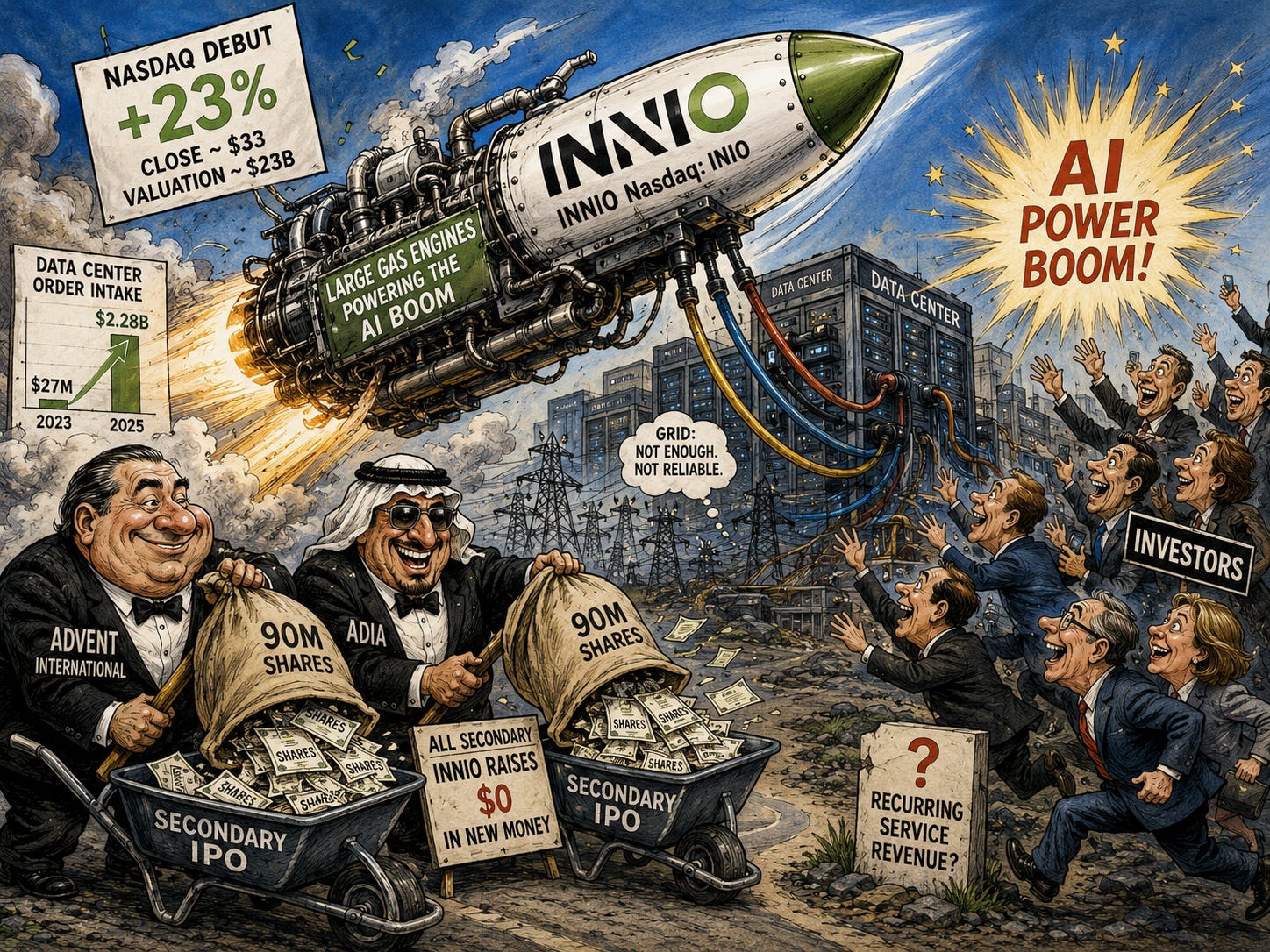
Innio, a maker of large gas engines that generate electricity on-site, surged on its Nasdaq debut yesterday under the ticker INIO. Its initial public offering, or IPO, was upsized to 90 million shares priced at $27, the top of the range, raising $2.43 billion. The stock opened about 15% above the offer price and climbed from there, closing up roughly 23% near $33 and valuing the company around $25 billion. Every share sold was “secondary,” meaning it came from existing owners, private equity firm Advent International and the Abu Dhabi Investment Authority, so Innio itself raised no new money from the deal. (Bloomberg)
Innio is an AI “picks and shovels” play: it doesn’t make the chips, it makes the engines that power the data centers driving the AI boom, which increasingly need electricity the grid can’t reliably supply. That demand has exploded, with Innio’s annual data-center order intake jumping from $27 million in 2023 to $2.28 billion in 2025. The strong open is a read on investor appetite for AI-infrastructure names beyond semiconductors, and it lands in a reopening IPO market: quantum firm Quantinuum listed the same day, and chipmaker Cerebras popped about 70% last month. What to watch: whether one-time equipment orders convert into the steady, long-term service revenue that justifies the price. (Reuters)
Sensei’s Insight: The all-secondary structure matters. This was private-equity owners cashing out, not Innio raising money to grow. The order growth is real, up roughly 80-fold in two years. The open question is whether those equipment sales turn into the recurring service revenue where the durable money sits.
🪨 Trump Bets $700 Million on Reviving US Coal
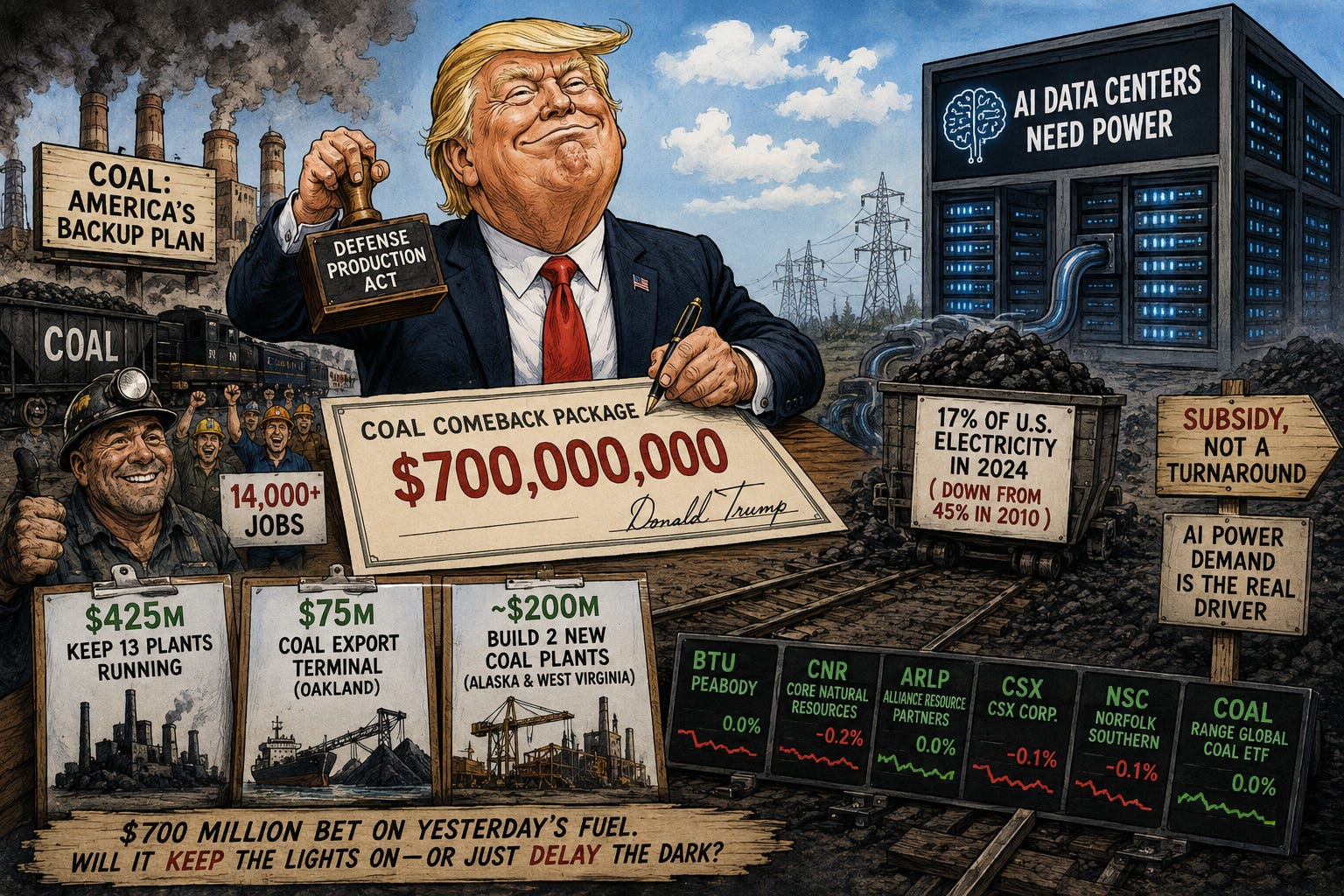
President Trump approved roughly $700 million yesterday to revive the US coal industry, invoking the 1950 Defense Production Act, a Cold War law that lets a president steer money to industries deemed vital to national security. The breakdown: about $425 million to keep 13 existing plants running across 10 states, $75 million for a long-delayed coal export terminal in Oakland, and close to $200 million to build two new coal plants in Alaska and West Virginia, the first new US coal plants since 2013. The White House says the package supports more than 14,000 jobs across coal, rail and construction. (Bloomberg)
The pitch is energy security: coal as backup power for the AI data centers straining the grid. For investors it’s a rare boost for a sector in long decline. Coal supplied about 17% of US electricity last year, down from 45% in 2010, pushed aside by cheaper natural gas and renewables. The names with the most exposure are coal producers Peabody (BTU), Core Natural Resources (CNR) and Alliance Resource Partners (ARLP), rail haulers CSX and Norfolk Southern that move the freight, and the Range Global Coal exchange-traded fund (COAL). The policy lift hadn’t shown up in those shares by the time of the announcement. What to watch: whether the funding turns into earnings, and whether more emergency orders to keep plants running follow.
Sensei’s Insight: This is a subsidy, not a turnaround. Coal’s share of US power has dropped from 45% to 17% in fifteen years, and $700 million won’t reverse that. What’s drawing investors to these stocks is AI’s power demand, not coal’s long-term future.
🛢️ Hezbollah Rejects Truce, Keeping Oil Risk Alive
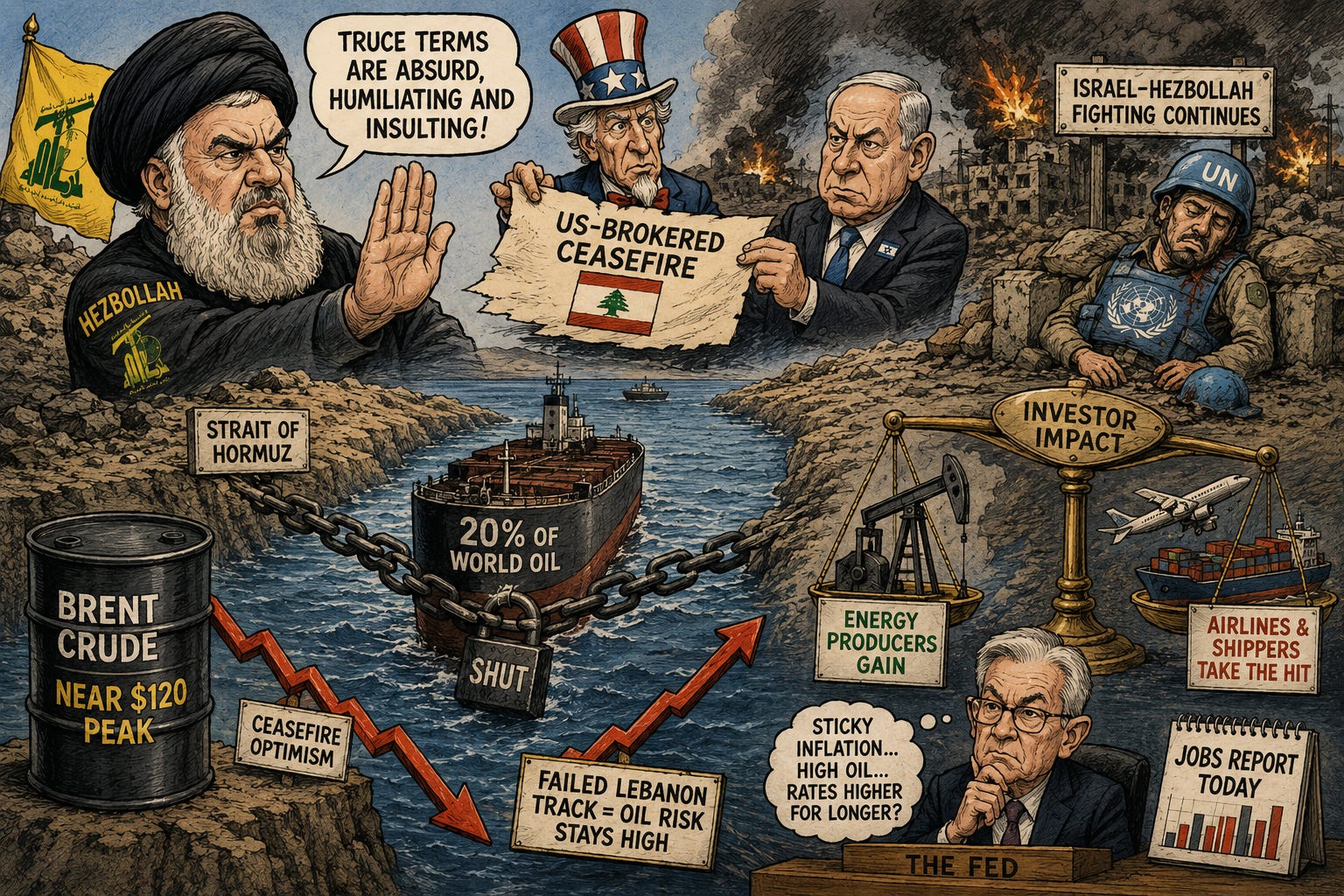
Hezbollah leader Naim Qassem rejected a US-brokered ceasefire between Israel and Lebanon’s government yesterday, calling the terms “absurd, humiliating and insulting” and demanding a full Israeli withdrawal. The problem for the deal: Hezbollah, the most powerful armed group in Lebanon, was never part of the talks that produced it, so its refusal hollows out the framework. The fighting is one front in the wider US-Israel war on Iran that began in late February and has kept the Strait of Hormuz, the channel that normally carries about 20% of the world’s oil, effectively shut. Israeli strikes killed at least four people in Lebanon yesterday, and a UN peacekeeper was killed in the crossfire. (AP)
For investors this is an oil and inflation story. Iran has tied any lasting truce to a Lebanon ceasefire, so Hezbollah’s rejection dims the odds of reopening Hormuz and easing energy prices. Brent crude had fallen from a near-$120 peak earlier in the war on ceasefire optimism, and a failed Lebanon track raises the risk that oil stays high. Pricier crude for longer feeds inflation, which feeds the Federal Reserve’s rate decisions, landing right on top of this morning’s jobs report. What to watch: oil’s move at the open, and whether energy producers gain while airlines and shippers absorb higher fuel costs.
Sensei’s Insight: Oil is the channel that matters here. As long as Hormuz stays shut, the inflation pressure keeping the Fed cautious doesn’t ease. A drawn-out Lebanon fight means the extra risk baked into oil prices, which has lifted energy stocks and squeezed airlines, isn’t going away soon.
Stories You Might Have Missed
⚛️ Quantinuum Pops 13% but Closes Flat on Debut
Quantinuum, the quantum-computing firm majority-owned by Honeywell, debuted on the Nasdaq yesterday under the ticker QNT. Its upsized offering raised $1.68 billion at $60 a share, above the marketed range, with demand reportedly topping 20 times the shares available. The stock opened at $68, up 13%, touched $71.35, then closed flat, a sign early excitement met profit-taking. The enthusiasm is about the future, not the present: revenue actually fell 73% last quarter to $5.24 million and the company lost $136.5 million, with a single Japanese research institute accounting for about 60% of last year’s sales. As the most prominent quantum pure-play to list, Quantinuum is expected to set the tone for smaller peers like IonQ and Rigetti. (CNBC)
⚖️ Trump Taps Loyalist Blanche for Attorney General
President Trump said he will nominate acting Attorney General Todd Blanche, his former personal defense lawyer, to run the Justice Department permanently. The pick heads to a Senate where Republicans hold a thin 53-47 majority, and a few defections could sink it: Senator Thom Tillis has signaled he could vote no over Blanche’s equivocation on January 6, and Majority Leader John Thune called confirmation “hard to say.” Blanche drew fire over a proposed $1.776 billion fund to compensate people claiming unjust prosecution, which he says is dead but Trump has since muddied. The market angle is indirect but real: the attorney general shapes antitrust enforcement and merger reviews, so a drawn-out confirmation fight prolongs uncertainty over how hard Washington polices corporate dealmaking. (CNN)
🔗 Connect with Us
Stay plugged in across platforms:
Sensei on X: sensei_live_
Martyn Lucas on X: MartynInvestor
Vaz on X: eVTOLHUB
📺 YouTube Channel (Live & Replays): Martyn Lucas Investor

🔍Deep Dive: Jobs, Jobs, Jobs
Why a strong number slams the door on cuts, and why a weak one is only bullish if the wage line agrees
The big one lands today. The May jobs report hits the wire at 1:30pm UK time, 8:30am ET, and it is the cleanest read we have on whether the Federal Reserve has any room left to cut rates this year. Under two weeks out from Kevin Warsh's first meeting as Chair, this one number shapes the whole second half of 2026. Here is what to watch, why it matters, and what each outcome means for the tape.