This content is for informational and educational purposes only and does not constitute financial advice. Always do your own research. Not financial advice (NFA).
👀 Today’s Stories at a Glance
💸 Big Tech AI spending reset: Amazon and others plan $650 billion in infrastructure, causing a massive market deleveraging event.
📉 Wall Street crowded trades buckle: Software and crypto plunged as investors demanded immediate ROI proof for massive AI investments.
🏗️ Amazon infrastructure phase begins: A $200 billion 2026 budget targets data centers and chips, prioritizing growth over margins.
🤖 Tesla shifts to humanoid robots: Production of flagship cars will cease to build one million Optimus units annually at Fremont.
🤖 Anthropic triggers software selloff: New autonomous agents caused a $285 billion market cap wipeout for traditional subscription software firms.
🔍 AI agent reality check: Despite market panic, hallucinations and security risks prevent these tools from replacing enterprise software immediately.
🧠 One Big Thing
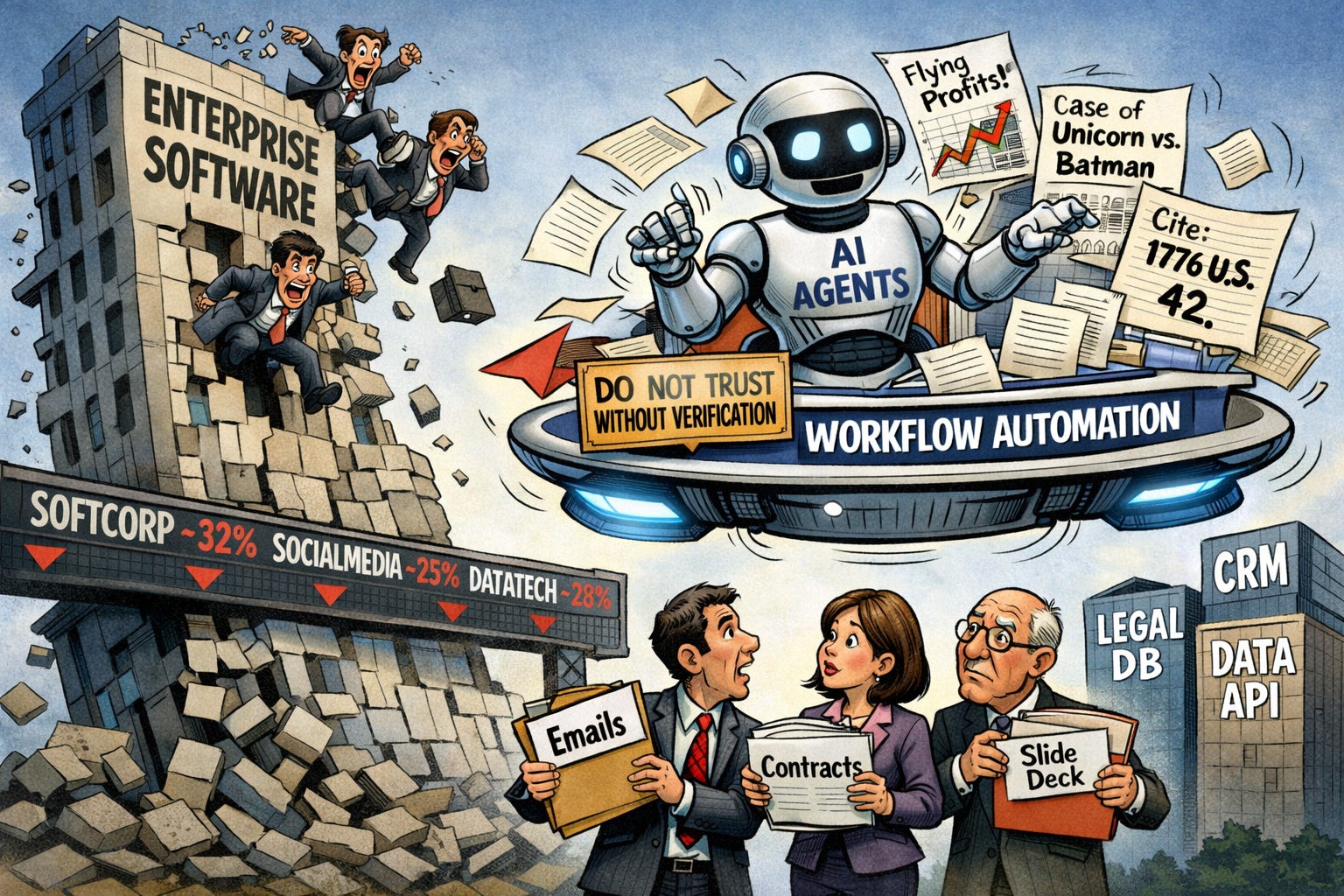
Recent stock market volatility suggests investors fear autonomous AI agents will soon cannibalize the enterprise software industry. This panic stems from new tools capable of automating complex workflows like legal research and document drafting. However, current AI models lack the accuracy and security required for unsupervised corporate use, often producing hallucinations or exposing data vulnerabilities. In reality, these agents function as users of existing software rather than replacements for it. They require established databases and APIs to operate effectively, potentially increasing the value of high-quality platforms. For investors, this disconnect has pushed software valuations to historic lows while core business fundamentals remain intact.
⚖️ Fear & Greed
📉 The Number That Matters
$200 BILLION
Amazon forecast a staggering $200 billion in 2026 capital expenditures, a 54% jump from 2025. Despite 24% growth in AWS revenue, shares plummeted 11% as investors questioned if AI infrastructure returns can keep pace with such colossal spending.
📊 Market Snapshot
Cryptocurrencies:
Bitcoin (BTC): $66,203 (▲ 5.44%)
Ethereum (ETH): $1,925 (▲ 5.57%)
XRP: $1.36 (▲ 12.17%)
Equity Indices (Futures):
S&P 500: $6,842 (▲ 1.11%)
NASDAQ 100: $24,834 (▲ 0.74%)
FTSE 100: £10,315 (▲ 0.58%)
Commodities & Bonds:
10-Year US Treasury Yield: 4.20% (▲ 0.38%)
Oil (WTI): $64 (▲ 0.55%)
Gold: $4,885 (▲ 2.27%)
Silver: $74.59 (▲ 5.15%)
Data as of UK (GMT): 11:44 / US (EST): 06:44 / Asia (Tokyo): 20:44
✅ 5 Things to Know Today
💸 Big Tech’s $650 Billion AI Arms Race
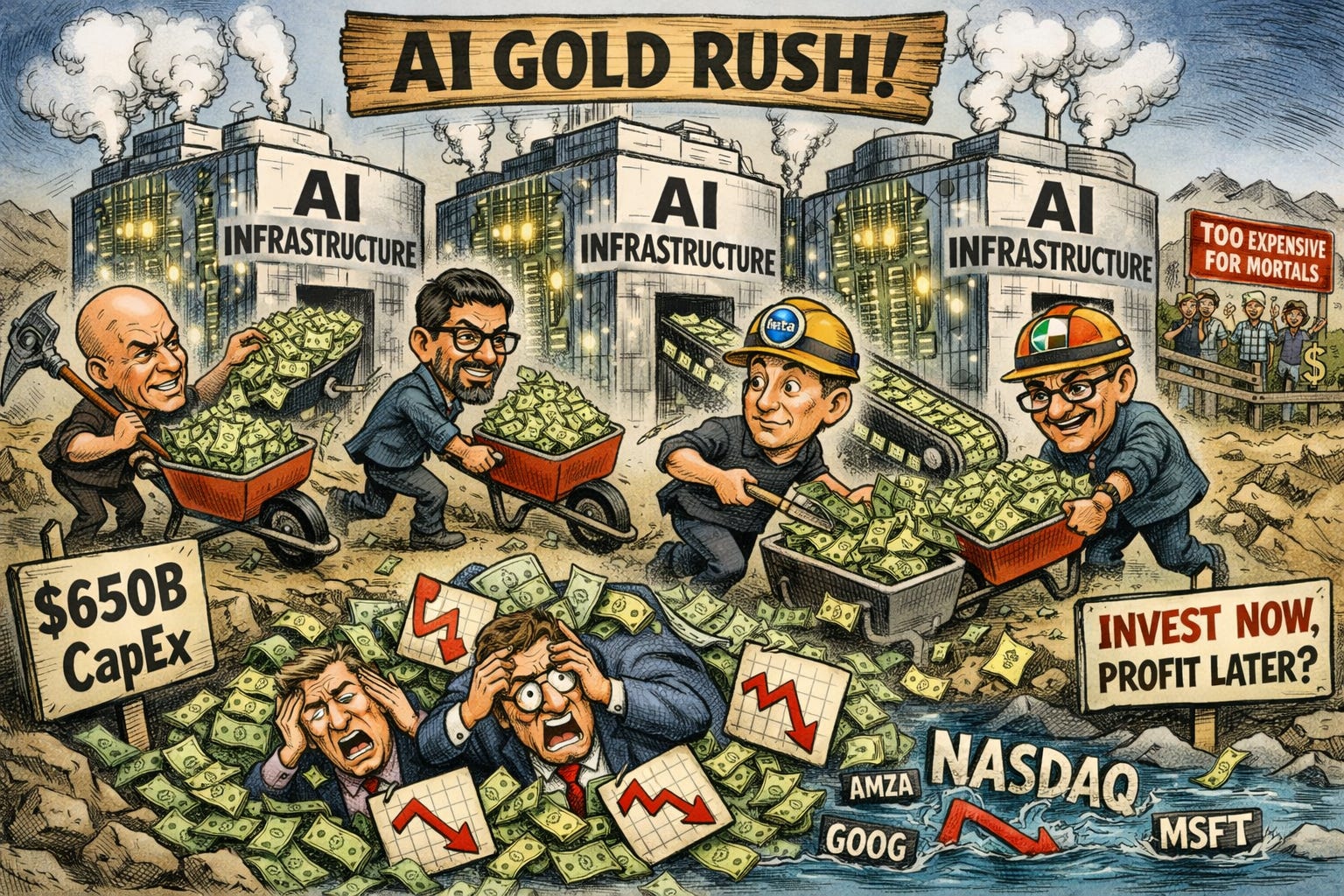
The “Big Four”: Amazon, Alphabet, Meta, and Microsoft, just dropped a combined 2026 capital expenditure forecast of roughly $650 billion. To put that in perspective, this single-year spend is nearly four times what 21 of the largest traditional industrial companies, including Exxon and Walmart, plan to spend combined. Amazon is leading the charge with a massive $200 billion projection, while Alphabet’s $175 billion to $185 billion guide effectively doubles its prior spending. This isn’t just a slight increase: it’s a total “reset” of the bar for infrastructure. These billions are flowing into “AI factories”—massive data centers filled with specialized chips, networking gear, and backup generators. While the spending signals confidence in AI demand, the market’s reaction has been brutal: Amazon and Microsoft both saw double-digit intraday slides as investors choked on the sheer scale of the bill (Bloomberg).
This spending boom has no parallel this century, drawing comparisons to the 19th-century railroad expansion or the 1990s telecom bubble. For years, Big Tech companies were “asset-light” cash machines, but they’ve now pivoted to being capital-heavy industrials. Meta’s property and equipment assets have quintupled since 2019, illustrating this shift. For retail investors, the narrative has flipped from “AI will boost every margin” to “AI is a massive cash drain with an uncertain payoff timeline.” We’re seeing a “deleveraging stampede” where even fundamental wins in cloud revenue are being overshadowed by the cost of staying in the race. Analysts call this a “winner-takes-most” market, meaning these firms feel they can’t afford to under-invest, even if it hammers their stock price in the short term. The result is a massive distortion in macro data, where a few affluent companies drive national investment figures while the rest of the economy remains muted.
Sensei’s Insight: The era of “cheap” AI growth is over. Watch the “AI capex hangover” in the Nasdaq: if these massive builds don’t show clear monetization by year-end, expect even deeper valuation compression.
📉 Wall Street’s Crowded Trades Hit a Wall
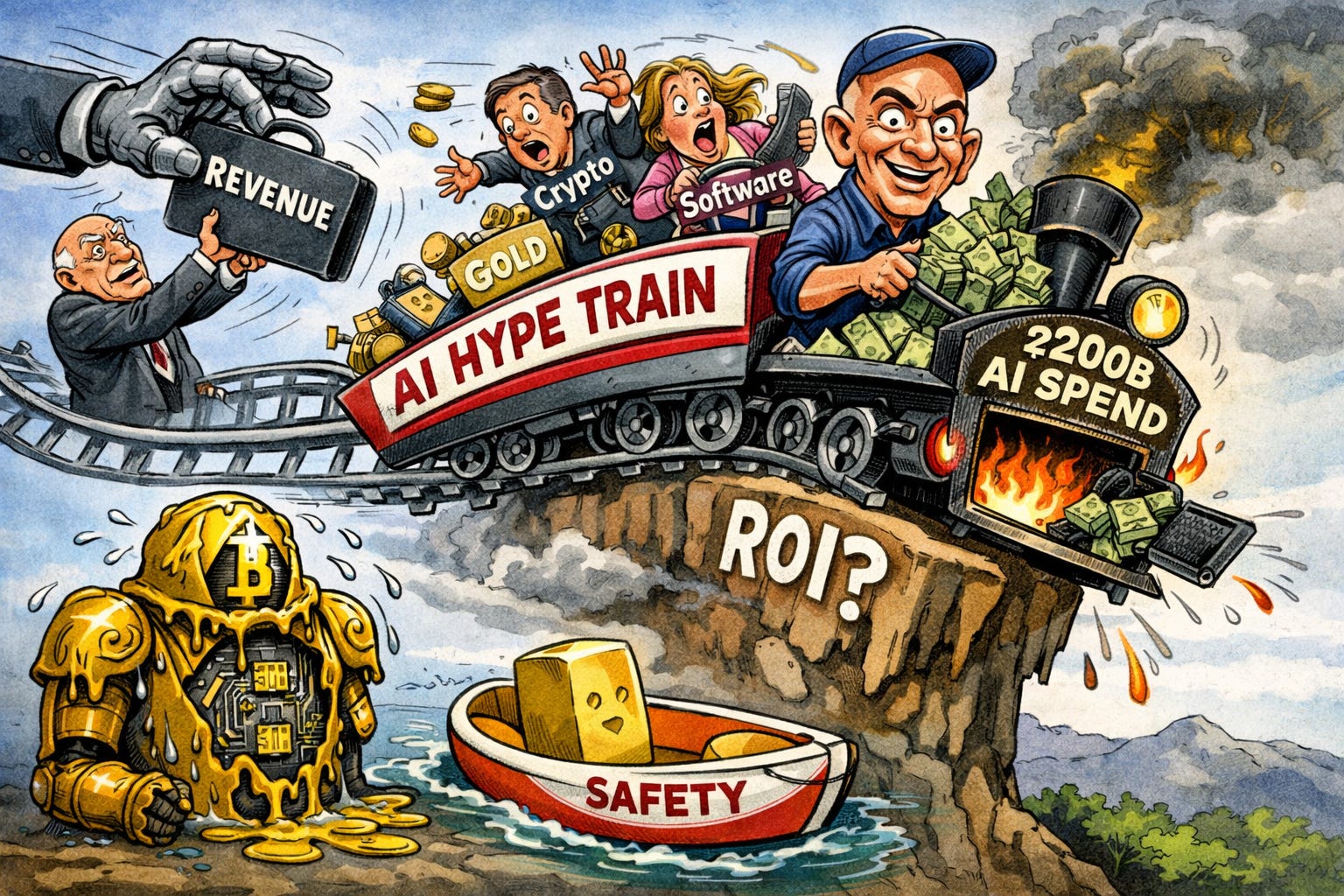
The multi-asset retreat we saw yesterday was a classic “get me out” moment as the market’s most popular bets, software, crypto, and precious metals, all buckled at once. The S&P 500 dropped 1.2%, but the real pain was under the hood. Software stocks faced a “SaaSpocalypse” triggered by Anthropic’s new AI tools, which investors fear could automate away the core revenue of traditional data and legal vendors. Bitcoin, once the post-election darling, plunged through the $70,000 floor to briefly touch $61,000, effectively wiping out 15 months of gains. The final blow came after-hours when Amazon revealed a $200 billion AI spending plan for 2026, causing its stock to crater 11% as shareholders balked at the massive price tag of the AI arms race (Bloomberg).
This isn’t just a random dip; it’s a fundamental repricing of “AI as a free lunch.” For a year, the narrative was that AI would boost every software company, but Anthropic’s new agents suggest AI might actually cannibalize them instead. When you combine that disruption fear with January’s job cut data, the highest since 2009, you get a sharp rotation into the safety of Treasuries. Retail investors should note that Bitcoin failed its “digital gold” test here, trading like a high-risk tech stock rather than a hedge while physical gold held up much better. The market is now demanding proof of ROI on AI spending, and right now, the $200 billion bills from the likes of Amazon are making everyone nervous about near-term free cash flow.
Sensei’s Insight: Watch the $60k level on Bitcoin and the 10-year Treasury yield. If the labor market continues to soften while AI spending climbs, the “Goldilocks” regime for tech is officially over.
🏗️ Amazon’s $200 Billion AI Bet
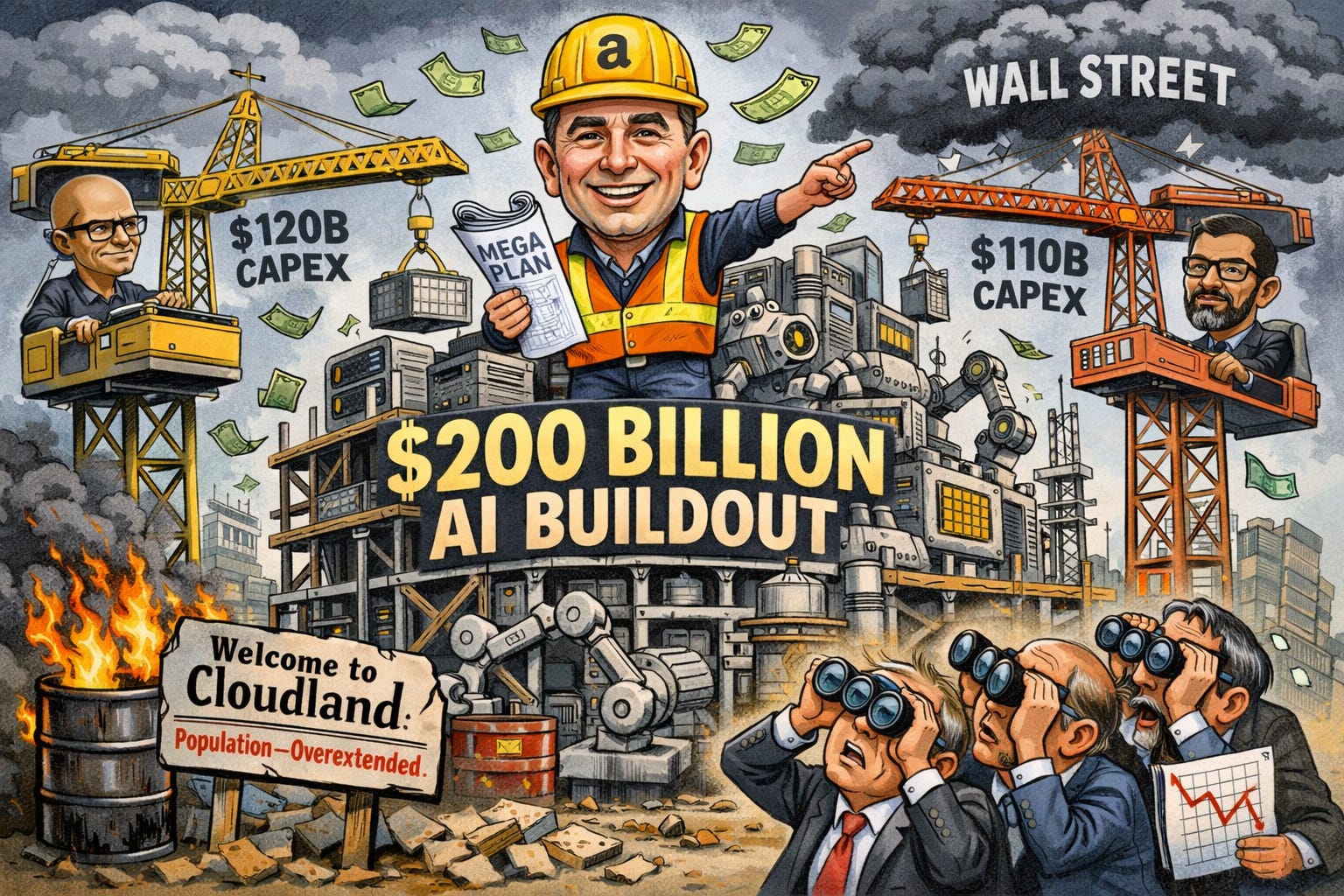
Amazon just signaled it’s moving into a massive, capital-intensive infrastructure phase, projecting a staggering $200 billion in capital expenditures for 2026. This isn’t just a slight bump. It’s a 50% increase over the $131 billion spent in 2025 and blew past Wall Street’s expected $150 billion mark. While AWS revenue grew a healthy 24% to $35.6 billion last quarter, the market didn’t love the math. The stock dropped as much as 11% in extended trading after Amazon guided Q1 operating income between $16.5 billion and $21.5 billion, missing the $22.2 billion consensus. Investors are clearly sweating the fact that spending is currently scaling much faster than immediate cloud returns (Bloomberg).
This pivot marks a shift for Big Tech from “capital-light software” to “capital-heavy utility.” CEO Andy Jassy is defending the spend as a once in a generation opportunity, with roughly 80% of that $200 billion likely earmarked for AI-related data centers, custom chips like Trainium, and robotics. For retail investors, the story here is the “AI arms race” hitting a fever pitch. Amazon, Microsoft, and Google are now locked in a cycle where they must spend record amounts just to stay in the game. The risk is an overbuild. If the AI demand doesn’t scale at the same pace as this infrastructure, we may see suppressed free cash flow and compressed margins across the sector for several quarters.
Sensei’s Insight: Watch the spread between AWS revenue growth and capex growth. If spending keeps outpacing sales, the “efficiency” narrative is dead, and we’re officially in a high-stakes infrastructure war.
🤖 The Pivot from EVs to “Physical AI”
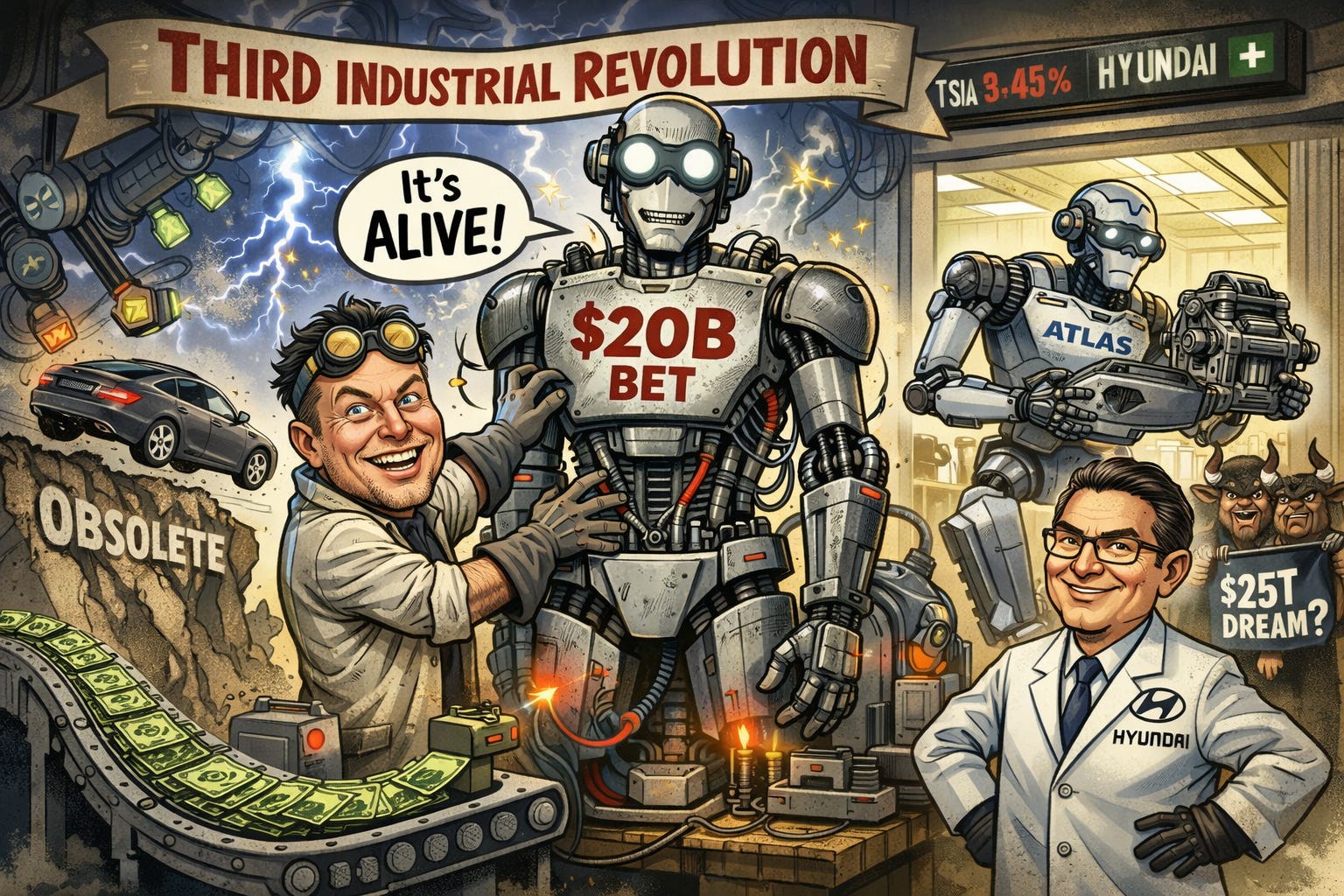
Tesla is officially betting the farm on its humanoid robot, Optimus. During the January 28, 2026, earnings call, Elon Musk announced the company will cease production of its flagship Model S and Model X vehicles to repurpose the Fremont factory. The goal is to build a production line capable of churning out 1 million Optimus units per year. While the move signals a massive strategic pivot, the market wasn’t immediately sold: Tesla shares fell roughly 3.45% in pre-market trading as investors weighed the loss of car revenue against a capital-intensive robot future. Meanwhile, Hyundai is moving just as fast with its Boston Dynamics “Atlas” robot. Hyundai plans to deploy Atlas for parts sequencing at its Georgia Metaplant starting in 2028, eventually scaling to complex assembly by 2030 with a target of 30,000 units annually (CNBC).
We’re seeing a fundamental shift from software-only AI to “Embodied AI,” where intelligence finally gets a physical form. The numbers coming out of Wall Street are getting aggressive: Morgan Stanley suggests humanoids could represent a 5 trillion dollar annual market by 2050, contributing to a broader 25 trillion dollar robotics ecosystem. This isn’t just about robots replacing workers; it’s about a complete supply chain overhaul. For retail investors, this means looking beyond the robots themselves to the “muscles” and “brains” of the industry. Dedicated ETFs like KOID are already tracking this, bundling Tesla and Nvidia with rare-earth miners like MP Materials and Lynas. These robots require specialized magnets and high-performance actuators that traditional industrial arms simply don’t use.
Sensei’s Insight: Watch the “Capex vs. Concept” gap. Tesla is doubling its 2026 capital expenditure to 20 billion dollars to fund this pivot, a move that could pressure margins long before the first million robots roll off the line.
🤖 Anthropic Triggers a “SaaSpocalypse”
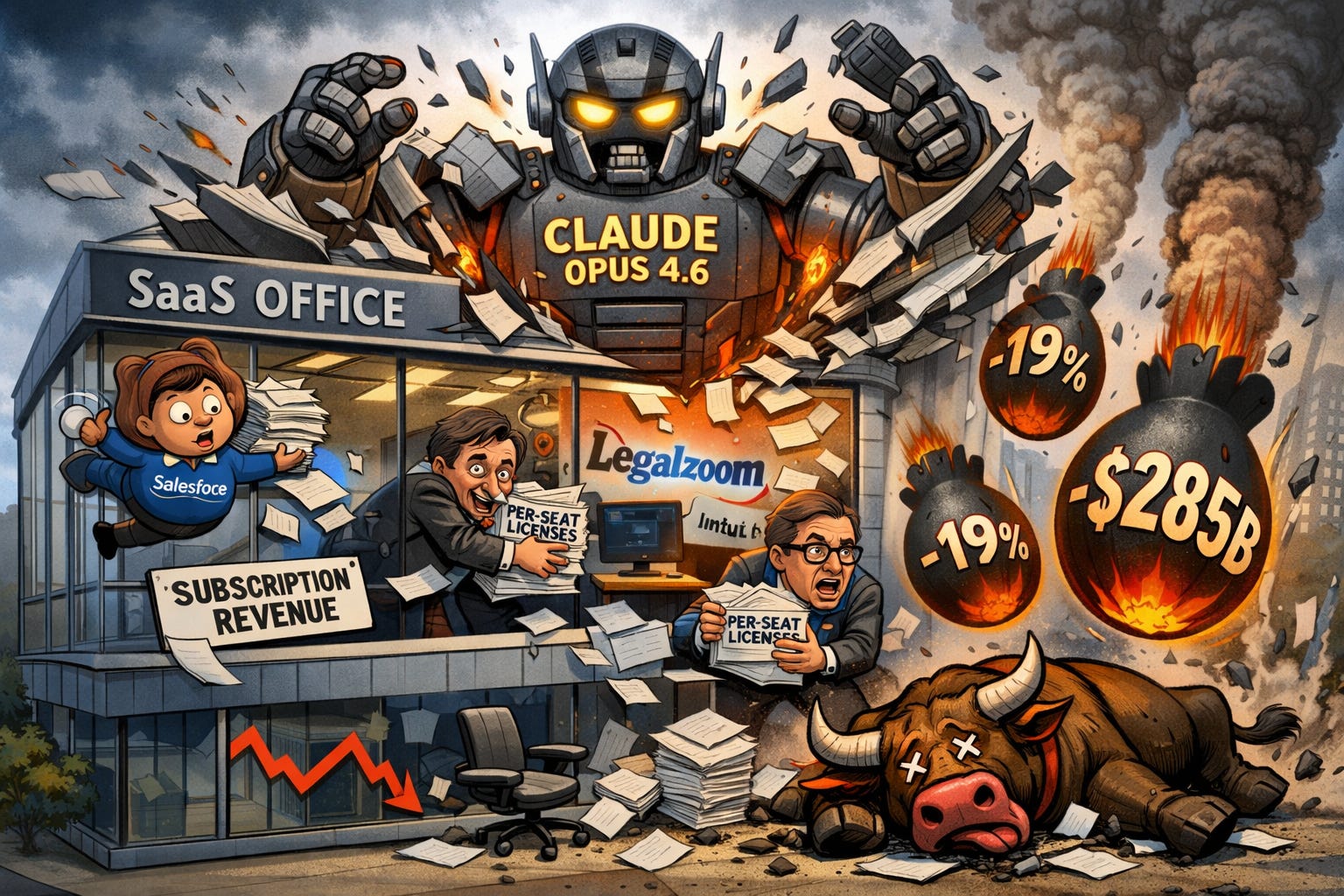
The perceived hierarchy of the AI world just shifted. Anthropic, long considered a “safety-first” runner-up to OpenAI, released a suite of tools that sent shockwaves through the equity markets this week. The catalyst wasn’t just another chatbot; it was the launch of Claude Cowork plug-ins specifically designed to automate legal, finance, and sales workflows, followed by the release of Claude Opus 4.6. This new model introduces “agent teams” that can work in parallel to solve complex problems without constant human hand-holding. The market reaction was swift and violent: a Goldman Sachs basket of US software stocks plunged 6% in a single day, erasing roughly $285 billion in market value as investors realized Anthropic is moving “up the stack” to compete directly with the software companies that previously used its tech (The Wall Street Journal)
This selloff, dubbed the “SaaSpocalypse” by some analysts, signals a fundamental re-pricing of risk for any company that sells “per-seat” subscriptions. If one AI agent can do the work of five junior staffers, the number of software licenses a firm needs could crater. We saw this play out in real-time as legal tech and data giants took a massive hit: Thomson Reuters fell roughly 16%, and LegalZoom dropped about 19% following the news. Even heavyweights like Intuit and Salesforce weren’t immune, sliding 11% and mid-single digits respectively. The fear is that “foundational” models like Claude are no longer just tools; they are becoming the application itself. While some, like Nvidia’s Jensen Huang, argue it’s “illogical” to think AI will replace software tools rather than just improve them, the “visibility premium” investors once paid for predictable SaaS earnings is clearly under fire (Bloomberg).
Sensei’s Insight: Watch the “seat count” narrative in upcoming software earnings. If Anthropic’s long-running agents can sustain tasks for hours, the traditional subscription model faces a structural threat that no amount of buybacks can fix.
🔗 Connect with Us
Stay plugged in across platforms:
Sensei on X: sensei_live_
Martyn Lucas on X: MartynInvestor
Vaz on X: eVTOLHUB
📺 YouTube Channel (Live & Replays): Martyn Lucas Investor

🔍Deep Dive: AI Agents Are Shaking Up Software Stocks, But Don’t Panic Yet