

This content is for informational and educational purposes only and does not constitute financial advice. Always do your own research. Not financial advice (NFA).
👀 Today’s Stories at a Glance
💼 Payrolls decide the week: July jobs land at 1:30pm BST, 8:30am ET, with hiring marked down to 80,000 and unemployment seen at 4.2%.
Crypto's rulebook slips to September: the Senate left town without a vote and 2026 passage odds hit a record low 14%.
🚀 The unlock was never the risk: SpaceX’s float more than doubled to 1.55 billion shares and the stock rose 6.4% anyway.
🛢️ Iran’s draft bans American ships: Brent climbed to $83.52 after Tehran published Hormuz terms seizing 20% of a violating ship’s cargo.
🏠 Airbnb beats and guides up: revenue rose 17% to $3.61 billion, nights booked accelerated to 10%, and shares gained about 10%.
🎮 Take-Two’s first GTA VI numbers: the games maker reports before the open with five days of pre-orders inside the quarter.
🇨🇳 China’s exports keep beating: July shipments rose 23% against a 22.2% forecast, lifting the trade surplus to $112.5 billion.
⚡ Nuclear power raises its guidance: Constellation earned $2.55 a share against $2.34 expected and signed another 920 megawatts of contracts.
☁️ Salesforce loses its engineering chief: shares fell 3% after four senior roles changed hands at once, including a 14-year veteran’s exit.
🔍 A soft jobs print is worth less now: the Payrolls Cheat Sheet maps every combination of jobs and wages, and what each one moves.
📈 Silver’s 20% snapback: silver has run from $54 to $64.33 in about twenty days and now faces stacked resistance.
🧠 One Big Thing
The market spent three weeks worrying about the wrong SpaceX event. The options market priced a 14 to 15% move for the week covering both the first earnings print and the largest dollar share unlock in US history, and could not separate them because both sat inside one weekly expiry. The historical record splits them cleanly: across 18 mega-cap first reports the median absolute move is 11.85%, while across 1,948 lock-up expiries the average three-day move is minus 1.5% with 37% of them positive. What happened matched that almost exactly. The print took the shares down 13.6% to a record low. The unlock, with the float more than doubling, took them up 6.4%. Watch the September window, where the real supply sits.
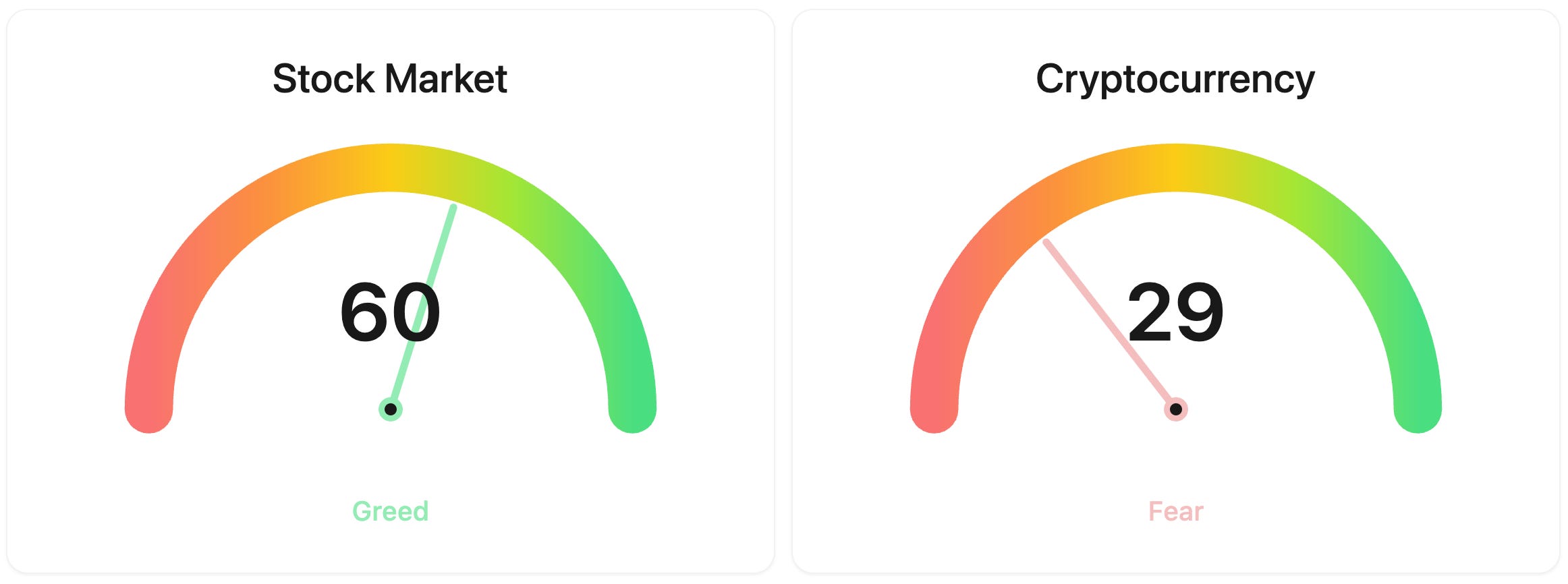
⚖️ Fear & Greed
📉 The Number That Matters
4.2%
The unemployment rate economists expect today, with a 4.3% tail and three Fed officials already voting to hike.
⚔️ Winners vs Losers
Winners
DOCS 0.00%↑ : +92.11% Doximity Inc. shares more than doubled after fiscal first quarter revenue of $156.6 million beat consensus and management raised its full year outlook by more than the size of the quarterly beat. The company also flagged over 30% growth in workflow active prescribers and 25% sequential growth in AI search queries, easing fears that rival clinical AI tools were eroding its position.
VATE 0.00%↑ : +42.11% INNOVATE Corp. surged after its Infrastructure subsidiary DBM Global posted a record second quarter with revenue up roughly 78% year over year, alongside margin expansion and backlog growth.
TEAM 0.00%↑ : +32.23% Atlassian Corporation jumped after fourth quarter revenue rose 28% to $1.77 billion and adjusted earnings of $1.87 per share beat the $1.50 consensus, with cloud revenue up 31% and remaining performance obligations up 44%. Guidance for the current quarter also came in ahead of Street estimates, calming concerns that AI coding tools would displace the platform.
FIGS 0.00%↑ : +26.78% FIGS Inc. climbed after second quarter revenue rose 28.8% to $196.6 million and the company lifted full year revenue growth guidance to roughly 20% from a prior 14% to 16% range. Results included a $20.5 million tariff recovery that investors will need to treat as largely non recurring.
NET 0.00%↑ : +15.67% Cloudflare Inc. rallied after second quarter revenue accelerated 36% to $696.1 million and management raised full year adjusted profit guidance to $1.25 to $1.26 per share. Chief Executive Matthew Prince said automated AI agent traffic exceeded half of total network traffic for the first time.
ABNB 0.00%↑ : +7.72% Airbnb Inc. rose after second quarter revenue climbed 17% to $3.61 billion and earnings of $1.37 per share topped the $1.25 consensus, ending a three quarter run of misses. Current quarter revenue guidance of $4.69 billion to $4.77 billion also landed above expectations.
Losers
CVRX 0.00%↑ : -42.58% CVRx Inc. collapsed after management cut full year revenue guidance to $58 million to $60 million from a prior $63 million to $67 million, citing sales force turnover, slower productivity ramps and reimbursement friction with a large Medicare Advantage payer. Second quarter revenue still grew 16% to $15.7 million with gross margin improving to 87%.
TTD 0.00%↑ : -27.28% The Trade Desk Inc. cratered after second quarter revenue grew just 3% to $715.1 million against a $751.4 million consensus and management guided third quarter revenue to at least $650 million versus expectations near $805 million. The company simultaneously replaced its chief financial officer, chief marketing officer and commercial chief.
QDEL 0.00%↑ : -22.49% QuidelOrtho Corporation slumped after cutting full year revenue guidance to $2.52 billion to $2.60 billion from $2.73 billion and lowering adjusted earnings guidance to $0.65 to $0.90 per share against a $1.85 consensus. The company also withdrew free cash flow guidance, overshadowing a second quarter revenue and earnings beat.
📊 Market Snapshot
Cryptocurrencies:
Bitcoin (BTC): $64,991 (▲ 1.14%)
Ethereum (ETH): $1,915 (▲ 0.65%)
XRP: $1.03 (▼ 0.15%)
Equity Indices (Futures):
S&P 500: 7,754 (▲ 0.24%)
NASDAQ 100: 29,651 (▲ 0.55%)
FTSE 100: 10,939 (▲ 0.81%)
Commodities & Bonds:
10-Year US Treasury Yield: 4.66% (▼ 0.43%)
Oil (WTI): $77 (▼ 2.02%)
Gold: $4,325 (▲ 1.99%)
Silver: $63.99 (▲ 4.03%)
Data as of: UK: 12:40 BST / US: 07:40 EDT / Asia (Tokyo): 20:40 JST
✅ 5 Things to Know
💼 The Jobs Number the Whole Week Was Built Around
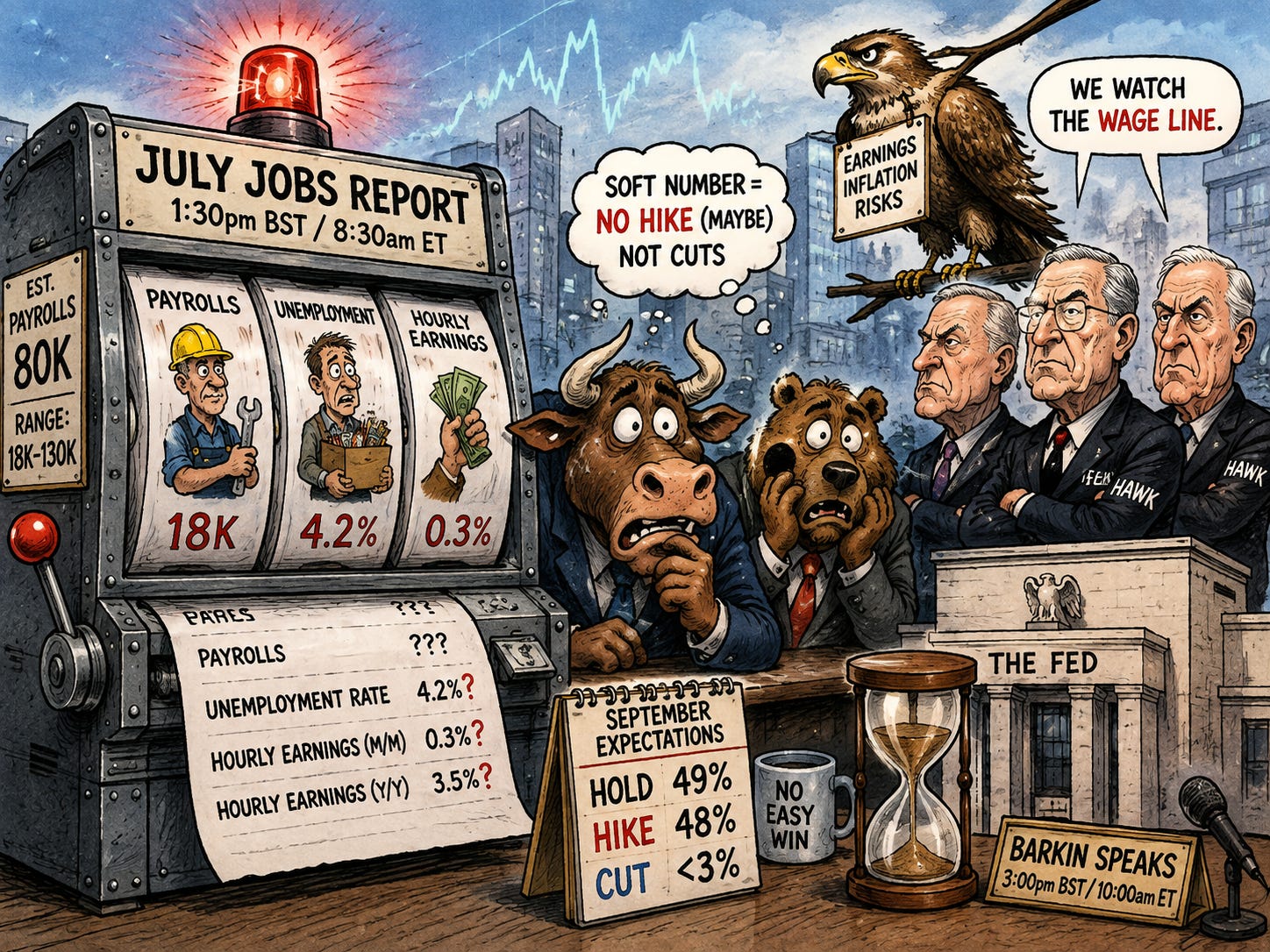
The July employment report lands at 1:30pm BST, 8:30am ET, and it is the release every other event this week has been arranged around. The Street has marked the payroll number down to roughly 80,000, with the spread running from as low as 18,000 up to 130,000, which tells you how little agreement there is. June delivered just 57,000 against a 110,000 consensus, roughly half, and the weakest reading in four months. The unemployment rate is expected to hold at 4.2%, though a 4.3% print is well within reach. Average hourly earnings are seen steady at 0.3% on the month and 3.5% on the year (CNBC).
What makes this awkward is the position the Fed has taken. The committee held its target range at 3.50 to 3.75% in July with three regional presidents voting to raise, the first three-way hawkish dissent since September 2016, and it lifted its own end-2026 projection at the same time. September now prices at 49% for a hold and 48% for a hike, with a cut under 3%. That changes what a soft number is worth: for two years weak payrolls meant cuts, and cuts meant a bid under everything, but today a soft print buys the removal of a hike instead. Smaller prize, narrower rally. Richmond Fed President Thomas Barkin speaks at 3pm BST, 10am ET, ninety minutes after the release.
Sensei’s Insight: The wage line is the one I care about. Payrolls can miss badly and still leave the hawks intact if earnings run hot, because that is the number the three dissenters keep pointing at. A firm payroll with 0.4% wages is the print nobody is positioned for.
⚖️ The Crypto Rulebook Slips to September
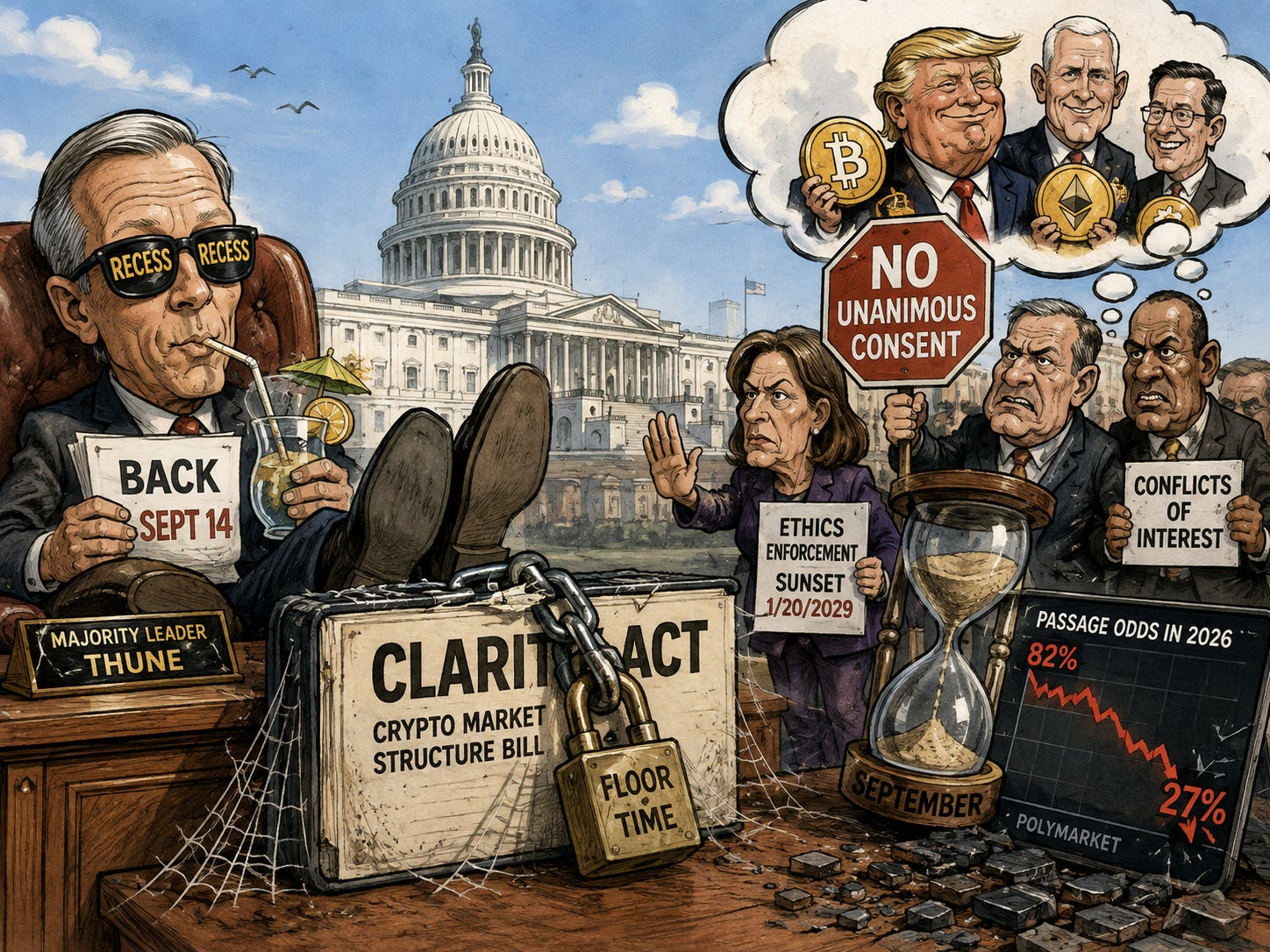
The Senate has left for its summer recess without voting on the CLARITY Act, the market-structure bill that would finally settle which American regulator governs which digital asset. Majority Leader John Thune confirmed late in the session that Democrats would not agree to bring it up before members left Washington, and said it would be queued up first when the chamber returns on 14 September. Passage odds for this year have collapsed on the news: the Polymarket contract on the bill being signed into law in 2026 has fallen to about 14%, a record low, from above 50% as recently as late July (CoinDesk).
The obvious question is how a vote can be delayed when no vote was ever scheduled, and the answer is the whole story. Nobody defeated this bill. It simply never got floor time. Getting a bill onto the Senate floor quickly requires unanimous consent, which any single senator can block, and Democrats declined to approve the time agreement that would have compressed the chamber’s remaining pre-recess business. The alternative route is a cloture motion, which needs 60 votes and consumes several days of floor time the Senate had already committed to a Russia sanctions package and a backlog of executive, intelligence and judicial nominations. With days rather than weeks left, the arithmetic never worked.
The second question retail investors keep asking is what is actually being argued about, because it is not the part of the bill that matters for exchanges. The core text is broadly settled: the CFTC would get exclusive jurisdiction over spot trading in digital commodities, the SEC would keep authority over primary-market transactions, and exchanges, brokers and dealers would register with the CFTC. What is unresolved is the ethics section governing officials’ own crypto interests. Trump agreed to restrictions covering himself, the vice president and members of Congress, but Democrats objected that enforcement would sit with an Attorney General seen as close to him and that the rules were written to sunset on 20 January 2029. Senators Thom Tillis and Ruben Gallego took over the compromise, with illicit finance and consumer protection still open alongside it.
What that leaves is a timing problem rather than a policy one, and timing is where this gets uncomfortable. If Thune filed cloture before members left, a first procedural vote could come as early as 15 September; if he files on the return, no earlier than 16 September. Either way that vote only opens debate, it does not pass anything, and the Senate has roughly three weeks of floor time before the midterm calendar starts eating windows. The market has been repricing this all summer, through a floated Independence Day signing ceremony and a late-July window that also came to nothing, and each miss has cost more than the last, with around $670 million of leveraged positions liquidated on one of them. What is striking is how little the latest delay has moved spot: Bitcoin is holding near $64,800 and XRP just above a dollar, which says the disappointment was priced well before it was confirmed (Yahoo Finance).
Sensei’s Insight: Three weeks of floor time in September against a bill that still has an unresolved ethics section is thin. The thing I am watching is not the text, it is whether Thune actually files cloture, because that is the only signal that separates a stated intention from a scheduled vote.
🚀 The Unlock Was Never the Risk, and the Tape Agreed
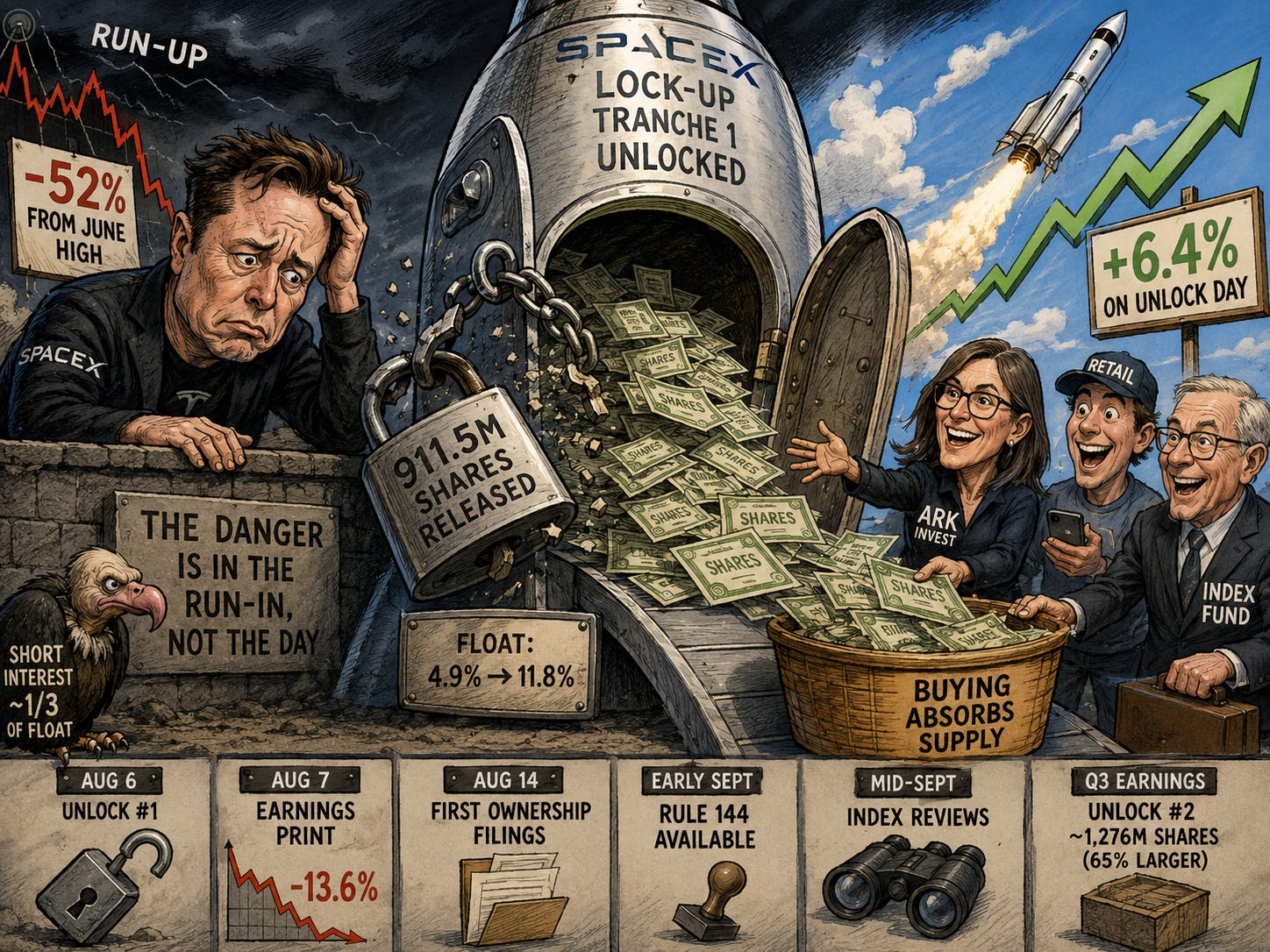
SpaceX cleared the first tranche of its post-listing lock-up yesterday, freeing about 911.5 million insider shares and lifting the tradable float to roughly 1.55 billion from 639 million, taking the freely traded portion of the company from 4.9% to 11.8%. On the arithmetic alone this was the largest dollar share unlock in American market history. The shares went up, trading as much as 6.4% higher at $115.20, with short interest near a third of the float and steady buying from ARK Invest and retail accounts absorbing the supply that did arrive (CNBC).
That is what the playbook we published ahead of the print argued would happen, and it is worth being precise about why, because the reasoning is reusable. The options market priced a 14 to 15% move for the week and could not split it, since the earnings release and the unlock sat inside a single weekly expiry. Our own work split them: across 18 mega-cap first earnings reports the median absolute move is 11.85%, against a normal 5.75%, while the academic record on 1,948 lock-up expiries puts the average three-day move at minus 1.5%, with 37% of expiries actually positive. That put the unlock at roughly one to four percent of price and the print at fifteen, which is why the piece said the volatile event was the results, not the release. It landed that way. The print took the shares down 13.6% to a record low close of $108.27 in the session after it, and the unlock took them up 6.4%.
The reason unlock size flatters to deceive is that it predicts almost nothing on its own. Arm released 9.5 times its float in 2024 and rose 2.1%, because SoftBank owned ninety percent and simply did not sell. Facebook released 0.87 times its float in 2012 while trading at half its offer price and rose 12.6% on the day. Holder intent separates them, not the share count, and here the tranche was dominated by employees plus the xAI-merger holders who came in at $105.32 and are barely above water. The supply has been deferred rather than cancelled. Affiliates cannot use Rule 144 until early September because the company has been SEC-reporting for under 90 days, the first ownership filings land on 14 August, and index funds will not buy against the larger float until the mid-September reviews. The tranche released at the third-quarter print, roughly 1,276 million shares, is 65% larger than this one.
Sensei’s Insight: The lesson generalises past this stock. When a dated, mechanical event is published months ahead, the market trades it before it arrives, so the danger sits in the run-in and not on the day. SpaceX fell 52% from its June high before a single locked share came free.
🛢️ Iran’s Hormuz Terms Turn the Oil Rally Back On

Brent crude climbed 1.25% to $83.52 a barrel this morning, extending a 3.8% jump to $82.49 in the previous session after Iranian state media published the draft terms Tehran wants attached to any reopening of the Strait of Hormuz. The document is considerably harder than the market had assumed. It would bar American and Israeli vessels from the waterway entirely, require countries Iran deems to have harmed it to pay compensation before passage is granted, and impose penalties on violators worth 20% of the cargo value aboard the ship. Roughly a fifth of the world’s seaborne oil moves through the strait (CNBC).
The reversal is the story. Prices had fallen about 8% across the week after Treasury Secretary Scott Bessent said a deal delivering freedom of movement could arrive within days, and by midweek Iran and Oman were reported to have agreed transit coordinates, with inbound traffic routed through Iranian waters and outbound through Omani. What the published draft shows is that the two sides were describing different agreements. For anyone modelling inflation, that matters more than the price itself: the July core reading came in at 0.1% on the month largely because fuel costs eased, and that easing was built on a Hormuz outcome nobody has actually signed.
Sensei’s Insight: Every cent of the oil retreat earlier this week was priced off a deal that does not exist yet. Terms this restrictive are an opening position rather than a final one, but until something is signed the inflation forecast underneath the Fed’s July hold is resting on a negotiation.
🏠 Airbnb Beats, Raises Guidance, and Jumps 10%
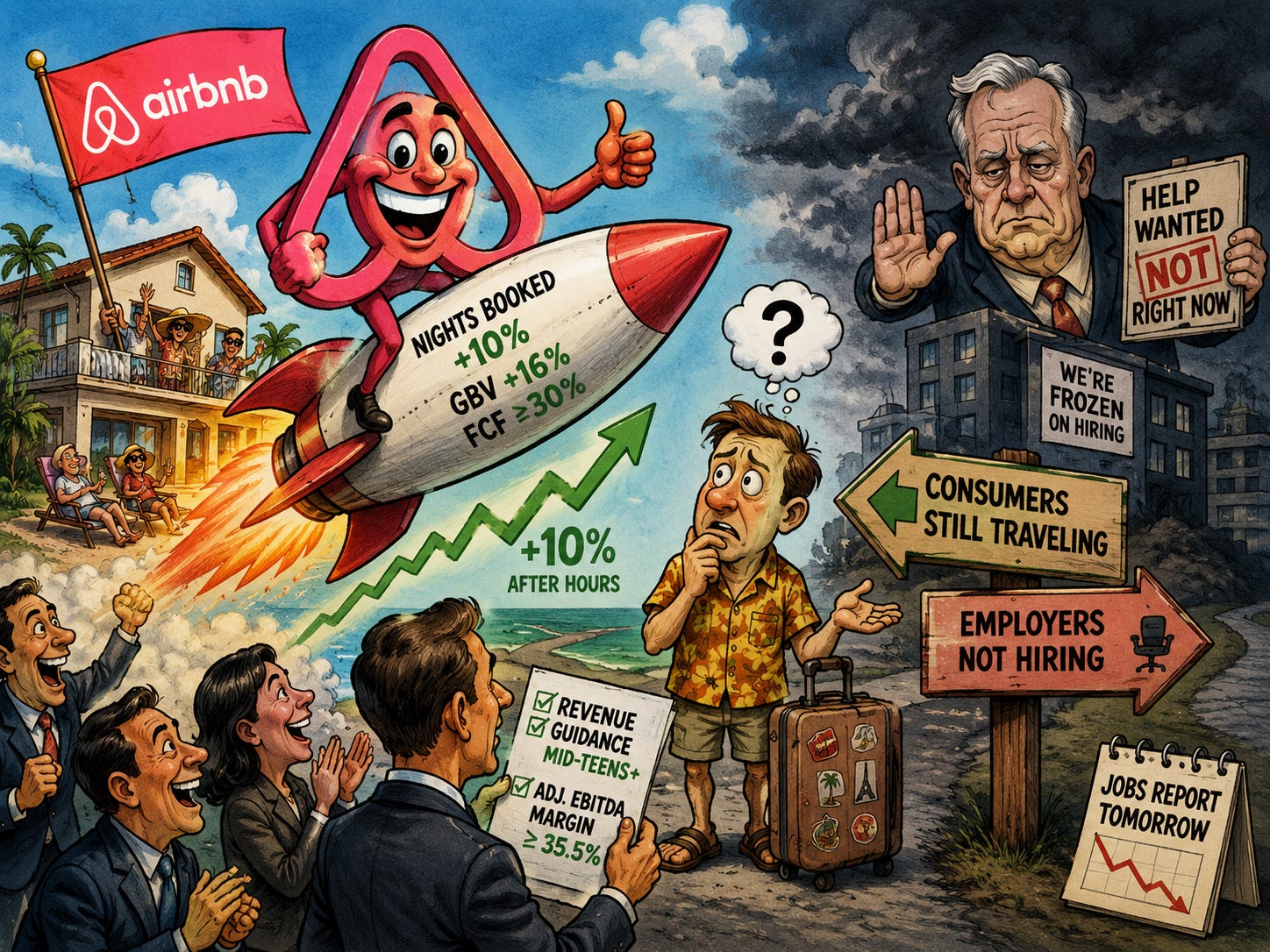
Airbnb reported second-quarter revenue of $3.61 billion, up 17% from $3.1 billion a year earlier and ahead of the $3.58 billion expected, with earnings of $1.37 a share against $1.25 forecast. Net income rose to $816 million from $642 million. The operational lines carried the print: nights and seats booked grew 10%, an acceleration on the first quarter, gross booking value rose 16% to $27.2 billion, and free cash flow climbed 30% to $1.25 billion from $962 million. Management raised full-year revenue growth guidance to at least the mid-teens and the adjusted EBITDA margin outlook to at least 35.5%. Shares gained about 10% after the close (CNBC).
An acceleration in nights booked is the part worth holding onto, because travel demand has been the market’s proxy for discretionary household spending all summer and the read had been softening. Marriott’s revenue per available room opened the week as the first check on whether the travel boom was cooling, and Airbnb closes it in the opposite direction. That lands hours before a payrolls report expected to show a weakening labour market, which is an uncomfortable pairing: consumers are still booking trips while employers appear to have stopped hiring. One of those two signals is early and the other is late.
Sensei’s Insight: Margin guidance going up alongside revenue guidance is the rarer half of this. Plenty of travel names are still buying growth with marketing spend. Guiding to 35.5% margins while nights accelerate says Airbnb is getting the volume without paying for it.
Stories You Might Have Missed
🎮 Take-Two Reports With GTA VI Pre-Orders Inside the Quarter
Take-Two Interactive reports fiscal first-quarter results before the open, with a call at 1pm BST, 8am ET, and the quarter to 30 June captures the first five days of Grand Theft Auto VI pre-orders after the window opened on 25 June. The company has guided to record fiscal 2027 net bookings of $8.0 billion to $8.2 billion, up around 18% on the year, and to a return to net profit after several loss-making years. Grand Theft Auto VI arrives on 19 November at $79.99 for the standard edition on PlayStation 5 and Xbox Series X and S. Take-Two has not committed to disclosing a pre-order count, so the bookings line and any change to the launch date are the numbers to read (Yahoo Finance).
🇨🇳 China’s Exports Beat Again as Imports Cool
China’s July exports rose 23% in dollar terms from a year earlier, ahead of the 22.2% growth forecast, while imports climbed 27.5%, and the trade surplus widened to $112.5 billion against the $107 billion expected. Both sides slowed from June, when exports surged 27%, the fastest since October 2021, and imports jumped 36%, the quickest in five years. Export growth above 20% for a second month says the tariff regime is biting less than the headline rates imply, with routing through third countries doing some of that work. The import slowdown is the line that moves the mining and industrial complex, since Chinese buying of iron ore, copper and crude sets the marginal price in all three (CNBC).
⚡ Constellation Energy Lifts Guidance on Data-Centre Demand
Constellation Energy reported adjusted operating earnings of $2.55 a share against the $2.34 analysts expected, on revenue of roughly $7.5 billion, and raised its full-year guidance to a range of $11.50 to $12.50 a share, taking the top end well above the $11.71 consensus. The company also signed another 920 megawatts of long-term power purchase agreements running 15 to 20 years, with deliveries scheduled between 2029 and 2032. Shares rose more than 4%. The nuclear generator has become one of the most direct ways to own AI capital spending without owning a chipmaker, and contracts stretching to 2032 are the part of that trade that does not depend on next quarter’s guidance (Yahoo Finance).
☁️ Salesforce Falls 3% on a Four-Way Leadership Reshuffle
Salesforce shares fell about 3%, the heaviest drag on the Dow, after the company announced four senior changes at once. Srini Tallapragada, president and chief engineering and customer success officer, stepped down after 14 years and will advise Marc Benioff through to August 2027. Rohan Kumar, who joined from Microsoft in June, becomes chief platform and engineering officer, Miguel Milano moves up to operating chief, and Alexa Vignone takes the revenue role. Tallapragada was central to building and shipping Agentforce, the AI platform the whole investment case now rests on, which is why a reshuffle rather than the results moved the stock (Yahoo Finance).
Deep Dive: The Payrolls Cheat Sheet
The number lands at 1:30pm BST, 8:30am ET.
A weak jobs number is still good news for this market, but it is worth a lot less than it used to be. There are no cuts on the table any more, so a soft print only buys the removal of a hike. Smaller prize, shorter rally.
So I have built the whole thing into one playbook. What each payroll outcome does to September pricing, the S&P, the 10-year, the dollar, gold, Bitcoin, the banks and the rate sensitives. The same again for wages, which is the half of the report most people skip. A matrix of the two together, so you can find the cell that matches whatever prints and know what that combination usually does. The four things that sound alarming and mean very little, including why 4.3% unemployment can print on a perfectly healthy number. And the levels I care about on the 10-year and the 30-year.
Have a read before the print. It is attached below: