This content is for informational and educational purposes only and does not constitute financial advice. Always do your own research. Not financial advice (NFA).
👀 Today’s Stories at a Glance
🤝 Iran Roadmap Survives Trump Threat: Switzerland talks set a 60-day peace path, though Lebanon strikes could still derail it.
🇬🇧 Starmer Quits, Gilts Stay Calm: Markets shrugged at the resignation, waiting instead on the chancellor Burnham picks.
🇮🇳 Jio Files India’s Biggest IPO: A $3.8 billion raise clears dollar debt to bankroll a $110 billion AI plan.
₿ Bitcoin Hits Four-Month Low: Near $64,000 and down 50% from October, ETF outflows keep draining risk appetite.
🇯🇵 Japan Fears AI “Black Ships”: Son warns of a cyber shock as SoftBank sells OpenAI-built defence.
🌎 USMCA Review Deadline Nears: Trump hesitates on renewal before the July 1 checkpoint, leaving carmakers exposed.
⛏️ BHP Takes Potash Writedown: A $2.3 billion Jansen charge sank shares 4.4%, their worst drop in months.
📈 Barclays Cuts Robinhood Target: A move to $82 questions how fast “Trump Accounts” actually lift profit.
📈 Chart of the Day: Bullish (BLSH): BLSH hit a fresh low near $24, testing a possible double bottom.
🧠 One Big Thing
Five separate stories today rhyme: Jio clearing debt for a $110 billion AI plan, Getty licensing images to OpenAI, SoftBank selling OpenAI-built defence, and memory names rallying into Micron's earnings. The common trade isn't the model layer, it's the plumbing beneath it. Whoever wins the AI race still needs the same memory, data and infrastructure, which is why HBM capacity sits sold out and Micron reports into a supercycle on June 24. The model bets are crowded and binary. The picks-and-shovels layer, memory and converged-infrastructure names, may offer cleaner exposure to the same demand without having to pick a winner.
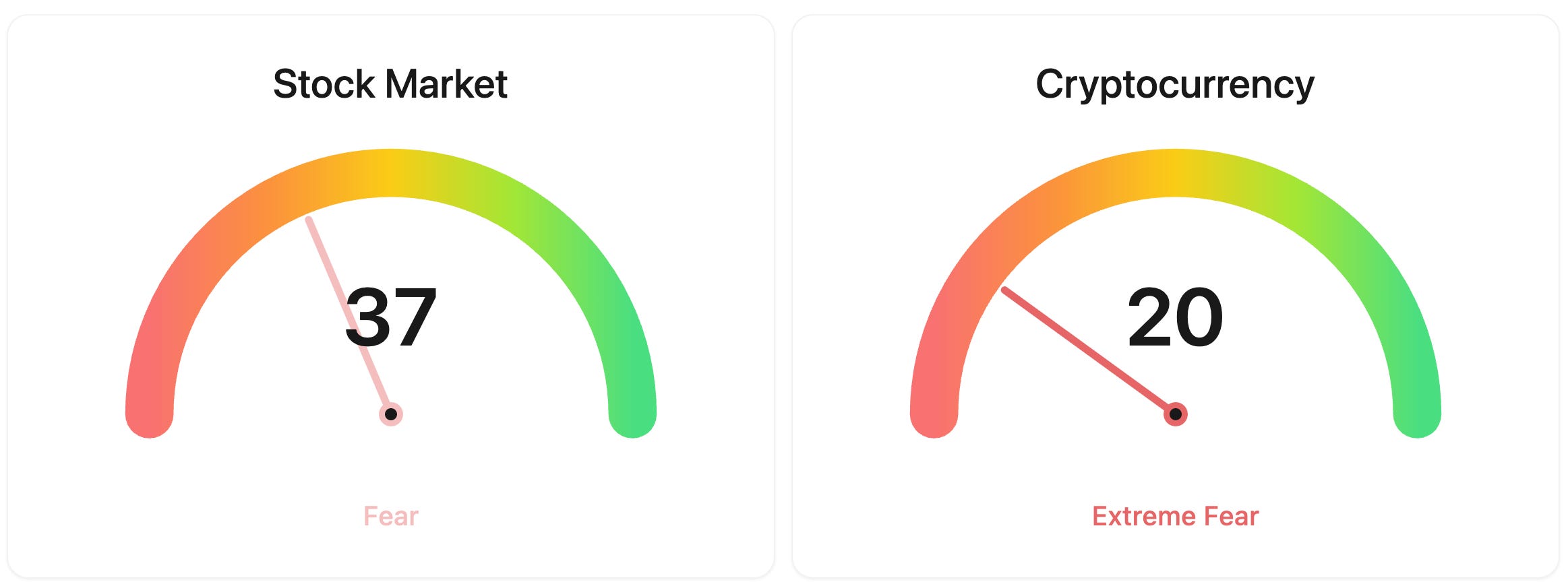
⚖️ Fear & Greed
📉 The Number That Matters
$3.4 BILLION
US spot Bitcoin ETFs have bled $3.4 billion across an 11-day stretch, the longest outflow run since their 2024 launch, and the redemptions show no sign of stopping.
⚔️ Winners vs Losers
Winners
GETY 0.00%↑ +119.78% Getty Images Holdings nearly doubled after unveiling a multi-year display agreement with OpenAI that brings its licensed image libraries into ChatGPT’s search and discovery features, announced Sunday evening. The deal validates the company’s AI licensing strategy and lands on a depressed sub-$1 share base, amplifying the move.
APGE 0.00%↑ +47.42% Apogee Therapeutics surged after AbbVie agreed to acquire the company for $135.11 per share in cash, valuing Apogee at roughly $10.9 billion and deepening AbbVie’s inflammation and immunology pipeline across atopic dermatitis and asthma.
DFTX 0.00%↑ +40.36% Definium Therapeutics jumped after reporting positive topline results from its Phase 3 Emerge study, in which a single dose of its LSD-based DT120 met the primary endpoint in major depressive disorder. The readout de-risks the lead program ahead of additional Phase 3 anxiety data due later this year.
ORKA 0.00%↑ +17.50% Oruka Therapeutics rallied as the $10.9 billion AbbVie-Apogee takeout reignited M&A appetite for inflammation and immunology biologics, spotlighting Oruka as a fellow Paragon-hatched dermatology play whose once-yearly psoriasis antibody has drawn favorable comparisons to AbbVie’s Skyrizi.
PENG 0.00%↑ +11.66% Penguin Solutions climbed as investors bid up AI-infrastructure and converged-memory names, with its MemoryAI and OriginAI inference platforms positioning the company as a direct beneficiary of surging demand for GPU-attached memory in AI data centers.
MU 0.00%↑ +4.56% Micron Technology gained alongside fellow memory names Western Digital (+5.20%) and Sandisk (+4.19%) as the AI memory supercycle extended into Micron’s fiscal third-quarter earnings on June 24, with sold-out HBM capacity and surging NAND and DRAM pricing underpinning the group.
Losers
SPCX 0.00%↑: SpaceX extended its post-IPO pullback, giving back more of the spike that followed its record June 12 debut as a $60 billion all-stock Cursor acquisition, a planned $20 billion bond offering, and the launch of put options handed bears their first practical tools to fade the thin-float rally.
📊 Market Snapshot
Cryptocurrencies:
Bitcoin (BTC): $64,611 (▲ 2.18%)
Ethereum (ETH): $1,768 (▲ 3.68%)
XRP: $1.15 (▲ 2.07%)
Equity Indices (Futures):
S&P 500: 7,563 (▼ 0.10%)
NASDAQ 100: 30,756 (▲ 0.12%)
FTSE 100: 10,411 (▲ 0.56%)
Commodities & Bonds:
10-Year US Treasury Yield: 4.49% (▲ 0.72%)
Oil (WTI): $75 (▼ 0.41%)
Gold: $4,204 (▼ 0.37%)
Silver: $66.23 (▲ 0.72%)
Data as of: UK: 12:51 BST / US: 07:51 EDT / Asia (Tokyo): 20:51 JST
✅ 5 Things to Know
🤝 US and Iran Agree Roadmap as Trump Threatens Strikes
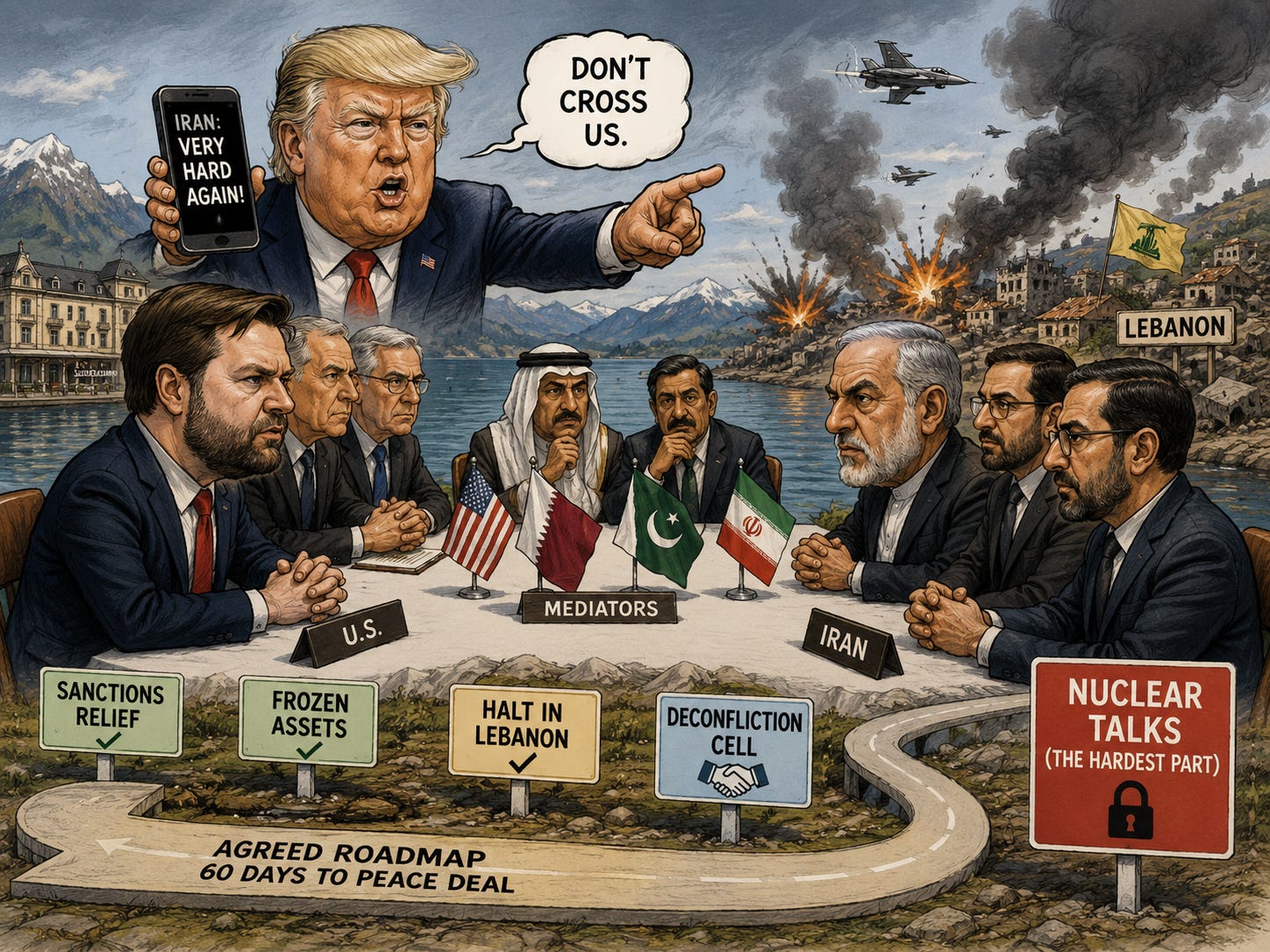
US and Iranian negotiators emerged from an all-night session in Switzerland with a roadmap towards a full peace deal within 60 days, the first direct talks since the two sides signed an interim agreement last week. Vice President JD Vance led the US delegation at the Lake Lucerne resort, with mediators Qatar and Pakistan shuttling between the rooms. The mood was tense. Midway through, President Trump posted that the US would hit Iran “very hard again” unless it reined in Hezbollah in Lebanon, and Iran’s team briefly refused to return to the table, though it never walked out. Both sides agreed to set up working groups on nuclear issues, sanctions and monitoring, with technical talks continuing through the week. (Washington Post)
For retail investors, this is the framework that has kept oil and inflation fears in check, and its weakest point is Lebanon. Israel is not party to the Swiss talks and has kept striking Hezbollah, the Iran-backed group it has been fighting in southern Lebanon, and Iran wants those strikes stopped before it goes any further. The two sides agreed a “deconfliction cell” intended to freeze that front, and both named it the first real test of the wider deal. With Israel outside the room and Trump threatening fresh attacks, the roadmap’s near-term survival rests less on what was signed in Switzerland than on whether the shooting in Lebanon actually stops. (Al Jazeera)
Sensei’s Insight: The roadmap front-loads Iran’s wins. Sanctions waivers, freed assets and a halt in Lebanon all come before nuclear talks even start. The nuclear question, the one the deal’s critics care about most, is deliberately last, which means the hardest part of this is still months away.
🇬🇧 Starmer Resigns, Gilts Wait on the Next Chancellor
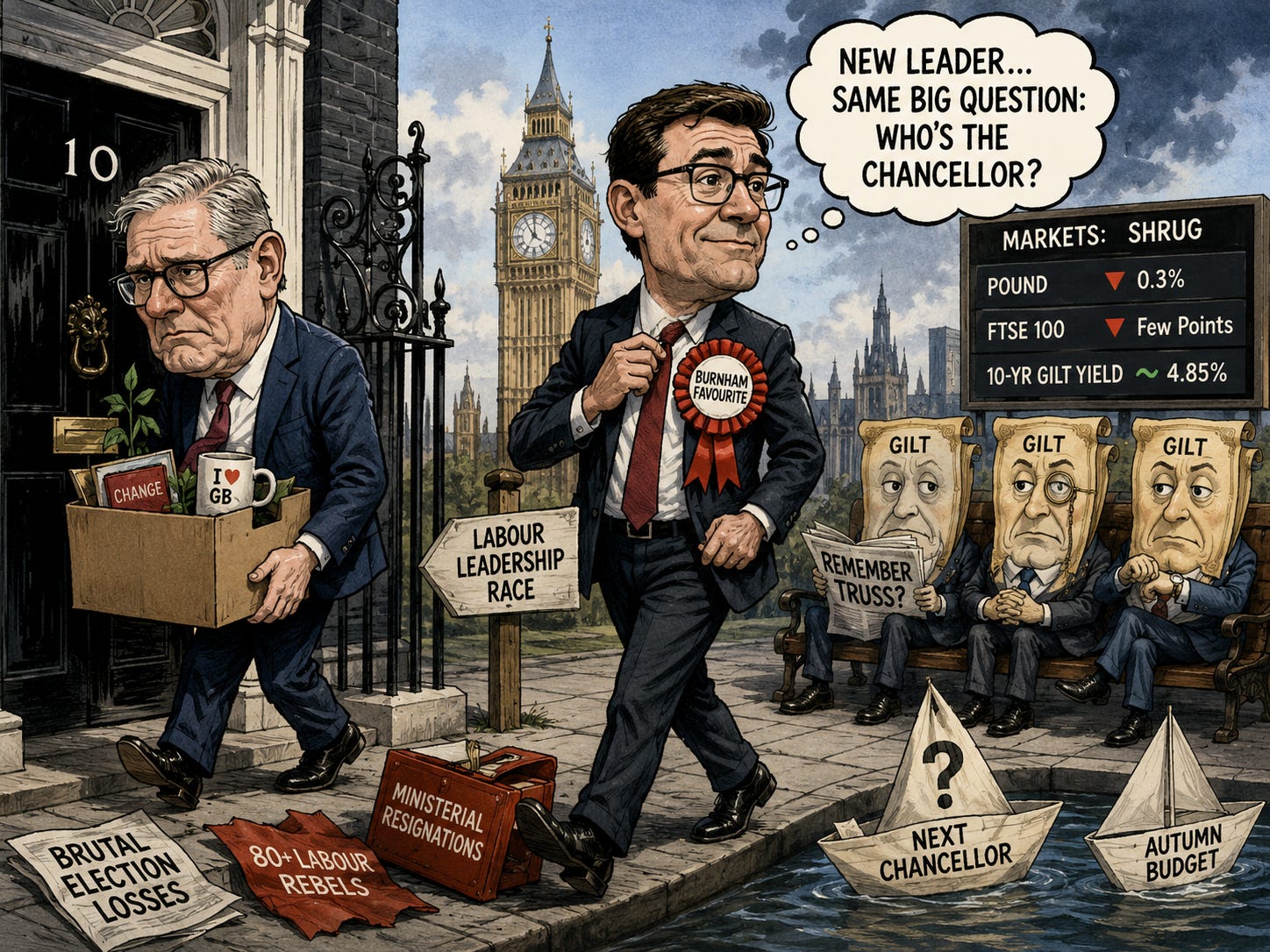
Keir Starmer said today he will resign as prime minister and Labour leader, and markets barely flinched, which tells you the exit was long expected. The pound slipped about 0.3% to around $1.319, extending a roughly 3% fall since February, the FTSE 100 dipped a few points, and the 10-year gilt yield, the rate on UK government debt, held near 4.85%. Starmer goes after a brutal stretch: heavy losses in May’s local elections, a revolt by more than 80 Labour members of Parliament, and a run of ministerial resignations. The final push came last week when Andy Burnham, the former Greater Manchester mayor, won a by-election, and he was sworn in as an MP today, removing the last barrier to a leadership bid (CNBC).
For UK markets the resignation itself changes little, because Burnham is the runaway favourite and nominations to replace Starmer open on 9 July and close a week later, with a new leader possibly in place within weeks if no one runs against him. The open question is fiscal. Burnham once said the government should not be “in hock to the bond markets,” a line he has since walked back while reportedly bringing on a former Bank of England chief economist as an adviser. Gilt investors remember Liz Truss, whose 2022 package of unfunded tax cuts sent yields soaring and ended her premiership in 50 days. What traders are waiting on now is who Burnham names as chancellor (Yahoo Finance).
Sensei’s Insight: Gilt yields jumped last week when Burnham won his seat, not today when Starmer quit. Markets are already pricing the next government’s spending plans, not this one’s exit. What moves sterling from here is the chancellor Burnham picks and the autumn budget that follows.
🇮🇳 Jio’s Record IPO Clears Debt to Fund AI
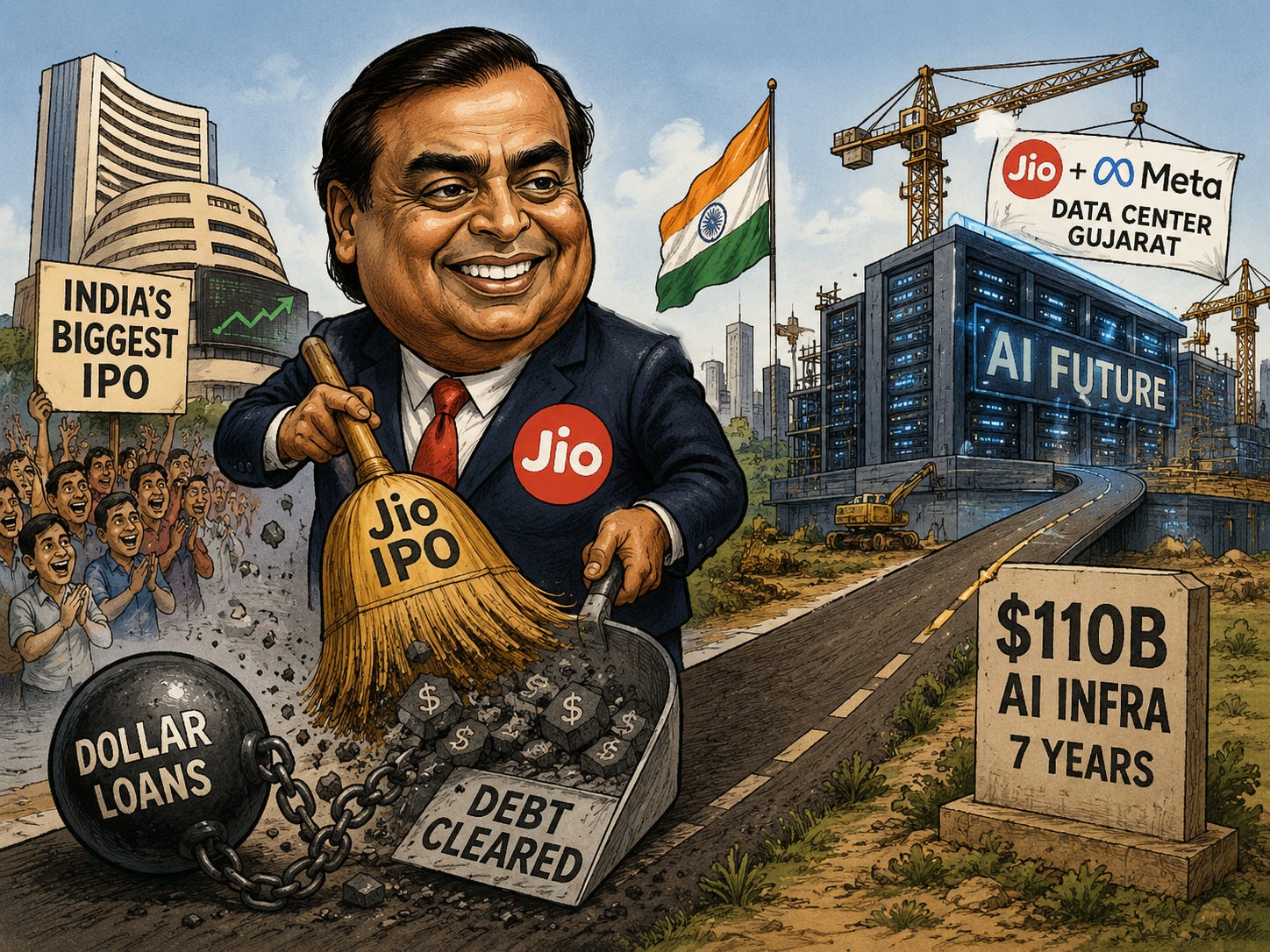
Mukesh Ambani’s Jio Platforms, the telecom and digital arm of Reliance Industries, filed papers for what would be India’s largest initial public offering, and the documents show most of the money is going to pay down debt rather than to existing owners. The deal aims to raise about $3.8 billion by issuing up to 270 million new shares, around 2.9% of the company, at a valuation analysts put between $131 billion and $180 billion. Almost $2.9 billion of the proceeds will repay foreign-currency loans at its telecom unit. Unlike many recent listings that mainly let early backers cash out, no current shareholder is selling a single share. (Bloomberg)
Clearing dollar debt now makes sense because of what comes next. At the same shareholder meeting, Ambani laid out a $110 billion artificial-intelligence infrastructure plan over seven years, including a data center built with Meta in Gujarat, and a clean balance sheet gives Jio room to spend. For retail investors, this is India’s biggest-ever listing and an early test of whether public markets will fund the AI buildout, a question that also hangs over the coming Anthropic and OpenAI offerings. The most direct read-through is Reliance itself, which rose about 6% before the meeting then closed roughly flat as the news matched expectations. A listing date and price band are still missing. (Reuters)
Sensei’s Insight: Strip the headline and this is a debt cleanup timed to bankroll a $110 billion AI bet. Reliance already ran up and gave it back, so the obvious move is spent. The next triggers are a price band, a listing date, and the Reliance Retail IPO behind it.
₿ Bitcoin Sinks to a Four-Month Low as Risk Drains
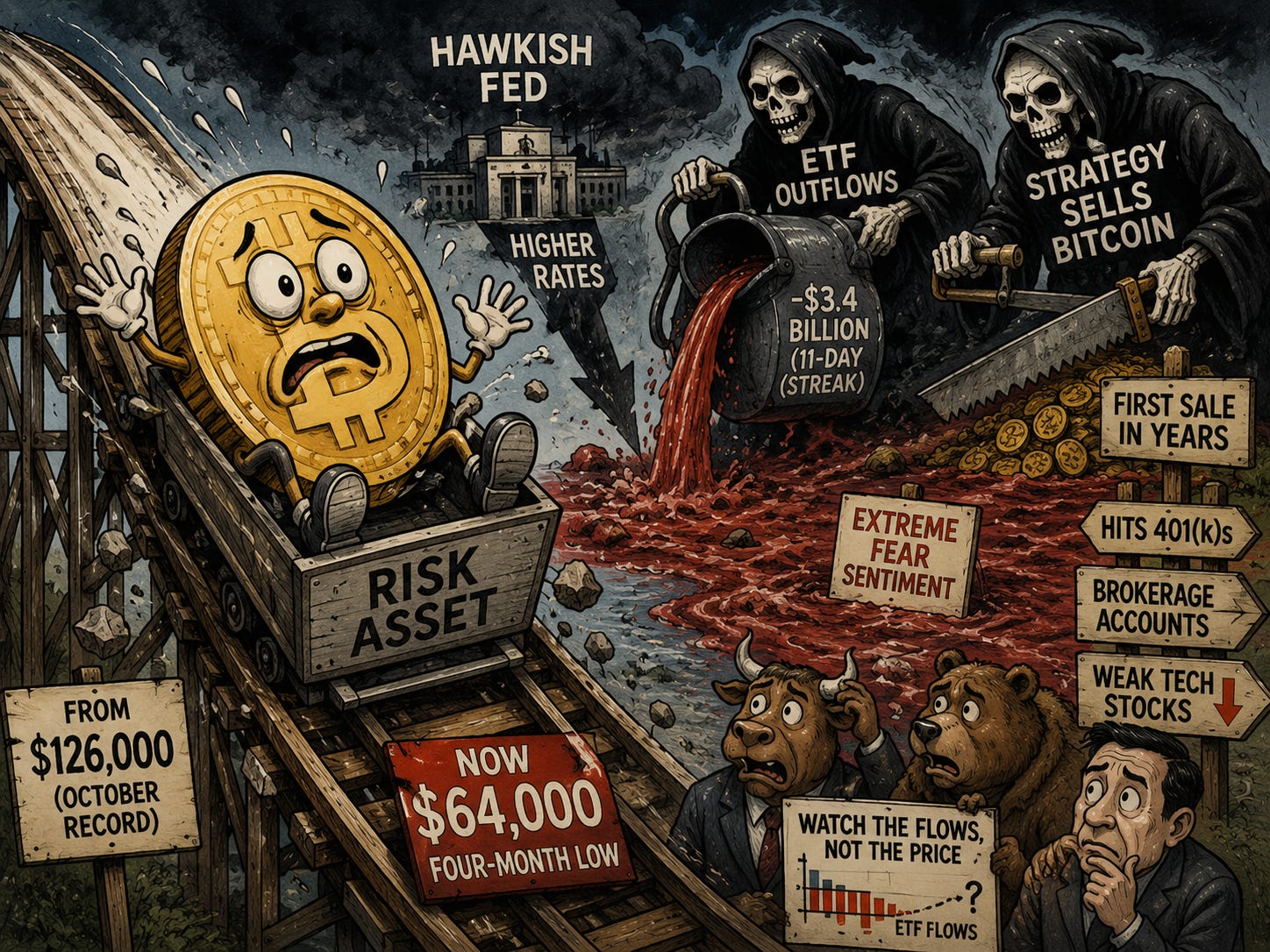
Bitcoin is acting as the market’s risk gauge, and right now it’s flashing caution. The cryptocurrency sits near $64,000, a near four-month low and down roughly 50% from its October record near $126,000, with sentiment trackers in “extreme fear.” The slide has macro roots: a hawkish Fed has lifted bond yields, and higher rates pull money out of speculative assets first. Two crypto-specific shocks made it worse. US spot Bitcoin exchange-traded funds bled about $3.4 billion over an 11-day stretch, the longest outflow run since they launched in 2024, and Michael Saylor’s Strategy sold Bitcoin for the first time in years, a break from its standing refusal to ever trim its holdings. (CNBC)
This reaches well beyond crypto wallets. Bitcoin now lives in ordinary brokerage and retirement accounts through ETFs, so the drop hits balances directly, and it tends to travel alongside weakness in other speculative bets like high-growth tech. Heading into a session that pairs a hawkish Fed with the Iran re-closure, Bitcoin is the cleanest read on how much risk the market wants to hold. There is a pattern worth watching: extended ETF outflow streaks have sometimes marked local bottoms, as forced selling exhausts itself. The number to track from here is the flows, whether redemptions stop, more than any single day’s price.
Sensei’s Insight: Forget the inflation-hedge label. Bitcoin is trading as a leveraged bet on risk appetite, falling when rates rise and stocks wobble. The number that matters now is ETF flows, not price. When the redemptions stop, the selling usually does too. That hasn’t happened yet.
🇯🇵 Japan Braces for an AI “Black Ships” Shock
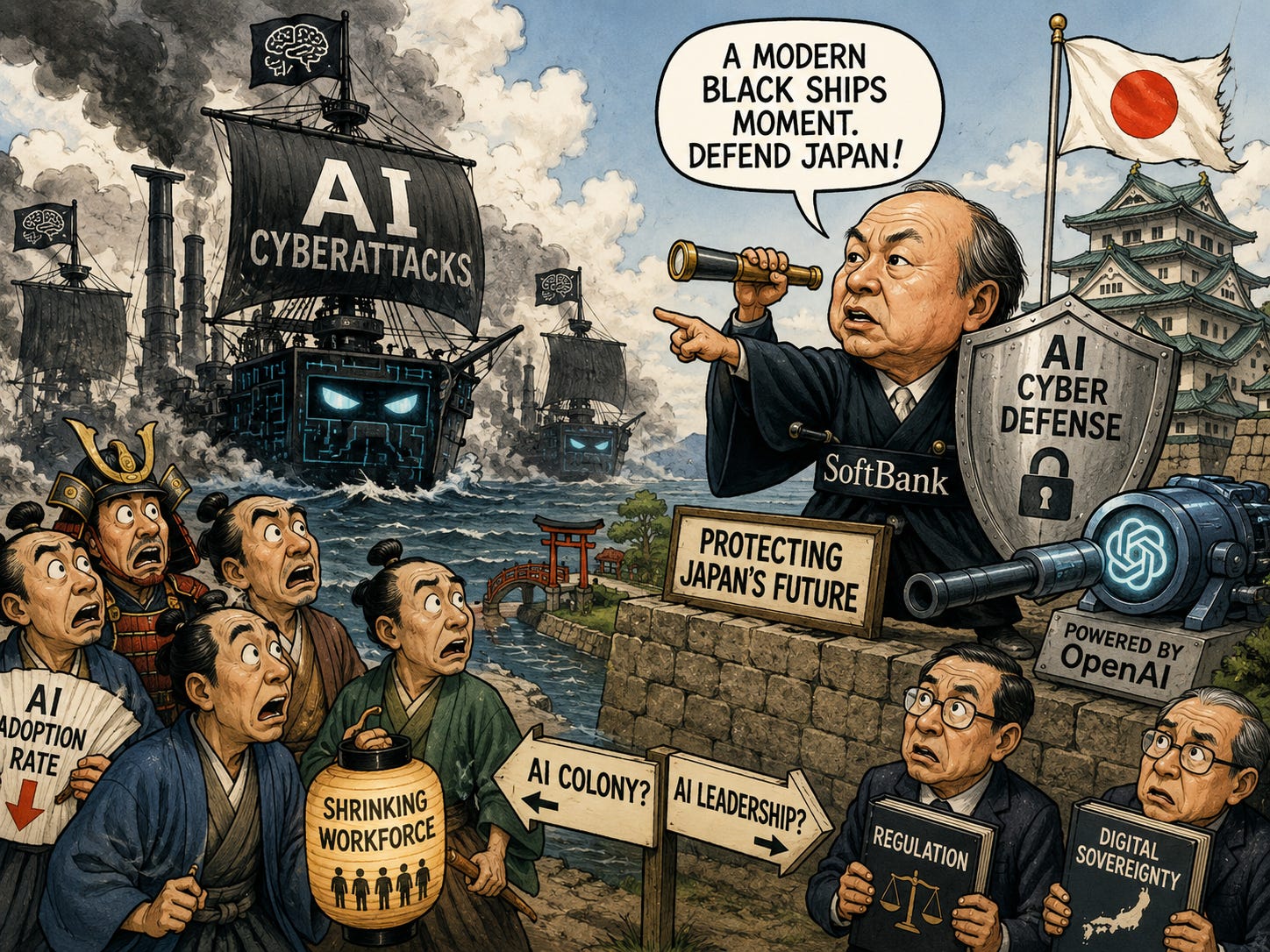
Japan is scrambling to avoid being overrun in artificial intelligence, and its biggest tech name is leading the charge. SoftBank founder Masayoshi Son warned that AI-powered cyberattacks could be a “Black Ships” moment for the country, a reference to the US warships that forced an isolated Japan open to trade in 1853. He paired the warning with a new SoftBank cybersecurity service built on OpenAI’s models, pitched as a way to defend Japanese infrastructure against AI-enabled attacks. The anxiety has a basis: Japan has one of the lowest workplace AI-adoption rates in the developed world, even as a shrinking workforce makes the technology hard to do without. (Reuters)
For investors, Japan is a live test of how a large developed economy absorbs the AI shock, and the response is reshaping its market. The fear cuts two ways. The country’s digital minister has warned Japan could end up an “AI colony,” dependent on foreign models, which is driving state-level cyber-defense spending and active regulation. Yet some argue Japan’s slow start is a hedge, letting it skip the costly, hype-driven early phase and adopt once the tools are proven. SoftBank, an OpenAI backer now selling AI defense, is the cleanest stock expression of both the promise and the risk. (Reuters)
Sensei’s Insight: The sharpest fear here isn’t lost jobs, it’s cybersecurity, where new AI models can find software flaws faster than humans can patch them. Note who profits from the fix: SoftBank and OpenAI are pitching AI defense against a threat their own tools help create. Watch Japan’s software names.
🌎 A Trade-Pact Deadline Looms as Trump Hesitates
The first formal review of the United States-Mexico-Canada Agreement, the pact that replaced NAFTA, hits its mandatory checkpoint on July 1. The three countries can renew it for another 16 years, revise it, or let it slide into yearly reviews until it expires in 2036. The signals point to friction: President Trump said this month he is “not looking to renew it,” citing US trade deficits with both neighbors, while Canada has formally asked to extend. Washington and Mexico City are negotiating; Canada’s track is lagging. The disputes center on auto rules, steel, dairy, and farm goods. For any company with cross-border North American supply chains, especially carmakers and parts suppliers, an unsettled deal means more tariff uncertainty, and the checkpoint is just over a week away.
⛏️ BHP Books a $2.3 Billion Potash Writedown
BHP, the world’s biggest miner, will take a $2.3 billion writedown on its Jansen potash project in Canada after another cost blowout. The second-stage expansion is now set to cost $6.9 billion, up about 40% from the earlier estimate, with first output slipping to around 2031, the third time BHP has busted the budget here. The charge is non-cash, an accounting markdown rather than spent money, yet shares still fell as much as 4.4%, their steepest drop in months, and pulled the broader mining index down about 4%. Potash, a fertilizer mineral, was meant to diversify BHP beyond iron ore and copper, and the sharp reaction shows investors questioning its spending discipline. Jefferies called the update “unhelpful” and kept a hold rating. (Bloomberg)
📈 Barclays Cools on Robinhood’s “Trump Accounts” Windfall
Robinhood helped build and now runs the app for “Trump Accounts,” the new government-seeded investment accounts for children under 18, and more than 5.5 million have signed up. Barclays cut its price target on the stock to $82, arguing investors are overestimating how much the program adds to profit any time soon and calling the near-term opportunity tiny. The longer-term prize is real, since millions of children making their first investment through Robinhood’s app could become lifelong customers, though parents may keep those accounts wherever they already bank. For a retail-brokerage stock that trades on user growth and trading volumes, the note is a reminder that a splashy headline and actual earnings are different things. (CNBC)
🔗 Connect with Us
Stay plugged in across platforms:
Sensei on X: sensei_live_
Martyn Lucas on X: MartynInvestor
Vaz on X: eVTOLHUB
📺 YouTube Channel (Live & Replays): Martyn Lucas Investor