This content is for informational and educational purposes only and does not constitute financial advice. Always do your own research. Not financial advice (NFA).
👀 Today’s Stories at a Glance
⏰ Trump Pauses Power Plant Strikes: Markets surged as the President delayed military action for five days to pursue diplomatic resolutions.
💰 Gold’s Safe Haven Trade Breaks: Metal prices plunged 10% as rising interest rate expectations and energy costs crushed traditional safety plays.
🪖 Marines Head to Expanding War: The Pentagon deployed 5,000 additional troops, signaling potential ground operations to secure critical oil straits.
☢️ Nuclear Startup X-Energy Files IPO: Amazon-backed developer seeks Nasdaq listing to commercialize advanced reactors amid a global energy supply crisis.
💻 Super Micro Stock Crashes: Shares plummeted 33% following federal charges against a co-founder for a $2.5 billion chip smuggling scheme.
🧠 One Big Thing
The Five-Day Fuse
Markets experienced a violent relief rally after President Trump delayed a threatened strike on Iranian power plants to pursue last-minute negotiations. The sudden pivot triggered a 4% surge in equities and a 10% collapse in oil prices as traders unwound positions betting on immediate infrastructure destruction. However, the five-day reprieve remains strictly conditional and does not resolve the physical blockade of the Strait of Hormuz. For investors, the volatility underscores a fragile environment where geopolitical headlines override traditional safe havens like gold. Real stability requires a definitive reopening of energy transit rather than temporary pauses in hostilities.
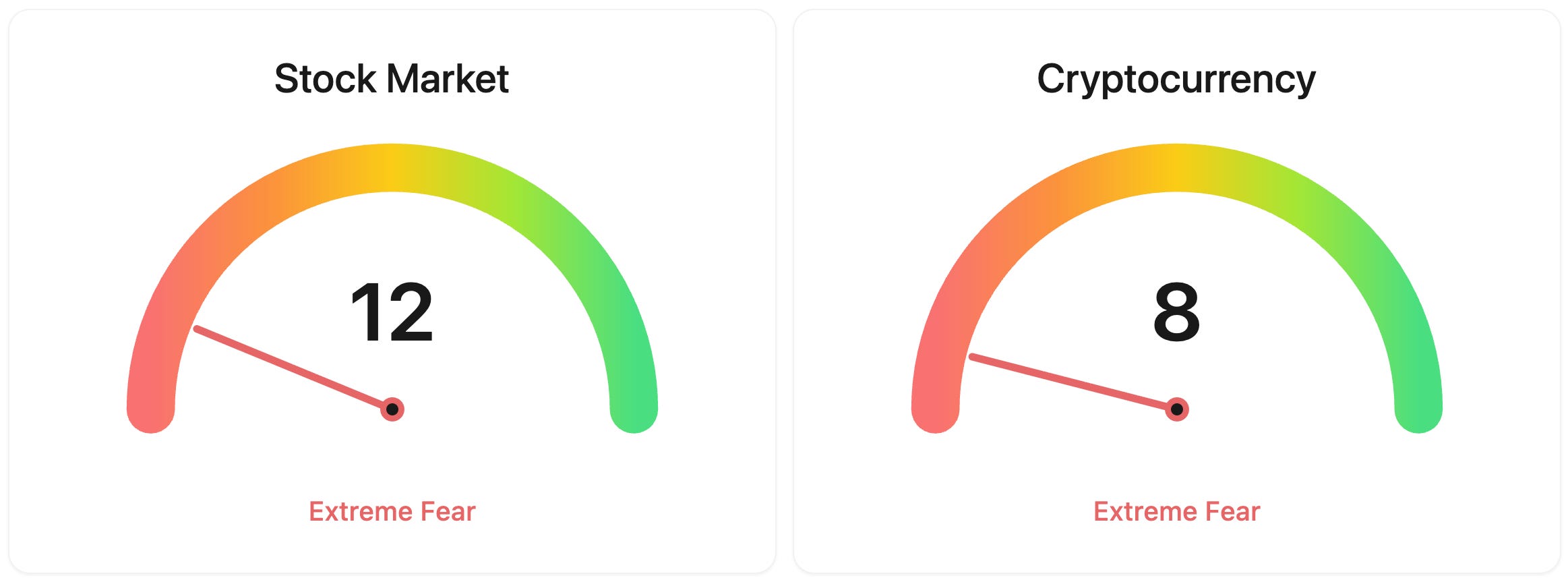
⚖️ Fear & Greed
📉 The Number That Matters
5 DAYS
President Trump has postponed military strikes on Iranian infrastructure for 5 days following productive conversations. The reversal triggered a 4% surge in the S&P 500 and a 10% drop in oil prices, though the pause remains conditional on successful negotiations.
⚔️ Winners vs Losers
Winners
WSHP 0.00%↑: WeShop Holdings Limited continued its momentum as the low-float social commerce company benefits from a string of recent catalysts including a strategic partnership with CAA Executive Search to build out its U.S. leadership team and new retail brand integrations on its platform.
APGE 0.00%↑: Apogee Therapeutics, Inc. is scheduled to report 52-week maintenance data from the Phase 2 APEX trial of its lead drug zumilokibart in atopic dermatitis today, with a conference call at 8:00 a.m. ET that could support Phase 3 initiation later this year.
FLUT 0.00%↑: Flutter Entertainment plc is getting a lift from the NCAA March Madness tournament, one of the biggest betting events of the year for its FanDuel sportsbook, while the company continues executing its $5 billion share buyback program.
Losers
HYMC 0.00%↑: Hycroft Mining Holding Corporation pulled back alongside a sharp drop in gold and silver prices, which hit 2026 lows as a stronger dollar, rising oil prices, and expectations of higher-for-longer interest rates pressured precious metals.
NEM 0.00%↑: Newmont Corporation fell as gold dropped below $4,150 to its lowest level of the year, with the metal recording its worst weekly performance since 2011 amid profit-taking and dollar strength despite ongoing Middle East tensions.
B 0.00%↑: Barrick Mining Corporation declined in lockstep with the broader gold miner selloff as precious metals extended their March correction, driven by leveraged position liquidations and capital rotating into bonds and the dollar.
AEM 0.00%↑: Agnico Eagle Mines Limited slid as the gold rout deepened, with the sector under pressure from rising real yields and forced selling in futures markets outweighing the traditional safe-haven bid from geopolitical uncertainty.
WPM 0.00%↑: Wheaton Precious Metals Corp fell as both gold and silver prices tumbled, with silver hitting its lowest closing level since December and recording its third straight losing week.
SCCO 0.00%↑: Southern Copper Corporation dropped as copper and base metals came under pressure from broader risk-off sentiment tied to the economic fallout from the Iran conflict and concerns about global demand amid rising energy costs.
MU 0.00%↑: Micron Technology, Inc. continued to pull back after reporting record fiscal Q2 results last week, with investors selling on concerns about a raised capex forecast above $25 billion despite blowout revenue of $23.86 billion and earnings that beat estimates by nearly 40%.
📊 Market Snapshot
Before Trump’s announcement
Cryptocurrencies:
Bitcoin (BTC): $68366 (▲ 0.76%)
Ethereum (ETH): $2041 (▼ -0.60%)
XRP: $1.37 (▼ -1.09%)
Equity Indices (Futures):
S&P 500: $6443 (▼ -1.42%)
NASDAQ 100: $23844 (▼ -1.07%)
FTSE 100: £9672 (▼ -1.66%)
Commodities & Bonds:
10-Year US Treasury Yield: 4.44% (▲ 1.25%)
Oil (WTI): $98 (▲ 0.06%)
Gold: $4261 (▼ -5.14%)
Silver: $63.70 (▼ -6.18%)
Data as of: UK (GMT) 10:50 / US (EST): 06:50 / Asia (Tokyo): 19:50
After Trump’s announcement
Cryptocurrencies:
Bitcoin (BTC): $70750 (▲ 4.27%)
Ethereum (ETH): $2169 (▲ 5.61%)
XRP: $1.43 (▲ 3.00%)
Equity Indices (Futures):
S&P 500: $6633 (▲ 1.47%)
NASDAQ 100: $24622 (▲ 2.16%)
FTSE 100: £9935 (▲ 1.00%)
Commodities & Bonds:
10-Year US Treasury Yield: 4.34% (▼ 1.09%)
Oil (WTI): $90 (▼ 8.34%)
Gold: $4399 (▼ 2.05%)
Silver: $67.58 (▼ 0.47%)
Data as of: UK (GMT) 11:27 / US (EST): 07:27 / Asia (Tokyo): 20:27
✅ 5 Things to Know Today
⏰ Trump Blinks on Power Plant Strikes, Markets Erupt
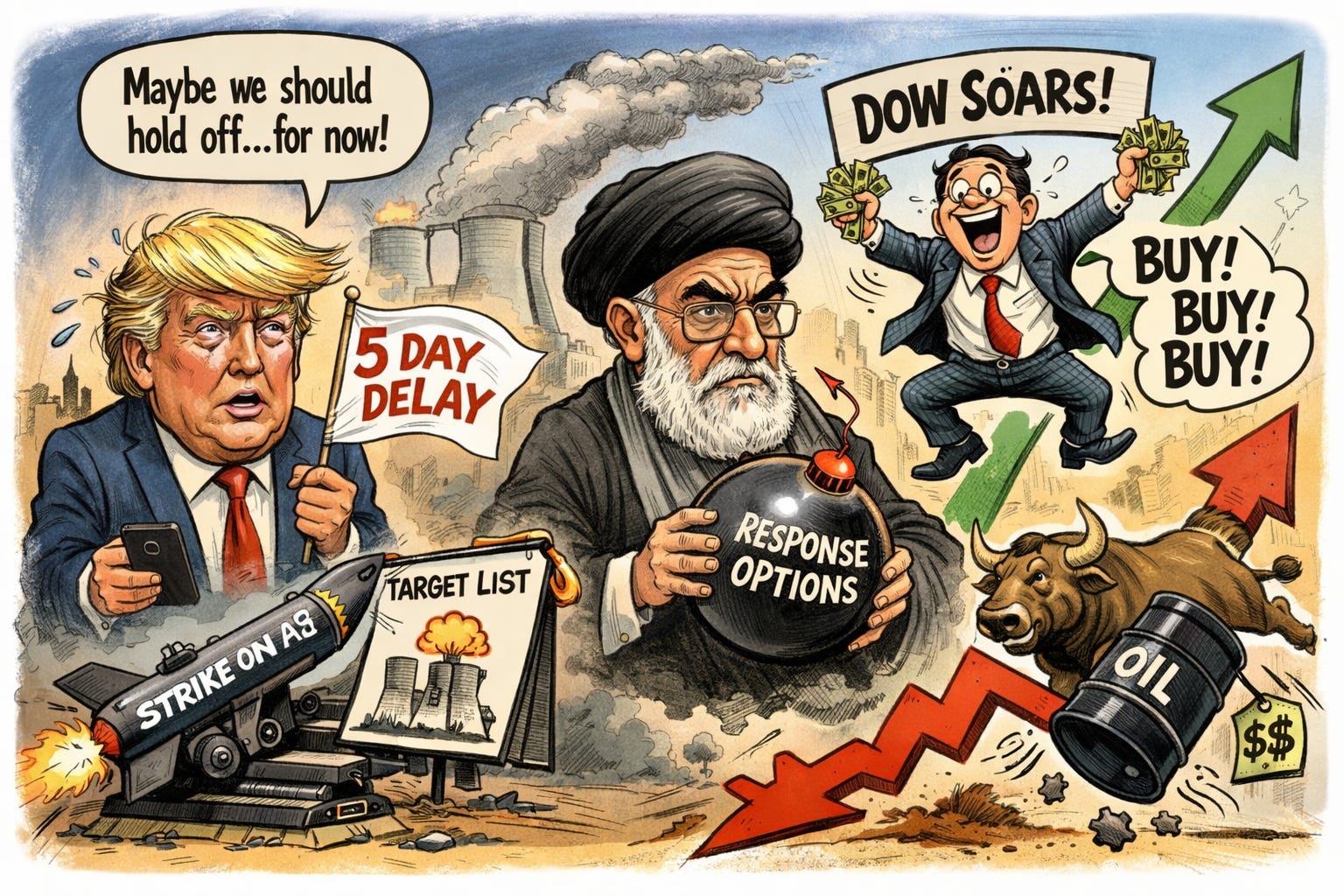
In a dramatic reversal that sent markets surging, President Trump announced today that he has instructed the “Department of War” to postpone all military strikes against Iranian power plants and energy infrastructure for five days, citing “very good and productive conversations” with Iran over the past 48 hours regarding “a complete and total resolution of our hostilities in the Middle East.” The S&P 500 jumped approximately 4% on the news and oil dropped roughly 10%, an extraordinary intraday swing that wiped billions off energy positions and added billions to everything else. The announcement came just hours before Trump’s own 48-hour ultimatum was set to expire, a deadline he had issued over the weekend threatening to “obliterate” Iran’s power plants “starting with the biggest one first” if the Strait of Hormuz was not fully reopened. Iran had not complied, and its military had instead warned it would target all US energy infrastructure in the region, deploy mines across the Gulf, and “completely close” the Strait indefinitely if attacked (CNBC).
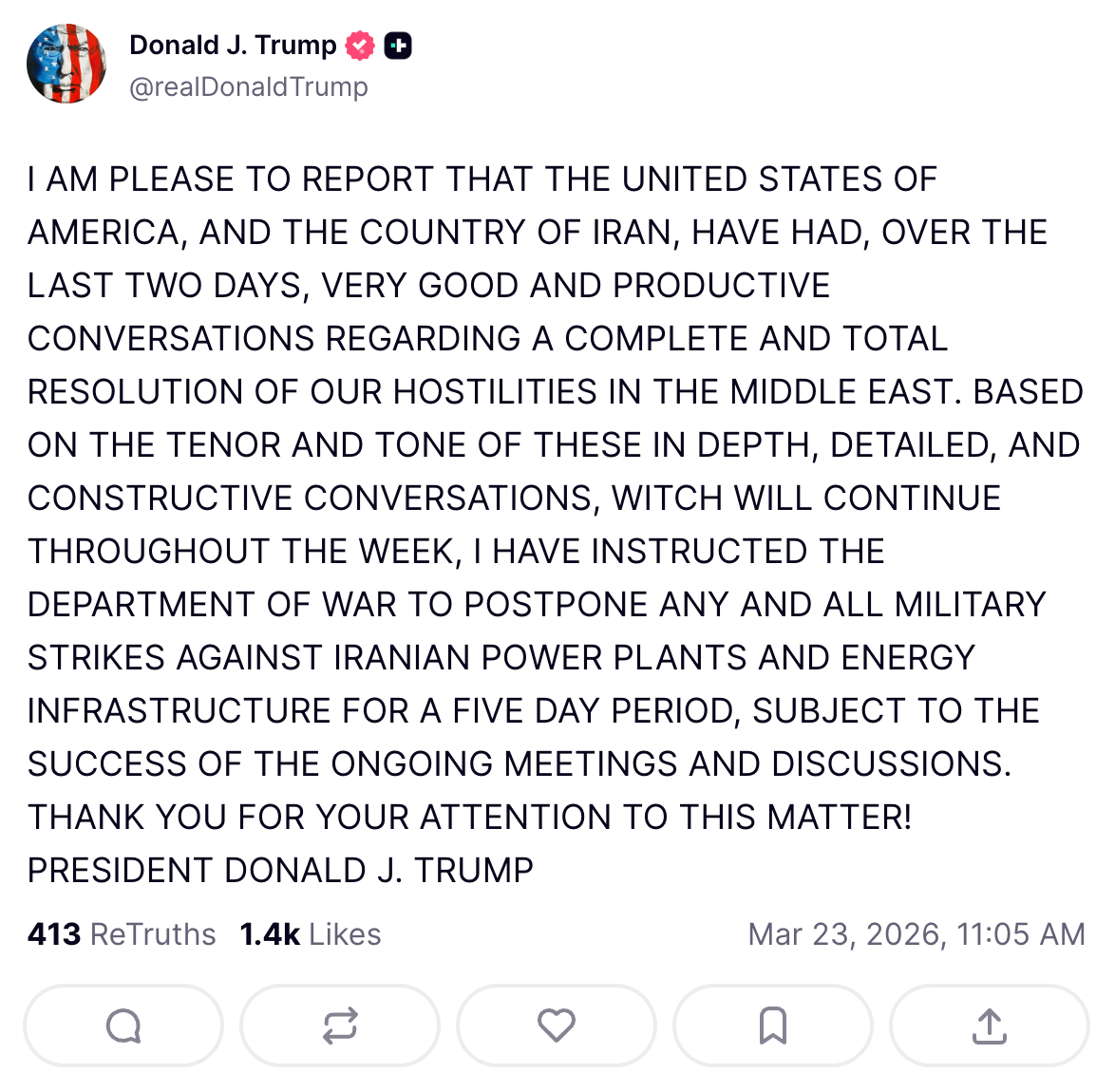
The pattern is becoming familiar. In the space of four days, Trump went from declaring “we’ve won” the war, to floating “winding down” military operations, to threatening what legal experts and international bodies have called a potential war crime, and now to pausing that threat in favour of talks. Under Article 56 of Additional Protocol I to the Geneva Conventions, power plants are classified as civilian infrastructure, and the International Committee of the Red Cross (ICRC) has stated that striking them “may constitute a war crime” due to cascading harm to hospitals, water treatment, and food supply chains. Senator Ed Markey called the original threat “a war crime.” Iran’s UN ambassador wrote to the Security Council calling it “inherently indiscriminate.” Military law professor Geoffrey Corn at Texas Tech University described Trump’s 51-word social media ultimatum as having “a feeling of ready, fire, aim,” adding that Trump “overestimated his ability to control the events once he unleashed this torrent of violence.” Amnesty International warned of “a substantial risk” of violating international humanitarian law. The five-day pause buys time, but investors should be cautious about treating this as a resolution. The war continues, strikes on military targets are ongoing, the Strait remains effectively closed, and Trump’s post explicitly conditioned the pause on the “success” of ongoing discussions, leaving open the possibility that infrastructure strikes resume next week if talks stall (PBS).
Sensei’s Insight: A 4% S&P jump and a 10% oil drop on a single Truth Social post is not resolution pricing. It is short-covering and relief, and it has happened before in this conflict only to reverse within days. The five-day window is conditional, the Strait is still closed, and the underlying inflationary damage has already been done. Treat this as a volatility event, not a turning point, until oil futures for 2027 start moving.
💰 Gold’s Safe Haven Trade Just Broke
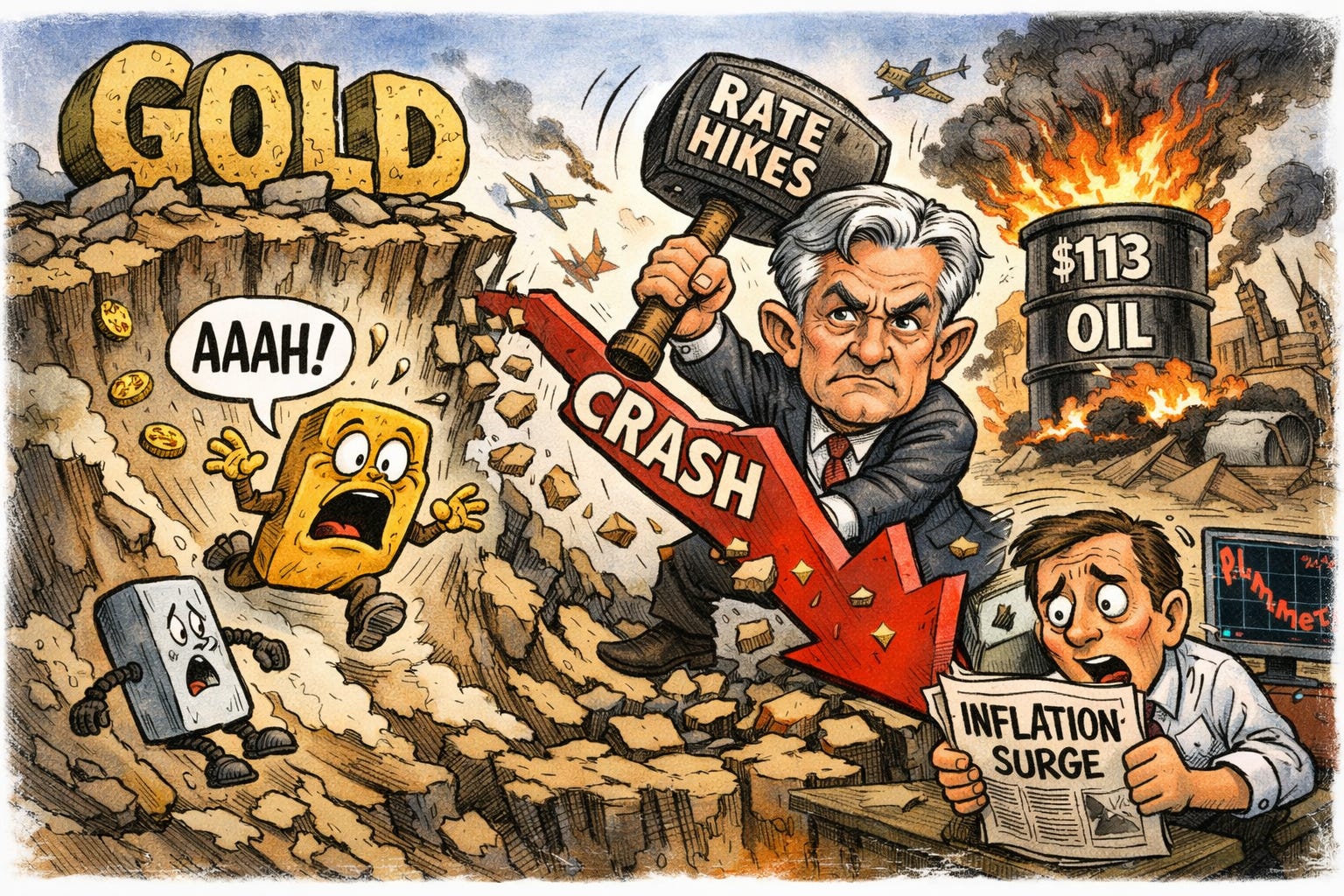
Gold has posted its worst weekly decline in over a decade, and today’s session extended the carnage before a late reversal. Spot gold plunged as much as 10% in early trading to near $4,119 an ounce, its lowest level of 2026, before bouncing sharply to around $4,300 after Trump’s announcement that he would pause infrastructure strikes for five days. Silver dropped more than 10% to around $62 before also recovering partially. Even after the bounce, gold remains down roughly 23% from its late January all-time high of $5,595 and has now fallen in every week since the war began. The selloff extends a decline that has defied expectations since the conflict started. Gold peaked weeks before the first strikes and has fallen almost continuously since, as the war’s inflationary impact has overwhelmed any flight-to-safety bid. Surging energy prices have forced markets to reprice interest rate expectations, with traders now pricing in a higher chance of a Federal Reserve rate hike than a cut by year-end. That is a direct headwind for gold, which pays no yield and becomes less attractive when rates rise (CNBC).
The broader market picture has been a rollercoaster. Asian markets opened in freefall, with South Korea’s KOSPI plunging 6.5% and Japan’s Nikkei falling 3.5%, before Trump’s pause announcement sent US equities surging approximately 4% and oil dropping roughly 10% from the session highs. Brent crude, which had climbed above $114 earlier in the day, pulled back sharply but remains elevated well above pre-war levels. Goldman Sachs had estimated flows through the Strait of Hormuz would remain at just 5% of normal levels for six weeks. The International Energy Agency (IEA) warned that more than 40 energy assets across nine countries have been severely damaged since fighting began, meaning supply disruptions could persist well beyond any ceasefire. The 10-year Treasury yield has jumped 41 basis points since the war began, to 4.38%, a massive move that pressures every rate-sensitive asset from housing to growth stocks. J.P. Morgan and Deutsche Bank have maintained year-end gold targets above $5,000 and $6,000 respectively, arguing the structural drivers of central bank buying and fiscal deficits remain intact, but the near-term picture remains dominated by the dollar and rates (Bloomberg).
Sensei’s Insight: Gold falling alongside equities is not a rotation. It signals that both asset classes are breaking down simultaneously, leaving few traditional places to shelter capital. When safe havens stop behaving like safe havens, it typically means markets are repricing the entire macro regime, not just one risk. Watch for cash and short-duration instruments to become the default hiding spot.
🪖 5,000 More Marines Head to an Expanding War
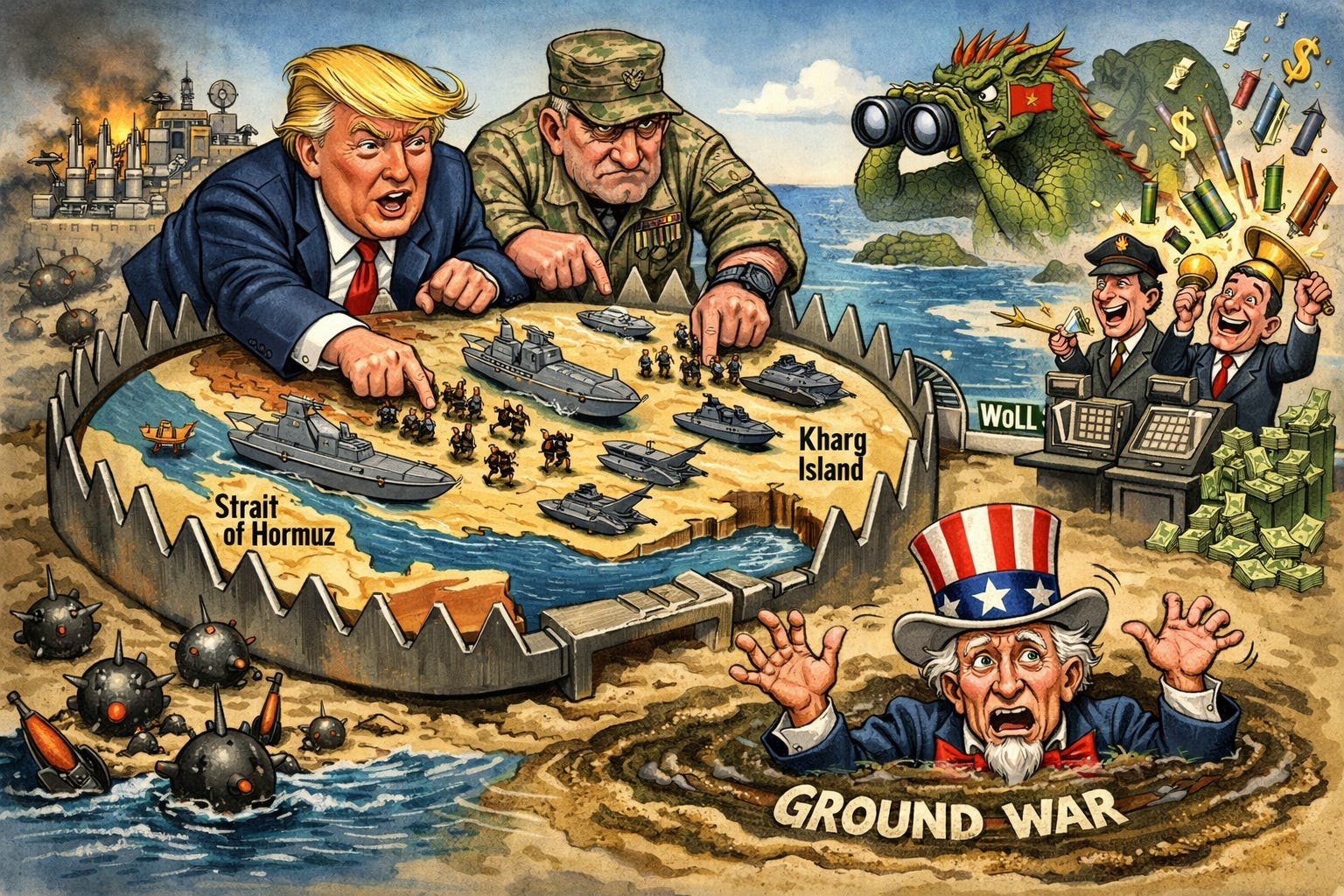
What began as an air campaign is starting to look increasingly like the precursor to a ground operation. The Pentagon is sending a second amphibious assault group to the Middle East, accelerating a military buildup that now totals roughly 55,000 US troops in the region. The USS Boxer and 11th Marine Expeditionary Unit (MEU) departed San Diego three weeks ahead of schedule, joining the USS Tripoli and 31st MEU already transiting from Japan. Together, the two deployments add approximately 5,000 Marines, six-plus warships, and squadrons of F-35B stealth fighters to the theatre. CBS reported that the Pentagon is actively drawing up ground troop deployment plans, and military analysts say the phasing is becoming clear: first, secure the Strait of Hormuz by raiding Iranian coastal fortifications and clearing mines; then, seize Kharg Island, Iran’s primary oil export terminal that handles 90% of its crude shipments. Axios reported the White House is actively considering the Kharg option, with a source saying the goal is to “weaken the Iranians more with strikes, take the island and then get them by the balls and use it for negotiations.” Military historian Dr Lynette Nusbacher told the Jerusalem Post this could be “the start of a boots on the ground operation,” noting the Marine units arriving are specifically trained for amphibious island seizure (Reuters).
The troop movements arrive as the war enters its fourth week with no diplomatic off-ramp in sight. Both Washington and Tehran have rejected ceasefire efforts brokered through Oman and Egypt. Iran’s Foreign Minister Abbas Araghchi told CBS that Iran “never asked for a ceasefire, and we have never asked even for negotiation.” Ali Larijani, Iran’s security chief who had been seeking a diplomatic channel, was killed in an Israeli strike last week. Trump himself, asked whether he fears Iran’s warning that US boots on the ground would be “another Vietnam,” replied: “No, I’m not afraid. I’m really not afraid of anything.” The redeployment of the 31st MEU from Japan also creates what analyst Carlton Haelig of the Centre for New American Security called “a ground combat and amphibious capability gap” in the Indo-Pacific, a concern for investors tracking China-Taiwan risk. A Quinnipiac poll found 74% of registered voters oppose sending US ground troops into Iran, while only 20% support it. Defence contractors remain direct beneficiaries: Lockheed Martin (LMT) trades near all-time highs above $670, and the Pentagon is seeking a $200 billion war supplemental from Congress that would supercharge revenue across the sector (ABC News).
Sensei’s Insight: The Indo-Pacific gap is the underpriced risk here. Pulling the 31st MEU from Japan removes one of the primary amphibious response forces covering the Taiwan Strait. If Beijing reads the redeployment as a window, defence stocks with Pacific exposure, from shipbuilders to missile defence, could see a second catalyst entirely unrelated to Iran.
☢️ Nuclear Startup X-Energy Files for Nasdaq IPO
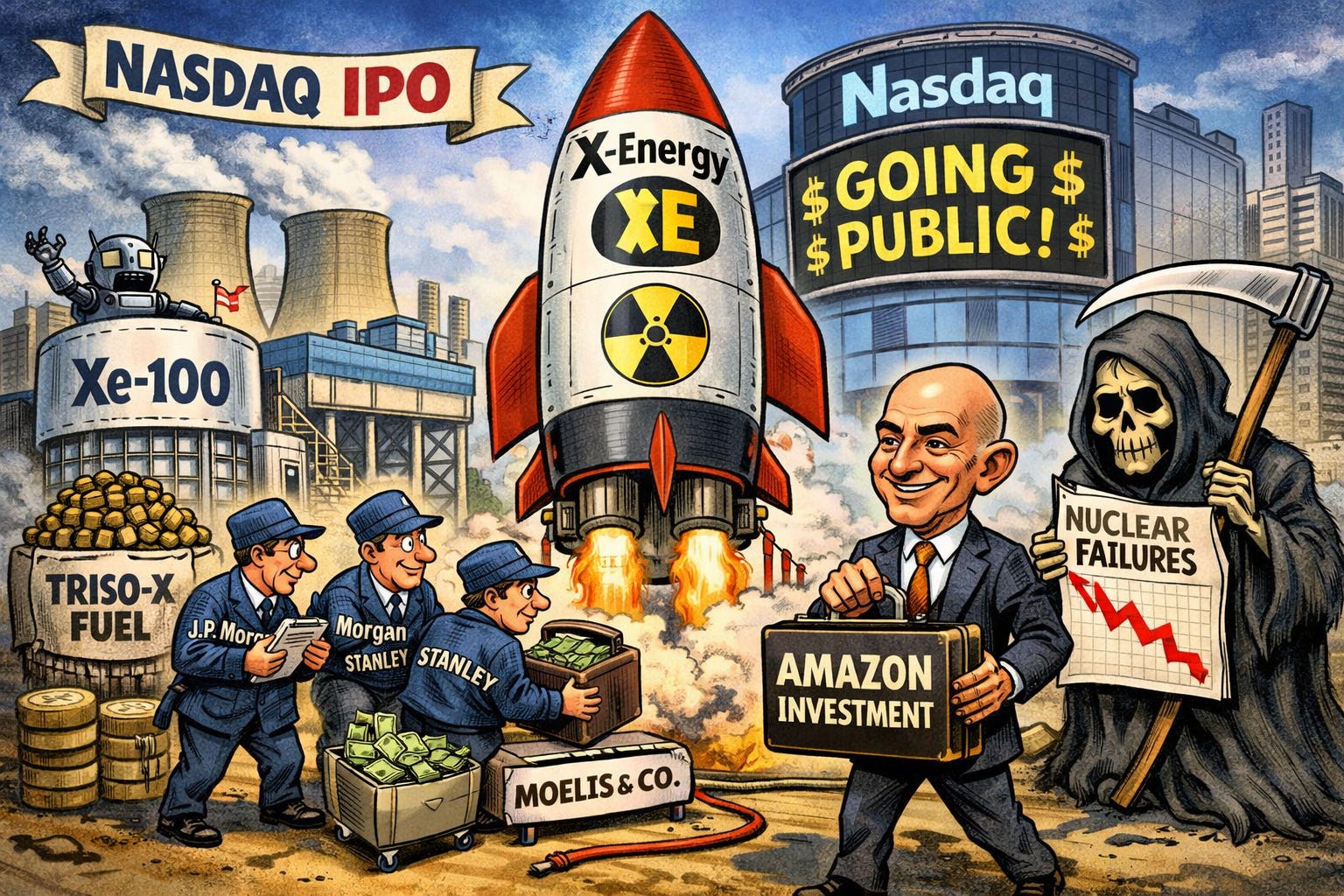
X-energy, the Amazon-backed developer of advanced small modular nuclear reactors, filed a draft registration statement with the Securities and Exchange Commission (SEC) last week for an initial public offering (IPO) on the Nasdaq under the ticker “XE.” The company did not disclose a share count or price range, with those details expected during the roadshow, typically three to six weeks after the initial filing. J.P. Morgan, Morgan Stanley, Jefferies, and Moelis & Company are leading the offering. X-energy develops the Xe-100, a Generation IV high-temperature gas-cooled reactor that produces 80 megawatts of electricity per unit, using proprietary TRISO-X fuel, uranium particles encased in layers of ceramic and graphite that the Department of Energy (DOE) has called the most robust nuclear fuel on the planet. The company’s fuel fabrication facility in Oak Ridge, Tennessee received its Nuclear Regulatory Commission (NRC) license in February and is expected to begin operations by May (Reuters).
The commercial pipeline is substantial: 11 gigawatts across approximately 144 planned reactors, with anchor customers including Amazon, which plans to use the reactors for data centres, Dow Chemical, which has selected its Texas Gulf Coast facility for the first deployment, and Centrica, which signed a partnership covering up to 6 gigawatts in the United Kingdom. X-energy has raised approximately $1.8 billion in private capital, including a $700 million oversubscribed Series D in November 2025 led by Jane Street with participation from ARK Invest and Point72. The filing comes after a failed Special Purpose Acquisition Company (SPAC) deal collapsed in 2023, and into a brutal market for nuclear peers: NuScale Power (SMR) has cratered 80% from its 52-week high to around $11.50, while Oklo (OKLO) trades at roughly $60 with no revenue. Bank of America estimates the United States small modular reactor market could reach $1 trillion by 2050 (Bloomberg).
Sensei’s Insight: The timing is counterintuitive but perhaps deliberate. A war that has spiked energy prices and exposed the fragility of fossil fuel supply chains is the strongest possible advertisement for domestic nuclear power. If X-energy prices well, it may signal that investors are beginning to separate the nuclear thesis from the broader tech selloff. NuScale and Oklo could see a sympathy bid.
💻 Super Micro Crashes 33% After Co-Founder Charged in $2.5 Billion Chip Smuggling Scheme
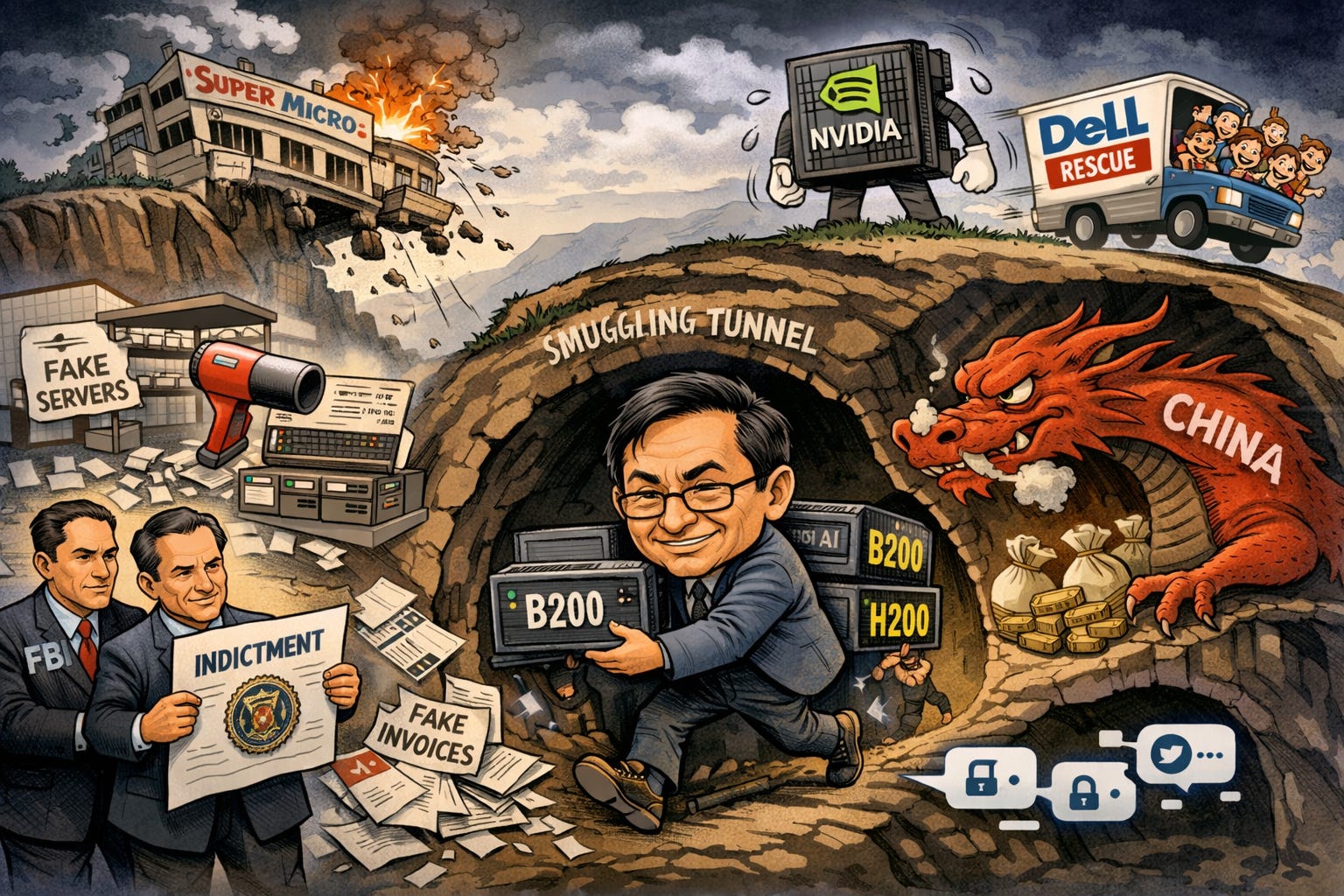
Super Micro Computer (SMCI) shares collapsed 33.3% to $20.53 last session, erasing roughly $5 billion in market value after federal prosecutors unsealed an indictment charging co-founder Yih-Shyan “Wally” Liaw and two associates with illegally diverting $2.5 billion worth of Nvidia-powered artificial intelligence (AI) servers to China. The Department of Justice (DOJ) alleged that between 2024 and 2025, Liaw orchestrated an elaborate scheme to route servers containing restricted Nvidia Blackwell B200 and Hopper H200 graphics processing units (GPUs) through a Southeast Asian front company. Prosecutors described fake purchase orders, dummy servers staged at warehouses to pass compliance inspections, serial number stickers removed with hair dryers and reapplied to decoys, and encrypted messaging to coordinate shipments. In one three-week stretch alone, approximately $510 million in servers were allegedly shipped to China (Reuters).
This is not Super Micro’s first governance crisis. Liaw resigned during a 2018 accounting scandal that led to a $17.5 million Securities and Exchange Commission (SEC) penalty and a Nasdaq delisting, only to be quietly rehired as an adviser in 2021, promoted to Senior Vice President in 2022, and restored to the board in 2023. In 2024, auditor Ernst & Young abruptly resigned, saying it could no longer rely on management’s representations, a bombshell that followed a devastating Hindenburg Research short report. Liaw resigned from the board effective immediately, and the company appointed DeAnna Luna, formerly Intel’s director of global export licensing, as acting Chief Compliance Officer. Super Micro is not named as a defendant, but Bernstein analyst Mark Newman captured the depth of the governance failure: it is one thing to be caught once, and quite another to rehire the same person who then allegedly does something worse. Dell Technologies (DELL) surged approximately 5% as analysts immediately identified it as the primary beneficiary of any customer defections (CNBC).
Sensei’s Insight: Nvidia quietly absorbs the collateral damage here. SMCI accounts for roughly 9% of Nvidia’s revenue, and Bernstein warned Nvidia may redirect chip allocations to Dell, HPE, and Foxconn. Watch whether Nvidia distances itself publicly. A reallocation announcement would confirm the supplier map for AI infrastructure is being redrawn in real time.
🔗 Connect with Us
Stay plugged in across platforms:
Sensei on X: sensei_live_
Martyn Lucas on X: MartynInvestor
Vaz on X: eVTOLHUB
📺 YouTube Channel (Live & Replays): Martyn Lucas Investor