This content is for informational and educational purposes only and does not constitute financial advice. Always do your own research. Not financial advice (NFA).
👀 Today’s Stories at a Glance
🛑 Shutdown odds spike: Senate Democrats block the funding bill after a fatal Border Patrol shooting in Minneapolis.
📉 Great Dollar Reset: Markets monitor the 150 yen level as coordinated central bank interventions potentially weaken the dollar.
🏆 Gold smashes $5,000: Prices hit record highs as investors flee to hard assets amid sovereign debt and shutdown fears.
🇨🇦 Tariff threat hits Canada: Trump threatens 100% tariffs on Canadian exports, causing a “Sell America” rotation in global markets.
🏦 Fed and tech blitz: Officials likely hold rates steady while Microsoft, Meta, Tesla, and Apple report critical quarterly earnings.
🔗 Yen shock risks: Shifting Japanese monetary policy threatens the global carry trade, potentially triggering sudden selloffs in risk assets.
🧠 One Big Thing
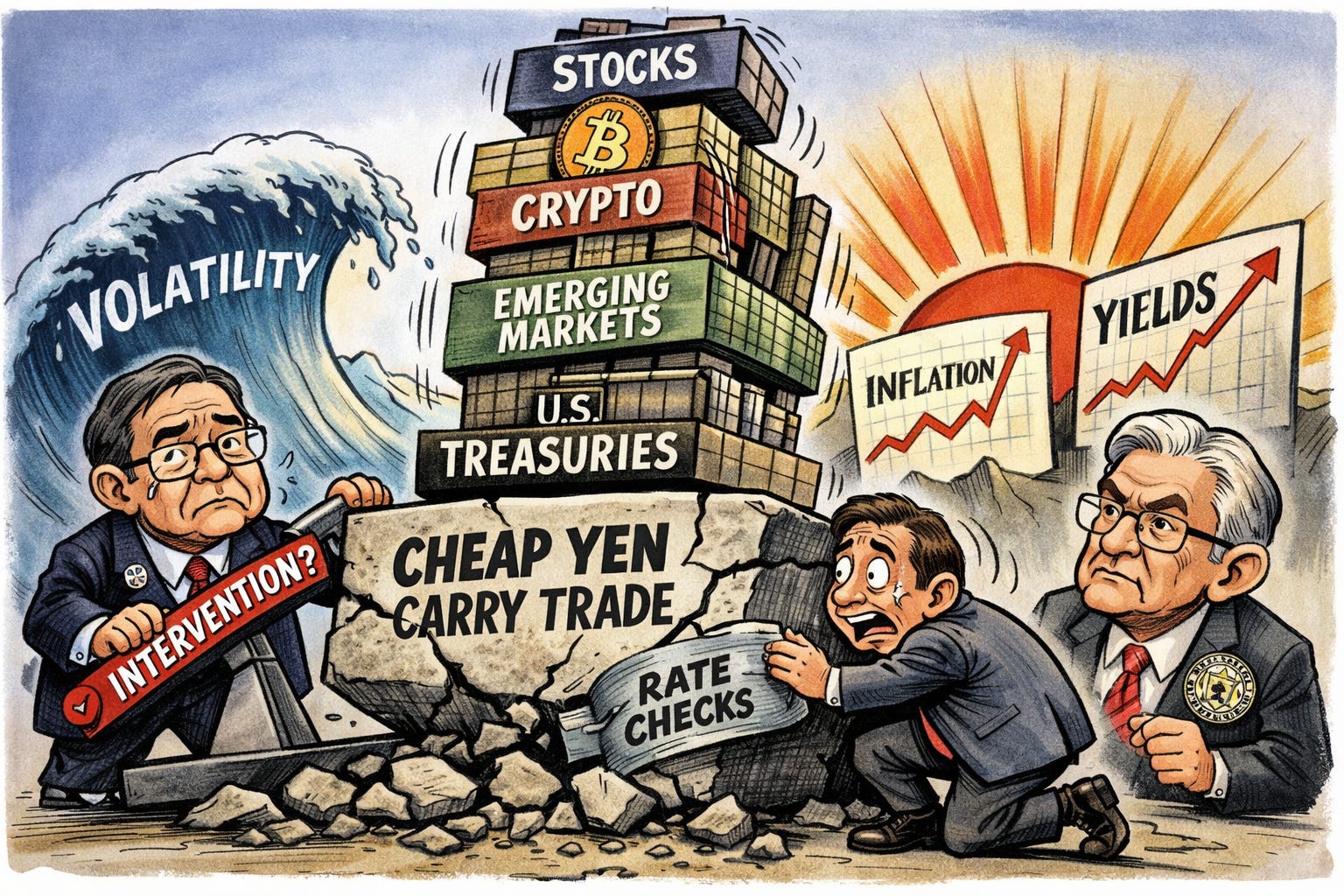
Japan’s role as a source of cheap global capital is fracturing as domestic interest rates rise and intervention risks mount. Higher Japanese bond yields and a strengthening yen are forcing the rapid unwinding of the carry trade. This reversal compels investors to sell international stocks, crypto, and bonds to repay yen-denominated loans. Recent scrutiny from the New York Fed suggests that yen volatility is now viewed as a threat to global financial stability. Japan’s transition away from zero-interest policies removes the low-cost leverage that previously supported asset valuations worldwide. Investors face increased market shocks as this previously stable foundation of global liquidity becomes a source of volatility.
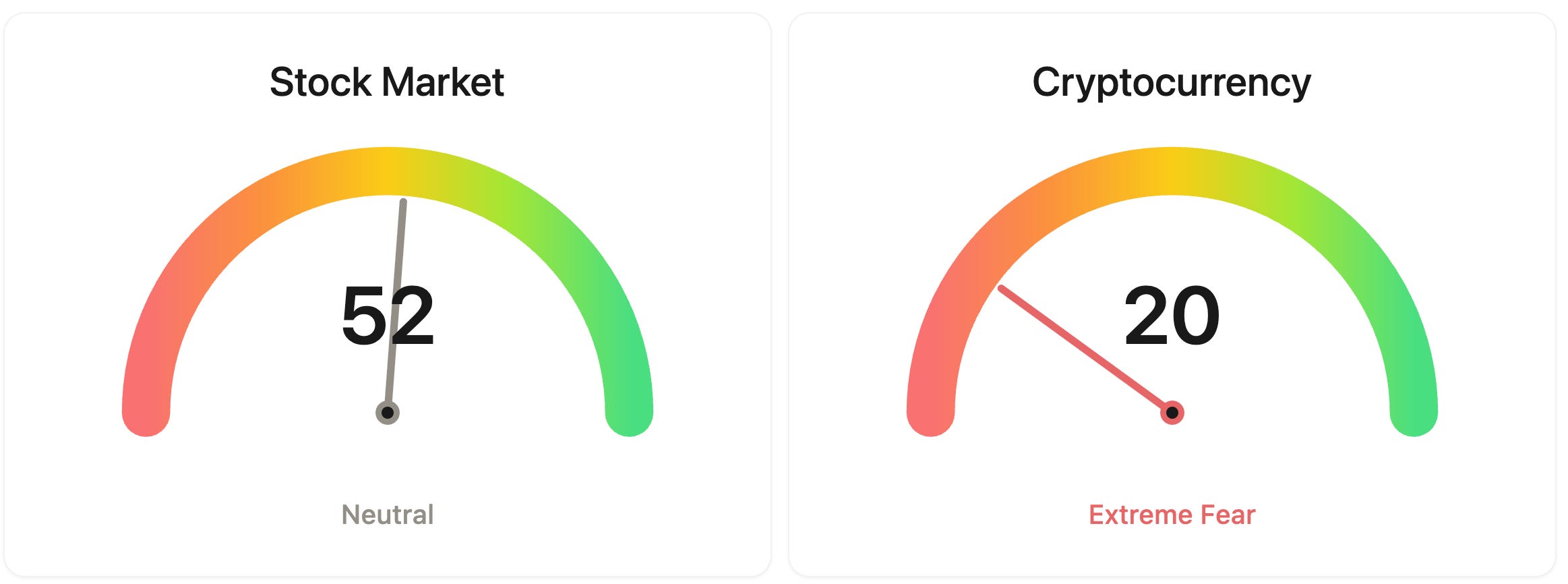
⚖️ Fear & Greed
📉 The Number That Matters
78%
Prediction markets indicate a 78% probability of a partial government shutdown by the January 31 deadline. This surge reflects the narrow Republican Senate majority’s inability to clear the 60-vote filibuster threshold amid a total collapse in bipartisan negotiations.
⚔️ Winners vs Losers
Winners
USAR 0.00%↑: USA Rare Earth surged following a $1.6 billion investment from the Trump administration, granting the government a 10% equity stake in the miner.
UAMY 0.00%↑: United States Antimony Corporation shares moved higher in sympathy with a broader critical minerals sector rally and continued optimism over its recent facility acquisition.
SCCO 0.00%↑: Southern Copper Corp. shares gained as copper prices hit record highs of $13,200 per ton amid a perceived long-term sector supercycle.
NEM 0.00%↑: Newmont Corporation rallied after gold prices reached a fresh record high of $5,100 per ounce, boosting the world’s largest gold producer.
Losers
RVMD 0.00%↑: Revolution Medicines shares plummeted after Merck & Co Inc. abandoned acquisition talks following a disagreement on the biotech company’s $30 billion valuation.
📊 Market Snapshot
Cryptocurrencies:
Bitcoin (BTC): $87,699 (▲ 1.34%)
Ethereum (ETH): $2,888 (▲ 2.64%)
XRP: $1.89 (▲ 3.04%)
Equity Indices (Futures):
S&P 500: $6,904 (▲ 0.03%)
NASDAQ 100: $25,655 (▼ 0.32%)
FTSE 100: £10,154 (▲ 0.04%)
Commodities & Bonds:
10-Year US Treasury Yield: 4.21% (▼ 0.61%)
Oil (WTI): $61 (▲ 0.03%)
Gold: $5,086 (▲ 1.95%)
Silver: $108.58 (▲ 5.15%)
Data as of UK (GMT): 11:31 / US (EST): 06:31 / Asia (Tokyo): 20:31
✅ 5 Things to Know Today
🛑 Shutdown Odds Spike as Minneapolis Shooting Paralyzes Senate
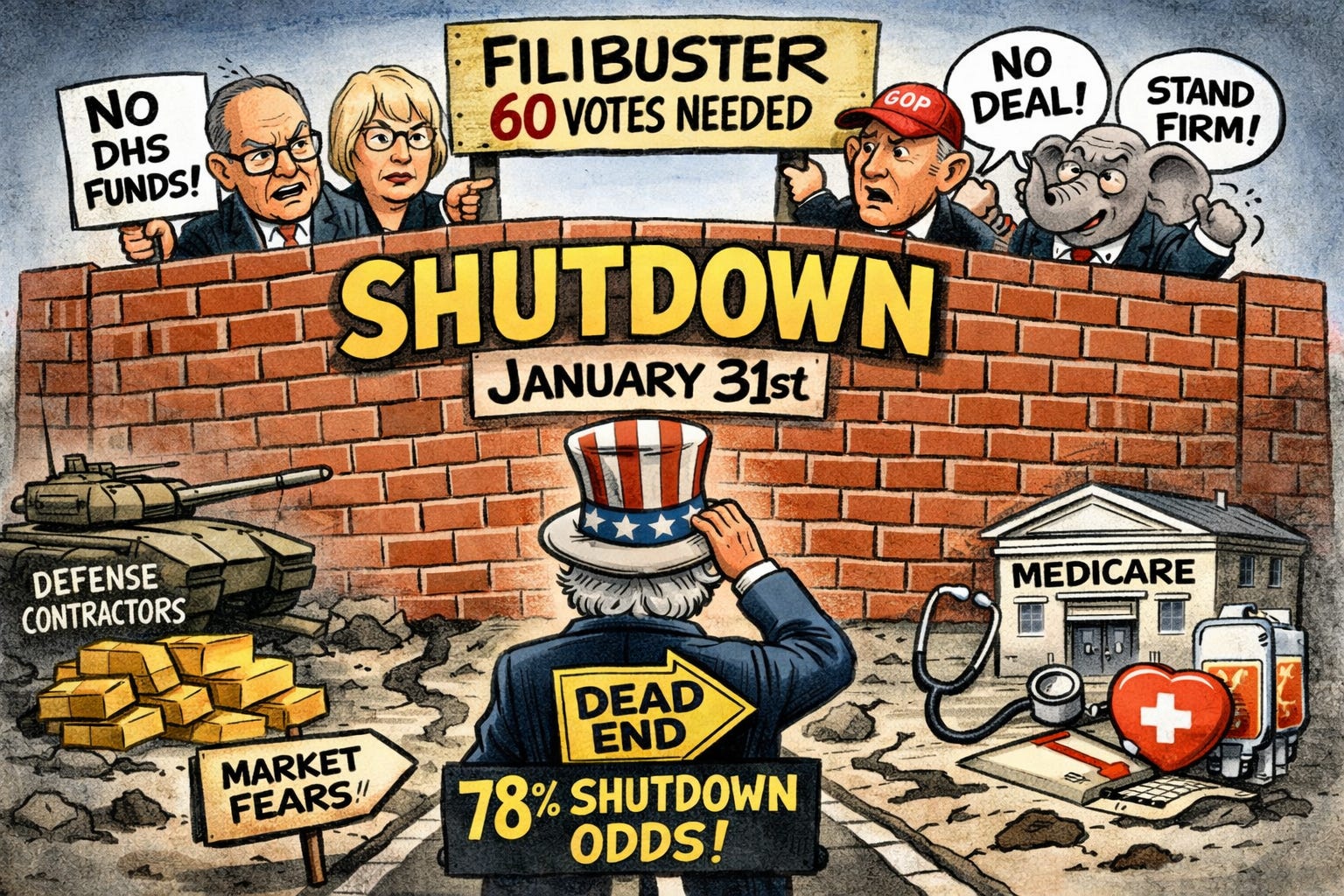
The killing of Alex Pretti, an ICU nurse and U.S. citizen, by Border Patrol agents on January 24 has thrown the $1.2 trillion omnibus funding bill into a tailspin. This is the second fatal federal shooting in Minneapolis this month, and Senate Democrats are drawing a hard line. Minority Leader Chuck Schumer and key appropriators like Patty Murray have vowed to block the massive six department package unless the Homeland Security portion is stripped out for separate negotiation. Since Republicans only hold 53 seats and need 60 to clear a filibuster, the January 31 deadline is looking increasingly like a brick wall. Prediction markets have already reacted, with odds of a partial shutdown surging from 9% to over 70% in just 48 hours (Bloomberg).
For retail investors, this isn’t just political theater: it’s a potential volatility catalyst for specific sectors. A shutdown would immediately freeze payments to major defense contractors like Lockheed Martin and disrupt Medicare reimbursements handled by the Department of Health and Human Services. Perhaps more importantly, it stops the flow of federal data. If the Bureau of Labor Statistics goes dark, markets lose the “eyes” needed to price interest rate moves, usually leading to higher spreads and defensive rotations into gold or Treasuries. With the House out of town and GOP leaders like Rick Scott refusing to split the bill, the path to a Friday resolution is narrowing fast.
Sensei’s Insight: Watch the 78% prediction market odds. If Tuesday’s Senate vote fails, we’re likely looking at a multi-day freeze that hits defense and healthcare sectors hardest. Keep an eye on gold.
📉 The Great Dollar Reset: Watching the 150 Line
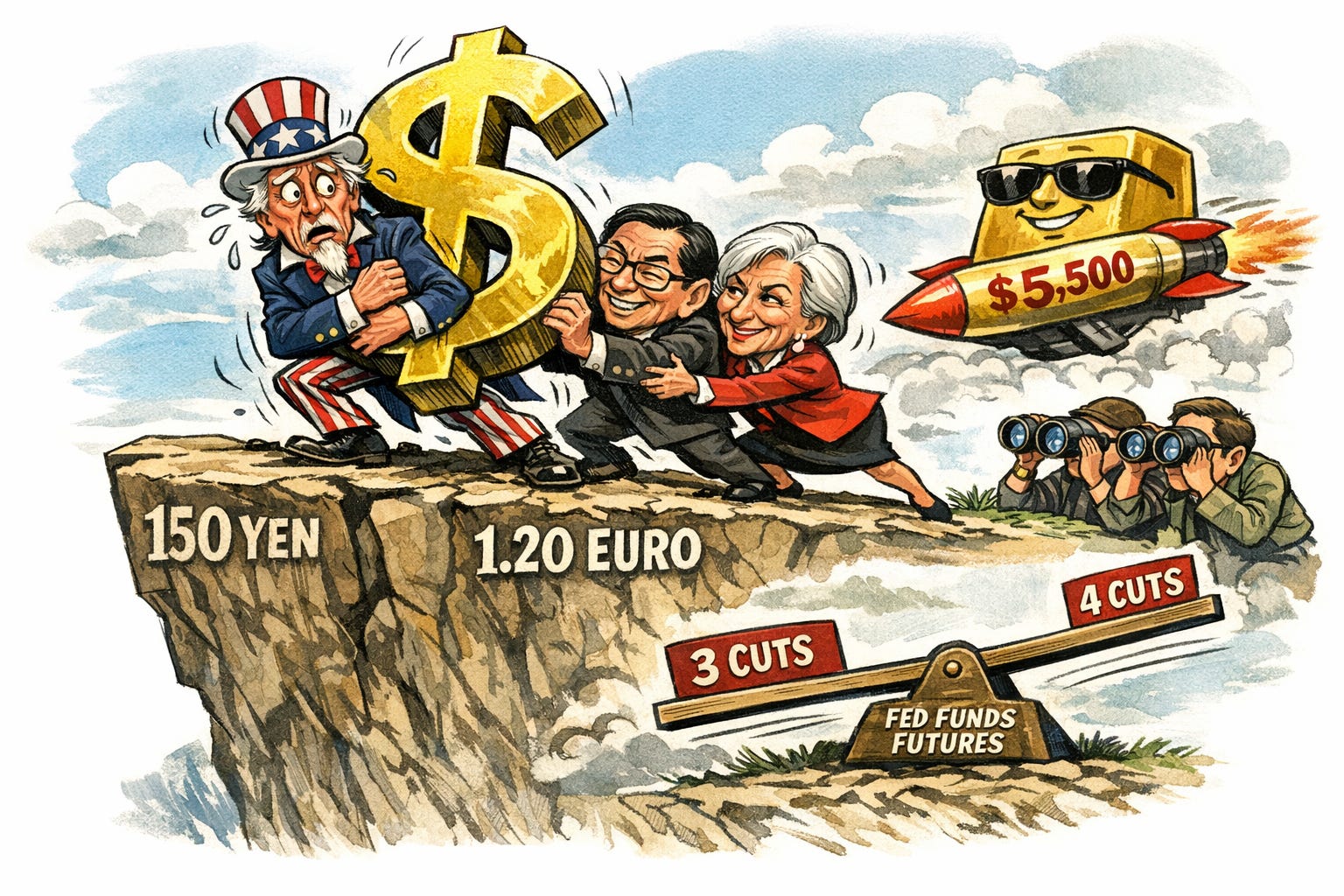
Currency markets are zeroed in on a critical psychological barrier as the USD/JPY pair tests the 150 level. If the pair breaks below this point, it’ll signal that the Japanese government’s intervention isn’t just a flash in the pan but a sustained success. We’re seeing similar tension in Europe, where the Euro’s approach to the 1.20 mark could confirm that the dollar’s weakness is becoming structural rather than seasonal. Meanwhile, gold is eyeing a test of $5,500, a level that would prove traders are fully committed to the debasement trade as they flee traditional fiat.
This isn’t just about random fluctuations. It looks like a potential inflection point where major global economies might be coordinating to engineer a weaker greenback. Retail investors should keep a close eye on Fed funds futures: if the market shifts from pricing three rate cuts to four for 2026, the dollar’s bearish trend could accelerate. The real test for equity markets will be the Nikkei’s reaction. If it can stabilize despite a surging Yen, it suggests the Japanese market has found a new equilibrium. It is a major shift in global monetary policy that could redefine inflation and your portfolio returns.
Sensei’s Insight: Watch for a break above 1.20 on the Euro. If that holds, the dollar’s structural decline is likely confirmed, signaling a regime shift where coordination beats individual central bank policy.
🏆 Gold Smashes $5,000 as the “Debasement Trade” Goes Vertical
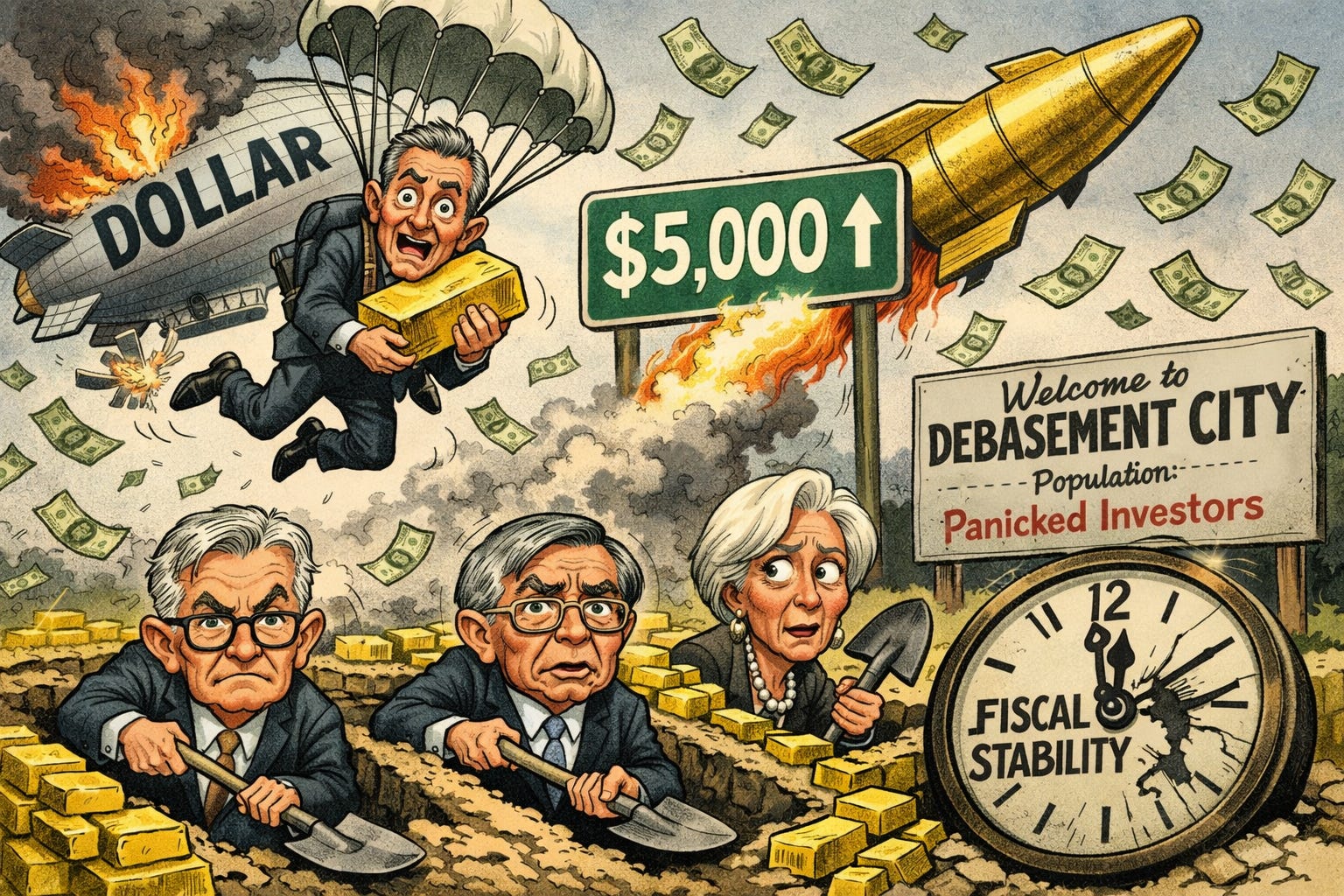
Gold prices shattered the $5,000 psychological ceiling on Monday, January 26, 2026, hitting an intraday high of $5,111 per ounce. This wasn't a fluke but a sustained 2.5% climb fueled by record central bank accumulation and massive ETF inflows totaling $89 billion last year. Silver followed the lead, blasting past $110 per ounce for the first time. The yellow metal is now up nearly 18% in the first 26 days of the year, marking its most aggressive start in decades. This rally signals a fundamental shift as institutional players move from paper assets into hard currency (Bloomberg)
The move reflects what institutional desks call the debasement trade, a hedge against crumbling confidence in sovereign debt and currency stability. Recent threats of 100% tariffs on Canada and European allies over Greenland have created a "policy erraticism" premium that investors are pricing into the metal. When you add Japan's bond market crash and a looming U.S. government shutdown on January 31, gold becomes the only exit door for capital. Mining stocks like Newmont and Barrick are already seeing outsized gains of 4% or more, offering a high-beta play for those who want more leverage than physical bullion provides.
Sensei’s Insight: Watch the $5,000 level to see if it flips from resistance to a hard floor. If the Fed meeting this week fails to soothe independence concerns, $5,500 is the next target.
🇨🇦 Trump’s 100% Tariff Threat Hits Canada
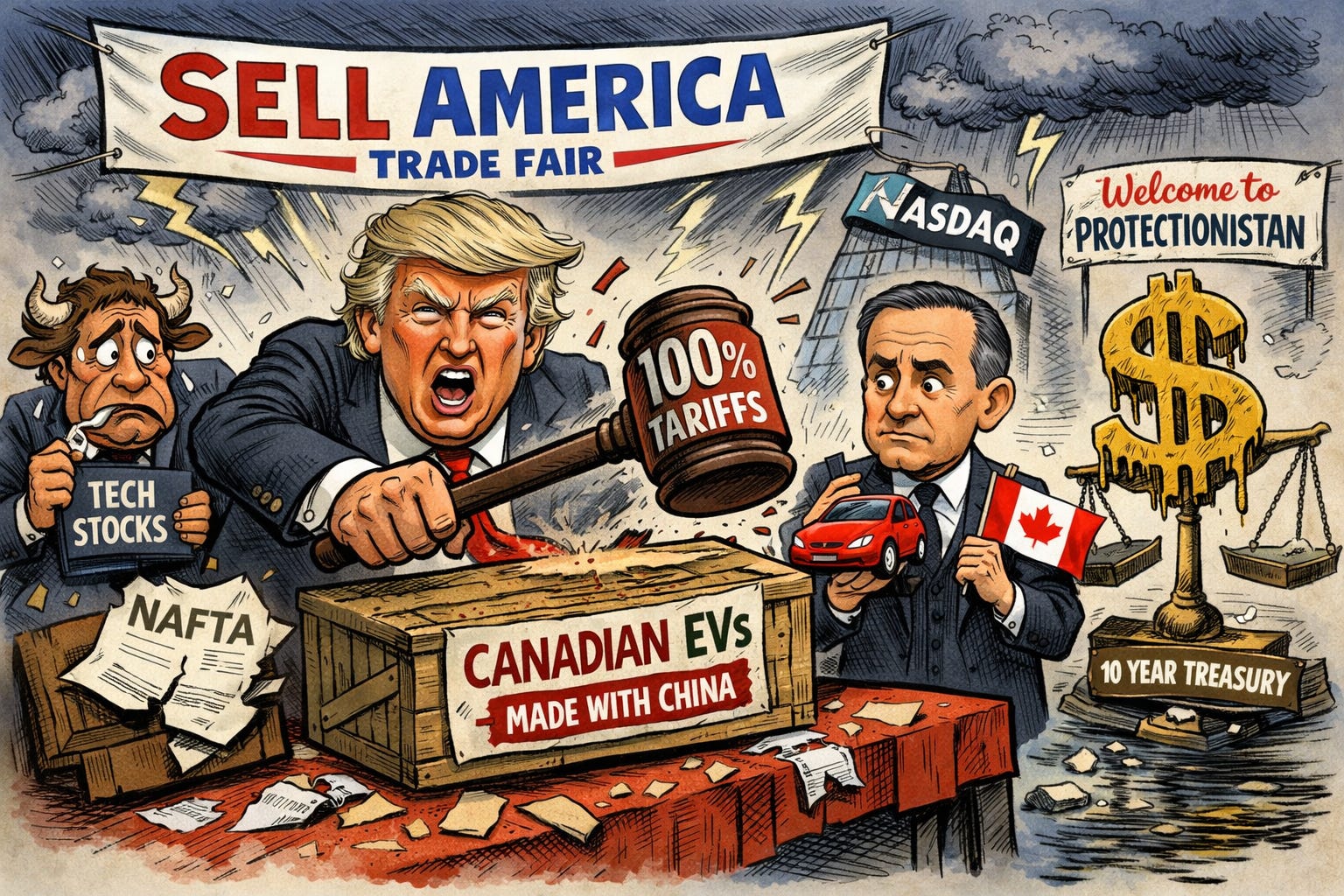
President Trump has reignited the “Sell America” trade by threatening a massive 100% tariff on all Canadian exports if Prime Minister Mark Carney moves forward with a strategic trade partnership with China. This follows a volatile week where Trump briefly targeted eight European nations with “Greenland tariffs” before pivoting his focus to Canada’s plan to allow 49,000 Chinese electric vehicles into its market. The threat effectively stalled the market’s recovery, with Dow futures sliding 51 points and the Nasdaq 100 down 0.4% as of Monday morning, January 26, 2026. This isn’t just rhetoric; it’s a direct challenge to the USMCA framework ahead of its summer review, signaling that any trade diversification away from the U.S. will face extreme penalties.
This matters because we’re seeing a rare, simultaneous drop in U.S. stocks, bonds, and the dollar—a “Sell America” trifecta that suggests global investors are losing confidence in U.S. policy stability. When the 10-year Treasury yield jumps to 4.168% while stocks fall, it means the traditional “safe haven” of government debt is being questioned. For retail portfolios, the risk is concentrated in the “Magnificent Seven” and semiconductors, which rely on global supply chains that these 100% tariffs would shatter. Meanwhile, the U.S. Dollar Index (DXY) hitting a four-month low of 97.1 suggests that the “protectionist” premium is actually making the dollar less attractive, not more.
Sensei’s Insight: Watch the 10-year yield and the DXY. If they keep moving in opposite directions during selloffs, it’s a sign that the “Sell America” rotation is becoming a structural shift.
🏦 Fed Hold and a Big Tech Earnings Blitz
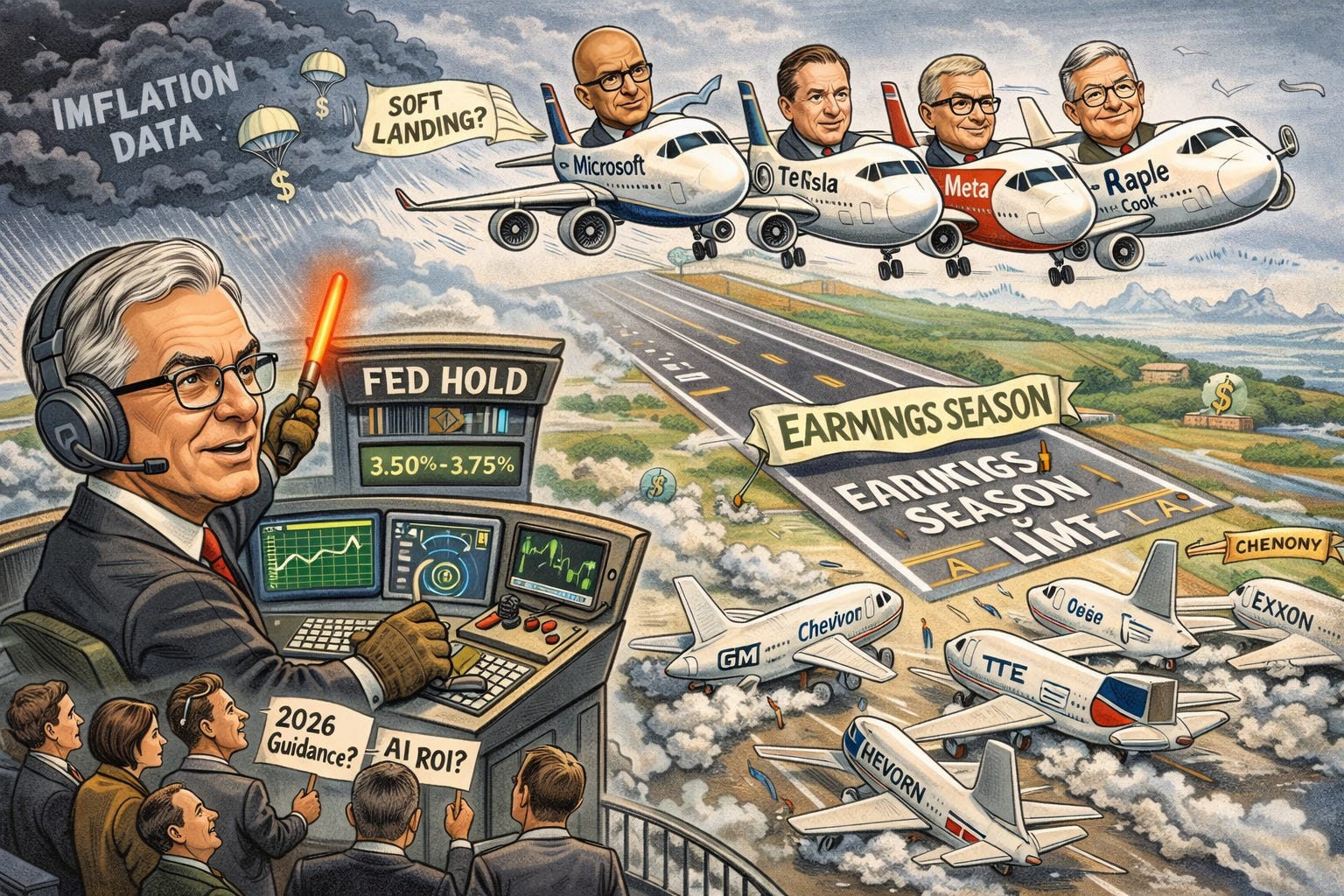
This week marks a major pivot from geopolitical drama back to pure fundamentals. The Federal Reserve’s policy meeting concludes Wednesday, where officials are widely expected to keep interest rates steady at 3.50% to 3.75%. While the Fed may be on pause, the earnings calendar is in overdrive. Four “Magnificent Seven” heavyweights report this week: Microsoft, Meta, and Tesla on Wednesday, followed by Apple on Thursday. With industrial bellwethers like Boeing and GM reporting Tuesday and energy giants Chevron and Exxon closing the week on Friday, the market is facing its most significant test of the new year (Barron’s).
This matters because we’re about to see if corporate growth can actually support these valuations. Investors are watching for any hints from Jerome Powell about how long the Fed plans to hold rates at these levels before considering further cuts. On the data front, Friday’s Producer Price Index (PPI) will suggest if wholesale inflation is still cooling. If the tech giants signal that AI spending isn’t hitting the bottom line yet, or if consumer confidence figures on Tuesday suggest the public is getting jittery, the recent market stability could be at risk.
Sensei’s Insight: Watch the 2026 guidance from the big exporters. If management teams at Boeing or the tech giants start hedging for trade headwinds, that “soft landing” narrative might start to feel a bit shaky.
🔗 Connect with Us
Stay plugged in across platforms:
Sensei on X: sensei_live_
Martyn Lucas on X: MartynInvestor
Vaz on X: eVTOLHUB
📺 YouTube Channel (Live & Replays): Martyn Lucas Investor

🔍Deep Dive: The Yen Shock That Can Hit Every Market