This content is for informational and educational purposes only and does not constitute financial advice. Always do your own research. Not financial advice (NFA).
👀 Today’s Stories at a Glance
💻 Big Tech earnings meet Fed: Five companies worth $16 trillion report alongside the Federal Reserve’s rate decision this week.
🚫 Beijing kills Meta-Manus deal: China orders unwind of $2 billion agentic artificial intelligence acquisition citing national security.
🛢️ Iran turns to Russia: Foreign minister Araghchi meets Putin as Brent crude tops $107 amid stalled talks.
✈️ Trump eyes Spirit rescue: Defense Production Act could fund $500 million bailout with 90% post-bankruptcy stake.
💵 Trump’s $51 million bond month: March disclosures show largest fixed-income buying since taking office, including high-yield exchange-traded fund.
🏛️ Warsh’s Fed path clears: Senator Tillis drops blockade, lifting Polymarket confirmation odds from 27% to 84%.
🛢️ Hengli denies Iran ties: Chinese refiner rejects sanctions claim after United States Treasury hits Dalian refinery.
🧠 One Big Thing
Five mega-cap technology names with a combined $16 trillion market value report earnings this week, while the Federal Reserve meets with futures pricing 100% odds of no rate change. The tension is whether artificial intelligence capital spending, forecast at $649 billion across the four cloud giants this year, can show matching revenue acceleration. Microsoft was punished earlier for thin Copilot monetization despite reaching 15 million paying users from 450 million Microsoft 365 customers. Watch the Q2 capex guide more than the Q1 print. A raised spending number without matching revenue could accelerate the rotation from software into semiconductors already underway.
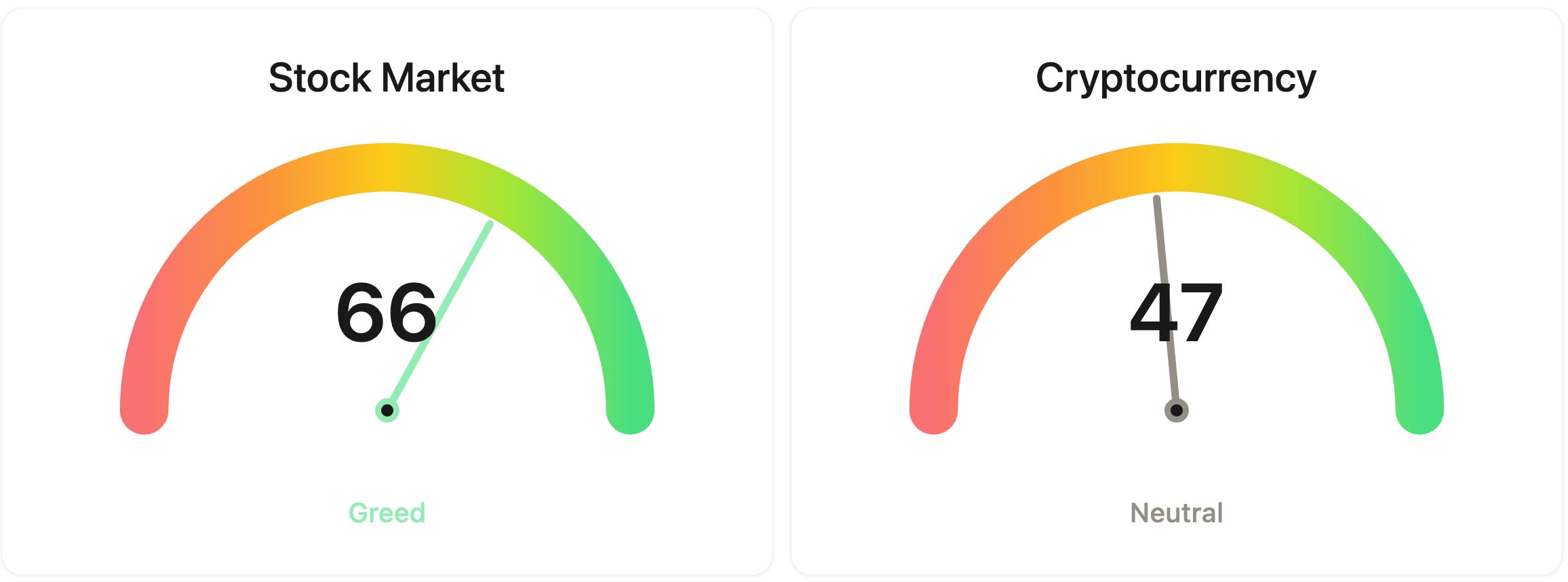
⚖️ Fear & Greed
📉 The Number That Matters
84%
Polymarket odds on Kevin Warsh being confirmed as Federal Reserve chair by mid-May jumped from 27% to 84% after Senator Tillis dropped his blockade, and that 84% reading reprices the path of rate cuts heading into 2026.
⚔️ Winners vs Losers
Winners
ORKA 0.00%↑: Oruka Therapeutics shares surged after the company announced positive Week 16 interim data from its EVERLAST-A Phase 2a trial of ORKA-001 in moderate-to-severe plaque psoriasis, with the half-life extended IL-23p19 antibody delivering strong skin clearance results.
SGMT 0.00%↑: Sagimet Biosciences jumped after providing a strategic update to advance denifanstat into a registrational Phase 3 acne trial in the second half of 2026, alongside pricing a $175 million stock offering with participation from Balyasny, Blue Owl Healthcare, BVF Partners and Farallon.
HTCO 0.00%↑: High-Trend International Group extended gains on continued momentum from its April 22 announcement of a strategic pivot into lithium and spodumene transportation, where voyages doubled year-on-year at margins management says significantly outperform traditional cargo.
RMAX 0.00%↑:RE/MAX Holdings spiked after agreeing to be acquired by The Real Brokerage in an $880 million enterprise value deal, with shareholders entitled to elect either $13.80 per share in cash or 5.152 shares of the combined Real REMAX Group.
OGN 0.00%↑: Organon & Co. soared after agreeing to be acquired by Sun Pharmaceutical Industries in an all-cash deal valued at $11.75 billion, with shareholders receiving $14 per share, a 103% premium to the stock’s April 9 close.
Losers
CMPX 0.00%↑: Compass Therapeutics collapsed after its COMPANION-002 Phase 2/3 study of tovecimig in second-line biliary tract cancer failed to reach statistical significance on overall survival, with William Blair flagging questions about the dataset’s approvability at the FDA despite the trial hitting progression-free survival and response rate endpoints.
REAX 0.00%↑: The Real Brokerage tumbled as the acquirer in the $880 million RE/MAX deal, with the $550 million financing commitment from Morgan Stanley and Apollo plus stock issuance overshadowing management’s projected $30 million in annual cost synergies by 2027.
QTTB 0.00%↑: Q32 Bio moved sharply lower in pre-market with no specific catalyst identified, though the move follows the company’s April 24 filing of a $75 million ATM offering with Cantor Fitzgerald.
DPZ 0.00%↑: Domino’s Pizza fell after Q1 2026 EPS of $4.13 missed the $4.31 consensus and revenue of $1.15 billion came up short, with diluted EPS down 4.6% on a $30 million unfavorable mark-to-market swing on the company’s DPC Dash investment and U.S. same-store sales of just 0.9%.
📊 Market Snapshot
Cryptocurrencies:
Bitcoin (BTC): $77792 (▼ -1.12%)
Ethereum (ETH): $2318 (▼ -2.21%)
XRP: $1.41 (▼ -1.21%)
Equity Indices (Futures):
S&P 500: $7158 (▼ -0.09%)
NASDAQ 100: $27446 (▲ 0.04%)
FTSE 100: £10366 (▼ -0.17%)
Commodities & Bonds:
10-Year US Treasury Yield: 4.32% (▲ 0.28%)
Oil (WTI): $96 (▲ 0.94%)
Gold: $4706 (▼ -0.05%)
Silver: $75.62 (▼ -0.04%)
Data as of: UK (BST) 1:30 PM / US (EDT): 7:30 AM / Asia (Tokyo): 10:30 PM
✅ 5 Things to Know Today
💻 $16 trillion earnings week meets the Fed
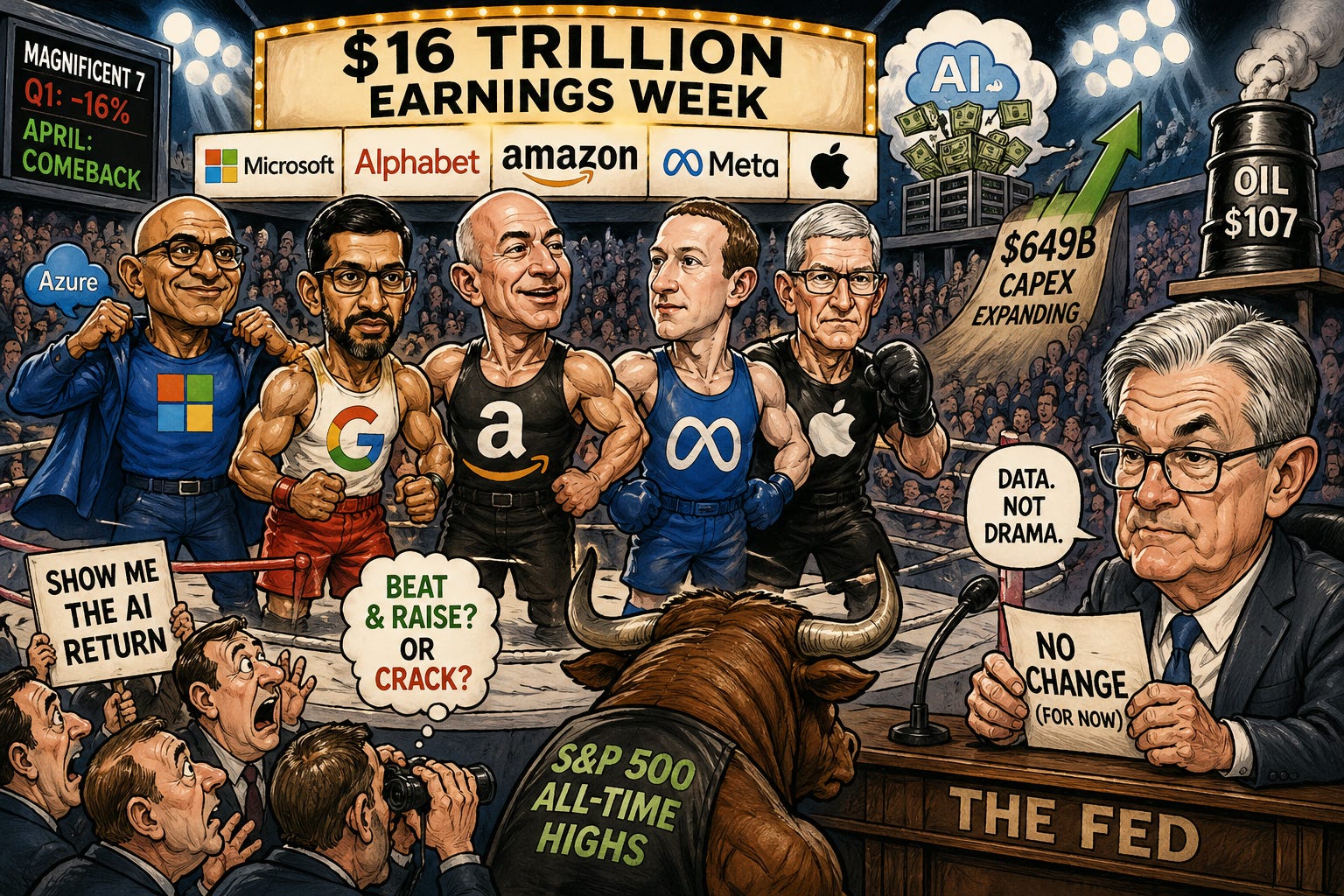
Microsoft, Alphabet, Amazon and Meta Platforms all report after the closing bell Wednesday, with Apple closing out the week Thursday. The five companies carry a combined market value near $16 trillion, roughly a quarter of the entire S&P 500. The Federal Reserve also meets Wednesday, with futures pricing 100% odds of no rate change. The S&P 500 and Nasdaq closed at fresh all-time highs Friday. Combined capital spending across the four cloud giants is forecast to hit $649 billion this year, up from $411 billion in 2025. Tesla and Nvidia round out the seven and report later in the cycle. (Bloomberg)
The bar has shifted from “any artificial intelligence (AI) investment is good” to “show me the revenue.” When Microsoft reported 15 million paying Copilot users earlier this year out of 450 million Microsoft 365 customers, the stock got punished for thin monetization rather than rewarded for scale. The Magnificent Seven fell 16% in the first quarter, more than twice the S&P 500’s drop, before roaring back in April with Alphabet, Amazon, Meta and Microsoft each up over 10%. With these five names representing a quarter of the index by weight, even one weak guide could trigger sharp rotation in passive funds. (CNBC)
Sensei’s Insight: The Q2 guide matters more than the Q1 print. Watch capex commentary closely. If any of the four cloud giants raises 2026 spending without specific revenue acceleration to match, the rotation from software into semis that’s already underway accelerates.
🚫 Beijing blocks Meta’s $2 billion Manus deal
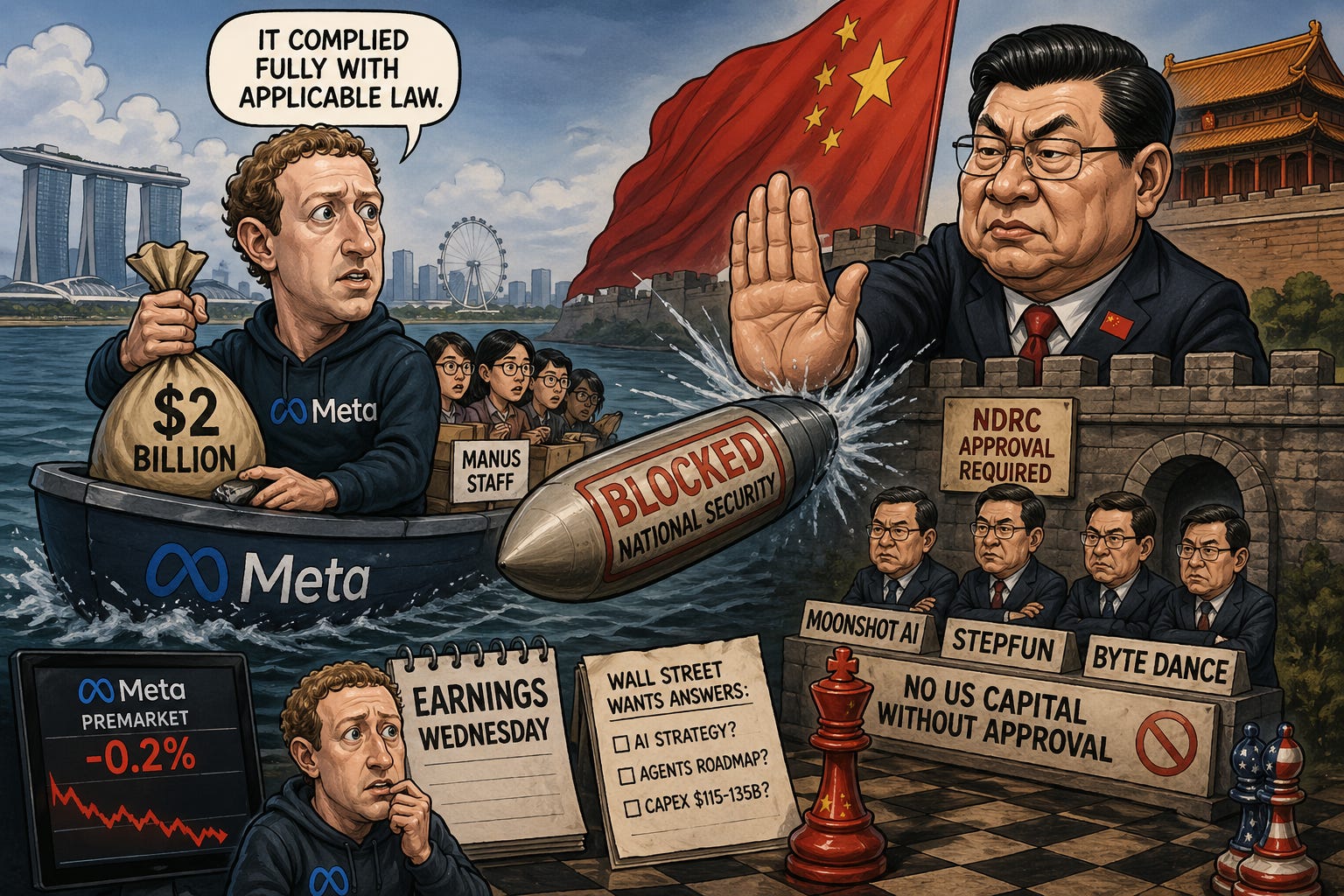
China’s National Development and Reform Commission ordered Meta to unwind its $2 billion acquisition of agentic AI startup Manus this morning, citing national security after a months-long review. The deal, announced last December, was meant to leapfrog Meta past rivals like OpenAI and Google in AI agents, software that executes tasks autonomously. Manus is incorporated in Singapore, but its founders are Chinese. Meta said the transaction “complied fully with applicable law” and expects “an appropriate resolution.” The complication is that capital has already moved, Manus staff have joined Meta’s Singapore offices, and existing investors including Tencent have already cashed out. Meta shares slipped about 0.2% in premarket trading. (Bloomberg)
This is a wider Beijing posture, not a one-off. Chinese regulators have separately told Moonshot AI, Stepfun and ByteDance to reject US capital unless explicitly approved, and the National Development and Reform Commission has restricted “red chip” Chinese firms from seeking Hong Kong listings. With Trump and Xi due to meet next month, the move reads as China staking ground on AI talent and intellectual property before negotiations open, using the most prominent US tech deal available as the marker. (CNBC)
Sensei’s Insight: Singapore incorporation didn’t insulate the deal because the founders were Chinese. That’s the precedent. Any US tech acquisition of a Chinese-founded firm is now subject to Beijing’s veto. Wednesday’s Meta call needs to address this head-on or the agentic AI strategy gets repriced.
🛢️ Iran’s Araghchi turns to Putin as talks stall
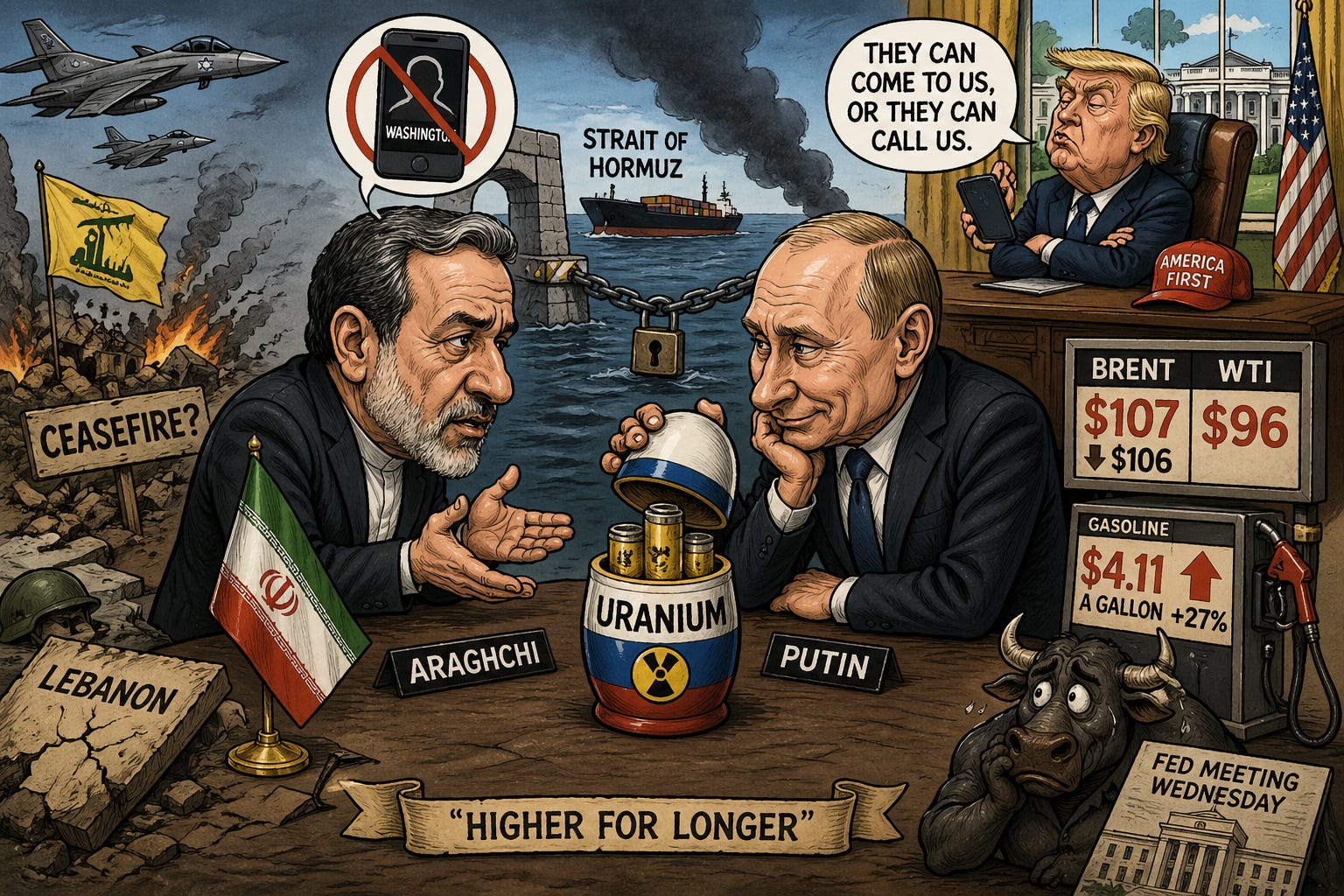
Iranian Foreign Minister Abbas Araghchi arrived in St. Petersburg this morning to meet Russian President Vladimir Putin, after Trump cancelled a planned trip by envoys Steve Witkoff and Jared Kushner to Pakistan over the weekend. Araghchi has been shuttling between mediators after stops in Islamabad and Muscat. Brent crude topped $107 in early trading before easing toward $106 on reports that Tehran has submitted a new proposal via Pakistan to reopen the Strait of Hormuz and extend the ceasefire, with nuclear talks deferred until the US blockade is lifted. West Texas Intermediate (WTI) hovered around $96. Trump said yesterday Iran “can come to us, or they can call us.” (CNN)
The oil squeeze isn’t easing. The US blockade has now turned away 38 ships from Iranian ports per Central Command, the strait remains effectively closed, and the International Energy Agency calls this the largest supply shock in oil-market history. US gasoline averaged $4.11 a gallon yesterday, up roughly 27% since the war began in February. Brent stuck north of $100 ahead of Wednesday’s Fed meeting makes any dovish pivot harder to justify, and the cost ripples directly into airline guidance, transport margins, and consumer spending names reporting later this earnings season. (Bloomberg)
Sensei’s Insight: Two wildcards markets are underpricing. Russia has offered to take custody of Iran’s enriched uranium, putting Putin inside any final deal. And Hezbollah attacks have Netanyahu ordering “forceful” strikes on Lebanon again. Either could push oil de-escalation past the Fed and Big Tech earnings.
✈️ Trump weighs Cold War law to save Spirit Airlines
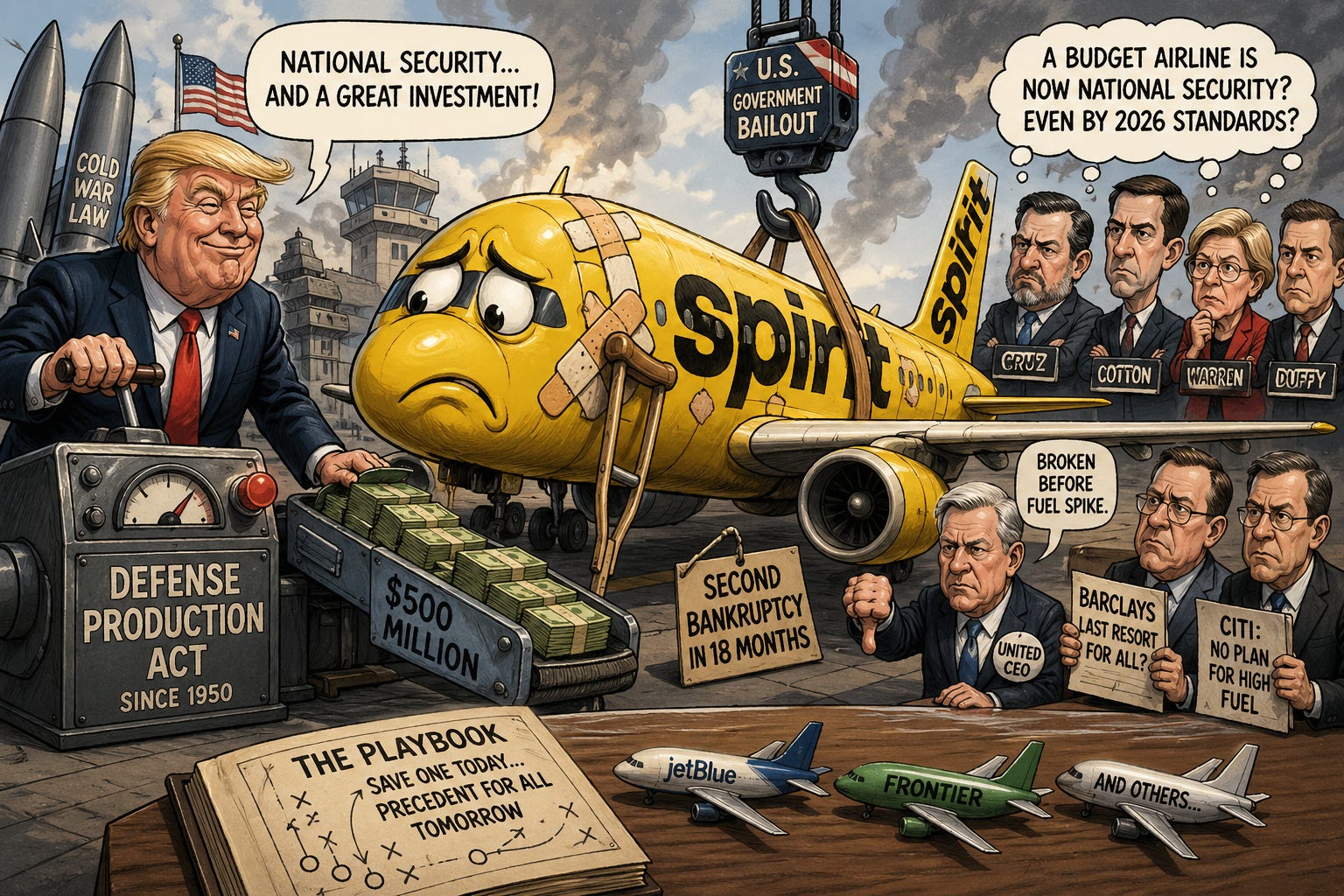
The Trump administration is considering invoking the Defense Production Act, a 1950s-era national-security law, as the legal basis to rescue Spirit Airlines from its second bankruptcy in 18 months. Reports indicate roughly $500 million in financing would start as a debtor-in-possession loan and convert into longer-term funding, with the government potentially taking warrants for up to a 90% post-bankruptcy stake. A bankruptcy court hearing is set for Thursday. Trump said in the Oval Office last week that “when the price of oil goes down, we’d sell it for a profit.” Spirit’s restructuring plan was finalised just before the Iran war doubled jet fuel prices. (Reuters)
The political coalition against the rescue is unusually bipartisan. Republican Senators Ted Cruz and Tom Cotton, Democrat Elizabeth Warren and Trump’s own Transportation Secretary Sean Duffy have all voiced doubts, while United Airlines CEO Scott Kirby said Spirit’s business model was broken before the fuel spike. Barclays warned the deal could become “a facility of last resort” for other distressed carriers, and that’s the line that should worry investors more than the Spirit terms themselves. If the precedent holds, JetBlue, Frontier and Allegiant trade with an implicit government backstop priced into the equity. (CNBC)
Sensei’s Insight: Thursday’s hearing writes the playbook for the next discount carrier that wobbles when fuel stays high. The Defense Production Act framing is creative legal engineering. If it holds for an airline, the next industry asking for a national-security rescue arrives faster than anyone expects.
💵 Trump’s March bond spree tops $51 million
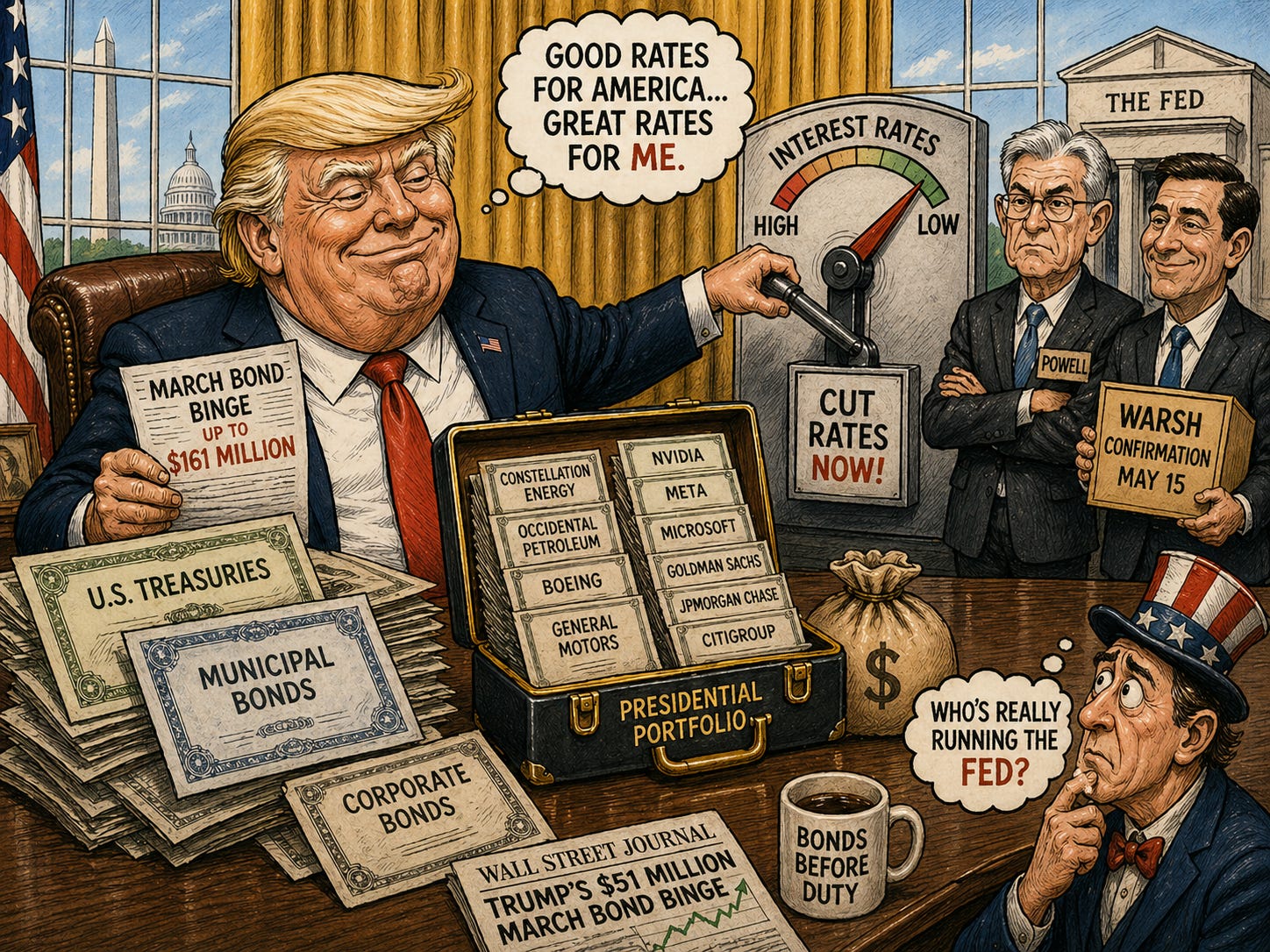
The US Office of Government Ethics released disclosures over the weekend showing President Trump made 175 financial transactions in March, with bond purchases worth between $51 million and $161 million depending on where each trade fell within disclosed value ranges. The 26 largest were each in the $1 million to $5 million bracket, mostly municipal bonds and US Treasuries. Corporate names included Constellation Energy, Occidental Petroleum, Broadcom, Nvidia, Meta, Microsoft, Citigroup, Goldman Sachs, JPMorgan Chase, Boeing and General Motors. The filing also lists a high-yield bond exchange-traded fund (ETF), a new wrinkle. It is Trump’s largest single-month bond buying disclosure since taking office. (Yahoo Finance)
When interest rates fall, bond prices rise. Trump has openly pressured the Fed to cut, has nominated Kevin Warsh, viewed as more dovish than Chair Jerome Powell, to replace him, and now personally owns a sizeable and growing fixed-income portfolio. Yesterday’s news that Senator Thom Tillis is dropping his blockade of Warsh’s confirmation makes May 15 a realistic installation date. Unlike every modern president before him, Trump has not used a blind trust, though the Office of Government Ethics has approved the filings. (CNBC)
Sensei’s Insight: The sector mix of energy, banks, defence and autos reads like a quiet bet on policy direction. The high-yield ETF is the line that gets uncomfortable. Junk bonds rally hardest when the Fed pivots dovish, exactly the scenario Warsh’s installation pushes closer.
Stories You Might Have Missed
🏛️ Tillis lifts Warsh’s Fed blockade
Senator Thom Tillis (R-NC) said yesterday on NBC’s “Meet the Press” that he will support Kevin Warsh’s confirmation as Federal Reserve chair, ending a weeks-long blockade after the Department of Justice dropped its criminal probe of Chair Jerome Powell late last week. The Senate Banking Committee is expected to advance Warsh’s nomination this week, with a floor vote possible before Powell’s term as chair ends May 15. Polymarket odds on confirmation by that date jumped from 27% to 84% on Friday. Warsh has signalled he wants to move the Fed away from core Personal Consumption Expenditures (PCE) inflation, abandon forward guidance, and accelerate balance-sheet runoff. (CNBC)
🛢️ Hengli denies Iran trade after US sanctions
China’s Hengli Petrochemical denied any dealings with Iran in a stock exchange filing yesterday, after the US Treasury sanctioned its Dalian refinery late last week under Executive Order 13902. Treasury called Hengli “one of Iran’s largest customers” and said the refiner had received Iranian crude shipments overseen by an arm of Iran’s Armed Forces General Staff. Hengli claims more than three months of crude inventory and has pledged to seek removal of the sanctions. Treasury Secretary Scott Bessent has separately warned two Chinese banks of secondary sanctions if Iranian money flows through their accounts. China takes more than 80% of Iran’s seaborne oil exports. (Reuters)
🔗 Connect with Us
Stay plugged in across platforms:
Sensei on X: sensei_live_
Martyn Lucas on X: MartynInvestor
Vaz on X: eVTOLHUB
📺 YouTube Channel (Live & Replays): Martyn Lucas Investor