

This content is for informational and educational purposes only and does not constitute financial advice. Always do your own research. Not financial advice (NFA).
🔑 Before the news: Lifetime closes on Sunday
American markets are closed today. Before we get into the news, I want to give you a date.
Sensei Desk opens on Tuesday 15 September, the day the Senate votes on whether to take up the CLARITY Act. It is a research desk that sits behind your membership. The newsletter tells you what happened. The Desk is the other half, the part where you stop reading about a company and start looking one up yourself. I am not going to walk through all of it here. You will see it next week.
Lifetime members go in first, on CLARITY Act day itself. That door closes on Sunday 13 September, and the Lifetime price increases on Sunday 20 September at midnight.
To upgrade, go to sensei.news/account and switch to Lifetime, then open a ticket on Discord so I can get you set up. If you are not on Discord, message me on Substack instead.
When you get in
Tuesday 15 September: Lifetime members, on CLARITY Act day itself.
Wednesday 16 and Thursday 17 September: Annual members.
Friday 18 and Monday 21 September: Monthly members.
I am opening it in waves for one reason. I would rather answer every question properly than lose half of you in an inbox on the busiest news day of the month.
The 2 dates to write down
Sunday 20 September, midnight: the Lifetime price increases.
Wednesday 30 September, midnight: the annual price increases, and anyone joining from October pays the new rate.
If you are already a member, your price does not change, now or in October. You keep what you are on. The increase is for people joining after the Desk exists, because until now the subscription bought you a newsletter, and from the 15th it buys you a newsletter and a research desk.
→ Upgrade to Lifetime
→ Upgrade to Annual
Become a member with a discount:
👀 Today’s Stories at a Glance
🔑 Lifetime closes on Sunday: Sensei Desk opens on Tuesday the 15th and Lifetime members go in first, on CLARITY Act day itself.
💾 Seoul’s chips melt up: the Kospi closed 4.61% higher at 6,995.39 as memory prices climb, with SK Hynix up 8.1% and Samsung 5.3%.
🏛️ Trump’s ultimatum to the Fed: cut rates or he halts trade with every country America runs a deficit with, he said on Friday.
🛢️ Iran wants an exclusion zone: Brent added $1.22 to $97.50 after America struck 3 Iranian tankers, and OPEC+ left October output alone.
🇬🇧 Healey speaks into a bond selloff: the 10-year gilt hit 5.16% on a sixth straight day of rises before his first big speech.
₿ Zcash and HYPE hit records: both broke all-time highs while bitcoin held near $80,000, and short sellers lost about $150m in 24 hours.
⛴️ Ship fuel is running short: the price of the main marine fuel is up 76% in Singapore since the Iran war began.
🇯🇵 The yen threatens the carry trade: it gained more than 2% last week, and markets put 75% odds on a Japanese rise this month.
🇪🇺 The ECB is expected to raise: a rise on Thursday is seen as certain, and futures imply a 75% chance of another by December.
🎥 Sunday’s member stream is up: your chart requests, my Lululemon position and more than 20 names, with timestamps so you can skip straight to one.
📈 One chart before you go: the Chart of the Day closes today’s edition with Lululemon and the walkthrough from Sunday night’s member stream.
🧠 One Big Thing
American markets are shut today for Labor Day. Asia has just had an enormous session, the Kospi up 4.61% and chip stocks flying, and none of it has been tested by a New York bid yet. Thin holiday trading exaggerates everything, in both directions.
The week that decides anything is back-loaded: the ECB on Thursday, then American inflation on Friday at 1:30pm UK, 8:30am ET. That Friday number is what the Fed votes on when it meets on 16 September.
That is the week Sensei Desk opens, which is deliberate. A week carrying a central bank decision, an inflation print and the CLARITY Act is exactly the week you want to be able to look something up rather than wait for someone to explain it to you.
⚖️ Fear & Greed
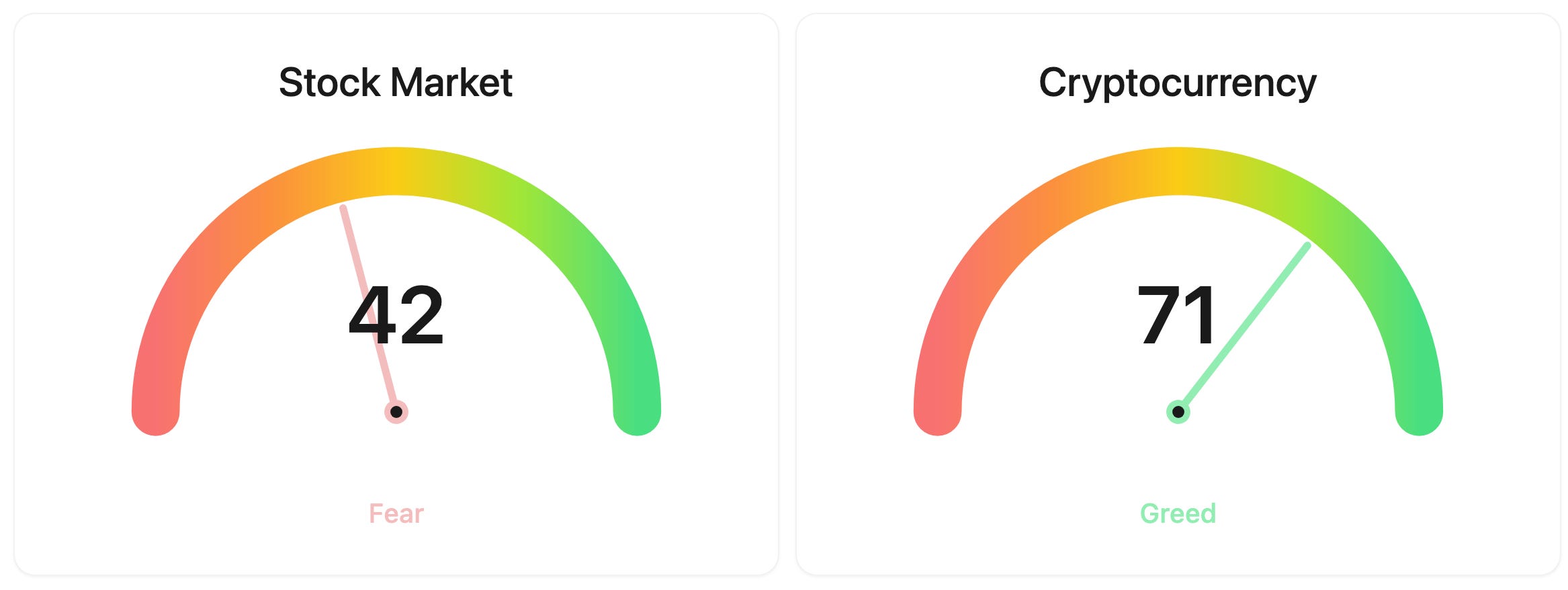
📉 The Number That Matters
More than 50%
Susquehanna expects DRAM memory contract prices to rise more than 50% this quarter, with NAND flash up about 60%. That shortage is what is driving Asia’s chip rally, and it lands in the price of phones and laptops too.
📊 Market Snapshot
Cryptocurrencies:
Bitcoin (BTC): $79,544 (▼1.00%)
Ethereum (ETH): $2,499 (▼0.64%)
XRP: $1.41 (▼1.03%)
Equity Indices (Futures):
S&P 500: 7,707 (▼0.19%)
NASDAQ 100: 29,561 (▼0.01%)
FTSE 100: 10,863 (▲0.34%)
Commodities & Bonds:
10-Year US Treasury Yield: 4.78% (▲0.25%)
Oil (WTI): $92 (▲1.09%)
Gold: $4,397 (▼0.71%)
Silver: $65.64 (▼0.84%)
Data as of: UK: 13:51 BST / US: 08:51 EDT / Asia (Tokyo): 21:51 JST
✅ 5 Things to Know
💾 Seoul jumps 4.61% while Wall Street sleeps
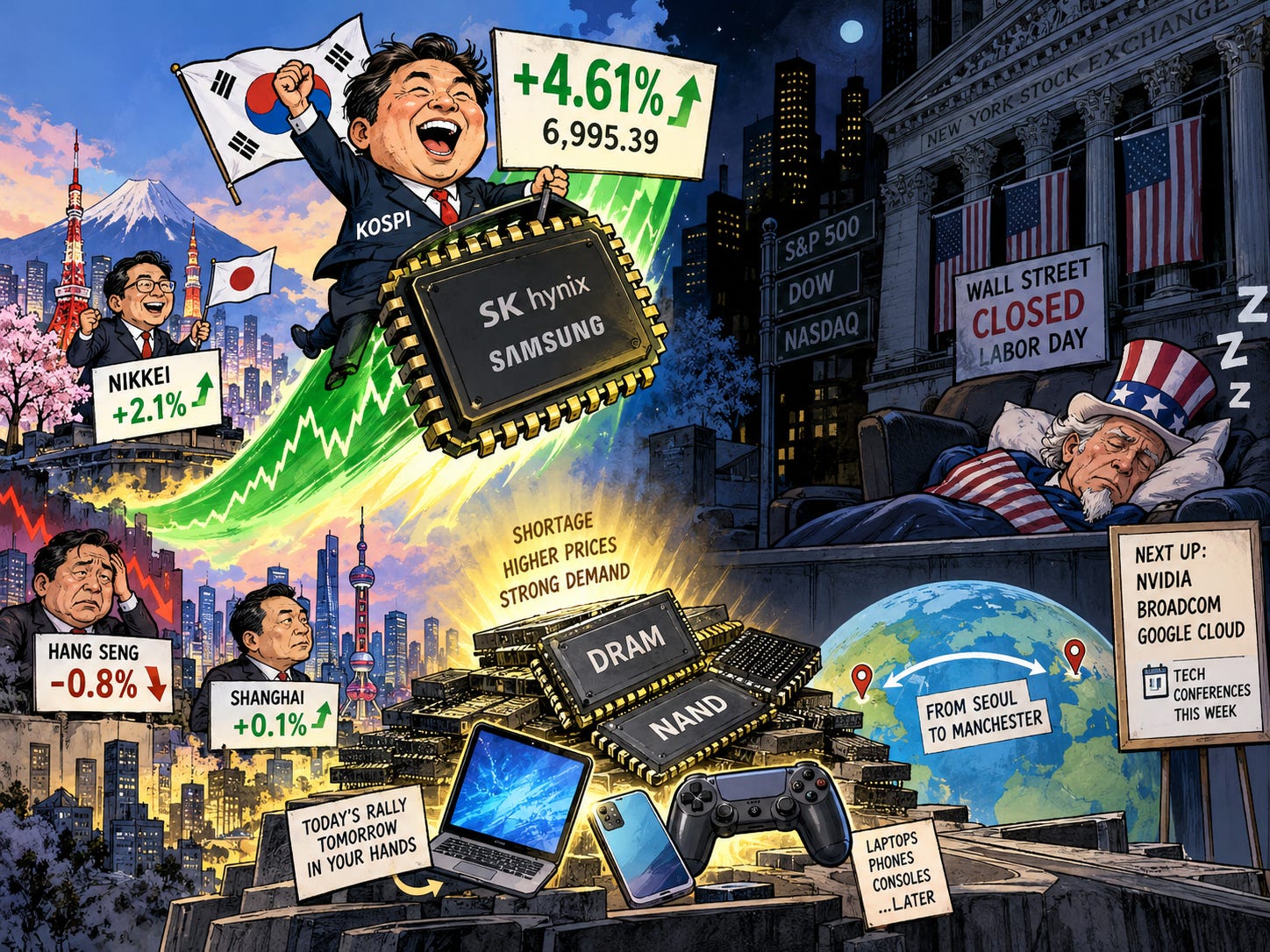
4.61%. South Korea’s Kospi closed 308.18 points higher at 6,995.39 on Monday, within touching distance of 7,000, and memory chips did nearly all of it. SK Hynix added 8.1% and Samsung Electronics 5.3%. Japan’s Nikkei 225 finished 2.1% higher at 66,399.84, with Rohm up 7.8%, Tokyo Electron 5% and Renesas 3.1%. The rest of the region did not follow: Hong Kong’s Hang Seng fell 0.8% to 25,458.03 and the Shanghai Composite crept up 0.1% to 3,934.36. American markets are closed for Labor Day, so none of this has met a New York price. (Associated Press)
So what set it off? Friday in New York, where the S&P 500, the Dow and the Nasdaq all fell while the Philadelphia Semiconductor Index rose more than 3%. Memory is in genuine shortage. Susquehanna expects DRAM contract prices to rise more than 50% this quarter and NAND about 60%, and Dell’s chief operating officer Jeff Clarke summed the problem up on the company’s earnings call as “DRAM, DRAM, DRAM, followed by NAND, NAND, NAND”. Counterpoint Research put second-quarter DRAM revenue growth at 57% on the previous quarter and 385% on the year. Micron traded around $1,006 on Friday. (BigGo Finance)
Those are the same chips that go into laptops, phones and games consoles, which is why a shortage priced in Seoul turns up months later on a shelf in Manchester.
Nvidia, Broadcom and Google Cloud all present at tech conferences this week, and those sessions will say whether the shortage is easing or deepening.
Sensei’s Insight: Everyone keeps calling the top on AI hardware and the memory names keep going up. This is a different animal from the accelerator trade. Shortage plus contract pricing is arithmetic, and arithmetic runs until new capacity arrives, which never happens quickly.
🏛️ Trump threatens the trading system over rates
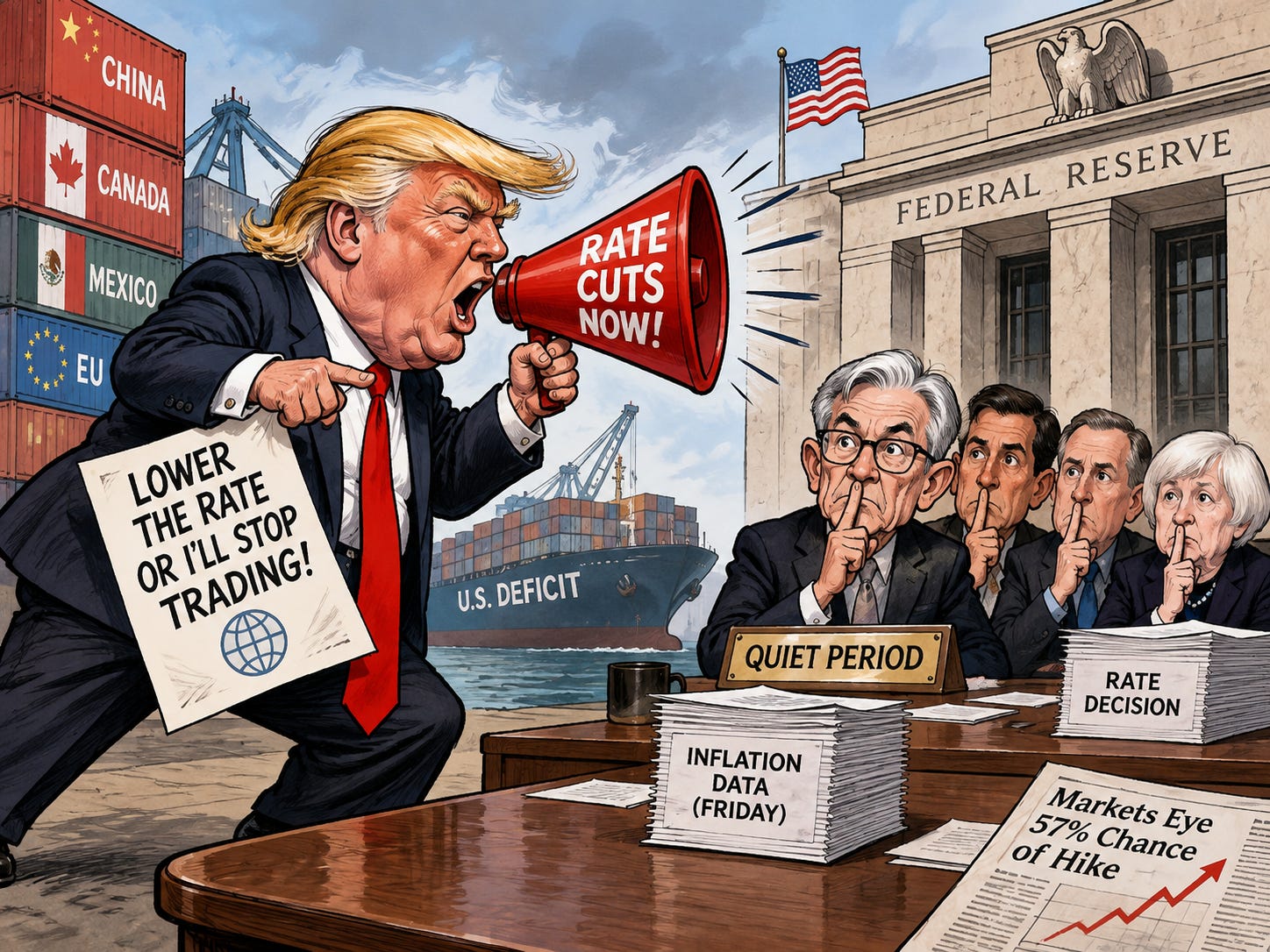
“LOWER THE RATE OR I’LL STOP TRADING WITH COUNTRIES WITH WHICH WE HAVE A DEFICIT.” That was the president on Friday, hours after the August jobs report showed American employers added about 162,000 jobs, close to 3 times what forecasters expected, with unemployment holding at 4.1% and July’s figure revised from a loss of 23,000 to a gain of 21,000. He also wrote that “The Fed Board, with its great new leader, must get smart” and told its members to “BE PATRIOTS for a change”. The list of countries America runs a goods deficit with includes Canada, Mexico, China and most of the European Union. (The New York Times)
Nobody at the Fed can answer him, because the pre-meeting quiet period is already running and no policymaker speaks in public until after the vote. Traders now price roughly a 57% chance of a rise this month, with everything resting on Friday’s inflation data. Governor Christopher Waller, speaking before the blackout began, asked “What’s the cost of waiting one meeting?” and said a single quarter-point rise would not bring inflation to 2% on its own. Governor Michael Barr said that if inflation is not moderating sufficiently, “then I think we should act decisively to raise rates”. Both of them pointed at Friday’s print. (Reuters)
Sensei’s Insight: Pressure like this makes a rise more likely. Kevin Warsh built his whole reputation on independence, and being publicly ordered around by the man who appointed him is the one thing that forces him to prove it in the room.
🛢️ Iran wants to draw a line outside the strait
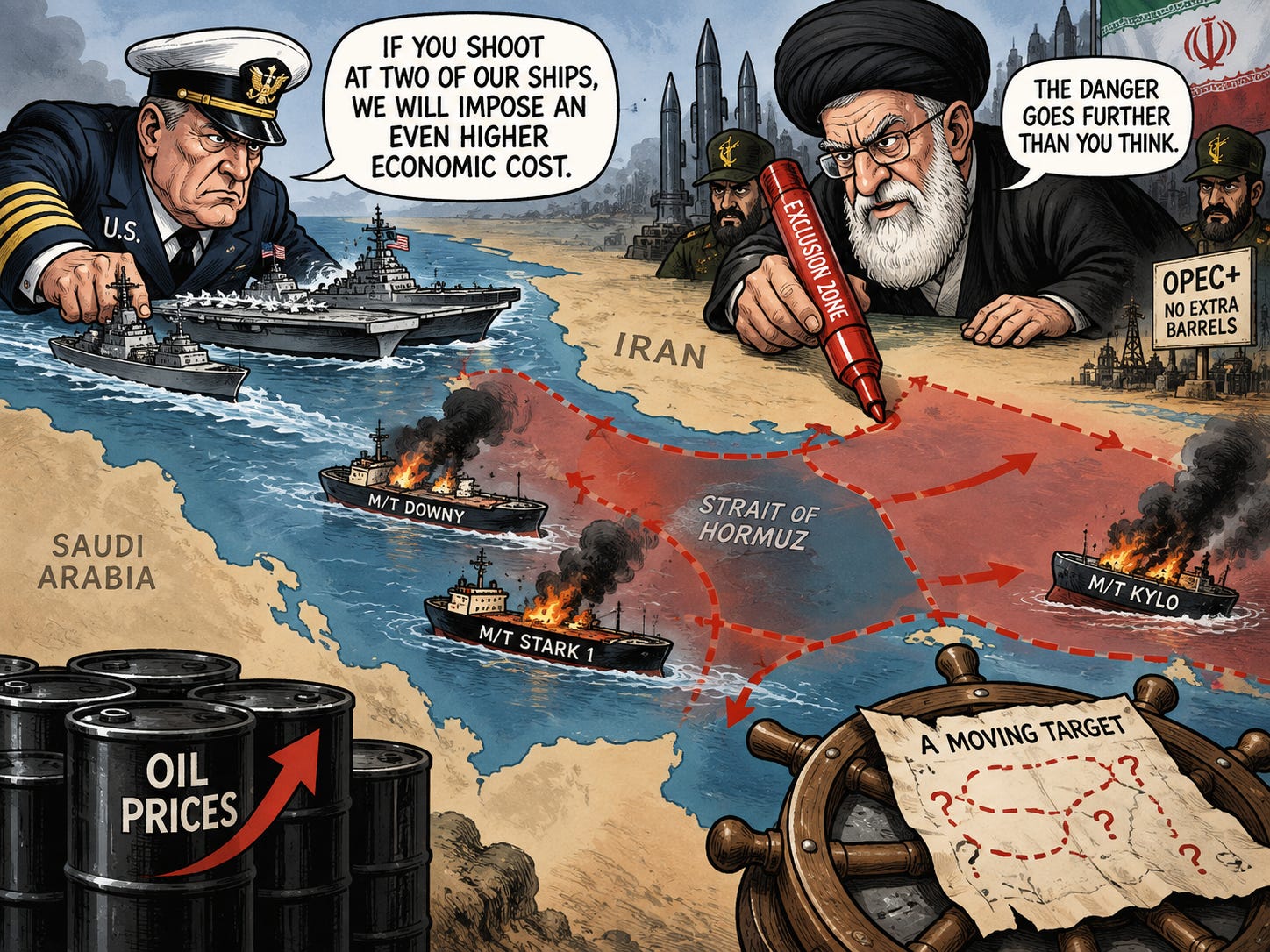
American forces struck 3 Iranian oil tankers on Saturday, after the Revolutionary Guard fired ballistic missiles at an American aircraft carrier and a guided missile destroyer, both of which evaded the attacks with no casualties. The M/T Downy off Kharg Island and the M/T Stark 1 near Jask were permanently disabled. A third vessel, the M/T Kylo, was destroyed near the Gulf of Oman; it was carrying no oil and its crew were told to abandon it first. Admiral Brad Cooper, who runs Central Command, put the doctrine plainly: “If you shoot at two of our ships, we will impose an even higher economic cost”. Brent added $1.22 to $97.50 on Monday and WTI $1.23 to $92.71, after Brent gained 8% last week and WTI close to 10%. (NBC News)
The new part of this is geographic. A senior Iranian official said Tehran plans to declare an “exclusion zone” outside the Strait of Hormuz, aimed at vessels it believes are trying to enter, which would push the danger area beyond the water everyone has been watching for 6 months. The strait itself is already effectively shut. Tehran claimed over the weekend to have hit an uncrewed American vessel inside it and a Central Command spokesperson called that “a total lie”. Meanwhile OPEC+ met on Sunday and left October production exactly where September’s is, with the 7 countries involved next meeting on 4 October. No extra barrels are coming while the map of where a ship can be hit gets bigger. (CNBC)
Sensei’s Insight: A blockade you can draw on a chart gets priced. A zone that moves does not, because insurers cannot underwrite it and owners cannot plan around it. That uncertainty is worth more on the oil price than any single tanker.
🇬🇧 The Chancellor speaks into a sixth day of selling
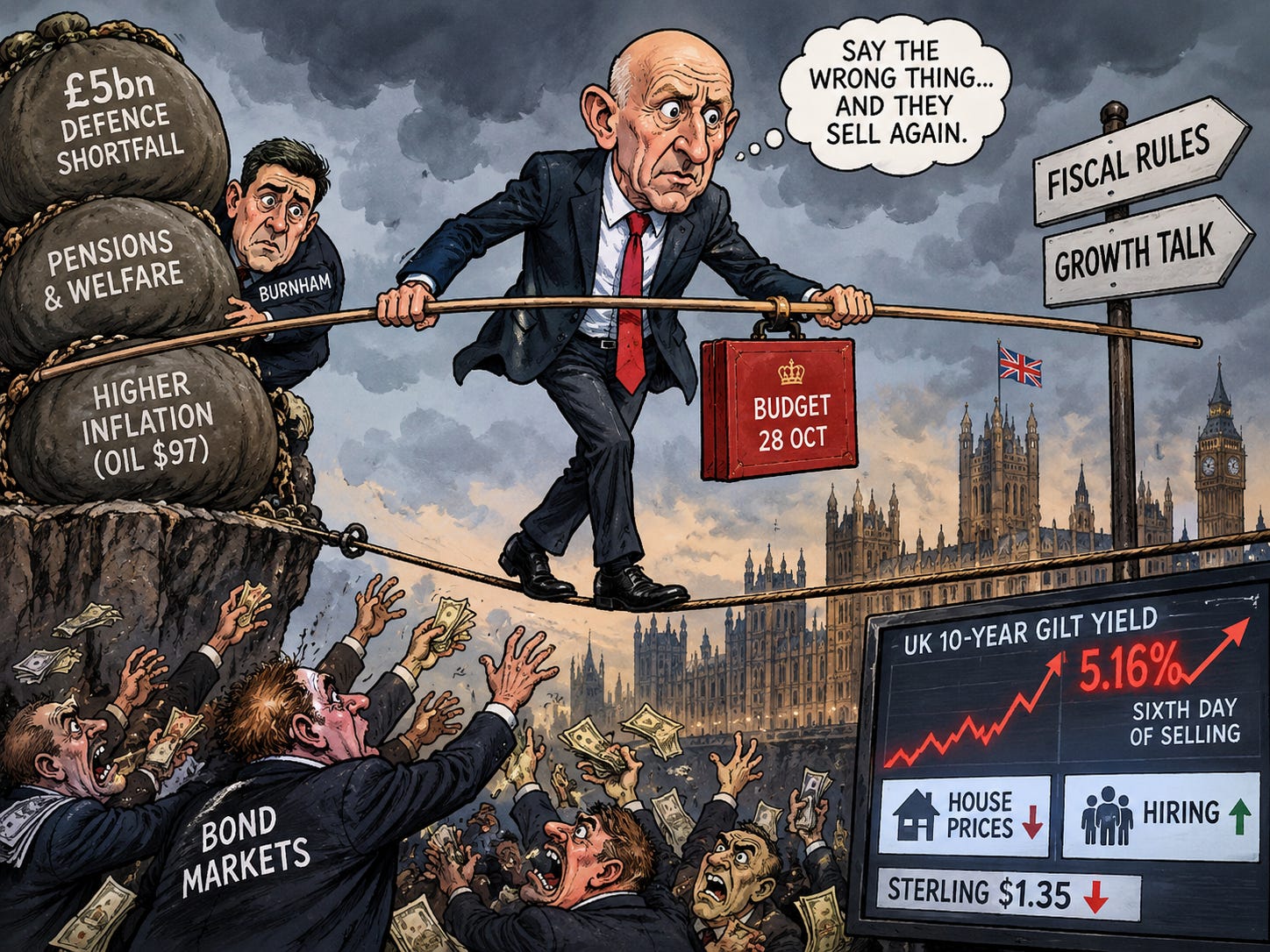
John Healey gives his first major speech as Chancellor today, ahead of his first Budget on 28 October, and the bond market has spent the run-up going the wrong way. The UK 10-year gilt yield rose to 5.16% on Monday, a sixth straight daily increase. Lloyds and the REC published on the same morning and their readings disagree: Lloyds says house prices fell year on year for the first time since November 2023, while the REC recruitment industry survey says British firms increased permanent hiring in August for the first time since 2022. Sterling eased a touch to $1.35. (Reuters)
Every basis point on that yield costs the Treasury money before Healey chooses a single policy, and he has an immediate £5bn shortfall in defence spending to cover alongside Andy Burnham’s commitments on pensions and welfare. The move is not purely British: global yields jumped after Friday’s American jobs report, and oil at $97 makes every inflation-linked bond market nervous at once. Liz Truss’s government ended in 2022 because the gilt market decided it did not believe the numbers, which is the precedent every investor in this market has in mind. (Reuters)
Sensei’s Insight: Watch what he says about the fiscal rules rather than what he says about growth. Growth talk is free. A hint that the rules might bend is what moves the 10-year, and the 10-year is what British lenders price off.
₿ Zcash and HYPE take the records bitcoin could not
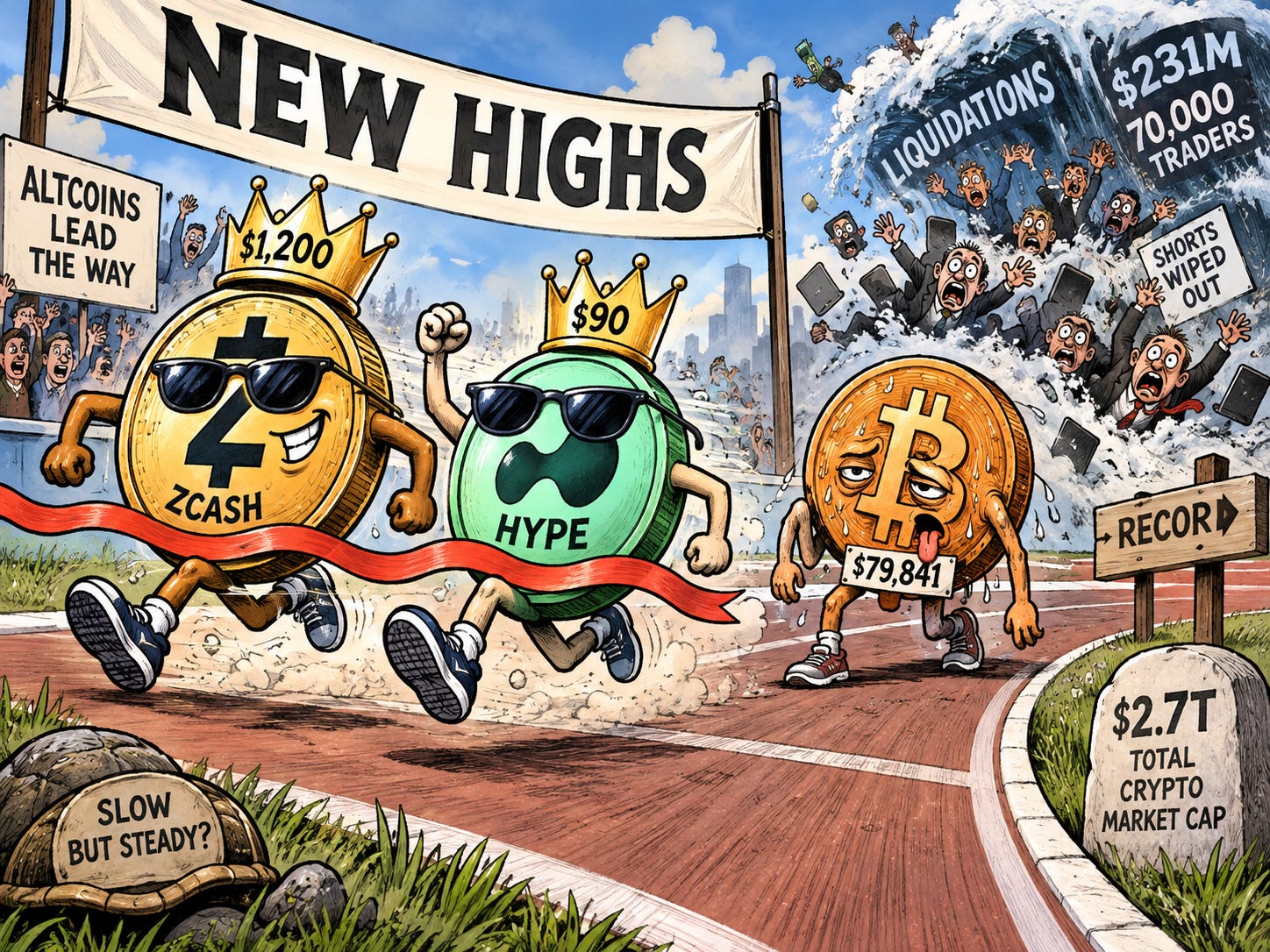
Over the weekend the total value of every crypto asset passed $2.7 trillion, back near where it peaked in May. Bitcoin held around the $80,000 mark and traded at $79,841.85 in Asian hours, which leaves it a long way below its own record. The all-time highs were set elsewhere. Zcash, the privacy coin, broke above $1,200 with a market value over $21bn. Hyperliquid’s HYPE token approached $90 with about $22bn. Those 2 now sit 9th and 10th by market value. (TradingKey)
The derivatives data shows who paid for it. More than 70,000 traders were liquidated over 24 hours, $231m in total, and close to $150m of that was short positions. A liquidation is a forced exit: the exchange closes a borrowed position when the collateral stops covering the loss, and closing a short means buying, which pushes the price up again. The single biggest liquidation was Zcash at nearly $50m, ahead of ether and ahead of bitcoin. Volatility has moved down the market cap table. (Reuters)
Sensei’s Insight: When the alts print records and bitcoin sits still, late money is chasing moves it already missed. I have seen this shape before and it continues longer than most people think, we mentioned this weeks ago, when the price was much lower.
Stories You Might Have Missed
⛴️ The fuel that moves cargo is running short
Refiners are choosing to make diesel, petrol and jet fuel instead of the heavy fuel oil that powers ships, because the margins are better, and the shipping industry is now short. Energy Aspects forecasts a deficit of 218,000 barrels a day in the third quarter, the first shortfall it has estimated since the third quarter of 2025, when it was 6,000. The price of very low sulphur fuel oil in Singapore, the world’s largest bunkering hub, is up 76% since the Iran war began, to just under $825 a tonne, against a 40% rise in Brent over the same period. Stocks in Singapore, Rotterdam and Fujairah sit about 30% below their 3-year seasonal averages. Higher bunker costs feed into freight rates, and freight rates feed into everything shipped. (Reuters)
🇯🇵 The yen is now a carry trade problem
The yen rose 0.1% to 156.01 per dollar on Monday, after gaining more than 2% last week. Markets price a 75% chance the Bank of Japan raises its policy rate a quarter point on 18 September, and a 60% chance of another move by December. Prime Minister Sanae Takaichi’s economic adviser publicly projected a rise this month, which is unusual and adds to the pressure. Eric Robertsen, chief strategist at Standard Chartered, called the recent burst of yen strength “a potential threat to carry outperformance”, and said persistent strength may signal that higher yen and dollar rates are starting to change how big investors allocate money. Borrowing cheap yen to buy assets elsewhere has been one of the best trades of the year. (Reuters)
🇪🇺 The ECB is expected to raise again on Thursday
Euro area policymakers meet on Thursday and a rise is treated as certain, with oil prices doing most of the persuading. Futures imply a 75% chance of a further increase by December, and Deutsche Bank expects the tightening to run through the end of the year. Euro area inflation ran at 3.3% in August against a core rate of 2.4%, so energy is doing the damage while the underlying picture stays contained. The decision and American producer price data land 15 minutes apart, so Thursday morning carries 2 releases almost on top of each other. The euro was little changed at $1.16 on Monday, and the dollar index sat flat at 99.16, close to its recent low of 98.56. (Reuters)