This content is for informational and educational purposes only and does not constitute financial advice. Always do your own research. Not financial advice (NFA).
👀 Today’s Stories at a Glance
🇨🇳 China Nudges Banks From Treasuries: Regulators are advising commercial banks to reduce US debt holdings to manage interest rate risk and concentration.
👻 The $44 Billion Bitcoin Glitch: Bithumb accidentally credited users with billions in “ghost” Bitcoin, sparking a flash crash and new regulatory oversight.
💹 Dow Jones Hits 50,000 Milestone: Blue-chip stocks reached historic highs as strong consumer sentiment and Japanese political stability boosted global investor confidence.
💊 Hims & Hers Scraps Wegovy Copy: The company halted its cheap weight-loss pill after FDA warnings and DOJ referrals for potential drug law violations.
🚀 Samsung Leads HBM4 Chip Race: Mass production of next-gen memory for Nvidia begins this month, shifting power away from rivals SK Hynix and Micron.
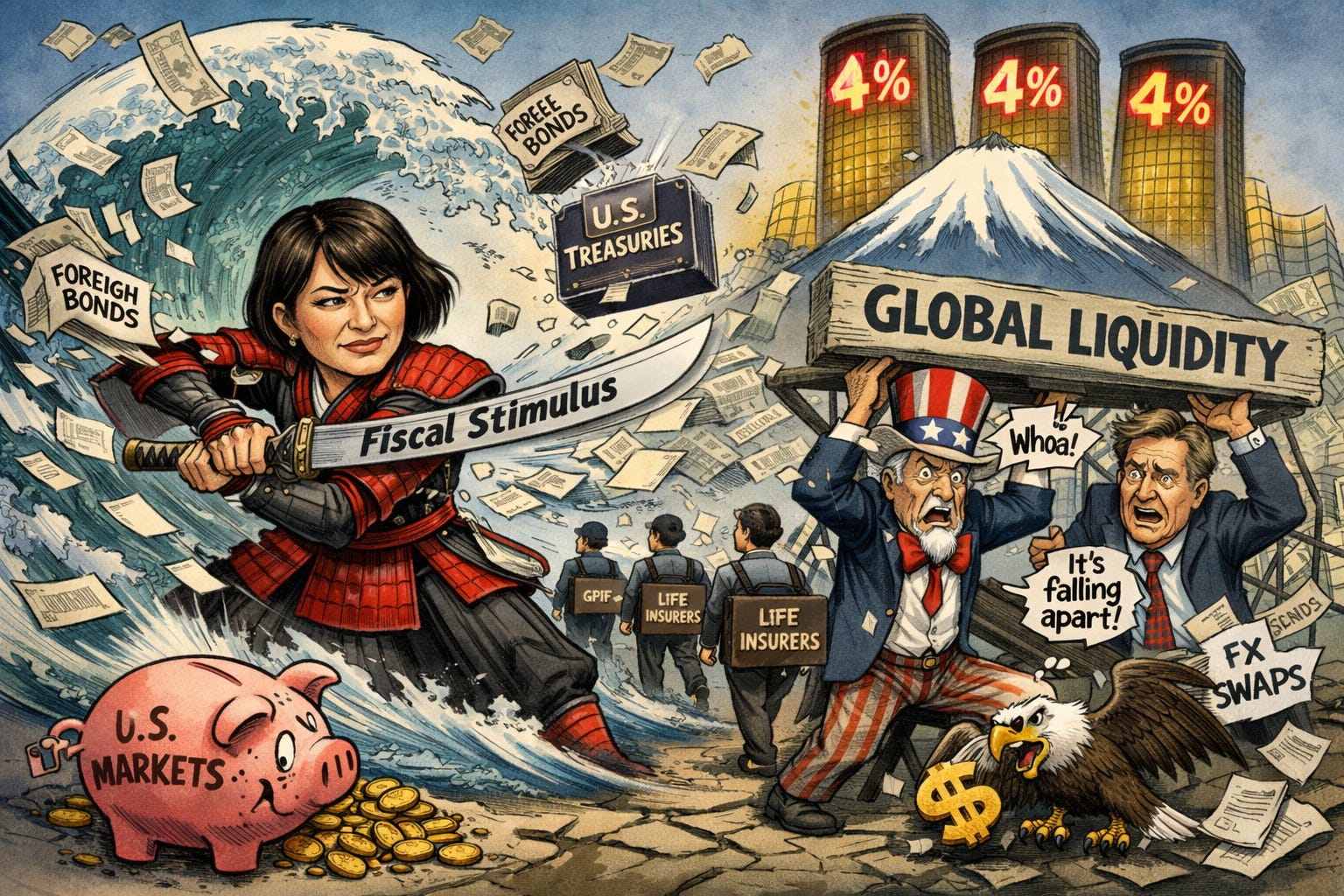
🇯🇵 Japan’s $6 Trillion Repatriation Threat: Rising domestic yields and Takaichi’s fiscal expansion are luring capital home, risking a massive sell-off of US Treasuries.
🧠 One Big Thing
Japan is transitioning from the world’s primary source of cheap liquidity to a high-yield domestic market, threatening a massive global capital reversal. Prime Minister Takaichi’s historic electoral mandate for aggressive fiscal expansion has pushed 40-year bond yields to unprecedented levels above 4%. This shift destroys the economic logic of the carry trade and makes holding foreign assets increasingly unattractive for Japanese institutions. As domestic returns finally compete with international yields, trillions in capital are poised to flow back to Tokyo. For global investors, this creates a dangerous feedback loop where repatriation strengthens the yen and forces further selling of U.S. Treasuries and equities. The era of Japan subsidizing global markets with low-cost funding is officially over.
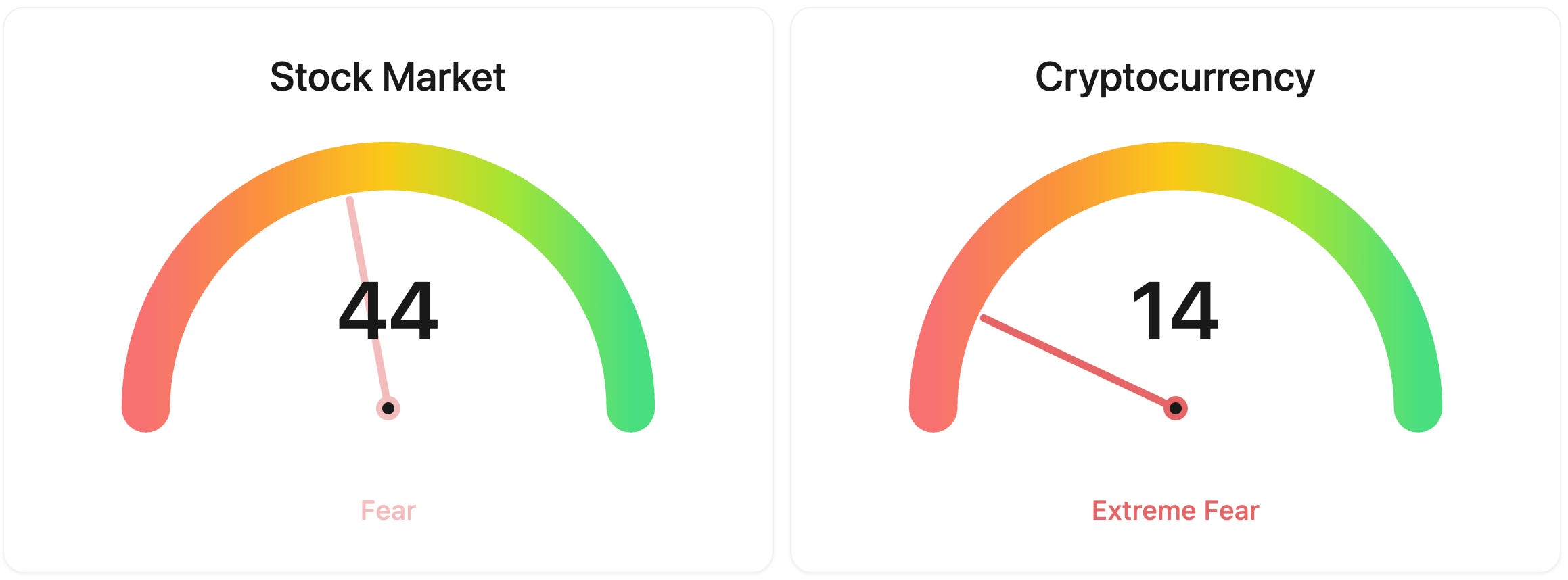
⚖️ Fear & Greed
📉 The Number That Matters
$1.2 TRILLION
Japanese entities held $1.2 trillion in US Treasuries as of late 2025, maintaining Japan's status as the largest foreign creditor to the United States. A repatriation of these holdings driven by rising domestic yields could exert massive selling pressure on global bonds.
⚔️ Winners vs Losers
Winners
NEXN 0.00%↑: Nexxen International Ltd. shares surged following reports of takeover interest and potential acquisition approaches from multiple parties.
AVXL 0.00%↑: Anavex Life Sciences Corp. rallied as the company reported fiscal Q1 2026 financial results and provided a clinical update on its Alzheimer’s treatment, blarcamesine.
DT 0.00%↑: Dynatrace, Inc. jumped after reporting fiscal Q3 earnings that exceeded analyst estimates and announcing a new $1 billion share repurchase program.
QS 0.00%↑: QuantumScape Corporation moved higher in a sector-wide risk-on trade for EV battery stocks, despite receiving a “Reduce” rating from several brokerages today.
Losers
HIMS 0.00%↑: Hims & Hers Health, Inc. tumbled after the FDA and DOJ signaled “swift action” against illegal mass-marketing of compounded GLP-1 weight-loss drugs.
📊 Market Snapshot
Cryptocurrencies:
Bitcoin (BTC): $69,087 (▼ -1.72%)
Ethereum (ETH): $2,031 (▼ -2.75%)
XRP: $1.40 (▼ -1.93%)
Equity Indices (Futures):
S&P 500: $6,917 (▼ -0.11%)
NASDAQ 100: $25,054 (▼ -0.43%)
FTSE 100: £10,360 (▼ -0.43%)
Commodities & Bonds:
10-Year US Treasury Yield: 4.23% (▲ 0.52%)
Oil (WTI): $64 (▲ 0.54%)
Gold: $5,014 (▲ 0.94%)
Silver: $80.39 (▲ 3.14%)
Data as of UK (GMT): 12:07 pm / US (EST): 7:07 am / Asia (Tokyo): 21:07
✅ 5 Things to Know Today
🇨🇳 China Nudges Banks Away from Treasuries
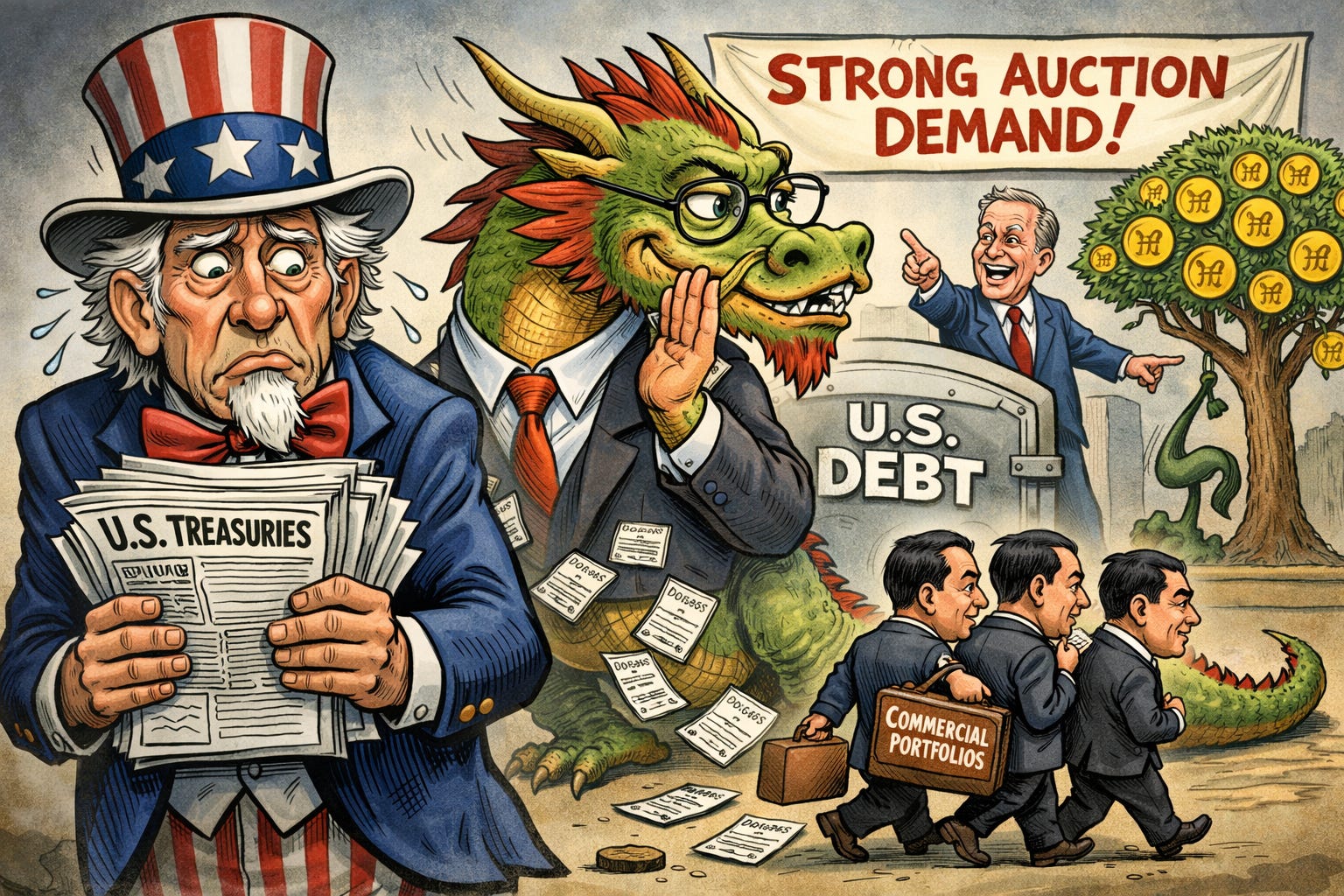
Chinese regulators are reportedly advising the country’s major financial institutions to scale back their holdings of US Treasuries. According to Bloomberg, officials have spent recent weeks verbally guiding banks to limit new purchases and “pare down” existing positions if they’re heavily exposed. The 10-year Treasury yield ticked up three basis points to 4.23% in response, while the dollar index dipped 0.2%, signaling a modest shift in global demand. It’s important to note this guidance specifically targets commercial bank portfolios rather than China’s massive sovereign foreign exchange reserves, which remain the primary pillar of their dollar liquidity (Bloomberg).
This isn’t a sudden geopolitical “attack” on the dollar, but rather a calculated move to manage concentration risk. Regulators are wary that sharp swings in US interest rates could leave Chinese banks vulnerable to significant mark-to-market losses. For retail investors, the immediate ripple effect was felt in the currency markets: the onshore yuan strengthened to 6.9284 per dollar, its firmest level since May 2023. While US Treasury Secretary Scott Bessent points to strong recent auction demand as a sign of stability, this “quiet quitting” by a major foreign buyer suggests we may see sustained upward pressure on yields and a continued bid for the yuan.
Sensei’s Insight: Watch the spread between US and Chinese 10-year yields. If Chinese banks transition from “passive holders” to “active sellers,” it may signal a floor for US rates regardless of Fed policy.
👻 The $44 Billion “Ghost Bitcoin” Glitch

South Korea’s second largest exchange, Bithumb, turned a $1.40 promotional “thank you” into a $44 billion nightmare on February 6. An employee mistakenly selected Bitcoin instead of Korean won as the payout unit, instantly crediting 620,000 BTC to several hundred accounts. For context, Bithumb only holds about 43,000 actual coins. This “ghost bitcoin” existed only on the exchange’s internal ledger, but it was tradeable. Before Bithumb could freeze the accounts 35 minutes later, users managed to sell 1,788 BTC, triggering a 15% localized flash crash. While 99.7% of the funds are now recovered, about 125 BTC remains missing (Korea Herald).
This isn’t just a typo story: it’s a structural warning. It proves that centralized exchanges (CEXs) often trade “IOUs” on internal databases that aren’t synced in real-time with the actual blockchain. Regulators in Seoul have already launched an emergency task force to investigate. They’re using this blunder to fast-track the Digital Asset Basic Act, which may force exchanges to implement bank-like “hard stops” on any transaction exceeding their actual reserves. For retail investors, it’s a reminder that your asset’s safety is only as good as the exchange’s internal accounting.
Sensei’s Insight: Watch the spread between Bithumb and global prices. If regulators mandate stricter on-chain reconciliation, expect local liquidity to tighten as “ghost” trading becomes a thing of the past.
💹 The Dow Hits 50,000 as Japan Goes Vertical
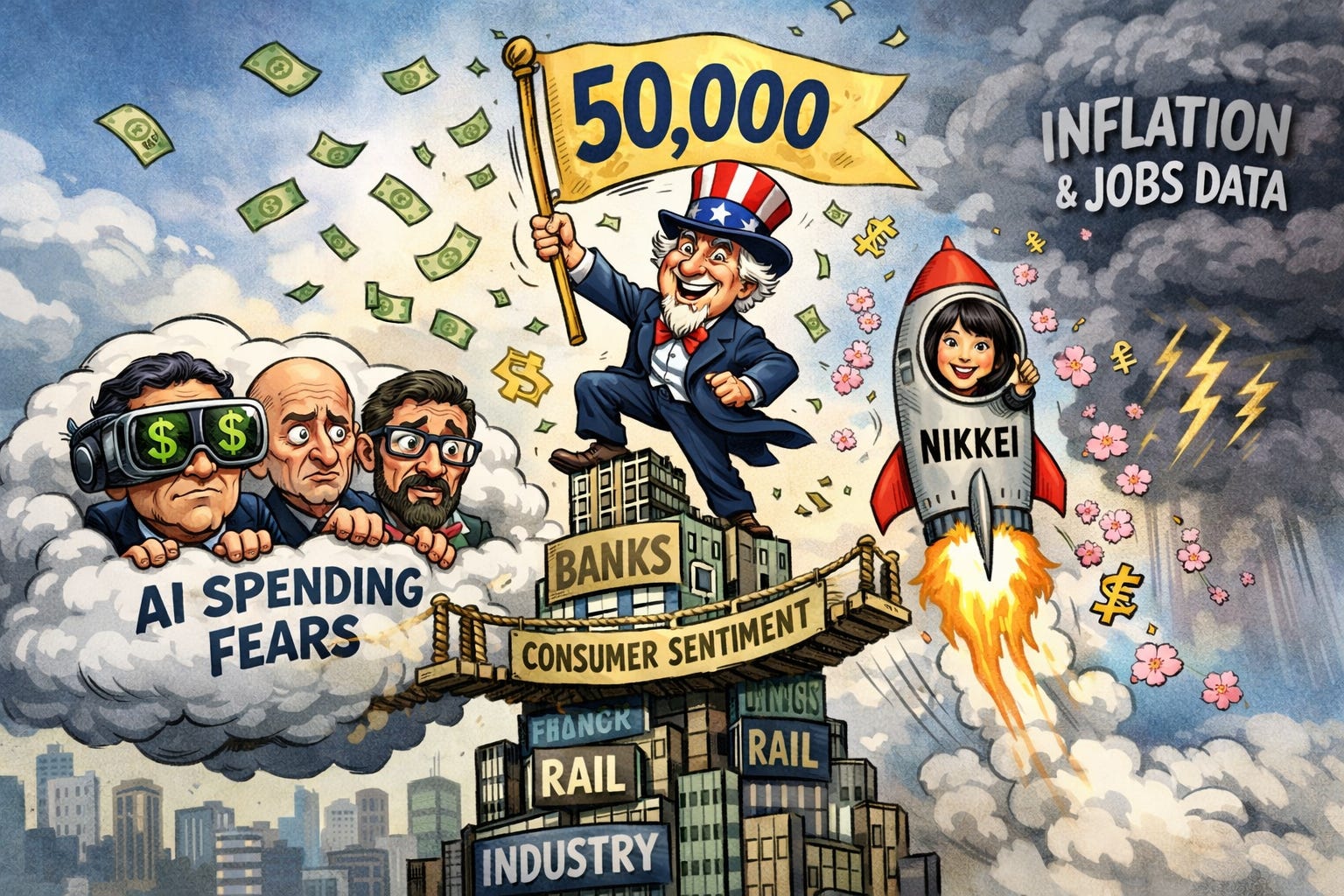
The Dow Jones Industrial Average just crossed a massive psychological line, closing above 50,000 for the first time in its 129-year history on Friday, February 6, 2026. It wasn’t a quiet move: the index jumped over 1,200 points as investors shook off a mid-week tech slump. A surprisingly strong University of Michigan consumer sentiment reading acted as the catalyst, signaling that the US consumer is still spending and inflation fears are cooling. Over in Tokyo, the Nikkei 225 is also hitting record highs following a landslide election win for Prime Minister Sanae Takaichi, whose pro-growth agenda has traders piling into Japanese stocks (Barron’s).
This move suggests the market is finally broadening out. Earlier in the week, investors were jittery that massive AI capital spending from giants like Alphabet and Amazon would cannibalize profits. Friday’s bounce changed the narrative, as the sentiment data gave traders a reason to rotate into “old economy” sectors like industrials and financials. Still, Monday’s slight dip in futures indicates that sentiment remains fragile. The market is now staring down a backlog of delayed jobs and inflation data, which will determine if this milestone has staying power or if it’s just a temporary positioning reset.
Sensei’s Insight: Watch the 50,000 level closely. If the Dow can’t hold this milestone during the upcoming data dump, it may signal that Friday’s surge was just a momentary burst of optimism.
💊 Hims & Hers Abandons Wegovy Copy Under Federal Pressure

Hims & Hers (HIMS) abruptly pulled its new $49 compounded weight-loss pill just 48 hours after launch, retreating from a direct confrontation with regulators and big pharma. The U-turn followed a “decisive” warning from the FDA, which explicitly named the company while announcing a crackdown on mass-marketed GLP-1 knockoffs. Tensions escalated when the Department of Health and Human Services (HHS) referred Hims to the Department of Justice (DOJ) for potential violations of federal drug laws. Market reaction was swift: Hims shares plunged 17% in early Monday trading, while Novo Nordisk shares gained as the risk of a cheap, unauthorized oral competitor suddenly vanished (Reuters).
This enforcement action signals the end of the “Wild West” for compounded GLP-1 drugs. Telehealth platforms have historically relied on drug shortages to justify selling cheaper alternatives, but Novo Nordisk’s official Wegovy pill is currently in full supply. This leaves “mass compounding” without its usual legal cover. There is also a major technical gap: Novo’s $1.8 billion absorption technology is patented, and the FDA remains wary of the untested delivery methods used in the Hims version. For investors, the takeaway is clear. The regulatory moat around billion-dollar weight-loss brands is getting deeper, while platforms that built their growth on compounding face a new reality of higher compliance costs and legal scrutiny.
Sensei’s Insight: Watch the DOJ referral closely. If federal investigators extend their focus to Hims’ existing injectable business, a significant portion of the company’s recent growth could be permanently sidelined.
🚀 Samsung’s HBM4 Leap Rattles the Memory Hierarchy
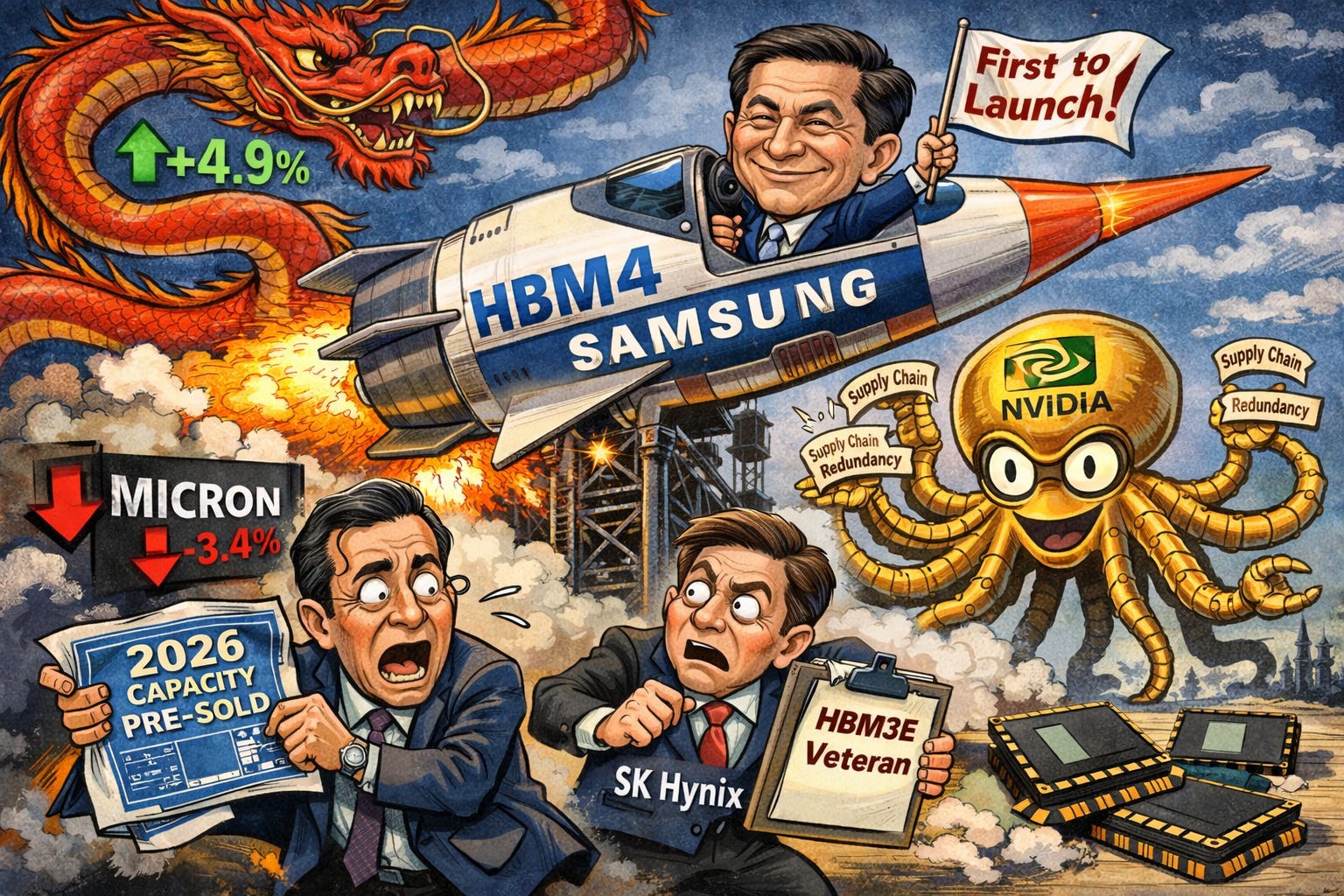
Samsung is reportedly set to begin mass production of its sixth-generation high-bandwidth memory, known as HBM4, later this month. According to Korean industry reports, the tech giant plans to ship these chips to Nvidia as early as the week following the Lunar New Year. This move positions Samsung as the first manufacturer to reach volume production for HBM4, leveraging a combination of its 10nm-class DRAM and a 4nm foundry process. The news sent Samsung’s stock up 4.9% in local trading, while Micron shares dipped roughly 3.4% in U.S. pre-market action as investors weighed the competitive shift (Yonhap News).
This development suggests a potential shift in the HBM power dynamic where Samsung is reclaiming a “first-mover” status that it lacked during the HBM3E cycle. For retail investors, the immediate pullback in Micron might look like a setback, but it’s worth noting that Micron has already locked in price and volume agreements for its entire 2026 HBM supply. Analysts suggest Nvidia and other major players are committed to a three-supplier sourcing strategy involving Samsung, SK Hynix, and Micron to ensure supply chain redundancy. Samsung’s early entry likely eases the global supply bottleneck for Nvidia’s next-gen “Vera Rubin” accelerators rather than creating a glut that would erode margins across the sector.
Sensei’s Insight: Watch the 2Q26 window when Micron begins its own HBM4 ramp. While Samsung has the early lead, the fact that 2026 capacity is already “sold out” across the board signals that demand still vastly outstrips supply.
🔗 Connect with Us
Stay plugged in across platforms:
Sensei on X: sensei_live_
Martyn Lucas on X: MartynInvestor
Vaz on X: eVTOLHUB
📺 YouTube Channel (Live & Replays): Martyn Lucas Investor

🔍Deep Dive: 🇯🇵 The “Takaichi Trade” and the $6 Trillion Repatriation Threat