

This content is for informational and educational purposes only and does not constitute financial advice. Always do your own research. Not financial advice (NFA).
👀 Today’s Stories at a Glance
📉 Inflation cooled, yields rose: core PCE came in at 3.0%, October hike odds fell to about 35%, and the 10-year still hit 5.29%.
💾 Micron’s record moved Tokyo: $54.23 billion of revenue and a $61.5 billion guide sent Advantest up 7% while Micron barely moved.
🛢️ Brent is back at $100: oil rose 2.4% after PetroChina reportedly cancelled October fuel exports and Washington sent Iran’s delegation home.
👟 Nike reports tonight: shares are down 38% this year, and analysts expect revenue down about 3% to $11.32 billion.
🪙 Bitcoin funds stopped buying: spot ETFs lost $148.7 million on Wednesday, ending a 9-day inflow run worth about $3.1 billion.
🏠 UK house prices slipped: Nationwide prices fell 0.2% in September, and annual growth halved to 0.8%, the weakest since December.
🏦 Bailey warns on AI: the Bank of England governor said AI’s boom could bring “some correction of asset prices” at some point.
🎬 Paramount’s $44 billion debt: the Warner Bros. takeover is being funded with bonds paying close to 9% on the longest notes.
🚗 Tesla’s delivery test: analysts expect 461,974 cars for the third quarter on Friday, 7% fewer than a year earlier.
🧠 One Big Thing
So here is what changed on Wednesday. August’s PCE inflation, the Fed’s preferred measure, came in softer than forecast, and the chance of another US rate rise on 28 October fell from about 71% on Monday to about 35%. The bond market went the other way. The 10-year Treasury yield closed at 5.29%, its highest since 2007, because the same morning showed the economy grew faster in the spring than first thought. Cooler prices and higher borrowing costs, on one day. Friday’s September payrolls, at 1:30pm UK, 8:30am in New York, show which one the Fed is more likely to act on.
⚖️ Fear & Greed
📉 The Number That Matters
2.2%
US growth in the second quarter was revised up to a 2.2% annual rate from 1.5%, on the same morning core inflation came in below forecasts. The bond market sold off on the growth.
⚔️ Winners vs Losers
🟢 Top Gainers
GLUE 0.00%↑ : +21.46% Monte Rosa Therapeutics, Inc. shares surged ahead of this morning’s presentation of full GFORCE-1 Phase 1 results for MRT-8102, its molecular glue degrader for patients at elevated cardiovascular risk. Interim data from the same study in January showed an 85% reduction in CRP, a key marker of heart-disease inflammation.
NU 0.00%↑ : +3.87% Nu Holdings Ltd. shares climbed after the Brazilian digital bank confirmed it is not pursuing a deal for UK challenger bank Monzo, recovering part of the roughly 10% slide triggered by takeover-talk reports earlier in the week.
CEG 0.00%↑ : +3.64% Constellation Energy Corporation shares rose after the company signed a long-term power agreement with Amazon covering 690 megawatts, including a roughly 190-megawatt uprate, while supporting the relicensing of its Calvert Cliffs nuclear plant in Maryland. The deal reignited the AI power trade, with Bloom Energy also bid higher pre-market.
🔴 Top Losers
CTVA 0.00%↑ : -75.79% Corteva, Inc. shares are trading ex-distribution after the company completed the spin-off of its seed business, Vylor, which debuts today with one share issued for every Corteva share held. The drop reflects value moved into Vylor rather than a sell-off, and leaves Corteva as a pure-play crop protection company.
LQDA 0.00%↑ : -5.16% Liquidia Corporation shares extended yesterday’s 57% collapse after a Delaware federal court ruled that its inhaled treatment Yutrepia infringes two claims of a United Therapeutics patent covering pulmonary hypertension linked to interstitial lung disease. Liquidia plans to appeal and will ask the FDA to remove that indication from Yutrepia’s label.
📊 Market Snapshot
Cryptocurrencies:
Bitcoin (BTC): $83,638 (▲ 0.06%)
Ethereum (ETH): $2,685 (▲ 0.00%)
XRP: $1.48 (▼ 0.54%)
Equity Indices (Futures):
S&P 500: 7,720 (▲ 0.06%)
NASDAQ 100: 30,795 (▲ 0.31%)
FTSE 100: 10,433 (▼ 1.38%)
Commodities & Bonds:
10-Year US Treasury Yield: 5.31% (▲ 0.40%)
Oil (WTI): $92 (▲ 1.93%)
Gold: $4,159 (▼ 0.06%)
Silver: $60.53 (▲ 0.17%)
Data as of: UK: 11:14 BST / US: 06:14 EDT / Asia (Tokyo): 19:14 JST
✅ 5 Things to Know
📉 Inflation cooled, and bond yields hit a 2007 high
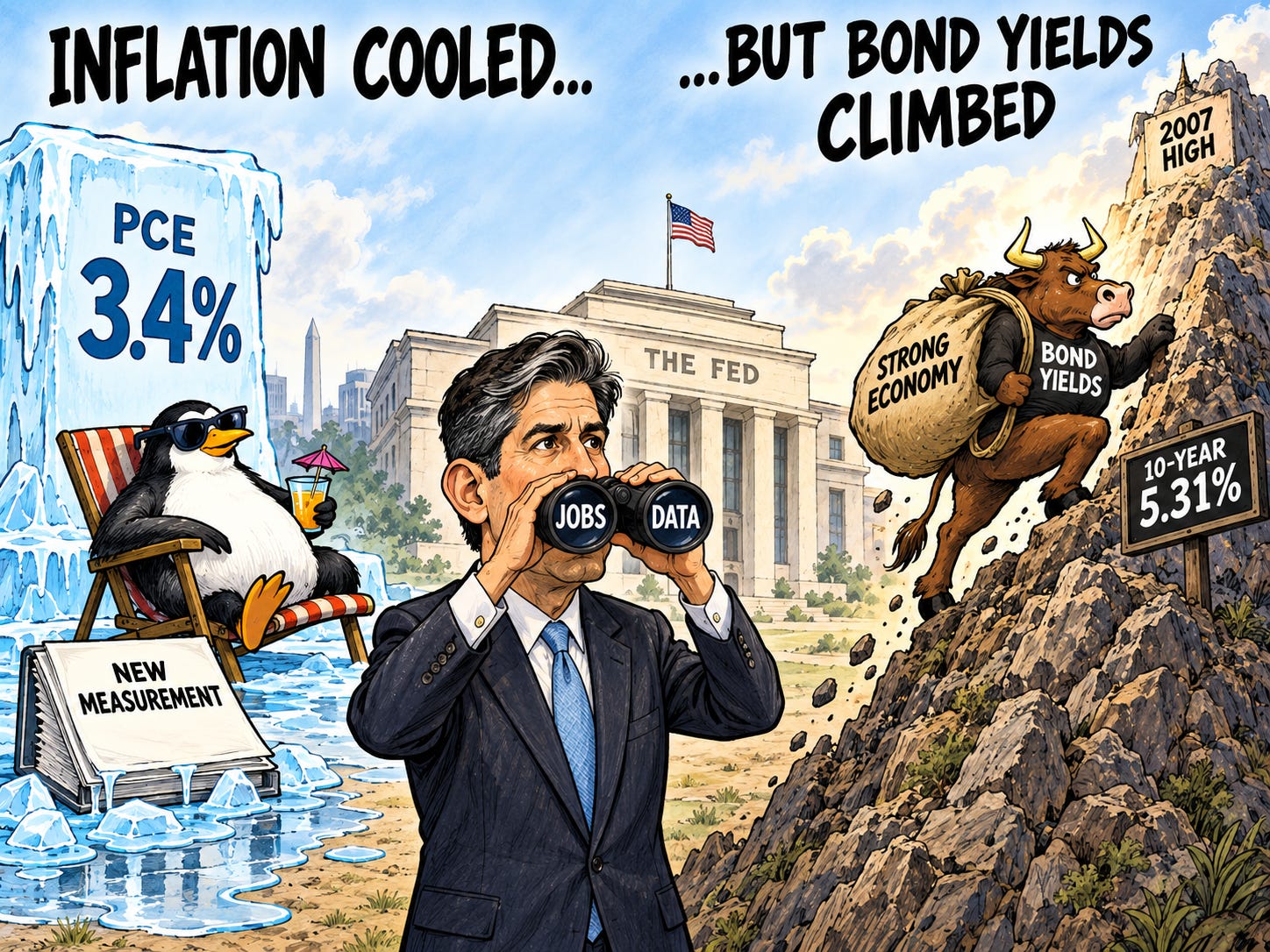
“The Fed wants inflation to fall because price pressures are easing, not because the way it’s measured changes.” Bill Adams of Fifth Third Commercial Bank said that after Wednesday’s PCE inflation numbers, and it explains the day. Core prices, which exclude food and energy, rose 3.0% over the year to August, against 3.3% expected. They rose 0.2% on the month, below the 0.3% forecast, and the headline rate came in at 3.4% against 3.7%.
The same release carried the government’s annual rewrite, which changed how software, legal fees and investment advice are priced back to 2021. That took about 0.3 points off the annual rates. Futures put the chance of an October rate rise at about 35% after the data, CME FedWatch showed, down from about 71% on Monday. Yahoo Finance
The bond market sold anyway.
Second-quarter growth was revised up to a 2.2% annual rate from 1.5%, and ADP counted 90,000 new private jobs in September, against 70,000 expected. The 10-year Treasury yield closed at 5.29% on Wednesday, up from 5.26%, and touched 5.31% in Asian trading on Thursday, its highest since June 2007. The 30-year yield closed at 5.64%. The S&P 500 fell 0.3% to 7,651.54, and the Dow lost 0.9%. BNN Bloomberg
So why would borrowing costs rise on a soft inflation number? Because a good part of the softness came from a new ruler. Services prices excluding energy and housing, a measure the Fed watches for wage pressure, rose 0.4% in August after 0.1% in July. Minneapolis Fed President Neel Kashkari said on Wednesday evening that inflation is “still too high, running at around 3%”, and he pencilled in one more rise this year and another in 2027.
The ISM survey of American factories lands at 3pm UK, 10am in New York. Fed Vice Chair Philip Jefferson speaks at 6:30pm UK, which is 1:30pm Eastern. September payrolls follow on Friday, with about 90,000 jobs expected in a Reuters poll, and the Fed decides on 28 October.
Sensei’s Insight: The inflation number did its job and the bond market looked straight through it. A 10-year at 5.29% says investors are pricing a strong economy, whatever the Fed does in October. What I am watching is Friday’s payrolls. A big number would put October straight back on the table.
💾 Micron’s record quarter moved Tokyo more than Micron
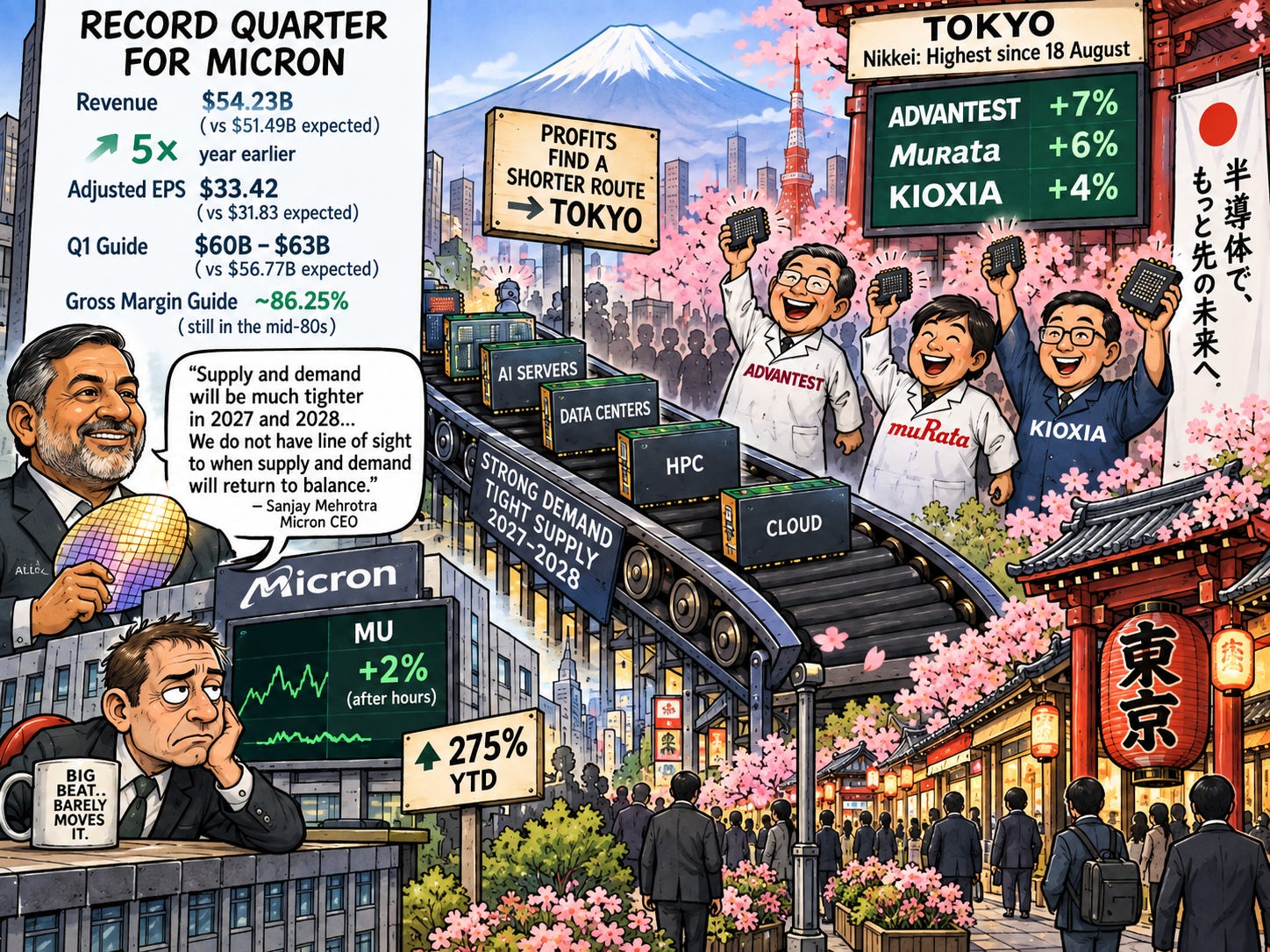
$54.23 billion. That was Micron’s revenue for the quarter to August, against $51.49 billion expected and nearly 5 times the same quarter a year earlier. Adjusted earnings came in at $33.42 a share, against $31.83 forecast. Micron guided to revenue of $60 billion to $63 billion for the current quarter, well above the $56.77 billion analysts had pencilled in, and to earnings of about $38.15 a share. Yahoo Finance
Wednesday’s edition named the gross margin guide as the number to watch. Micron guided to about 86.25% for the current quarter, a touch below the 86.8% it just reported and still in the mid-80s. Chief executive Sanjay Mehrotra said supply and demand will be “much tighter in calendar 2027 and 2028 than they were in 2026”, and that “we do not have line of sight to when supply and demand will return to balance.” He said more than 75% of Micron’s 2027 output is already committed to customers. TradingKey
How did the market take it? Micron’s shares dipped after the release, then rose about 2% after hours, and they were close to flat before Thursday’s US open. The bigger move came in Japan. The Nikkei closed at its highest since 18 August, led by the chip-testing maker Advantest, up about 7%, with Murata up 6% and the memory maker Kioxia up 4%. Under the surface, falling shares on the Tokyo index outnumbered rising ones by 157 to 68.
Sensei’s Insight: Micron guided to a margin of about 86.25%, which says memory prices are still rising. The stock had already risen about 275% this year, and a beat this size barely moved it. What I am watching is the suppliers in Tokyo, which took the gain instead.
🛢️ Brent climbed back to $100 as China kept its fuel
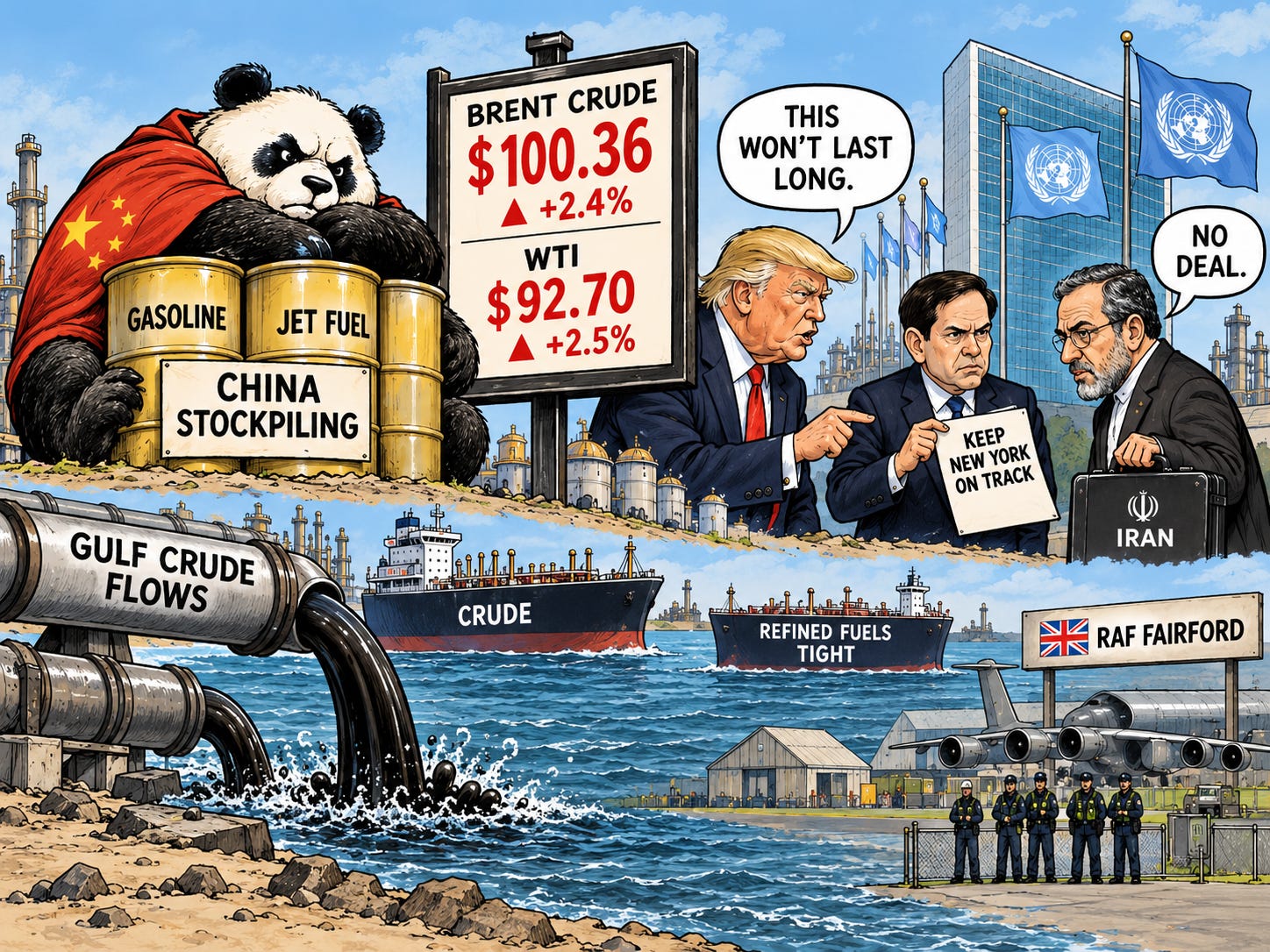
Brent crude rose 2.4% to $100.36 a barrel by 9:23am UK time on Thursday, and West Texas crude gained 2.5% to $92.70. Reuters reported that PetroChina, China’s state oil major, cancelled several gasoline and jet fuel shipments planned for October to protect supply at home. Brent’s December contract, now the benchmark after November’s expired, had already risen 1.9% to settle at $98.03 on Wednesday. CNBC Africa
Diplomacy went backwards at the same time. Secretary of State Marco Rubio ordered Foreign Minister Abbas Araghchi and Iran’s UN delegation to leave New York after weekend talks through Qatari mediators made little progress, AP reported. Iran’s mission said it left on a schedule it had given the State Department on 17 September. President Trump told reporters on Wednesday: “It’s going to end very soon, one way or the other.”
Britain is now part of the story too. Prime Minister Andy Burnham said there are “strong indications that Iran played a part” in the weekend incident at RAF Fairford, the Gloucestershire base that hosts US bombers. 5 British men in their 20s were arrested and released on bail, and police found petrol but no explosives. Araghchi denied any role. Al Jazeera
Why did prices rise when Gulf crude is flowing again? Crude and fuel are different markets. Crude shipments through Hormuz have recovered to about 13.2 million barrels a day, and Saudi Arabia is loading again at its Red Sea port of Yanbu. Exports of refined fuels such as diesel and jet fuel were still only 58% of pre-war levels in JPMorgan’s estimate on Tuesday. OPEC+ meets online on Sunday 4 October.
Sensei’s Insight: Crude is getting out of the Gulf. Fuel is the tighter market, and China holding its gasoline and jet fuel at home squeezes it further. What I am watching is Sunday’s OPEC+ meeting, and whether Washington’s “one way or the other” turns into a date.
👟 Nike reports tonight with shares near 12-year lows
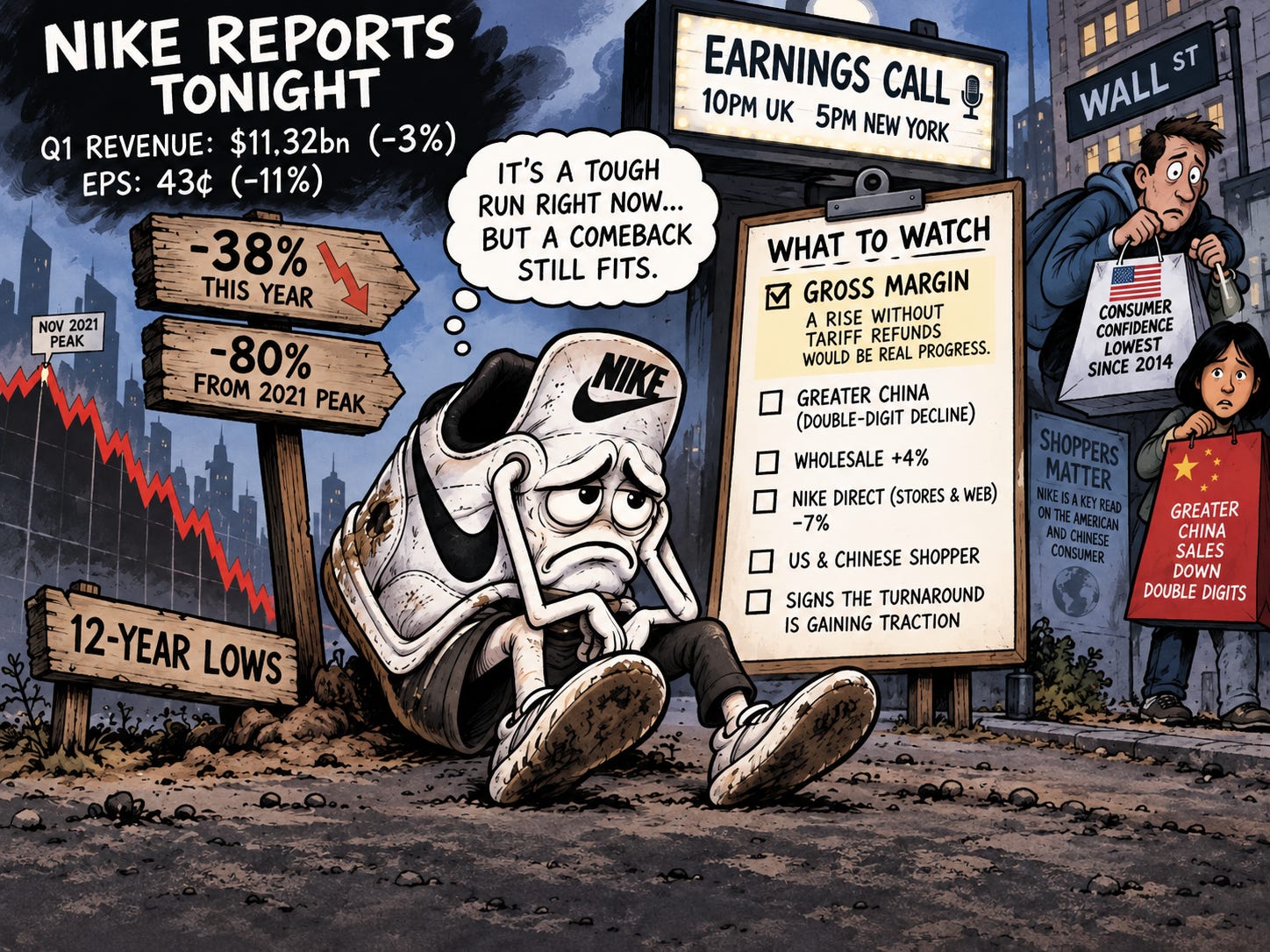
Later today, Nike reports its first-quarter results with its shares down 38% this year. The numbers are due after the US close, around 9:15pm UK, which is 4:15pm in New York. Analysts expect revenue of about $11.32 billion, down about 3% on the year, and earnings of about 43 cents a share, down about 11%. The shares trade about 80% below their November 2021 peak. IG
Nobody should be surprised by a fall in sales. Chief executive Elliott Hill’s team had already warned that revenue was likely to decline through the first half of the fiscal year. Last quarter, the gross margin jumped 8.9 percentage points, much of it from one-off tariff benefits. Greater China revenue fell by double digits. Sales through wholesale partners rose 4% while Nike’s own stores and website fell 7%. The call starts at 10pm UK, 5pm in New York.
Why does a shoe company matter this week? Nike is one of the clearest reads on the American and Chinese shopper at a time when US consumer confidence has fallen to its lowest since 2014.
Sensei’s Insight: Management told everyone revenue would keep shrinking through the first half, and the shares have fallen 38% this year. What I am watching is the gross margin. A rise that does not lean on tariff refunds would be the first hard evidence the turnaround is reaching the numbers.