

This content is for informational and educational purposes only and does not constitute financial advice. Always do your own research. Not financial advice (NFA).
👀 Today’s Stories at a Glance
🛢️ Oil clears $100: Brent settled at $101.21 after the US sank 5 Iranian tankers and Iran hit 10 ships.
🏷️ The oil print in disguise: American producer prices land this afternoon, and energy is expected to do most of the work.
🇪🇺 65 out of 65: every economist Reuters polled expects the ECB to lift its deposit rate to 2.50% today.
🇨🇳 A record 317 basis points: America now pays that much more than China to borrow for 10 years.
🤖 Oracle reports tonight: a $638 billion backlog meets $70 billion of planned spending, borrowed in an AI-heavy bond market.
📱 The foldable costs $1,999: Apple’s iPhone Duo landed, the shares closed down 0.28%, and memory costs are the worry.
🇬🇧 Britain borrows at 1998 prices: £5 billion of gilts sold this morning with long yields at their highest in 28 years.
🇯🇵 Yen at a 7-month high: the Bank of Japan is expected to lift rates to a 31-year high on 18 September.
₿ Bitcoin holds near $78,000: XRP sits at $1.38, and the Senate’s CLARITY cloture vote arrives on 15 September.
🔍 Producer prices are the first read on $100 oil: today's Cheat Sheet covers the core readings and the road to 28 October.
📈 Oil is heading for $100 and inflation goes with it: Chart of the Day covers $100.72, $92.04 and what sits above.
🧠 One Big Thing
So. Oil went through $100 a barrel on Wednesday and it is now setting monetary policy. Does a war price count as inflation? Central banks have to treat it as inflation for as long as it lasts, which is why 4 of them vote in the next 9 days. The European Central Bank raises rates this afternoon. The Federal Reserve votes on 16 September, the Bank of England on the 17th, the Bank of Japan on the 18th. American producer prices land today and consumer prices tomorrow, and energy does most of the work in today's number.
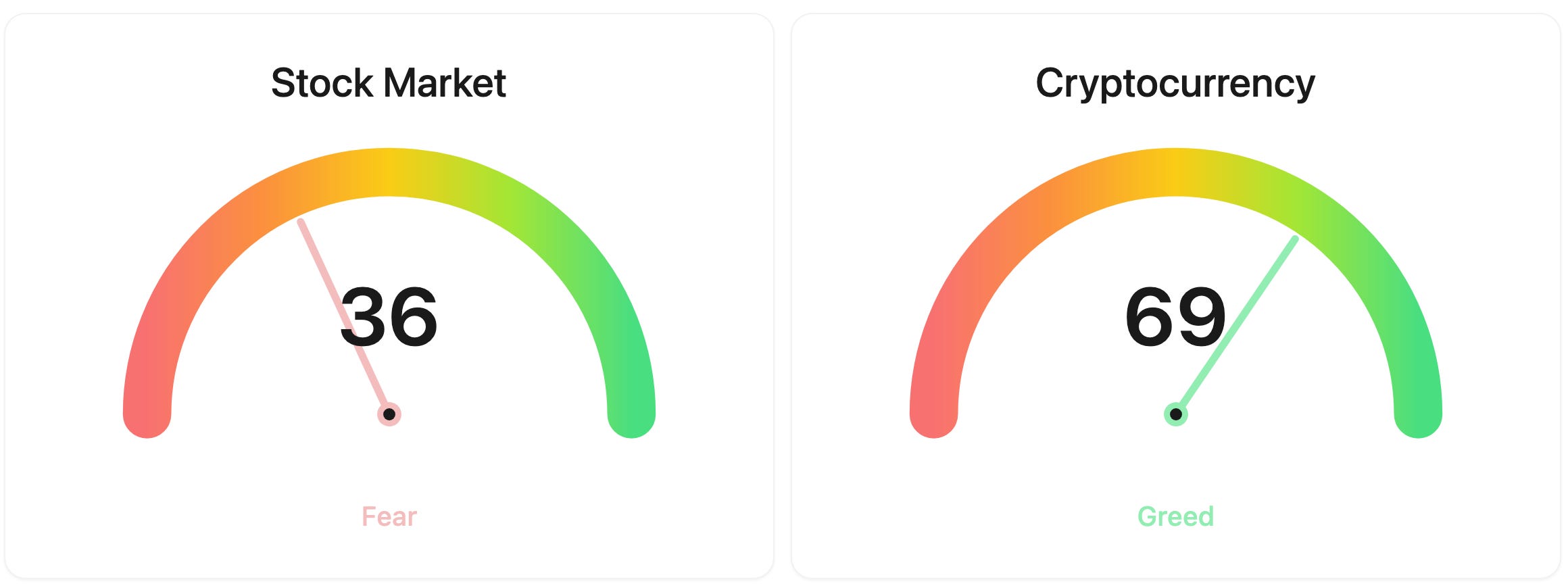
⚖️ Fear & Greed
📉 The Number That Matters
317 basis points
That is how much more the American government pays to borrow for 10 years than China does. It is the widest gap in records going back to 2002, and money follows yield.
⚔️ Winners vs Losers
Winners
No major winners so far today.
Losers
SHOE 0.00%↑ : 20.26% Shoe Station Group, Inc. collapsed after cutting full year adjusted EPS guidance to $0.75 to $0.90 against $1.48 consensus, with Q2 revenue of $284.3 million missing estimates as comparable sales fell 7.1%. Gross margin contracted to 31.9% from 38.8% on aggressive inventory liquidation into an increasingly promotional footwear market.
COO 0.00%↑ : 16.82% The Cooper Companies, Inc. sank after guiding Q4 EPS to $1.07 versus $1.19 consensus and concluding its strategic review by retaining CooperSurgical, saying the offers received were not in shareholders’ best interest. Management flagged reduced US channel inventory at CooperVision persisting into Q4.
NAVN 0.00%↑ : 15.33% Navan, Inc. dropped despite beating on Q2 revenue at $232.8 million and EPS at $0.05, as operating expenses jumped 46% against 35% revenue growth and the raised full year guidance landed broadly in line with consensus. The BoomPop acquisition adds a near term profitability drag with accretion not expected until fiscal 2028.
FCX 0.00%↑ : 7.11% Freeport-McMoRan, Inc. fell alongside a sharp copper unwind after a Reuters report that the White House has stalled its refined copper tariff decision on affordability concerns ahead of November’s midterms, undercutting the tariff trade that drove copper to record highs.
SCCO 0.00%↑ : 6.34% Southern Copper Corporation slid in sympathy on the same stalled US copper tariff report, with copper futures down over 4% as traders unwound stockpiling positions built on expectations of a 15% levy from January 2027.
📊 Market Snapshot
Cryptocurrencies:
Bitcoin (BTC): $78,025 (▼ 0.36%)
Ethereum (ETH): $2,468 (0.00%)
XRP: $1.38 (▼ 0.94%)
Equity Indices (Futures):
S&P 500: 7,644 (0.00%)
NASDAQ 100: 29,339 (▼ 0.37%)
FTSE 100: 10,635 (▼ 0.09%)
Commodities & Bonds:
10-Year US Treasury Yield: 4.87% (▲ 0.41%)
Oil (WTI): $97 (▲ 0.68%)
Gold: $4,387 (▼ 0.31%)
Silver: $65.78 (▼ 2.21%)
Data as of: UK: 12:33 BST / US: 07:33 EDT / Asia (Tokyo): 20:33 JST
✅ 5 Things to Know
🛢️ Both navies are sinking tankers now
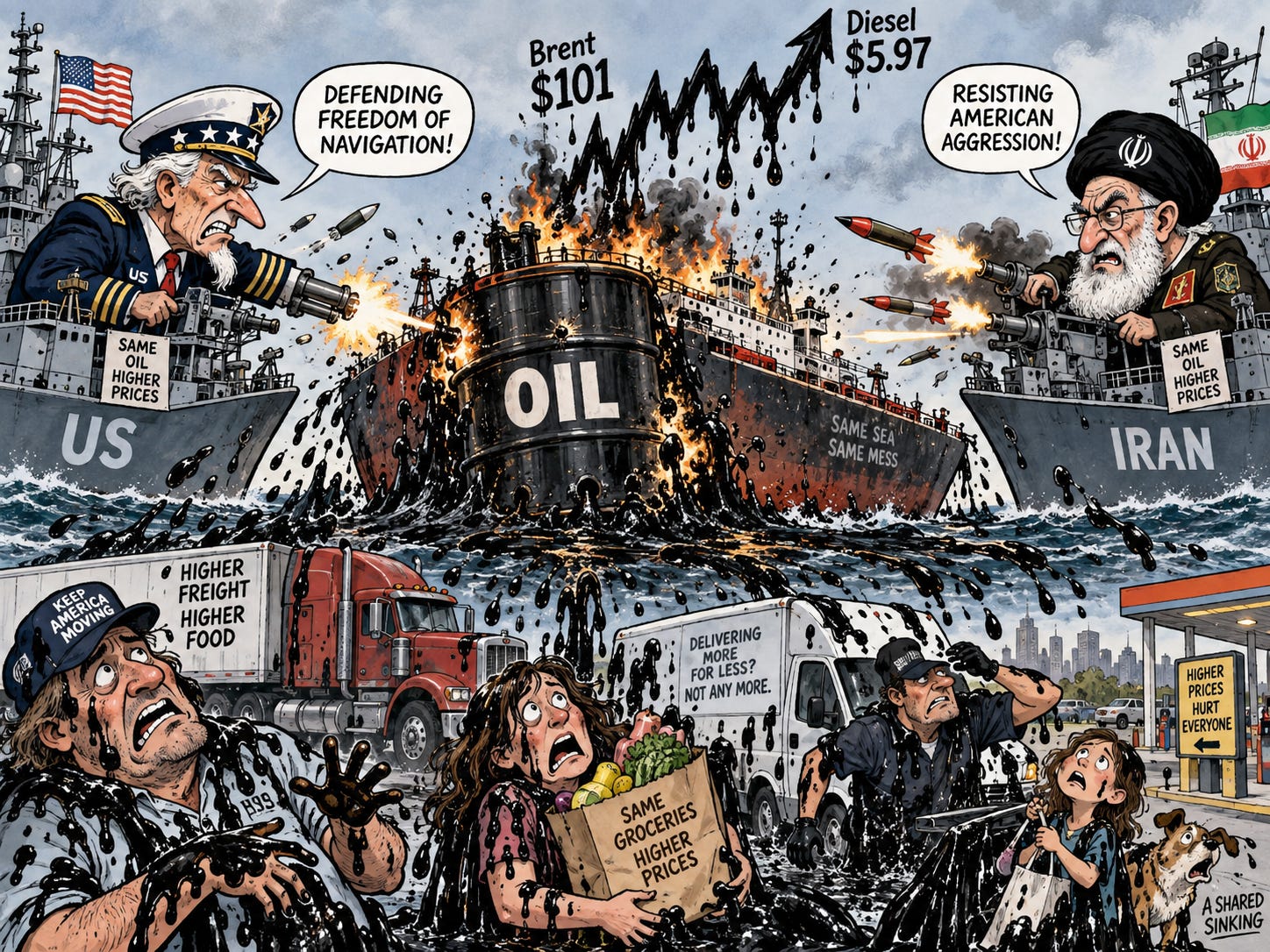
Brent crude settled at $101.21 on Wednesday, its first trip into triple digits since 24 July. It got there on the largest declared wave of attacks on shipping since the war began 6 months ago. The American military sank 5 Iranian oil tankers. Iran said it struck 10 ships in and around the Strait of Hormuz, including 2 US vessels, and fired a barrage of 20 ballistic missiles at an airbase used by American forces in Jordan. Jordan’s armed forces said 18 were intercepted and 2 landed in empty ground. WTI for November delivery rose 2.03% to $94.92. (The Japan Times)
Crude at $100 is a wholesale price. Diesel is where a household meets it. American on-highway diesel jumped 36.8 cents in the week to 7 September, to a national average of $5.97 a gallon. That is past the $5.81 record set in June 2022. Diesel moves almost everything that travels by road, so that figure arrives in food and freight costs with a lag of weeks. For 6 months each side attacked a different kind of target. Both are now sinking tankers, which means the war has found a currency and the exchange rate is the oil price. Brent was still holding above $100 on Thursday morning. (Forbes)
Sensei’s Insight: Look. Both sides are sinking the same kind of ship now, which means neither has an exit that looks like winning. I am watching whether Brent holds triple digits into next week’s votes, because that is the number the rate setters see.
🏷️ Today’s inflation number is mostly an oil number
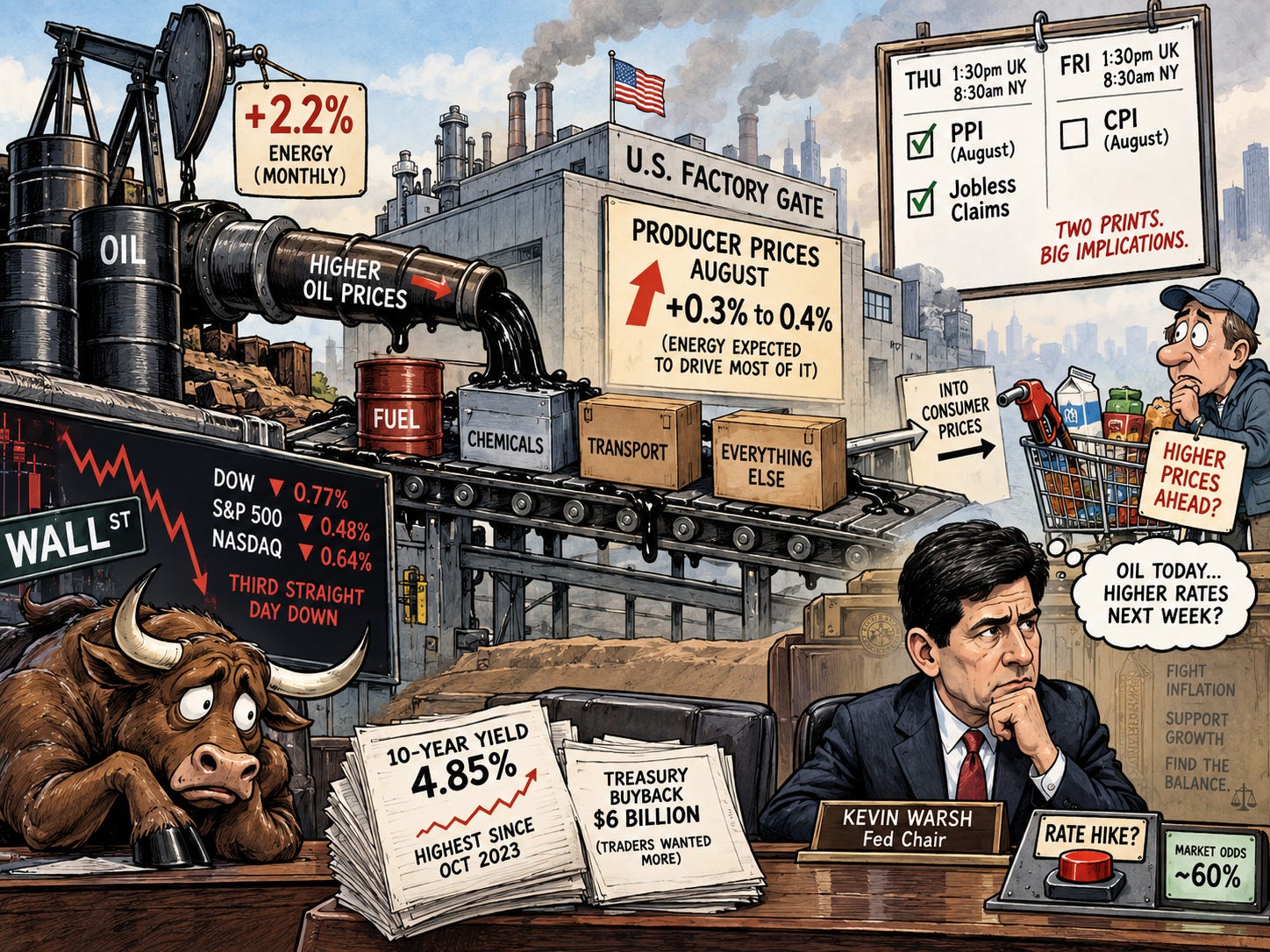
American producer prices for August publish at 1:30pm UK, which is 8:30am in New York. Forecasters look for a monthly rise of 0.3% to 0.4% after a flat July, and energy is expected to supply most of it. Some estimates put the August energy component up around 2.2% on the month, and the annual rate is expected to jump to about 5.3% from 4.7%. Producer prices measure what companies receive at the factory gate, so they are the earliest clean read on whether crude has entered the supply chain rather than sitting in the futures market. Consumer prices follow at the same time on Friday. Weekly jobless claims land in the same minute as the producer figure. (TradingKey)
Wall Street fell for a third straight session on Wednesday.
The Dow Jones Industrial Average dropped 405.41 points, 0.77%, to 52,380.66. The S&P 500 lost 0.48% to 7,636.36 and the Nasdaq Composite 0.64% to 26,253.34. The 10-year Treasury yield reached 4.85%, its highest since October 2023, and it got there on a day the Treasury was trying to hold yields down. Scott Bessent’s department said it would buy back up to $6 billion of longer-dated government debt, roughly triple a normal operation. Traders had looked for something nearer $10 billion, so yields climbed anyway. (Yahoo Finance)
Futures markets put the odds of a quarter-point rise at next Wednesday’s Federal Reserve vote at around 60%, with prediction markets running a few points below that. That leaves 2 prints in 2 days to settle it.
Sensei’s Insight: Numbers first, meaning second. Energy is carrying this print, and no central bank has ever drilled a well. Warsh has told us he reads the 6-month inflation run over the monthly noise, so that is the line I am checking.
🇪🇺 The ECB raises rates today and nobody disagrees
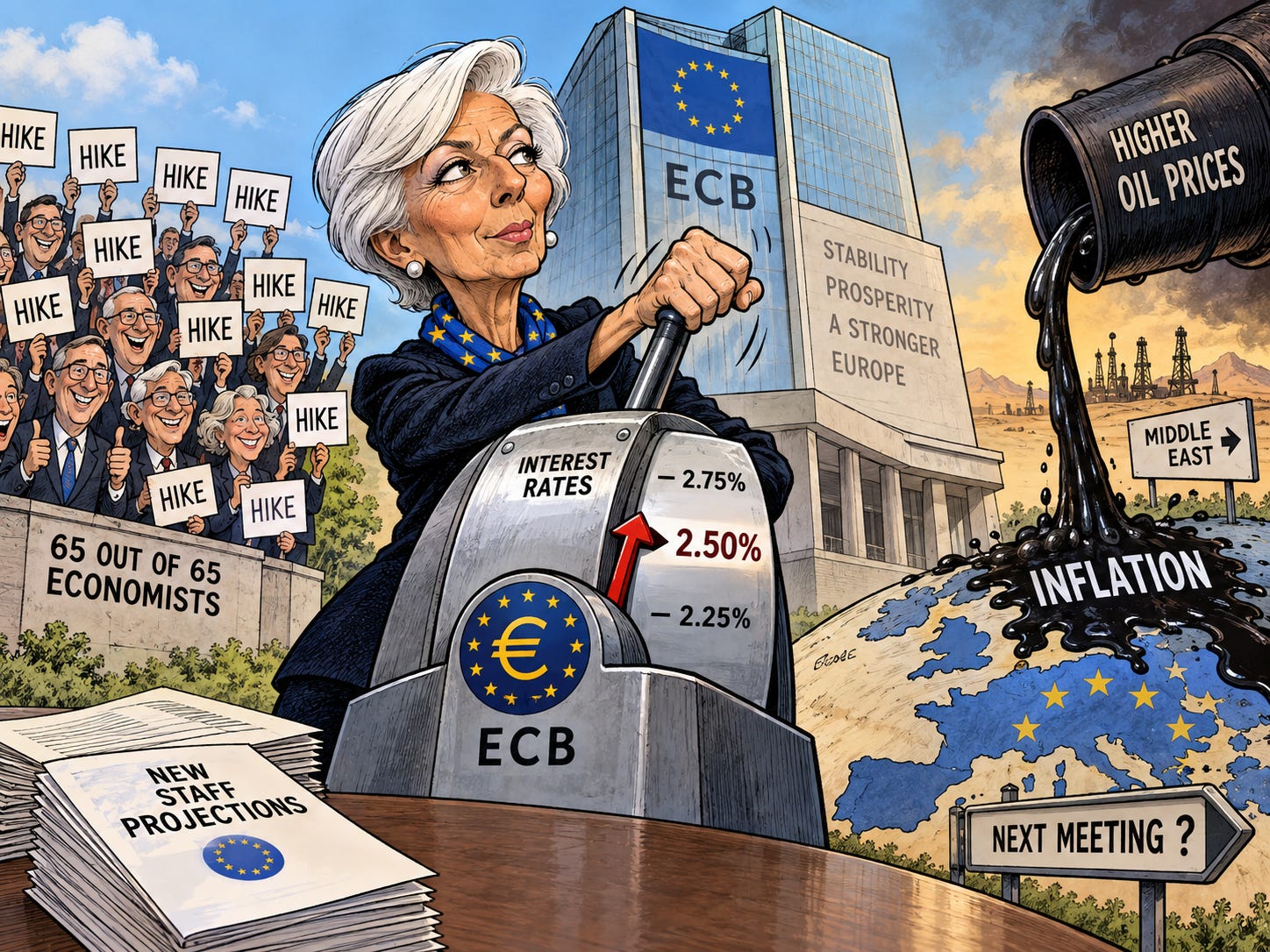
Every one of the 65 economists Reuters polled between 31 August and 3 September expects the European Central Bank to lift its deposit rate by a quarter point to 2.50%. The main refinancing rate goes to 2.65% with it. Money markets have the move fully priced. The decision comes at 1:15pm UK, which is 8:15am in New York, and Christine Lagarde takes questions 30 minutes after that. Euro area headline inflation ran at 3.3% in August with the energy component up 14.3%. The meeting is being held in Berlin, hosted by the Bundesbank. (FXStreet)
Analysts expect Lagarde to raise without guiding, repeating the meeting-by-meeting language rather than committing to a follow-up. New staff projections publish alongside the decision. The euro area imports almost all of its crude, so a Middle East price shock reaches European inflation faster and harder than it reaches American inflation. That is why Frankfurt has a unanimous forecast while Washington has a coin flip. European shares were slightly higher into the decision, with the STOXX 600 up 0.1% at 641.23 after tumbling 1.4% on Wednesday. This is the first of 4 central bank votes inside 9 days and the only one whose outcome is not in doubt. (Investing.com)
Sensei’s Insight: Now. 65 out of 65 is a rare thing in this job, and it tells you the communicating has already happened. What Lagarde says about the next meeting matters more than today’s quarter point, and the press conference is where that lands.
🇨🇳 A record gap opens between American and Chinese bonds
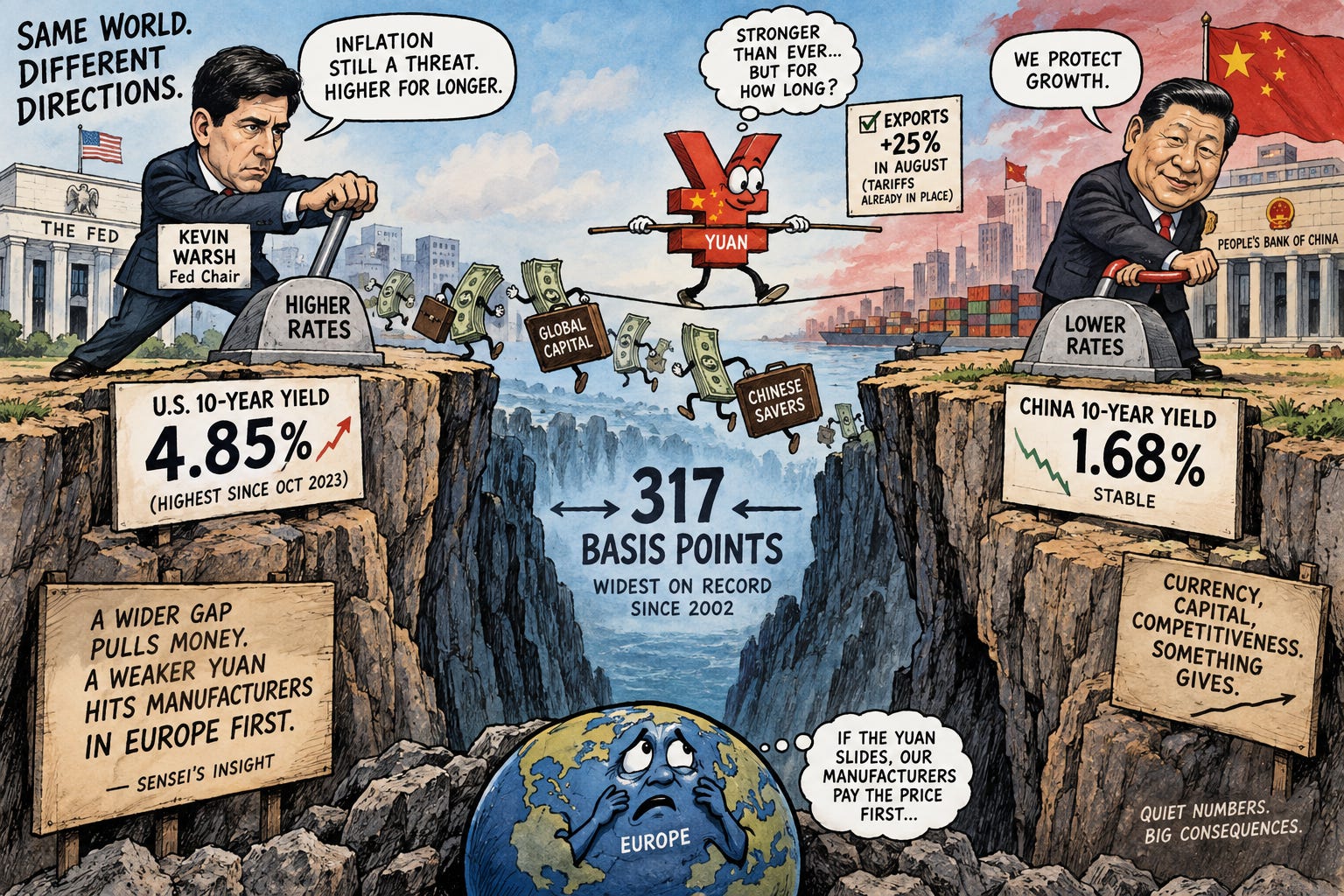
317 basis points. That is the gap between what the American government pays to borrow for 10 years and what China pays, and Bloomberg puts it at the widest in data going back to 2002. Basis points are hundredths of a percentage point, so 317 of them is 3.17%. The American 10-year reached 4.85% on Wednesday, its highest since October 2023. The Chinese 10-year sat at 1.68% and has barely moved. The 2 central banks are pointed in opposite directions, because the Federal Reserve is still leaning against inflation while the People’s Bank of China is protecting growth. (CRFB)
A gap that size is a pull on money. Capital drifts toward the higher yield, from foreign holders of Chinese bonds and from Chinese savers looking abroad, and that pressure lands on the currency. The yuan has been sitting near its strongest levels against the dollar in years, held up by exports that grew 25% in August with American tariffs already in place. Those 2 forces now point opposite ways, and the bond gap has never been this wide while the currency has been this strong. Which one gives first is the thing worth following. (Bloomberg)
Sensei’s Insight: Here’s the thing to watch. This is the quiet number in today’s edition and it moves more money than the loud ones. A sliding yuan gives every manufacturer that competes with China a pricing problem, and that reaches Europe long before it reaches America.
🤖 The AI buildout has moved into the bond market
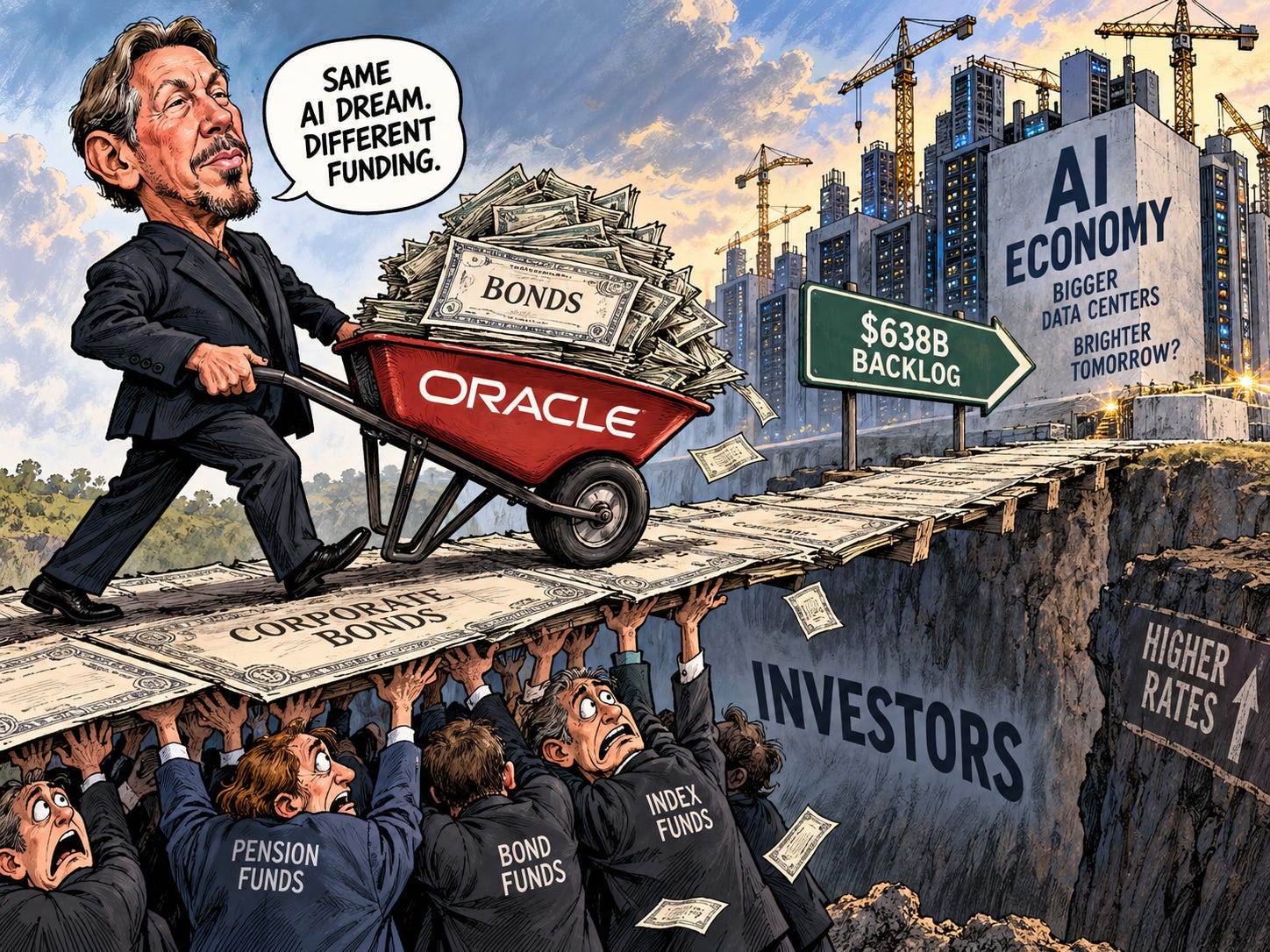
How much does it cost to build the AI economy? Oracle answers part of that after the American close today, with the call at 10pm UK, 5pm in New York. Analysts expect revenue of about $19.13 billion, up roughly 28% on the year. Backlog is the line the market actually trades. Remaining performance obligations, meaning work customers have contracted and Oracle has yet to deliver, ended the last quarter at $638 billion. That is up 363% year on year and up $85 billion in 3 months. Against that, the company has guided to a net capital spending outlay of around $70 billion this financial year. The shares closed at $162.52 on Wednesday and are down about 18% in 2026. (Oracle)
Paying for that requires borrowing, and the borrowing has grown large enough to change an index. Goldman Sachs Research counts nearly $500 billion of AI-related debt issued so far in 2026. AI-linked borrowers now make up roughly 30% of net new issuance in the American investment-grade corporate bond market. An ordinary corporate bond fund therefore holds a slice of the AI trade whether it went looking for one or not. The 5 largest cloud companies issued about $35 billion a year between 2020 and 2024, then $93 billion in 2025, and roughly $132 billion so far this year. All of it is priced off a 10-year yield that just touched 4.85%. (Goldman Sachs)
Sensei’s Insight: Essentially, the AI story stopped being an equity story this year and became a credit story. I am watching how much of that $638 billion backlog turns into delivered revenue this quarter, because contracted work only becomes cash when the machines are actually running.
Stories You Might Have Missed
📱 Apple’s foldable arrives at $1,999
Apple named its first foldable the iPhone Duo and priced it from $1,999, with a 2 terabyte configuration reaching around $3,000. The book-style handset carries an outer screen of 5.3 to 5.5 inches and an inner one of 7.6 to 7.8 inches in a titanium frame. Apple also lifted the iPhone 18 Pro by $100 against last year’s model. The shares opened at $315.49, spent almost the whole 80-minute presentation lower, and closed down 0.28%. Analysts put the flat response down to component costs, with memory prices climbing faster than the price rises cover. (Benzinga)
🇬🇧 Britain sells gilts into the worst yields since 1998
The Debt Management Office auctioned £5 billion of the 2030 gilt between 9am and 10am UK on Thursday, which is 4am to 5am in New York. It goes into a market where long-dated yields touched 5.89% in early September, the highest since 1998, and where the 10-year sits near 5.2%. Chancellor John Healey delivers his first Budget on 28 October with borrowing costs at those levels, which prices every spending line higher before he chooses a single policy. The Bank of England votes on 17 September and is widely expected to hold, with markets fully pricing a rise by December. (Investing.com)
🇯🇵 The yen nears a 7-month high before Japan votes
The yen traded around 153.38 per dollar on Thursday, close to its strongest in 7 months. The Bank of Japan votes on 18 September and is widely expected to lift its policy rate to 1.25%, which would be the highest in roughly 31 years. The Nikkei 225 eased 0.04% to 65,240 on Wednesday, because a stronger yen cuts the home-currency value of overseas earnings for Japanese exporters and makes Japanese shares dearer for foreign buyers. Japan has also been selling Treasuries this year to defend the currency, which is one of the forces pushing American long yields higher. (Trading Economics)
₿ Bitcoin holds near $78,000 as the Senate clock runs down
Bitcoin traded around $78,000 on Thursday morning after a soft session, and XRP sat at $1.38 against a 2.46% fall in the CoinDesk 20 index over 24 hours. The year has been hard across the board. Bitcoin is down 29% since January and is still the strongest of the 4 largest coins, with ether off 37%, solana 40% and XRP 47% from its January peak. The Senate holds a cloture vote on the CLARITY Act on 15 September. Cloture settles only whether debate opens on the bill and it needs 60 votes to carry, so it enacts nothing by itself. (CoinDesk)
🔩 The copper tariff trade unwinds
Copper miners fell hard after Reuters reported that the White House has not decided on tariffs for refined copper, with officials weighing higher costs for manufacturers against the case for more domestic mining. Affordability is the pressure point ahead of November’s midterms. Traders and industrial buyers had spent months shipping metal into the United States ahead of the expected duties, building one of the world’s largest stockpiles and driving copper to record highs. Freeport-McMoRan fell 7.11% and Southern Copper 6.34%. Broader copper tariffs would raise input costs for carmakers, construction and electrical equipment, which is the argument that has stalled them. (Reuters)