This content is for informational and educational purposes only and does not constitute financial advice. Always do your own research. Not financial advice (NFA).
👀 Today’s Stories at a Glance
🛢️ Oil Surges Above $100: Triple-digit prices spike gas costs and threaten global diesel supply.
📉 Bond Gains Erased: Oil-driven inflation pushed yields higher, wiping out yearly returns and delaying rate cuts.
🏦 Revolut Wins UK License: This approval protects UK deposits and clears a path for American expansion.
🚢 Gulf Shipping Attacks Spread: New strikes in Iraq and Oman make the region risky for exports.
🇨🇳 China Halts Fuel Exports: Beijing ordered refiners to cancel shipments, prioritizing domestic supply as markets tighten.
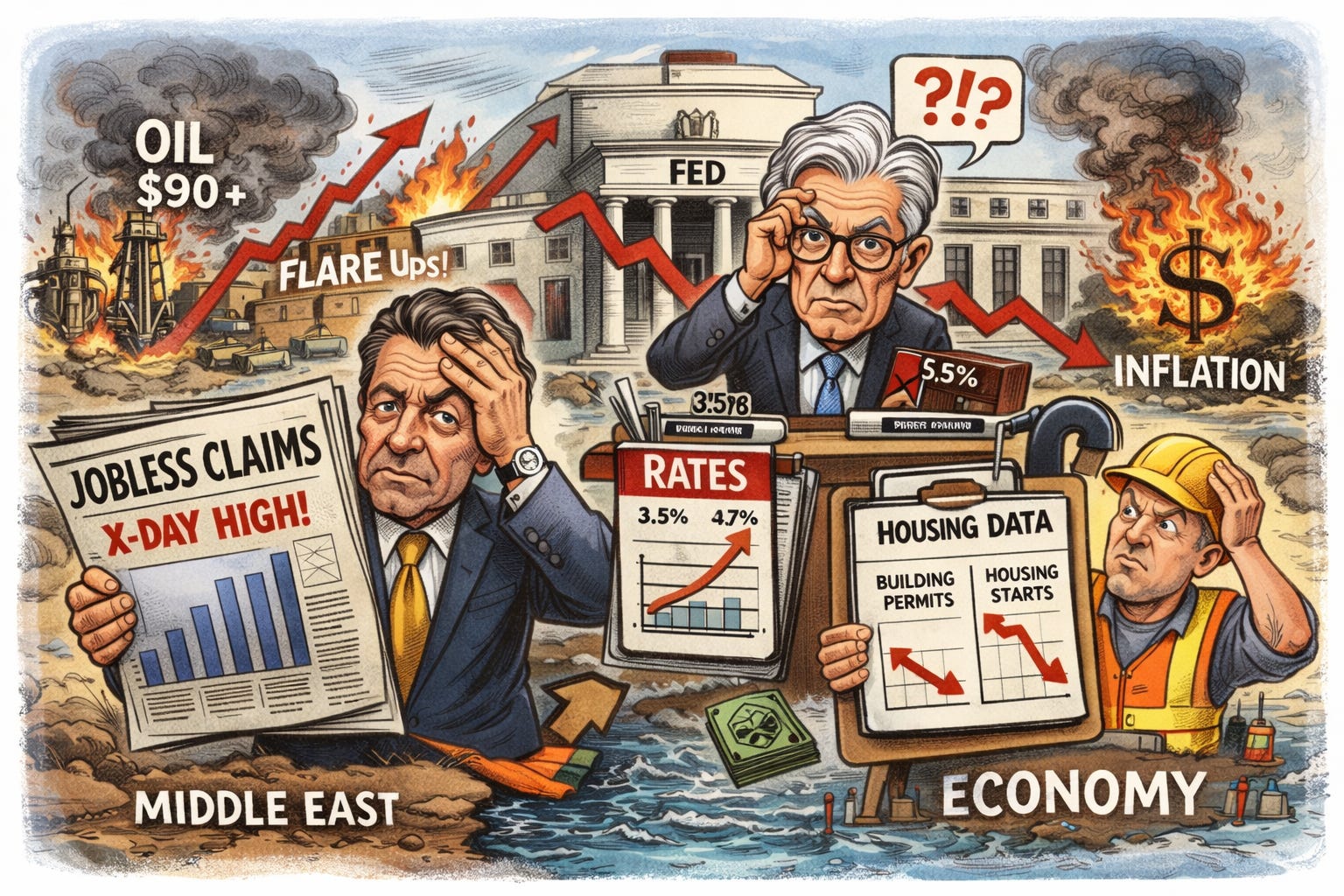
🔍 Economic Data Cheat Sheet: Critical jobless and housing reports will signal if the economy is cracking.
🧠 One Big Thing
The Energy Trap
Global energy markets are entering a historic supply crisis as oil surpasses $100 again despite record strategic reserve releases. The conflict has expanded beyond the Strait of Hormuz to hit regional refining hubs and secondary ports. This escalation transforms a simple crude spike into a structural shortage of critical finished fuels like diesel. As a result, the traditional bond market hedge has failed because inflation concerns now outweigh the typical flight to safety. Investors must navigate a Federal Reserve currently trapped between a cooling labor market and rising energy costs. These conditions effectively remove the prospect of immediate interest rate relief.
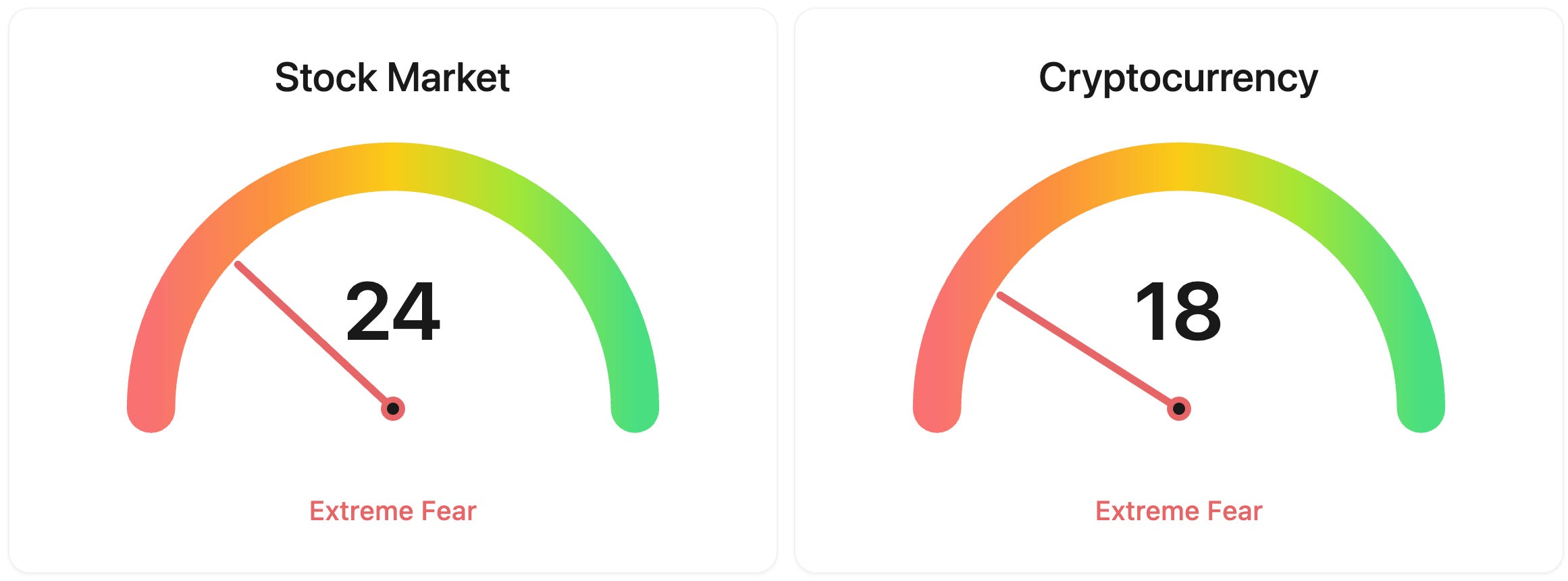
⚖️ Fear & Greed
📉 The Number That Matters
4 MILLION
The Middle East has lost 4 million barrels per day of refining capacity due to the Strait of Hormuz closure. This disrupts the global supply of finished fuels like diesel and jet fuel, beyond just raw crude production.
⚔️ Winners vs Losers
Winners
BMBL 0.00%↑: Bumble Inc. surged after Q4 revenue of $248.2 million beat estimates by 12%, and Q1 2026 guidance of $244 million at the midpoint came in nearly 16% above analyst expectations, signaling stronger momentum than the Street anticipated from the dating app’s turnaround plan.
CDXS 0.00%↑: Codexis, Inc. rallied after reporting Q4 EPS of $0.11, crushing the $0.01 consensus, with revenue jumping 81% year over year to $38.9 million driven by a $37.8 million technology transfer agreement with Merck. The company guided 2026 revenue to $72 million to $76 million.
LWLG 0.00%↑: Lightwave Logic, Inc. climbed after announcing a development agreement with Tower Semiconductor to integrate its electro-optic polymer modulator designs into Tower’s PH18 silicon photonics platform, targeting 110GHz+ bandwidth for 400G per lane data center applications.
WOOF 0.00%↑: Petco Health and Wellness Company, Inc. jumped after Q4 adjusted EBITDA came in well above its own outlook and fiscal 2026 EBITDA guidance of $415 million to $430 million topped analyst estimates, as the retailer enters what management called the growth phase of its turnaround.
FLY 0.00%↑: Firefly Aerospace Inc. gained after the successful launch of Alpha Flight 7 from Vandenberg Space Force Base, completing orbital insertion, delivering a demonstrator payload for Lockheed Martin, and validating key Block II upgrades including a new in-house avionics suite.
Losers
NTSK 0.00%↑: Netskope, Inc. fell despite reporting strong Q4 results with ARR up 31% to $811 million and revenue up 32% to $196.3 million. The sell-off was driven by a lock-up expiration making roughly 390 million shares eligible for sale, widening GAAP operating losses, and cautious forward guidance citing macro headwinds.
📊 Market Snapshot
Cryptocurrencies:
Bitcoin (BTC): $70,492 (▲ 0.43%)
Ethereum (ETH): $2,071 (▲ 0.95%)
XRP: $1.39 (▲ 0.38%)
Equity Indices (Futures):
S&P 500: $6,738 (▼ -0.38%)
NASDAQ 100: $24,887 (▼ -0.39%)
FTSE 100: £10,301 (▼ -0.37%)
Commodities & Bonds:
10-Year US Treasury Yield: 4.23% (▲ 0.00%)
Oil (WTI): $91 (▲ 3.46%)
Gold: $5,182 (▲ 0.11%)
Silver: $86.90 (▲ 1.37%)
Data as of: UK (GMT/BST) 11:09 / US (EST/EDT): 07:09 / Asia (Tokyo): 20:09
✅ 5 Things to Know Today
🛢️ Oil Blasts Past $100 as the War Hits Your Wallet
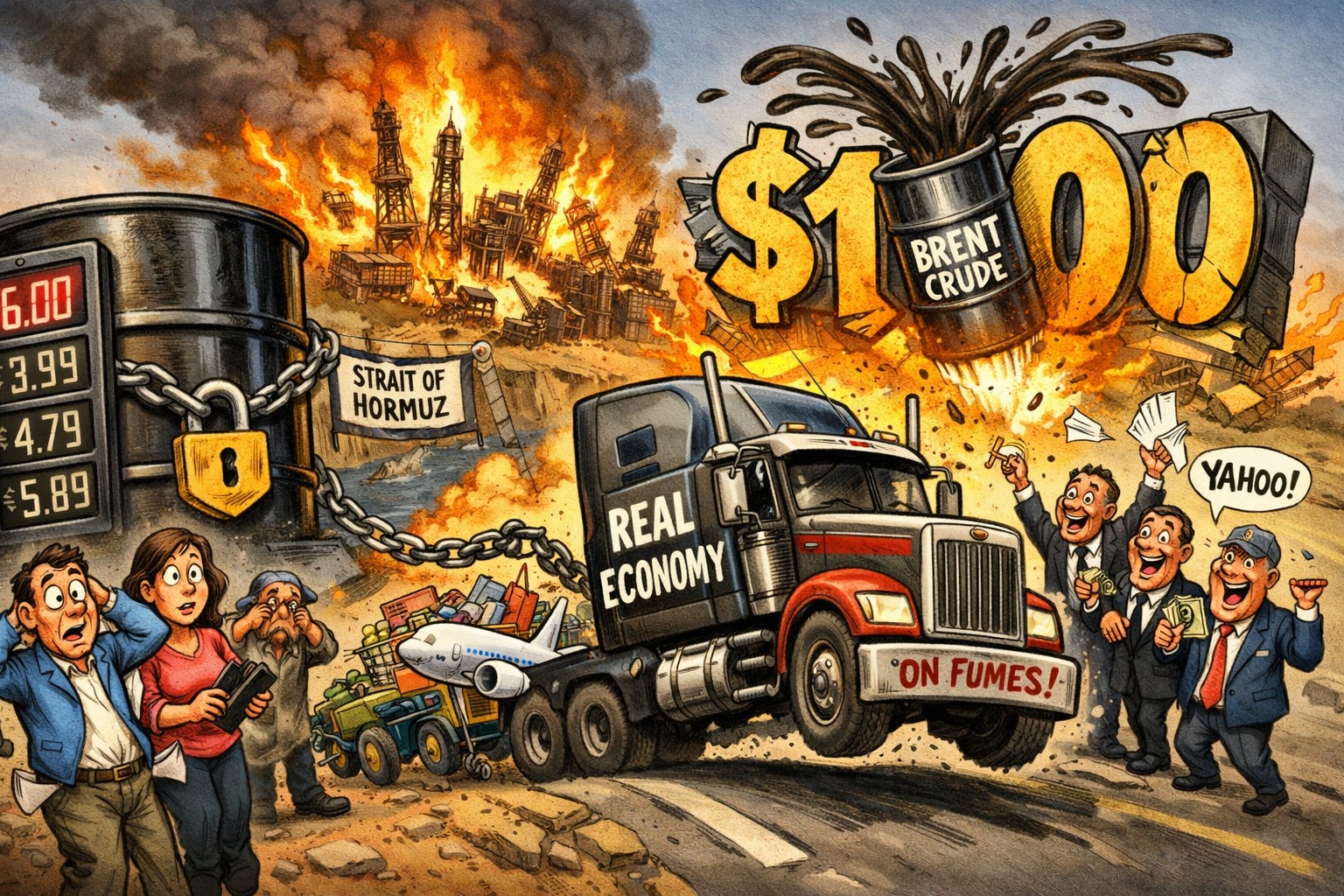
Brent crude surged as much as 10% today, briefly touching $101.59 a barrel during Asian trading and holding above triple digits for the first time since 2022. The move came despite the International Energy Agency’s (IEA) record 400 million barrel reserve release announced yesterday, which the market shrugged off almost immediately. Goldman Sachs raised its fourth quarter Brent forecast and warned that if flows through the Strait of Hormuz remain depressed through March, daily prices could exceed the 2008 all-time high of $147.50. The futures market is flashing extreme stress: the gap between the two nearest Brent contracts blew out to more than $4.50, up from just 61 cents a month ago, a signal that physical buyers are scrambling for any available supply (Bloomberg).
The price spike is now landing directly in household budgets. Average US retail gasoline hit $3.58 per gallon this week according to the American Automobile Association (AAA), up 20% from $2.98 before the war began. Diesel is approaching the $5 per gallon mark last breached in 2022, a threshold that matters far beyond the pump because diesel powers the trucks, tractors, and construction equipment that move the real economy. Airlines are passing costs through too. Cathay Pacific announced today it will double its passenger fuel surcharge from March 18, and carriers from India to Sweden are following suit. More than 46,000 flights have been cancelled across the Middle East region since February 28, and the flights still operating are burning more fuel on longer routes as they avoid Iranian and Russian airspace (CNBC).
The IEA’s own monthly report today declared this the largest supply disruption in the history of the global oil market, with 7.5% of world supply knocked out and an estimated 8 million barrels per day lost in March. The agency also slashed its 2026 demand growth forecast by roughly 25% to 640,000 barrels per day, the lowest figure since the IEA began forecasting this year, suggesting it already sees meaningful economic damage. Critically, 4 million barrels per day of regional refining capacity has been jeopardised by the Strait of Hormuz closure, which means the Middle East is losing the ability to produce not just crude oil but the finished fuels, like diesel and jet fuel, that the world actually uses.
Sensei’s Insight: Goldman’s $147 warning grabs the headlines, but the number to watch is diesel. Crude can spike and retreat. A diesel shortage feeds into the cost of every physical good that moves by road, rail, or sea, and the loss of 4 million barrels of Gulf refining capacity means this is not a problem more drilling can solve.
📉 Global Bonds Wipe Out All 2026 Gains as the Oil Shock Breaks the Playbook
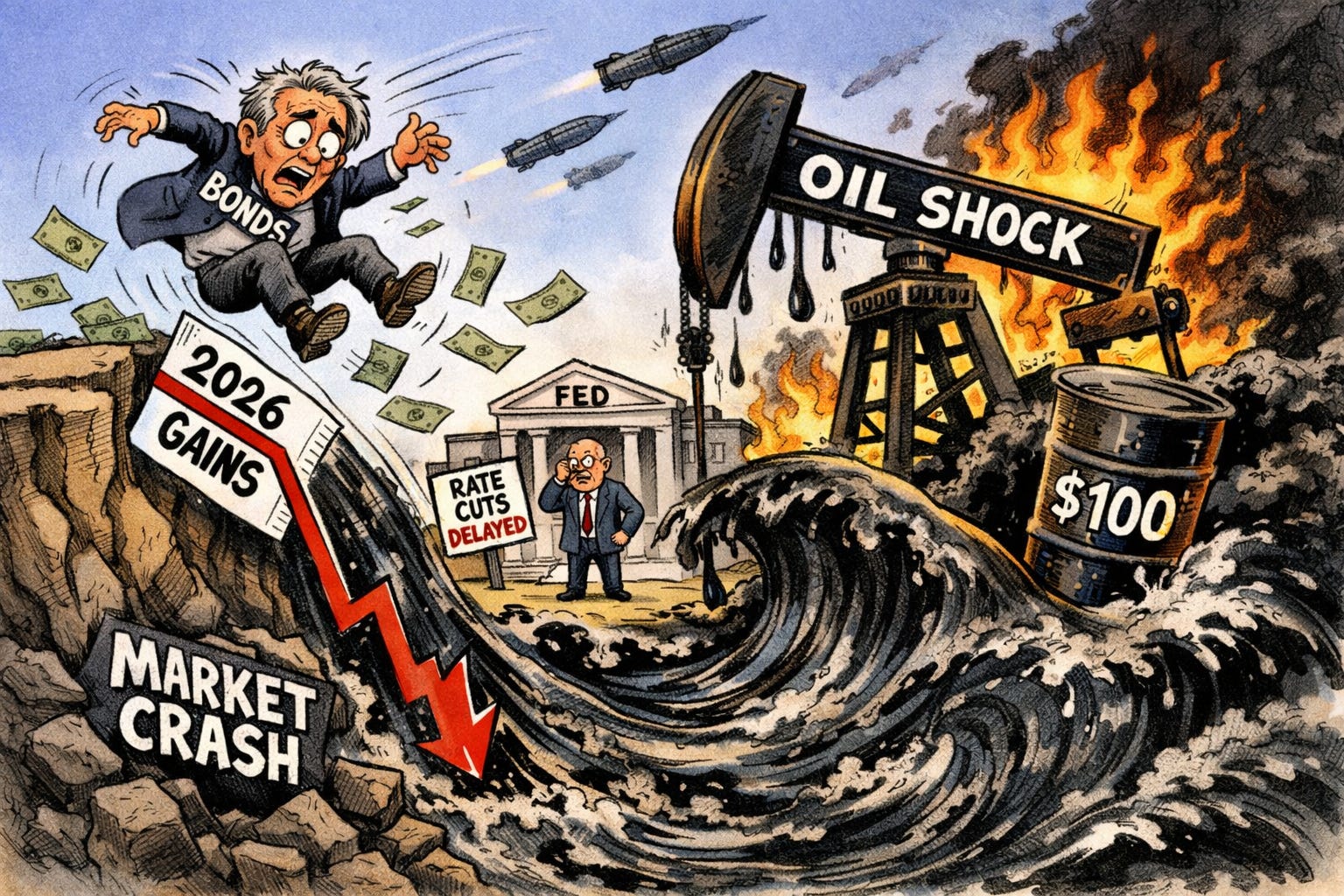
The Bloomberg Global Aggregate Index, which tracks total returns from investment-grade government and corporate bonds worldwide, has gone flat for the year. It had been up as much as 2.1% through February 27, the day before the war began. That entire gain has been erased in under two weeks. US Treasury yields climbed to five-week highs today as oil pushed back above $100, and Germany’s 10-year bund yield hit its highest level since 2023. What makes this selloff unusual is that the traditional “flight to safety” into government bonds during a war has not materialised. The inflationary impact of the oil shock is outweighing the safe-haven bid, meaning bonds are losing on both sides of the equation (Bloomberg).
The IEA’s record reserve release was supposed to be the calming hand on the market. It has been anything but. The 400 million barrels sounds enormous, and it is by historical standards, roughly seven times larger than the 2022 Ukraine response. But the maths does not work. The US portion of 172 million barrels over 120 days delivers roughly 1.43 million barrels per day. Global daily consumption runs at about 103 million barrels. Citigroup estimates each day the Strait of Hormuz stays closed costs between 11 and 16 million barrels of lost supply. As one commodities manager put it, the sheer size of the release may have spooked investors rather than reassured them, because it signals the IEA believes the disruption could last far longer than markets had assumed. Prices surged on the day the release was announced, not the reaction anyone planned for (Reuters).
Goldman Sachs economists pushed back their forecast for the next Federal Reserve rate cut from June to September, arguing that a higher inflation path makes it harder for the Fed to ease anytime soon. The Fed is widely expected to hold rates steady at next week’s meeting with traders pricing in a 99% chance of no change. Meanwhile, the stress is spreading into less liquid corners of finance. Morgan Stanley and Cliffwater LLC capped withdrawals from some of their private credit funds this week after a surge in redemption requests. Private credit funds invest in loans that are not traded on public markets, making them harder to exit quickly. Withdrawal caps can create a negative feedback loop where investors in similar funds rush to redeem before they get locked out too. Emerging market assets are also under pressure, with the MSCI Asia-Pacific index falling roughly 1.8% today and the Philippine peso leading losses among Asian currencies as fuel-importing nations bear the brunt.
Sensei’s Insight: The Fed is caught between two fires. February's payrolls fell by 92,000 jobs, screaming for rate cuts. Oil above $100 screams the opposite. Goldman pushing the first cut to September means both sides of the economy, borrowers and savers, stay under pressure with no relief in sight.
🏦 Revolut Finally Wins Its UK Banking License

Revolut secured a full UK banking license yesterday from the Prudential Regulation Authority (PRA), the Bank of England’s regulatory arm, ending a process that began in 2021. The $75 billion fintech company can now operate as a fully licensed bank in its home market, offering lending products to its 13 million UK customers and bringing their deposits under the Financial Services Compensation Scheme (FSCS), which protects up to £120,000 per person if a bank fails. Previously, Revolut’s UK customers sat within a less-regulated electronic money license with no deposit protection. The company entered a restricted “mobilisation phase” in July 2024, which took significantly longer than the standard timeline because no company of Revolut’s size had gone through the process before (Bloomberg).
The license unlocks far more than lending in Britain. Chief Executive Nik Storonsky had publicly said the drawn-out UK process was blocking Revolut’s applications for authorisation in other countries. The company applied for a US banking charter from the Office of the Comptroller of the Currency (OCC) earlier this month, and clearing the UK hurdle removes a significant obstacle to American expansion, Revolut’s largest growth opportunity. The company has announced plans to invest £10 billion across its global operations over the next five years, launch in 30 new markets by 2030, and is still weighing a stock market listing that would rank among the largest European tech offerings in years (CNBC).
Sensei’s Insight: The real prize is the US banking license. Getting the UK done was a prerequisite, not the destination. If Revolut secures a US charter, it enters the most profitable consumer banking market in the world. For incumbent UK banks, the lending threat is real but gradual. For Revolut’s eventual IPO valuation, the US story is what moves the needle.
🚢 Shipping Attacks Spread Across the Gulf as the War's Footprint Widens
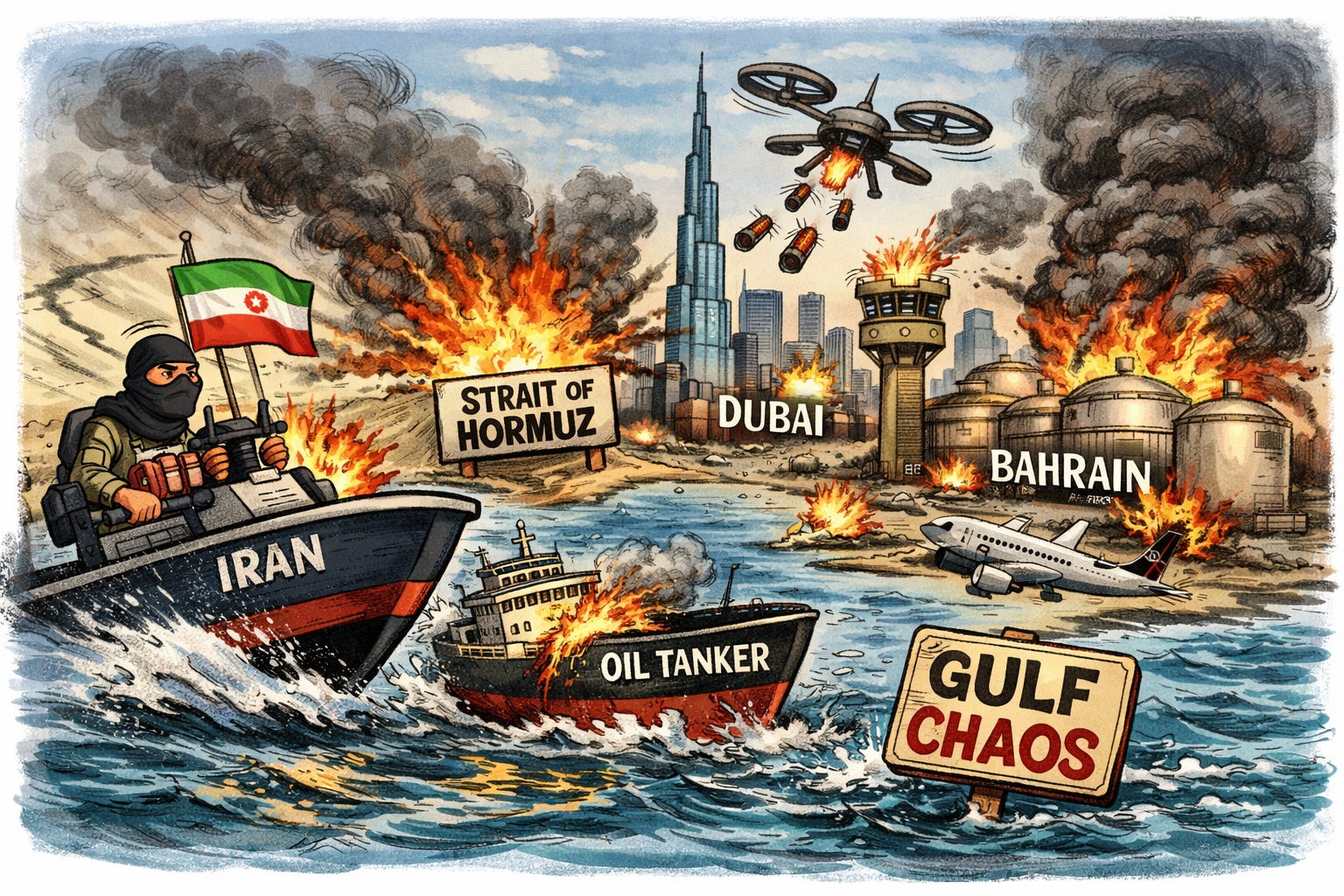
The geography of the crisis expanded significantly today. Two oil tankers were attacked in Iraqi territorial waters, prompting Iraq to suspend operations at its oil terminals. The vessels, the Marshall Islands-flagged Safesea Vishnu and the Malta-flagged Zefyros, were struck by Iranian explosive-laden boats. Separately, Oman evacuated all vessels from the Mina Al Fahal oil terminal as a precautionary measure. This is significant because Mina Al Fahal sits outside the Strait of Hormuz and handles roughly 1 million barrels per day of Omani exports, making it one of the last functioning exit routes for Middle Eastern crude. The port was reopened after several hours, but the precedent has been set: even ports that were considered safe alternatives to the strait are now vulnerable (Bloomberg).
Iran has simultaneously broadened its strikes across multiple Gulf states, with military operations increasingly reaching into densely populated areas. In Dubai, drones struck buildings in Creek Harbour, the Al Bada’a district, and on Sheikh Zayed Road, one of the city’s main arteries. Goldman Sachs and Citigroup both told their Dubai staff to stay away from offices, and Citibank closed its UAE branches through March 14. This followed Iran’s joint military command declaring banks and financial institutions as legitimate targets. In Kuwait, drones hit the international airport causing material damage, and shrapnel from interceptions damaged six overhead power lines. In Bahrain, fuel tanks at the Muharraq facility were struck, leading APM Terminals to suspend port operations at Khalifa Bin Salman Port through March 13.
The pattern is clear: Iran is pursuing a strategy designed to make the entire Persian Gulf region too risky for commercial operations, not just the Strait of Hormuz itself. This changes the market’s risk calculation fundamentally. Until this week, investors were pricing in a Hormuz disruption with workarounds via alternative ports. That assumption is breaking down. Oman crude, one of only two grades still eligible for setting the Middle East’s Dubai price benchmark after varieties loading from within the Gulf were excluded last week, was trading at around $132 a barrel today, a roughly $32 to $36 premium over Brent that reflects the scarcity of oil that can actually be loaded and shipped.
Sensei’s Insight: The Oman crude premium over Brent tells you something the headline price does not. At $132 versus roughly $96 to $100 for Brent, the market is saying that the ability to physically move oil is now worth more than the oil itself. That premium could widen further if attacks on non-Hormuz ports continue.
🇨🇳 China Orders Refiners to Cancel Fuel Export Cargoes
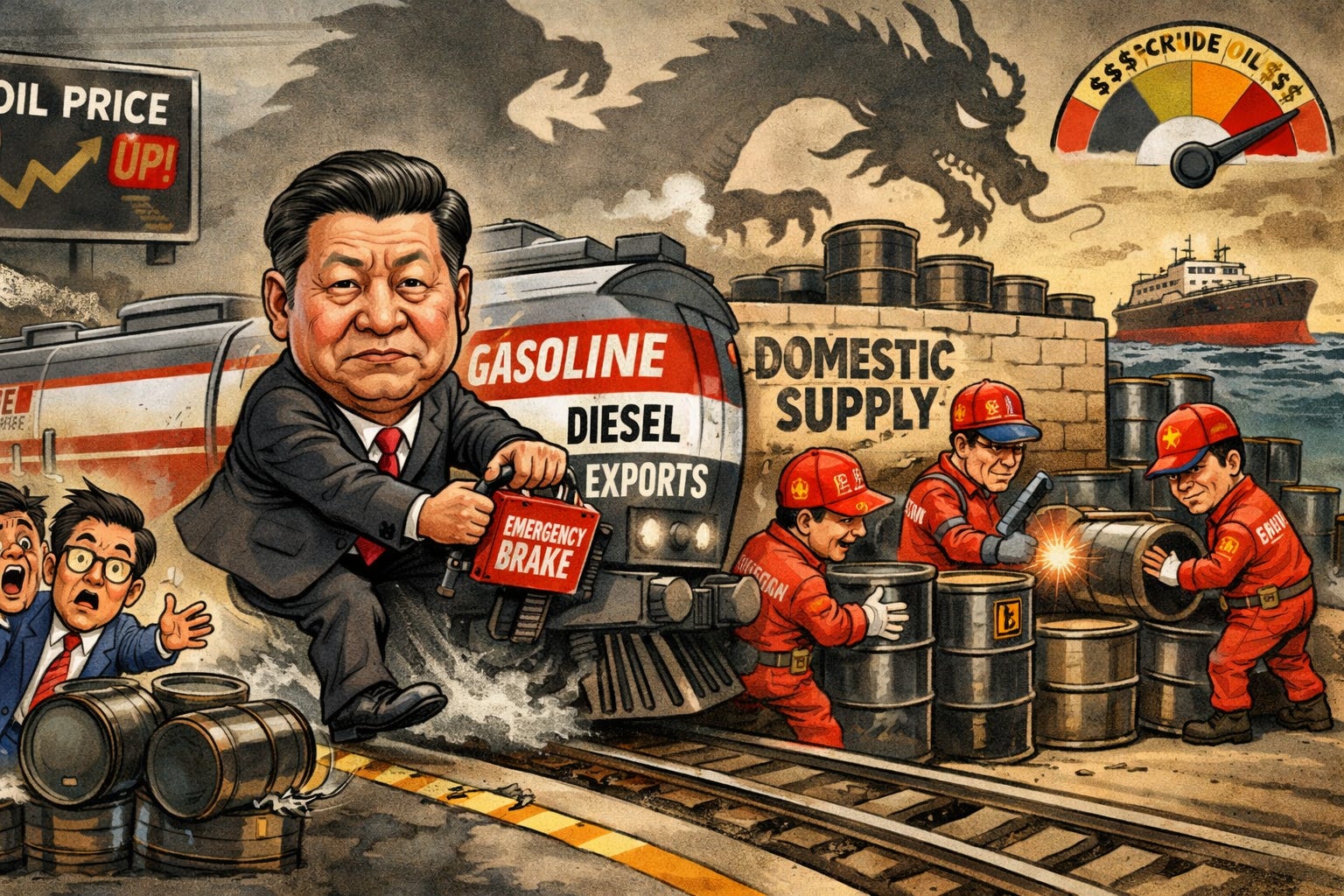
Beijing has ordered its largest oil refiners to cancel already-agreed export shipments of gasoline and diesel, escalating an earlier directive that stopped short of mandatory cancellations. The National Development and Reform Commission (NDRC), China’s top economic planner, instructed PetroChina, Sinopec, CNOOC, Sinochem, and Zhejiang Petrochemical to halt outbound fuel cargoes, with exceptions only for international jet fuel refuelling and supplies to Hong Kong and Macau. China ranks as Asia’s third-largest fuel exporter behind South Korea and Singapore, and its vast refining sector primarily serves domestic demand. But even as a relatively small exporter, the decision signals that Beijing is prioritising domestic supply security over export revenue, a sign of genuine concern about the duration and severity of the disruption (Bloomberg).
The impact is likely to show from April onwards, since most March cargoes have already been fixed. But for the Asia-Pacific fuel market, this removes a supply buffer that importing nations were counting on. At least two Chinese refineries, Zhejiang Petrochemical and Sinopec’s Fujian plant, have already begun reducing throughput this month as the cost of crude climbs. Combined with the IEA’s warning about 4 million barrels per day of Gulf refining capacity being knocked out, the loss of Chinese fuel exports adds another layer to a tightening global diesel and gasoline picture. Wholesale diesel prices in China have already jumped 13.5% since the war began.
Sensei’s Insight: When the world’s largest oil importer starts hoarding fuel, it tells you something about how long Beijing expects this crisis to last. China does not make moves like this for a disruption it thinks will end in days.
🔗 Connect with Us
Stay plugged in across platforms:
Sensei on X: sensei_live_
Martyn Lucas on X: MartynInvestor
Vaz on X: eVTOLHUB
📺 YouTube Channel (Live & Replays): Martyn Lucas Investor

🔍Deep Dive: JOBLESS CLAIMS + HOUSING DATA CHEAT SHEET