

This content is for informational and educational purposes only and does not constitute financial advice. Always do your own research. Not financial advice (NFA).
👀 Today’s Stories at a Glance
🏛️ A Fed hawk either side of the print: Beth Hammack speaks fifteen minutes before the July PPI lands, and Tom Barkin ten minutes after.
💻 Cisco beats everything and falls anyway: Record revenue of $17.3 billion and $9.3 billion of AI orders, yet the shares dropped after hours.
🧠 Cerebras raises its forecast, drops 17%: A record $209.9 million quarter came with a loss of $2.98 a share against 18 cents expected.
🛢️ Oil’s six-day run ends: Brent slipped towards $88 after Trump claimed total control of Hormuz and Iran refused to reopen the waterway.
🇬🇧 Britain grows 0.4% through a war: Second-quarter output slowed from 0.6%, though the annual rate picked up to 1.2% from 0.9%.
🍔 Peltz moves on Wendy’s: The shares jumped as much as 15% and were halted, on a take-private bid expected within weeks.
💾 Intel raises $20 billion, not $15 billion: The chipmaker upsized its share sale and priced it at $95, diluting earnings by about 5%.
🔧 The AI order book reports tonight: Applied Materials is seen at about $9 billion of revenue, with advanced packaging guided up 50%.
₿ Bitcoin slips under $64,000: XRP holds the $1 line it has defended since November 2024, with futures bets at a ten-month high.
📄 PPI is the number that comes next: The PPI Day Cheat Sheet covers every outcome, the component guesses and the lines that feed the Fed’s target.
🧠 One Big Thing
Two of the biggest names in AI hardware reported last night, and both shares fell. Cisco had its best quarter on record. Cerebras raised its forecast for the whole year. Nothing was wrong with either set of numbers, but both shares had already run a long way, so a good quarter was exactly what people were already paying for. That is worth knowing whatever you own, because it is now true of most of the AI trade. Applied Materials reports tonight into the same setup, so watch what it does on a beat.
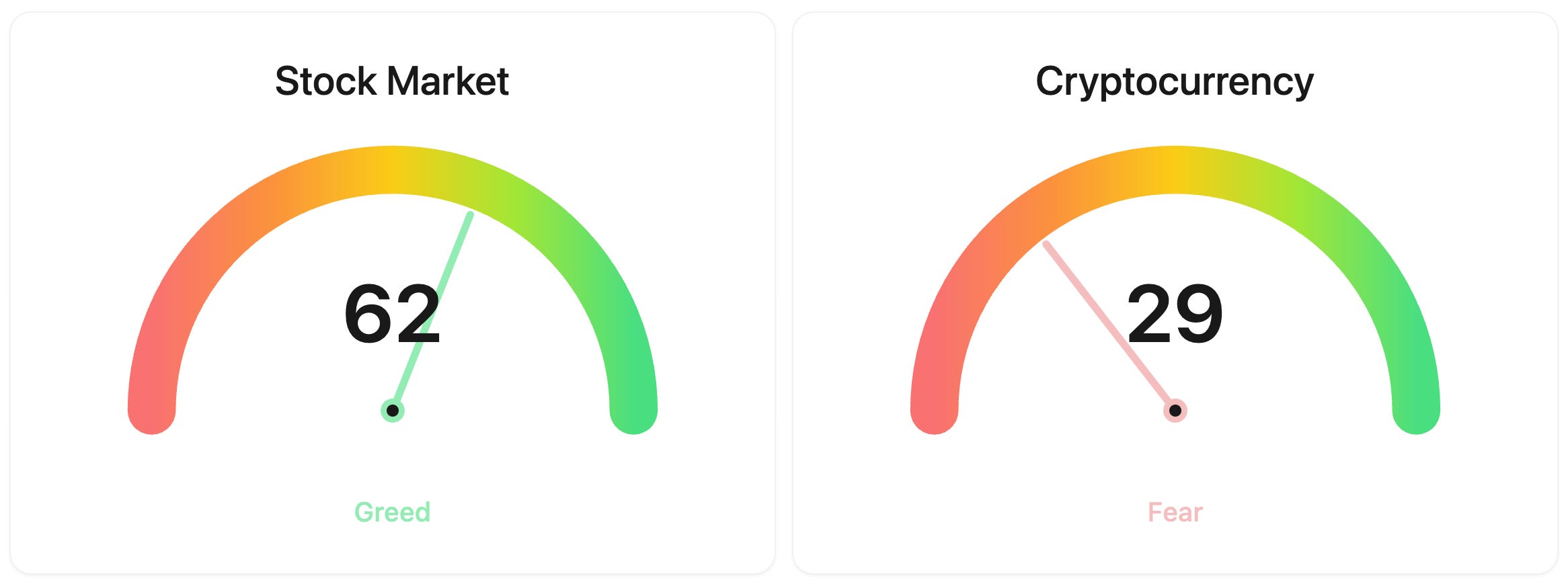
⚖️ Fear & Greed
📉 The Number That Matters
4.683%
The Treasury sold $42 billion of ten-year notes yesterday at 4.683%, the highest yield any ten-year auction has cleared since 2007, and it sells thirty-year bonds this evening.
⚔️ Winners vs Losers
Winners
ARX 0.00%↑ : +43.57% Accelerant Holdings soared after the specialty insurance risk exchange operator released its second quarter results ahead of the opening bell, its first report since a run of enhanced partnership announcements with Lloyd’s of London, Incline P&C and Hippo Holdings. The stock went into the print roughly 60% below its 52 week high, leaving room for an outsized reaction.
CURI 0.00%↑ : +33.57% CuriosityStream Inc. jumped after posting record second quarter results with revenue up 22% year on year and licensing revenue up 48%, and raising full year 2026 guidance while declaring a third quarter dividend of 8.5 cents per share.
HLIT 0.00%↑ : +24.25% Harmonic Inc. rallied after second quarter broadband solutions revenue came in ahead of analyst expectations, prompting an upward revision to its annual forecast in the first full quarter following the June sale of its video business.
OMER 0.00%↑ : +19.11% Omeros Corporation climbed after second quarter results highlighted commercial sales momentum for newly approved YARTEMLEA alongside debt reduction and share repurchases.
DELL 0.00%↑ : +4.11% Dell Technologies Inc. extended a near 10% regular session gain, driven by Super Micro Computer’s fiscal 2027 revenue guidance of 65 to 72 billion against a 52.5 billion consensus and CoreWeave’s expanded backlog, both read as confirmation that AI server demand behind Dell’s own record backlog remains intact.
Losers
OTLK 0.00%↑ : -23.24% Outlook Therapeutics, Inc. slid after pricing a public offering of 55.6 million shares and accompanying warrants for gross proceeds of about 55 million, at a combined price of 99 cents, days ahead of its August 17 Nasdaq minimum bid price compliance deadline.
STUB 0.00%↑ : -19.32% StubHub Holdings, Inc. dropped after second quarter profit came in near breakeven against Street expectations for a clear profit, overshadowing record revenue of 573.1 million and gross merchandise sales up 34% to 3.1 billion. Management raised full year gross merchandise sales guidance but left adjusted EBITDA guidance unchanged.
CBRS 0.00%↑ : -18.55% Cerebras Systems Inc. fell after core revenue of 180 million missed the 194 million analysts expected, with a decline in the hardware business overshadowing raised full year revenue guidance and a remaining performance obligation of 25.4 billion.
📊 Market Snapshot
Cryptocurrencies:
Bitcoin (BTC): $63,541 (▲0.19%)
Ethereum (ETH): $1,881 (▲0.14%)
XRP: $1.01 (▲0.15%)
Equity Indices (Futures):
S&P 500: 7,784 (▲0.17%)
NASDAQ 100: 29,875 (▲0.07%)
FTSE 100: 10,793 (▼0.49%)
Commodities & Bonds:
10-Year US Treasury Yield: 4.67% (▼0.38%)
Oil (WTI): $82 (▼1.25%)
Gold: $4,389 (▼0.43%)
Silver: $64.91 (▼0.59%)
Data as of: UK: 11:41 BST / US: 06:41 EDT / Asia (Tokyo): 19:41 JST
✅ 5 Things to Know
🏛️ Two hawks speak, minutes after producer prices
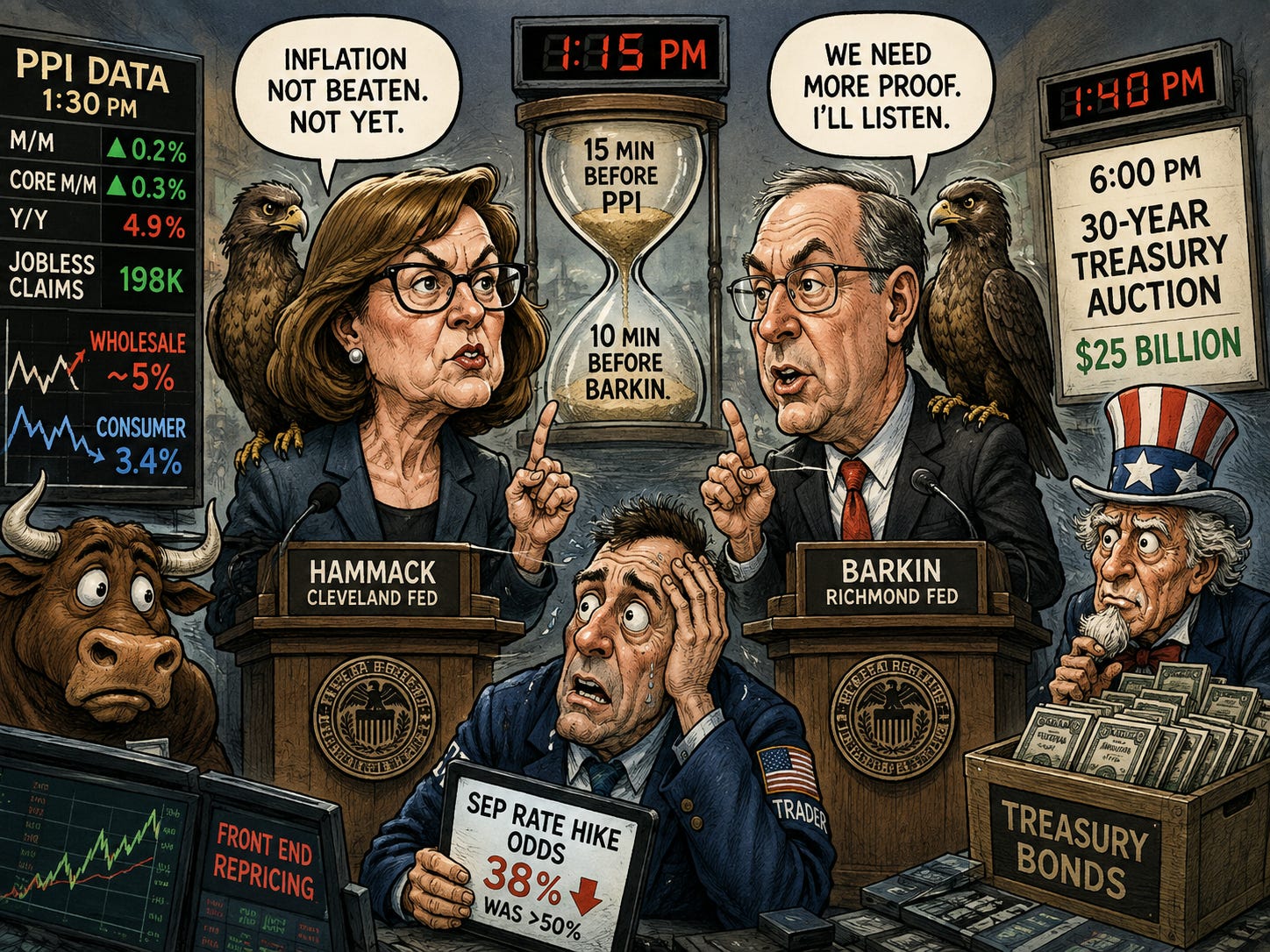
Producer prices for July land at half past one this afternoon, and economists expect a rise of 0.2% on the month after a fall of 0.3% in June, with the core measure seen at 0.3% and the annual rate cooling to 4.9% from 5.5%. The release tracks what factories and wholesalers charge each other, so it works as an early warning for what consumers pay later. It arrives fifteen minutes after Beth Hammack of the Cleveland Fed starts speaking, and ten minutes before Tom Barkin of Richmond follows her. Hammack was one of three officials who voted to raise rates in July, and she votes again in September. Weekly jobless claims land at the same moment, with 198,000 expected against 199,000 last week (CNBC).
Yesterday’s consumer prices did the market a favour. Headline inflation rose 0.1% on the month and eased to 3.4% on the year, core came in at 0.2% and 2.5%, and traders cut the odds of a September rate rise into the high 30s from above 50% earlier in the week. The S&P 500 added 0.26% to close at 7,749. Producer prices can undo some of that, because wholesale inflation is still running near 5% while the consumer measure sits at 3.4%, and that gap closes either by warehouse prices falling or by shop prices catching up. The bond market gives its own verdict at six this evening, when the Treasury sells $25 billion of thirty-year bonds, a day after its ten-year sale cleared at 4.683% (Yahoo Finance).
Sensei’s Insight: Hammack does not need to say anything new for this to move. The market has spent a fortnight guessing what the hawks think. If she sounds unmoved by a soft print, the September trade comes straight back and the front end reprices.
💻 Cisco beats every number and falls anyway
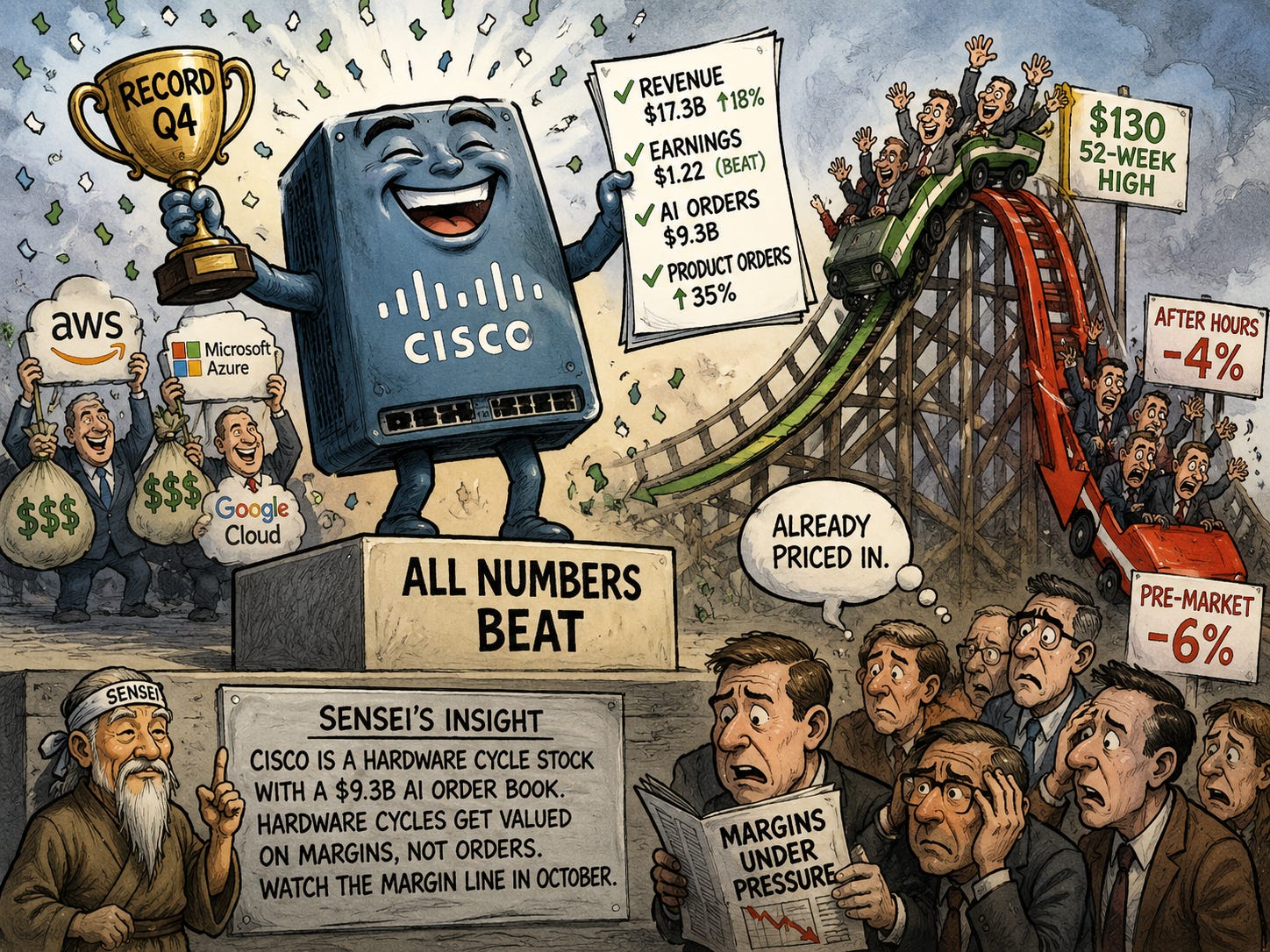
Cisco reported record quarterly revenue of $17.3 billion, up 18% on a year earlier, and adjusted earnings of $1.22 a share against the $1.13 analysts expected, both above the top of its own guidance range. Orders for AI infrastructure from the largest cloud companies reached $9.3 billion across the financial year, roughly four and a half times the prior year, with about $4 billion of that booked in the final quarter alone. Total product orders rose 35%. The company guided to revenue of $72.2 billion to $73.4 billion for the year ahead (Yahoo Finance).
The shares fell anyway. Cisco closed the regular session up 2.9% at $123.95, near the top of a 52-week range running from $65.75 to $130.37, then dropped more than 4% after the close once management flagged that gross margins face pressure from a heavier hardware mix. The shares were down about 6% ahead of the open this morning. That is the whole reaction in one line: a stock up around 60% this year has already been paid for a good quarter, so the next buyer needs something more. Selling more physical boxes and proportionally less software is exactly how an AI hardware boom turns up in a networking company’s margins.
Sensei’s Insight: Cisco spent a decade being the boring one. It is now a hardware cycle stock carrying a $9.3 billion AI order book, and hardware cycles get valued on margins rather than on orders. That margin line is what I am watching in October.
🧠 Cerebras raises its forecast and drops 17%
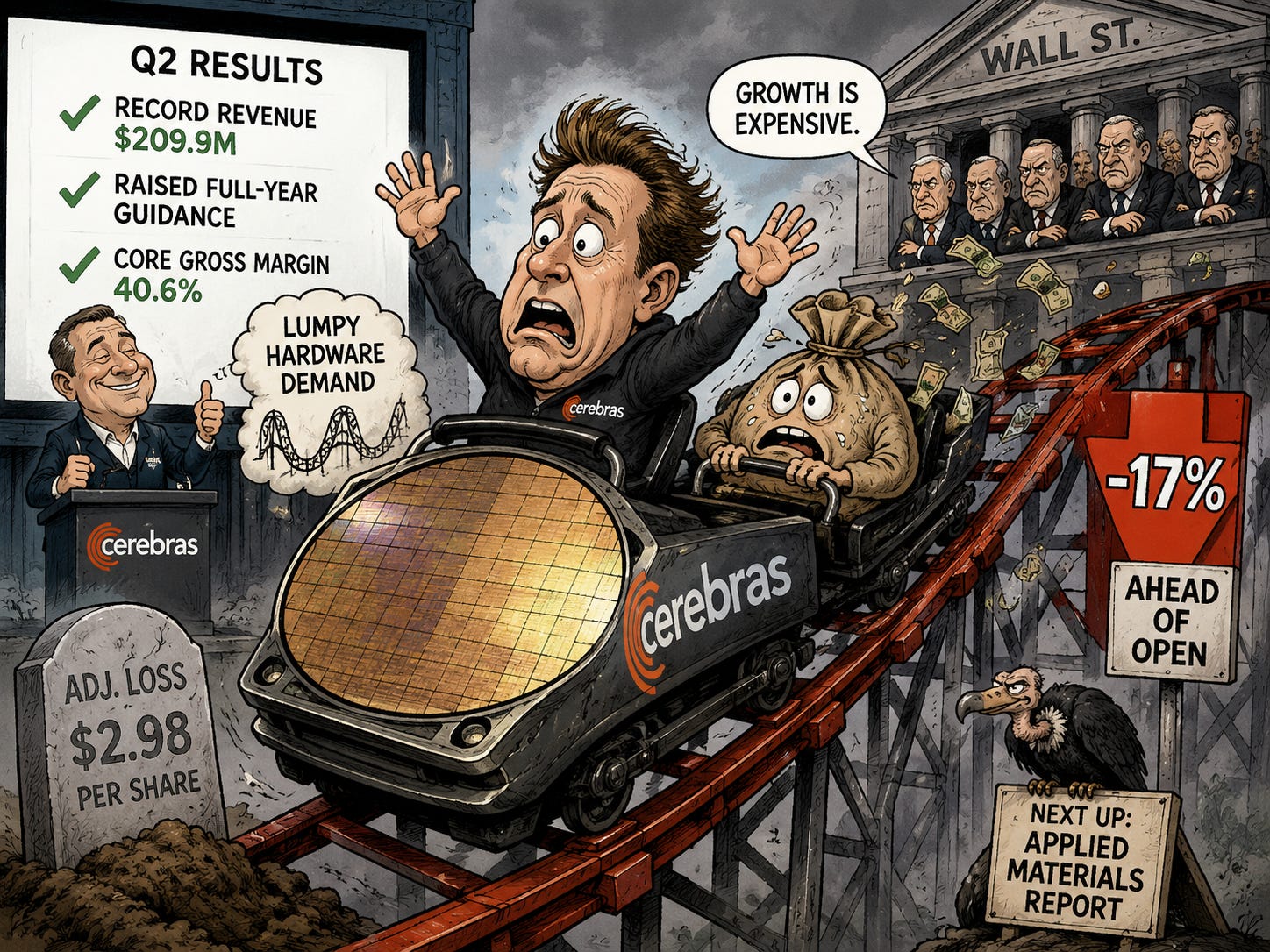
Cerebras Systems reported record quarterly core revenue of $209.9 million, more than double a year earlier, and lifted its full-year core revenue forecast to between $880 million and $890 million from $855 million to $865 million. Core gross margin improved to 40.6%, a gain of 9.4 percentage points on the year. It also posted an adjusted loss of $2.98 a share against the 18 cents analysts had modelled, and its hardware business shrank on what management described as lumpy demand. The stock closed up 11.5% at $261.76, fell about 16% after hours, and was down more than 17% ahead of the open this morning (CNBC).
This is only the second set of results since Cerebras listed, and the second time the market has treated its growth as expensive rather than impressive. The company sells wafer-scale processors, single chips roughly the size of a dinner plate, into a market where Nvidia sets the terms, and its revenue arrives in a handful of large deals rather than a steady flow. That is what lumpy means in practice, and it is why one soft quarter of hardware sales reads as a warning rather than noise. Applied Materials reports tonight and offers a cleaner read on whether the underlying equipment orders are still growing (Bloomberg).
Sensei’s Insight: Raising guidance and still falling tells you the loss did the damage, not the demand. A company burning close to three dollars a share every quarter has to fund that somewhere, and Intel has just shown the market what raising the money looks like.
🛢️ Oil’s six-day run ends as Hormuz talks harden

Brent crude fell about 1.2% to just under $88 a barrel, snapping a six-session advance that had carried it above $89. The move followed a hardening of positions over the Strait of Hormuz, which has been effectively shut since Iran attacked commercial shipping in the Gulf earlier this year. Trump said the United States had total control of the waterway and repeated a demand for reparations from Tehran as a condition for talks. Iran rejected the claim outright and said the strait stays closed until Washington changes its behaviour (Bloomberg).
The International Energy Agency now expects the global oil market to run a shortfall of 1.8 million barrels a day this quarter, and the emergency release of 400 million barrels agreed in March, the largest in the agency’s fifty-year history, replaced only a fraction of what the closure removed. The link for readers runs straight back to the Fed. Energy is why three officials voted to raise rates in July, and yesterday’s inflation figures covered a month when petrol was cheaper. The oil price building now shows up in the August print, published in September, days before the Fed meets (CNBC).
Sensei’s Insight: Every leg of this has been headline driven and every dip has been bought back. Until a deal is signed rather than briefed, I am treating rallies on optimism as noise. The only thing that settles it is tankers moving again.
🇬🇧 Britain grows 0.4% through a war

The UK economy expanded 0.4% in the second quarter, matching what economists expected and slowing from 0.6% in the first. Services did the work with growth of 0.5%, construction added 0.3%, and production output was flat. On the year the economy grew 1.2%, up from 0.9% in the first quarter, so the annual picture improved even as the quarterly pace eased. June was stronger than the quarter as a whole, which hands the third quarter a better starting point than the headline number suggests (Bloomberg).
The context makes it more interesting than the figure. This covers the first full quarter of the Iran war, with energy prices climbing and the Strait of Hormuz closed, and the economy still grew. That leaves the Bank of England with a version of the Fed’s problem: activity holding up while imported energy costs push inflation the wrong way. Sterling and gilts take more of their direction from this release than from any other domestic number this month, and the next set of UK inflation figures will be read against it.
Sensei’s Insight: Growth of 0.4% in a quarter with a closed shipping lane and crude near $90 is a better result than it reads. The risk here is not the growth number. It is energy keeping British inflation elevated while the pace slows.
Stories You Might Have Missed
🍔 Peltz prepares a bid for Wendy’s
Wendy’s shares jumped as much as 15% and were briefly halted for volatility after reports that Nelson Peltz’s Trian Fund Management is assembling a group of investors to take the burger chain private. A regulatory filing puts Trian’s stake at 7.85% and Peltz’s personal holding at 16.24%, and the consortium may include BlueFive Capital and Flynn Group, one of the longest-serving franchisees in the system. A bid is expected within weeks, though the timing could move. Wendy’s said it would review any proposal in line with its fiduciary duties. The chain carries a market value of about $1.44 billion after a long stretch of weak demand and a change of leadership (Forbes).
💾 Intel takes $20 billion instead of $15 billion
Intel priced 210.5 million shares at $95 each, raising $20 billion after upsizing a deal originally announced at $15 billion, with underwriters holding a thirty-day option that could carry the total beyond $23 billion. Net proceeds come to roughly $19.7 billion, earmarked for general corporate purposes including capital spending. Bank of America put the dilution at about 5% of earnings per share, while arguing the size of the raise signals confidence in demand rather than distress. It follows a year in which the US government took a 10% stake in the company, and it ranks among the largest equity sales any chipmaker has done during the AI build-out (CNBC).
🔧 The AI order book reports tonight
Applied Materials publishes third-quarter results after the US close, having guided to revenue of $8.95 billion give or take $500 million, with analysts modelling about $9 billion, up 23% on a year earlier, and earnings of $3.39 a share. The company sells the machines that make chips, so its order book runs ahead of almost everyone else’s revenue. Management expects leading-edge logic, DRAM and advanced packaging to drive more than 80% of the growth in wafer fabrication equipment spending this calendar year, and has guided its advanced packaging business to grow 50% to 60%. The shares sit about 27% below their peak (CNBC).
₿ Bitcoin slips under $64,000 as XRP defends $1
Bitcoin traded near $63,500 in the hours after the inflation report, about 1.6% below the session high it set before the release, with US spot Bitcoin ETFs recording roughly $61 million of net outflows. XRP held at about $1.01, a line it has defended since November 2024, and sits around 14% below its July peak of $1.18. Open interest in XRP futures reached its highest level since October, which historically points to a larger move once the market picks a direction rather than to the direction itself (CoinDesk).