

This content is for informational and educational purposes only and does not constitute financial advice. Always do your own research. Not financial advice (NFA).
👀 Today’s Stories at a Glance
🇰🇷 Seoul halts trading: The Kospi fell 7.57% and stopped trading for 20 minutes, its seventh straight fall and 21% in 7 sessions.
🏛️ Hot print, no rush: Core US inflation rose 0.3% against 0.2% expected, and 2 Fed officials said they want more data first.
🏭 TSMC guides higher again: TSMC’s quarterly profit rose 69% to a record $23.59 billion, and it guided fourth-quarter sales about 14% higher.
🚢 A box ship sinks: The container ship GFS Pride sank in the Strait of Hormuz as Iran struck 4 vessels within hours.
🤖 Anthropic’s $16.8 billion quarter: Anthropic told investors its quarterly revenue hit $16.8 billion with an adjusted profit, ahead of a planned IPO.
🇬🇧 UK economy beats forecasts: Britain’s economy grew 0.1% in August, against a 0.1% fall expected, helped by a 1.2% rise in manufacturing.
🏦 Morgan Stanley’s IPO money: Wealth clients brought in $232.4 billion of new assets, and just over half was tied to IPO flows.
🪙 Bitcoin slips under $81,000: US bitcoin ETFs lost $261.4 million on Wednesday as hotter inflation hit crypto prices.
🔍 The Pipeline Print: A second hot reading after CPI would make an October rate rise likely, and our Cheat Sheet shows what to watch.
📈 Silver back at $54.53 support: Chart of the Day covers the $54.53 shelf, the broken $61.11 line and the $49.78 zone below.
🧠 One Big Thing
Wednesday’s US inflation figure made money dearer, and the stocks most reliant on borrowed money took the hit overnight. Core prices rose 0.3% in September against 0.2% expected. Chip stocks fell 4.3% in New York, and Seoul’s market fell 7.57% on Thursday. The Fed’s own officials called the number bad and said they want more data before moving. The next piece of that data lands at 1:30pm UK today, which is 8:30am in New York: producer prices, which feed the Fed’s own inflation gauge. A second hot reading would put a rate rise on 28 October firmly on the table.
⚖️ Fear & Greed

📉 The Number That Matters
21%
South Korea’s Kospi has fallen 21% in 7 straight sessions, after a 7.57% drop on Thursday that halted trading for 20 minutes.
⚔️ Winners vs Losers
🟢 Top Gainers
No major winners today.
🔴 Top Losers
RKLB 0.00%↑ : -9.33% Rocket Lab Corporation fell after pushing the debut launch of its Neutron rocket from Q4 2026 into 2027 because of manufacturing issues. The news came after Wednesday’s close and extends a six-day slide that has wiped around 21% off the stock.
SKHY 0.00%↑ : -6.63% SK hynix Inc. sank after its Seoul shares closed 11% lower in a Kospi rout that tripped circuit breakers. Hot US inflation data, AI funding worries and reports of HBM4 equipment delivery delays drove the selling.
BE 0.00%↑ : -4.74% Bloom Energy Corporation extended Wednesday’s 9% drop as a hot inflation print and firm oil prices revived fears that higher-for-longer rates will slow data centre financing.
STX 0.00%↑ : -4.42% Seagate Technology Holdings led storage names lower alongside Western Digital (-4.31%) and Sandisk (-4.16%) as the week’s memory rout deepened. China’s ChangXin DRAM breakthrough and hotter-than-expected US inflation are driving investors out of one of 2026’s most crowded AI trades.
NBIS 0.00%↑ : -4.04% Nebius Group N.V. extended Wednesday’s 10% slide as AI cloud names sold off on debt worries, with peer CoreWeave plunging more than 15% as its rising debt load came into focus.
DELL 0.00%↑ : -3.79% Dell Technologies Inc. extended Wednesday’s 11% plunge after Barclays cut the stock to Equal Weight. The bank cited a stretched valuation after a 300%-plus rally this year and slower growth as memory-driven pricing normalises.
✅ 5 Things to Know
🇰🇷 Seoul halted trading as the chip sell-off spread
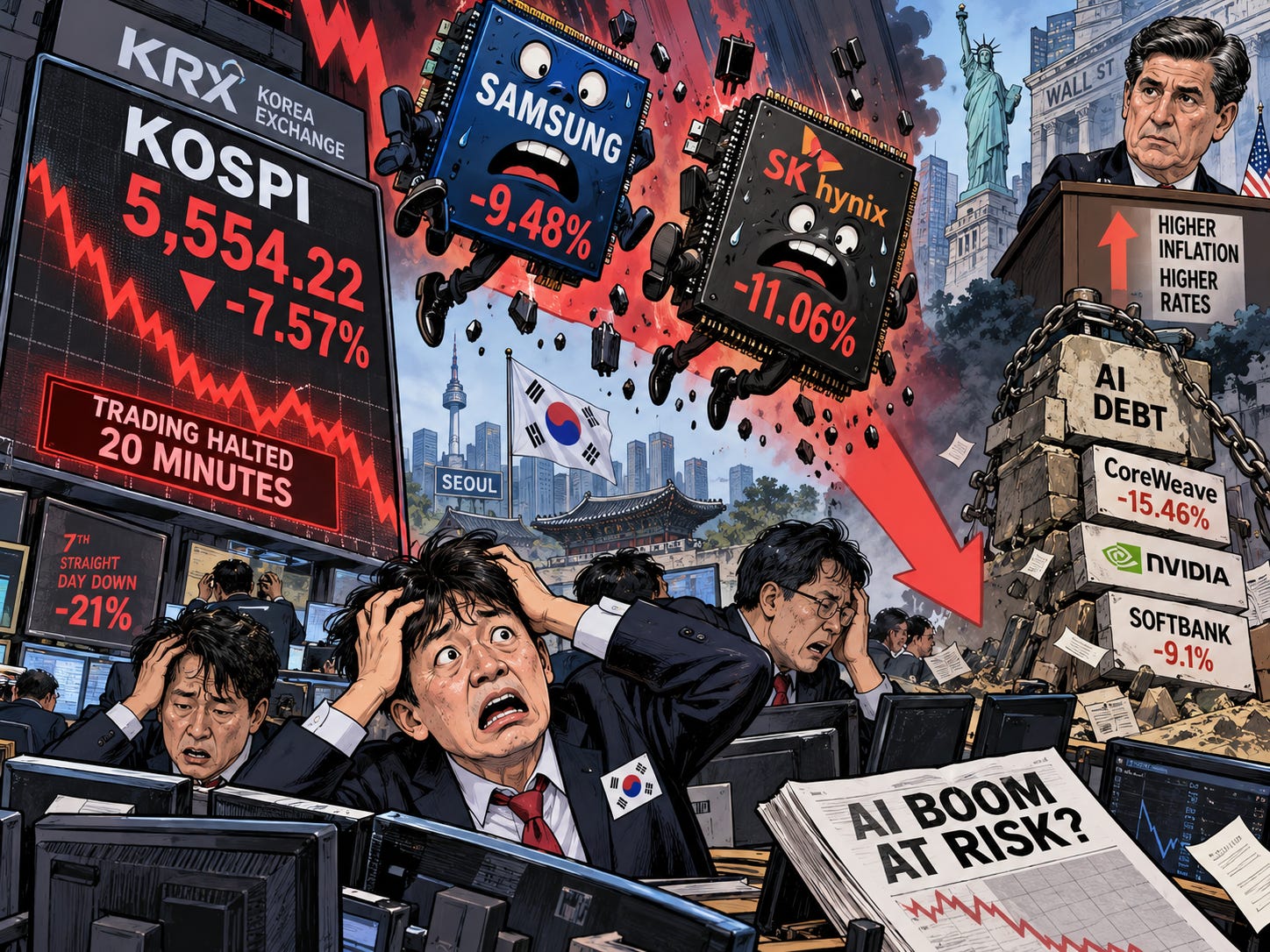
South Korea’s Kospi fell 7.57% on Thursday 15 October to close at 5,554.22, its lowest close since 7 April. Trading across the whole market stopped for 20 minutes after a circuit breaker kicked in at about 4:30am UK (11:30pm New York on Wednesday). At the low, the index was down 9.29%. Samsung Electronics closed 9.48% lower and SK Hynix 11.06% lower. It was the seventh fall in a row, and the Kospi has lost 21% across those 7 sessions. Foreign investors sold a net 3.63 trillion won, their eighth straight day of selling. Aju Press
So why did it break on Thursday? In New York on Wednesday, 2 things hit at once. Core inflation came in hotter than forecast, which pushed up the cost of money. And the doubts over who pays for the AI build-out got louder. CoreWeave, which rents out Nvidia chips and borrows heavily to buy them, fell 15.46% to $65.78 after the research firm Gartner projected that about 80% of these “neocloud” providers could be gone by 2030. The Philadelphia chip index fell 4.30%. Japan’s Nikkei fell 4.90% on Thursday, with SoftBank Group down 9.1%. Seoul’s financial authorities held an emergency meeting and warned investors against excessive borrowing. Yahoo Finance AP via Click2Houston
Sensei’s Insight: No new problem with Samsung’s or SK Hynix’s orders came out overnight. The cost of money in New York went up, and the AI trade runs on borrowed money. That’s my read. What I am watching is the foreign selling streak, now 8 days long.
🏛️ Inflation ran hot and the Fed said there is no rush
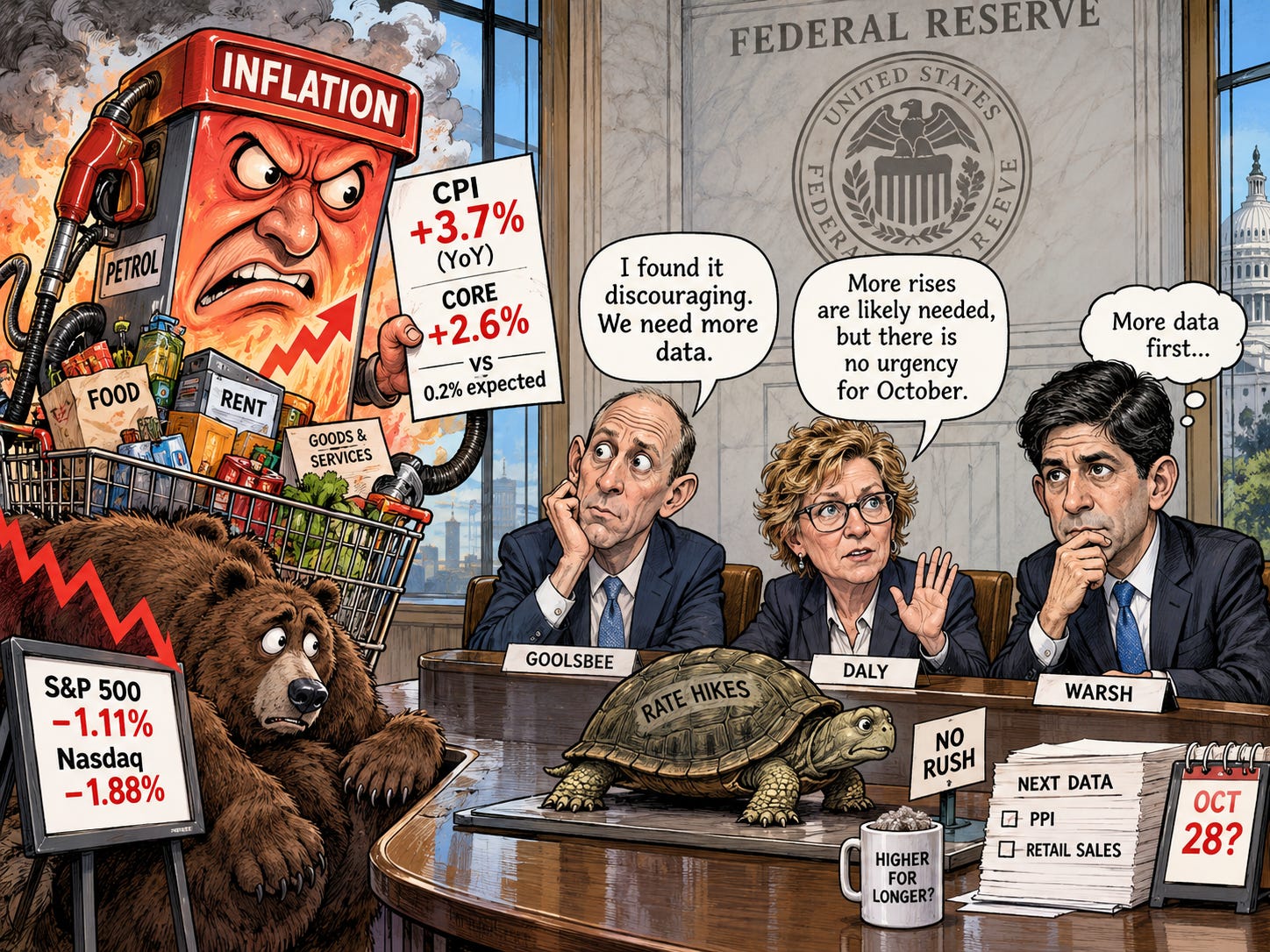
Core prices rose 0.3% in September. Consensus was 0.2%. That is a miss in the wrong direction. Headline inflation rose to 3.7% on the year, from 3.4% in August, against 3.6% expected, with petrol doing most of the lifting. Core inflation, which strips out food and energy, rose to 2.6% from 2.4%. The S&P 500 fell 1.11% to 7,718.94, ending a long run without a 1% drop, and the Nasdaq fell 1.88%. Only health care, consumer staples and energy rose. TheStreet
Traders’ odds of a rate rise on 28 October briefly passed 1 in 2 after the release, then fell back. The Fed’s own officials explain the pullback. “I found it discouraging,” Chicago Fed president Austan Goolsbee told Yahoo Finance. “We need to get more data.” San Francisco Fed president Mary Daly told Reuters more rises are likely needed, with no urgency for October. The next data lands at 1:30pm UK (8:30am New York). Producer prices are expected up 0.3% on the month at the core level, after 0.2% in August, and retail sales up 0.3%. Fed chair Kevin Warsh speaks in Bangkok at 4:30am UK on Friday, which is 11:30pm New York on Thursday. Yahoo Finance Investing.com
Sensei’s Insight: Goolsbee called the number discouraging. Daly said there is no urgency. Both want to wait. That tells me October needs a second hot reading, and producer prices are the first chance. If the pieces that feed the Fed’s own gauge run hot, 28 October is live. That’s my read.
🏭 TSMC posted a record and guided higher into the rout
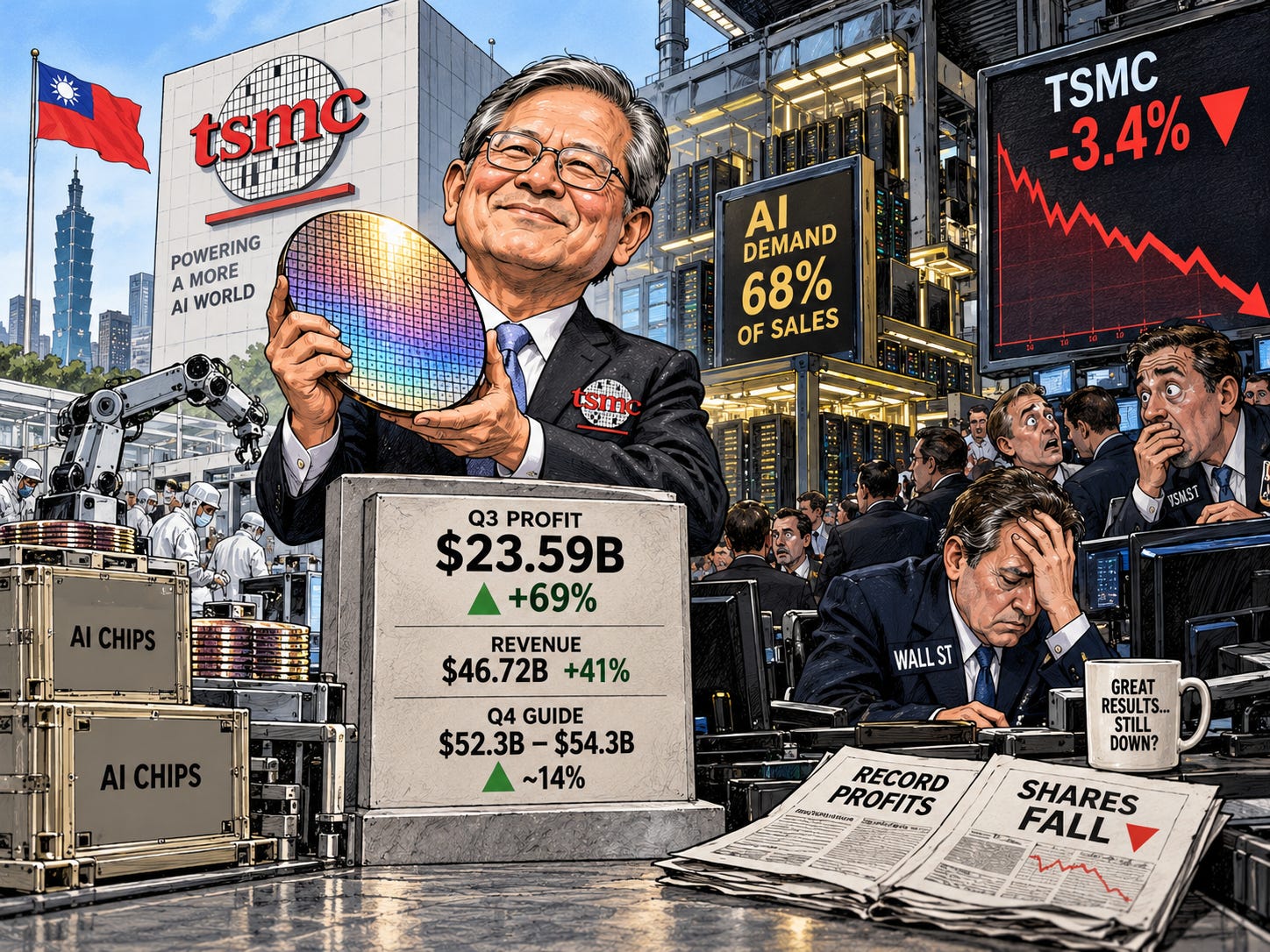
$23.59 billion. That is what TSMC earned in the third quarter, up 69% on a year earlier and a record. In local money it was NT$763.1 billion, against NT$746.3 billion expected by analysts polled by LSEG. Revenue rose 41.2% to $46.72 billion. Chips for high-performance computing, which is mostly AI, made up 68% of sales. The gross margin came in at 66.4%, inside the company’s 65% to 67% range. Investing.com via Reuters
What matters more is the next quarter. TSMC expects fourth-quarter revenue of $52.3 billion to $54.3 billion, about 14% more than the third quarter at the midpoint. It plans to spend $60 billion to $64 billion on new capacity in 2026. Its US-listed shares closed at $430 on Wednesday, down 3.4% before the results, and traded at $421.49 after hours. Taiwan’s market fell on Thursday with the rest of Asia. Investing.com
Sensei’s Insight: The world’s biggest chipmaker just guided its next quarter about 14% bigger. Its shares fell anyway. The market is arguing about who can afford the chips. TSMC’s numbers say the orders are still coming. What I am watching is whether that 14% shows up in the monthly sales figures.
🚢 A container ship sank in Hormuz as Iran widened its targets

The GFS Pride, a Singapore-flagged container ship, sank in the Strait of Hormuz on Wednesday 14 October. All 21 crew were evacuated safely, Singapore’s maritime authority said. Iran’s Revolutionary Guards said the ship hit a mine while using an “illegal and dangerous” route. The cause has not been confirmed. Its sister ship, the GFS Giselle, was also hit and reached a safe anchorage. Iran struck 4 vessels in a matter of hours. US Central Command said 19 million barrels of crude passed through the strait the day before. Maritime Executive
Container ships carry the goods that end up on shop shelves. That widens the war’s reach beyond oil. Brent still fell 1.5% to about $104.43 on Thursday morning, from Wednesday’s $106.06 settlement. Reuters reported that Washington is considering easing sanctions on some tankers that carried Venezuelan, Russian and Iranian oil, to bring down record freight rates. Nothing has been decided. Iranian officials told Reuters they plan to step up strikes on tankers. FinanceFeeds
Sensei’s Insight: Freight now sits next to fuel in the inflation fight, and that matters on a day when the Fed is reading producer prices. The oil price fell on a plan that has not been agreed. What I am watching is whether Washington signs it off.
🤖 Anthropic’s revenue hit $16.8 billion before its IPO

Anthropic, the company behind the Claude chatbot, told prospective investors its revenue reached $16.8 billion in the third quarter, Bloomberg reported on Wednesday 14 October. It said it reached profitability on an adjusted basis during the quarter. For the whole of 2025, revenue was about $4.6 billion, with a net loss of nearly $42 billion. Formal marketing for a share listing could start as soon as the week of 9 November. Prospective investors suggested a valuation of $1.8 trillion to $2 trillion. Anthropic declined to comment. Yahoo Finance via Bloomberg
Why does a private company’s quarter matter on a day like this? It speaks to the question that sank CoreWeave. Gartner’s worry is whether AI revenue will ever cover the money spent on chips and data centres. Anthropic is one of the biggest renters of that computing power, and a quarter of $16.8 billion is part of the answer. “Adjusted” profit leaves costs out, and the full numbers arrive only with the listing documents. Yahoo Finance via Bloomberg
Sensei’s Insight: This is the other side of the CoreWeave sell-off. The labs renting the chips are now showing revenue to match. One adjusted quarter is a start, and 2025 still lost nearly $42 billion. What I am watching is the full filing.
Stories You Might Have Missed
🇬🇧 Britain’s economy grew in August against forecasts
The UK economy grew 0.1% in August, official figures showed on Thursday 15 October, against a 0.1% fall expected. It follows 0.4% growth in July. Manufacturing did the work, up 1.2%. Consumer-facing services fell 0.3%, with restaurants down 2.7%, and construction fell 0.2% for a fourth straight month. If September is flat, the third quarter would show growth of about 0.7%. Businesses are holding up while households cut back, and that split is what the Bank of England weighs at its 5 November decision. Investing.com
🏦 Morgan Stanley’s wealth arm took in $232 billion
Morgan Stanley earned $3.03 a share in the third quarter, on revenue of $20.3 billion, up 12%, it said on Wednesday 14 October. Its wealth management arm had record revenue of $9.1 billion. New client assets came to $232.4 billion, against $81.0 billion a year earlier, and just over half of that was tied to IPO-related flows. Stock trading revenue rose 41% to $5.8 billion, while fixed income fell 7% to $2.0 billion. That is the same split JPMorgan and Goldman Sachs showed earlier in the week. SEC filing
🪙 Bitcoin slipped below $81,000
Bitcoin fell below $81,000 early on Thursday after the hot inflation figure, down more than 2% in 24 hours, CoinDesk reported. Ether, XRP and Solana fell between 3.5% and 4%. US spot bitcoin ETFs lost $261.4 million on Wednesday, according to Farside data, led by Fidelity’s FBTC at $152.7 million and BlackRock’s IBIT at $110.9 million. Ether ETFs lost $130 million. CoinDesk Crypto Briefing