This content is for informational and educational purposes only and does not constitute financial advice. Always do your own research. Not financial advice (NFA).
👀 Today’s Stories at a Glance
🏦 The Fed raised and is not finished: 16 of 18 officials expect another rise this year, and 2027’s cuts have gone.
🇬🇧 Britain held and the hawks stayed at 3: the Bank of England kept Bank Rate at 3.75% on July’s 6 to 3 vote.
🛒 American shoppers spent the most in 5 months: retail sales rose 1.2% in August against the 0.8% forecast.
🛢️ Saudi Arabia put a date on the repair: half the East-West pipeline returns within days, and Brent settled at $105.83.
🏛️ A crypto tax bill moved the morning after: the House tax committee approved wash-sale rules for digital assets, 38 votes to 5.
🥇 Gold ran $126 in both directions: it hit $4,366 before the Fed, $4,240 after it, and was back at $4,315 by late morning.
🏠 Lennar’s margin fell to 15.8%: the homebuilder earned $1.19 a share against $2.29 in the same quarter last year.
🌍 Trump threatened Europe over Canada: the EU offered Ottawa associate membership, and the president called the idea laughable.
🚚 J.B. Hunt lost 13.3% on diesel: the trucking firm warned rising fuel and drayage costs will hit third-quarter profit.
📈 Oil went through $100, now it has to hold it: Chart of the Day covers $100.72, $98 and $92.04.
🧠 One Big Thing
The Federal Reserve raised rates by a quarter point last night, and everybody expected that. The rest of it was the surprise. The grid where officials mark their own expectations now puts the end of 2027 at 4.1%, the same place as the end of this year. In June that line read 3.6%. Watch the arithmetic, because those dots plot the middle of the rate range rather than the top, and 4.1% points at a range a quarter point above the one just set. Next year’s cuts have been deleted. Futures are pricing more tightening than the Fed’s own grid shows.
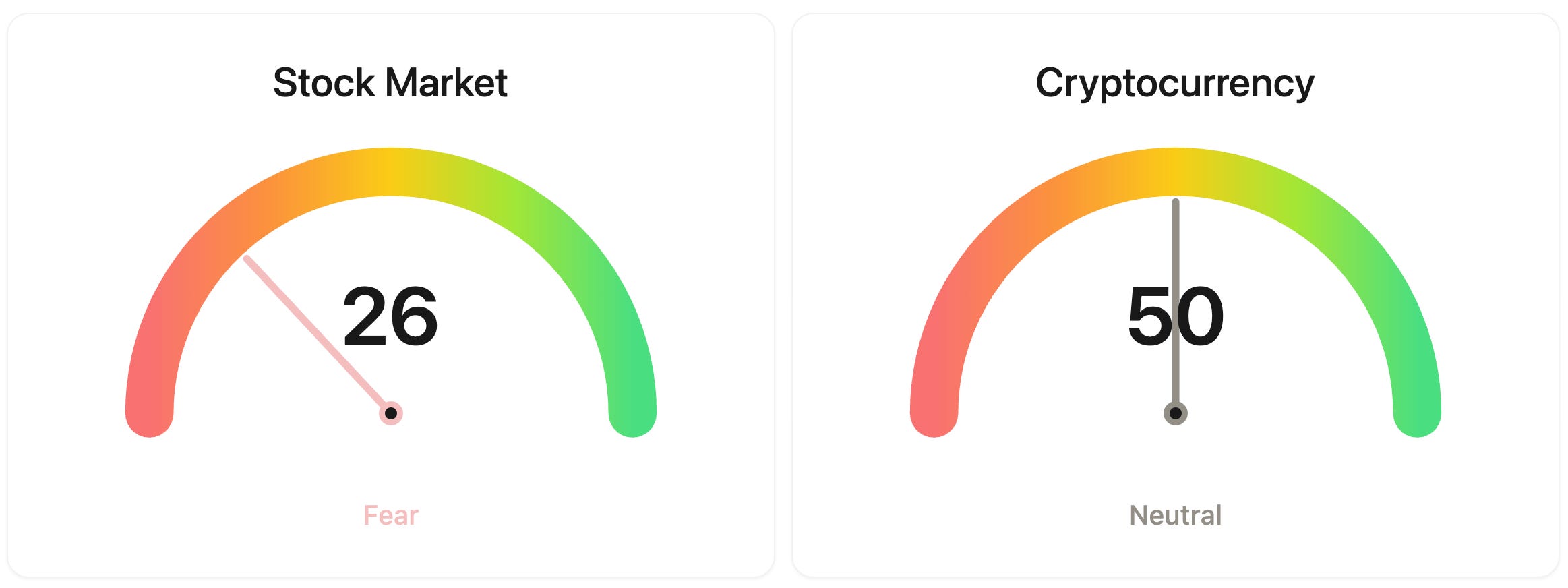
⚖️ Fear & Greed
📉 The Number That Matters
4.1%
The Fed’s median forecast now puts interest rates at 4.1% at the end of 2027, the same level it expects at the end of this year. In June the same officials had 3.6%.
⚔️ Winners vs Losers
Winners
DCX 0.00%↑ : +63.31% Digital Currency X Technology Inc. shares rocketed in pre-market on a speculative momentum surge in the sub-one-dollar crypto treasury stock, with no company announcement behind the move.
GNRC 0.00%↑ : +33.92% Generac Holdings Inc. shares soared after signing a supply deal worth up to 8 billion dollars to provide backup generators for Amazon data centres. Initial deliveries of 2.4 billion dollars are due in 2027 and 2028, and Amazon also received warrants to buy up to 1.69 million Generac shares.
VICR 0.00%↑ : +11.74% Vicor Corporation shares climbed after signing a licensing agreement with an unnamed AI hardware maker for its Vertical Power Delivery technology, opening a new royalty stream from its patents on power modules for AI chips.
NBIS 0.00%↑ : +8.95% Nebius Group N.V. shares rallied after announcing a second major price increase for on-demand NVIDIA GPU computing, effective 1 October.
BE 0.00%↑ : +4.84% Bloom Energy Corporation shares rose after the House passed a bipartisan bill that makes large data-centre operators pay for power-grid upgrades, which strengthens the case for Bloom’s on-site fuel cells.
Losers
FLNC 0.00%↑ : -20.99% Fluence Energy, Inc. shares plunged after cutting its fiscal 2026 revenue guidance to about 2.4 billion dollars, down from a 3.0 billion midpoint, because production at its Houston contract manufacturing plant is ramping up more slowly than planned. It now expects an adjusted EBITDA loss of about 200 million dollars, against a previous midpoint loss of 10 million.
📊 Market Snapshot
Cryptocurrencies:
Bitcoin (BTC): $76,298 (▲ 0.20%)
Ethereum (ETH): $2,432 (▲ 0.63%)
XRP: $1.29 (▼ 0.38%)
Equity Indices (Futures):
S&P 500: 7,687 (▲ 0.84%)
NASDAQ 100: 29,577 (▲ 1.09%)
FTSE 100: 10,713 (▲ 0.33%)
Commodities & Bonds:
10-Year US Treasury Yield: 4.98% (▼ 0.72%)
Oil (WTI): $101 (▼ 1.38%)
Gold: $4,315 (▲ 1.19%)
Silver: $63.93 (▲ 1.53%)
Data as of: UK: 11:42 BST / US: 06:42 EDT / Asia (Tokyo): 19:42 JST
✅ 5 Things to Know
🏦 The Fed raised, then took next year’s cuts away
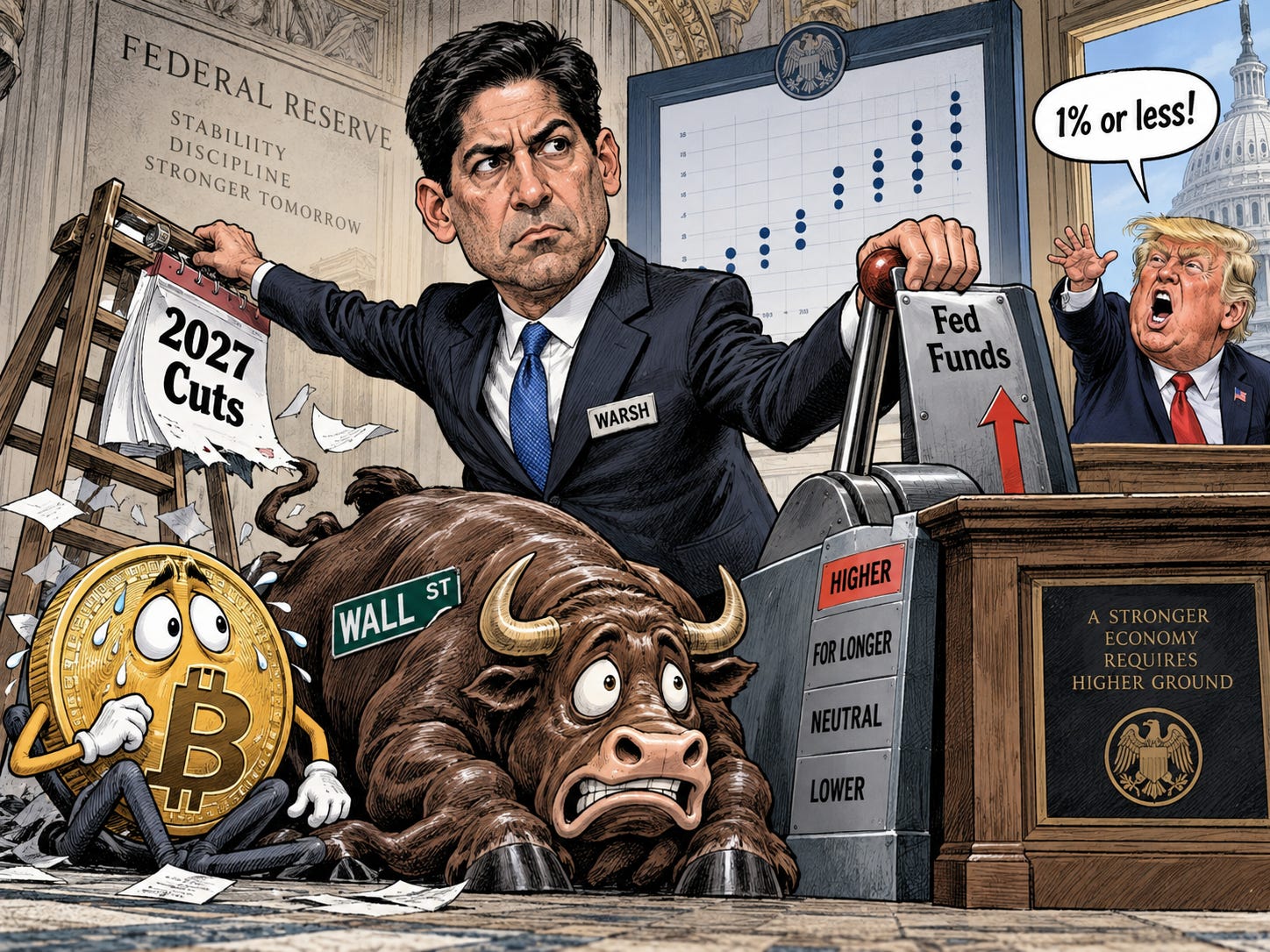
The Federal Reserve lifted its target range to 3.75% to 4.00% on Wednesday evening, all 12 voters in favour, the first American increase since 2023. The statement described resilient spending, strong investment and an economy expanding at a solid pace, and said inflation remains too high. “The plain fact is that inflation is too high, and has been for too long,” Chair Kevin Warsh said. He named 3 things that had changed since July: evidence of a stronger economy, inflation trends that still failed the Fed’s test, and a changed geopolitical outlook. He was explicit that the decision came from the overall picture rather than from any single retail sales or inflation report. (Federal Reserve)
The forecasts are where the change sits. The median official now puts the appropriate rate at 4.1% at the end of 2026 and again at the end of 2027. Here is the part that catches people out. The dots plot the middle of the target range rather than the top of it, and the middle of the range set on Wednesday is a quarter point below where that median sits. In plain terms, the 4.1% dot points at a range of 4.00% to 4.25%, one step above the range just announced. So the forecast carries another quarter point this year even though the headline rate already reads 4%, and then no net reduction between those 2 year-end dates. In June the same officials had 3.6% for the end of 2027. Warsh submits no dot of his own. “I am not in the forward guidance business,” he said when asked about further rises. (Federal Reserve)
Around that path sits stronger growth, lower unemployment at 4.1%, and slightly higher inflation this year, with both headline and core measures reaching 2% only in 2029. Warsh does not see broad financial conditions as clearly restrictive. “We removed a dose of accommodation,” is how he put the decision, which in ordinary language means money and credit are now a little less easy to get. Asked how a rate rise fixes a closed shipping route, he agreed that it cannot. His argument is that the Fed’s job is to stop an initial price shock spreading through the economy and changing what people expect inflation to be.
Bond markets took the hawkish half. The 2-year Treasury yield rose 7 basis points to about 4.74%, which is 0.07 of a percentage point, while the 10-year ended Wednesday only 2 basis points higher, just above 5.00%, so the curve flattened rather than sold off. Futures now price at least 3 more rises by the middle of 2027, ahead of the Committee’s own grid. Warsh gave 3 reasons for the rise in long-term yields: a stronger economy, competition for funding as large technology companies invest, and geopolitical pressure. President Trump posted the same afternoon that American rates should be “1%, or less”. Warsh declined to discuss their conversations, saying only that independence is a two-way street.
Sensei’s Insight: My reading is that the higher projected rate path is a headwind for crypto compared with June. Cash and bonds become more competitive, while borrowing to buy riskier assets becomes more expensive. XRP can respond to that change in appetite even without a new development specific to Ripple.
🇬🇧 Britain held and the hawks stayed at 3
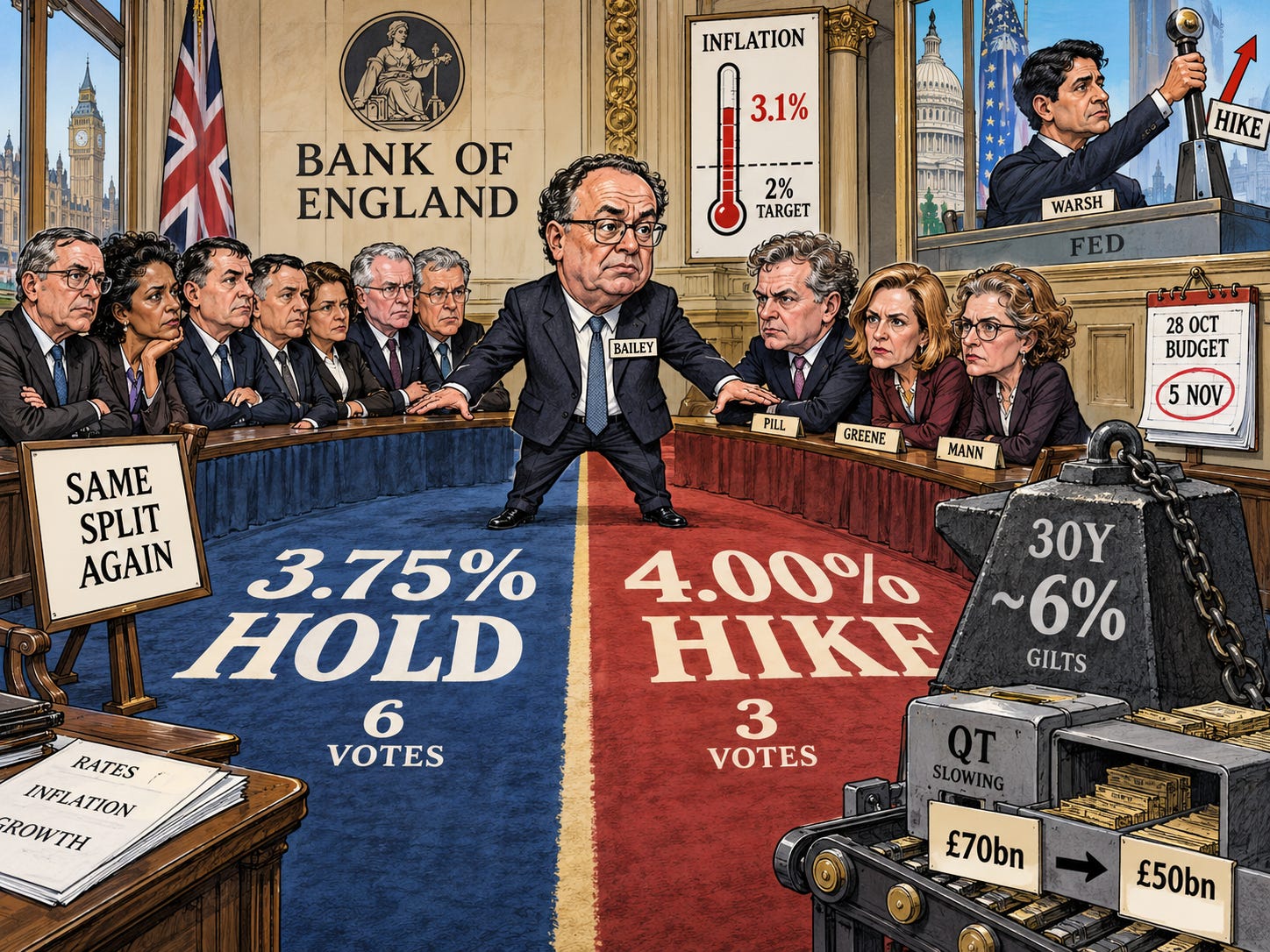
The Bank of England kept Bank Rate at 3.75% at 12:00pm UK, which is 7:00am in New York, and the vote came in at 6 to 3 for a second meeting running. Huw Pill, Megan Greene and Catherine Mann again preferred a quarter point rise to 4.00%. Nobody voted for a cut. Both the rate and the split matched what economists had forecast, and market pricing had put roughly a 30% chance on a rise going in, having been close to nothing a fortnight earlier. Wednesday’s inflation reading was 3.1%, the first above 3% since March.
The split is the part worth noticing, because it did not move. A fourth vote for a rise would have pushed Governor Andrew Bailey towards the tie-breaking position and made a November move close to certain. That did not happen, and it did not happen after a headline inflation reading above 3% or with the Federal Reserve raising the night before. The hawks are the same 3 they were in July. Markets had a quarter point nearly fully priced for 5 November going into this meeting, so that is where the argument gets settled. The Autumn Budget lands on 28 October, 8 days before it.
The Committee also took its annual vote on quantitative tightening, which sets how fast the Bank shrinks the pile of government bonds it bought during the pandemic and the crisis before it. That decision publishes with the minutes, and gilts care about it more than they care about a hold. UBS said on 9 September that it expected the programme to slow to £50 billion over the year from October, down from £70 billion, with active sales holding at about £20 billion because the reduction comes from fewer bonds maturing rather than from selling less. The 30-year gilt yield has been sitting near 6%, so the size of that programme reaches British borrowing costs whatever Bank Rate does. (Yahoo Finance)
Warsh had been asked about other central banks the night before and said only that many of them face inflation pressure of their own, declining to predict what any of them would do. The 2 decisions, 17 hours apart, went opposite ways.
Sensei’s Insight: Same 3 hawks. No fourth joined them, and that is after a 3.1% headline and an American rise the night before. This Committee is not voting on a price Britain imports. November settles it.
🛒 American shoppers handed the Fed its argument
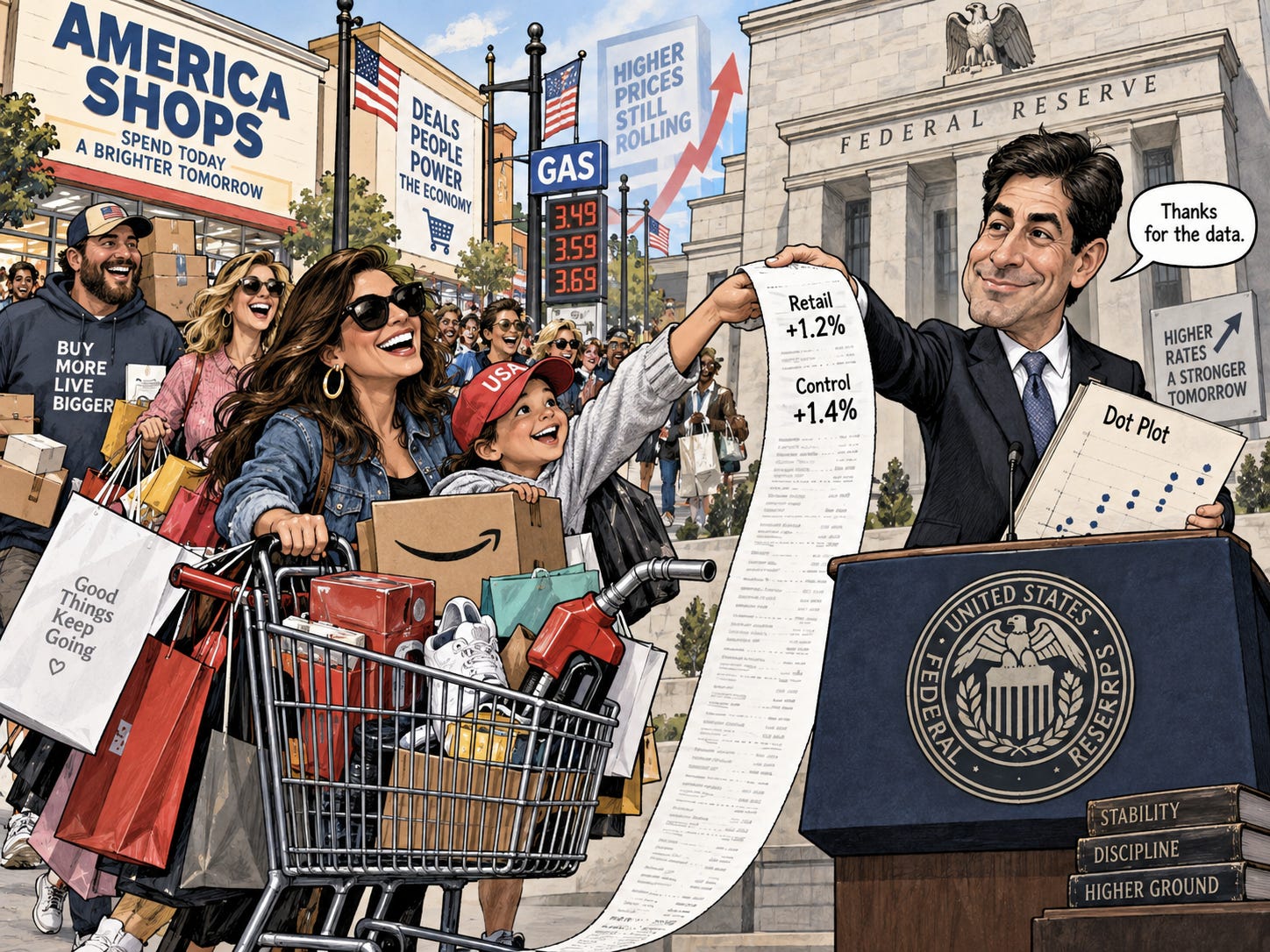
August was a strong month in American shops. Retail sales rose 1.2% to $773.9 billion, the largest monthly gain in 5 months and well above the 0.8% economists expected, after a July that was revised to a 0.5% fall. The release landed at 1:30pm UK, which is 8:30am in New York, 5 and a half hours before the Federal Reserve announced. The control group, the slice that strips out cars, petrol, building materials and restaurants and feeds straight into the GDP calculation, jumped 1.4% against a 0.4% forecast. Gains were broad, led by petrol stations and online retailers. Sales are up 6% on the year. (FXStreet)
That print is why the statement that followed reads the way it does. The Fed described domestic spending as resilient, productivity as strong and capital investment as robust, and removed the supply-shock language that had let it wait. A consumer spending at this pace is a consumer who lets companies pass higher energy, tariff and wage costs along, and that is the kind of inflation interest rates can actually reach. The counterweight sits in the same release: some of August’s strength came from petrol stations, where the money bought fuel rather than anything else. The next hard read is personal consumption expenditures inflation, which is the measure the Committee targets.
Sensei’s Insight: Every argument for waiting rested on the American consumer cracking. 1.4% on the control group is not cracking. That number did more to justify the dot plot than anything Warsh said into a microphone afterwards, and it landed before he opened his mouth.
🛢️ Saudi Arabia finally put a date on the repair

Brent settled at $105.83 a barrel on Wednesday, down 2.7% on the day, and slipped again on Thursday morning. American WTI was near $101 by late morning UK time, down 1.38% on the day. Saudi Arabia said about half of the East-West pipeline’s capacity should return to service within days and full flows in roughly 6 weeks, the first timetable published since drone attacks shut the line. The kingdom is moving more crude through the Strait of Hormuz with American military support, and offering extra cargoes to Asian refiners by ship-to-ship transfer off Oman’s Sohar port. United States Energy Secretary Chris Wright said 18 million barrels of crude and products passed through Hormuz earlier this week. (Saxo Bank)
Every previous week of this story was measured in things stopping. Vessel counts fell. A pipeline closed. A meeting was cancelled. This is the first week with a restart schedule attached to it, and the market took 2.7% off Brent on the strength of it. American inventory data did the rest of the work, with crude stocks falling only 0.6 million barrels against a larger expected draw while petrol and distillate stocks rose. The war premium has not gone anywhere while the Yanbu export terminal is still disrupted and Hormuz traffic runs far below normal. What has changed is that there is now a supply number pointing the other way. (Reuters)
Sensei’s Insight: For a month this market only moved on what got destroyed. Now there is a repair schedule with weeks written on it. The schedule is the claim and the barrels are the proof, so I am watching whether the first restarted cargoes actually turn up on time.
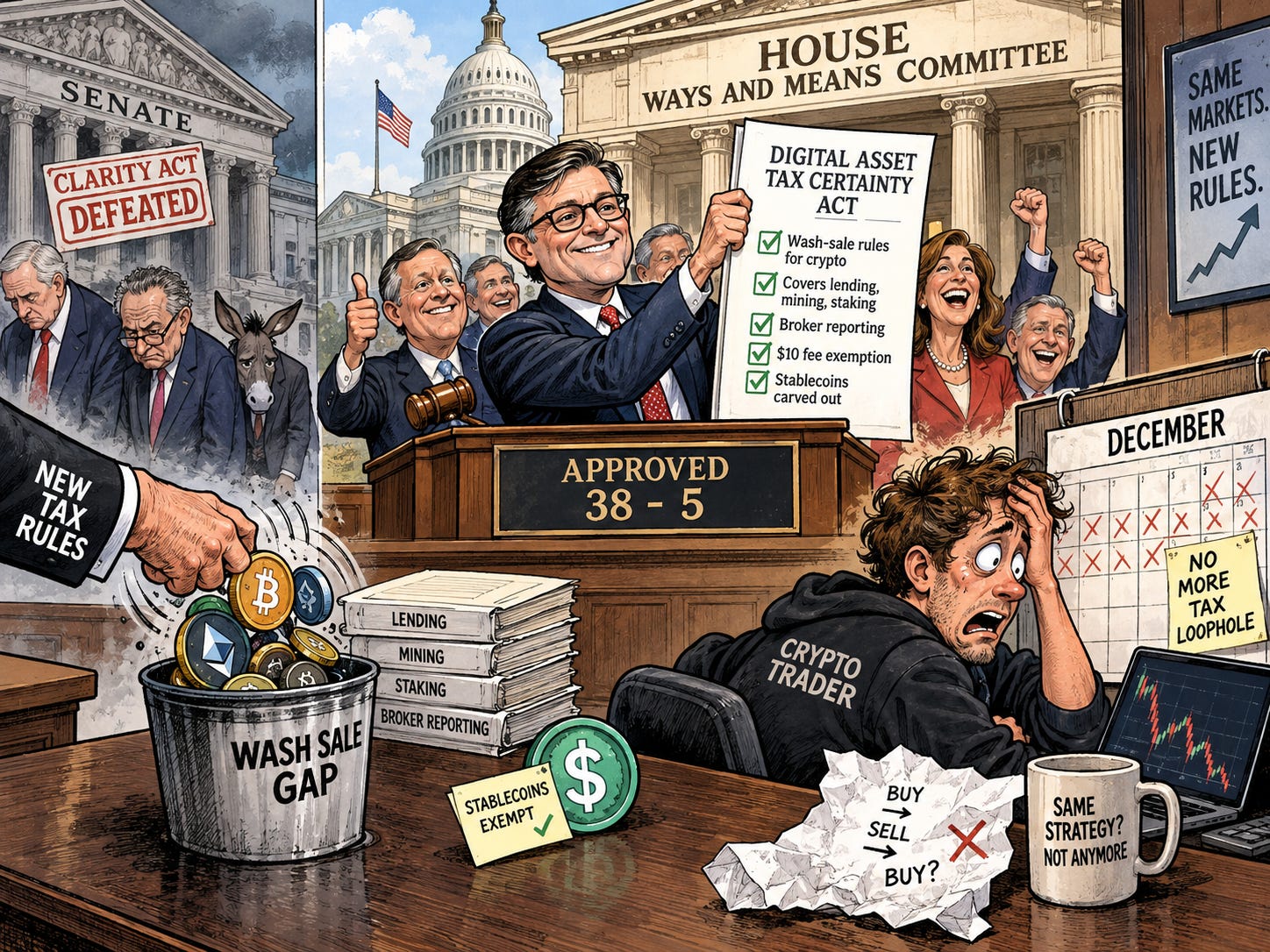
🏛️ A crypto tax bill moved the morning after