This content is for informational and educational purposes only and does not constitute financial advice. Always do your own research. Not financial advice (NFA).
👀 Today’s Stories at a Glance
🎯 NVIDIA Beats, Stock Yawns: Blowout numbers and a twenty-five-fold dividend hike still couldn’t lift the stock.
🛢️ Oil Cracks as Iran Talks Near: Brent fell six dollars on diplomacy signals; Iran’s Hormuz tollbooth keeps the risk premium elevated.
🤖 OpenAI Files for Trillion-Dollar Listing: Confidential filing imminent; September debut could value the ChatGPT maker at $1 trillion.
🚀 SpaceX Targets Record $80 Billion Debut: $1.7 trillion valuation, June 12 trading start; Starlink profits cover rocket and AI losses.
🦅 Hawks Hidden in Federal Reserve Minutes: April vote was eight to four, but the majority quietly backed firming if inflation persists.
⚛️ Quantum Names Rip on Federal Grants: $2 billion package with government equity stakes; International Business Machines (IBM) leads with $1 billion.
🏦 Trump Opens Fed Rails to Fintech: Executive order pushes regulators to review direct payment access for crypto and fintech firms.
🥩 Cargill Locks Out Colorado Beef Workers: 1,700 Teamsters shut out after 90% contract rejection; beef prices already set to rise 10%.
🏭 Drones Hit Russian Refining Capacity: Strikes shut 83 million tonnes of capacity; Russian petrol export ban extended through July.
🇹🇼 Trump Eyes Taiwan Call, Arms Package: First leader-to-leader contact since 1979 looms; $14 billion weapons deal still pending Congress.
🧠 One Big Thing
Two trillion-dollar listings filing within roughly a week of each other is the real story. SpaceX prices at $1.7 trillion with Starlink carrying loss-making rockets and an AI unit. OpenAI follows at up to $1 trillion despite projecting a $14 billion loss in 2026. Both depend on profitable subsidiaries covering frontier bets and both put founders in effective control. The signal is that the AI capital cycle has moved from private rounds to public markets, forcing index funds into the trade. Retail exposure becomes structural before unit economics get tested.
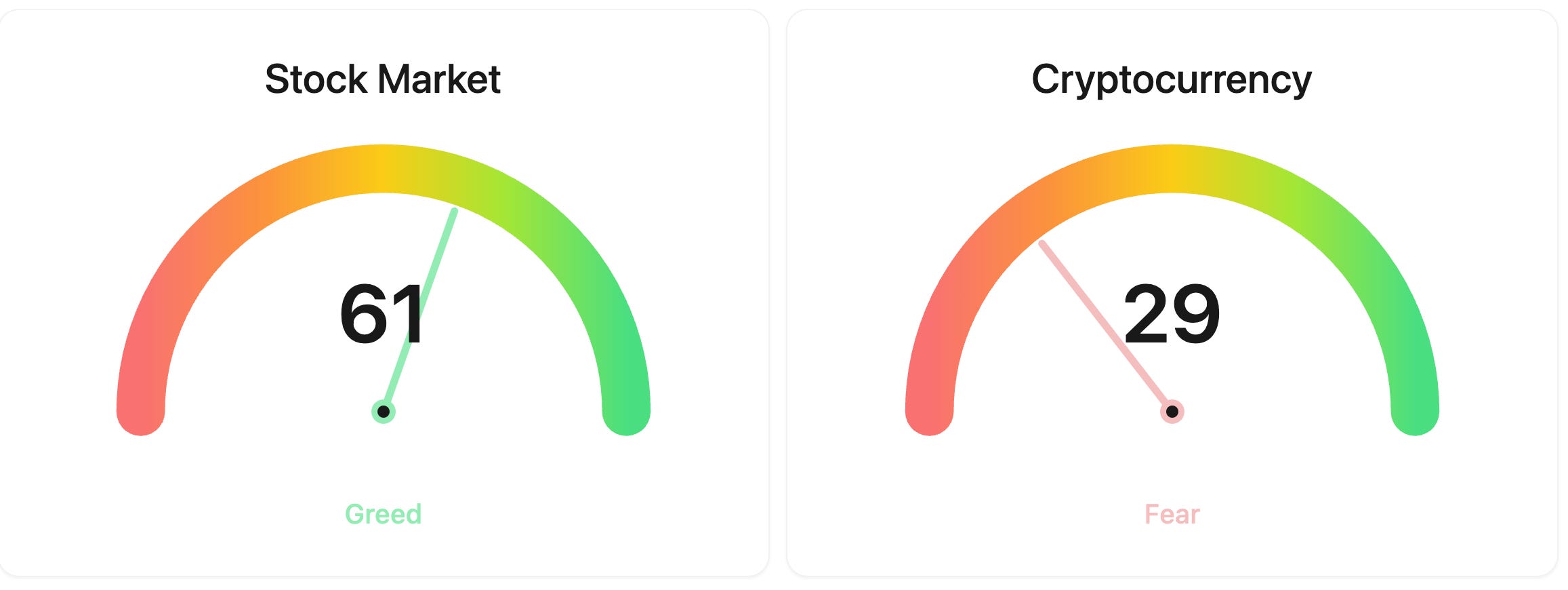
⚖️ Fear & Greed
📉 The Number That Matters
$1.7 TRILLION
SpaceX is listing at $1.7 trillion despite only Starlink turning a profit; the rocket business lost $619 million last quarter and the artificial intelligence unit lost $2.5 billion. Index funds may be forced buyers regardless.
⚔️ Winners vs Losers
Winners
QBTS 0.00%↑: D-Wave Quantum Inc. surged after a Wall Street Journal report that the company is set to receive a $100 million grant under the Trump administration’s $2 billion quantum computing package, with the federal government taking a minority equity stake in return.
RGTI 0.00%↑: Rigetti Computing Inc. jumped on confirmation that it is one of the named recipients of the $2 billion federal quantum funding package, with $100 million earmarked for the company in exchange for a US government equity stake.
GFS 0.00%↑: GlobalFoundries Inc. gained after being named the second-largest recipient of the federal quantum grant package, set to receive $375 million from the Commerce Department in exchange for a government equity stake.
APLD 0.00%↑: Applied Digital Corporation rose after announcing a second 300 MW lease with the same US-based investment-grade hyperscaler behind its Delta Forge 1 site, deepening one of the company’s largest data center partnerships.
AAP 0.00%↑: Advance Auto Parts Inc. spiked after Q1 adjusted EPS of $0.77 came in well above the $0.46 consensus on revenue of $2.61 billion, with comparable sales growing 3.5%.
IBM 0.00%↑: International Business Machines led the named beneficiaries of the federal quantum push, with the Commerce Department agreeing to award the company $1 billion of the $2 billion grant package in exchange for a minority equity stake.
Losers
INTU 0.00%↑: Intuit Inc. tumbled after announcing a 17% workforce reduction affecting over 3,000 employees alongside its fiscal Q3 results, with $300 million to $340 million in restructuring charges and weakness at Mailchimp overshadowing an EPS beat and raised full-year guidance.
📊 Market Snapshot
Cryptocurrencies:
Bitcoin (BTC): $77,244 (▼ -0.31%)
Ethereum (ETH): $2,115 (▼ -0.58%)
XRP: $1.37 (▲ 0.07%)
Equity Indices (Futures):
S&P 500: $7,412 (▼ -0.01%)
NASDAQ 100: $29,234 (▼ -0.54%)
FTSE 100: £10,386 (▼ -0.50%)
Commodities & Bonds:
10-Year US Treasury Yield: 4.61% (▲ 0.48%)
Oil (WTI): $101 (▲ 1.73%)
Gold: $4,517 (▼ -0.57%)
Silver: $74.98 (▼ -1.20%)
Data as of: UK (BST) 12:18pm BST / US (EDT): 7:18am / Asia (Tokyo): 8:18pm
✅ 5 Things to Know ( + 1 Bonus Story)
🎯 NVIDIA Cleared the Blowout Bar, Stock Didn’t Care
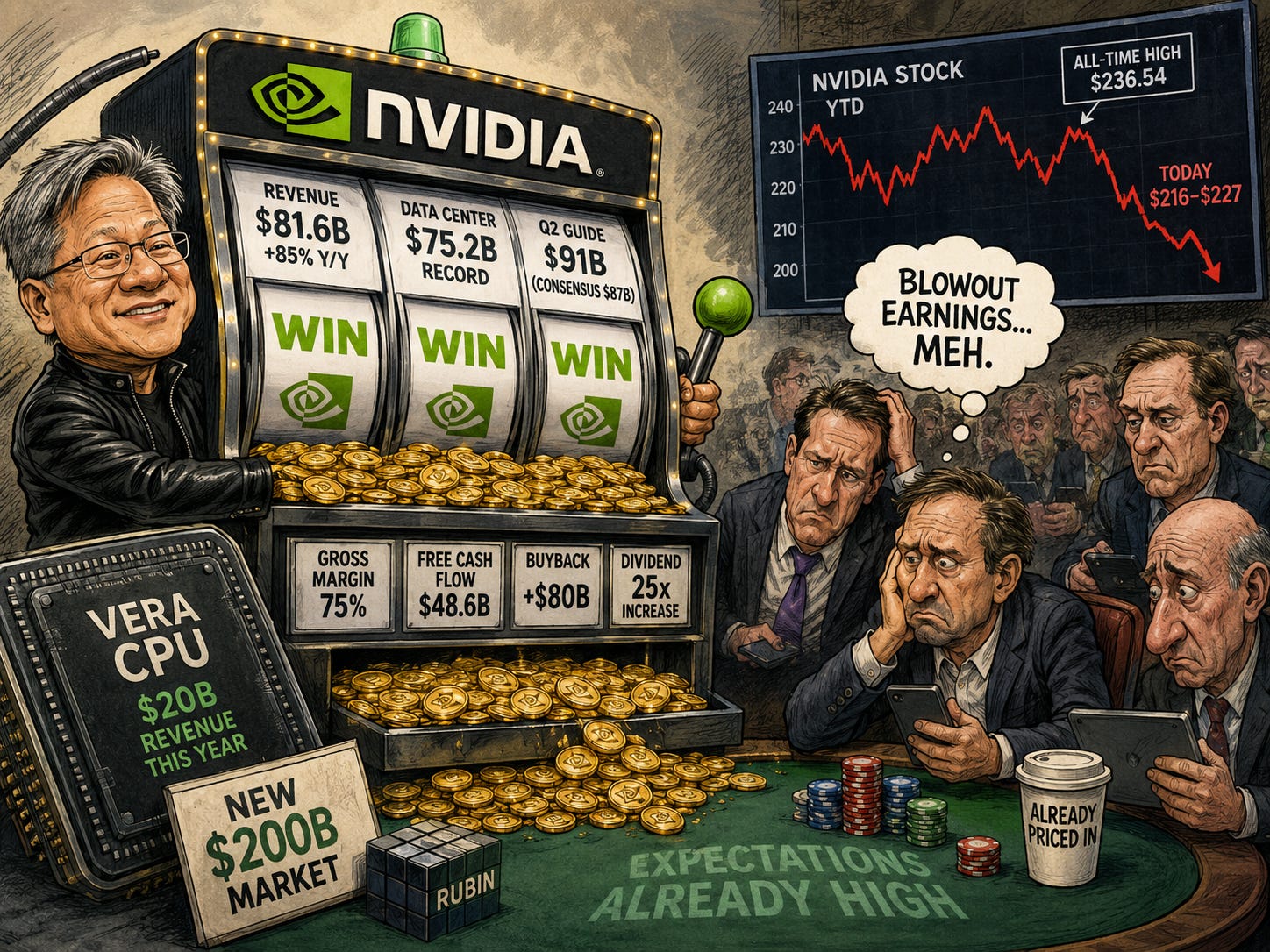
NVIDIA delivered the blowout scenario yesterday on every line that mattered and the market still couldn’t get excited. First-quarter revenue landed at $81.6 billion, up 85% year on year and above the $80 billion mark that had been the bull camp’s clean-blowout threshold. Data Center revenue hit a record $75.2 billion, more than $2 billion ahead of consensus. The Q2 guide came in at $91 billion, well clear of the roughly $87 billion published Wall Street expectation. Non-GAAP gross margin held at 75%. Free cash flow for the quarter alone was $48.6 billion. Shares slipped roughly 1.5% in extended trading and drifted lower again today between $216 and $227, still six points below last week’s $236.54 all-time high. (CNBC)
The gap between the numbers and the price action is the real story. Published consensus was $87 billion for the Q2 guide. The buy-side whisper, the figure the funds were actually positioned for, sat closer to $89 to $90 billion. NVIDIA’s $91 billion beat the consensus comfortably but only edged past the number already in the price. NVIDIA also stacked the deck on capital returns, authorizing an additional $80 billion in share buybacks and lifting the quarterly dividend twenty-five fold from one cent to twenty-five cents per share. For a company that has historically reinvested almost everything into chip development and supply chain, that dividend hike is a signal of regime change, not just a cash-return gesture. (Yahoo Finance)
The reveal most of the market has under-priced came late on the call. Chief financial officer Colette Kress disclosed that NVIDIA has visibility to roughly $20 billion in standalone CPU revenue this year, opening what Jensen Huang called a “brand new” $200 billion total addressable market. The Vera CPU, paired with the upcoming Rubin graphics chip, is being positioned as a purpose-built processor for agentic artificial intelligence, the autonomous software agents companies are now deploying at scale. If those numbers hold, NVIDIA enters its first full year of standalone CPU sales as one of the world’s largest CPU suppliers, a lane long dominated by Intel and Advanced Micro Devices. With Vera Rubin not ramping until the fourth quarter of fiscal 2027 and China data center revenue still sitting at zero, that CPU story may be the cleaner forward catalyst than the next quarterly print. (Yahoo Finance)
Sensei’s Insight: The dividend hike is the tell. At a $5 trillion market cap, NVIDIA is quietly graduating from hyper-growth story to mature compounder, and the muted price action is the market re-rating its expectations in real time. The thesis isn’t broken, it’s maturing. Future drawdowns in a business generating $48 billion in quarterly free cash flow tend to look very different in hindsight than they do in the moment.
🛢️ Oil Drops 6% as Trump Says Iran Deal Is Close
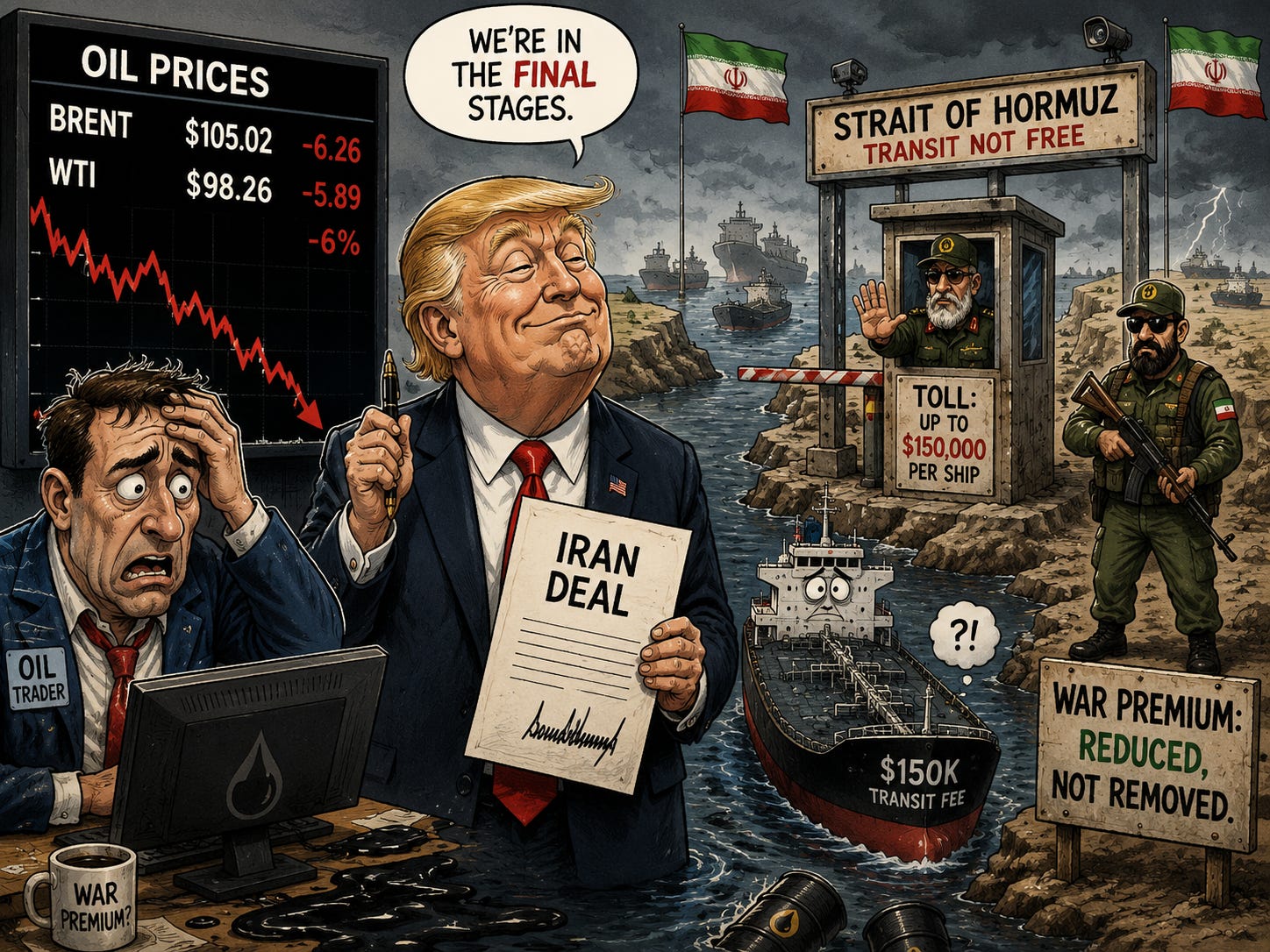
Brent crude settled down $6.26 at $105.02 yesterday and US West Texas Intermediate fell $5.89 to $98.26, its first close below $100 in weeks, after President Trump told reporters that negotiations with Iran were in the “final stages.” Trump also said he had canceled a planned wave of strikes on Tuesday to give diplomacy room. Three supertankers carrying about 6 million barrels of Middle East crude finally crossed the Strait of Hormuz, the first significant tanker movement in over two months. Iran’s Islamic Revolutionary Guard Corps simultaneously warned of “crushing blows in places you do not expect” if US strikes resume. (Reuters)
The drop is the war-premium coming out, not normalization. Oil at $105 is still roughly 50% above pre-conflict levels, and US commercial crude stocks fell 7.9 million barrels last week against a 2.9 million consensus draw. ADNOC’s chief executive said yesterday it will take at least four months to restore Middle East flows to 80% of pre-conflict levels even with a deal. A Reuters investigation published yesterday detailed how Iran has built a working transit-fee system at Hormuz, with state-to-state deals required and fees reportedly running up to $150,000 per ship. Wood Mackenzie’s bull case puts Brent at $200 if Hormuz stays largely shut through year-end; the bear case is $80 by end-2026 if a deal sticks and traffic resumes. (CNBC)
Sensei’s Insight: A 6% drop is the easy part. Iran has built a working tollbooth at Hormuz, with some transits now requiring state-to-state deals or fees of up to $150,000 per ship. Even a peace deal doesn’t dismantle that mechanism overnight. The risk premium for shipping insurance and freight stays.
🤖 OpenAI Lines Up the Next Trillion-Dollar IPO
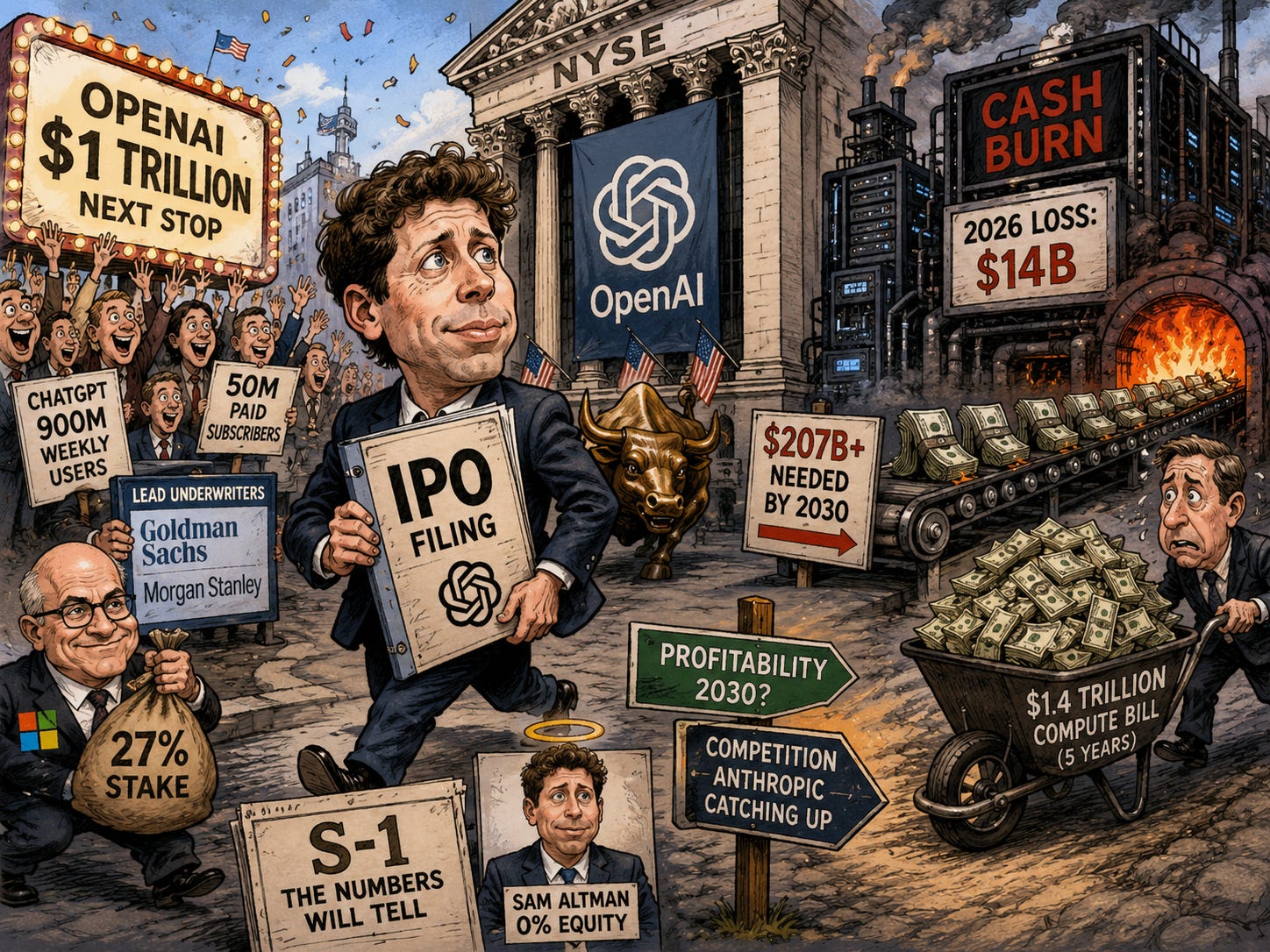
OpenAI is preparing to confidentially file its initial public offering paperwork with the Securities and Exchange Commission as soon as tomorrow, putting the ChatGPT maker on a path to a September listing that could value the company at up to $1 trillion. The filing arrives within days of SpaceX going public with its own prospectus and follows a federal jury’s dismissal earlier this week of Elon Musk’s lawsuit challenging OpenAI’s for-profit restructuring. That ruling removed the last meaningful legal obstacle to a listing. Goldman Sachs and Morgan Stanley are leading the underwriter selection, with OpenAI reportedly targeting at least $60 billion in primary capital at the low end of preliminary discussions. (CNBC)
The financial backdrop tells two stories at once. OpenAI was valued at $852 billion in its March funding round, a $122 billion raise that pulled in $50 billion from Amazon, $30 billion from NVIDIA, and $30 billion from Microsoft. The company now generates around $2 billion in revenue every month, with ChatGPT crossing 900 million weekly users and 50 million paid subscribers. Rival Anthropic is closing the race fast, posting more than $30 billion in annualized revenue and reportedly raising fresh capital at a $900 billion valuation. Sam Altman has been pushing to list ahead of Anthropic, while chief financial officer Sarah Friar has favored a longer runway. (Yahoo Finance)
The cost picture is where retail investors need to focus. Internal projections suggest OpenAI may lose $14 billion in 2026 alone, with no path to profitability expected until 2030. HSBC analysts estimate the company will need more than $207 billion in additional capital between now and the end of the decade to fund its compute commitments, which Altman has put at roughly $1.4 trillion over five years. Microsoft holds a 27% stake in the restructured public benefit corporation. Sam Altman, despite running the company, owns no equity. The S-1 prospectus, when it eventually goes public, will be the first time the audited numbers behind the brand are visible to outside investors. (Yahoo Finance)
Sensei’s Insight: OpenAI carries the strongest brand in AI and the heaviest cash burn in modern tech. A $1 trillion valuation assumes the lead survives Anthropic’s surge and that compute costs eventually bend. Forced index buying after listing will distort early price action, so the signal to watch in the S-1 is the unit economics behind ChatGPT, not the revenue headline.
🚀 SpaceX Files for the Biggest IPO in History
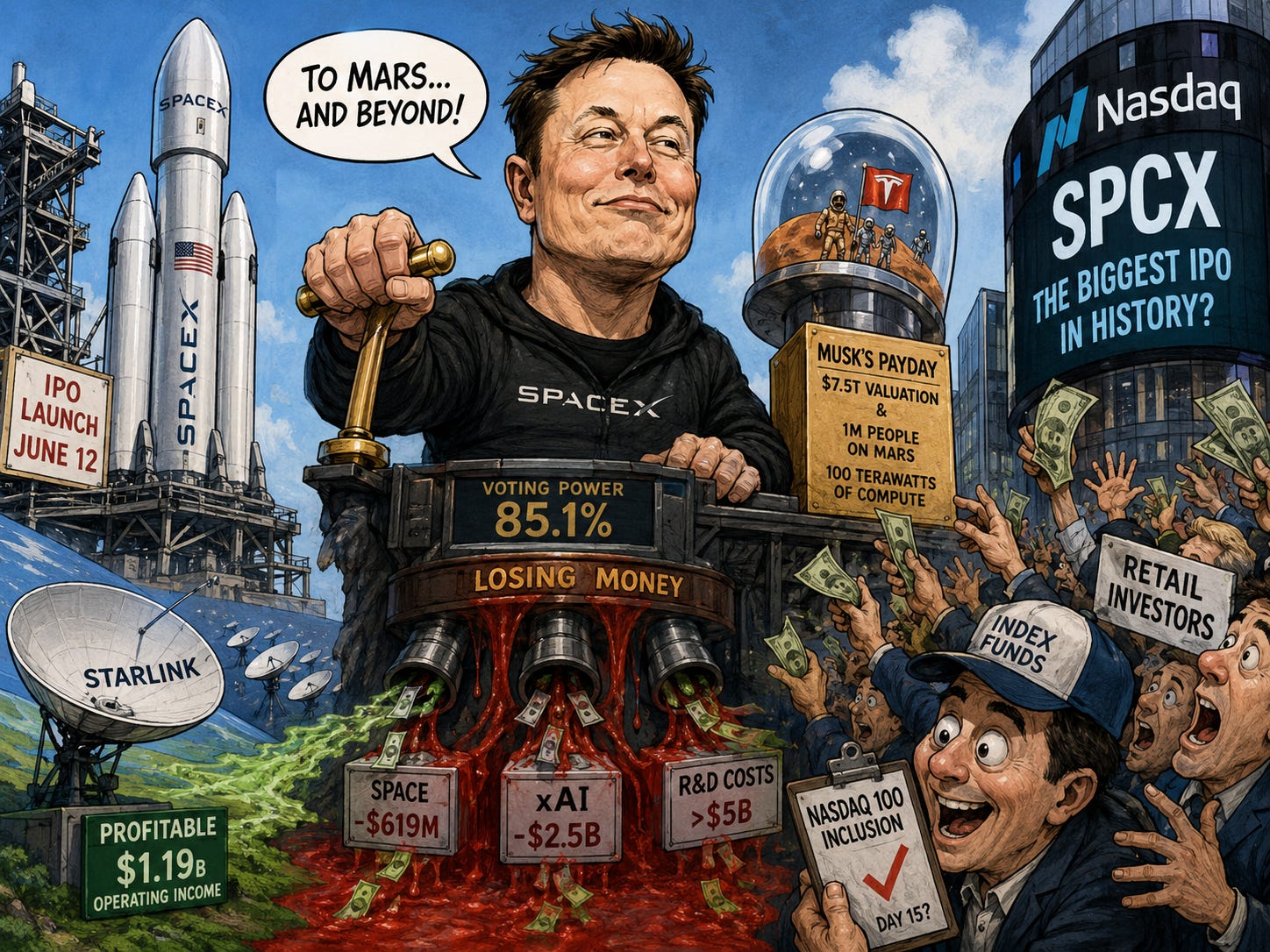
SpaceX filed its public prospectus yesterday, putting an official countdown on what is set to be the largest initial public offering ever to hit Wall Street. The company is seeking to raise around $80 billion at a roughly $1.7 trillion valuation, which would crush the previous record set by Saudi Aramco’s $26 billion debut in 2019. Shares will list on the Nasdaq and Nasdaq Texas under the ticker SPCX, with Goldman Sachs, Morgan Stanley, and Bank of America leading a syndicate of more than twenty underwriters. The roadshow begins June 4, pricing is expected June 11, and the stock is targeting its first day of trading on June 12. (Bloomberg)
The financial picture inside the S-1 confirms what private-market investors had long suspected. SpaceX generated $18.7 billion in revenue in 2025, but only one of its three operating segments actually turned a profit. Starlink, the satellite internet division, ended the most recent quarter with $1.19 billion in operating income and crossed 10.3 million subscribers across 164 countries. Everything else loses money. The space segment that builds and launches rockets lost $619 million in the same quarter. The AI unit, built on the absorbed xAI business, lost $2.5 billion, with research and development costs above $5 billion last year as the company stocks up on GPUs. (CNBC)
The governance structure is where retail investors need to pay the closest attention. Elon Musk will hold 85.1% of the voting power after the listing through a dual-class share structure that gives his Class B holdings ten votes each, and the total rises to 86% including senior executives. Outside shareholders effectively have no path to influence the company. Musk’s compensation plan reads more like science fiction than corporate targets. The full one billion performance shares only vest if SpaceX hits a $7.5 trillion market capitalization and establishes a permanent Mars colony of at least one million inhabitants, with separate tranches tied to space-based data centers generating 100 terawatts of compute. Roughly twenty percent of 2025 revenue came from federal government contracts, listed among the 36 pages of risk factors. (Yahoo Finance)
Sensei’s Insight: Strip out the Mars rhetoric and what’s really listing is a Starlink business wrapped in a rocket option. The $1.75 trillion valuation prices Musk’s full vision at retail, while one profitable segment carries everything else. Likely Nasdaq 100 inclusion within fifteen days of trading will force index funds to buy regardless of price, which is the demand setup retail investors should understand going in.
🦅 The Hawkish Camp Was Bigger Than Four Dissents
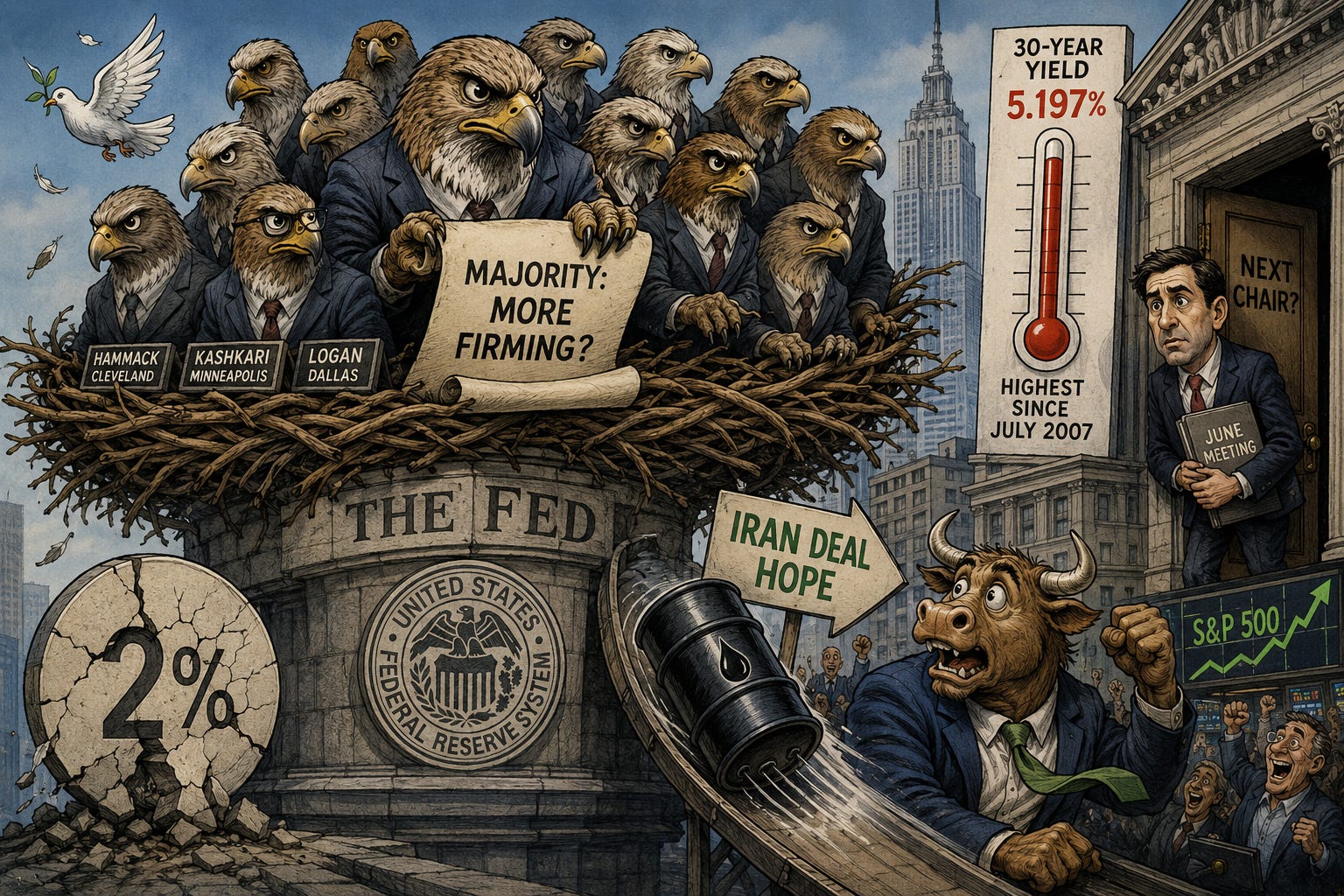
The April Federal Open Market Committee (FOMC) minutes hit the wire yesterday evening and the headline was the most lopsided Fed vote in 33 years. Beneath the 8-4 split, the room was more hawkish still. A majority of participants said some policy firming would likely become appropriate if inflation continues to run above the 2% target. “Many” indicated they would have preferred removing the easing bias language from the statement entirely. The vast majority noted an increased risk that inflation takes longer than expected to return to target. The Fed uses these words carefully. “A majority” means ten or more of the nineteen participants, the strongest hawkish signal in any minutes release this cycle. The three regional presidents who voted against the easing bias (Beth Hammack at Cleveland, Neel Kashkari at Minneapolis, and Lorie Logan at Dallas) were not isolated voices. Their concerns were shared widely enough that another seven or so participants quietly sympathised without dissenting publicly. (CNBC)
What kept markets from punishing the print was Iran. President Trump said US-Iran negotiations were in their “final stages” mid-morning yesterday, sending West Texas Intermediate crude down 5.66% to below $100 a barrel. With the energy leg of the inflation story softening in real time, stocks pushed to fresh highs even as the 30-year Treasury yield touched 5.197% intraday, the highest since July 2007. The real test now is the April Personal Consumption Expenditures (PCE) print on 28 May and Kevin Warsh’s debut meeting on 16 and 17 June. If oil stays sub-$100 and the Middle East de-escalation holds, the path back to cuts stays open. If energy reaccelerates, the hawkish majority on the Committee now has a written mandate to act on it. (Continuum Economics)
Sensei’s Insight: Stephen Miran, the lone dovish dissenter at the April meeting, has left the committee. The three regional hawks remain in place. Warsh inherits the chair next month with the voting math already moved against the cut path he was hired to deliver.
⚛️ Trump’s $2 Billion Bet on Quantum Sends Stocks Flying
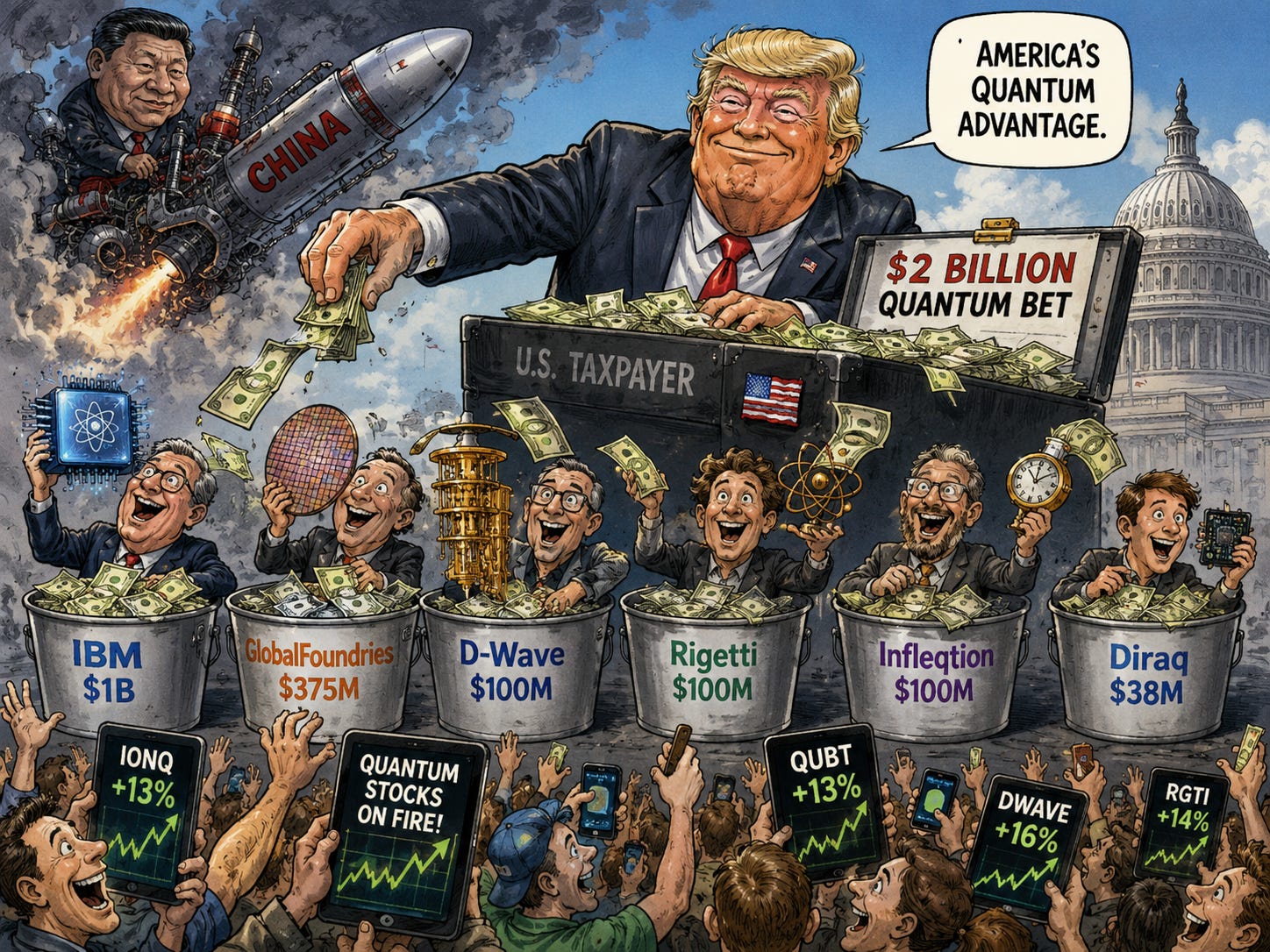
Quantum computing stocks ripped higher in early trading today after the Trump administration confirmed it is awarding $2 billion in grants to nine quantum-computing companies while taking minority equity stakes in each. IBM is the headline beneficiary, set to receive $1 billion to accelerate the development of specialized quantum chips, sending the stock up roughly 6.5% in premarket trading. GlobalFoundries is in line for $375 million, with shares surging toward a four-year high. D-Wave Quantum, Rigetti Computing, and Infleqtion are each receiving $100 million, with startup Diraq getting $38 million. The pure-play quantum names exploded: Infleqtion gained as much as 23% ahead of the open, D-Wave ran up 16%, and Rigetti jumped nearly 14%. (MarketWatch)
The deal extends a strategy Washington has now used multiple times in less than a year. The Commerce Department took a 10% stake in Intel last August in exchange for $8.9 billion in chip funding, and the government has since taken equity in rare-earth miners MP Materials and USA Rare Earth. IBM is pairing its $1 billion in federal funding with $1 billion of its own investment to build a new quantum chip foundry called Anderon, a joint structure that mirrors how the Intel deal was packaged. Commerce Secretary Howard Lutnick framed the announcement in national security terms, with the explicit goal of countering China’s aggressive spending on next-generation computing. (CNBC)
The market reaction tells you everything about how retail has been positioned. Quantum stocks have largely been speculative trades, with no path to meaningful revenue and a dependence on long-duration research narratives. A direct federal investment changes that profile overnight. The companies on the list now have a Washington backer with credibility and capital, while sympathy buying lifted names across the sector before all nine recipients were even confirmed: IonQ jumped 13%, Quantum Computing Inc. gained another 13%. The flip side is dilution. Minority equity stakes for the government mean fewer shares for existing holders, and a federal stakeholder brings new political and strategic constraints. (Yahoo Finance)
Sensei’s Insight: This is American industrial policy in real time. Government ownership puts a floor under names that previously had none, but it also caps how freely these companies can operate. The bigger tell is the sympathy buying across names not yet confirmed in the deal. Retail is now treating the entire quantum sector as a single risk-on trade.
Stories You Might Have Missed
🏦 Trump Tells Fed to Open Payment Rails to Crypto and Fintech
President Trump signed an executive order Monday directing federal financial regulators to review barriers to fintech access to Federal Reserve payment rails, building on the Fed’s December prototype for a “skinny master account” with no interest paid, no discount-window access, and a balance cap of the lesser of $500 million or 10% of assets. The order asks the Fed to report back in 120 days and decide complete applications within 90 days if direct access is legally permissible. Structurally positive for Coinbase, Circle, PayPal, Block, and Robinhood, which could potentially settle payments more directly without sponsor banks. Competitive headwind for sponsor banks like Cross River and Customers Bancorp. The Independent Community Bankers of America has already pushed back, asking the Fed to retain discretion to deny applications from crypto-linked firms. (Reuters)
🥩 Cargill Locks Out 1,700 Beef Workers in Colorado
Cargill locked out roughly 1,700 Teamsters at its Fort Morgan, Colorado beef plant earlier this week after workers rejected the company’s “last, best and final” offer by close to 90%. The plant has not been processing cattle since April 23. Cargill offered a five-year deal with a 70-cent first-year wage rise falling to 30 cents by year five; the union wanted a dollar in year one and a three-year contract. Live cattle futures fell nearly 1% on the news. The US cattle herd sits at 86.2 million head, the smallest in 75 years, with the US Department of Agriculture forecasting beef prices up 10.1% in 2026. Cargill is one of four packers controlling about 85% of US slaughter, so a drawn-out shutdown could squeeze Tyson, Kroger, Walmart, and McDonald’s at the meat counter. (Reuters)
🏭 Ukrainian Drones Knock Out a Quarter of Russian Refining
Ukrainian drone strikes have forced almost every major refinery in central Russia to halt or sharply cut output. The damage list runs across Kirishi (offline since May 5), Ryazan, Moscow, Yaroslavl, and Lukoil’s NORSI plant at Kstovo, struck again yesterday. Combined annual capacity affected: more than 83 million tonnes, about a quarter of Russia’s total. Those plants supply over 30% of Russian petrol and roughly 25% of diesel. Ukraine’s drone command said six of ten refineries it has hit this month are fully shut, and Moscow extended its petrol export ban through the end of July to protect domestic supply. The squeeze pushes more Russian crude onto export markets while tightening global product supply, supporting refining margins at Valero, Marathon Petroleum, Phillips 66, and HF Sinclair. Oil and gas taxes still fund roughly a quarter of Russia’s federal budget. (Reuters via Moscow Times)
🇹🇼 Trump Says He'll Call Taiwan's President, $14B Arms Package Pending
Trump said yesterday that he will speak with Taiwan President Lai Ching-te while still weighing whether to formally send Congress a roughly $14 billion arms package authorised in January. No call has been scheduled, but a direct Trump-Lai conversation would be the first leader-to-leader contact since Washington switched diplomatic recognition to Beijing in 1979. Lai used his second-anniversary address yesterday to say Taiwan's future "must be determined together by our 23 million people." The move lands one week after Trump's summit with Xi, where Taiwan was explicitly raised, and puts Taiwan Semiconductor Manufacturing Company back in focus given its 92% share of leading-edge chip production for customers including Nvidia and Apple. (Bloomberg)
🔗 Connect with Us
Stay plugged in across platforms:
Sensei on X: sensei_live_
Martyn Lucas on X: MartynInvestor
Vaz on X: eVTOLHUB
📺 YouTube Channel (Live & Replays): Martyn Lucas Investor