This content is for informational and educational purposes only and does not constitute financial advice. Always do your own research. Not financial advice (NFA).
👀 Today’s Stories at a Glance
🚢 Hormuz seizures expose ceasefire gaps: Gunboats grab two container ships as Tehran pockets fresh transit tolls from the Strait.
🇪🇺 Brussels frees €90bn for Kyiv: Hungary’s veto collapses, Druzhba crude flows again, defence contractors line up for the tranche.
✈️ Boeing beats, China deal pending: Record $695bn backlog and a possible 500-jet Chinese order hinge on next month’s Trump-Xi summit.
🕵️ $430M oil short front-runs Trump: Fourth suspicious trade this month landed two minutes before a Truth Social ceasefire post.
🌍 Beijing grounds Taiwan president’s jet: Three island nations revoke overflight permits under Chinese debt pressure, nudging semiconductor tail risk higher.
🏛️ Ballroom contract hides donor names: Lockheed, Palantir and Alphabet surface as the usual conflict-of-interest review is waived.
🔧 TSMC plans Arizona packaging fab: Advanced chip packaging moves stateside by 2029 as Beijing tightens the screws on Taipei.
⚡ GE Vernova rides AI power surge: Orders jump 71%, backlog hits $163bn, widening the AI trade into grid equipment.
🧠 One Big Thing
Hormuz Premium Turns Permanent
The Strait of Hormuz crisis escalated yesterday when Iranian forces seized two container ships and damaged a third, hours after Trump extended the US-Iran ceasefire indefinitely. A truce that pauses missiles but permits ship seizures and state-collected transit tolls is not peace. Iran's deputy parliament speaker confirmed the first Hormuz toll revenues landed in the central bank overnight. Brent swung between $96.83 and $102 a barrel, war-risk insurance jumped roughly twelvefold, and jet fuel sits near $209. If Tehran keeps monetising the strait, the oil premium outlasts every headline about talks.
⚖️ Fear & Greed
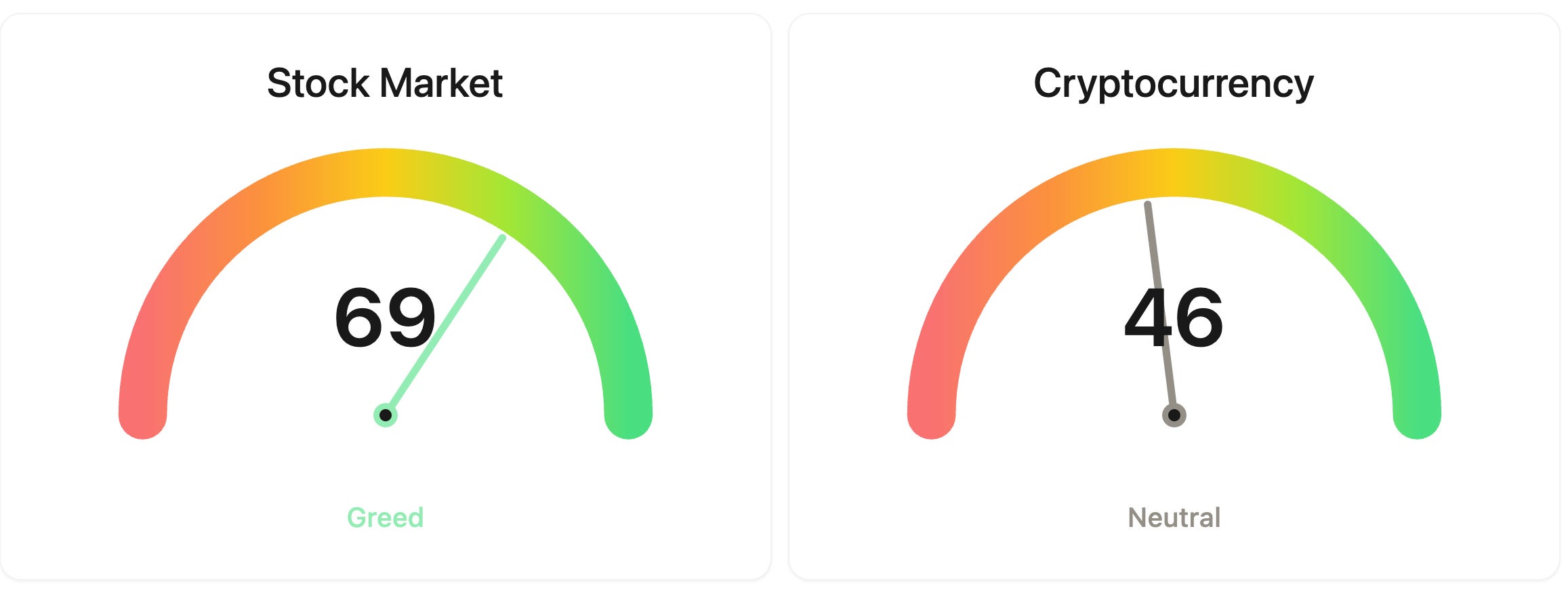
📉 The Number That Matters
$2.1 BILLION
Anonymous traders have placed roughly $2.1 billion in well-timed Iran-linked bets this month, including a $430 million Brent short that cleared minutes before Trump's ceasefire post. The $2.1 billion pattern now sits with the Commodity Futures Trading Commission.
📊 Market Snapshot
Cryptocurrencies:
Bitcoin (BTC): $77741 (▼ -0.59%)
Ethereum (ETH): $2330 (▼ -1.90%)
XRP: $1.42 (▼ -0.90%)
Equity Indices (Futures):
S&P 500: $7123 (▼ -0.10%)
NASDAQ 100: $27020 (▼ -0.23%)
FTSE 100: £10411 (▼ -0.61%)
Commodities & Bonds:
10-Year US Treasury Yield: 4.31% (▲ 0.09%)
Oil (WTI): $93 (▲ 0.46%)
Gold: $4718 (▼ -0.55%)
Silver: $75.52 (▼ -2.87%)
Data as of: UK (BST) 13:00 / US (EDT): 08:00 / Asia (Tokyo): 22:00
✅ 5 Things to Know Today
🚢 Iran seizes ships, shreds ceasefire optics
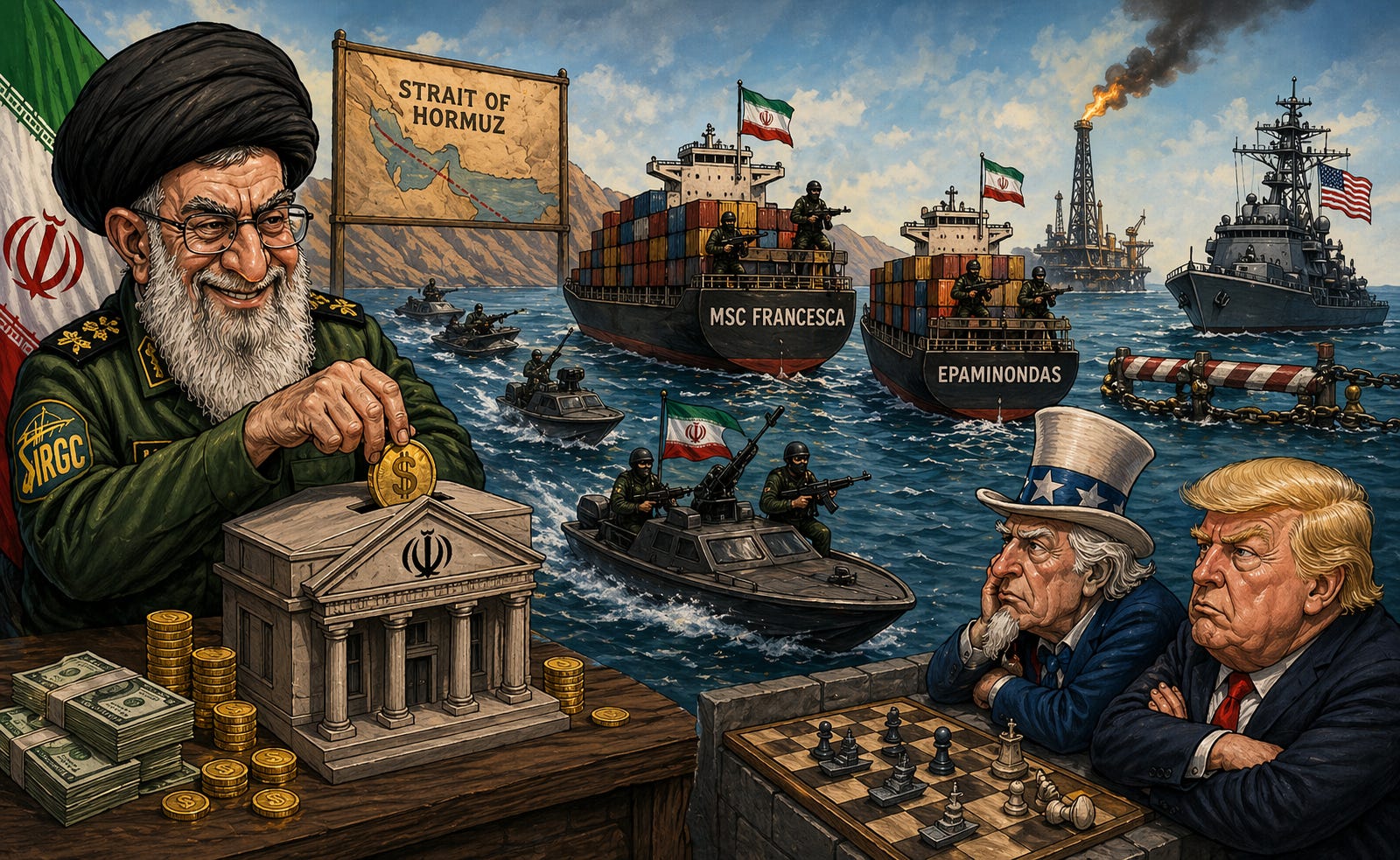
Iran’s Islamic Revolutionary Guard Corps (IRGC) attacked at least three commercial vessels in the Strait of Hormuz yesterday morning and hauled off two of them, the container ships MSC Francesca and Epaminondas. The strikes, involving gunboats and rocket-propelled grenades, caused heavy damage to the bridge of one ship. Fifteen Filipino crew were confirmed safe. The raids came hours after President Trump extended the US-Iran ceasefire indefinitely, exposing how little the truce actually covers. Overnight, Iran’s deputy parliament speaker said the first transit-toll revenues from Hormuz had landed in the state’s central bank. (CNBC)
The ceasefire pauses missile strikes but not the economic strangulation. The US naval blockade keeps Iranian ports sealed, Central Command has now turned around 31 vessels, and Iran is charging whoever dares to transit. Brent crude swung between $96.83 and $102 a barrel, WTI settled near $91.54, and war-risk insurance premiums for Gulf tankers have jumped to roughly $7.5 million per voyage versus $625,000 pre-war. Airlines, shippers, chemicals and anything sensitive to jet fuel (now near $209 a barrel) stay squeezed. Energy majors and tanker names like Frontline and International Seaways keep catching the bid. (Reuters)
Sensei’s Insight: A ceasefire that still allows ship seizures and state-collected transit tolls is a trading premium, not a peace. The thing to watch is whether Iran’s new Hormuz toll becomes a permanent revenue line. If Tehran can monetise the strait without ending the blockade, this oil premium doesn’t go away with talks.
🇪🇺 EU unlocks €90bn Ukraine loan as Russian oil restarts
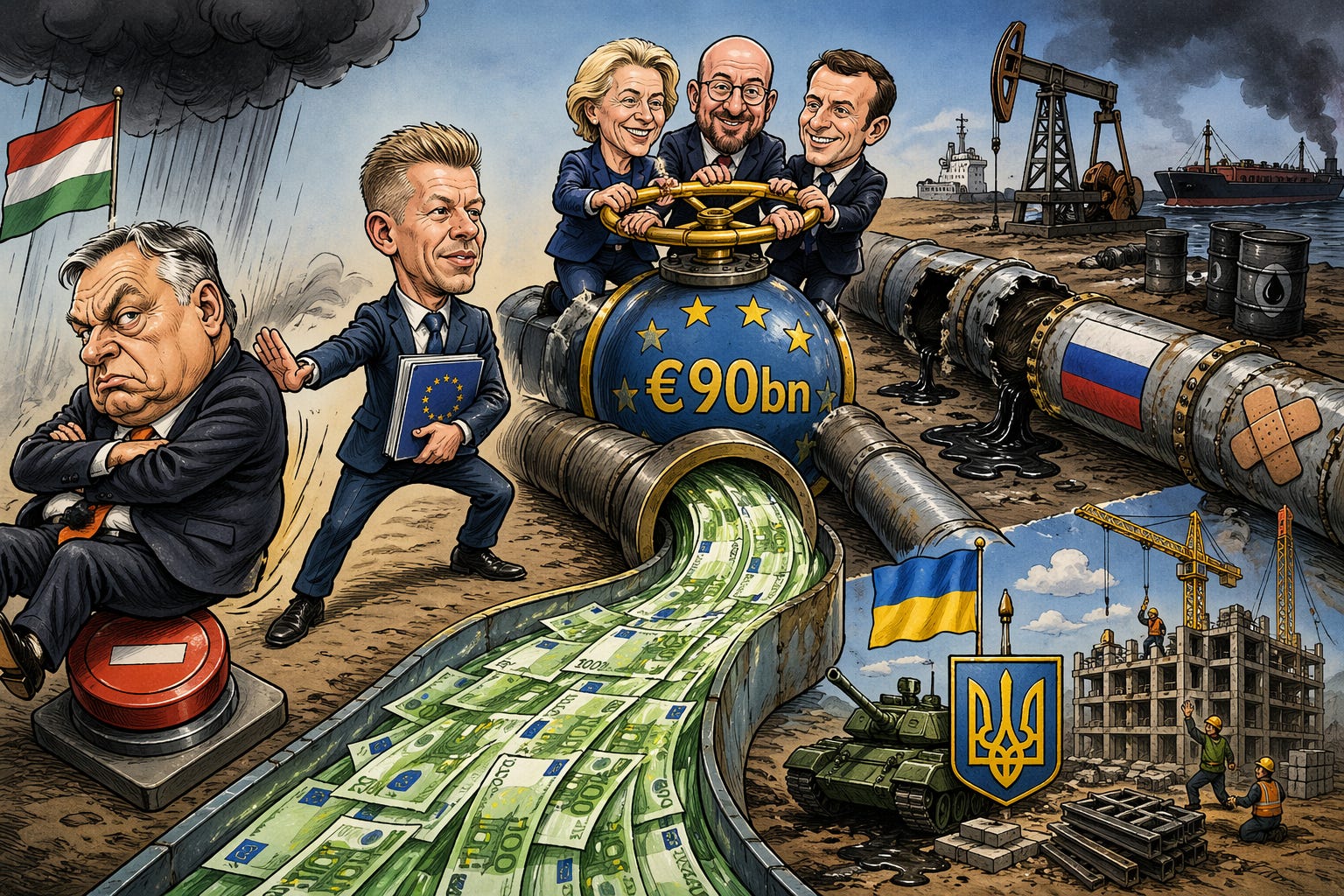
Russian crude started flowing again through Ukraine’s section of the Druzhba pipeline yesterday at 09:35 GMT, three months after a Russian drone strike shut it down. Within hours, European Union ambassadors provisionally approved a €90 billion loan to Kyiv that Hungary had been blocking since February. Final sign-off by all 27 member states came through this morning, along with the bloc’s 20th sanctions package against Russia. The loan splits roughly €60 billion for Ukrainian defence procurement and €30 billion for budget support, spread across 2026 and 2027. First disbursement is expected by late May or early June. (Reuters)
The unlock matters for retail investors in three ways. Russian crude returning to Europe marginally eases the oil tightness caused by the Hormuz crisis. The €60 billion military tranche is a direct tailwind for European defence names like Rheinmetall, BAE Systems, Leonardo and Saab, plus Ukraine reconstruction-linked stocks such as Heidelberg Materials and CRH. The new sanctions package puts fresh pressure on Russia’s “shadow fleet” of tankers. Slovak Prime Minister Robert Fico has already grumbled he “would not be surprised if the loan were unblocked and then oil supplies were cut off again.” Bratislava remains the next potential flashpoint.
Sensei’s Insight: The real shift here is the end of Viktor Orbán’s veto. His election loss earlier this month broke Hungary’s grip on EU Ukraine policy in a way nothing else had. Successor Péter Magyar takes office next month. That changes the bloc’s posture toward Russia for the rest of this war.
✈️ Boeing posts surprise beat, eyes 500-jet China order
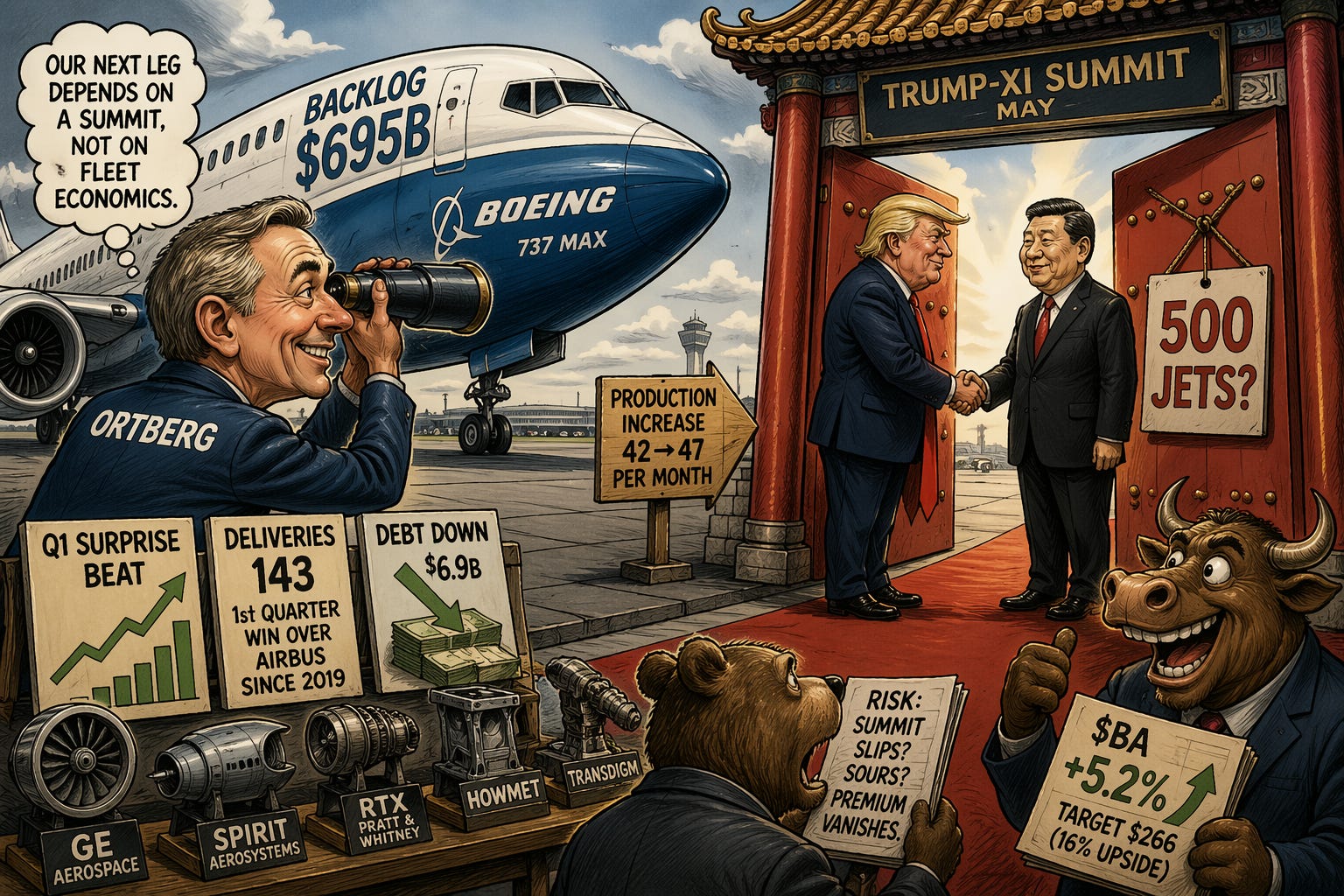
Boeing reported first-quarter revenue of $22.22 billion yesterday, beating the $21.97 billion consensus, with an adjusted loss of just $0.20 a share against a forecast loss of $0.83. Revenue climbed 14% year-over-year. The planemaker delivered 143 commercial aircraft, its first quarterly delivery win over Airbus since 2019, and cut total debt by $6.9 billion in the quarter. Backlog hit a record $695 billion. Shares jumped 5.2% to close around $229. CEO Kelly Ortberg told Reuters that a potential Chinese airline order of up to 500 737 MAX jets plus widebodies now depends on the Trump-Xi summit scheduled for next month. (CNBC)
China was once 25% of Boeing’s order book. It’s now roughly 2%, or about 130 planes out of a 6,100-aircraft backlog. A 500-jet deal would rank among the largest commercial aircraft orders ever, and would validate Boeing’s plan to push 737 MAX production from 42 a month to 47 by mid-year. Suppliers stand to benefit across the chain: GE Aerospace (LEAP engines), Spirit AeroSystems (fuselages), RTX’s Pratt & Whitney, Howmet and TransDigm. Wall Street’s consensus price target of roughly $266 implies 16% upside from here. Ortberg also guided to full-year free cash flow of as much as $3 billion. (Reuters)
Sensei’s Insight: Ortberg effectively pinned Boeing’s next leg higher on a presidential summit rather than on fleet economics. That makes Boeing a stock whose catalyst is geopolitical, not industrial, which is an unusual framing for an aerospace earnings beat. If the May summit slips or sours, the China premium unwinds fast.
🕵️ $430M oil short beats Trump post by minutes
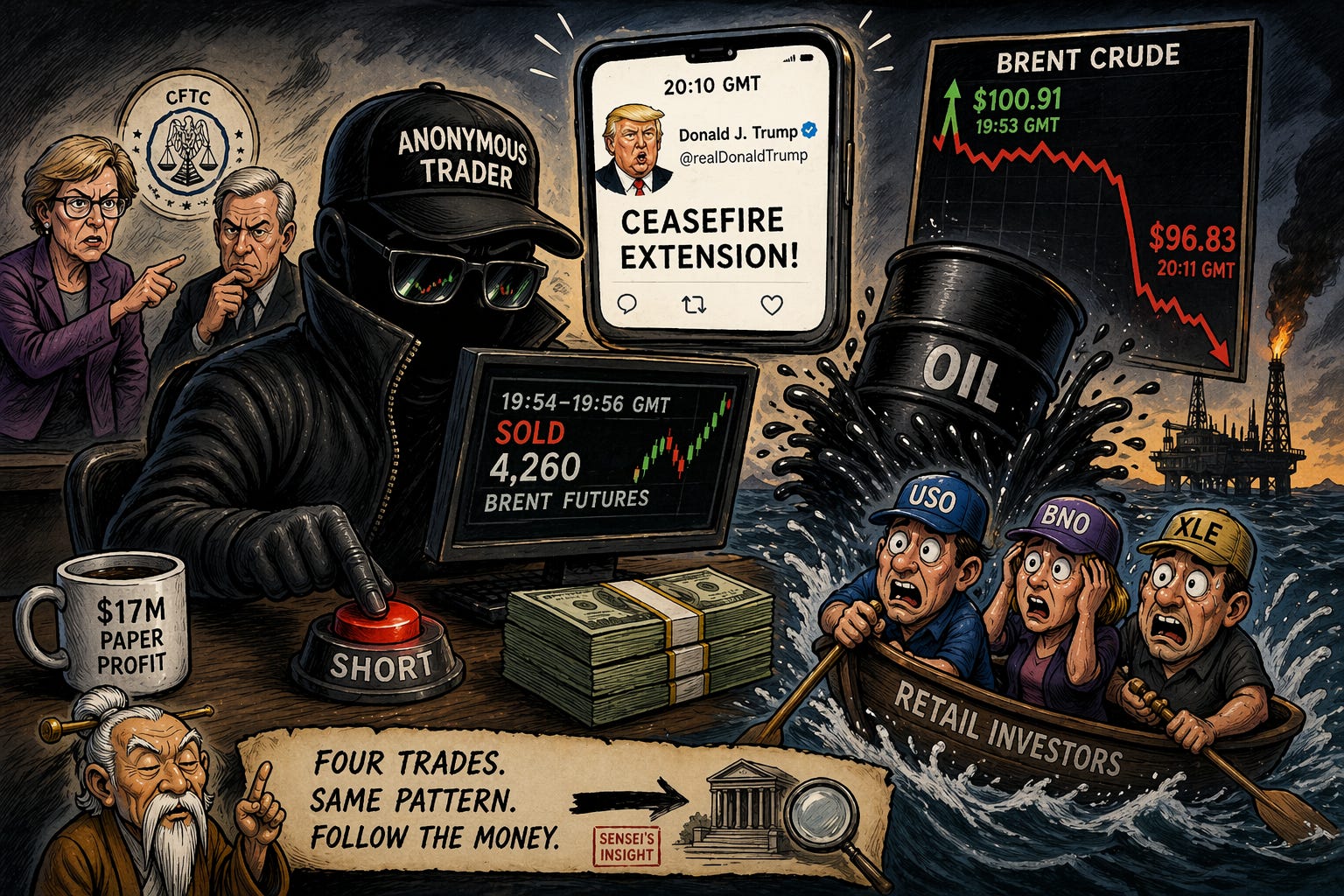
Anonymous traders sold 4,260 Brent crude futures contracts, worth roughly $430 million, in a two-minute window between 19:54 and 19:56 GMT on Tuesday evening. Trump posted his ceasefire-extension announcement on Truth Social at 20:10 GMT. Brent promptly slid from $100.91 to $96.83 a barrel, generating a paper profit of around $17 million in minutes. It’s the fourth suspicious, well-timed bet tied to a Trump Iran announcement in just over a month: roughly $500 million in March before a delayed strike, $950 million before the original April ceasefire, $760 million before Iran’s Hormuz declaration. April’s total suspicious notional now runs near $2.1 billion. (Reuters)
The pattern turns an Iran story into a market-fairness story. The US Commodity Futures Trading Commission (CFTC) has been probing the earlier trades since mid-month and has requested data from CME Group and Intercontinental Exchange (ICE). Senators Elizabeth Warren and Sheldon Whitehouse have pressed for a broader inquiry, and the White House has reportedly warned staff against trading on non-public information. For anyone holding oil exchange-traded funds like USO, BNO or the XLE energy sector ETF, the bets are landing on the other side of retail trades in the exact same markets. (Reuters)
Sensei’s Insight: Four trades in a month, all correctly timed, all in thin post-settlement hours. If the CFTC brings charges, this becomes the largest commodities insider-trading action in decades. The more interesting ripple is whether it forces the administration to change how market-moving posts get released.
🌍 China pressures Africa to ground Taiwan’s president
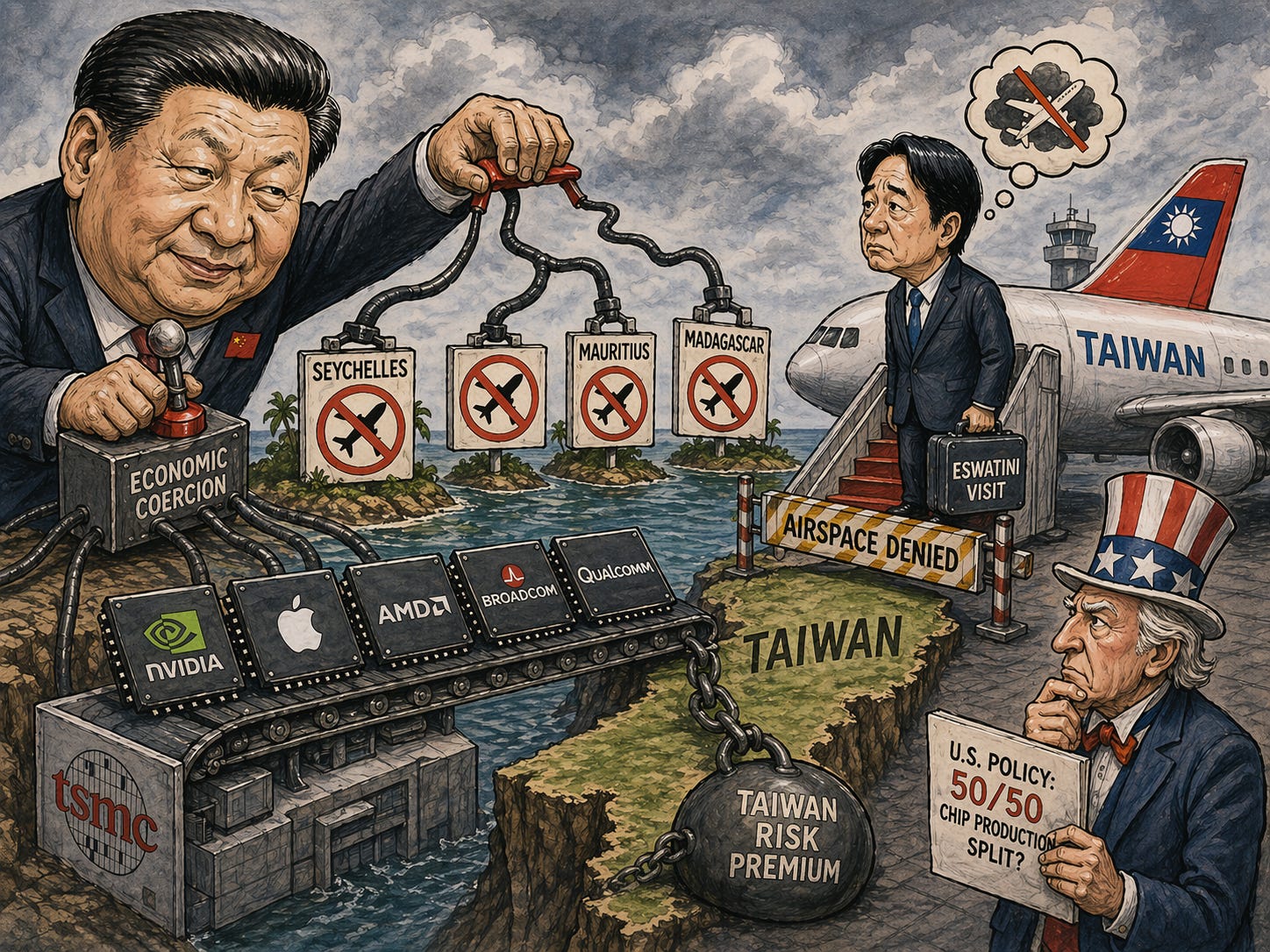
Taiwan President Lai Ching-te’s trip to Eswatini was cancelled yesterday after Seychelles, Mauritius and Madagascar abruptly revoked overflight permissions for his presidential aircraft. Taipei’s office blamed “economic coercion” by Beijing, with a senior Taiwan security official telling Reuters that China had specifically threatened to withdraw debt relief from the three island nations. Eswatini is Taiwan’s only remaining formal diplomatic ally in Africa and one of 12 worldwide. It’s the first known case in which a Taiwanese president has had to cancel a foreign trip because of airspace denial. The US State Department called the move “an abuse of the international civil aviation system.” (Reuters)
For retail investors, any tightening of the Taiwan screw reads through one stock: TSMC (Taiwan Semiconductor Manufacturing Company), which makes roughly 90% of the world’s most advanced chips. Every Nvidia GPU, every iPhone processor, every artificial-intelligence accelerator runs through Taiwan. That puts TSM, Apple, Nvidia, AMD, Broadcom and Qualcomm indirectly exposed to every new form of Chinese pressure on the island. Beijing’s new tactic is diplomatic asphyxiation rather than military force, and it’s cheaper and more deniable than sending warships. The Trump administration is also pushing Taiwan toward a “50/50” semiconductor production split with US fabs. (AP)
Sensei’s Insight: This is a new instrument in Beijing’s Taiwan kit. Military pressure draws global headlines and condemnation. Third-country airspace coercion is quieter, cheaper, and harder to counter. If the tactic repeats, the Taiwan risk premium baked into the whole semiconductor complex deserves a fresh look.
📌 Stories you might have missed
🏛️ White House ballroom contract shields donor names
A contract obtained through a Freedom of Information Act lawsuit by watchdog group Public Citizen shows the $300 million White House ballroom project explicitly preserves donor anonymity and exempts the White House itself from the conflict-of-interest review that applies to the National Park Service and Interior Department. Thirty-seven publicly disclosed donors include Lockheed Martin (over $10 million contributed while holding $33.4 billion in 2025 federal contracts), Palantir, Amazon, Google, Microsoft, Coinbase, T-Mobile, Comcast and Booz Allen Hamilton. Alphabet’s $22 million contribution came as part of settling Trump’s lawsuit over his post-January 6 YouTube suspension. Headline-risk story for named donors rather than an immediate stock mover. (Reuters)
🔧 TSMC to open Arizona packaging plant by 2029
TSMC (Taiwan Semiconductor Manufacturing Company) said yesterday it now plans to open an advanced chip-packaging plant in Arizona by 2029, with construction already under way. Packaging, the step where wafers are cut and assembled into finished chips, has been one of the critical bottlenecks for artificial-intelligence accelerators: even chips fabricated at TSMC’s Arizona fabs currently have to travel back to Taiwan to be packaged. Moving that step stateside makes the US semiconductor supply chain meaningfully more self-sufficient at the exact moment Beijing is intensifying pressure on Taipei. Direct beneficiaries include TSMC itself, US customers Apple, Nvidia, AMD and Qualcomm, and packaging partner Amkor. (Reuters)
⚡ GE Vernova soars on AI-driven power demand boom
GE Vernova raised its 2026 revenue and margin outlook yesterday as orders for gas turbines and grid equipment surged 71%, with backlog ballooning to $163 billion. The stock jumped more than 13% on the day. Data centres and artificial-intelligence-driven electricity demand did the heavy lifting. The result broadens the AI investment trade well beyond chips and hyperscalers into the “picks and shovels” of the electric grid: turbine makers, transformer suppliers and transmission-equipment builders. Industrial and utility capital expenditure is now visibly reshaping around AI power needs. Adjacent names catching the read-through include Siemens Energy, Eaton, Quanta Services and Vertiv. (Reuters)
🔗 Connect with Us
Stay plugged in across platforms:
Sensei on X: sensei_live_
Martyn Lucas on X: MartynInvestor
Vaz on X: eVTOLHUB
📺 YouTube Channel (Live & Replays): Martyn Lucas Investor