

This content is for informational and educational purposes only and does not constitute financial advice. Always do your own research. Not financial advice (NFA).
👀 Today’s Stories at a Glance
🔍 Big Tech’s spending spooks the market: Alphabet and Tesla both fell after hours as ballooning AI budgets overshadowed strong sales.
🛢️ Oil races toward $100: Brent jumped almost 5% to nearly $98 after Houthi missiles struck two Saudi oil tankers.
₿ Bitcoin slips as odds fade: BTC eased toward $65,700 as CLARITY Act passage odds tumbled to 38% on Democrat pushback.
🏦 The ECB decides today: Europe’s central bank is set to hold at 2.25%, leaving Lagarde’s tone the market’s real signal.
🖥️ Intel reports into a high bar: The chipmaker, up 163% this year, reports tonight with its foundry turnaround under the microscope.
💼 ServiceNow jumps as software wins: The AI-software firm beat and raised guidance, rising about 4% while the big spenders got punished.
💻 IBM stumbles on weak sales: Revenue missed and mainframe sales fell 42%, though the stock steadied after last week’s 25% crash.
🥇 Gold slips from a two-week high: Bullion eased to about $4,089 after touching $4,130, torn between Mideast havens and rising yields.
🔍 Deep Dive, SpaceX playbook check-in: SPCX hit the retest zone weeks early, near its post-IPO low, as the IPO playbook’s calls land.
📈 Chart of the Day, SpaceX: SPCX broke to a fresh post-IPO low near $115, the lower edge of the playbook’s retest band.
🧠 One Big Thing
The market just punished Alphabet for spending more even though the demand was clearly there, with cloud revenue up 82%. That is the shift worth noticing: investors no longer treat AI capital spending as automatically good, they want proof it pays off. At the same time ServiceNow, which sells AI software rather than building the infrastructure, jumped about 4%. A rotation is forming, away from the capital-heavy hyperscalers and chip suppliers and toward the software layer that monetises AI without the balance-sheet risk. Watch whether Intel tonight gets the Alphabet treatment for its foundry cash burn, or the ServiceNow one.
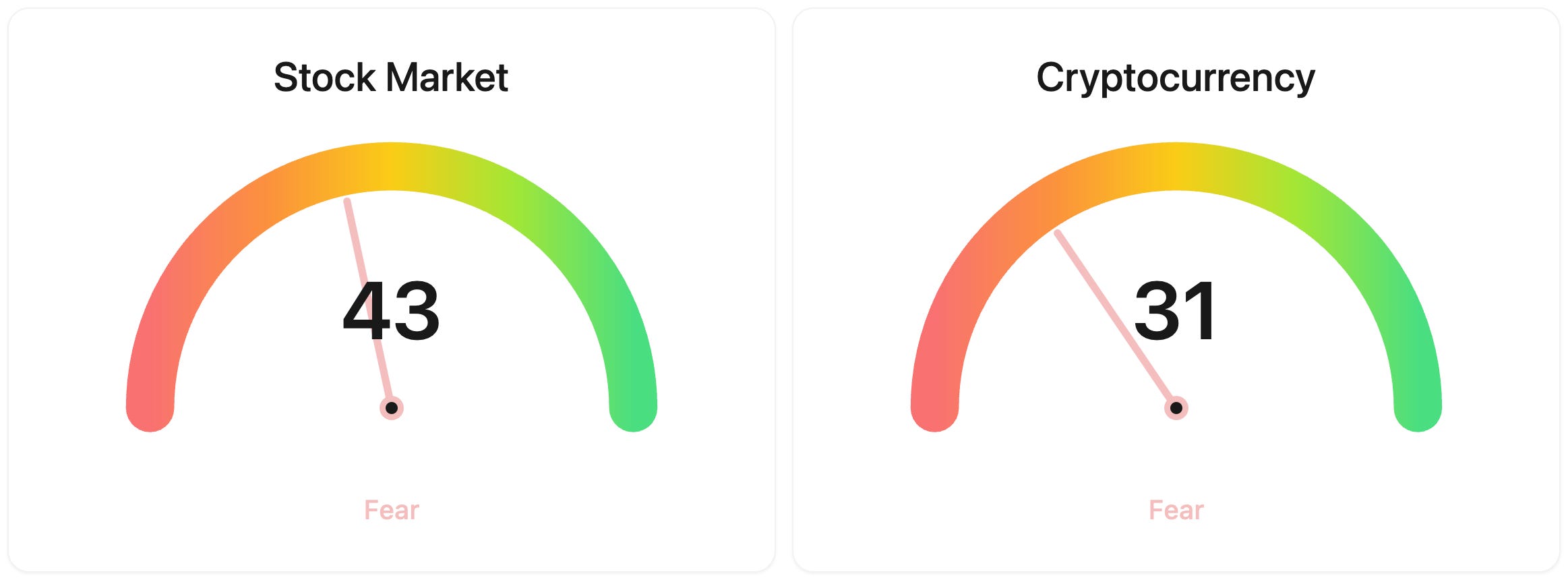
⚖️ Fear & Greed
📉 The Number That Matters
$205 billion
Alphabet lifted its 2026 capital-spending plan to as much as $205 billion, and that rising bill, not its revenue beat, is what sent the shares lower after hours and reawakened fears over the cost of the AI build-out.
⚔️ Winners vs Losers
Winners
NVEC 0.00%↑: +26.62% NVE Corporation surged after reporting fiscal first quarter revenue up 81% to $11.0 million and earnings of $1.32 per diluted share, with management pointing to accelerating semiconductor demand and newly launched medical sensor products.
HYLN 0.00%↑: +16.28% Hyliion Holdings jumped after being awarded a $41.7 million cost plus fixed fee contract from the Office of Naval Research covering the design, construction, testing and delivery of 2 megawatt and 3 megawatt KARNO power generation systems.
SKHY 0.00%↑: +6.87% SK hynix depositary receipts climbed as the memory complex extended its rebound on rising DRAM and NAND contract prices. The move is amplified by arbitrage positioning ahead of the July 29 window that opens conversion between the receipts and the underlying Korean shares.
NOW 0.00%↑: +6.83% ServiceNow rallied after beating the high end of its guidance on every top line and profitability metric, with subscription revenue up 23% in constant currency and full year subscription guidance lifted to $15.77 billion.
URI 0.00%↑: +6.76% United Rentals climbed on record second quarter results, posting adjusted earnings of $12.76 per share on revenue of $4.41 billion and raising full year revenue guidance to a range of $17.5 billion to $17.8 billion.
RTX 0.00%↑: +5.71% RTX Corporation gained after its second quarter results landed before the open, with the aerospace and defense group riding surging global defense budgets and a record $271 billion backlog into the print.
LMT 0.00%↑: +5.49% Lockheed Martin rose after reporting second quarter results before the open, a sharp turn from a first quarter that missed on both lines, with missile and fire control programs including PAC-3 and THAAD converting backlog into revenue.
TMO 0.00%↑: +5.02% Thermo Fisher Scientific advanced after releasing second quarter results before the open, extending a run that has the stock up more than 14% over the past month on bioproduction and pharma services strength.
Losers
ROL 0.00%↑: −16.95% Rollins slumped after second quarter revenue of $1.08 billion and adjusted earnings of $0.32 per share both missed estimates, with management flagging slower growth in residential pest control brands that lean on consumer initiated search demand.
TSLA 0.00%↑: −5.89% Tesla fell after posting record quarterly revenue of $28.24 billion but adjusted earnings of just $0.33 per share against a $0.53 consensus, as capital expenditure surged 142% to $5.79 billion and free cash flow turned negative.
TXN 0.00%↑: −4.14% Texas Instruments slipped despite a second quarter double beat and above consensus third quarter guidance, as investors took profits on a stock that had gained more than 65% year to date heading into the print.
GOOGL 0.00%↑: −6.11% Alphabet dropped after lifting 2026 capital expenditure guidance to a record $195 billion to $205 billion, overshadowing a quarter in which revenue reached $119.8 billion and Google Cloud revenue grew 82%.
📊 Market Snapshot
Cryptocurrencies:
Bitcoin (BTC): $65,733 (▼0.50%)
Ethereum (ETH): $1,928 (▼0.24%)
XRP: $1.14 (▼0.48%)
Equity Indices (Futures):
S&P 500: 7,512 (▼0.37%)
NASDAQ 100: 29,050 (▼0.45%)
FTSE 100: 10,702 (▼0.05%)
Commodities & Bonds:
10-Year US Treasury Yield: 4.68% (▲0.34%)
Oil (WTI): $91 (▲4.82%)
Gold: $4,090 (▼0.93%)
Silver: $58.75 (▼1.64%)
Data as of: UK: 11:40am BST / US: 6:40am EDT / Asia (Tokyo): 7:40pm JST
✅ 5 Things to Know
🔍 Google beats on almost everything and still falls
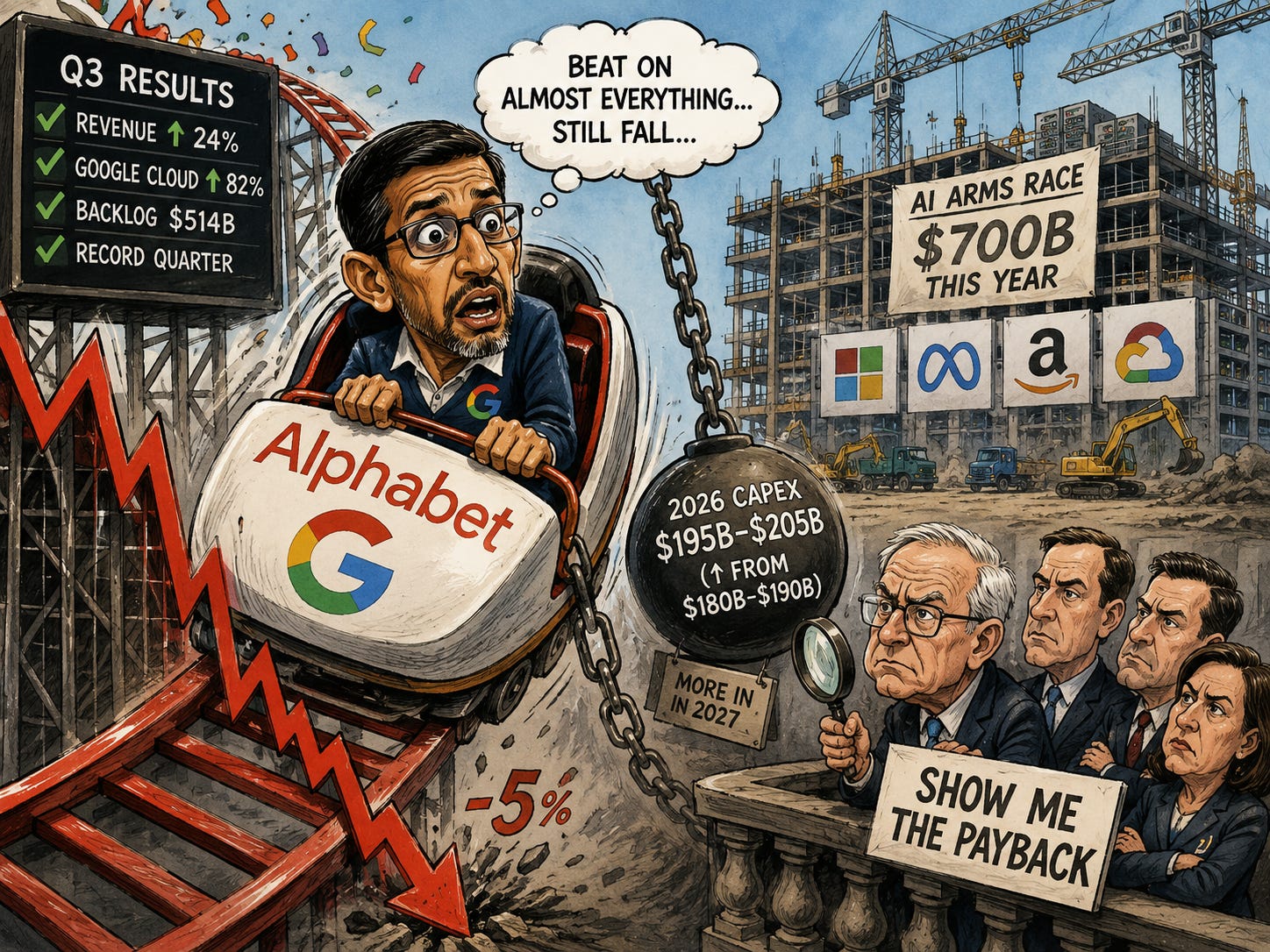
Alphabet posted one of its strongest quarters ever after the US close yesterday, and the shares still dropped about 5%. Revenue rose 24% on the year to $119.8 billion, ahead of the roughly $117 billion analysts expected. Google Cloud grew 82% to $24.8 billion, and the backlog of signed but not yet delivered cloud work reached a record $514 billion. The catch was a single line. Alphabet raised its 2026 capital-spending plan to between $195 billion and $205 billion, up from $180 to $190 billion and well above the roughly $188 billion the market had modelled, with quarterly spending hitting a record $44.9 billion and free cash flow for the quarter turning negative by $5.9 billion (CNBC).
Here is why a great quarter got punished. For most of the past two years, when a big tech firm said it would spend more on AI, its stock went up, because heavier spending was read as winning the race for computing power. That rule has flipped. Capital spending is cash that leaves today to build data centres and buy chips, and it then shows up as a cost on the books for years afterwards, whether or not the promised revenue arrives on time. By lifting its build toward $205 billion and flagging still more in 2027, Alphabet is committing to a wave of future costs, and investors have stopped funding that on faith. They now want to know when it pays back, and a strong cloud number is not enough if the bill is growing faster than the proof.
Alphabet is not alone in this. The five largest US cloud builders are on course to spend around $700 billion this year, most of it on AI, each racing not to be the one that under-builds and loses the decade. The problem is that AI revenue is still arriving in a trickle next to that flood of spending, and Tesla, reporting the same evening, also swung to burning cash. Microsoft, Meta and Amazon all report in the coming days and face the same test, so the question for each is how it frames the payback, not just the spend (CNBC).
Sensei’s Insight: Google beat on almost everything and still fell, and that is the whole story. The market has stopped rewarding AI spending on trust and now asks when it pays back. Watch Microsoft, Meta and Amazon next: raise the budget without the proof and they get the same treatment.
🛢️ Oil races toward $100 as tankers burn

Oil surged again today, with Brent crude climbing about 4.6% to nearly $98 a barrel, its highest since late May, and US West Texas Intermediate up almost 5% to around $90.60. The trigger was a sharp escalation at sea: Iran-backed Houthi militants said they fired missiles and drones at two Saudi oil tankers, the Encelia and the Layla, accusing them of breaking a blockade. The strikes came as the US renewed threats to widen its campaign against Iran, with reports of a B-1 bomber deployment, keeping the Strait of Hormuz, the channel that carries roughly a fifth of the world’s seaborne oil, at the centre of the market’s worry (CNBC).
The move matters far beyond the petrol pump. The slide in oil earlier this summer, from around $95 to the low $70s after a June ceasefire, was the single biggest reason inflation cooled on both sides of the Atlantic. A sustained climb back toward triple digits would unwind much of that relief and strengthen the case for central banks to keep rates high. It lands a week before the Federal Reserve meets on the 28th and 29th, and on the same morning the European Central Bank sets policy, sharpening every “higher for longer” conversation in the room.
Sensei’s Insight: This is the story that quietly undoes the good inflation news. Attacks on tankers, not just talk, is what took Brent to a two-month high. If it holds near $98, the friendly inflation prints of this summer may prove to be the last soft ones.
₿ Bitcoin slips as the crypto bill’s odds tumble
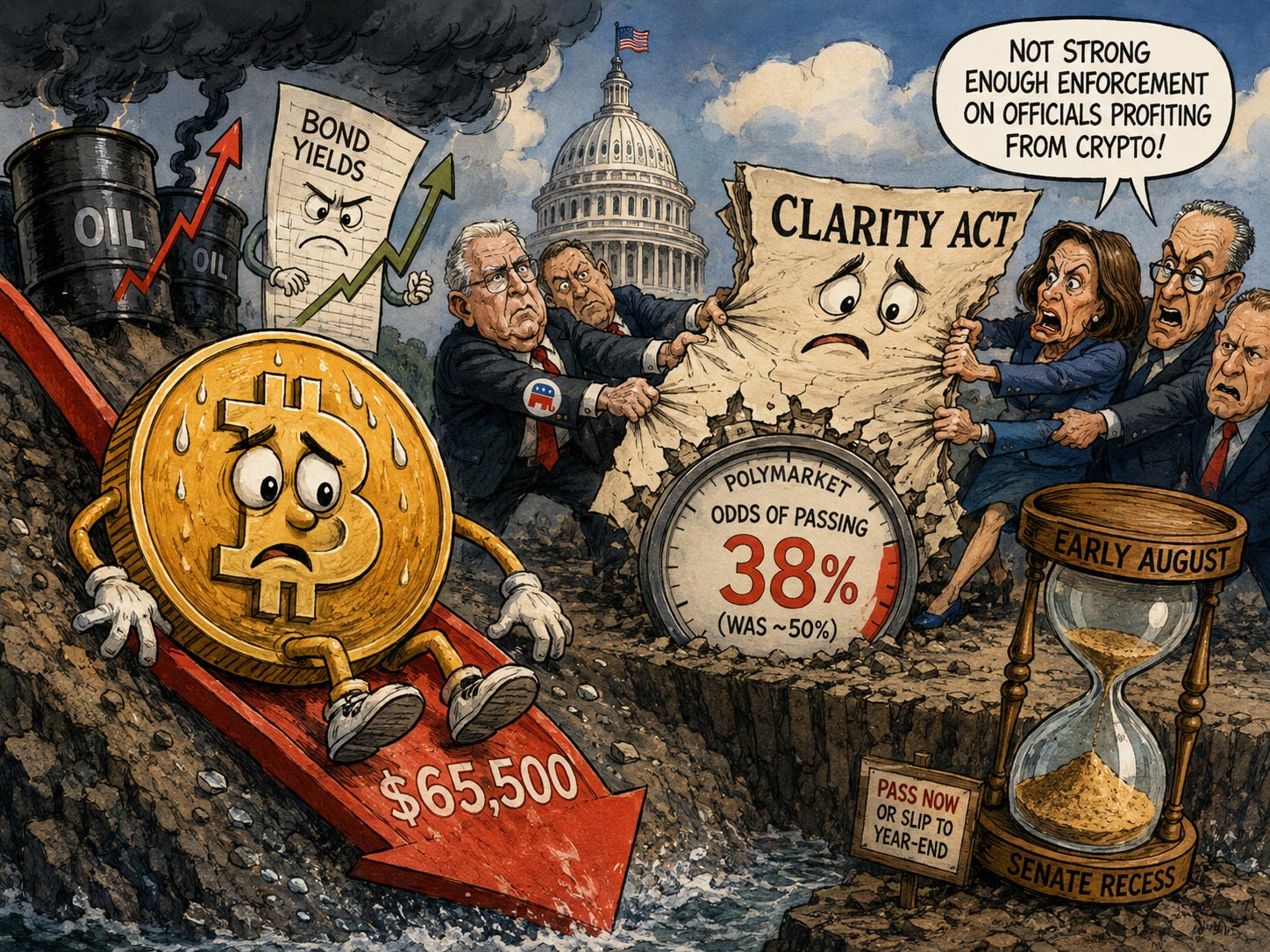
Bitcoin eased back toward $65,700 today, slipping under pressure from rising oil, firmer bond yields and a wobble in Washington. The market-structure bill known as the CLARITY Act lost momentum after Senate Republicans released an updated draft and key Democrats promptly criticised it, sending its chances of passing this year sliding. Prediction market Polymarket now puts those odds near 38%, down from close to half a week ago. The sticking point is the ethics provision that the White House and President Trump had agreed to, with lawmakers still split over how the ban on officials profiting from digital assets should be enforced (CoinDesk).
The clock is the real pressure. Crypto advocates are pointing to an early-August deadline, with the Senate due to break for its summer recess, so the bill either clears in the next couple of weeks or likely slips toward the year end. That leaves Bitcoin caught between two forces: a macro backdrop turning less friendly as oil and yields rise, and a regulatory prize that keeps looking further away. For a market that had rallied on hopes of a clear US rulebook, a fading vote count removes one of its main supports.
Sensei’s Insight: Price led the politics up, and now it is following the politics down. The enforcement fight is real and the recess clock is unforgiving. With oil and yields also leaning against risk, crypto has lost the easy tailwind it enjoyed a week ago.
🏦 The ECB holds while keeping September in play
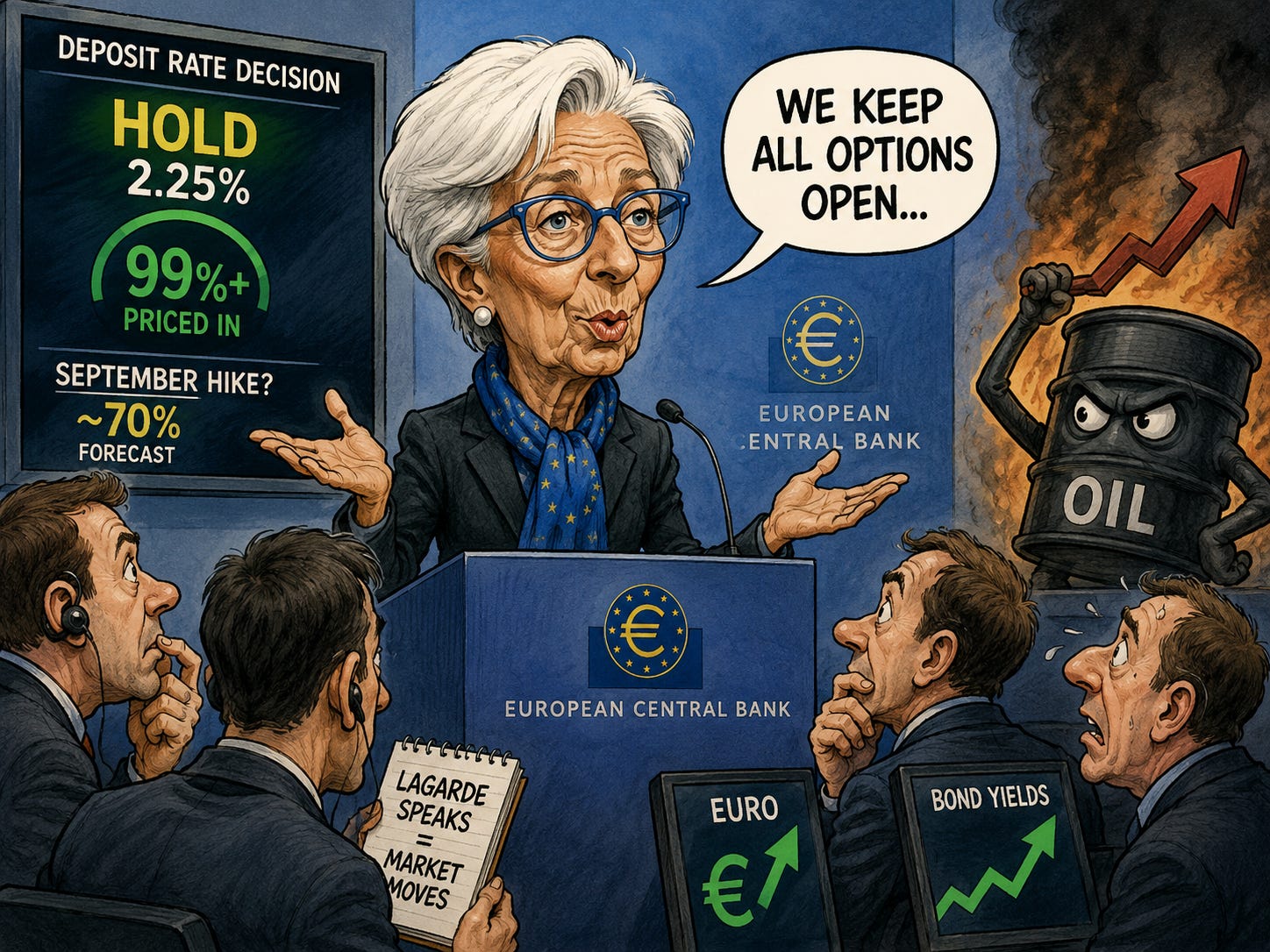
The European Central Bank announces its rate decision today, and a hold is close to certain, with markets pricing better than a 99% chance the deposit rate stays at 2.25%. That makes the decision itself a near non-event and hands the entire signal to President Lagarde’s press conference. This is a meeting without fresh staff forecasts, so the tone of her words carries unusual weight, especially with the ECB having become the first major central bank to raise rates in response to the war when it hiked in June (Yahoo Finance).
For investors the question is whether a September hike is still live. Around 70% of forecasters expect one more increase this year, and that move is nearly fully priced, so Lagarde faces a balancing act: sound concerned enough about prices to keep her options open, without stoking expectations the market has already banked. The fresh jump in oil only complicates the picture, reviving the inflation risk the ECB has been guarding against. Any hint that September is firming would lift the euro and European bond yields, while a softer message would take the second hike off the table.
Sensei’s Insight: The decision is settled before it is read, so the euro trades on Lagarde’s adjectives, not the number. The oil spike hands the hawks a live argument. If she leans into it, September stops being a maybe and starts looking like a plan.
🖥️ Intel reports into an unforgiving bar
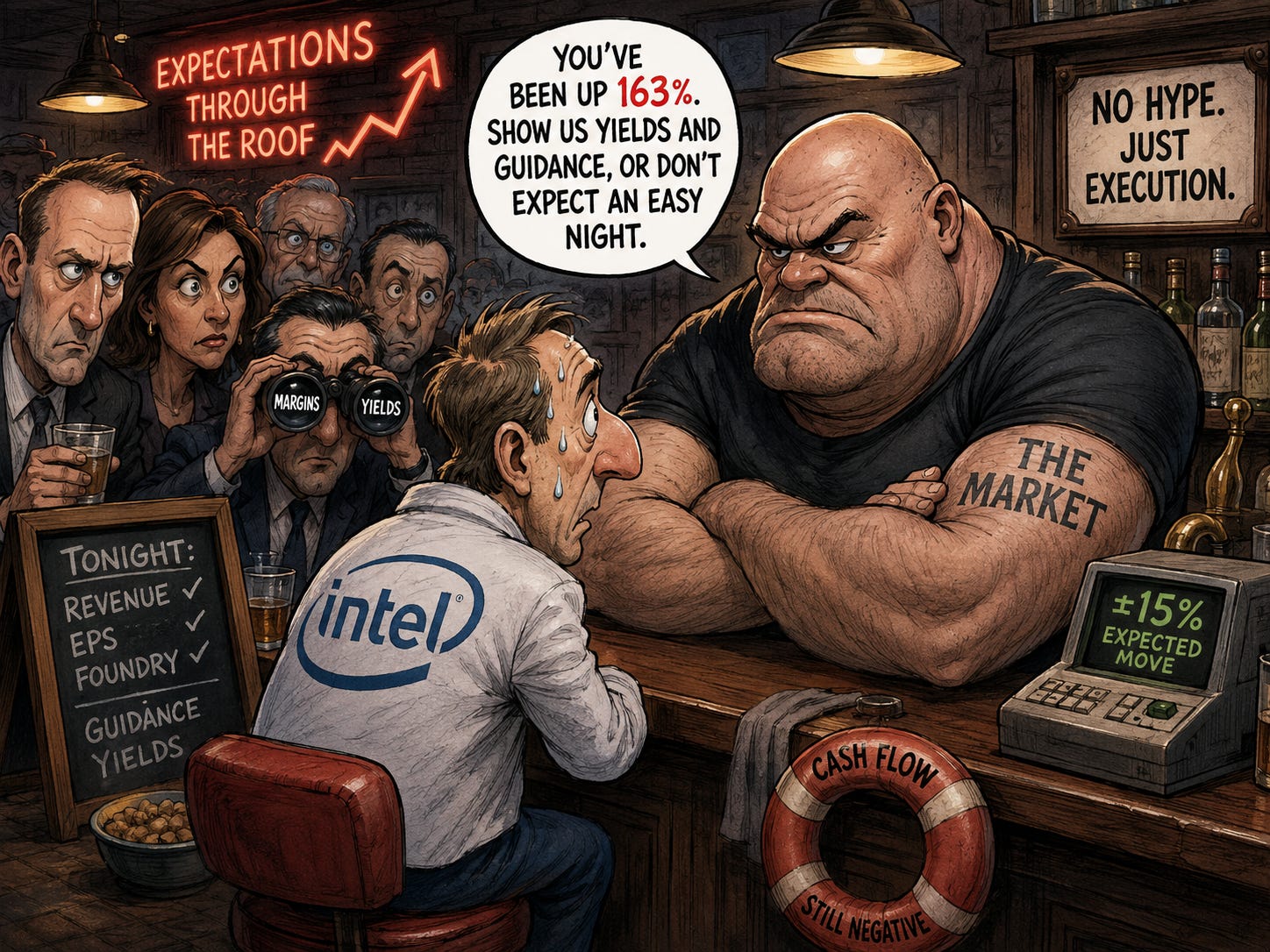
Intel reports second-quarter results after the US close today, and expectations could hardly be higher. The stock has climbed about 163% this year on hopes its long-struggling foundry business is finally turning, so the bar tonight is steep. Analysts look for revenue near $14.4 billion, up about 12% on a year ago, and adjusted earnings of roughly $0.21 a share, a sharp swing from a loss in the same quarter last year. Options traders are bracing for a move of around 15% in either direction, a sign of how much is riding on the print (Yahoo Finance).
The detail the market cares about is the foundry, the business that makes chips for other companies, where Intel has been signing marquee names including Apple, Microsoft and a reported Google order for custom AI chips. Revenue there is seen near $5.5 billion, but the unit is still burning cash, and gross margins around the mid-30s reflect the low early yields on its new 18A process. After the punishment Alphabet took for heavy spending, Intel arrives at an awkward moment: it needs to show its own vast investment is starting to pay, not just pile up. A miss on margins or guidance could hit hard given how far the shares have already run.
Sensei’s Insight: Up 163% into the print, Intel has priced the turnaround before proving it. The foundry is the whole story, and with cash still going out the door, tonight is about yields and guidance, not the headline profit. Little room for a stumble.
Stories You Might Have Missed
💼 ServiceNow jumps as software sidesteps the spending fear
ServiceNow offered the counterpoint to the megacap gloom, its shares rising about 4% after hours on a clear beat. The software firm grew subscription revenue almost 25% to $3.88 billion, posted adjusted earnings of $0.90 a share against the $0.86 expected, and raised its full-year subscription outlook for the second time to about $15.77 billion. It said the annual value of contracts tied to its AI products has passed $1 billion, with a renewal rate of 98%. The reaction was telling on a day when investors punished companies for spending on AI: ServiceNow sells the software that runs on top of that infrastructure, so it profits from the AI build-out without carrying the enormous capital bills, and the market rewarded exactly that (Yahoo Finance).
💻 IBM stumbles on soft sales and a mainframe drop
IBM had a rough quarter, with revenue of $17.16 billion rising just 1% and falling short of the $17.9 billion analysts wanted, while adjusted earnings of $2.93 a share also missed. Mainframe sales dropped 42% as a product cycle faded, and the company trimmed its full-year guidance. The shares steadied, edging up about 2% after the report, but only after a brutal run-up: IBM had already crashed roughly 25% in a single session last week on a disappointing pre-announcement, so much of the bad news was in the price. The contrast with ServiceNow was stark, an older technology giant leaning on legacy hardware struggling on the same evening a nimble software rival raced ahead (CNBC).
🥇 Gold slips from a two-week high as yields bite
Gold eased today, slipping about 1% to around $4,089 an ounce after touching roughly $4,130 in the previous session, its highest in two weeks. The metal is caught in a tug of war. The escalating Middle East conflict and a softer dollar have fuelled safe-haven buying, which drove this week’s climb, but the same oil surge that lifts inflation expectations also strengthens the case for higher-for-longer interest rates, and higher rates dull the appeal of an asset that pays no yield. That leaves bullion pinned near its highs rather than breaking out, a reminder that even with strikes at sea and a jittery stock market, the cost of money still sets the ceiling (Yahoo Finance).
🔍 Deep Dive: SpaceX Hit the Playbook's Retest Zone. Is It Time to Buy the Dip?

Five weeks ago, before SPCX ever traded, our SpaceX IPO Playbook drew the whole shape: a day-one pop, an index-driven squeeze to a summer high, then a break below the $135 offer once the underwriting props lapsed, into a retest of the low-to-mid $100s. The stock has walked that path almost date for date, and it has reached the retest zone weeks early. Here is the check-in, with the receipts.