This content is for informational and educational purposes only and does not constitute financial advice. Always do your own research. Not financial advice (NFA).
👀 Today’s Stories at a Glance
📈 Micron Shatters Revenue Record: Record quarter and a roughly $50 billion guide reignite the memory boom and pricing power.
🍔 Wendy’s Meme Rally Erupts: A 25% surge meets sales down 8%, leaving shorts squeezed and latecomers exposed.
🛢️ Oil Breaks Below $70: Tankers flood back through Hormuz, turning a wartime scarcity premium into glut pricing.
₿ Bitcoin Tests $60,000 Floor: Rate-hike bets and six weeks of fund outflows drag crypto down with tech.
🔤 Alphabet Joins The Dow: Google’s parent replaces Verizon, pushing the index’s technology weighting to a record.
💾 SK Hynix Plans Record Listing: Memory maker targets up to $29 billion on Nasdaq around mid-July, the largest ever.
🖥️ Qualcomm Lands Microsoft And Meta: Two cloud giants back its data-centre chip push, yet shares fell 5% on the news.
🏠 Housing Bill Lifts Builders: Landmark affordability act passes, sending the housing index up 5.4% to a February high.
🇨🇳 Alibaba Sues The Pentagon: Chinese giant fights a military blacklist as a June 30 procurement ban looms.
🔍 Deep Dive: Inflation Cheat Sheet: A members’ guide to today’s personal consumption expenditures print and its rate-bet stakes.
🧠 One Big Thing
The overlooked read in Micron's quarter is where the profit is pooling. With high-bandwidth memory sold out and allocated past 2027, the AI bottleneck has shifted from accelerators to the memory feeding them, and that is where pricing power sits. Micron's record 84.9% gross margin is the tell. The sympathy bids in Sandisk and Western Digital, plus SK Hynix's $29 billion listing, show the market repricing the whole memory tier, not one name. The open question is whether memory suppliers keep taking more of the AI margin than the chip designers. Watch gross margins across the memory group, since that spread could widen further.
⚖️ Fear & Greed
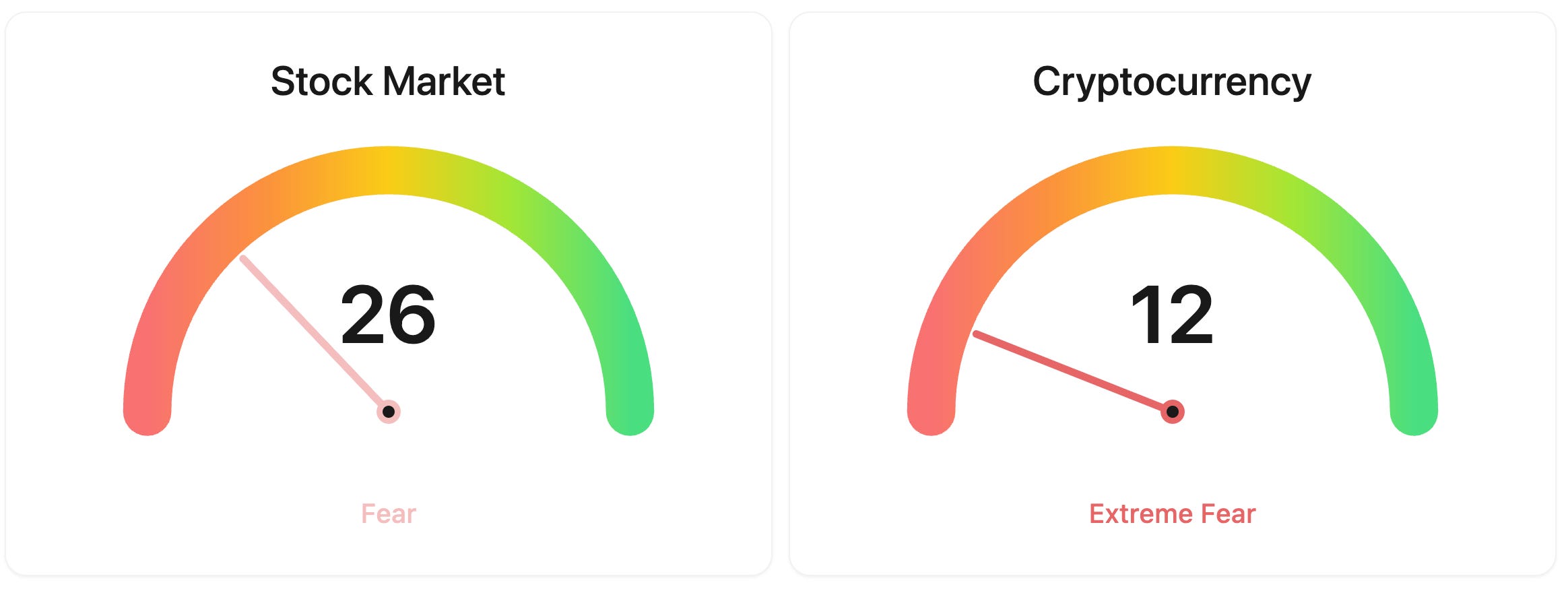
📉 The Number That Matters
70%
Markets now price a roughly 70% chance of a Federal Reserve rate hike by September, a sharp swing from the cuts expected before June's meeting, and the main weight on bitcoin and tech.
⚔️ Winners vs Losers
Winners
AZI 0.00%↑: Autozi Internet Technology popped after announcing a convertible note financing of up to 5.25 million dollars to fund auto parts supply chain acquisitions, though the outsized move mostly reflects mechanical volatility in a roughly 5 million dollar market cap micro float that has spiked repeatedly on corporate announcements this year.
MU 0.00%↑: Micron Technology surged after reporting record fiscal third quarter revenue of 41.5 billion dollars and an 84.9 percent gross margin that beat the high end of guidance, then guiding fiscal fourth quarter revenue to roughly 50 billion dollars on sustained AI memory and high bandwidth memory demand.
WEN 0.00%↑: Wendy’s Company extended a sharp rally after naming former Potbelly executive Steve Cirulis as chief financial officer and chief strategy officer, a catalyst that ignited a heavily shorted name into a Save Wendy’s retail short squeeze alongside Trian take private speculation.
SNDK 0.00%↑: Sandisk Corporation rose in sympathy with Micron’s blowout report, which validated the NAND and memory pricing upcycle, with the high beta storage name extending gains across the after hours and pre market sessions.
QCOM 0.00%↑: QUALCOMM Incorporated climbed alongside the broader memory and semiconductor complex after Micron’s results and Q4 guidance signaled stronger for longer AI chip demand.
WDC 0.00%↑: Western Digital Corporation advanced in sympathy with Micron as the record quarter and storage upcycle read through directly to its enterprise SSD and high capacity drive business.
GLW 0.00%↑: Corning Incorporated gained on the semiconductor and AI infrastructure bid following Micron’s results, with its optical fiber and data center connectivity exposure drawing momentum.
TER 0.00%↑: Teradyne advanced as Micron’s blowout helped the semiconductor index recover, lifting chip test and equipment names tied to the AI buildout.
BE 0.00%↑: Bloom Energy rose with the broader AI power and data center infrastructure trade as Micron’s results reinforced expectations for sustained AI capacity expansion.
Losers
ELME 0.00%↑: Elme Communities dropped after disclosing that its 280 million dollar Riverside Apartments sale collapsed when the buyer terminated the agreement, prompting the liquidating REIT to withdraw its estimated distribution ranges, with the move amplified by the thin float of its wind down stub.
SPRY 0.00%↑: ARS Pharmaceuticals fell after a commercial update revealed no new major insurance coverage or formulary wins for its neffy epinephrine nasal spray in the July cycle, disappointing investors who had hoped for additional payer additions.
TSHA 0.00%↑: Taysha Gene Therapies declined after pricing a 200 million dollar stock offering at 6.00 dollars per share, a dilutive raise into strength that followed positive Rett syndrome trial data and a wave of analyst price target increases.
BABA 0.00%↑: Alibaba Group Holding slipped to a fresh 52 week low after Anthropic accused operators tied to its Qwen AI lab of a large scale distillation campaign against its Claude model in a letter to Congress, adding to pressure from soft China consumer data.
📊 Market Snapshot
Cryptocurrencies:
Bitcoin (BTC): $61,660 (▲ 1.08%)
Ethereum (ETH): $1,651 (▲ 1.93%)
XRP: $1.08 (▲ 0.91%)
Equity Indices (Futures):
S&P 500: 7,482 (▲ 0.72%)
NASDAQ 100: 30,145 (▲ 2.14%)
FTSE 100: 10,502 (▲ 0.59%)
Commodities & Bonds:
10-Year US Treasury Yield: 4.41% (▲ 0.27%)
Oil (WTI): $69 (▼ 0.97%)
Gold: $3,993 (▲ 0.02%)
Silver: $57.53 (▲ 0.28%)
Data as of: UK: 10:20am BST / US: 5:20am EDT / Asia (Tokyo): 6:20pm JST
✅ 5 Things to Know
📈 Micron’s Blowout Reignites the AI Trade
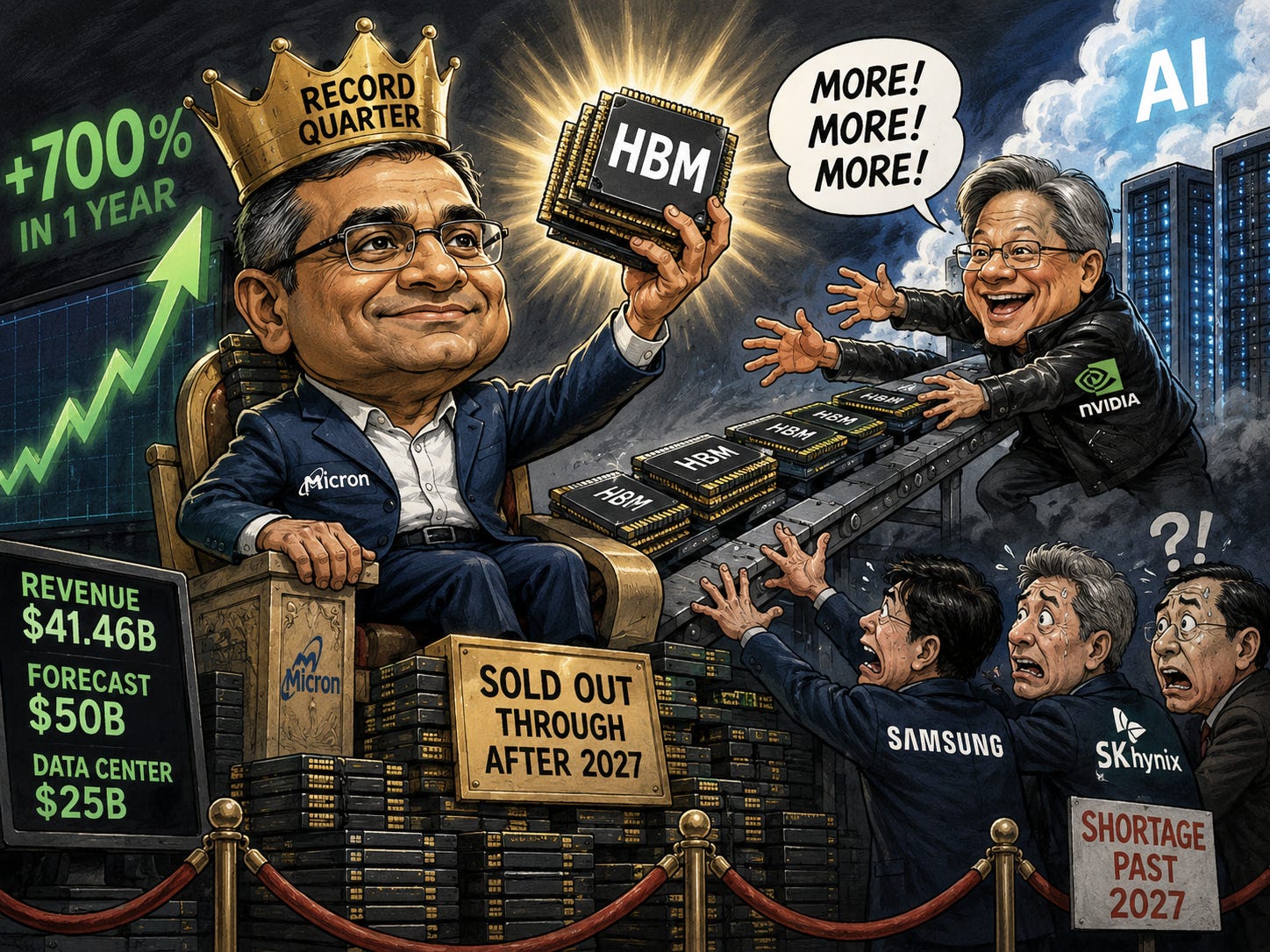
Micron reported the biggest quarter in its history after the close yesterday, and the numbers buried the fear that AI spending has peaked. Revenue hit $41.46 billion, up about 346% from a year ago and well past the roughly $35.6 billion analysts expected, while adjusted earnings came in at $25.11 a share against forecasts near $20.50. The bigger shock was the forecast: Micron guided current-quarter revenue to about $50 billion, far above the roughly $43 billion Wall Street had penciled in. Data-center revenue reached about $25 billion, gross margins set a record, and the board declared a $0.15 dividend. Shares jumped about 14% after hours toward $1,200, capping a roughly 700% run over the past year. (CNBC)
For retail investors, this is the clearest signal yet that the AI buildout is still speeding up, which is exactly what Tuesday’s global chip rout doubted when South Korea’s market fell almost 10%. Micron’s high-bandwidth memory, the stacked chips that feed Nvidia’s AI accelerators, is sold out, and chief executive Sanjay Mehrotra said the shortage will run past 2027. The company can supply only half to two-thirds of what customers want, so the question is shifting from whether AI demand is real to who actually gets the chips. Memory and chip funds climbed after hours, and stock futures pointed higher into this morning, pulling the AI trade back off the mat.
Sensei’s Insight: Micron now says it can’t make enough memory to meet demand until after 2027. That flips the question from whether AI orders are real to who actually secures the supply, and it keeps Micron’s pricing power and record margins locked in place.
🍔 Wendy’s Meme Rally Outruns a Shrinking Business

Wendy’s became the market’s newest meme stock yesterday, surging as much as 42% before a volatility halt and closing up about 25% at $7.86, its biggest one-day jump since March 2020. The day before, the shares sat at $6.26, a price last seen roughly two decades ago after years of falling sales. Two things lit the fuse. The chain named former Potbelly executive Steve Cirulis as chief financial officer, and a viral “Save Wendy’s” post on Reddit’s WallStreetBets forum rallied retail traders into one of the most heavily shorted restaurant stocks. More than 200 million shares changed hands, about 15 times the recent average. (CNBC)
For retail investors, Wendy’s is a live lesson in how far a stock can move on sentiment alone. The business is going the other way: first-quarter US same-store sales fell about 8% and net income dropped 42%. Short sellers held somewhere between 23% and 34% of the tradable shares depending on the source, real squeeze fuel, but well below the 140% that powered GameStop in 2021. That gap matters, because a squeeze fades once the forced buying runs out, and late buyers tend to be the ones left holding the stock when momentum turns. The next real test is Wendy’s second-quarter earnings, where sales trends either back the turnaround story or hand the momentum back to the shorts. (Yahoo Finance)
Sensei’s Insight: The squeeze fuel here is real but smaller than the GameStop era. Short interest sits near a quarter of the float, not the 140% that detonated in 2021. Wendy’s second-quarter results are the next test of whether the crowd stays in.
🛢️ Oil Drops Below $70 as Hormuz Reopens
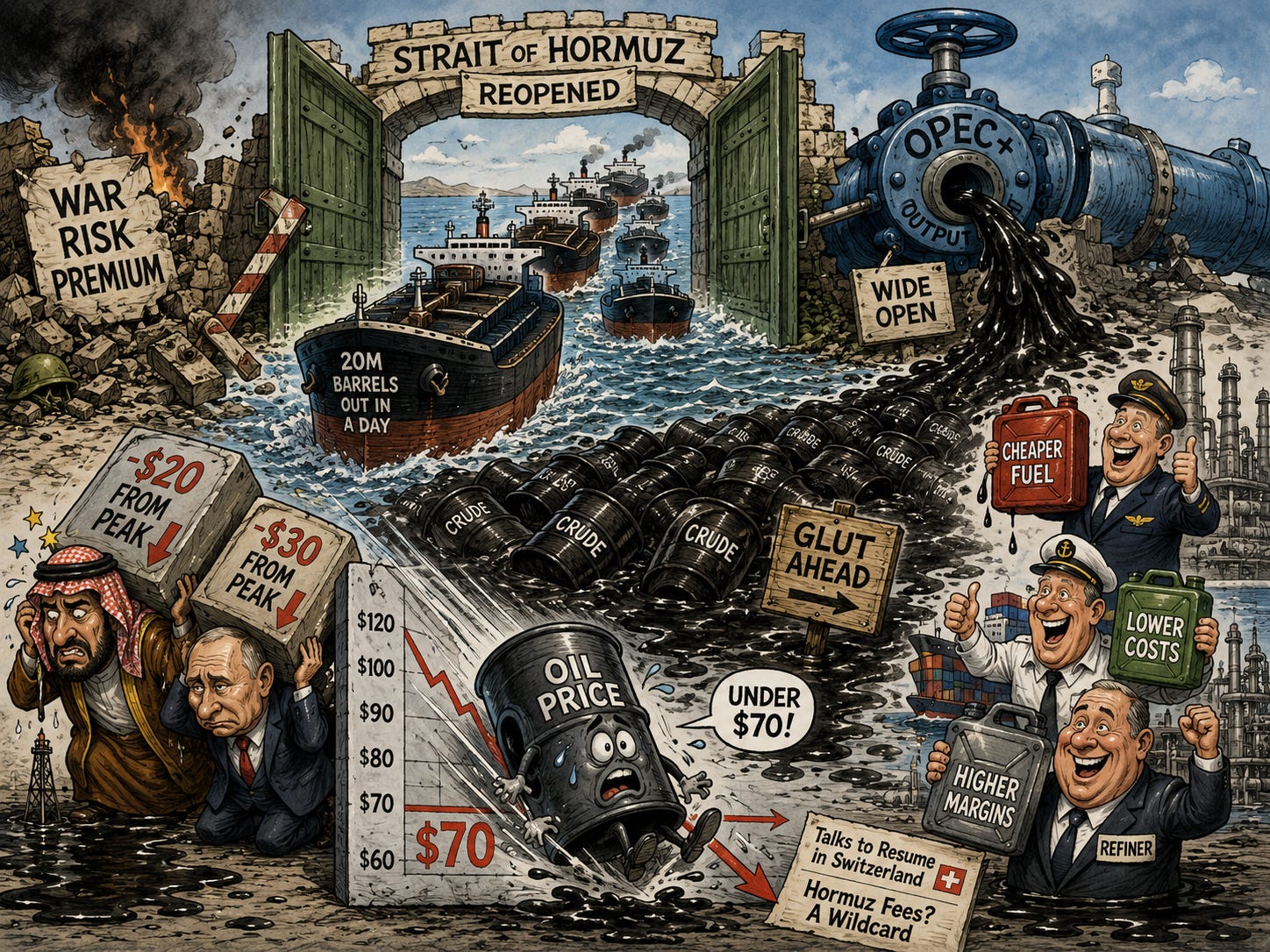
Oil fell hard yesterday as tankers streamed back through the Strait of Hormuz, the waterway that carries about a fifth of the world’s crude. US benchmark West Texas Intermediate briefly dropped under $70 a barrel for the first time since early March, settling at $70.34, while global benchmark Brent fell more than 4% to around $73.74, its lowest since before the US-Iran war began in late February. Both are down roughly 40% from their wartime peaks. The trigger was a wave of previously trapped oil hitting the market: the US energy secretary said about 20 million barrels exited Hormuz in a single day, and physical cargoes are now selling at a discount. (CNBC)
For retail investors, cheaper crude is mostly good news. It pulls down gasoline prices and eases the inflation pressure that has the Federal Reserve leaning toward higher rates, which helped stocks firm and Treasury yields fall yesterday. It squeezes oil producers, while refiners, airlines and shippers gain from cheaper fuel. The market has flipped from pricing missing barrels to pricing a glut, and the barrels were always coming: analysts already expected a 2026 oversupply as the OPEC+ group restored output, and the trapped wartime crude is now landing on top of that. The wildcards from here are whether the US-Iran deal holds, with technical talks due to resume in Switzerland, and whether Iran ends up charging fees for Hormuz transit. (Reuters)
Sensei’s Insight: Even before the war, analysts expected oil to be oversupplied in 2026 as OPEC+ restored production. The trapped wartime barrels rushing back now land on top of that glut, which is why the floor for crude could keep slipping as long as the deal holds.
₿ Bitcoin Slides Toward $60,000 as Hike Bets Build
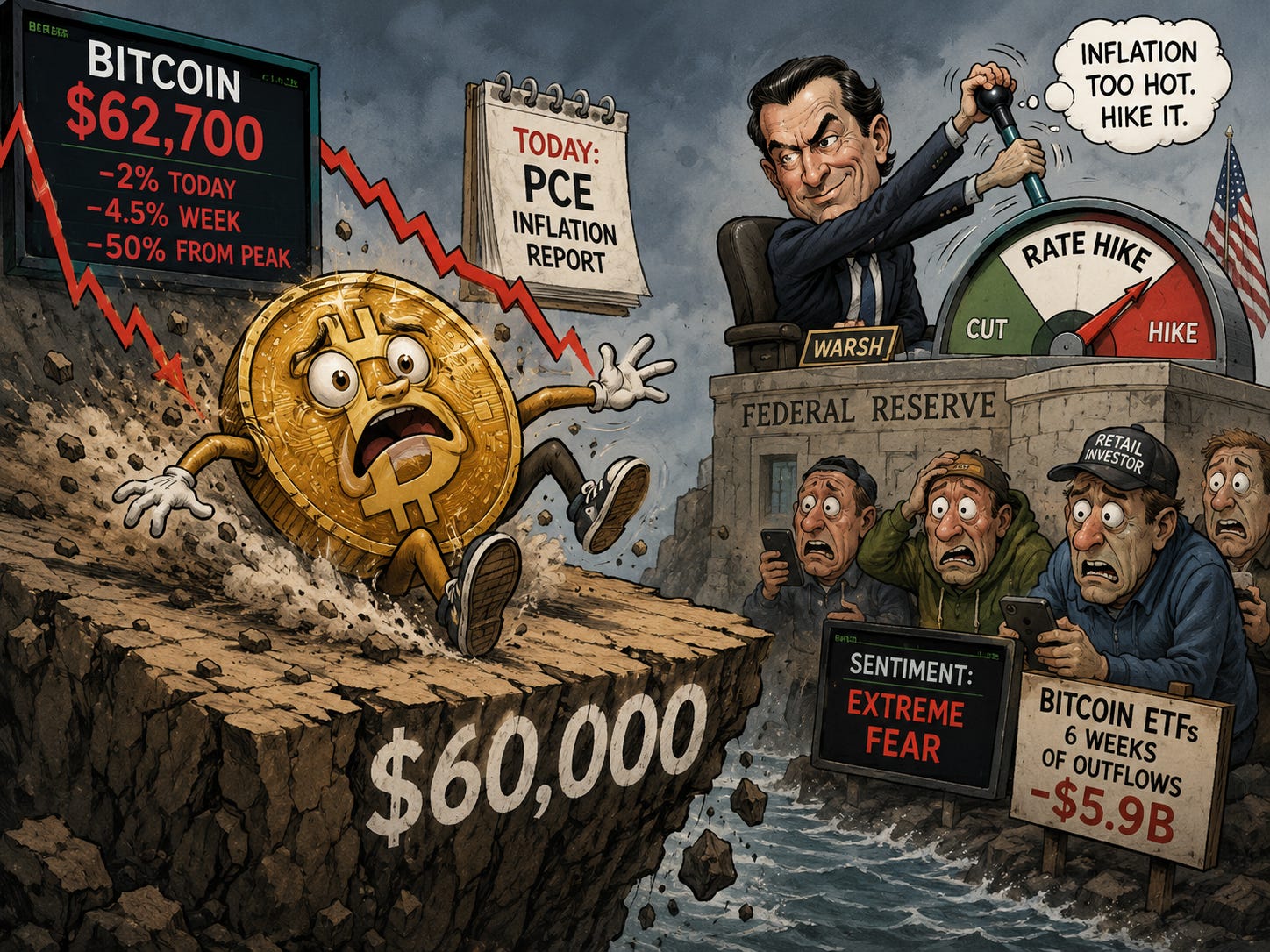
Bitcoin kept sliding yesterday, trading around $62,700, down about 2% on the day and 4.5% on the week, leaving it within reach of the $60,000 level traders are watching as a floor. The world’s largest cryptocurrency is now more than 50% below its October record near $126,000. The selling is not really about crypto. After the Federal Reserve’s June meeting, the first chaired by Kevin Warsh, markets swung from expecting rate cuts to pricing a roughly 70% chance of a rate hike by September. Higher rates hurt assets like bitcoin that pay no yield. Sentiment gauges sit in “extreme fear,” and spot bitcoin exchange-traded funds (ETFs) have now seen six straight weeks of outflows, about $5.9 billion in all. (Yahoo Finance)
For the many retail investors who now hold crypto directly or through ETFs, the takeaway is that bitcoin is moving as a high-risk version of the Nasdaq, not the independent hedge it is often sold as. It fell alongside chip stocks this week on the same hawkish-Fed and AI-spending worries. The next catalyst lands today: the Fed’s preferred inflation gauge, the personal consumption expenditures index, is due, and a hot reading would harden the rate-hike bets that have pressured bitcoin, while a soft one could ease them. If $60,000 breaks, analysts flag the high-$50,000s as the next downside test.
Sensei’s Insight: Bitcoin is trading like a leveraged tech stock right now, not a hedge. The same rate fears dragging the Nasdaq are dragging crypto. Today’s inflation reading is the next domino: a hot number pushes a Fed hike closer, and the $60,000 floor with it.
🔤 Alphabet Joins the Dow as It Tilts Toward Tech
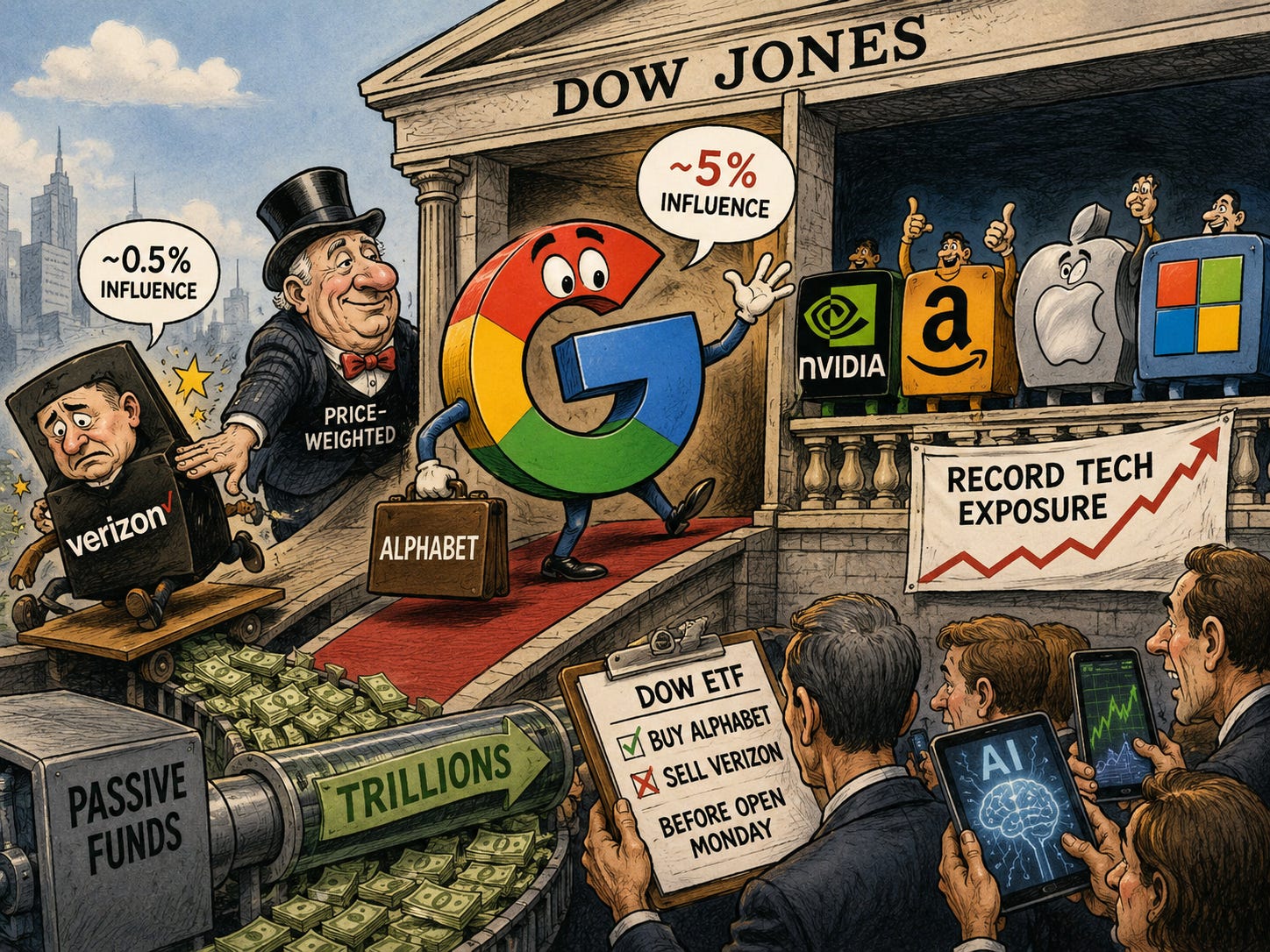
Alphabet, Google’s parent, is joining the Dow Jones Industrial Average, the 30-stock index many people treat as shorthand for “the market.” It replaces Verizon before the opening bell on Monday. The change matters more than a routine reshuffle because of how the Dow is built: it is price-weighted, so a stock’s sway depends on its share price, not the company’s overall size. Verizon’s low price gave it only about half a percentage point of influence. Alphabet’s much higher price hands it roughly 5%. With Alphabet in, the five most valuable US tech companies, Nvidia, Amazon, Apple, Microsoft and now Alphabet, all sit in the index together. Alphabet rose about 1% on the news. (CNBC)
For retail investors, index membership is not just symbolic. Trillions of dollars track major benchmarks, so funds that follow the Dow, like the SPDR Dow Jones Industrial Average ETF, have to add Alphabet and drop Verizon to match the new lineup before Monday’s open. That is forced, mechanical demand for Alphabet shares. The bigger shift is what it does to the index: adding Alphabet pushes the Dow’s exposure to mega-cap technology to a record, which means the 130-year-old “blue-chip” gauge now rises and falls more closely with the same AI trade driving Micron and Nvidia. A separate change hits the same day, when Honeywell completes the spin-off of its aerospace arm.
Sensei’s Insight: Funds that track the Dow have to add Alphabet and drop Verizon before Monday’s open, no matter the price, so the demand is automatic. The bigger change is that the Dow’s technology weighting just hit a record, tying the old industrial index more tightly to the AI trade.
Stories You Might Have Missed
💾 SK Hynix Plans a Record $29 Billion US Listing
SK Hynix, the South Korean memory maker that supplies most of the high-bandwidth memory used in Nvidia’s AI chips, said yesterday it plans to raise up to about $29 billion by listing American depositary receipts, which let foreign companies trade on US exchanges, on the Nasdaq around July 10. At the top of that range it would be the largest such share sale ever, topping Alibaba’s $25 billion New York debut in 2014. The cash will fund new chip factories and advanced packaging back home. For retail investors, this hands US buyers direct access to one of the purest AI-memory plays, and it could pull SK Hynix’s valuation toward that of its US rival Micron. It also lands the same week as Micron’s blowout, concentrating attention on the AI-memory boom and the huge sums being raised to feed it. (Reuters)
🖥️ Qualcomm Lands Microsoft and Meta for AI Chips
Qualcomm used its investor day yesterday to name Microsoft and Meta as early customers for its push into artificial-intelligence data-center chips, its biggest attempt yet to break a dependence on smartphones. Microsoft will use Qualcomm’s new memory-focused computing technology in its Azure cloud, and Meta signed a multi-year deal to use Qualcomm’s new data-center processor. Qualcomm also confirmed it is buying AI-software startup Modular for about $3.9 billion to build a rival to Nvidia’s software ecosystem. The market reaction was a “sell the news” drop: the stock fell about 5% to around $193, as investors weighed the cost of the deal and a crowded field against an already stretched valuation. Landing two of the biggest cloud buyers validates the strategy, but it puts Qualcomm head to head with Nvidia and AMD. (CNBC)
🏠 Homebuilders Jump on a Landmark Housing Bill
US homebuilder stocks rallied yesterday after Congress passed the biggest housing affordability bill in decades, the 21st Century ROAD to Housing Act, which cleared the House 358 to 32 and aims to speed construction by easing federal building rules. The PHLX Housing Index rose 5.4% to its highest level since February. D.R. Horton and Lennar, the two largest builders, each gained more than 6%, their best day since January, while PulteGroup jumped over 8%. President Trump then canceled the signing ceremony, saying he won’t sign until Congress passes a separate elections bill. That may not matter much, because if he simply does nothing for 10 days, the housing bill becomes law without his signature. For retail investors, analysts say the real payoff is long-term supply rather than an immediate jump in sales. (Reuters)
🇨🇳 Alibaba Sues the Pentagon Over a Blacklist
Alibaba, the Chinese e-commerce and cloud giant whose shares are widely held by US investors, sued the US Department of Defense this week to get itself removed from a Pentagon list of alleged “Chinese military companies.” Alibaba argues the designation, added in early June, has “no basis in fact or law,” and that it is a retail, logistics and cloud business with an independent board and no military ties. The stakes are concrete: starting June 30, the Pentagon is barred from buying from listed companies, and the rule can ripple out to US contractors, which Alibaba says could pressure its own American advisers to drop it. The case is a test for every Chinese firm on the roughly 188-name list, and it keeps the US-China tech standoff, a recurring drag on Chinese stocks, front of mind. (AP)
🔗 Connect with Us
Stay plugged in across platforms:
Sensei on X: sensei_live_
Martyn Lucas on X: MartynInvestor
Vaz on X: eVTOLHUB
📺 YouTube Channel (Live & Replays): Martyn Lucas Investor