

This content is for informational and educational purposes only and does not constitute financial advice. Always do your own research. Not financial advice (NFA).
👀 Today’s Stories at a Glance
💾 Nvidia told the market what 2027 looks like: 70% growth against the 44% analysts had modelled.
👶 Meta buys its way out of a trial: $16.7 billion to 29 states, plus daily limits on teenage accounts.
🇰🇷 Memory chips forced a rate rise: Korea went to 3% and lifted its 2026 growth forecast to 3.3%.
📉 Core PCE came in bang on 0.2%: nothing changed, so Warsh gets the last word at Jackson Hole on Friday.
🛢️ Hormuz gets a price list: Iran and Oman agreed who gets paid for the strait, and crude has given up 4 sessions.
🤗 Nvidia is buying Hugging Face: $12.9 billion for the library where developers download open-source AI models.
☁️ The software selloff got a counterexample: Salesforce lifted its full-year guide and the shares rose 12%.
₿ Bitcoin held $79,027 through the print: 2 lenders launched credit lines and a mortgage secured on coins.
🔍 Nvidia earned $59.7bn and collected $24.1bn: today’s Deep Dive follows the $35.6 billion gap and who owes it.
📈 We bought Nvidia at $190 and it is over $223: Chart of the Day covers the Deep Trend at $193.23 and the Momentum Band.
🧠 One Big Thing
Nvidia did something on Wednesday night it has never done before. It told the market what it expects to sell a full year out: about 70% revenue growth in the year to January 2028, against the 44% analysts had in their models. That works out at roughly $690 billion of revenue for a company that closed Wednesday worth $5.08 trillion, which makes it the largest company on earth and the biggest single position in most index funds. The shares were up about 6% before the US open. Jensen Huang then added the line that carries the weight. Demand is running higher than 70%, and supply is what caps it at 70%.
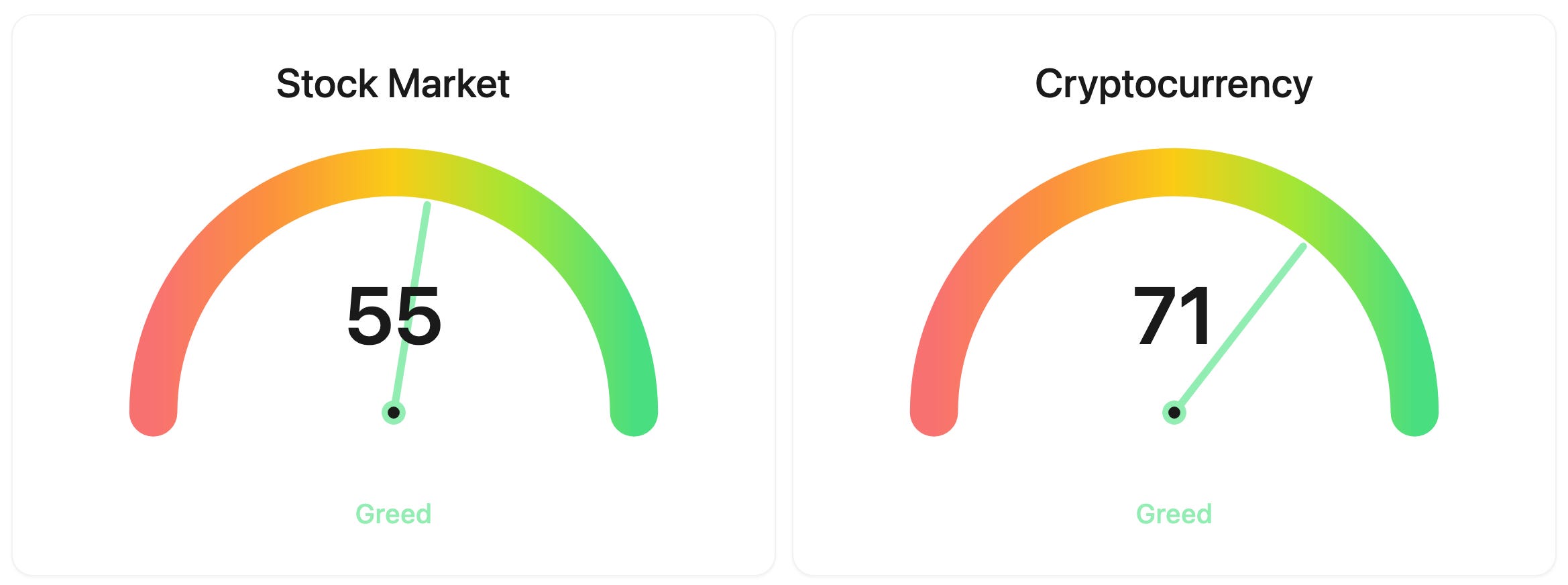
⚖️ Fear & Greed
📉 The Number That Matters
$279 billion
That is what Nvidia has now committed to its own suppliers for chips, memory and manufacturing capacity, up from $119 billion 3 months ago. Memory prices did most of it, and the money is committed before a single sale.
⚔️ Winners vs Losers
Winners
OKTA 0.00%↑ : 17.66% Okta, Inc. surged after its fiscal second quarter results beat estimates and management lifted full year revenue guidance, crediting a surge in identity security demand tied to the AI buildout.
DG 0.00%↑ : 12.55% Dollar General Corporation rallied after beating on both earnings and revenue in its second quarter and raising its full year outlook, as shoppers continued to trade down in search of value.
CRM 0.00%↑ : 10.23% Salesforce, Inc. jumped after delivering record second quarter fiscal 2027 results, raising guidance, and expanding its partnership with Anthropic’s Claude.
CRWD 0.00%↑ : 8.89% CrowdStrike Holdings, Inc. climbed after its fiscal second quarter revenue and annual recurring revenue topped estimates, with management pointing to record ARR growth driven by AI security adoption.
NVDA 0.00%↑ : 5.91% NVIDIA Corporation recovered from an initial after hours dip and moved higher after reporting revenue of $96.2 billion, up 106% year over year with data center revenue up 117%, and guiding to roughly $108 billion for the current quarter.
Losers
WEN 0.00%↑ : 15.15% Wendy’s Company slumped after Reuters reported that Nelson Peltz’s Trian has no plans to make a take private bid for the burger chain right now, citing its performance and valuation, which unwound the buyout premium built into the stock.
LUCK 0.00%↑ : 12.46% Lucky Strike Entertainment Corporation fell after reporting fourth quarter and full year fiscal 2026 results before the open.
HPQ 0.00%↑ : 10.48% HP Inc. dropped despite beating on its fiscal third quarter and lifting its full year earnings and free cash flow forecasts, as investors focused on margin pressure in the print.
📊 Market Snapshot
Cryptocurrencies:
Bitcoin (BTC): $79,551 (▲ 0.67%)
Ethereum (ETH): $2,505 (▼ 0.05%)
XRP: $1.43 (▲ 0.25%)
Equity Indices (Futures):
S&P 500: 7,725 (▲ 0.46%)
NASDAQ 100: 29,588 (▲ 1.02%)
FTSE 100: 10,831 (▼ 0.14%)
Commodities & Bonds:
10-Year US Treasury Yield: 4.66% (▲ 0.32%)
Oil (WTI): $82 (▲ 0.42%)
Gold: $4,598 (▲ 0.01%)
Silver: $68.47 (▲ 0.53%)
Data as of: UK: 12:34 BST / US: 07:34 EDT / Asia (Tokyo): 20:34 JST
✅ 5 Things to Know
💾 Nvidia guided a whole year ahead for the first time
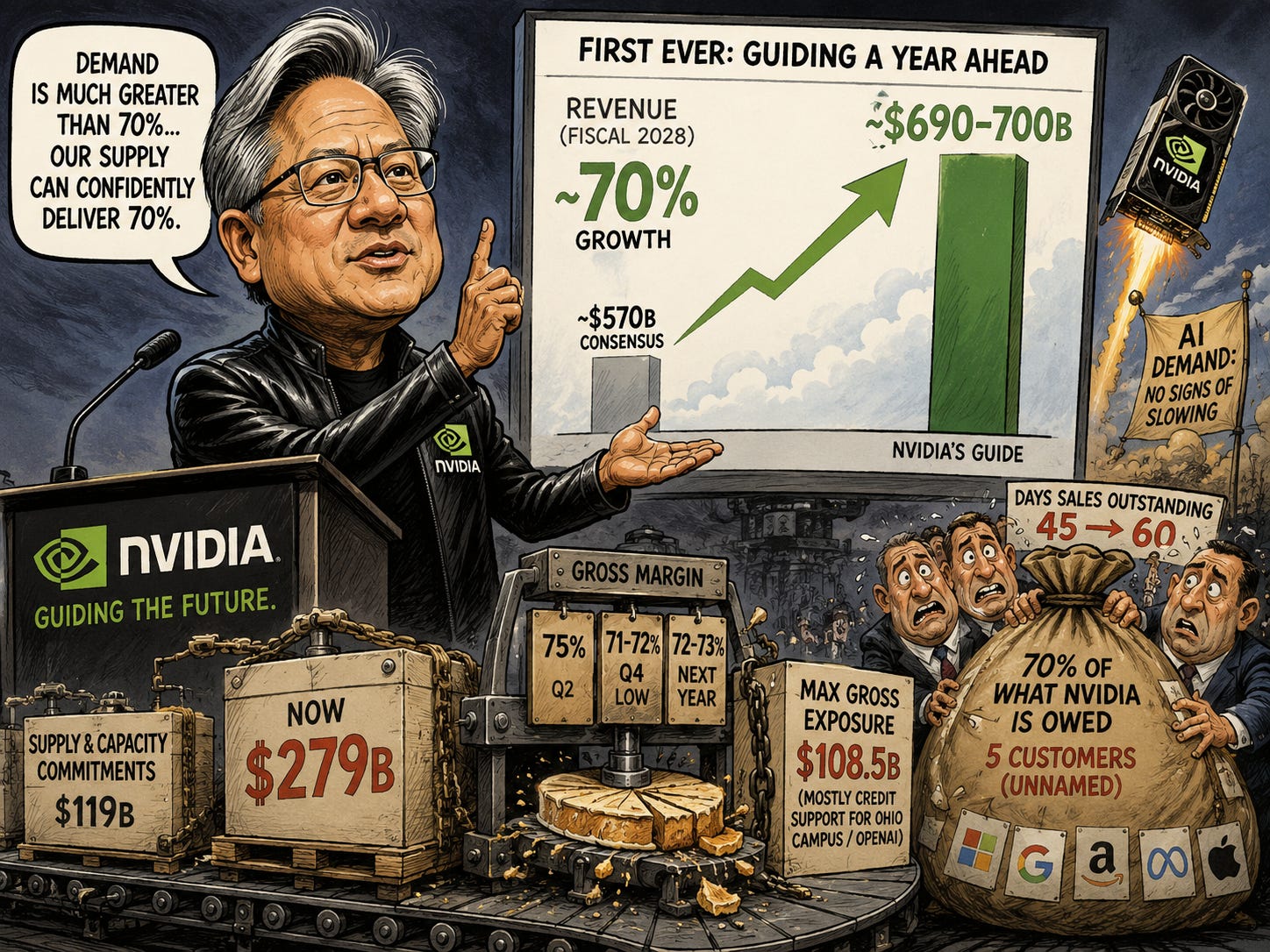
$96.2 billion. That is what Nvidia sold in the 3 months to 26 July, up 106% on the same quarter last year and past the $92.2 billion analysts had modelled. Data centre revenue was $89 billion, up 117%, and it now accounts for 92% of the company. Adjusted earnings came in at $2.22 a share against the $2.06 to $2.09 expected. Chief financial officer Colette Kress guided the current quarter to $108 billion, plus or minus 2%, and said that number assumes no data centre sales in China at all.
Then she did something the company has never done.
She guided a year in advance. Kress told investors revenue would grow about 70% in fiscal 2028, which runs to January of that year, against the 44% analysts had penned in. In money, that is roughly $690 billion to $700 billion of revenue against a consensus near $570 billion. Huang was asked on the call whether Nvidia could really deliver it, and his answer pushed the number the other way. “Even though our demand is much greater than 70%, our supply allows us to confidently deliver 70%,” he said. He also said the whole supply chain is running flat out. The shares rose about 6% before the bell. (Reuters)
There is a bill attached to all of this. Kress said supply and capacity commitments have gone from $119 billion to $279 billion in 3 months, driven by memory prices that have climbed all year, and gross margin is guided down from 75% in the quarter just reported to 74% now, bottoming at 71% to 72% in the fourth quarter before settling around 72% to 73% next year. She also put a figure on the guarantees critics have been asking about: maximum gross exposure of $108.5 billion, most of it credit support for the Ohio campus that will host compute leased to OpenAI. “We recognize the scale of this support, and we know some will call this circular financing,” she said. “We see it differently.” (Fortune)
Sensei’s Insight: A year-ahead guide is a hostage to fortune and Nvidia has never given one before, which is how badly it wanted the bubble argument shut down. The 70% gets the headlines. I am watching the $279 billion of commitments, because that stays signed whatever demand does.
There is more on this below. Today’s Deep Dive sits at the foot of the edition and takes the other half of the quarter: Nvidia booked $59.7 billion of profit and collected $24.1 billion of cash, days sales outstanding went from 45 to 60 in 3 months, and 70% of what the company is owed now sits with 5 customers its own filing does not name.
👶 Meta pays $16.7 billion and changes the apps
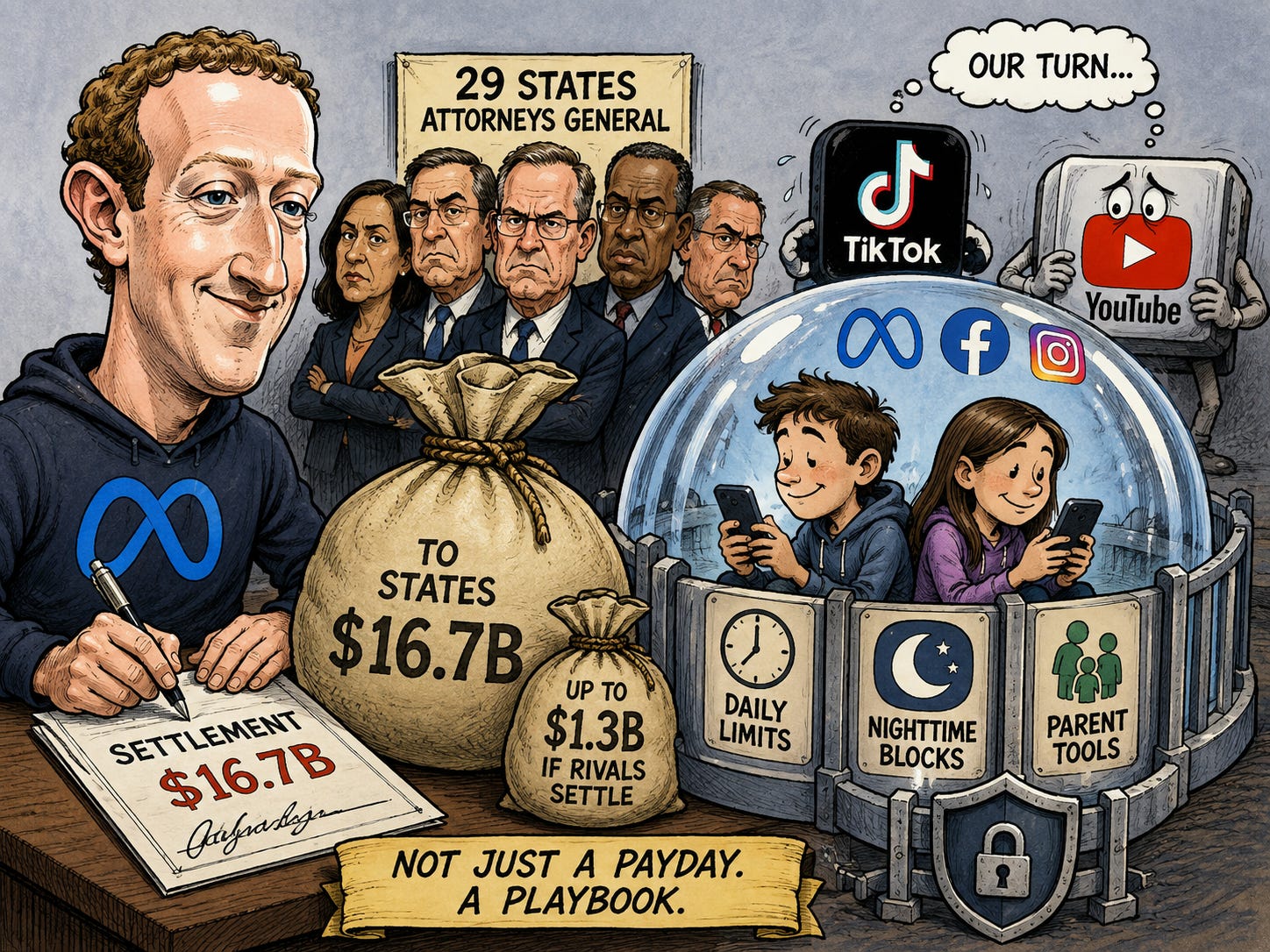
What is a landmark trial worth if it stops before the verdict? About $16.7 billion. Meta agreed on Wednesday to settle claims brought by 29 state attorneys general over the mental health harm its platforms do to children, ending a trial that had been running in California. The total rises as high as $18 billion if TikTok and YouTube settle their own cases with the states, so part of the headline figure depends on companies Meta does not control. The shares rose 4% in premarket trading on Wednesday morning. (CNBC)
The money is the smaller half of it. Meta also agreed to daily usage limits and nighttime blocks on teenage accounts, stronger age checks designed to keep children off the apps altogether, and new tools for parents, and those changes apply to Facebook and Instagram permanently. The read across is worth more than the number. The same states are still litigating against TikTok and YouTube, and the terms Meta has just signed set the shape of what those companies will be asked for, which puts Alphabet on the hook for whatever YouTube ends up agreeing. (CNN)
Sensei’s Insight: The number being reported is $18 billion and the number Meta actually agreed to pay is $16.7 billion, with the rest resting on 2 rivals signing. Watch the product changes instead of the cheque. Daily limits and nighttime blocks touch engagement, and engagement is the business.
🇰🇷 Korea raised rates again, and chips are why
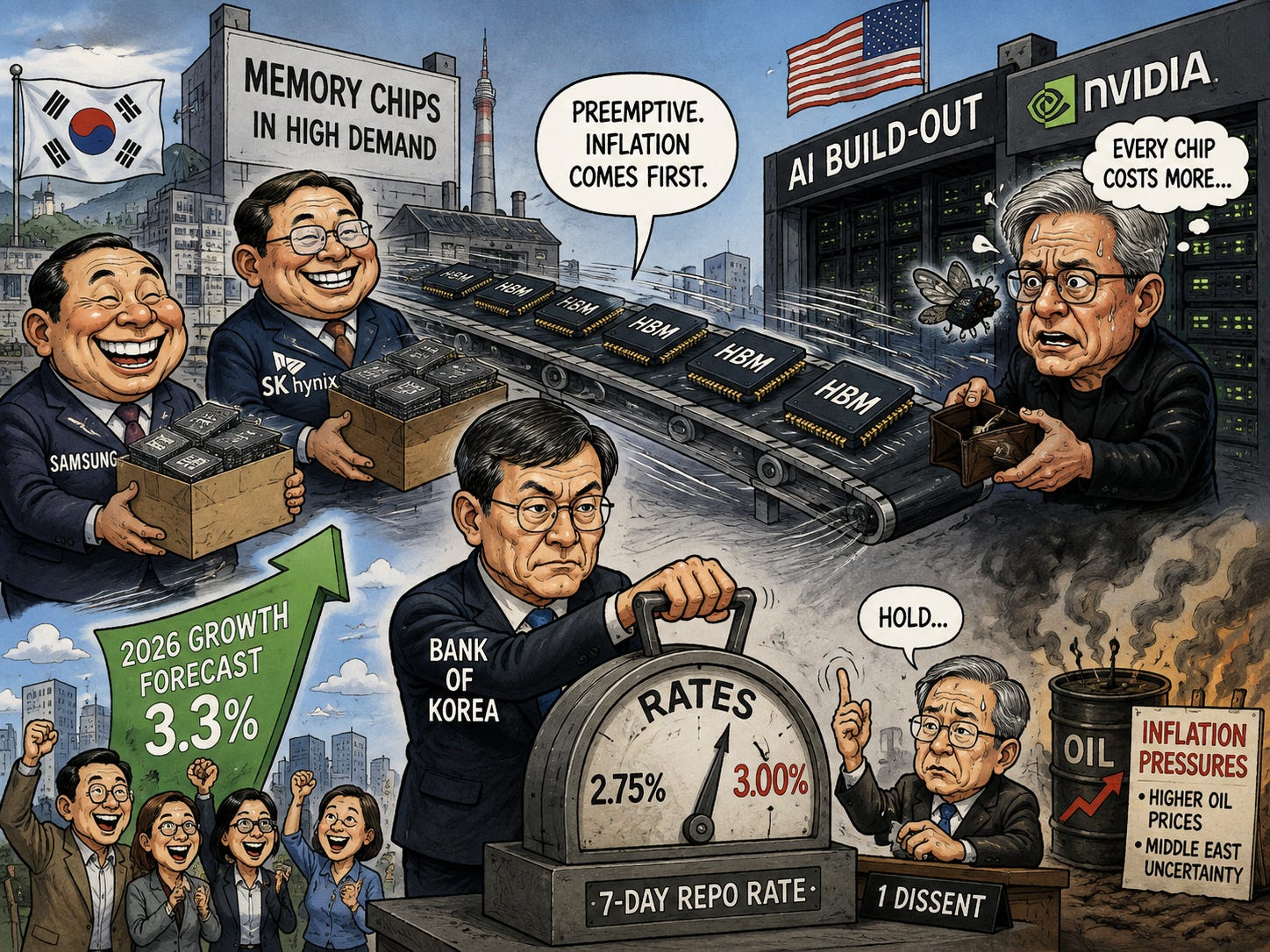
Korea raised. Again. The Bank of Korea lifted its 7-day repo rate by a quarter point to 3% on Thursday, the second rise in 2 meetings and the first back-to-back increase since January 2023. The vote was 6 to 1, with Hwang Kun-il voting to hold at 2.75%. July consumer prices ran at 2.8% and core inflation at 2.6%, the sharpest core reading since December 2023 and comfortably above the 2% target. Governor Shin Hyun-song called the move preemptive, and the board’s statement named higher oil prices and Middle East uncertainty among the pressures behind it. (The Korea Herald)
The forecast that came with the decision moved further than the rate did. The Bank lifted its 2026 growth call to 3.3% from 2.6%, which would be Korea’s first year of 3% or better since 2021, after the economy already grew 3.8% in the first half. What is doing that? Memory chips. Samsung and SK hynix are selling every high-bandwidth memory chip they can make into the AI build-out, and SK hynix shares rose about 3% in Seoul on Thursday on Nvidia’s results. The same boom that arrives in Seoul as an export windfall arrives in Santa Clara as an input cost, and both landed inside 12 hours. (Invezz)
Sensei’s Insight: Korea is the first central bank in this cycle to tighten because of AI. Chip exports are running so hot the economy cannot absorb them without prices moving. If the build-out holds through 2027, Korea will not be the last one raising into it.
📉 The inflation number landed and settled nothing
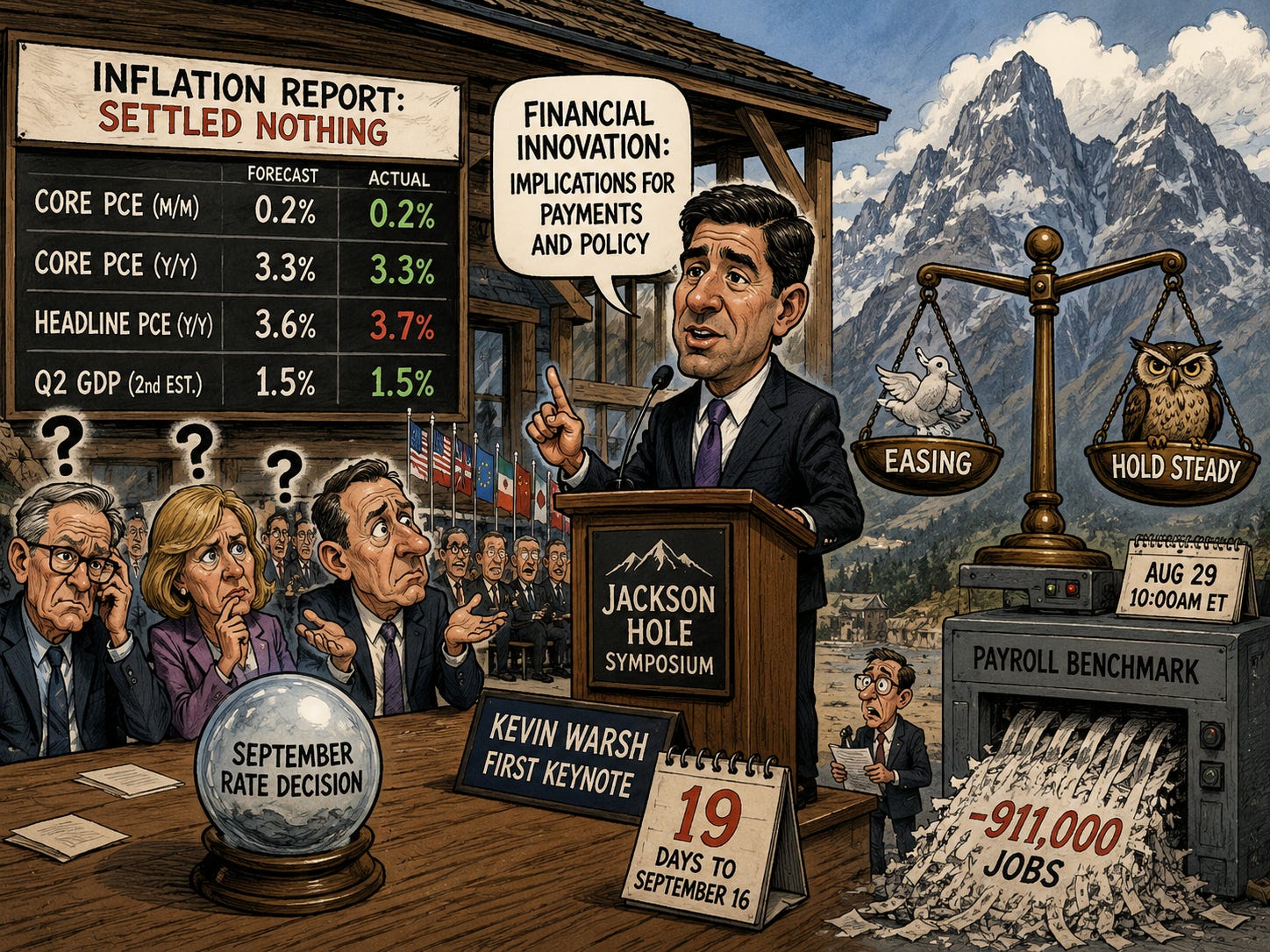
Consensus was 0.2% on the month for core PCE. Core PCE came in at 0.2%, and 3.3% over the year, unchanged from June. That is precisely what was forecast, and it moves the September argument nowhere. The headline index was the awkward one, holding at 3.7% annually where forecasters had 3.6%, while personal spending stalled. The second estimate of second-quarter growth arrived the same minute and held at 1.5% annualised, with an upward revision to consumer spending offset by an upward revision to imports. Yesterday’s edition put the annual core rate at about 3.2%, and 3.3% is where it printed. (CNBC)
The Jackson Hole symposium opened on Thursday in Wyoming, with roughly 120 central bankers, academics and policymakers from more than 70 countries under the title Financial Innovation: Implications for Payments and Policy. Kevin Warsh gives his first keynote as Fed chair on Friday at 10:00am Eastern, which is 3:00pm UK, 19 days before the 16 September decision. Interest rates are not in the title of the symposium. The Bureau of Labor Statistics publishes its annual payroll benchmark revision at the same minute, and last year’s exercise took 911,000 jobs out of the 2025 count, so the labour-market half of the argument gets rewritten while the chair is speaking. In July, 3 members dissented in favour of a rise. (Federal Reserve Bank of Kansas City)
Sensei’s Insight: A print landing exactly on forecast is the least useful outcome available, because nobody’s mind changed. That hands Friday’s speech more weight than a first keynote should ever carry, and Warsh has not yet had to move a market with his own words.
🛢️ Hormuz gets a price list and oil falls again
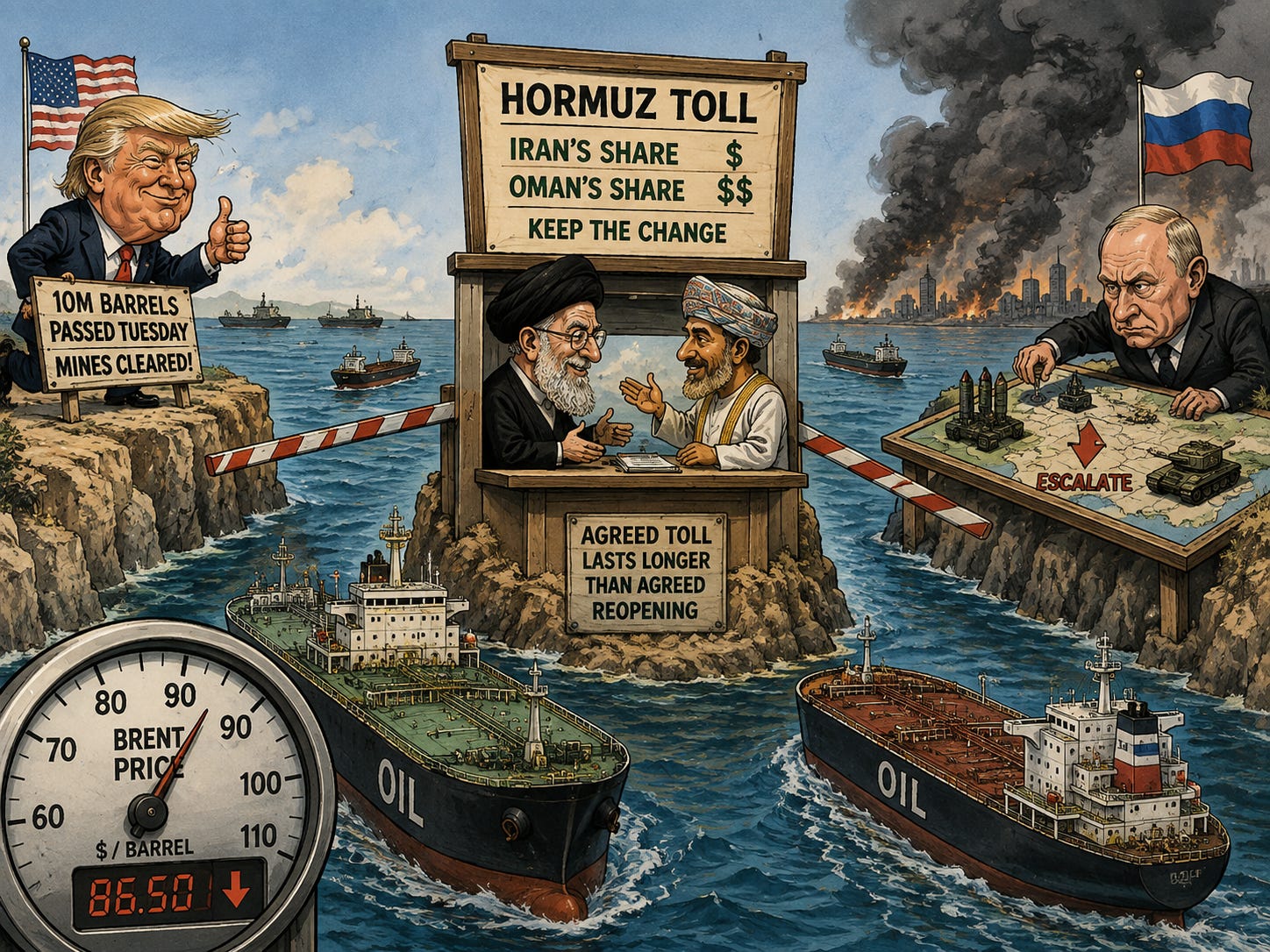
Brent crude has given up ground for 4 sessions, trading below $87 a barrel on Thursday morning before steadying, after Iran and Oman reached an agreement covering each country’s share of the Strait of Hormuz’s waters and the revenues attached to them. Tehran cautioned that reopening the strait takes more than a deal with Oman, and has previously tied it to Washington lifting the naval blockade, dropping oil sanctions and unfreezing assets. Donald Trump said 10 million barrels of oil passed through the waterway on Tuesday and repeated that the mines there have been cleared. (Trading Economics)
The strait normally carries about a fifth of the world’s oil and gas exports and there is no practical alternative route for most of it, which is why an argument over a narrow stretch of water moves the price of petrol everywhere. Prices have also softened because the American sanctions announced on Monday spared Iran’s trading partners, so the supply disruption traders had spent a fortnight pricing in never arrived. Pulling the other way, Bloomberg reported on Wednesday that Vladimir Putin is preparing to escalate attacks on Ukraine after concluding peace talks have hit a dead end, which opens a second energy risk in Europe as the first one narrows. (Meduza)
Sensei’s Insight: Agreeing who gets paid for the strait lasts longer than agreeing to reopen it. A toll that has been negotiated tends to stay negotiated, so the cost of moving a barrel through Hormuz does not go back to where it sat before the war.
Stories You Might Have Missed
🤗 Nvidia agreed to buy the internet’s model library
The Information reported on Wednesday night that Nvidia has agreed to buy Hugging Face for $12.9 billion. Hugging Face is where developers download and share open-source AI models, in the way a public code library works, and it was last valued at $4.5 billion in a 2023 round that Nvidia itself put money into. Revenue runs at about $150 million a year. The logic is defensive: OpenAI, Google, Amazon and Anthropic are all designing their own chips, and a healthy open-source ecosystem keeps the rest of the market on Nvidia hardware. Neither company has commented, and Business Insider reported that nothing has been signed. (TechCrunch)
☁️ Salesforce raised the year and the shares jumped
Salesforce reported second-quarter revenue of $11.35 billion on Wednesday evening, up 10.8% on the year and roughly in line with expectations, and lifted full-year revenue guidance to about $46.25 billion at the midpoint from $46.05 billion. Full-year adjusted earnings guidance went up to $16.69 a share at the midpoint. Billings were $9.77 billion, up 8.6%, and free cash flow reached $1.1 billion, up 81%. The shares rose about 12% afterwards. Salesforce is the largest company in the category that has spent this year being sold as the one AI eats first. Intuit fell 12% the day before on its own guide. (FinancialContent)
₿ Crypto bought the inflation dip back
Bitcoin dipped through the 8:30am Eastern inflation release on Wednesday, which is 1:30pm UK, then closed at $79,027, up 0.59% on the day. Ethereum settled at $2,506, up 2.58%, and Solana was the strongest major at $102.17, up 5.76%. XRP was the only one lower, easing 0.76% to $1.4224. Lenders launched 2 products this week that let holders borrow against coins instead of selling them. Galaxy opened retail credit lines secured on bitcoin, ether and staked solana at 8.99% a year, and Better and Coinbase launched a mortgage that lets American buyers pledge crypto as collateral toward a house purchase. (The Rio Times)