This content is for informational and educational purposes only and does not constitute financial advice. Always do your own research. Not financial advice (NFA).
👀 Today’s Stories at a Glance
🛢️ Brent hits $70: Geopolitical tension and Trump’s “Armada” warning drive oil prices past the 2026 oversupply narrative.
⚡ Tesla’s AI pivot: Shifting focus to robotics, Tesla repurposes factories for Optimus despite falling annual automotive revenues.
🚀 Meta’s superintelligence bet: Massive infrastructure spending fuels record revenue as AI tools significantly boost digital advertising performance.
🚀 Gold’s record rally: Prices touch $5,600 as global central banks ditch U.S. Treasuries for neutral reserve assets.
💰 Microsoft’s spending surge: Shares fell after a $37.5 billion AI bill squeezed margins despite strong cloud growth.
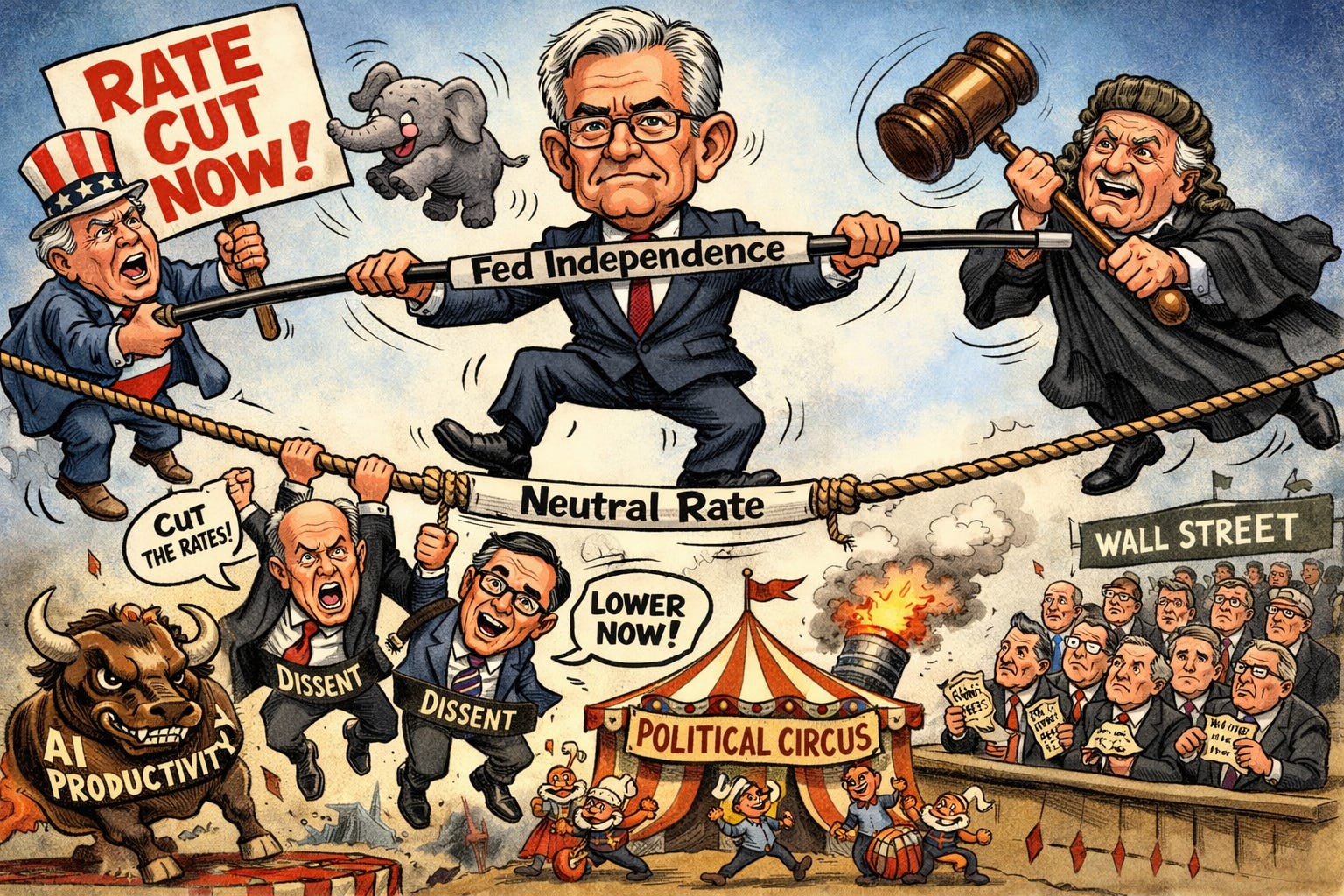
🔍 Fed hits neutral: Jerome Powell holds rates steady at 3.5%, signaling an end to the easing cycle.
🧠 One Big Thing
The Federal Reserve has officially transitioned to a neutral policy phase by maintaining interest rates between 3.5% and 3.75%. This shift signals that borrowing costs are no longer actively slowing the economy, effectively ending the cycle of aggressive policy changes. While internal dissent exists, the board now views the labor market as stable and intends to ignore temporary price spikes caused by new tariffs. For investors, this move removes the prospect of "easy money" gains from rapid rate cuts in the first half of 2026. Stability is the new baseline, though legal challenges to Fed independence remain a background volatility risk. Success now depends on corporate productivity and cash flow rather than anticipating further central bank intervention. (See more in the Deep Dive section).
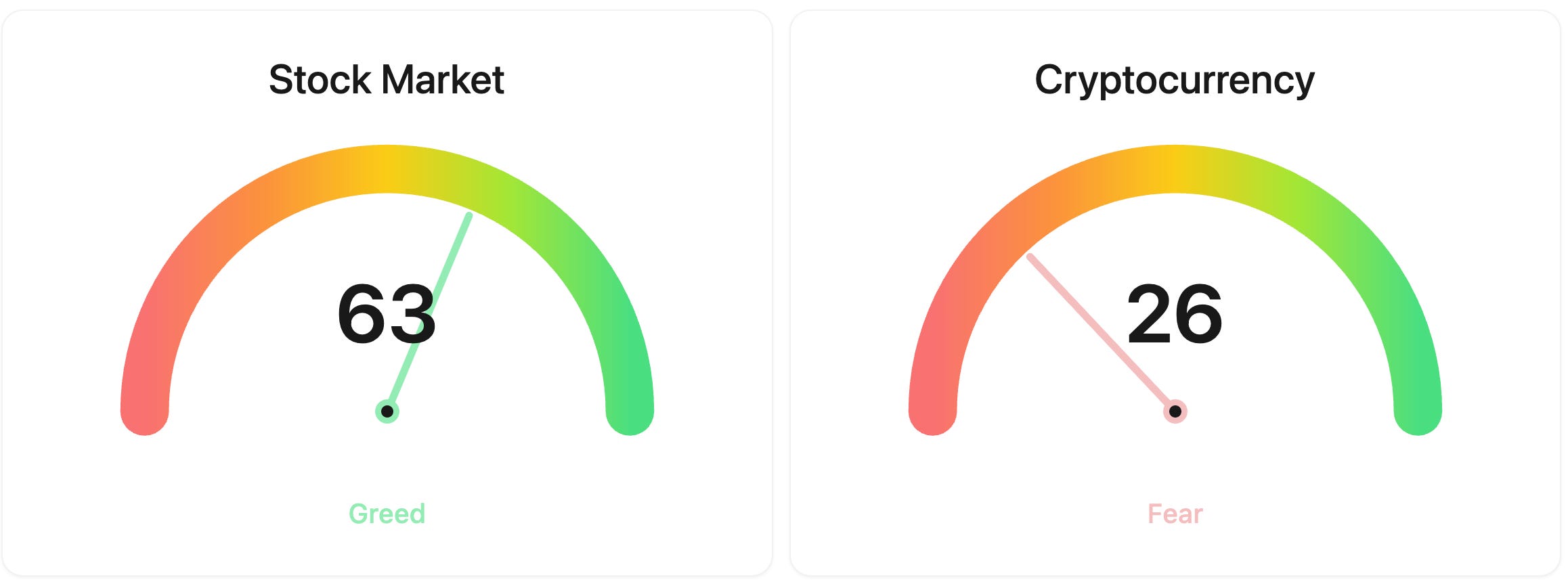
⚖️ Fear & Greed
📉 The Number That Matters
$5,600
Gold reaches a record $5,600 per ounce following a $1,000 “flash” rally in ten days. Escalating Middle East tensions and a four-year low in the U.S. dollar drive the longest winning streak since 2024.
⚔️ Winners vs Losers
Winners
DLX 0.00%↑: Deluxe Corp. moved higher after delivering a Q4 earnings beat and providing 2026 profit guidance that surpassed Wall Street expectations.
LBRT 0.00%↑: Liberty Energy Inc. rallied after reporting a Q4 beat, announcing new AI power deals, and increasing its quarterly dividend by 13%.
RCL 0.00%↑: Royal Caribbean surged after posting record Q4 results and reporting all-time high bookings and ship orders for the upcoming year.
IBM 0.00%↑ : IBM stock jumped after a Q4 beat driven by $12.5 billion in AI business and strong financial guidance for fiscal year 2026.
META 0.00%↑: Meta Platforms shares rose as the company reported a Q4 beat and issued 2026 revenue guidance that exceeded analyst estimates.
SCCO 0.00%↑: Southern Copper Corp. climbed after a Q4 earnings beat and record margins supported by a 320,000 ton global copper deficit.
Losers
GUTS 0.00%↑: Fractyl Health Inc. tumbled after the company announced a trial data delay and disclosed cash concerns that extend only into early 2027.
JOBY 0.00%↑: Joby Aviation Inc. shares plunged after pricing a $1.2 billion capital raise that includes significant shareholder dilution at a 15% discount.
WHR 0.00%↑: Whirlpool Corp. fell as the company missed Q4 earnings estimates and issued a weak 2026 outlook alongside a decline in free cash flow.
LVS 0.00%↑: Las Vegas Sands declined after reporting Q4 results as concerns over margin compression and rising wage expenses in Macao outweighed an earnings beat.
USAR 0.00%↑: USA Rare Earth Inc. plummeted following the announcement of a $3.1 billion government deal that involves a massive 75% dilution for current shareholders.
NOW 0.00%↑: ServiceNow Inc. shares fell despite a Q4 beat as investors reacted negatively to 2026 guidance and increased competition from Anthropic and OpenAI.
MSFT 0.00%↑: Microsoft Corp. declined after a record $37.5 billion capital expenditure report triggered return on investment concerns despite a Q2 earnings beat.
📊 Market Snapshot
Cryptocurrencies:
Bitcoin (BTC): $87,809 (▼ 1.54%)
Ethereum (ETH): $2,929 (▼ 2.58%)
XRP: $1.87 (▼ 2.08%)
Equity Indices (Futures):
S&P 500: $6,992 (▲ 0.07%)
NASDAQ 100: $26,199 (▲ 0.16%)
FTSE 100: £10,226 (▲ 0.71%)
Commodities & Bonds:
10-Year US Treasury Yield: 4.25% (▲ 0.00%)
Oil (WTI): $65 (▲ 2.05%)
Gold: $5,521 (▲ 1.94%)
Silver: $118.52 (▲ 1.64%)
Data as of UK (GMT): 12:03 pm / US (EST): 7:03 am / Asia (Tokyo): 9:03 pm
✅ 5 Things to Know Today
🛢️ Brent Hits $70: The Trump “Armada” Premium

Oil markets just ripped through the $70 ceiling for the first time since September, with Brent crude climbing 2.7% to $70.26 today. This 5% rally since Monday is being fueled by President Trump’s escalating rhetoric. On Wednesday, he took to social media to warn Iran of a “massive Armada” en route to the Persian Gulf, demanding a nuclear deal or “devastating consequences.” This follows the 2025 “Operation Midnight Hammer” strikes on Iranian nuclear sites. While Iran says their fingers are on the trigger, the real fear is a bottleneck at the Strait of Hormuz, where 20% of global oil flows (Bloomberg).
This moves the needle because it completely breaks the 2026 “oversupply” narrative. Most analysts started the year expecting a glut to keep prices near $50, but Trump’s ultimatum has injected a $3 to $4 geopolitical risk premium into every barrel. Interestingly, the big oil stocks like Exxon and Chevron haven’t fully joined the party yet: they’re up less than 1% today. This suggests the market sees this as a temporary spike rather than a long-term shift in fundamentals. If you want to see where the real anxiety lives, look at the tanker markets: war-risk insurance for the Gulf is up 60%, and spot charter rates for large carriers have doubled.
Sensei’s Insight: Watch the “call option” volume. Traders are buying protection against a $100 spike at record rates. If the Armada reaches the Gulf without a deal, expect that $70 floor to become a springboard.
⚡ Tesla’s Great Pivot: From Car Maker to AI House
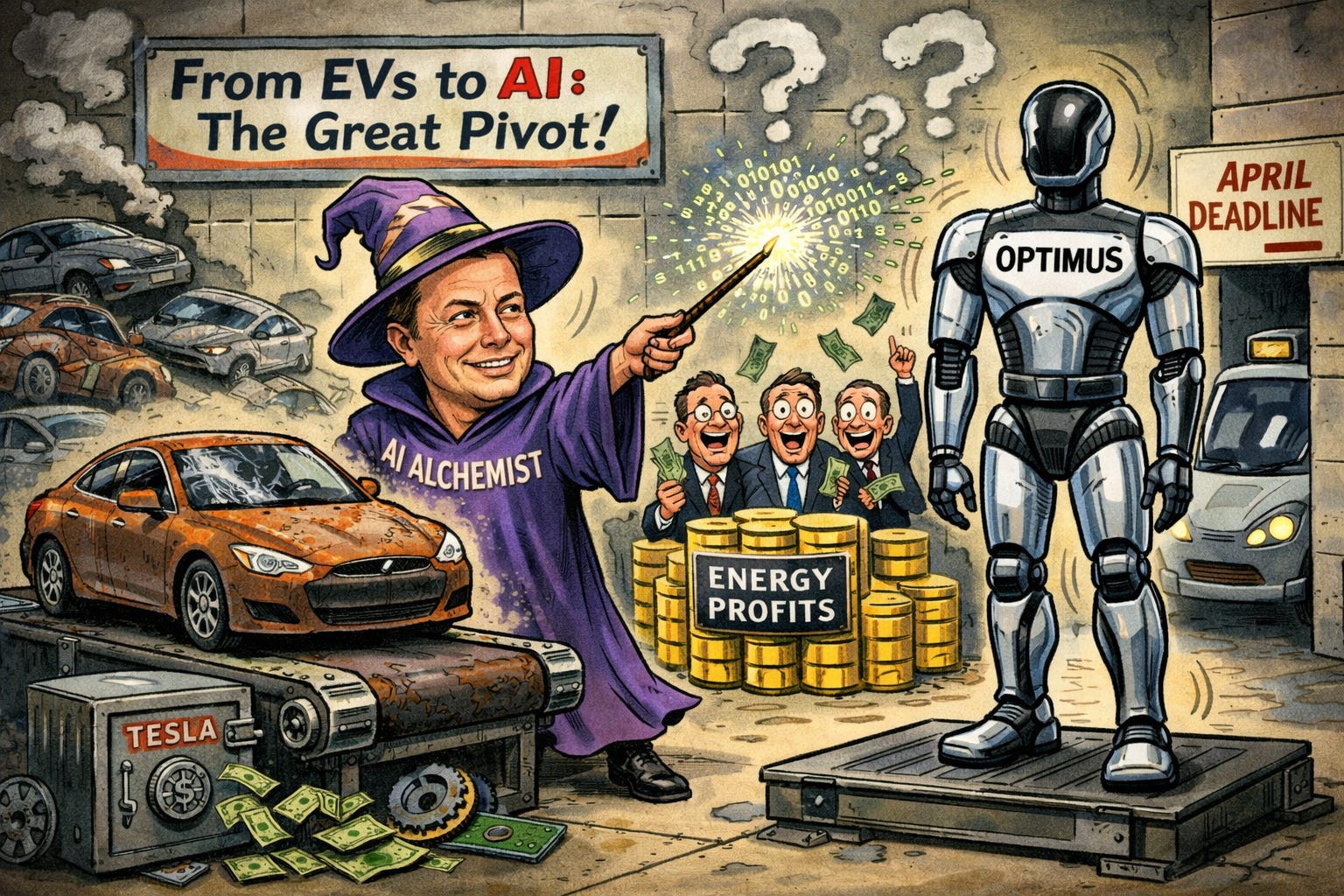
Tesla’s Q4 2025 results confirm the company is mid-pivot. While revenue of $24.9 billion slightly beat expectations, the bigger picture shows Tesla’s first-ever annual revenue decline, with total 2025 sales down roughly 3%. Automotive revenue specifically dropped 11% year over year as the global EV market cools and competition from Chinese brands like BYD intensifies. However, Tesla managed a “quality beat” on the bottom line, reporting adjusted EPS of $0.50 against the $0.44 expected. This was driven by a surprise jump in total gross margin to 20.1%, thanks to a record-breaking performance in the energy segment and tighter cost discipline in the car business (Tesla Investor Relations)
This report marks the end of Tesla as a pure-play high-growth car company. Management is now explicitly reframing the firm as a “physical AI” and robotics platform. To prove it, they’re making a massive bet: winding down production of the legacy Model S and Model X to repurpose factory space for the Optimus humanoid robot. They’re also planning a massive capex super-cycle, with spending expected to exceed $20 billion in 2026. This capital will fund everything from “Cybercab” production to a potential domestic “Terafab” for AI chips. Investors are currently look past the shrinking auto sales because the energy business is booming, with Megapack and Powerwall deployments hitting a record 14.2 GWh this quarter.
Sensei’s Insight: Watch the $20 billion capex spend. Tesla is sacrificing short-term cash flow to build a robotics empire. If Cybercab production misses its April ramp, the “AI premium” could evaporate quickly.
🚀 Meta’s $135B Bet on “Superintelligence”
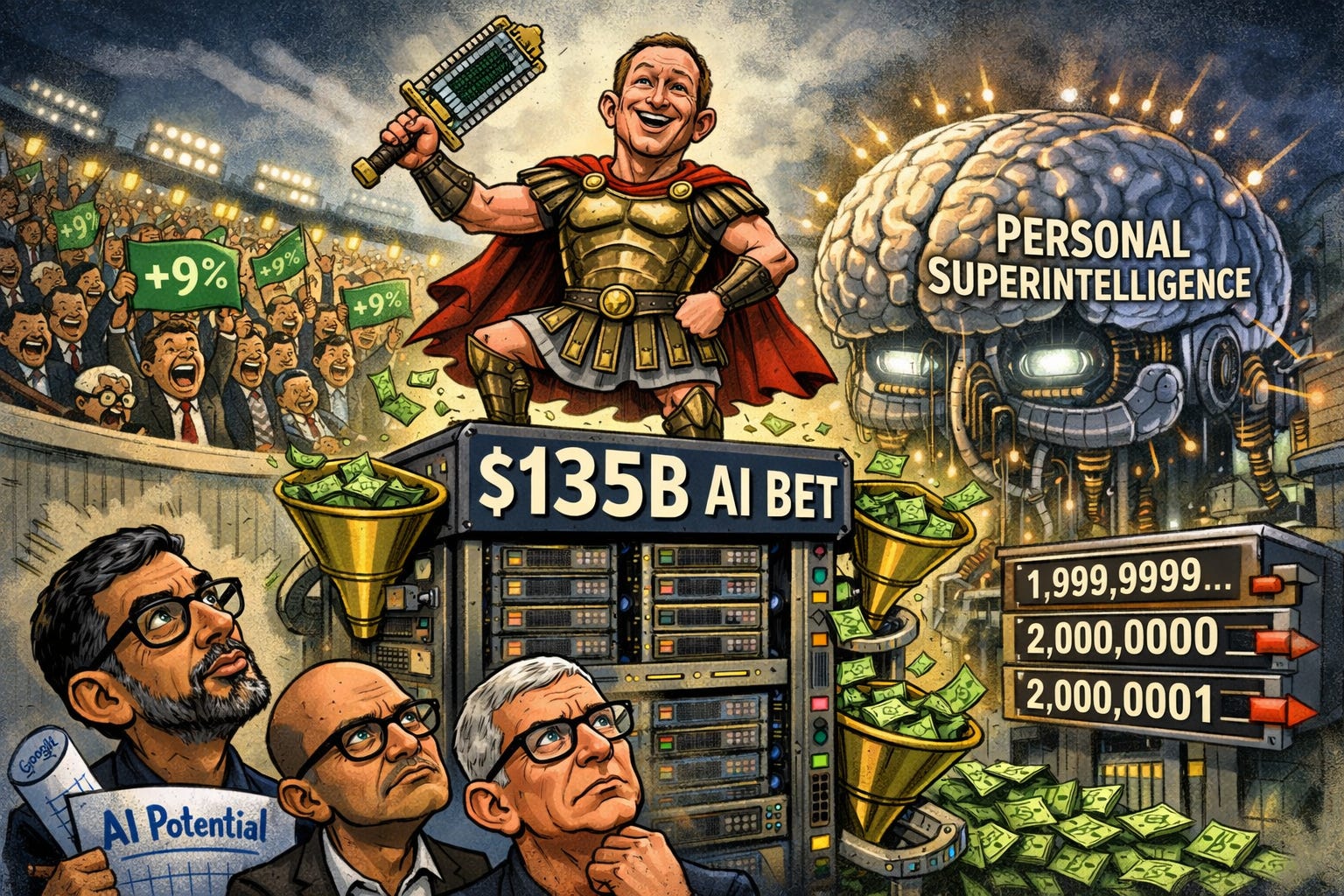
Meta just dropped a Q4 earnings report that managed to turn a massive spending warning into a victory lap. Revenue hit $59.89 billion, comfortably ahead of the $58.41 billion the street expected, while earnings per share landed at $8.88. But the real shocker wasn’t the beat, it was the price tag for the future. Mark Zuckerberg is nearly doubling capital expenditures to a range of $115 billion to $135 billion for 2026, up from roughly $72 billion in 2025. This means Meta is planning to pour almost every cent of its free cash flow back into data centers and silicon. Investors initially flinched at the cost, but shares rallied 9% in after-hours trading once management explained that this isn’t just “spending,” it’s already generating cash.
This matters because Meta is proving that AI isn’t just a buzzword for them, it’s a functional revenue driver. While other tech giants are still talking about “potential,” Meta is seeing a 3.5% lift in ad clicks and a $10 billion annual run rate for its new video generation tools. They’re pivoting from general AI to what Zuck calls “personal superintelligence,” which uses your specific history across 3.5 billion users to serve ads and content. The 24% revenue growth shows they’re outperforming peers like Google by using AI to squeeze more value out of every impression. For us, the story is no longer about whether they’ll spend the money, but whether their proprietary models can keep the ad machine growing fast enough to offset the massive infrastructure bill.
Sensei’s Insight: Watch the operating income guidance. Meta claims 2026 income will still grow despite the capex surge. If that math holds, the current valuation looks like a bargain, if not, margins are at risk.
🚀 Gold hits $5,600: The $1,000 “Flash” Rally

Gold just pulled off a staggering $1,000 move in ten days, rocketing from below $4,600 to touch a record $5,600 per ounce. This nine-day winning streak is the longest since early 2024, signaling a sharp pivot in global capital. The move intensified on January 28 after President Trump warned that a “massive armada” is heading to Iran, prompting Tehran to put its forces on high alert. Simultaneously, the U.S. dollar plummeted to a four-year low. Trump dismissed the currency’s slide as “great,” effectively signaling to the market that the administration tolerates a weaker dollar to boost exports, which has removed a major traditional headwind for precious metals.
This rally isn’t just about headlines; it’s a structural realignment driven by aggressive de-dollarization. For the first time in three decades, gold has overtaken U.S. Treasuries as the largest foreign reserve asset. Central banks are lead-buying, with 95% of those surveyed planning to increase holdings this year. Poland is the standout, recently approving a plan to lift its reserves to 700 tonnes to enter the global “top ten” holders. China has now reported 14 consecutive months of purchases, signaling a strategic exit from U.S. debt in favor of “neutral” assets that cannot be frozen or weaponized. This massive shift absorbs roughly 26% of global mine output, creating a hard floor for prices even as retail demand hits record levels (Investing.com)
Sensei’s Insight: Watch the $5,300 level as the new “floor.” While the parabolic speed suggests a tactical pullback is possible, the systematic selling of U.S. debt by major powers indicates that gold is being treated as the new anchor of the global financial system.
💰 The $37.5 Billion Reality Check
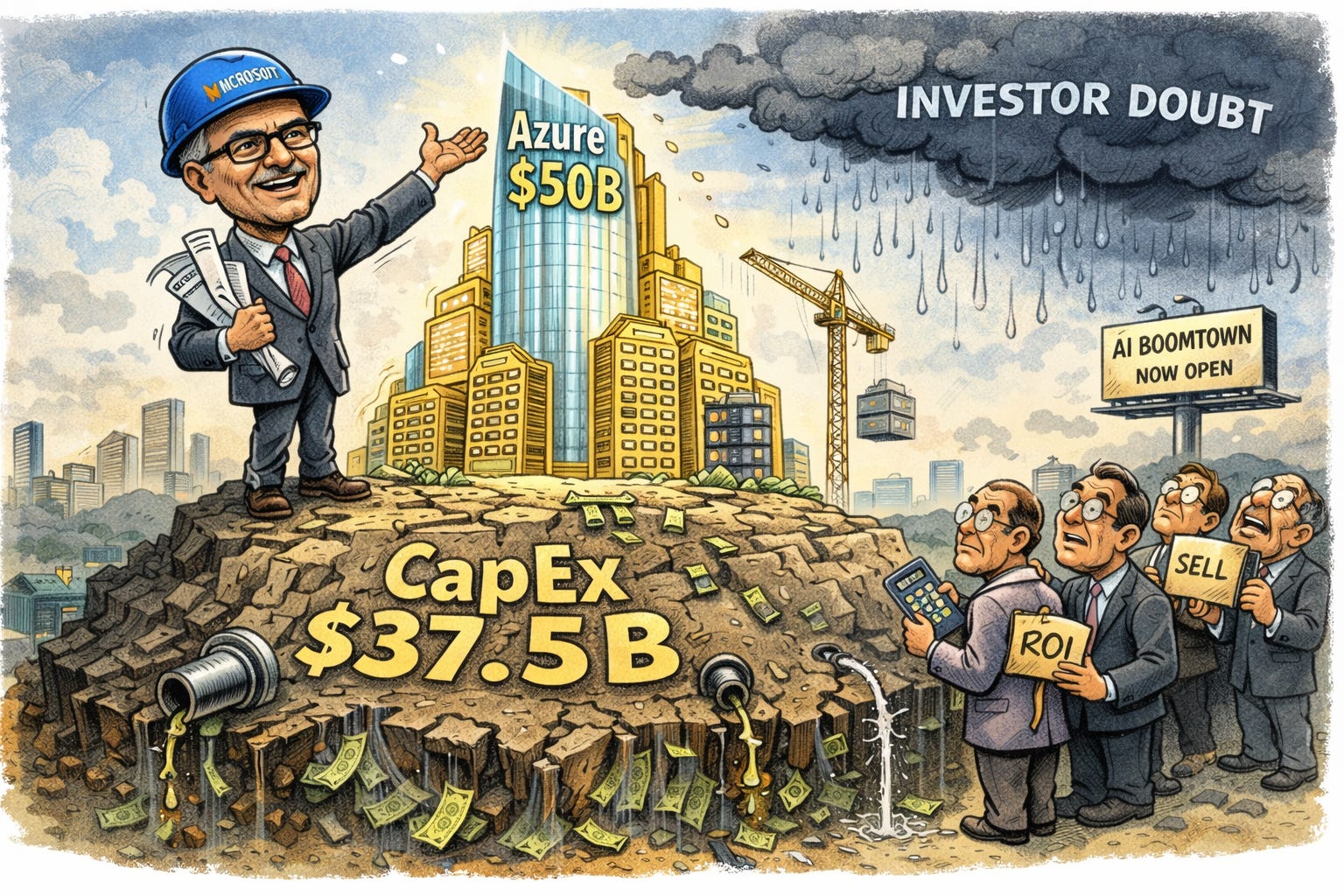
Microsoft just delivered a masterclass in operational excellence that the market promptly ignored. For Q2 FY26, the company posted a healthy beat with $4.14 in adjusted EPS and $81.27 billion in revenue, up 17%. The headline grabber should have been the cloud business crossing the $50 billion quarterly milestone for the first time, but a different number stole the show: $37.5 billion in capital expenditures. That is a 66% jump in spending year over year, significantly overshooting the $34.31 billion analysts expected. Even though Azure grew 39%, matching high expectations, the sheer scale of the bill to get there triggered a sharp selloff, with shares dropping as much as 7% in after-hours trading (Microsoft Investor Relations)
This reaction signals a fundamental shift in how we need to value these tech giants. The “trust us” phase of AI investment is over, and the market is now hyper-focused on return on investment (ROI). Microsoft’s gross margins squeezed down to 68%, their narrowest in three years, which tells you that building out AI infrastructure is getting more expensive, not more efficient. While CEO Satya Nadella argues that they are just meeting “unprecedented demand,” the math is getting tighter. Investors are beginning to worry that if cloud growth stays at 39% while spending keeps climbing at 66%, the leverage that made Microsoft a darling is starting to move in the wrong direction.
Sensei’s Insight: Watch the gap between capex growth and Azure revenue. If spending continues to outpace growth, the “AI power utility” narrative fails, and we could see a broader valuation reset.
🔗 Connect with Us
Stay plugged in across platforms:
Sensei on X: sensei_live_
Martyn Lucas on X: MartynInvestor
Vaz on X: eVTOLHUB
📺 YouTube Channel (Live & Replays): Martyn Lucas Investor

🔍Deep Dive: Jerome Powell’s “Neutral” Pivot: A Deep-Dive into the January 2026 Fed Decision