

This content is for informational and educational purposes only and does not constitute financial advice. Always do your own research. Not financial advice (NFA).
👀 Today’s Stories at a Glance
🏛️ Powell Goes Out Hawkish: Federal Reserve held rates as four members dissented at Chair Powell’s final meeting.
🛢️ Brent Hits Four-Year High: Brent settled at $118 a barrel after Trump confirmed the Iran blockade stays open-ended.
☁️ AWS Posts Fastest Growth Since 2022: Amazon Web Services revenue grew 28% to $37.6 billion on artificial intelligence workload demand.
💸 Meta Lifts AI Capex Ceiling: Meta raised its 2026 capex range to $125 to $145 billion, citing higher chip prices.
💳 Visa’s Strongest Growth Since 2022: Visa posted 17% revenue growth as cross-border volume signals consumer spending remains intact.
🔍 Cloud Surge Hits Three Hyperscalers: Google Cloud jumped 63% and Azure rose 40%, confirming artificial intelligence demand is industry-wide.
⚡ Meta Reshapes Entergy’s Capex Plan: Entergy lifted spending by $14 billion to power Meta’s Louisiana data centre campus.
💔 Ackman’s Fund Drops On Debut: Pershing Square USA fell roughly 18% from its $50 offering price on day one.
📉 Robinhood Slides on Crypto Slump: Robinhood dropped over 10% as cryptocurrency trading revenue fell 47% year over year.
🧠 One Big Thing
The Federal Reserve held rates at 3.50% to 3.75% but four members dissented, the largest policy-meeting split since October 1992. Powell described current policy as already mildly restrictive, language that removes the cushion for cuts markets had priced into 2026. The statement also hardened, dropping softer phrasing from the inflation line and tying global energy directly to the inflation outlook. Core personal consumption expenditures rose to 3.2% in March, moving the wrong direction. Cut probabilities for 2026 may need repricing lower, and rate-sensitive equities could lose a tailwind investors had treated as locked in. Watch the June meeting for the easing bias to drop.
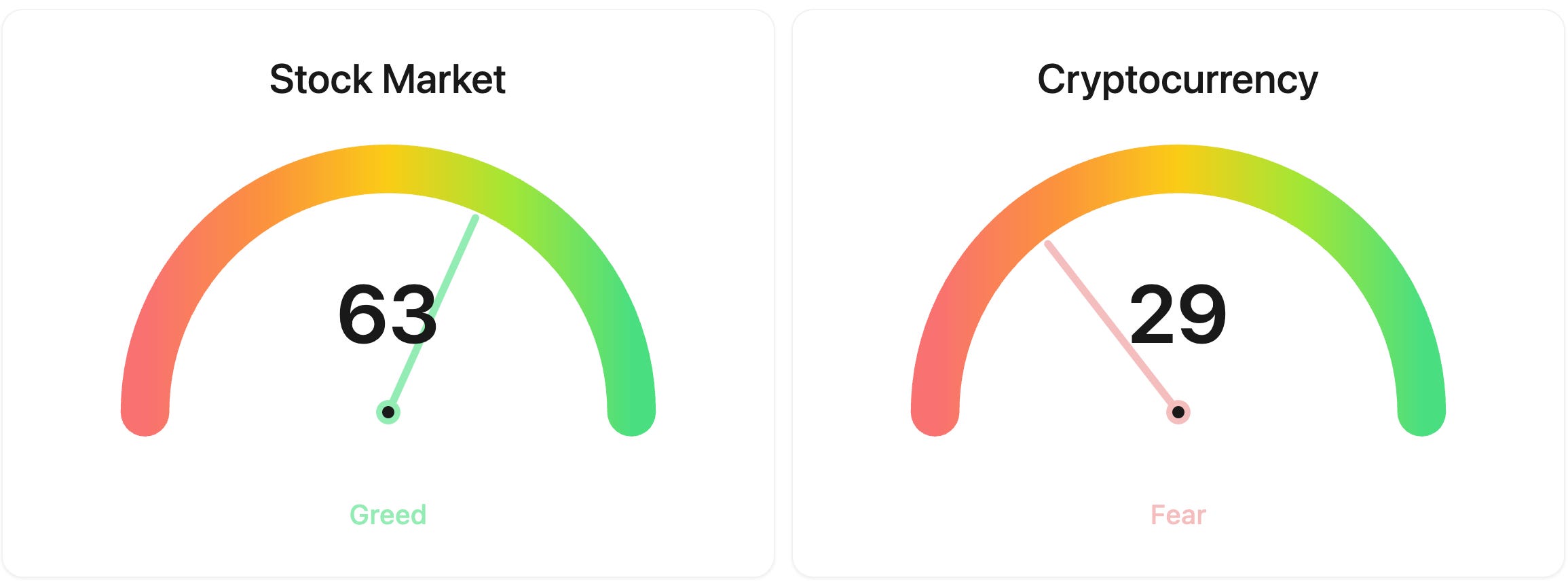
⚖️ Fear & Greed
📉 The Number That Matters
$145 BILLION
Meta lifted its 2026 capital expenditure ceiling to $145 billion, with the $145 billion top end roughly $10 billion above the prior range and explicitly tied to higher artificial intelligence (AI) chip pricing, sending shares down 6% after hours.
⚔️ Winners vs Losers
Winners
MRAM 0.00%↑: Everspin Technologies posted Q1 revenue of $14.9 million, up 13% year-over-year, and announced a new $40 million contract with a US prime contractor for state-of-the-art MRAM process technology serving the defense industrial base, with Q2 revenue guidance of $15.5-$16.5 million also topping consensus.
VIAV 0.00%↑: Viavi Solutions delivered fiscal Q3 revenue of $406.8 million, up 42.8% year-over-year and well ahead of estimates, with management citing strong data center and aerospace and defense demand and guiding Q4 revenue above the Street.
PI 0.00%↑: Impinj beat Q1 revenue expectations on all-time record endpoint IC bookings and guided Q2 revenue to a midpoint of $104.5 million, roughly 8% above consensus and signaling a sharp inflection toward higher profitability.
QCOM 0.00%↑: Qualcomm topped Q2 fiscal 2026 estimates with non-GAAP EPS of $2.65 on $10.6 billion in revenue, with record automotive revenues exceeding $5 billion annualized and growing 38% year-over-year offsetting weakness in Chinese handset demand.
CVNA 0.00%↑: Carvana reported a record Q1 with retail units up 40% to 187,393, revenue up 52% to $6.4 billion, and record adjusted EBITDA of $672 million, marking its sixth consecutive quarter of 40%-plus retail unit growth.
GOOGL 0.00%↑: Alphabet jumped after Q1 revenue rose 22% to $109.9 billion with Google Cloud growth accelerating to 63%, EPS of $5.11 crushing the $2.62 consensus, and Cloud backlog nearly doubling sequentially to over $460 billion
Losers
CHKP 0.00%↑: Check Point Software is sliding ahead of its Q1 2026 earnings release this morning, extending recent weakness driven by a string of analyst price-target cuts and lingering investor concern over the company’s prior guidance reset and decelerating billings.
TDOC 0.00%↑: Teladoc Health reported a Q1 GAAP loss of $0.36 per share that missed estimates, with BetterHelp revenue down 9% year-over-year and Q2 revenue guidance of $597-$626 million bracketing the lower end well below the $623.7 million consensus.
META 0.00%↑: Meta Platforms beat Q1 with revenue up 33% to $56.3 billion but raised full-year capex guidance to $125-$145 billion from $115-$135 billion, with management citing higher memory component pricing and additional data center costs that will weigh on free cash flow.
KLAC 0.00%↑: KLA Corporation pulled back despite beating fiscal Q3 estimates, raising the dividend 21% to $2.30, and authorizing an additional $7 billion buyback, with investors taking profits after a sharp run-up and focusing on tariff and DRAM-driven gross margin headwinds.
📊 Market Snapshot
Cryptocurrencies:
Bitcoin (BTC): $76029 (▲ 0.34%)
Ethereum (ETH): $2261 (▲ 0.36%)
XRP: $1.37 (▲ 0.25%)
Equity Indices (Futures):
S&P 500: $7144 (▲ 0.47%)
NASDAQ 100: $27386 (▲ 0.22%)
FTSE 100: £10314 (▲ 1.15%)
Commodities & Bonds:
10-Year US Treasury Yield: 4.40% (▼ -0.68%)
Oil (WTI): $107 (▼ -1.47%)
Gold: $4626 (▲ 1.81%)
Silver: $73.51 (▲ 3.09%)
Data as of: UK (BST) 11:14 / US (EDT): 07:14 / Asia (Tokyo): 20:14
✅ 5 Things to Know Today
🏛️ Powell’s Final FOMC Brings Four Dissents and a Hawkish Hold
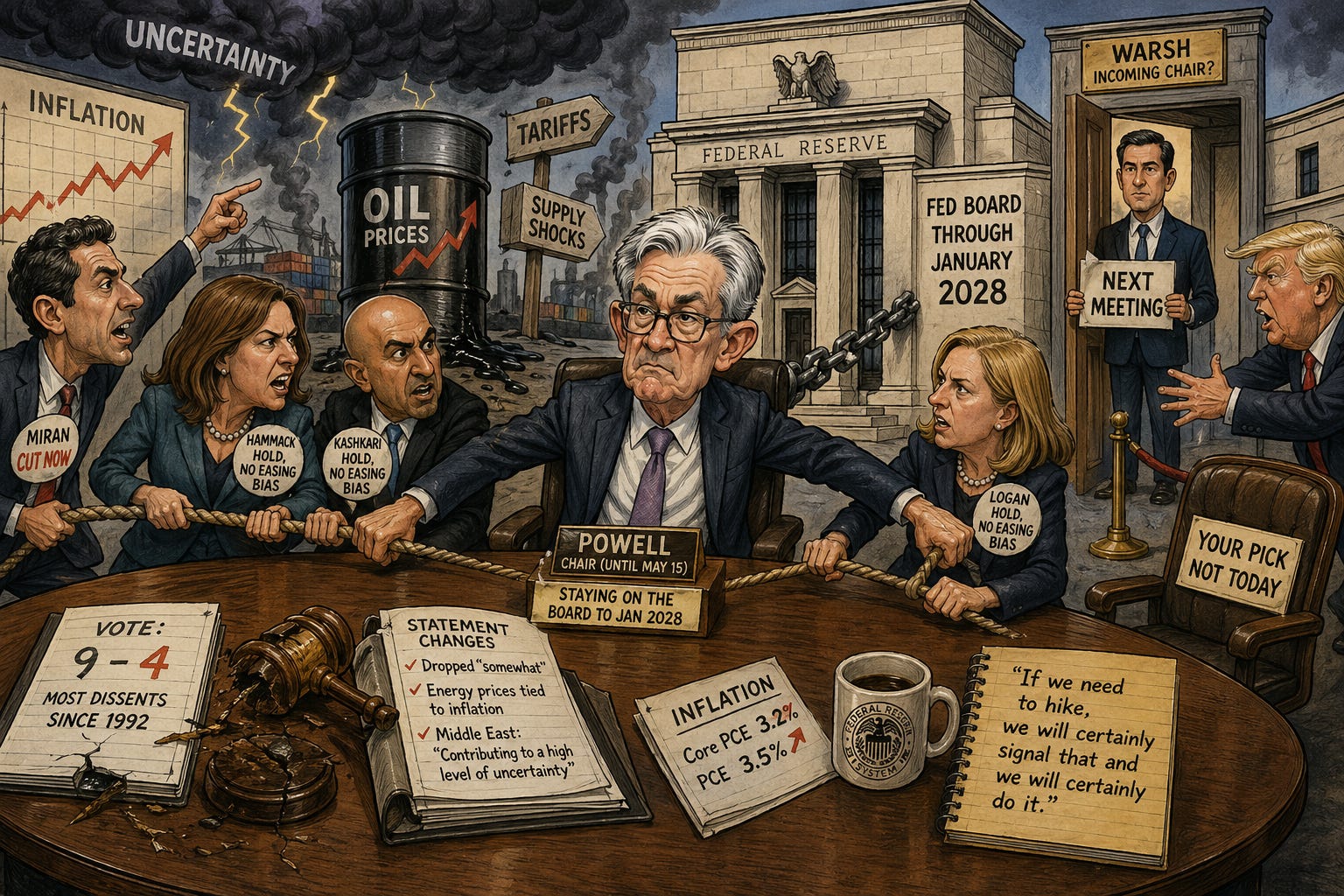
The Fed held rates at 3.50% to 3.75% for a third straight meeting, but the real story was the vote itself. Four members dissented, the most since October 1992. Stephen Miran wanted a cut. Beth Hammack, Neel Kashkari and Lorie Logan all backed the hold but voted against keeping the easing bias in the statement. That’s a Fed openly splitting on Powell’s last meeting as Chair, and Powell himself admitted “the center is moving toward a more neutral place.” The statement also hardened. The word “somewhat” was dropped from the inflation line, global energy prices were tied directly to inflation for the first time, and the Middle East language escalated from “uncertain” to “contributing to a high level of uncertainty about the economic outlook.” (Federal Reserve)
At the press conference Powell confirmed core PCE rose to 3.2% and headline PCE hit 3.5% in March, both moving the wrong way. He said the Fed wants to see “the back side of the oil shock and progress on tariffs before we even thought about reducing rates.” On hike risk: “If we need to hike, we will certainly signal that and we will certainly do it.” He described policy as being at “the high end of neutral or perhaps mildly restrictive,” which removes the cushion for cuts even if the committee wanted them. Powell also said the easing bias being removed “conceivably could come as soon as the next meeting” under Warsh.
Powell then dropped the bombshell. He confirmed he will remain on the Fed’s Board of Governors after his term as Chair ends on May 15, citing “unprecedented” legal attacks on the central bank in its 113-year history. “The things that have happened really in the last three months have left me no choice but to stay,” he said. On Fed independence: “I think it’s at risk.” By staying, Powell denies President Trump the ability to fill his board seat with a more accommodative nominee, and with his governor term running through January 2028, he will be in the room for every rate decision Warsh makes. The Senate Banking Committee separately advanced Warsh by a 13-11 party-line vote yesterday morning, the most partisan such vote in the committee’s history. Full Senate confirmation is expected the week of May 11. (Fortune)
Sensei’s Insight: This was a hawkish hold dressed as a normal hold. The cut narrative for 2026 is essentially dead unless oil collapses and tariffs roll off, neither of which is close. The June meeting under Warsh almost certainly drops the easing bias, and that flip is the next big tape-mover. The bigger long-term story is Powell sitting in the room as a swing voter through 2028, which changes the political math for every rate decision under Warsh. Today at 13:30 BST we get Q1 GDP and the official March PCE drop, but Powell already pre-announced the inflation print on the podium, so growth is the swing variable.
🛢️ Oil Hits 4-Year High as Blockade Becomes Indefinite

The market got something more significant than another supply-risk headline yesterday: confirmation that the US naval blockade of Iranian ports is no longer a temporary pressure tool but an open-ended condition. Trump told Axios the US would maintain it until Iran agreed to a nuclear deal, using language, “they are choking like a stuffed pig”, that ruled out any near-term off-ramp. Brent crude settled at $118.03 a barrel, up 6.1% and the highest close since June 2022, while West Texas Intermediate hit $106.88, up nearly 7%. The physical market confirmed what the price implied: the Energy Information Administration reported a 6.2 million barrel crude inventory draw, roughly 27 times the 231,000-barrel decline analysts had forecast, as record US exports of 6.44 million barrels per day helped drain domestic stockpiles. (CNBC)
The squeeze is reaching American consumers directly. Gasoline inventories fell sharply alongside crude, pump prices averaged $4.23 a gallon according to AAA, and gasoline futures rose more than 5% to their highest since 2022. GasBuddy analyst Patrick De Haan warned some Midwest markets could push above $5 a gallon if refinery constraints continue into summer. Goldman Sachs raised its fourth-quarter Brent forecast to $90 a barrel while placing its sustained upside scenario at $115 to $120, and JPMorgan warned prices could overshoot toward $150 if the Strait of Hormuz remains effectively closed past mid-May. Energy stocks are the only clear beneficiaries: Occidental Petroleum, Exxon, and Chevron each rose between 2% and 4%, while airlines retreated on fuel-cost pressure. (Reuters)
Sensei’s Insight: A crude draw 27 times larger than forecast is not a sentiment trade , it’s a physical-market signal that supply tightness was extreme before the price spike even began. The extreme gap between near-term spot prices and lower deferred futures suggests the market still expects eventual resolution, but has completely stopped betting on a quick one. Every week that passes without Hormuz reopening narrows that gap further.
☁️ AWS Notches Fastest Cloud Growth in Four Years on AI Demand
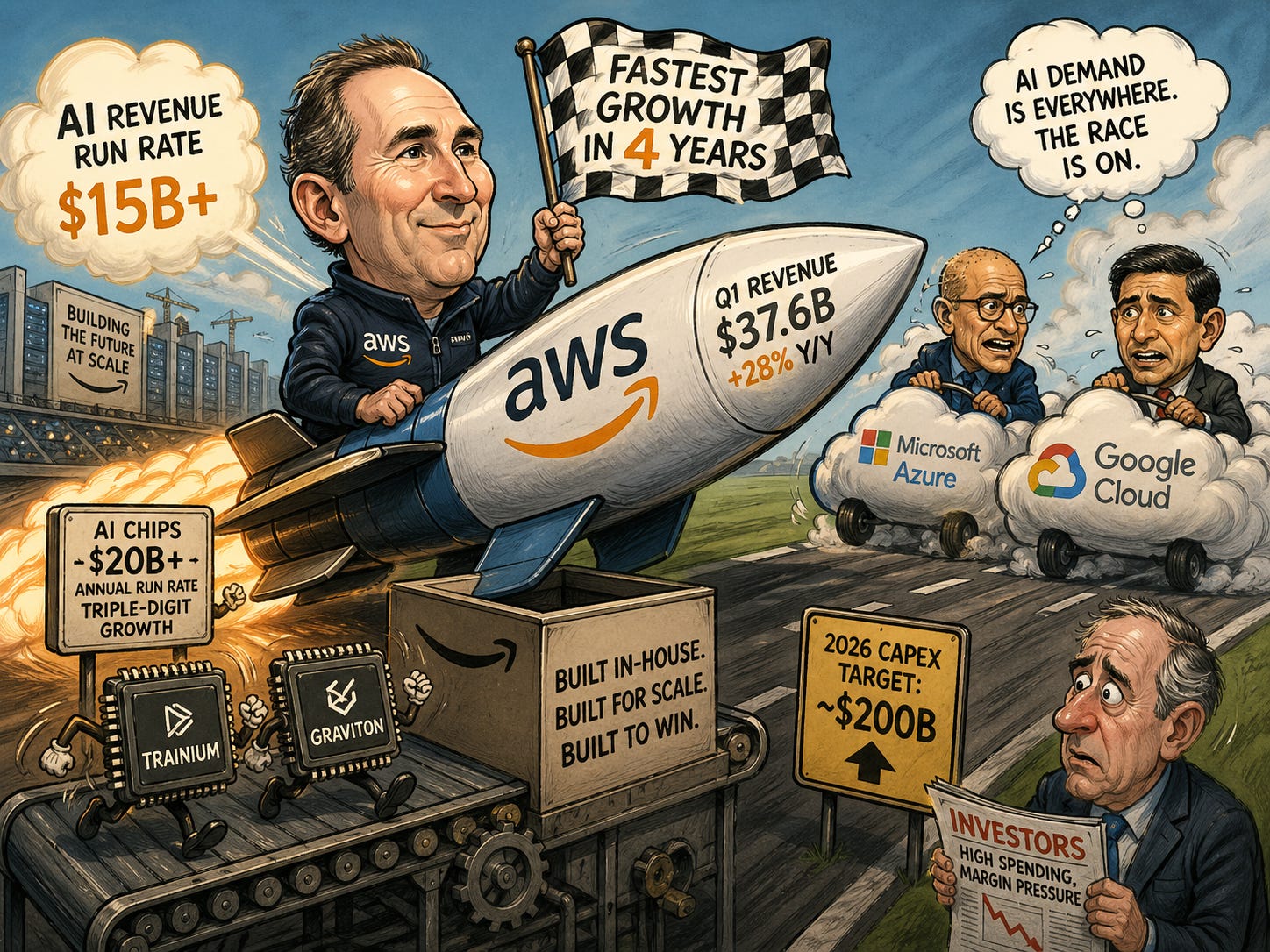
Amazon Web Services grew revenue 28% year over year to $37.6 billion in the first quarter, the fastest pace in 15 quarters and meaningfully ahead of the $36.6 billion analysts expected. Amazon’s total revenue rose 17% to $181.5 billion, and companywide operating income came in at $23.9 billion, well above the $20.8 billion consensus and above the top of the company’s own guidance range. Chief Executive Andy Jassy disclosed for the first time that AWS’s AI-related revenue had crossed a $15 billion annual run rate, and the company’s custom chips business, spanning the Trainium and Graviton processors, was growing at triple-digit rates on an annualized base above $20 billion. Separately, OpenAI committed to roughly 2 gigawatts of Amazon’s Trainium capacity starting in 2027, and Amazon said it would invest up to $25 billion more in Anthropic on top of the $8 billion already committed. (Amazon)
The result landed alongside equally strong cloud numbers from Alphabet and Microsoft, both reported the same evening, confirming that AI-driven enterprise demand is industry-wide and no longer concentrated in one hyperscaler. Despite the AWS beat, Amazon shares were little changed after hours because second-quarter operating income guidance of $20 billion to $24 billion had a midpoint below the $22.9 billion analyst estimate, the familiar tension where strong near-term revenue growth is offset by the weight of infrastructure spending on margins. Amazon is targeting roughly $200 billion in capital expenditure this year, up from $131.8 billion in 2025. Jassy framed the spend as a deliberate bet: “We’re not investing approximately $200 billion in capex in 2026 on a hunch.” (Reuters)
Sensei’s Insight: Amazon’s AI chips crossing $20 billion in annual run rate is the detail most investors will underweight. Amazon is replicating its retail supply-chain playbook in compute: build in-house, reduce Nvidia dependence, use proprietary chips to lock in customers and protect margins. If Trainium keeps scaling, the chip story inside AWS could eventually be as significant as the cloud business itself.
💸 Meta Bets $145 Billion on AI, Stock Falls After Hours
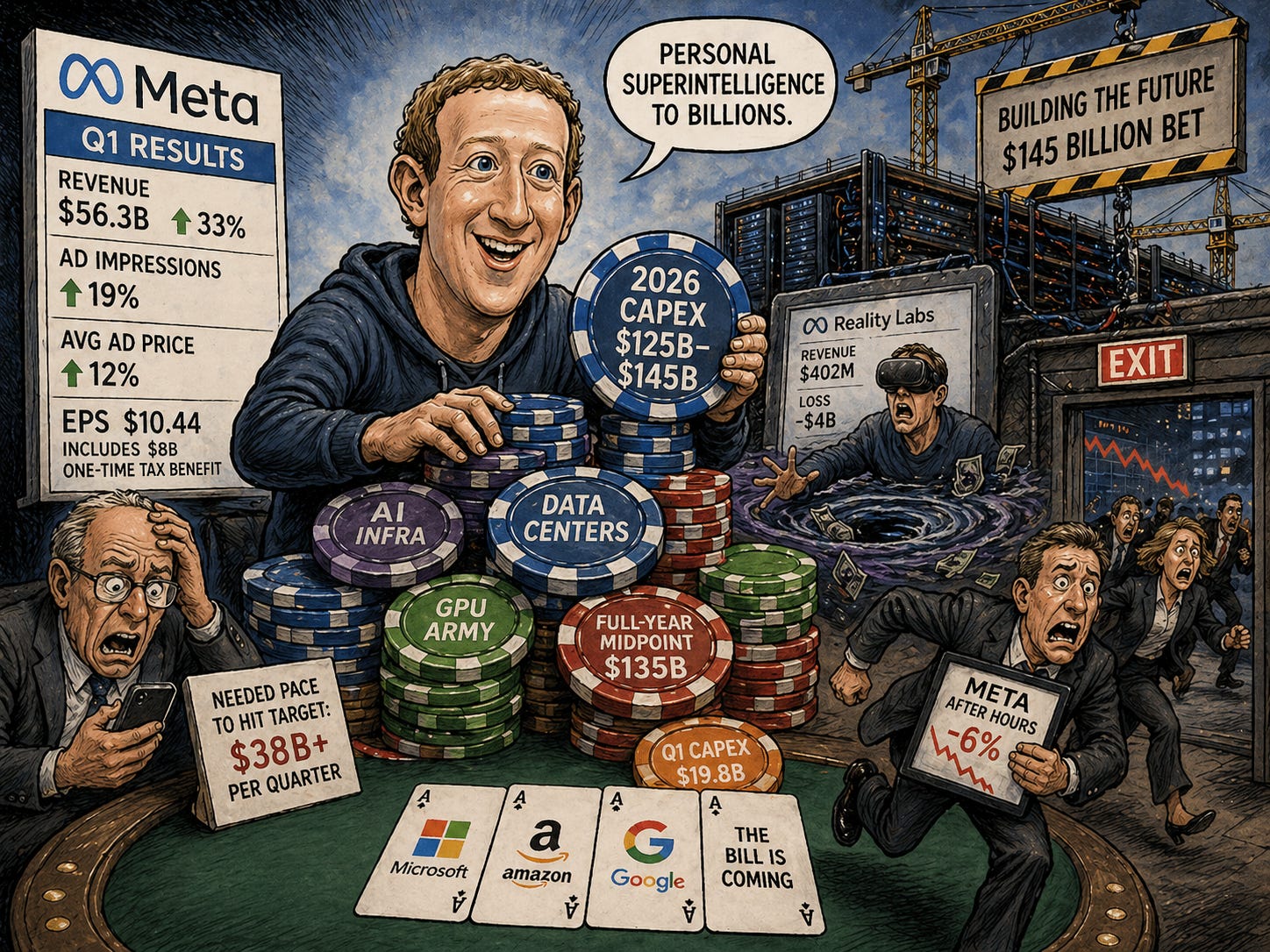
Meta’s first-quarter advertising business was by almost any measure excellent, but investors sold the stock roughly 6% after hours because the company raised its 2026 capital expenditure forecast by $10 billion at the midpoint, and then disclosed that actual Q1 spending came in far below the pace needed to hit the new target. Revenue rose 33% to $56.3 billion, beating consensus. Ad impressions rose 19% and average ad price climbed 12%, both improvements driven by AI-enhanced targeting tools including Advantage Plus. Diluted earnings per share were $10.44, though that figure included an $8 billion one-time tax benefit; on an adjusted basis the beat was more modest. The revised 2026 capex range of $125 billion to $145 billion, up from $115 billion to $135 billion, reflects what CFO Susan Li described as “higher component pricing”, the clearest public confirmation yet that AI chip costs are rising across the industry. (Meta Investor Relations)
The spending tension goes deeper than the headline range. Meta’s Q1 capex was only $19.8 billion, well below the roughly $27 billion analysts had expected. To hit the new full-year midpoint of $135 billion, the company needs to average more than $38 billion per quarter for the rest of the year, a significant acceleration. Meta paid zero in share buybacks during Q1, compared with $12.75 billion in the same period last year, redirecting that cash to infrastructure. Reality Labs, the metaverse and hardware division, lost another $4 billion on just $402 million of revenue, meaning the core advertising engine is still subsidising multi-year bets with no visible payoff. Mark Zuckerberg called it “a milestone quarter” and said Meta was on track to deliver “personal superintelligence to billions of people,” a framing that signals conviction but offers investors little precision on when the capex pays back. (Reuters)
Sensei’s Insight: Li’s specific language about “higher component pricing” is the line that will move Nvidia and Broadcom when markets open. Meta is not raising capex because it changed strategy, it’s raising it because chips cost more than it projected three months ago. That inflation is almost certainly sitting on Microsoft’s, Amazon’s, and Google’s books too.
💳 Visa’s $3.7 Trillion Quarter Says Consumers Are Still Spending
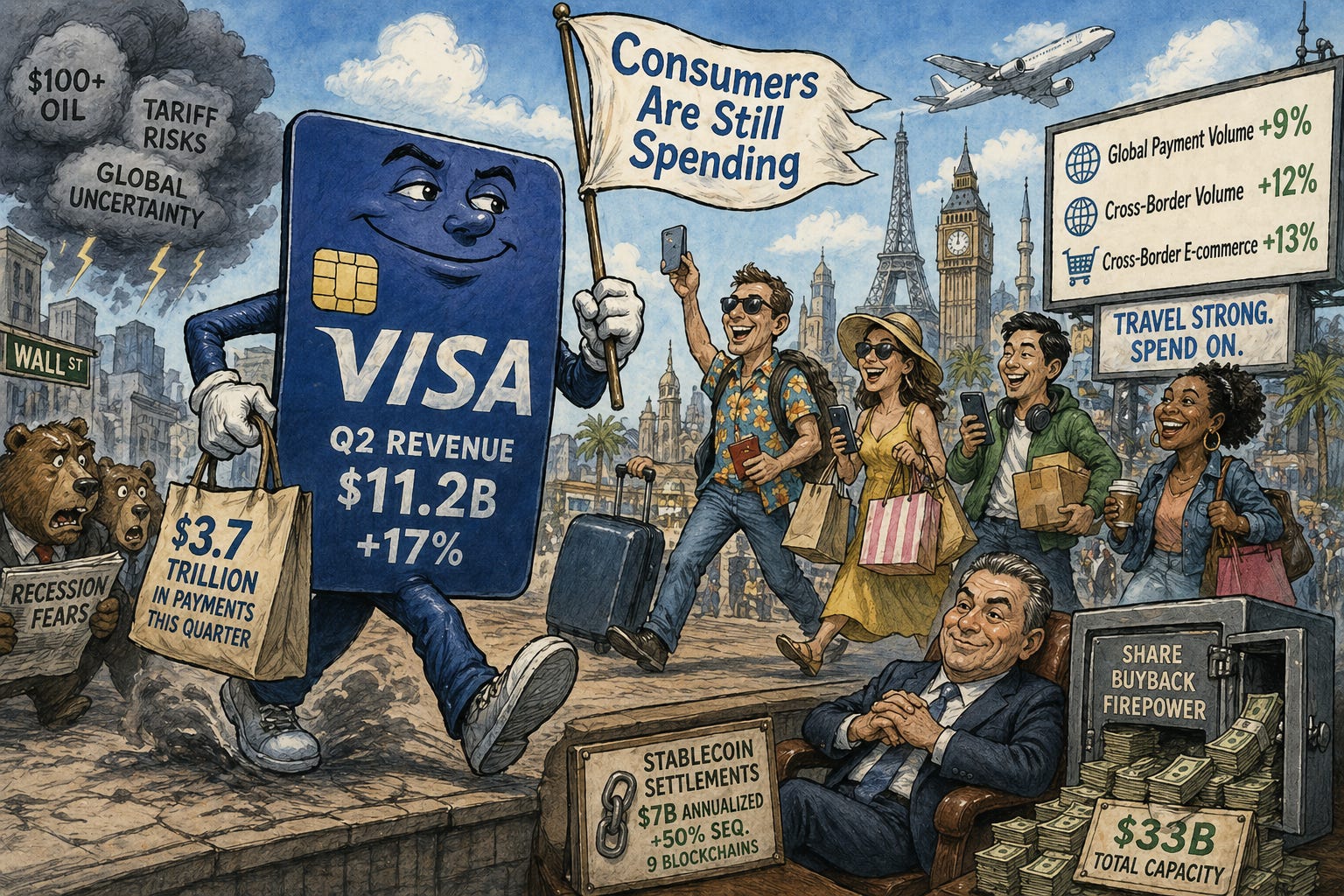
At a moment when oil is above $100 a barrel, tariffs are still unresolved, and recession fears are circulating, Visa’s quarter delivered the clearest counter-evidence available. The company posted fiscal second-quarter revenue of $11.2 billion, up 17% and the strongest growth since 2022, with non-GAAP earnings per share of $3.31 against the $3.10 consensus. Global payment volume grew 9%, processed transactions rose 9%, and cross-border volume, the network’s highest-margin activity, climbed 12% on a constant-currency basis. The company authorised a new $20 billion share buyback programme, adding to $13.2 billion already in place for roughly $33 billion in total capacity. Visa shares rose about 8.7% during Wednesday’s regular session, the largest one-day gain in approximately four years. (Wall Street Journal)
Because Visa earns a small fee from the flow of every transaction on its network rather than from lending, its results function as an unusually clean real-time signal on spending and travel. Cross-border e-commerce volume rose 13%, international travel held up despite the Middle East conflict, and CFO Chris Suh said the company “does not see signs of the lower spend consumer weakening in our volumes.” Mastercard, which reports today, rose roughly 3.5% in sympathy. The company raised its full-year net revenue growth forecast, giving investors a management-endorsed signal that the spending resilience is not expected to fade soon. Higher nominal spending can also support Visa’s revenue even when inflation is the driver, since the network earns fees on the dollar value of transactions. (Reuters)
Sensei’s Insight: The most underappreciated number in the Visa print is the stablecoin settlement run rate: $7 billion annualised, up 50% sequentially, now running across nine blockchains. Visa is quietly building stakes in crypto-payment rails and AI-driven commerce infrastructure. The bears focused on long-term disintermediation risk are not seeing a company in retreat.
Stories You Might Have Missed
🔍 Google Cloud and Azure Confirm the AI Cloud Surge Is Real
Alphabet and Microsoft reported first-quarter results alongside Amazon on Wednesday evening, turning the session into the most consequential tech earnings night of the year. Google Cloud grew 63% year over year to roughly $20 billion, well above the roughly 50% growth analysts had expected, with its backlog nearly doubling from the prior quarter to over $460 billion. Microsoft Azure grew 40%, broadly in line with expectations, and CEO Satya Nadella said Microsoft’s AI business had crossed a $37 billion annual revenue run rate, up 123% year over year. Alphabet shares rose around 4% after hours on the Google Cloud surprise; Microsoft’s reaction was more muted given the in-line result. The three cloud giants accelerating simultaneously is the clearest signal yet that enterprise AI spending has become structural, sustaining demand across chips, networking equipment, data centres, and power infrastructure. (Reuters)
⚡ Meta’s Louisiana Data Centres Are Reshaping a Utility’s Entire Business
Entergy raised its four-year capital spending plan by $14 billion to $57 billion yesterday, almost entirely to serve Meta’s “Hyperion” data centre campus in Richland Parish, Louisiana, a 4-million-square-foot complex that Meta expects to eventually draw around 5 gigawatts of power, roughly twice the peak demand of New Orleans. The buildout involves seven new combined-cycle gas plants adding more than 5,200 megawatts of capacity and roughly 240 miles of high-voltage transmission. Entergy said Meta will bear the full infrastructure cost and that existing ratepayers will see net savings over time, though consumer advocates have contested that framing. The company raised its long-term earnings guidance by $0.50 per share by 2029, implying around 12% annual earnings growth through 2030. This is the clearest illustration yet of AI capital spending flowing from Big Tech balance sheets into regulated utility capital plans and gas turbine order books. (Reuters)
💔 Ackman’s $5 Billion IPO Starts With an 18% Drop
Bill Ackman’s Pershing Square USA, a closed-end fund designed to give ordinary investors direct access to his concentrated investment strategy, debuted on the NYSE yesterday and immediately fell roughly 18% from its $50 offering price to close near $40.90. The offering raised about $5 billion, at the low end of a marketed $5 billion to $10 billion range, making it one of the largest closed-end fund listings in US history but a clear commercial disappointment given how loudly it was pitched as a Berkshire Hathaway-style vehicle for everyday investors. The sharp first-day discount is worth noting for anyone watching the broader 2026 IPO pipeline: even a high-profile structure backed by one of Wall Street’s most recognisable managers ran into a discount problem once early institutional buyers started looking for an exit. Ackman’s net worth, estimated at around $9 billion by Forbes, is now more directly tied to where the public listing trades each day. (Bloomberg)
📉 Robinhood Falls 10% as Crypto Revenue Collapses 47%
Robinhood reported first-quarter results that missed both revenue and earnings estimates, sending the stock down more than 10% during Wednesday’s session. Cryptocurrency trading revenue fell 47% year over year to $134 million as retail crypto activity slowed sharply in early 2026, while total revenue of $1.07 billion came in roughly 6% below the $1.14 billion consensus. The one area of genuine growth was prediction-market event contracts, where revenue surged 320% to $147 million as users placed a record 8.8 billion contracts, with CEO Vlad Tenev saying the product was tracking around $3 billion in April volume alone. The print previews what Coinbase may report on May 7: a meaningfully weaker crypto-trading environment at the consumer level in the first quarter, even if institutional crypto activity has been more stable. The stock’s reaction also reinforces that Robinhood’s multiple is increasingly sensitive to the crypto cycle, not just to its underlying brokerage business. (Yahoo Finance)
🔗 Connect with Us
Stay plugged in across platforms:
Sensei on X: sensei_live_
Martyn Lucas on X: MartynInvestor
Vaz on X: eVTOLHUB
📺 YouTube Channel (Live & Replays): Martyn Lucas Investor

🔍Deep Dive: 🇺🇸 GDP, PCE, ECI & CLAIMS CHEAT SHEET: April 30, 2026
A four-headed dragon prints at 13:30 BST · 8:30 AM ET: Q1 Gross Domestic Product (GDP) advance estimate, March Personal Consumption Expenditures (PCE), the Q1 Employment Cost Index (ECI), and weekly initial jobless claims, all simultaneously. It lands less than 24 hours after Jerome Powell’s final press conference as Fed Chair, where he essentially pre-released the headline inflation numbers. Today is the test of whether the inflation re-acceleration story has substance underneath it, or whether growth and the labor market are starting to crack at the same time.