This content is for informational and educational purposes only and does not constitute financial advice. Always do your own research. Not financial advice (NFA).
👀 Today’s Stories at a Glance
📉 Broadcom Falls Despite Doubling AI: AI revenue jumped 143%, but a held long-term target sparked a 14% drop.
🚀 SpaceX Opens IPO to Retail: The $75 billion debut carves out 30% for ordinary buyers, but the float is tiny.
💼 Jobs Data Pushes Fed Hawkish: Strong hiring and sticky prices have all but killed this year’s rate-cut case.
👟 Lululemon Reports Near Seven-Year Low: Shares down 38% this year face a 10% swing on tonight’s guidance.
🛢️ Oil Near $100 Snaps Rally: Renewed Iran war fears pushed crude higher and ended the S&P 500’s win streak.
🛡️ CrowdStrike Splits but Still Drops: A billings miss sent shares down 13% despite a beat and four-for-one split.
🤖 Anthropic Files for AI IPO: The Claude maker kicked off a race of trillion-dollar listings near a $965 billion value.
⚡ Navitas Jumps on Nvidia Deal: A power-delivery win for Nvidia’s AI servers lifted shares 20% and extended a 346% run.
🚗 Car Tariffs Threaten EU Deal: A July 4 deadline could revive a 25% levy hitting $70 billion in trade.
🛍️ Macy’s Lifts Outlook on Luxury: A 3% comparable-sales rise and Bloomingdale’s strength prompted a raised full-year forecast.
🧠 One Big Thing
A wave of trillion-dollar listings is forming, and it changes the supply picture more than any single deal. SpaceX prices around June 11 at $1.75 trillion, Anthropic has filed near a $965 billion value, and OpenAI is expected within weeks. That much new mega-cap stock arriving at once could pull liquidity from existing leaders as investors rotate into the fresh names. The wrinkle is the Nasdaq-100 fast-entry rule, which may force index funds to buy SPCX about 15 days after listing regardless of price. Passive money becomes a forced buyer, and that signals distortion in where capital flows next.
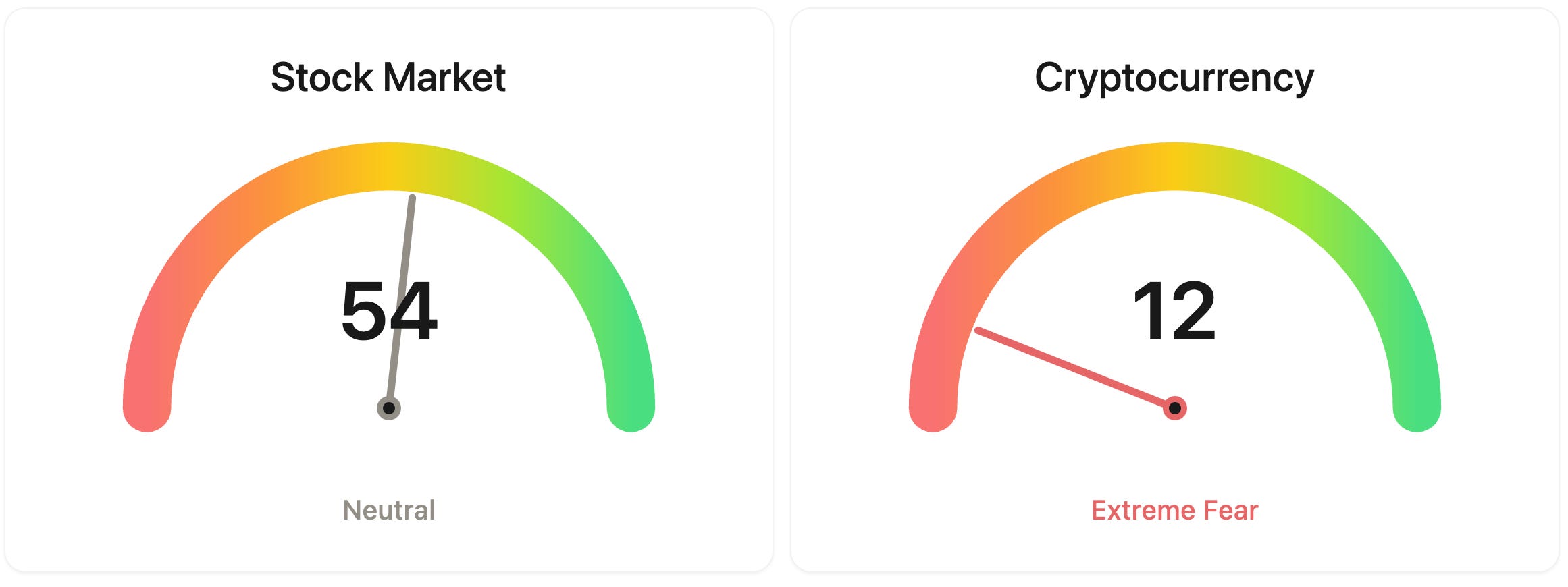
⚖️ Fear & Greed
📉 The Number That Matters
3% TO 4%
SpaceX is freeing just 3% to 4% of its stock to trade, against the usual 10% to 20%, a thin float that could spike big at the open and collapse just as fast.
⚔️ Winners vs Losers
Winners
No major winners today.
Losers
ADCT 0.00%↑: ADC Therapeutics SA cratered after its LOTIS-5 trial in second-line diffuse large B-cell lymphoma met its progression-free survival endpoint but showed only modest benefit with no clear overall survival trend, prompting RBC Capital to downgrade the stock and slash its price target to $2 from $6.
PVH 0.00%↑: PVH Corp. fell despite beating on first-quarter revenue and adjusted EPS, as full-year adjusted EPS guidance of roughly $11.95 at the midpoint came in below Wall Street expectations and overshadowed the quarterly beat.
NTSK 0.00%↑: Netskope Inc. dropped after its fiscal first-quarter results showed a narrow revenue miss against estimates and continued heavy losses, disappointing investors in the cybersecurity name following a volatile post-IPO stretch.
AVGO 0.00%↑: Broadcom Inc. sank even after a record quarter, because its third-quarter AI chip guidance of $16 billion fell short of the roughly $17.2 billion analysts expected and CEO Hock Tan declined to raise the full-year $100 billion AI revenue target, triggering a broad selloff that also dragged down Arm, Micron, and Coherent in sympathy.
DDD 0.00%↑: 3D Systems Corporation declined after pricing a $50 million upsized public stock offering at $3.05 per share, a discount to the prior close that diluted shareholders following the stock’s triple-digit year-to-date rally.
CRWD 0.00%↑: CrowdStrike Holdings Inc. fell despite beating estimates, raising full-year guidance, and announcing a four-for-one stock split, as a billings shortfall gave investors a reason to take profits after a steep run higher.
📊 Market Snapshot
Cryptocurrencies:
Bitcoin (BTC): $62,364 (▼ 2.64%)
Ethereum (ETH): $1,736 (▼ 4.14%)
XRP: $1.14 (▼ 4.59%)
Equity Indices (Futures):
S&P 500: 7,532 (▼ 0.53%)
NASDAQ 100: 30,233 (▼ 1.31%)
FTSE 100: 10,254 (▼ 0.50%)
Commodities & Bonds:
10-Year US Treasury Yield: 4.48% (▼ 0.40%)
Oil (WTI): $95 (▼ 1.48%)
Gold: $4,476 (▲ 0.96%)
Silver: $73.48 (▲ 1.08%)
Data as of: UK (BST): 12:09 / US (EDT): 07:09 / Asia (Tokyo): 20:09
✅ 5 Things to Know
📉 Broadcom Doubles AI Revenue, Stock Drops Anyway
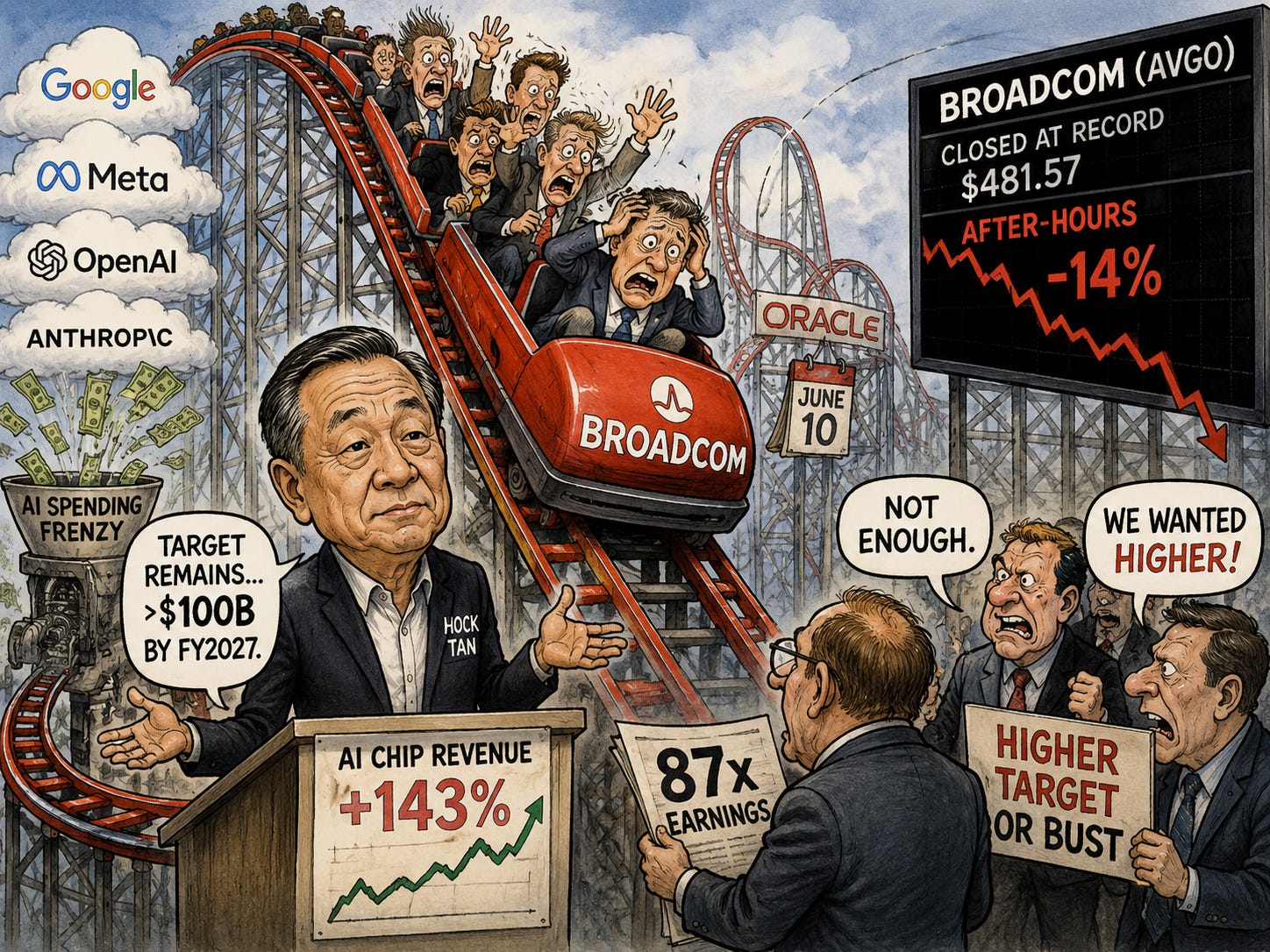
Broadcom delivered the kind of quarter that usually sends a stock flying and got the opposite. After yesterday’s close, the chipmaker posted fiscal second-quarter revenue of $22.19 billion, up 48% from a year earlier, with adjusted earnings of $2.44 a share, both roughly in line. The standout was artificial intelligence: AI chip revenue hit $10.8 billion, up 143%, and the company guided current-quarter AI sales to around $16 billion. Yet the stock, which had closed at a record $481.57 the day before, up about 40% this year, tumbled as much as 14% in after-hours trading. The trigger: chief executive Hock Tan reiterated, but did not raise, his target of more than $100 billion in AI chip sales for fiscal 2027. (CNBC)
Broadcom is the clearest read on custom AI chips, the made-to-order silicon that Google, Meta, OpenAI, and Anthropic use instead of buying everything from Nvidia, so its guidance moves the whole AI-spending trade. The sell-off says something simple: at about 87 times earnings, doubling AI revenue no longer clears the bar, and investors wanted the long-term target lifted. The same anxiety hit Oracle yesterday, which fell more than 5% on worries about how much cash the cloud giants must burn to chase AI, even after Alphabet lined up $80 billion for computing infrastructure, including a $10 billion investment from Berkshire Hathaway. Oracle reports next, on June 10, facing the same scrutiny. (Yahoo Finance)
Sensei’s Insight: Broadcom grew AI revenue 143% and the stock still fell. At these prices, beating estimates isn’t enough; the market wanted the long-term target raised, and Tan kept it at $100 billion. Oracle reports June 10, with the same question and heavier cash burn.
🚀 SpaceX’s Record IPO Reaches Retail, Strings Attached
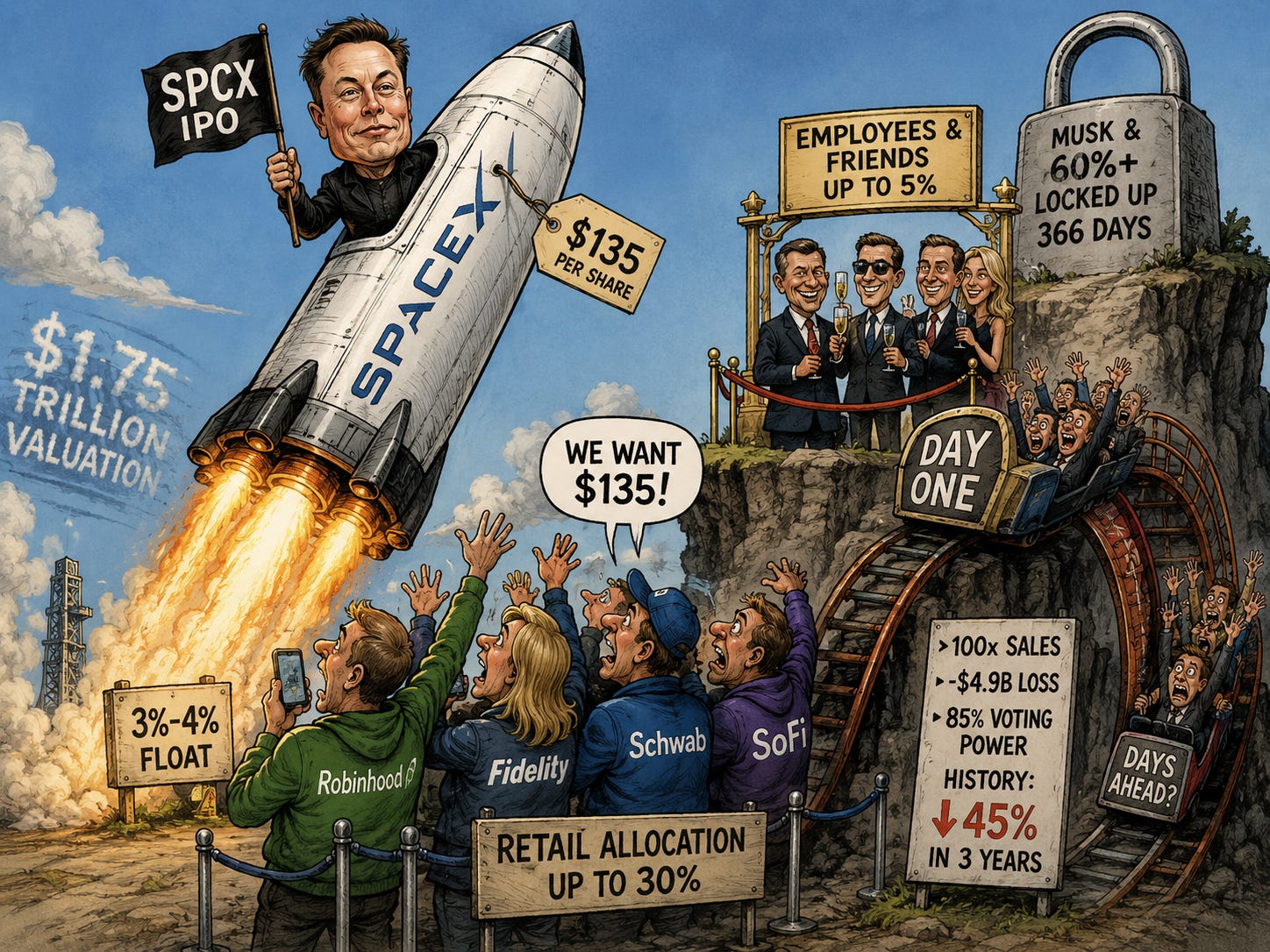
SpaceX has set the terms for what will be the largest stock market debut in history, and it has built in an unusual amount of room for ordinary investors. Elon Musk’s rocket and satellite company plans to sell shares at a fixed $135 each, raising roughly $75 billion at a valuation of at least $1.75 trillion. That is more than double the previous record, Saudi Aramco’s $29.4 billion listing in 2019. The company has carved out up to 30% of the deal for retail buyers, roughly triple the usual slice. Formal marketing is underway this week, with pricing due around June 11 and trading on Nasdaq under the ticker SPCX expected June 12. (CNBC)
Getting in at the $135 offer price is the hard part. In the US, platforms including Robinhood, Fidelity, Schwab, SoFi and E*TRADE can request shares at that price through their IPO access tools, though Schwab requires a $100,000 balance and demand is expected to swamp supply, so most applicants may get partial fills or nothing and end up buying at the open instead. UK readers are not locked out the way they normally would be for a US listing. SpaceX is running a UK retail offer through Marex, the firm that owns Winterflood, which acts as the go-between letting UK platforms and brokers pass client orders into the deal. Separately, brokers such as Trading 212 will offer SPCX from the first day of Nasdaq trading with fractional shares, though at the open market price rather than the $135 offer level. (City AM)
Day one is where the small float matters. The float is the share of the company actually free to trade, and SpaceX is releasing only about 3% to 4% of itself, against the 10% to 20% a typical listing puts out. A small float and heavy demand is a recipe for a fast move up at the open, because too much money is chasing too few shares. The same thinness works in reverse: with so little stock about, it takes only modest selling to drag the price down hard once early buyers take profits, which is why Morningstar has flagged swings of 20% to 30% in the opening days. The prospectus also sets aside up to 5% of the Class A shares for employees and the friends and family of executives, run by Morgan Stanley, with no lock-up, the rule that normally stops insiders selling right after a listing. Musk and more than 60% of pre-IPO stock stay locked for 366 days, so a select group can sell into a first-day pop while everyone else waits, and the larger block of stock only comes free a year out. (Bloomberg)
The price is the catch. At $135, SpaceX is valued at more than 100 times its annual sales, with revenue of $18.67 billion in 2025 against a net loss near $4.9 billion. Starlink, the satellite-internet arm, is the only profitable piece, earning about $1.19 billion last quarter, while the rockets and the xAI artificial-intelligence unit lose billions. Buyers get almost no say either, with Musk keeping more than 85% of the voting power. History is not flattering to deals like this: companies listing with sales above $100 million and a price more than 40 times revenue have fallen an average of 45% over the following three years. One thing to watch is the Nasdaq-100 fast-entry rule, under which index funds may be forced to buy SPCX about 15 trading days after listing, whatever the price by then. (Yahoo Finance)
Sensei’s Insight: This looks built to pop, then struggle to hold the gain. A float of just 3% to 4% means too few shares for the demand, so it could spike at the open and fall just as fast when early buyers sell. At more than 100 times sales, with a lock-up cliff a year out, I’m treating it as a trade, not a hold. I will release the full playbook before pricing on June 11.
💼 Strong Jobs Data Tilts the Fed Toward Hiking
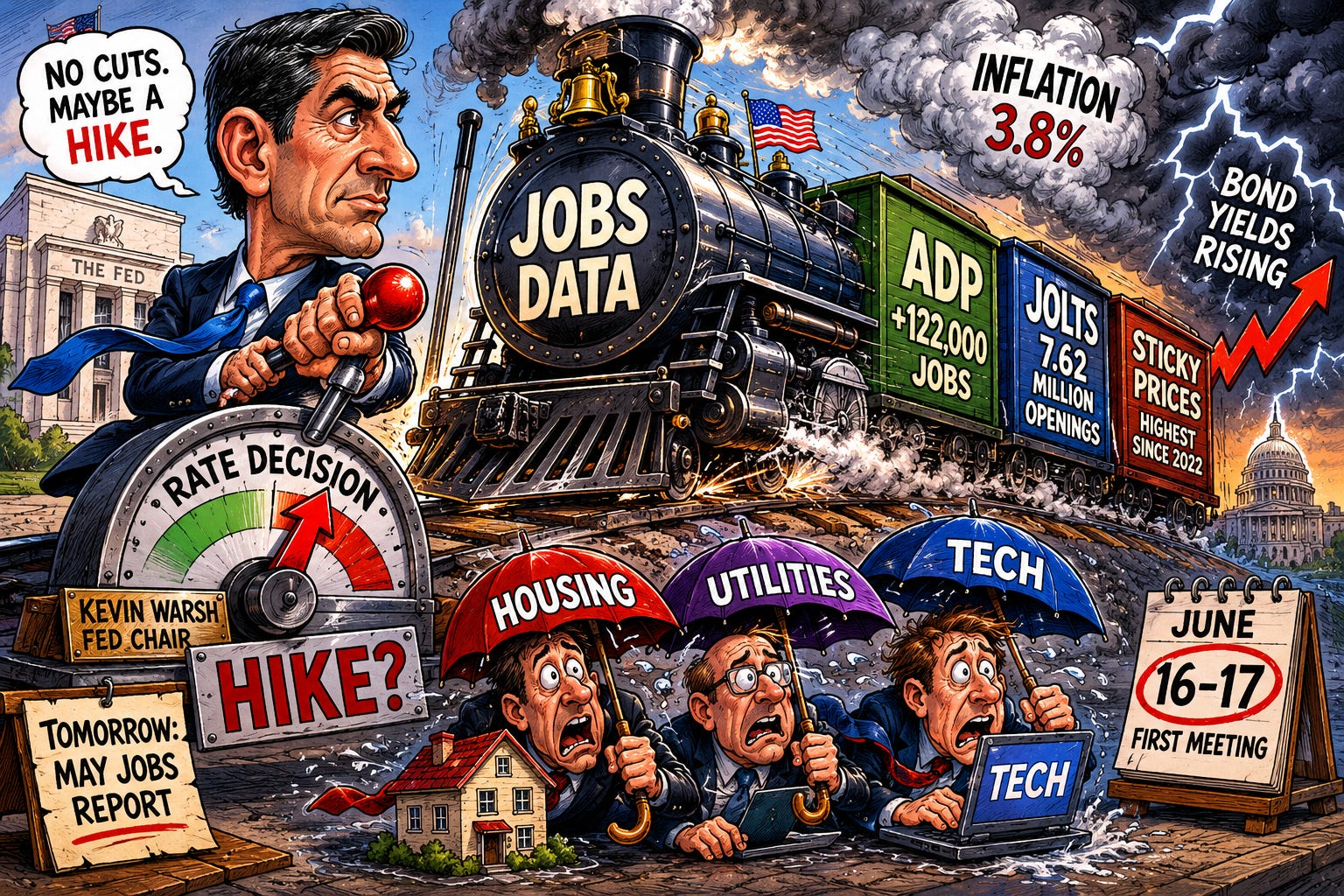
The case for Federal Reserve rate cuts this year is quietly disappearing, and this week’s labor data is why. Private employers added 122,000 jobs in May according to the ADP payrolls report, beating forecasts and marking the strongest month since January 2025. The day before, the government’s Job Openings and Labor Turnover Survey (JOLTS) showed 7.62 million open positions in April, the most in two years and well above expectations. On top of that, the services-sector survey from the Institute for Supply Management showed companies paying the highest input prices since 2022. A firmer job market and stickier prices point the same direction: no cuts coming. (CNBC)
For investors, this resets the calendar. New Fed chair Kevin Warsh holds his first rate meeting on June 16 and 17, and markets now treat a cut as off the table, with a small but rising chance he raises rates later this year as inflation runs near 3.8%. The immediate test is tomorrow’s official jobs report for May, where economists expect around 90,000 new positions, down from April’s 115,000. A strong number could harden hike worries and pressure rate-sensitive corners of the market, from housing and utilities to high-priced tech; a weak one could revive cut hopes and calm bond yields. (CNBC)
Sensei’s Insight: Six months ago the debate was how many cuts. Now it’s whether Warsh hikes at all. Tomorrow’s payrolls is the next read, and a strong number pushes hike odds higher into his first meeting on June 16. Rate-sensitive stocks tend to feel it first.
👟 Lululemon Reports Tonight Near a Seven-Year Low
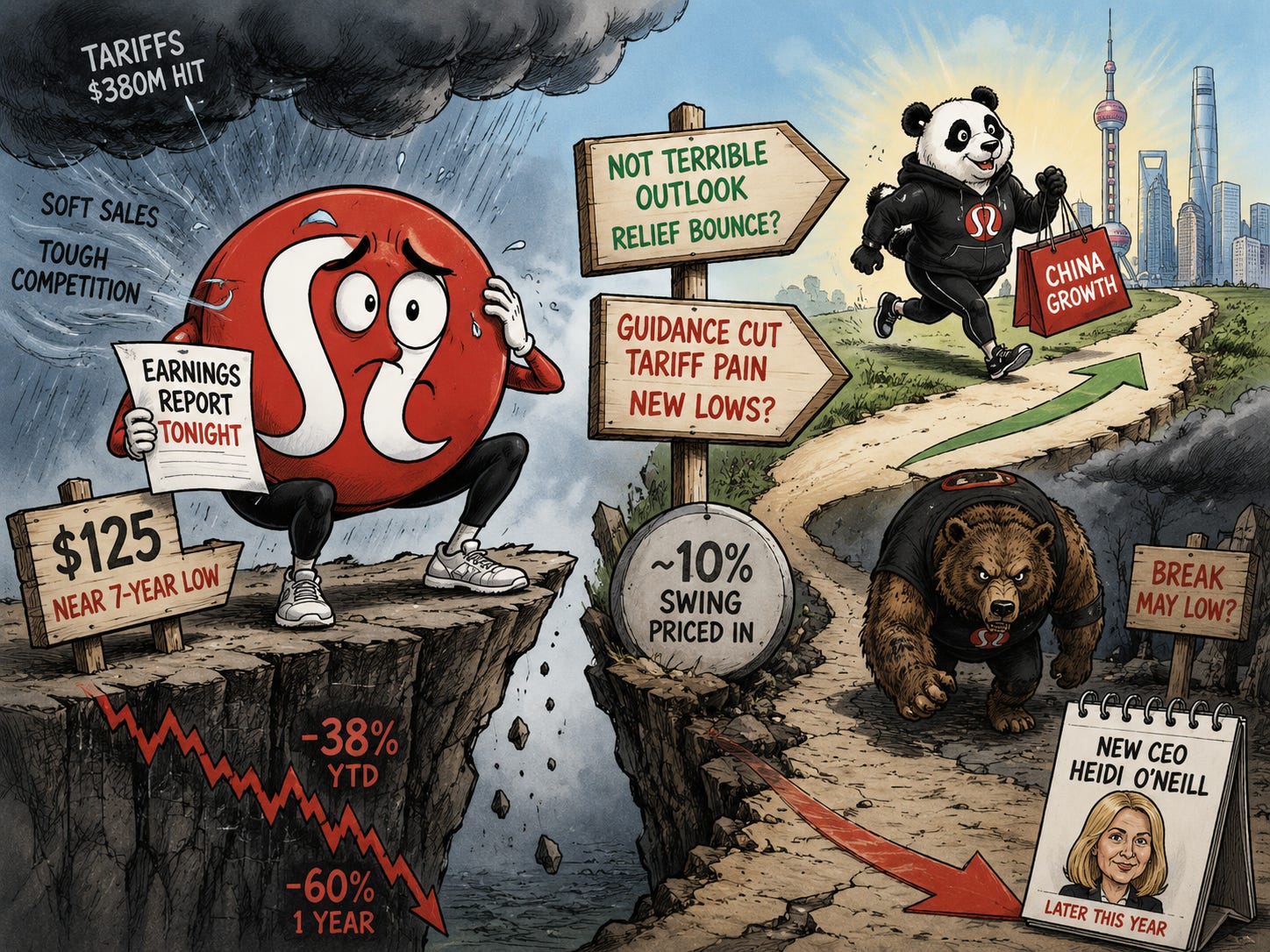
Lululemon heads into its earnings report after today’s close in rough shape, and traders are braced for a big move. The athletic-apparel maker’s stock sits near a seven-year low around $125, down about 38% this year and roughly 60% over the past 12 months, dragged down by soft North American sales, margin pressure from tariffs, and stiff competition from cheaper rivals. Wall Street expects first-quarter earnings of about $1.68 a share, down 35% from a year ago, on revenue near $2.4 billion. Options pricing implies a swing of around 10% in either direction once the results land. Most analysts have moved to the sidelines, with several cutting their price targets in recent weeks. (Yahoo Finance)
For retail investors, tonight’s report is less about the quarter just gone and more about whether the bleeding stops. The swing factor is guidance: management already warned that North American sales could fall this year, and a fresh cut, or any deeper hit from tariffs it pegs at roughly $380 million in gross costs in 2026, could harden the bear case. A steadier outlook, helped by fast growth in China, could spark a relief bounce given how beaten-down the shares are. The setup also frames a split in the consumer, with higher-end shoppers still spending while aspirational brands like Lululemon feel the squeeze. New chief executive Heidi O’Neill, a former Nike executive, takes the helm later this year. (Yahoo Finance)
Sensei’s Insight: The stock is down 38% this year, so expectations sit on the floor. That cuts both ways: another guidance cut could break the May low, while an outlook that simply isn’t terrible could spark a sharp bounce. Options are pricing a swing of about 10% tonight.
🛢️ Oil Nears $100 as Iran War Halts the Rally
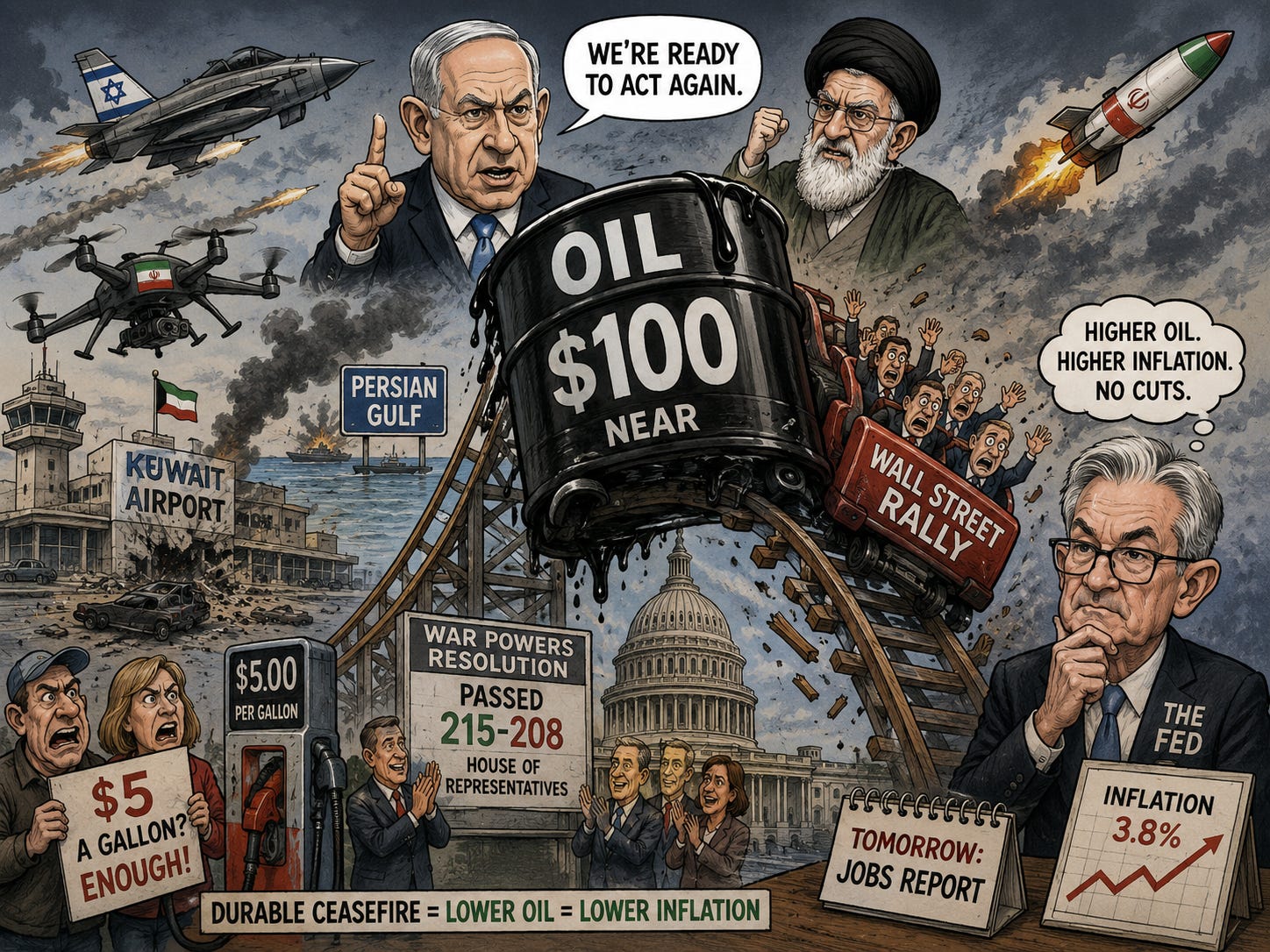
The Iran war is back at the centre of the market, and it broke Wall Street’s run. The S&P 500’s nine-session winning streak snapped yesterday as crude climbed back toward $100 a barrel, with Brent around $96, on fears the fragile ceasefire is failing. The escalation came in waves: Israeli Prime Minister Benjamin Netanyahu told CNBC that Israel and the United States were ready to resume military action against Iran if needed, an Iranian drone struck Kuwait’s main airport and killed one person, and the two sides traded fresh strikes in the Persian Gulf. Traders looked past the few calming signals, a separate ceasefire agreed between Israel and Lebanon and a comment from President Trump that Iran had agreed not to build nuclear weapons, and fixed on the oil price. (Bloomberg)
For investors, the war now runs straight through the rate story. Oil back near $100 feeds directly into inflation running near 3.8% and is the main reason the case for Federal Reserve cuts this year has all but vanished ahead of the June 16 and 17 meeting. That makes the path of crude the variable that matters, and the only thing that brings it down is a durable ceasefire. Yesterday the House of Representatives passed a war powers resolution directing an end to US involvement, 215 to 208, the first time such a measure has cleared either chamber since the conflict began in late February. It is symbolic and still needs the Senate, but it is the first real sign political pressure to end the war is building, driven by constituents paying around $5 a gallon for petrol. The next reads come fast: whether the ceasefire holds after the Kuwait strike, the Senate’s response, and tomorrow’s official jobs report. (CNN)
Sensei’s Insight: Oil back near $100 is why Fed cut talk has gone quiet and why the rally broke. Yesterday’s House vote is symbolic; it still needs the Senate and faces a likely veto. The ceasefire holding is what brings crude, and inflation, back down.
Stories You Might Have Missed
🛡️ CrowdStrike Beats and Splits but Still Falls
CrowdStrike delivered a strong quarter and the stock fell anyway, echoing the reaction to Broadcom the same evening. After yesterday’s close the cybersecurity firm reported revenue of $1.39 billion, up 26% from a year earlier and ahead of estimates, with adjusted earnings of $1.10 a share. It raised full-year guidance, posted record annual recurring revenue of $5.51 billion, and announced a four-for-one stock split that takes effect in early July. Shares still dropped as much as 13% in extended trading from a $747.61 close. The problem was billings, which grew 18% against 26% revenue growth and missed forecasts, and second-quarter guidance that merely matched expectations after a steep rally had left the stock priced for more. (Bloomberg)
🤖 Anthropic Files to Join the AI IPO Race
Anthropic, the maker of the Claude AI assistant, confidentially filed paperwork for an initial public offering (IPO) earlier this week, kicking off a race among the biggest artificial-intelligence companies to go public. The filing followed a $65 billion funding round that valued Anthropic near $965 billion, edging past rival OpenAI’s $852 billion mark, with revenue running at an annualized $47 billion in May, up from about $10 billion a year earlier. OpenAI is expected to file its own paperwork within weeks. For retail investors, it sets up a wave of trillion-dollar AI listings alongside SpaceX, and a potential new way to invest directly in the AI boom. (CNBC)
⚡ Navitas Jumps on Nvidia AI Power Deal
Navitas Semiconductor jumped about 20% yesterday after the chipmaker said it would supply power-delivery technology for Nvidia’s next-generation AI server systems, showcased at the COMPUTEX trade show in Taipei. The product helps feed electricity efficiently to power-hungry AI chips, a growing bottleneck as data centers scale up. The endorsement from the world’s biggest AI hardware company extends an extraordinary run: Navitas is up roughly 346% this year. The flipside is the price tag. The rally leaves the company worth about $7.5 billion, near 176 times this year’s expected sales, and Wall Street’s average rating sits at hold. (Yahoo Finance)
🚗 Car Tariffs Loom Over Stalled US-EU Deal
A fresh dispute is testing the trade truce between the United States and European Union as a hard deadline nears. US Trade Representative Jamieson Greer said both sides remain committed to last year’s agreement, under which the EU scraps industrial tariffs and opens farm markets in return for the US cutting car tariffs from 25% to 15%. The reassurance followed a US proposal to tax goods from 60 countries it accuses of tolerating forced labour, including a 10% levy on some EU products, which Brussels called baseless. Trump has given the EU until July 4 to enact its side of the deal or face the return of a 25% car tariff, which would hit roughly $70 billion in trade and squeeze BMW, Volkswagen, and Ford. The European Parliament has yet to vote. (Reuters)
🛍️ Macy’s Lifts Forecast as Bloomingdale’s Shines
Macy’s gave a rare upbeat read on the US shopper yesterday, beating estimates and raising its full-year outlook. First-quarter comparable sales rose 3%, the chain’s strongest start in four years, with luxury arm Bloomingdale’s up 10.2%, helped partly by the bankruptcy of rival Saks. Revenue came in at $4.68 billion, ahead of the $4.61 billion expected, and the company lifted its full-year earnings forecast to between $2.00 and $2.20 a share. Shares ticked higher. After a long stretch of store closures and turnaround plans, the results suggest higher-income consumers are still spending, a hopeful sign for the broader retail sector. (CNBC)
🔗 Connect with Us
Stay plugged in across platforms:
Sensei on X: sensei_live_
Martyn Lucas on X: MartynInvestor
Vaz on X: eVTOLHUB
📺 YouTube Channel (Live & Replays): Martyn Lucas Investor