This content is for informational and educational purposes only and does not constitute financial advice. Always do your own research. Not financial advice (NFA).
👀 Today’s Stories at a Glance
📉 Bitcoin tests critical $70k support: Prices fell as 2024 euphoria evaporated, triggering massive liquidations and $545 million in ETF outflows.
🥈 Silver plunge follows China selloff: Spot prices touched $73 after Shanghai futures selling triggered a violent unwinding of speculative leverage.
🚀 Alphabet sets $185B AI benchmark: Massive 2026 infrastructure spending plans surfaced alongside a 48% jump in Google Cloud revenue.
📉 AMD hit by brutal reset: Shares crashed 17% on cautious guidance despite beating expectations, prompting ARK Invest to buy the dip.
☁️ Amazon enters cloud heavy week: Investors await Q4 results to see if AWS can justify a $125 billion infrastructure spending cycle.
🧠 One Big Thing
The De-leveraging Domino Effect
A violent wave of mechanical liquidations is currently sweeping through global markets, forcing a sharp decoupling of speculative assets from their fundamental narratives. Bitcoin has plunged 44% from its peak as it trades like a high-beta tech stock rather than a safe haven, while silver recently collapsed 17% due to forced selling in Chinese futures markets. This volatility is driven by balance-sheet mechanics and margin calls rather than long-term demand shifts. Institutional risk managers are now liquidating positions in crypto and metals to cover collateral requirements elsewhere. As major players like Alphabet double down on massive infrastructure spending, the broader market is pivoting toward a brutal scrutiny of cash flows and margin health. Investors are witnessing a structural reset where exhausted liquidity is rapidly evaporating the euphoria of previous months.
⚖️ Fear & Greed
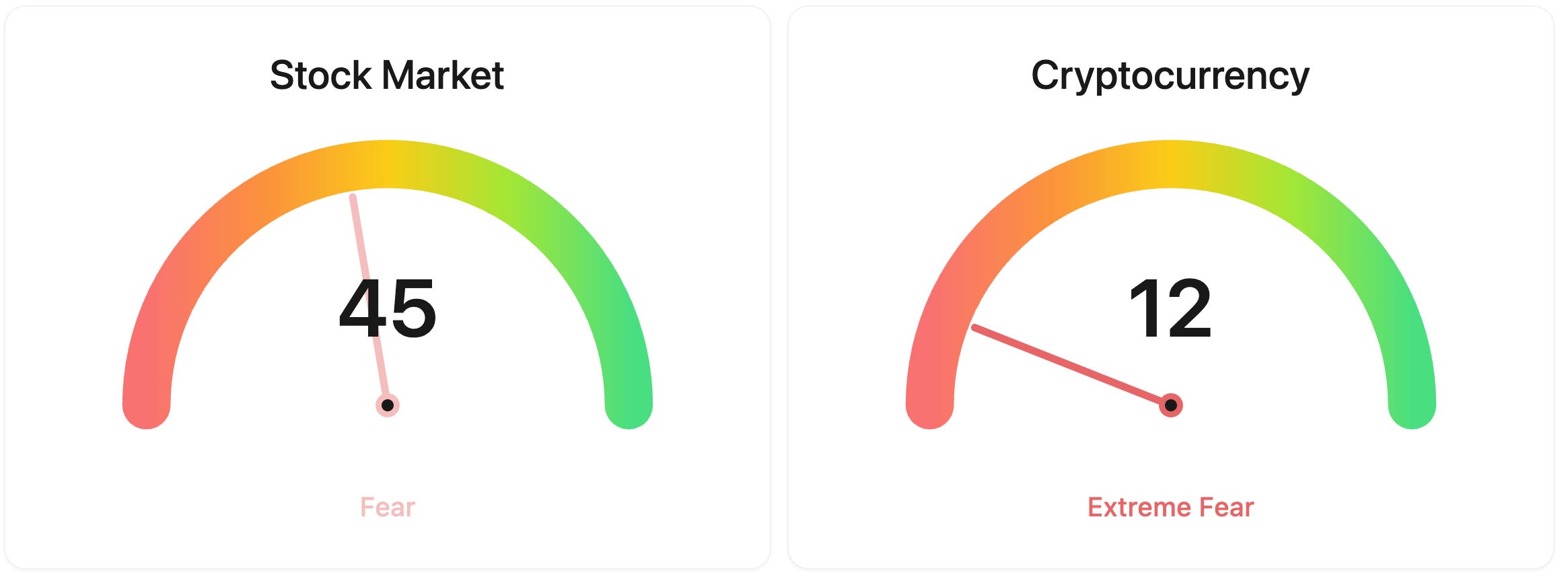
📉 The Number That Matters
$70,000
Bitcoin slid to under $70,000 overnight, hitting its lowest price level since November 2024. The asset failed to hold critical support as macro headwinds and $2.5 billion in forced liquidations accelerated the February market correction.
📊 Market Snapshot
Cryptocurrencies:
Bitcoin (BTC): $70,215 (▼ 3.91%)
Ethereum (ETH): $2,076 (▼ 3.24%)
XRP: $1.36 (▼ 9.88%)
Equity Indices (Futures):
S&P 500: $6,889 (▼ 0.23%)
NASDAQ 100: $25,025 (▲ 0.10%)
FTSE 100: £10,359 (▼ 0.49%)
Commodities & Bonds:
10-Year US Treasury Yield: 4.28% (▼ 0.05%)
Oil (WTI): $65 (▼ 0.20%)
Gold: $4,866 (▼ 1.98%)
Silver: $78.13 (▼ 11.40%)
Data as of UK (GMT): 11:53 am / US (EST): 6:53 am / Asia (Tokyo): 8:53 pm
✅ 5 Things to Know Today
📉 Bitcoin’s “Crisis of Faith” Tests $70k Support

Bitcoin is currently grappling with a “crisis of faith” as prices slid toward the psychologically vital $70,000 mark on Thursday. This latest leg lower represents a staggering 44% drawdown from the October 2025 peak of $126,000, wiping out roughly $1.7 trillion in total crypto market value since that high. The selloff intensified alongside a nasty retreat in AI heavyweights like Alphabet and Qualcomm, which dragged the Nasdaq lower and triggered a broad “risk-off” move across global markets. In the last 24 hours alone, the volatility triggered $722 million in forced liquidations for leveraged traders, while U.S. spot Bitcoin ETFs pivoted from heavy buying to a massive $545 million net outflow on Wednesday, led by BlackRock’s IBIT (Bloomberg).
This isn’t just a crypto-specific hiccup: it’s a cold shower for the “digital gold” thesis. While gold has recently attracted safe-haven flows, Bitcoin is behaving like high-beta tech, moving in lockstep with speculative AI stocks. As SynFutures’ Wenny Cai points out, the price action is now being dictated by “balance-sheet mechanics” rather than hopeful narratives. This means risk managers are cutting exposure to meet margin calls and collateral requirements, effectively turning the ETFs into exit ramps rather than support pillars. For retail investors, the takeaway is clear: the post-election euphoria of late 2024 has officially evaporated, replaced by a deleveraging cycle where even institutional believers are being forced to trim their sails.
Sensei’s Insight: Watch the $68,000 level closely. If that 2024-era support fails to hold the line against these mechanical liquidations, the market’s “crisis of faith” may turn into a structural reset.
🥈 Silver’s “Dead Cat Bounce” Fails as China Sells
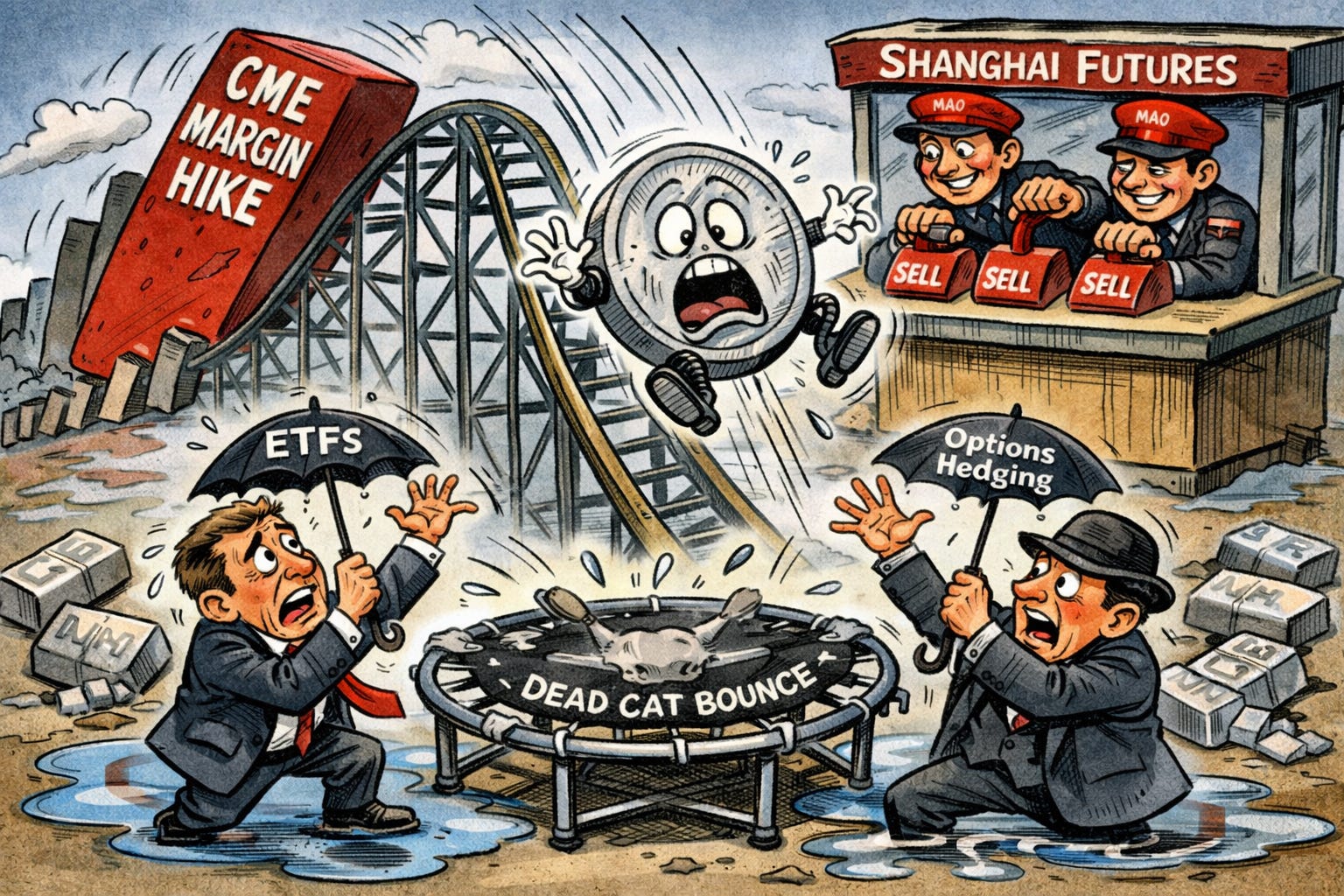
The fragile recovery in precious metals just hit a wall. After a brief two-day rebound from last week’s historic crash, spot silver plunged as much as 17% during Asian trading hours on Thursday, briefly touching the $73 mark. The selling pressure originated in the Shanghai futures market before spilling into London and New York, effectively wiping out most of the recent gains. While silver trimmed some losses to trade down roughly 11% by mid-morning in London, the volatility remains extreme. This secondary leg down follows a “parabolic” January rally where silver accelerated from $80 to over $110 in just 12 days, a vertical move that almost inevitably invited this violent unwinding of speculative leverage (Bloomberg).
This isn’t a shift in long-term industrial demand: it’s a “positioning wash-out” driven by the market’s internal plumbing. When silver prices gap lower, leveraged ETFs and dealers hedging options are forced to sell futures to rebalance, creating a self-reinforcing feedback loop. This is being compounded by CME margin hikes that essentially force over-leveraged traders to exit or pony up more cash. For retail investors, the takeaway is the growing influence of Chinese speculators on global price discovery. When Shanghai silver futures turn, the impact now ripples instantly through Western markets. While banks like Goldman Sachs and Standard Chartered still see a medium-term “tailwind” for metals due to expected Fed rate cuts, the current environment is defined by thin liquidity and high-speed de-leveraging
Sensei’s Insight: Watch the $70 support level closely. If silver breaks into the $60s, expect the risk-off mood to bleed further into tech stocks and crypto as investors scramble for liquidity.
🚀 Alphabet’s $185 Billion AI Receipt
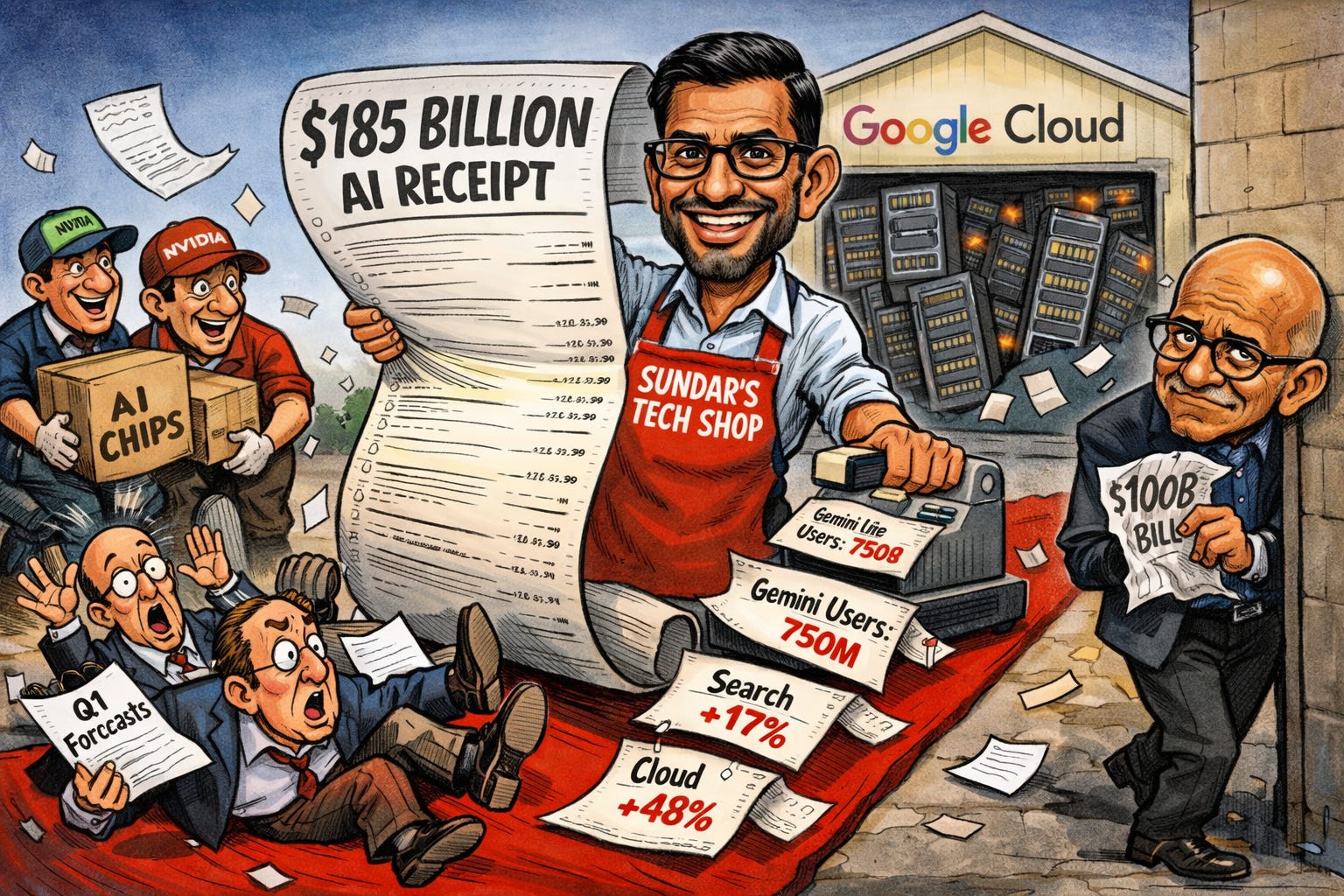
Alphabet just reset the ceiling for AI infrastructure, guiding 2026 capital expenditures to a massive range of $175 billion to $185 billion. To put that in perspective, it’s nearly double the $91.4 billion they spent in 2025 and roughly 50% higher than what Wall Street expected. The stock initially plunged 8% in after-hours trading as investors choked on the price tag, but it clawed back most of those losses once the “receipts” came out. Google Cloud revenue jumped 48% to $17.7 billion, and Search grew 17%, suggesting AI isn’t killing their core business but actually expanding it (Bloomberg).
This matters because we’re seeing a widening gap between companies spending on AI “vibes” and those with actual math. Unlike Microsoft, which saw its stock hammered recently for high spending and murky returns, Alphabet showed a cloud backlog that doubled year-on-year to $240 billion. They also revealed that Gemini now has 750 million monthly users and will soon serve as the “brain” for Apple’s redesigned Siri. For the broader market, this is a massive green light for the supply chain: Nvidia, Broadcom, and chip equipment makers like Lam Research all rallied because Google’s $185 billion has to be spent on their hardware.
Sensei’s Insight: The market is finally over “AI potential” and onto “AI P&L.” Watch the $185 billion level as the new benchmark: if revenue growth cools while this spending ramps, the honeymoon ends fast.
📉 AMD’s Brutal Reset and ARK’s Big Bet
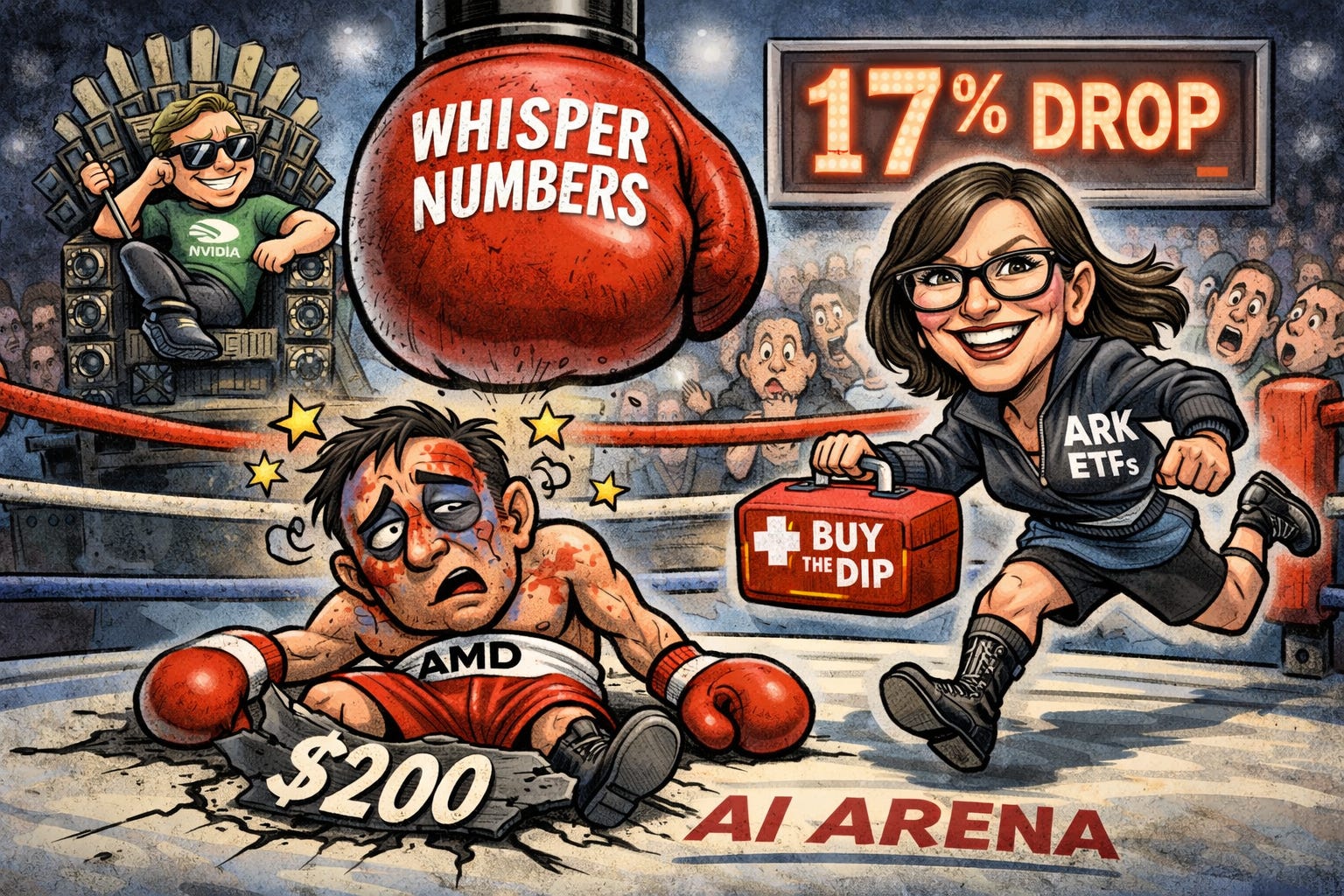
AMD shares took a massive 17% hit on Wednesday, closing at $200.19 after a post-earnings selloff that wiped out tens of billions in market value. It was the stock’s worst single-day performance since 2017. Paradoxically, the company actually beat Q4 expectations, reporting $10.27 billion in revenue and $1.53 in adjusted EPS, both topping consensus. The trouble started with the Q1 outlook. Management guided revenue to roughly $9.8 billion, which technically beats official analyst estimates but fell short of the aggressive “whisper numbers” investors demand for AI-adjacent stocks. Into this carnage, Cathie Wood’s ARK Investment Management stepped in, snapping up 141,108 shares across five of its ETFs, a move valued at approximately $28.2 million (Barron’s).
This wasn’t a “miss” in the traditional sense; it was a collision with reality. Investors discovered that roughly $400 million of AMD’s Q4 beat came from one-time China shipments rather than recurring AI momentum, which effectively cooled the “Nvidia-killer” narrative. When a stock rallies 40% in three months, as AMD did leading into this report, it’s priced for perfection. Any guidance that is merely “good” rather than “spectacular” triggers a violent valuation reset. ARK’s decision to buy the dip suggests they view this 17% haircut as a sentiment-driven overreaction rather than a fundamental flaw in the AI hardware thesis. For the rest of the market, it’s a clear signal that the “AI lift” is no longer rising all boats equally. Quality of revenue and margin health are now being scrutinized just as much as top-line growth.
Sensei’s Insight: Watch the $200 level closely. If AMD fails to hold this psychological floor despite ARK’s support, it signals that the market is aggressively re-rating AI multiples across the board.
☁️ Amazon’s Cloud-Heavy “Coiled Spring” Moment
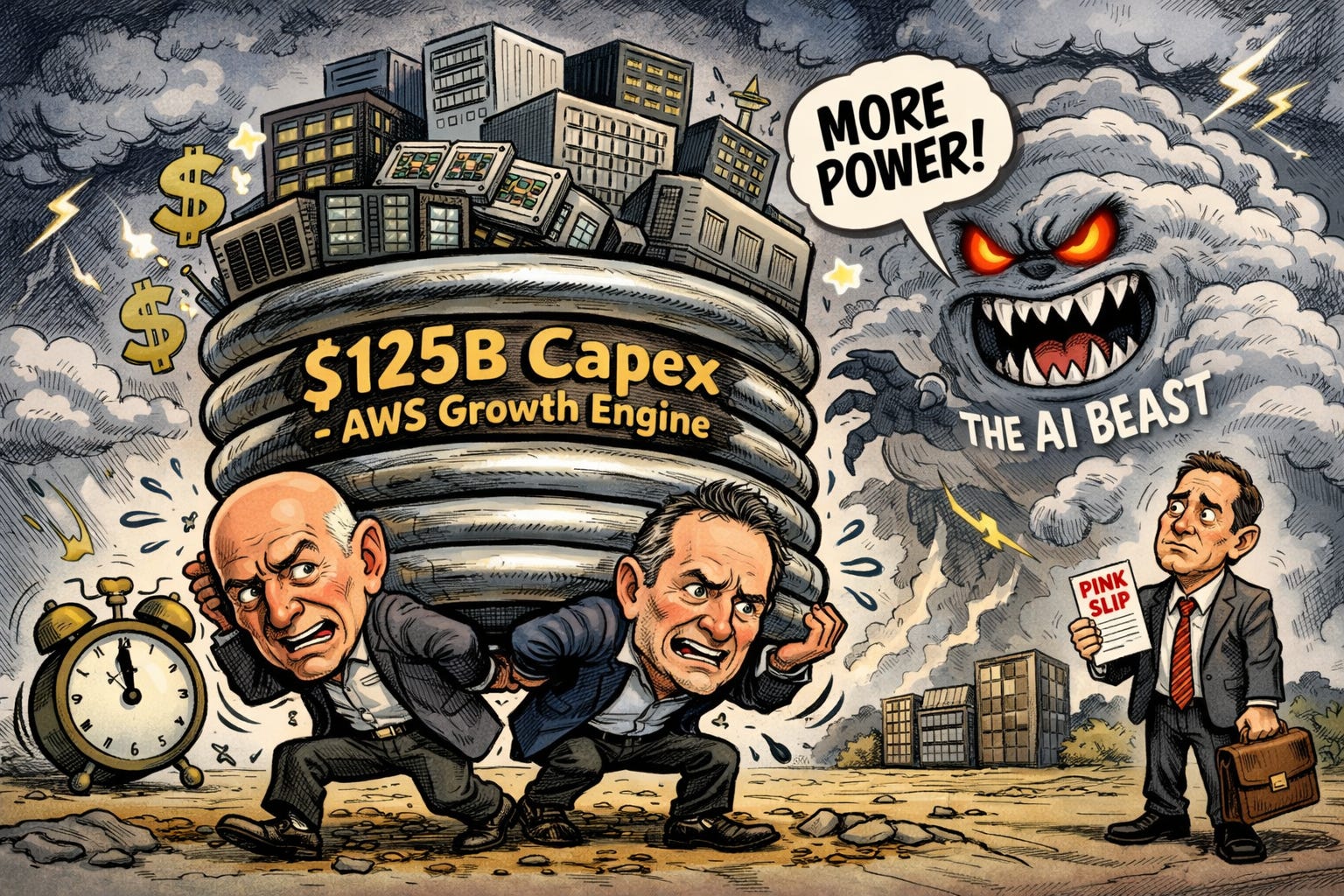
Amazon reports Q4 2025 earnings after the bell today, and the market is laser-focused on whether its cloud unit, AWS, can carry the weight of a massive $125 billion capital expenditure cycle. Analysts are looking for revenue of $211.4 billion and adjusted earnings per share of $1.97. The real story, however, is the momentum in AWS, which grew 20% to $33 billion in the previous quarter. To keep the “coiled spring” narrative alive, AWS likely needs to hit the $34.8 billion to $35 billion range this evening. This growth is backed by a $200 billion backlog and a management commitment to double AWS power capacity by 2027 to feed the AI beast (Barron’s).
This report is a high-stakes test of “productive capex.” While peers like Microsoft and Google have seen mixed reactions to their AI spending, Amazon is trying to prove it can spend aggressively while simultaneously leaning out. The recent announcement of 16,000 corporate job cuts, aimed at removing layers and bureaucracy, suggests a push to protect margins while pouring billions into data centers and proprietary AI chips. Investors should watch the Q1 2026 guidance: the Street expects revenue of $175.6 billion and EPS of $1.73. If Amazon can pair accelerating cloud growth with these efficiency gains, it validates the thesis that its heavy infrastructure spend is already yielding scalable returns.
Sensei’s Insight: Watch the AWS growth rate and the 2026 capex outlook. If cloud growth hits 21% or higher, it signals that Amazon’s massive infrastructure bets are successfully capturing the AI shift.
🔗 Connect with Us
Stay plugged in across platforms:
Sensei on X: sensei_live_
Martyn Lucas on X: MartynInvestor
Vaz on X: eVTOLHUB
📺 YouTube Channel (Live & Replays): Martyn Lucas Investor