This content is for informational and educational purposes only and does not constitute financial advice. Always do your own research. Not financial advice (NFA).
👀 Today’s Stories at a Glance
🪖 Iran Leadership Stalls Ceasefire: Decapitated leadership prevents peace talks while military units act without central control.
🏛️ Senate Rejects War Powers Resolution: Senators backed strikes despite high public disapproval and undefined victory conditions.
🛢️ Aramco Oil Bypass Hits Bottleneck: Limited port capacity prevents Saudi Arabia from effectively bypassing closed shipping lanes.
⚡ Broadcom Forecasts AI Revenue Surge: Strong earnings suggest AI infrastructure spending remains resilient despite growing geopolitical risks.
🔋 Amprius Leads Battery Density Race: Silicon-anode technology promises energy gains for emerging electric aviation and defense.
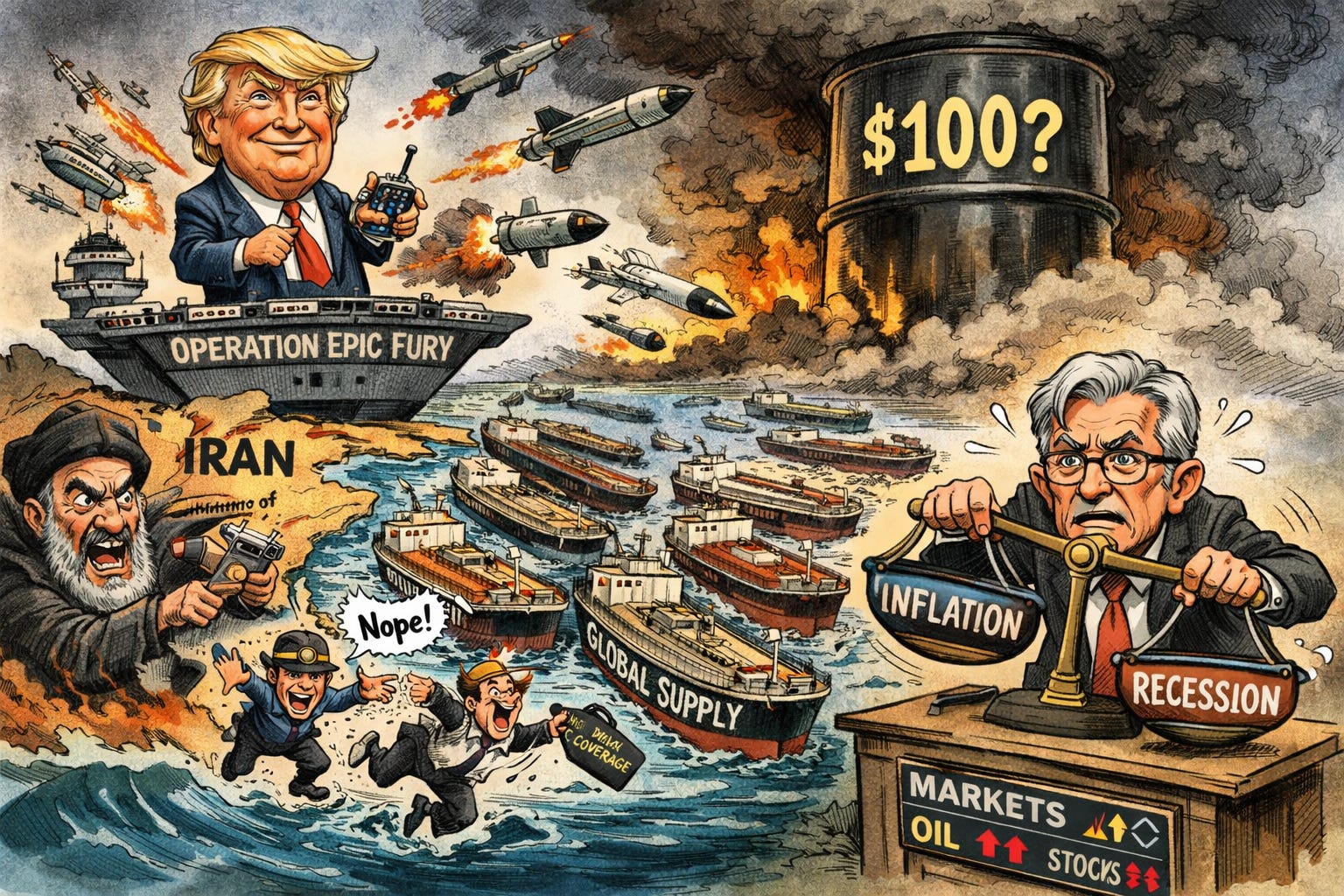
🔍 Operation Epic Fury Risks Stagflation: Closing the Strait threatens growth as markets underestimate the leadership vacuum.
🧠 One Big Thing
The Negotiation Vacuum
The decapitation of Iran’s leadership has created a structural power vacuum that eliminates any immediate path to a ceasefire. Markets are currently pricing in a temporary four-week disruption to global energy supplies based on traditional conflict models. However, the destruction of the clerical body responsible for succession means no recognized authority exists to negotiate an end to hostilities. This leaves the military in control of escalation while the diplomatic off-ramp remains closed. Investors face a high risk that the closure of the Strait of Hormuz will persist far longer than anticipated. A sustained energy shock under these conditions could force the Federal Reserve into a stagflationary trap.
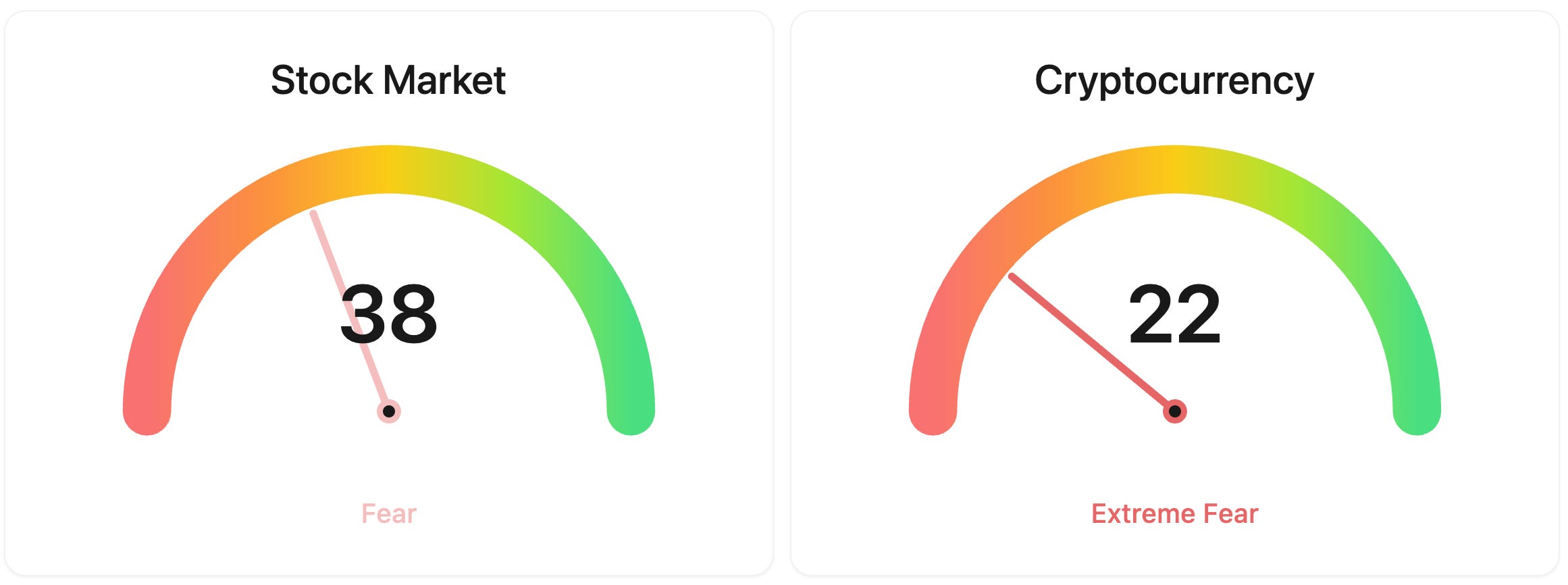
⚖️ Fear & Greed
📉 The Number That Matters
59%
A CNN poll reveals 59% of Americans disapprove of the military strikes against Iran. This public opposition contrasts sharply with 2002 Iraq War support levels as the Senate remains split 53 to 47 on continuing the campaign.
⚔️ Winners vs Losers
Winners
ALTO 0.00%↑: Alto Ingredients, Inc. surged after reporting Q4 2025 earnings of $0.28 per share, blowing past analyst estimates of $0.02 by $0.26.
TTD 0.00%↑: The Trade Desk, Inc. soared after CEO and co-founder Jeff Green disclosed the purchase of approximately 6 million company shares worth around $148 million, with the move amplified by a report detailing early discussions about bringing OpenAI on as a customer of its ad-buying platform.
AVGO 0.00%↑: Broadcom Inc. climbed after posting record Q1 fiscal 2026 revenue of $19.3 billion, up 29% year over year, with CEO Hock Tan projecting AI chip revenue from custom accelerators alone could exceed $100 billion in 2027, while the company guided Q2 revenue to approximately $22 billion and authorized a new $10 billion share buyback program.
Losers
GO 0.00%↑: Grocery Outlet Holding Corp. collapsed after Q4 results showed flat same-store sales and full-year 2026 EPS guidance of $0.50 at the midpoint, missing analyst estimates by 38.6%, while EBITDA guidance of $227.5 million also came in well below the $274 million Wall Street expected.
PEPG 0.00%↑: PepGen Inc. dropped after the FDA placed a partial clinical hold on its FREEDOM2-DM1 Phase 2 trial, citing questions about preclinical pharmacology and toxicology data for its myotonic dystrophy type 1 drug candidate PGN-EDODM1.
MOBX 0.00%↑: Mobix Labs, Inc. continued pulling back after a 300%+ single-day surge earlier this week driven by a U.S. Navy Tomahawk cruise missile component order, with the stock giving back a significant portion of those gains as the initial momentum fades.
📊 Market Snapshot
Cryptocurrencies:
Bitcoin (BTC): $72,896 (▲ 0.31%)
Ethereum (ETH): $2,132 (▲ 0.24%)
XRP: $1.44 (▲ 0.72%)
Equity Indices (Futures):
S&P 500: $6,868 (▼ -0.04%)
NASDAQ 100: $25,090 (▼ -0.15%)
FTSE 100: £10,573 (▼ -0.34%)
Commodities & Bonds:
10-Year US Treasury Yield: 4.11% (▲ 0.32%)
Oil (WTI): $77 (▲ 1.04%)
Gold: $5,164 (▲ 0.46%)
Silver: $84.34 (▲ 1.00%)
Data as of UK (GMT): 12:23 / US (EST): 07:23 / Asia (Tokyo): 21:23
✅ 5 Things to Know Today
🪖 Iran War, Day Six: Nobody Left to End It

Six days into the US-Israel military campaign against Iran, the conflict shows no sign of a negotiated off-ramp and the reason may be structural rather than political. The opening strikes of Operation Epic Fury killed Supreme Leader Ali Khamenei and multiple senior officials, leaving a power vacuum at the top of the Iranian state. The Assembly of Experts, the clerical body constitutionally responsible for selecting a new supreme leader, was bombed by Israel on day four. With no recognised successor and no functioning leadership chain above the Islamic Revolutionary Guard Corps (IRGC), there is currently no single authority in Tehran with the legitimacy to negotiate a ceasefire, even if elements within the regime wanted to (CNN).
Iran officially denied reports of backchannel contact between its Ministry of Intelligence and the CIA, with a senior adviser saying the country has “no intention of negotiating with the US.” Meanwhile the IRGC announced this morning that retaliatory attacks will intensify. Iran struck an oil tanker in the Persian Gulf today, the first confirmed shipping casualty of the conflict, and drones landed on Azerbaijani territory, drawing a former Soviet republic into the war’s orbit. Goldman Sachs estimates the oil market is currently pricing in roughly four weeks of disruption before Brent normalises. The leadership vacuum is the variable that could push that timeline well beyond what markets have assumed (Fortune).
Sensei’s Insight: Goldman’s four-week disruption model assumes a counterparty capable of ending the conflict. That counterparty no longer exists. Iran’s civilian leadership structure has been decapitated and the body that would select a successor bombed. The IRGC can escalate but it cannot negotiate. Markets may be solving for the wrong variable.
🏛️ Senate Backs Trump’s War, But 59% of Americans Don’t
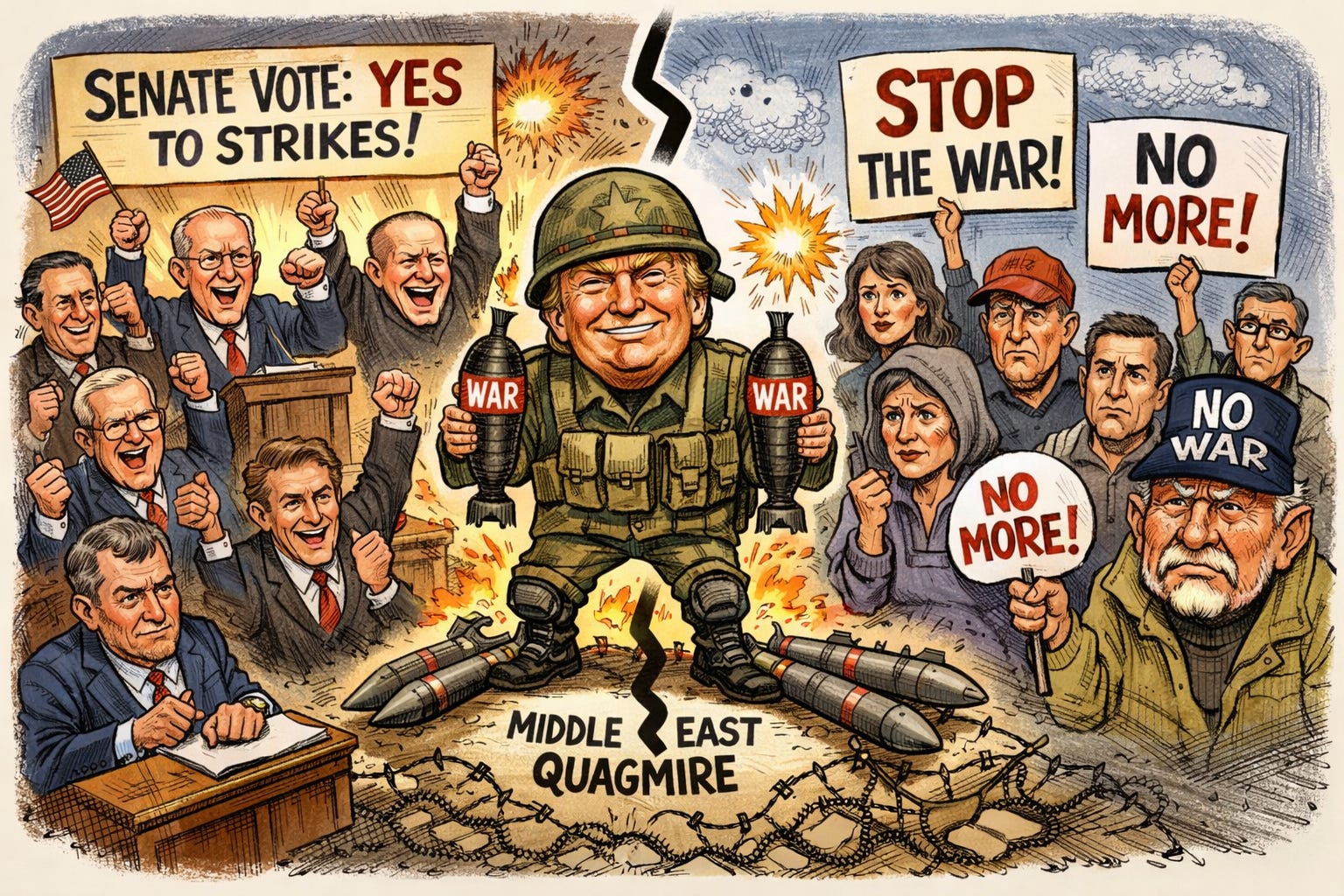
The US Senate voted 53 to 47 yesterday to reject a Democratic-backed procedural motion that would have halted military strikes on Iran under the War Powers Resolution, a 1973 law designed to limit a president’s ability to commit forces to armed conflict without congressional authorisation. The vote split almost entirely along party lines. Only one Democrat, John Fetterman of Pennsylvania, crossed the aisle to support the administration. Only one Republican, Rand Paul of Kentucky, voted to halt the strikes. The House of Representatives is voting today on its own version of the resolution; Speaker Mike Johnson said he is confident it will fail (NBC Washington).
The resolution was always expected to fail, and markets had largely priced in that outcome. The more significant signal is the political context around it. A CNN poll conducted the first weekend of the conflict found 59% of Americans disapprove of the strikes, a striking contrast to the post-September 11 environment, when the 2002 Iraq War authorisation passed the Senate 77 to 23 with broad bipartisan support. Senator Richard Blumenthal, after a classified briefing with military officials, said he was “more fearful than ever” that ground troops may be required to achieve objectives the administration has not clearly defined. Defense Secretary Pete Hegseth has said the conflict could last anywhere from three to eight weeks (CNN).
Sensei’s Insight: Wars end when both sides agree on what ending looks like. The administration has offered multiple shifting justifications for the strikes, none fully consistent. Without a defined objective there is no measurable victory condition, and without that, markets cannot model an exit. That ambiguity carries its own risk premium.
🛢️ Aramco’s Bypass Plan Has a Problem: The Math Doesn’t Add Up
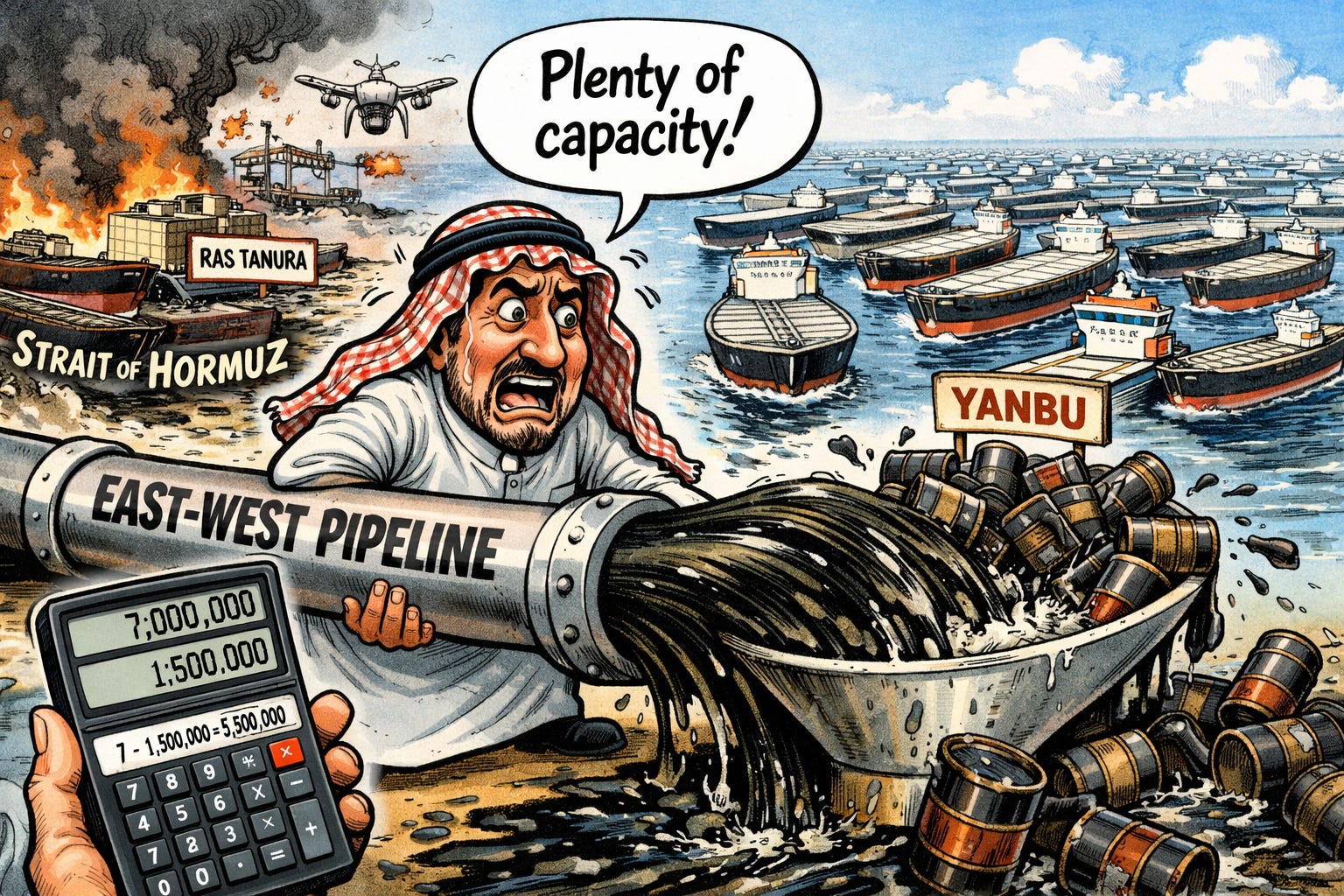
Saudi Aramco, the world’s largest oil exporter, has begun rerouting crude shipments away from the Strait of Hormuz and toward Yanbu, its Red Sea port, instructing buyers of Arab Light crude to load cargoes there instead of from its usual Persian Gulf terminals. To do this, the company is relying on its East-West Pipeline, a 750-mile crossing of the Arabian Peninsula built precisely for scenarios like this one. The pipeline carries a rated capacity of 5 million barrels per day, and in 2019 it handled up to 7 million barrels per day when a gas liquids line was temporarily converted to carry crude. First Yanbu cargo loadings are expected to begin today (Reuters via BNN Bloomberg).
The problem is port capacity. Saudi Arabia normally exports around 7.2 million barrels per day, of which approximately 6.38 million transit Hormuz. But vessel tracking data from Kpler shows Yanbu’s actual loading peak was just under 1.5 million barrels per day in April 2020, a fraction of what the pipeline can theoretically deliver. The gap between pipeline throughput and port loading capacity means Aramco’s bypass is partial at best. Compounding the picture, the Ras Tanura export terminal, one of the world’s largest, was shut this week after a drone strike. Supertanker rates from the Middle East to China have more than doubled to a record $423,736 per day, reflecting precisely this bottleneck (CNBC).
Sensei’s Insight: Aramco’s rerouting covers perhaps 1.5 million of the 6.38 million barrels per day it normally ships through Hormuz. Iraq has no bypass at all and has already cut 1.5 million barrels per day in production because storage is full. The UAE’s Fujairah pipeline was struck this week. The region’s collective shortfall is considerably larger than Aramco’s headlines imply.
⚡ Broadcom Says $100 Billion in AI Chips by 2027. Wall Street Believes It.
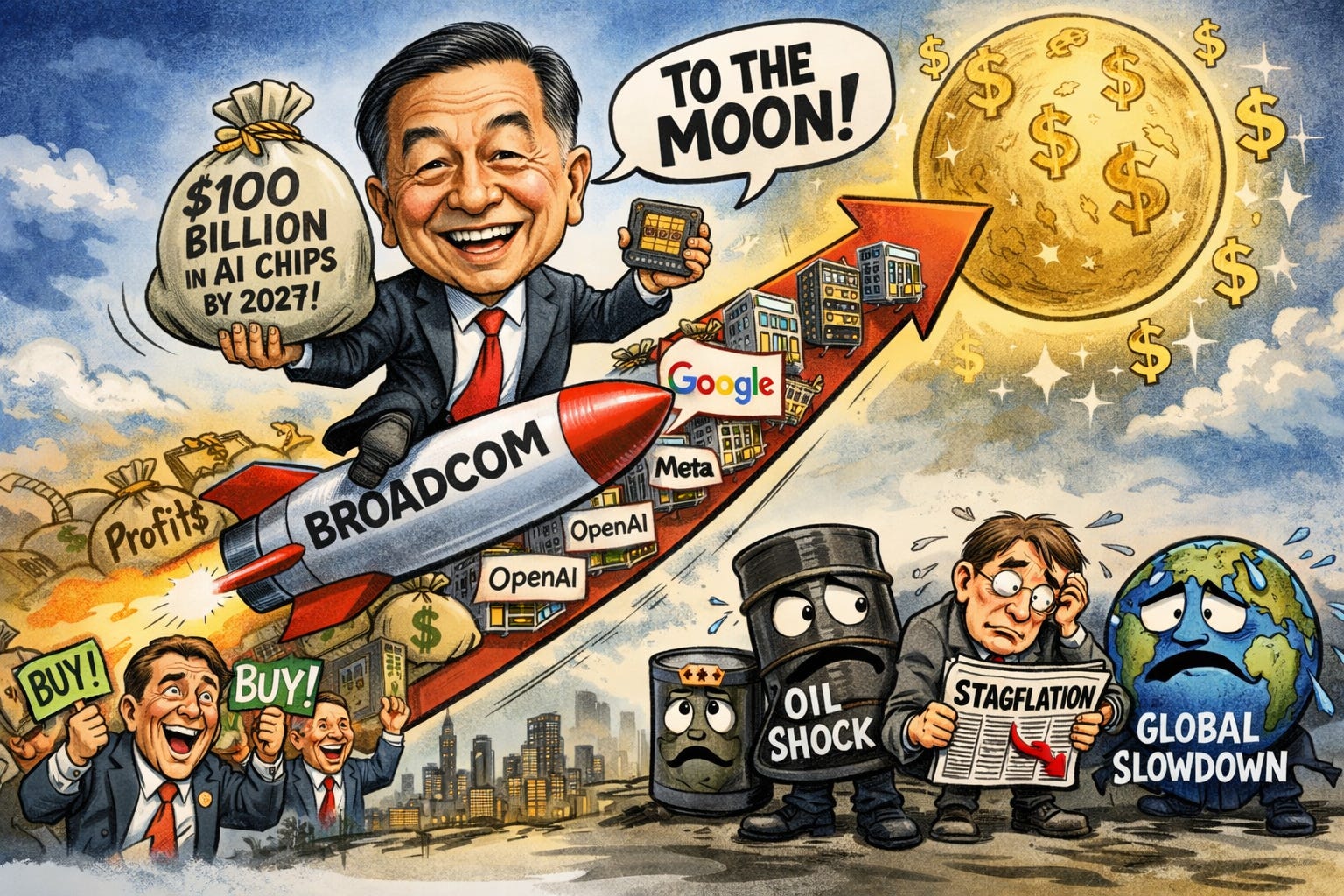
Broadcom reported fiscal first quarter 2026 earnings after the close yesterday, posting total revenue of $19.31 billion, up 29% year-over-year. The headline number was strong, but the figure markets focused on was narrower: artificial intelligence semiconductor revenue hit $8.4 billion for the quarter, up 106% year-over-year. Chief Executive Hock Tan then went further, telling analysts the company has “line of sight to achieve AI revenue from chips, just chips, in excess of $100 billion in 2027.” Guidance for the current quarter calls for total revenue of approximately $22 billion, implying 47% year-over-year growth, with AI chip revenue specifically expected to reach $10.7 billion, representing 140% year-over-year growth (CNBC).
Broadcom designs custom AI chips called application-specific integrated circuits, or ASICs, for major technology companies including Google, Meta, OpenAI, and Anthropic, who want compute power tailored to their specific workloads rather than buying Nvidia’s general-purpose graphics processing units off the shelf. On the call, Tan said Broadcom is already supplying Anthropic with one gigawatt of tensor processing unit compute in 2026, with demand expected to exceed three gigawatts in 2027. The results land as a direct counter-signal to the war-driven risk-off mood dominating markets this week. The AI infrastructure spending cycle, the numbers suggest, is not pausing for geopolitics. The stock was indicated around 5% higher in after-hours trading (StockTitan).
Sensei’s Insight: Tan’s $100 billion forecast assumes hyperscaler capital expenditure budgets survive an oil shock, potential stagflation, and slowing global growth simultaneously. Those budgets have held through every macro headwind so far. Whether they hold through this one is the single most consequential question in technology investing right now.
🔋 Amprius Earnings: A Battery Breakthrough With Implications for Electric Aviation
Silicon-anode battery developer Amprius reports Q4 results as demand for higher energy-density batteries grows across drones, electric aircraft, and next-generation mobility.
Amprius Technologies (NYSE: AMPX 0.00%↑) has just released its Q4 and full-year 2025 earnings, reinforcing why the company is drawing growing attention across both the battery technology and advanced aviation sectors. Known for developing high-energy silicon-anode lithium batteries, Amprius targets applications where weight and performance are critical, from drones and electric aircraft to next-generation mobility platforms. With revenue growth accelerating and demand rising for higher energy-density batteries, the company is positioning itself at the intersection of electric aviation, defence systems, and high-performance electrification. The earnings call is embedded below for readers who want to hear management’s commentary directly.
While still in the early stages of scaling production, Amprius sits in a strategic position as industries search for batteries capable of pushing beyond the limits of traditional lithium-ion technology. Higher energy density could unlock longer endurance for electric aircraft and unmanned aerial systems, where every kilogram of weight matters. The company has also referenced engagement with Amazon through innovation and climate-technology programmes, although details of potential commercial collaboration remain undisclosed. We will dedicate additional airtime to Amprius later today in the Analyst Room with Vaz, where we will examine the company’s technology, market positioning, and what its progress could mean for the future of electric flight.
Vaz’s Insight: We have been following Amprius for some time and the stock price suggests the company is becoming increasingly attractive to investors, yet it still remains somewhat under the radar. What makes Amprius particularly interesting is that its silicon-anode battery technology is not only competing with leading EV battery standards used by companies such as Tesla, but in some cases exceeding them by nearly 50% in energy density. From my perspective, the most compelling upside may lie in aviation, particularly the emerging flying-taxi industry, where every kilogram or pound of weight matters. Higher energy density can translate into improved range, payload, and operating economics. Amprius is already engaged with several companies developing electric aircraft and eVTOL systems. I would not be surprised if the company continues its parabolic growth trajectory, with significantly higher upside this year and beyond.
🔗 Connect with Us
Stay plugged in across platforms:
Sensei on X: sensei_live_
Martyn Lucas on X: MartynInvestor
Vaz on X: eVTOLHUB
📺 YouTube Channel (Live & Replays): Martyn Lucas Investor

🔍Deep Dive: Operation Epic Fury: The Oil Shock the Market Has Been Dreading