

This content is for informational and educational purposes only and does not constitute financial advice. Always do your own research. Not financial advice (NFA).
👀 Today’s Stories at a Glance
📉 Long Bond Yields Crack 5%: Morgan Stanley warns of the first real stock correction since March if the move continues.
⚡ NextEra Bids $66.8B for Dominion: Largest US utility merger ever, built around Northern Virginia’s artificial intelligence (AI) power demand.
⚖️ Jury Tosses Musk’s OpenAI Case: Oakland verdict in under two hours clears the way to OpenAI’s initial public offering (IPO).
🛢️ Birol Warns Oil Stocks Draining: International Energy Agency (IEA) chief says commercial inventories have only weeks of cushion left.
💊 Pharma Loses Final Pricing Appeal: Supreme Court denies six drugmakers as Ozempic and Wegovy face negotiated prices in 2027.
🌶️ India Gas Squeeze Hits California: Hormuz closure forces India to cut alkylate exports, pushing pump prices above $6 a gallon.
🌱 HSBC Backs Chinese Cleantech Push: $4B credit line accelerates Chinese solar, battery and AI infrastructure exporters into overseas markets.
☁️ Google and Blackstone Build AI Cloud: $5B Blackstone stake in a tensor processing unit (TPU) venture hedges against Nvidia.
🧠 One Big Thing
NextEra's $66.8 billion bid for Dominion and the Blackstone-Google cloud venture are the same trade in two wrappers. Hyperscalers need power and chips at a scale their own balance sheets cannot carry, so the build is moving onto utility roll-ups and private capital vehicles instead. NextEra gets the megawatts; Blackstone gets the tensor processing units (TPUs). For investors, the cleanest reads are the picks-and-shovels names: GE Vernova and Quanta on the grid side, and the alternative asset managers writing the equity cheques behind the chip build. Watch which side compounds faster as artificial intelligence (AI) capex crosses $700 billion in 2026.
⚖️ Fear & Greed
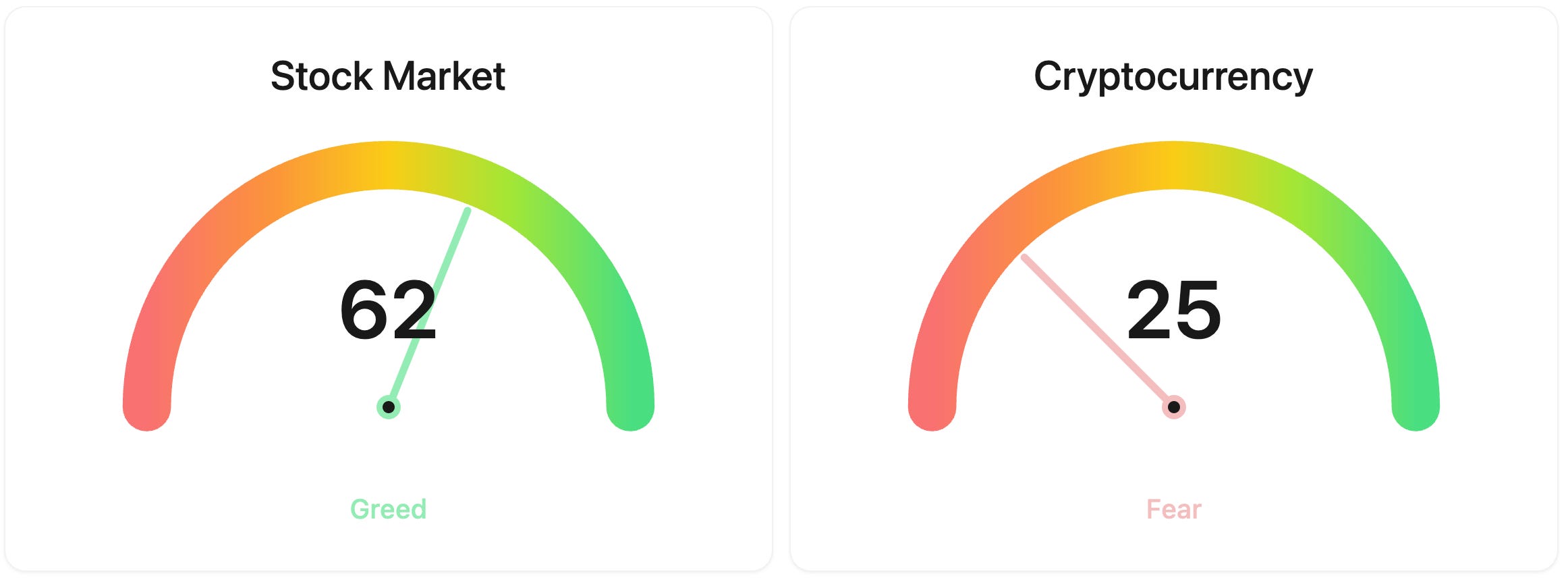
📉 The Number That Matters
5.12%
The 30-year Treasury yield closed at 5.12% yesterday, its highest level since June 2007, with Morgan Stanley warning the first real equity correction since March could follow if 5.12% holds.
⚔️ Winners vs Losers
Winners
AGYS 0.00%↑: Agilysys Inc. shares jumped after the hospitality software company reported fiscal Q4 adjusted EPS of $0.63 versus the $0.50 consensus and issued FY27 revenue guidance of $365M to $370M, above the $363.59M Street estimate.
RLAY 0.00%↑: Relay Therapeutics Inc. rallied ahead of the ISSVA World Congress in Philadelphia, where the company will present a late-breaking clinical readout on May 20 for its mutant-selective PI3Kα inhibitor zovegalisib in PIK3CA-driven vascular malformations.
EVTC 0.00%↑: Evertec Inc. surged after announcing a strategic agreement with Transbank, Chile’s leading payments operator, under which Evertec will run Transbank’s transactional scope and selected platforms, deepening its Latin American footprint.
NOW 0.00%↑: ServiceNow Inc. extended Monday’s roughly 8% rally after Bank of America reinstated coverage with a Buy rating and a $130 price target, citing the company’s agentic AI opportunity.
Losers
No major losers to report on today
📊 Market Snapshot
Cryptocurrencies:
Bitcoin (BTC): $76,830 (▼ -0.17%)
Ethereum (ETH): $2,113 (▼ -0.75%)
XRP: $1.37 (▼ -1.31%)
Equity Indices (Futures):
S&P 500: $7,375 (▼ -0.31%)
NASDAQ 100: $28,917 (▼ -0.62%)
FTSE 100: £10,378 (▲ 0.27%)
Commodities & Bonds:
10-Year US Treasury Yield: 4.62% (▲ 0.65%)
Oil (WTI): $104 (▲ 1.31%)
Gold: $4,538 (▼ -0.62%)
Silver: $75.94 (▼ -2.27%)
Data as of: UK (BST) 12:27 / US (EDT): 07:27 / Asia (Tokyo): 20:27
✅ 5 Things to Know
📉 30-Year Yield Tops 5%, Wilson Warns Stocks Could Crack
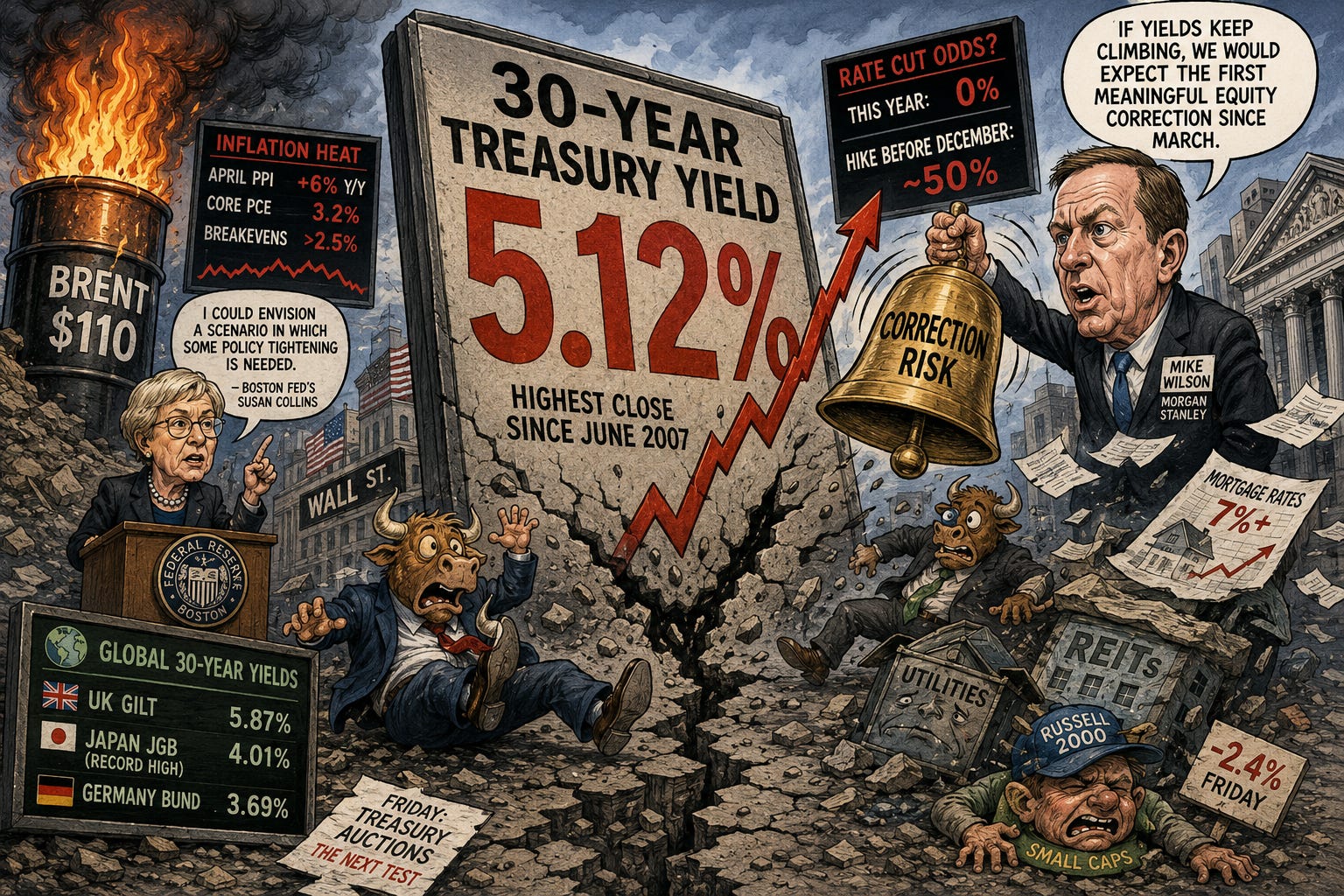
The 30-year Treasury yield closed at 5.12% yesterday, its highest since June 2007, while the 10-year touched 4.63% intraday. Morgan Stanley’s Mike Wilson told clients yesterday that if yields keep climbing his team would expect the first meaningful equity correction since markets bottomed in March. The rout has broadened globally: the UK 30-year gilt hit 5.87%, Japan’s 30-year crossed 4% for the first time on record, and Germany’s 30-year Bund touched 3.69%. Fed funds futures now price near-zero chance of a rate cut this year and roughly 50% odds of a hike before December. (Bloomberg)
The argument has shifted from deficits to inflation. Earlier bond stress focused on weak auctions and Treasury bill issuance. This wave is driven by the energy shock: Brent above $110, April PPI up 6% year over year, core PCE at 3.2%, and breakeven inflation back above 2.5% for the first time since 2022. Boston Fed President Susan Collins said last week she could “envision a scenario in which some policy tightening is needed.” For retail investors, higher long yields raise mortgage rates, compress multiples on long-duration tech, and erode the relative appeal of utility and REIT yields. The Russell 2000 fell 2.4% on Friday and small caps remain the most exposed names. (Yahoo Finance)
Sensei’s Insight: The 30-year just printed its highest close in 19 years and Morgan Stanley is now publicly calling for the first stock correction since March. The next CPI print and Friday’s Treasury auctions are the immediate tests of whether the inflation framing holds.
⚡ NextEra’s $66.8B Dominion Bid Bets on AI Power
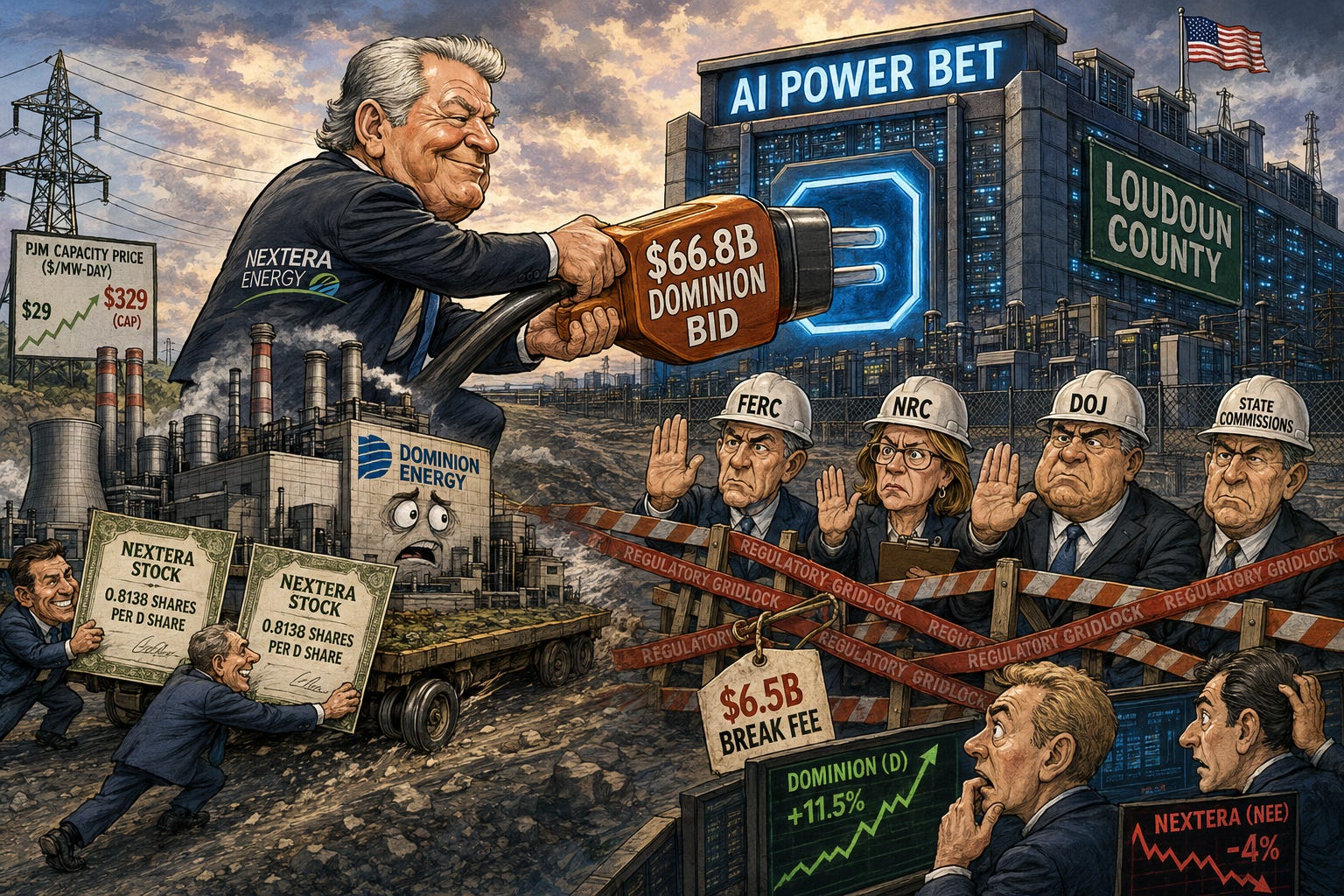
NextEra Energy agreed yesterday to buy Dominion Energy in an all-stock deal valued at $66.8 billion, the largest electric-utility merger in US history. Dominion shareholders get 0.8138 NextEra shares for each Dominion share, a 23% premium to Friday’s close. The combined company would carry $249 billion of market value, $420 billion of enterprise value, 10 million customer accounts and 110 gigawatts of generation. Dominion (D) jumped 11.5% on the announcement while NextEra (NEE) fell 4%, and an investor-rights firm has opened an inquiry into whether NEE got the best price for shareholders. (CNBC)
The strategic logic is data centers. Dominion sits at the heart of Northern Virginia’s Loudoun County, the world’s largest data-center cluster, where PJM capacity prices have jumped from $29 per megawatt-day to the FERC-approved cap of $329. The combined company says its large-load pipeline tied to AI customers exceeds 130 gigawatts. Regulatory hurdles are steep: approvals are required from FERC, the NRC, state commissions in Virginia, North Carolina, South Carolina and Florida, plus DOJ antitrust review. NextEra targets close in 12 to 18 months but Dominion’s own guidance points to the second half of 2027. The deal carries a $6.5 billion termination fee if regulatory failure kills it. (Utility Dive)
Sensei’s Insight: This is the biggest bet a US utility has ever placed on AI power demand. NEE’s 4% drop reflects real regulatory risk over a multi-year close and the size of that termination fee. Grid suppliers like GE Vernova and Quanta Services track the same theme.
⚖️ Musk Loses OpenAI Lawsuit, Clearing IPO Path
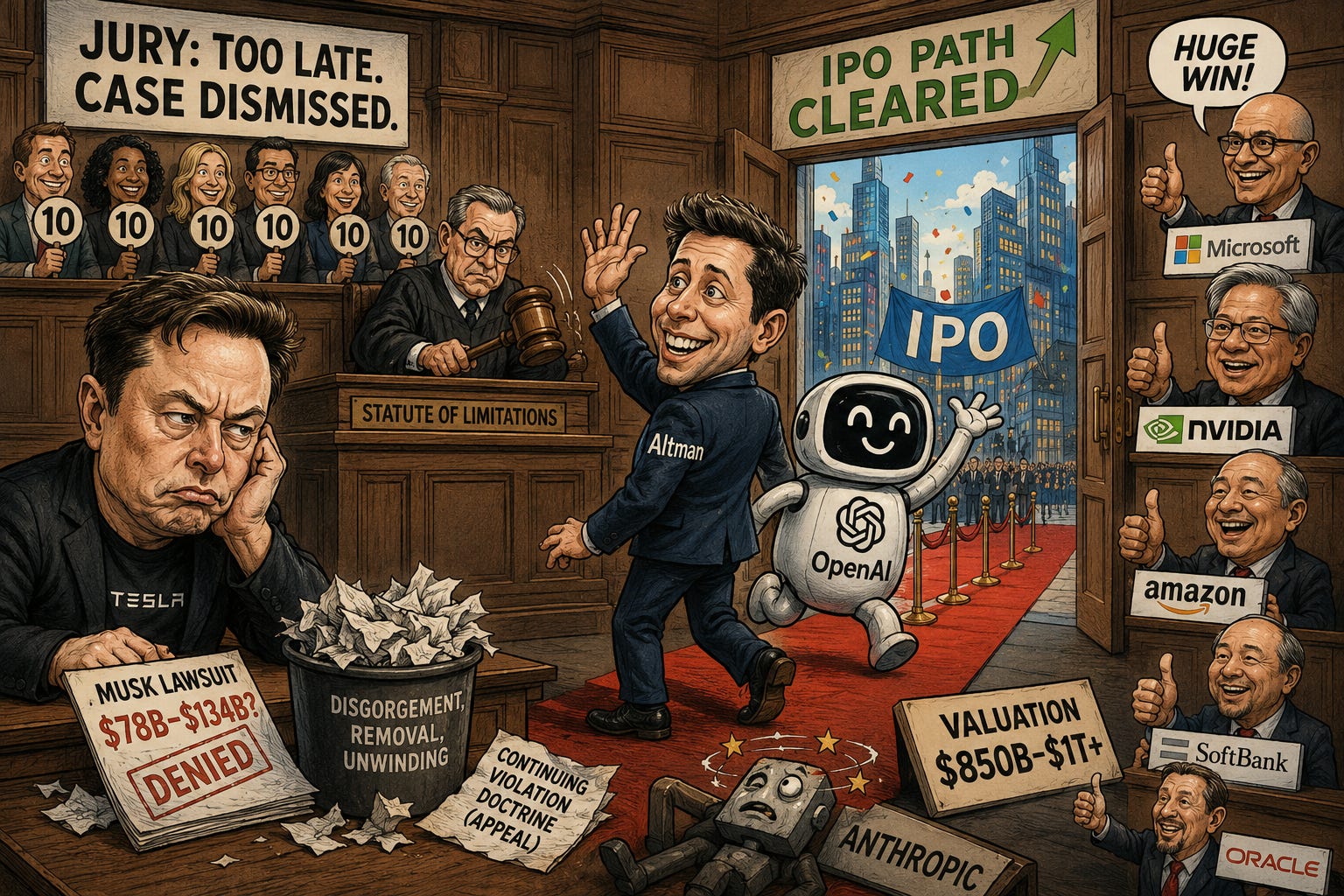
A unanimous federal jury in Oakland ruled yesterday that Elon Musk waited too long to sue OpenAI, dismissing his case on statute-of-limitations grounds after less than two hours of deliberation. The judge accepted the advisory verdict on the spot. Musk had sought between $78.8 billion and $134 billion in disgorgement plus the removal of Sam Altman and Greg Brockman and an unwinding of OpenAI’s 2025 restructuring. He recovers nothing. His attorney announced an appeal would rely on the “continuing violation doctrine,” which can extend the limitations clock in some circumstances. (CNBC)
The verdict removes the biggest legal threat to an OpenAI public offering. The company was valued at $852 billion in its $122 billion February funding round, with Microsoft holding about a 27% economic stake and additional capital from Amazon, Nvidia and SoftBank. A win for Musk would have forced a structural unwind that wiped out hundreds of billions in equity. Wedbush’s Dan Ives called the outcome a “huge win,” and trial lawyer James Rubinowitz described it as “the cleanest possible legal win” because OpenAI only needed to prove the case was filed late. The next event is an expected IPO prospectus filing, with secondary-market trades implying valuations from $850 billion to over $1 trillion. (NBC News)
Sensei’s Insight: Musk will appeal, but the structural threat is gone. OpenAI can now restructure and file an IPO without a judge’s pen hanging over it. Microsoft, Nvidia and Oracle benefit the most as suppliers and partners, while Anthropic loses a competitor it might have caught flat-footed.
🛢️ Oil Inventories Have “Weeks” Left, IEA Chief Warns

IEA executive director Fatih Birol told reporters at a G7 meeting in Paris yesterday that commercial oil inventories are draining “very fast” and have only “several weeks” of cushion at current rates. The agency now estimates the Iran war is cutting 2026 global supply by 3.9 million barrels a day, sharply higher than its previous 1.5 million estimate. Strategic reserve releases have been adding 2.5 million barrels a day to the market, but Birol said those reserves “are not endless.” Brent for July settled at $112.10 yesterday before retreating to $109.09 in Asian trading after Trump said he was holding off a planned Tuesday strike on Iran for “serious negotiations.” (Reuters)
The “perception gap” Birol described sits between the physical market, where barrels are draining at a record pace, and financial markets that keep getting whipsawed by Trump headlines. The US Strategic Petroleum Reserve fell to 374 million barrels last week after a record 9.9-million-barrel weekly draw, the lowest level since July 2024. Energy Secretary Chris Wright has said he plans to refill 200 million barrels later in 2026, which would only restore pre-war levels. The next test is whether negotiations actually advance. If they stall, Birol’s warning becomes the dominant story. If they hold, financial markets get a reprieve while commercial stocks keep draining. (CNBC)
Sensei’s Insight: Birol is the most senior global energy official publicly saying the world is closer to running short of usable oil than financial markets are pricing. Trump’s overnight pause cut crude 2 to 3%, but it does not refill the SPR or open Hormuz. Refiner margins and tanker rates carry the cleaner signal from here.
💊 Supreme Court Hands Pharma a Final Loss on Drug Prices
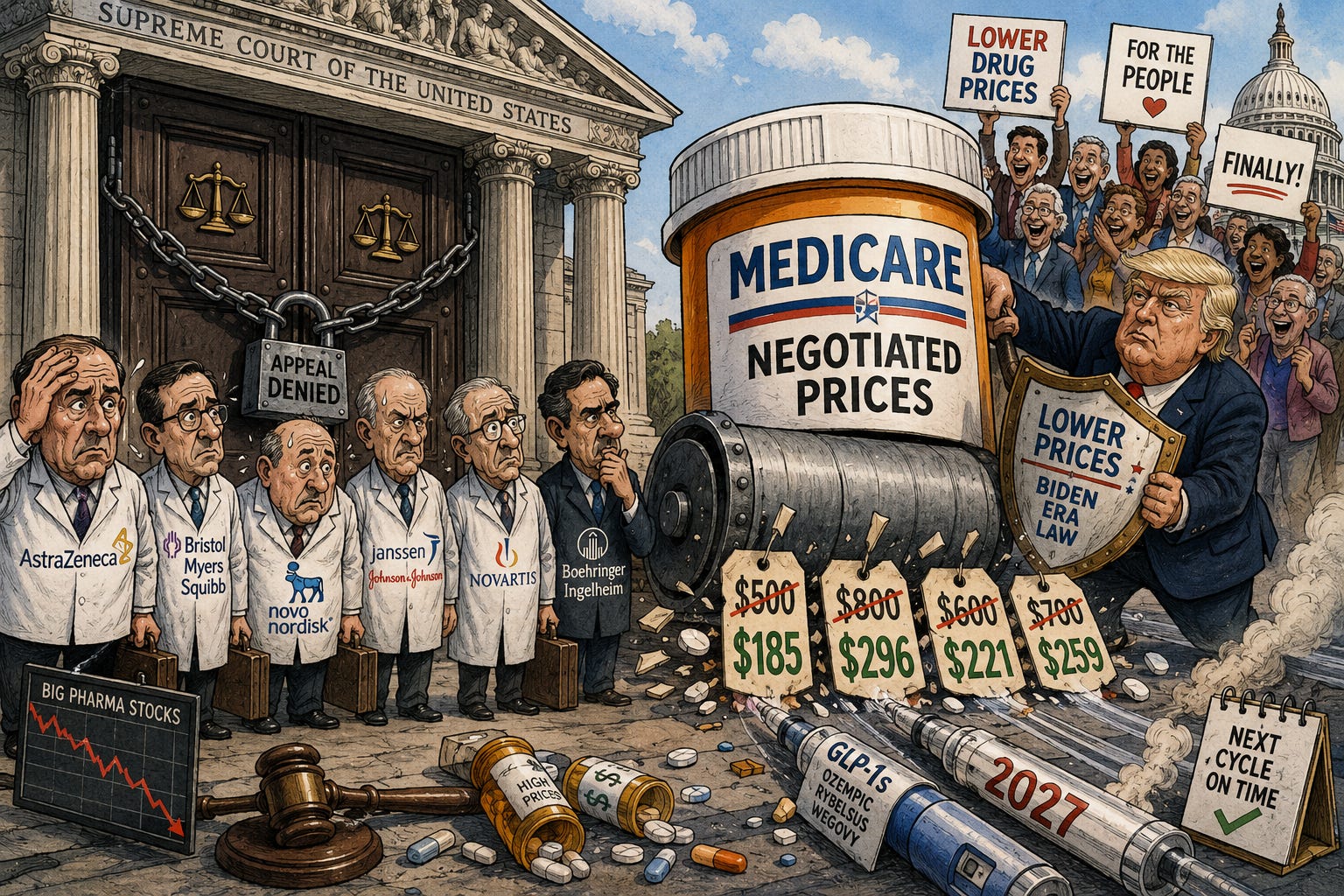
The Supreme Court declined yesterday to hear appeals from six drugmakers challenging Medicare’s drug-price negotiation program, leaving lower-court rulings in favor of the government intact. AstraZeneca, Bristol Myers Squibb, Novo Nordisk, Johnson & Johnson’s Janssen unit, Novartis and Boehringer Ingelheim all lose their constitutional challenge under the Takings Clause, the First Amendment compelled-speech doctrine, and Due Process. The first 10 negotiated prices took effect on January 1 with an average 63% cut. Another 15 drugs go live in 2027, including Novo Nordisk’s GLP-1s Ozempic, Rybelsus and Wegovy, and 15 more were selected for 2028, with Part B drugs administered in clinical settings now in scope for the first time. (Reuters)
The political picture has flipped. The Trump administration is now defending a Biden-era program because lower drug prices are popular with voters, and the new third cycle of negotiations is on a CMS timetable that runs through next year. For investors, the program is no longer a court risk; it is a baseline. The names most exposed include Novo Nordisk on GLP-1s, J&J on Stelara and Xarelto, BMY on Eliquis, AstraZeneca on Farxiga and Novartis on Entresto. PhRMA’s standing position is that the law will reduce future research investment, but the legal channel to stop it is now closed. (Bloomberg)
Sensei’s Insight: The denial converts a contingent legal risk into a permanent margin reset for the branded-drug industry. The bigger item retail hasn’t fully priced in is GLP-1 pricing pressure starting in 2027, when Ozempic, Rybelsus and Wegovy hit their negotiated prices.
Stories You Might Have Missed
🌶️ India’s Cooking-Gas Crisis Reaches California Pumps
A Reuters investigation traced California’s $6-plus gasoline price directly to India’s shortage of LPG cooking gas. India imports more than 90% of its LPG from the Middle East, and with Hormuz still closed Delhi has ordered refiners to maximise LPG output by cutting alkylates, a high-octane blending component used in California’s strict CARBOB gasoline. Indian alkylate exports fell to 33,000 barrels a day in April from 61,000 in March. The squeeze hits a state that has already lost about 17% of its refining capacity to the Phillips 66 LA and Valero Benicia closures. AAA shows California today at $6.15 a gallon compared with $4.52 nationally. UC Davis economists project a further $1.21 rise by August. (Reuters)
🌱 HSBC Opens $4B Lending Pool for China Clean Tech
HSBC launched a $4 billion credit facility yesterday for Chinese companies in solar, batteries, EVs, data centers and AI infrastructure looking to expand abroad. CEO Georges Elhedery has aggressively pivoted HSBC toward Asia and the Gulf, and has pledged to keep investing in China despite US tariffs and export controls. China accounted for roughly half of global cleantech exports last year and two-thirds of solar and battery exports, with Chinese firms committing more than $180 billion to overseas clean-tech projects since 2023. The facility tilts the global playing field further toward Chinese exporters and pressures First Solar, Enphase, Tesla and the European battery hopes still rebuilding after Northvolt. (Reuters)