This content is for informational and educational purposes only and does not constitute financial advice. Always do your own research. Not financial advice (NFA).
👀 Today’s Stories at a Glance
📉 Nasdaq Sheds $1 Trillion: artificial intelligence leaders lead the fall, with no Fed cut left to cushion it.
🧠 Google’s $250 Billion AI Exodus: two star researchers quit, denting the structural lead Alphabet sold to investors.
🛢️ Iran Oil Floods Back: a sanctions licence reopens exports, dragging crude toward the mid-seventies and cooling inflation.
💊 AbbVie Buys Apogee, Up 47%: a $10.9 billion bid for an eczema drug lifts the biotech nearly 47%.
🚀 SpaceX Drops 16% on Debt: a surprise $20 billion bond sale extends a brutal three-day slide.
💾 Memory Chips Run Hot: SK Hynix tops Samsung as Micron’s results tomorrow become the sector’s real test.
🏛️ Greenspan Dies at 100: the Fed ‘Maestro’ passes as Warsh revives talk of his rate-cutting put.
⛏️ China Blacklists Rare-Earth Miners: Beijing targets MP Materials and a peer, though both shares barely moved.
⛽ Lawsuit Targets AI Gas Pricing: California drivers accuse retailers of using shared software to inflate pump prices.
📈 Small Caps Hit Record: the Russell 2000 closes above 3,000 for the first time, signalling a broadening rally.
📈 Chart of the Day: Silver: silver tests $60 support, with a double bottom potentially ending the selloff.
🧠 One Big Thing
The market just lost its safety net, and three separate stories say so. Through the AI rally, every dip was bought on faith the Fed would cut; now rate-hike bets are climbing and the dollar sits at a one-year high. Greenspan, who invented that very reflex, died the same week the put bearing his name stopped working. The one force that could revive it is falling oil, with crude back near $74 cooling the inflation that turned the Fed hawkish. Watch whether cheaper energy pulls hike odds lower; until it does, dips may keep getting sold rather than bought. Today's Deep Dive carries this further.
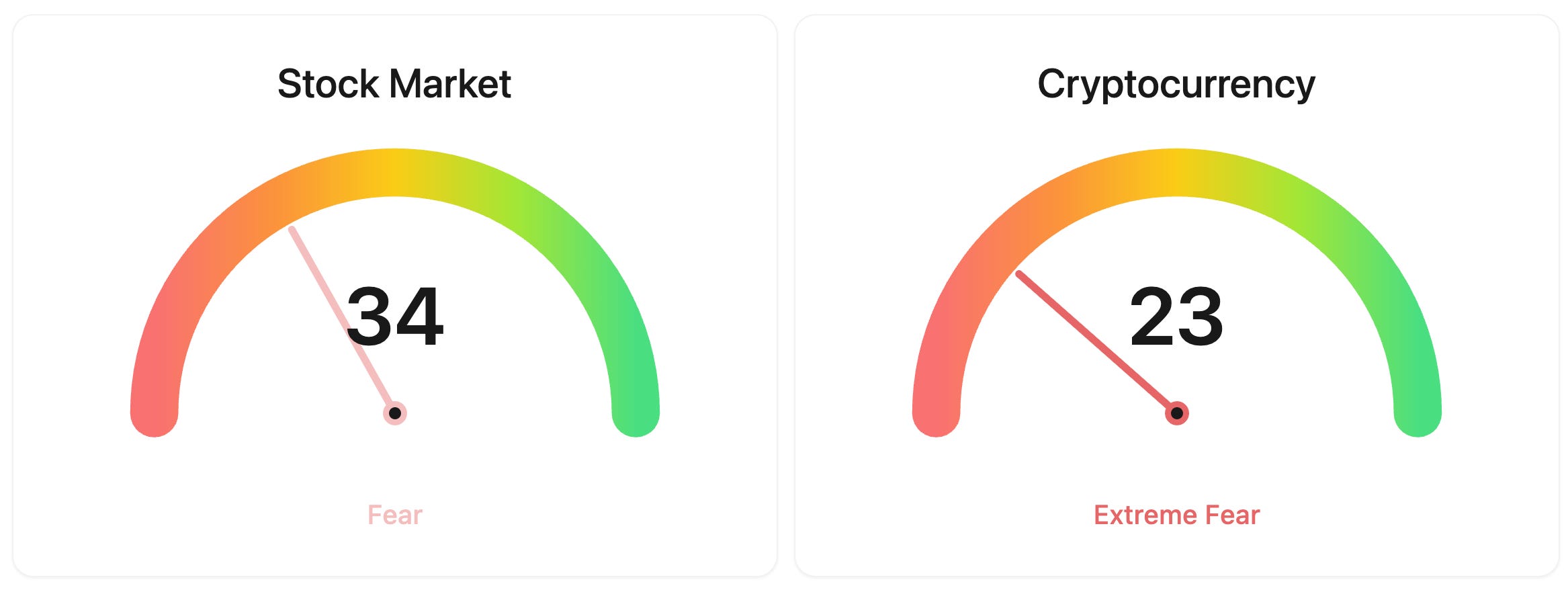
⚖️ Fear & Greed
📉 The Number That Matters
$600 BILLION
SpaceX has handed back more than $600 billion in market value across three sessions, and with insider lockups starting to expire in August, that $600 billion may not be the end of it.
⚔️ Winners vs Losers
Winners
EPC 0.00%↑: Edgewell Personal Care jumped after Bloomberg reported the company rejected an unsolicited takeover offer from private equity firm Yellow Wood Partners, priced at $30 per share, with the board deeming it too low.
IBM 0.00%↑: International Business Machines rose after President Trump signed two quantum computing executive orders Monday evening and publicly praised CEO Arvind Krishna, building on momentum from IBM joining OpenAI’s Daybreak cyber partner program.
Losers
PRIM 0.00%↑: Primoris Services plunged after disclosing additional cost overruns in its Renewables business, cutting its full year 2026 outlook, and announcing the departure of its chief operating officer. Stock Titan
📊 Market Snapshot
Cryptocurrencies:
Bitcoin (BTC): $62,470 (▼ 2.32%)
Ethereum (ETH): $1,658 (▼ 3.94%)
XRP: $1.11 (▼ 1.86%)
Equity Indices (Futures):
S&P 500: 7,440 (▼ 1.35%)
NASDAQ 100: 29,831 (▼ 2.68%)
FTSE 100: 10,385 (▼ 0.38%)
Commodities & Bonds:
10-Year US Treasury Yield: 4.49% (▼ 0.53%)
Oil (WTI): $74 (▼ 0.39%)
Gold: $4,126 (▼ 1.58%)
Silver: $62.10 (▼ 4.50%)
Data as of: UK: 12:30 BST / US: 07:30 EDT / Asia (Tokyo): 20:30 JST
✅ 5 Things to Know
📉 $1 Trillion Off the Nasdaq, and No Fed Rescue
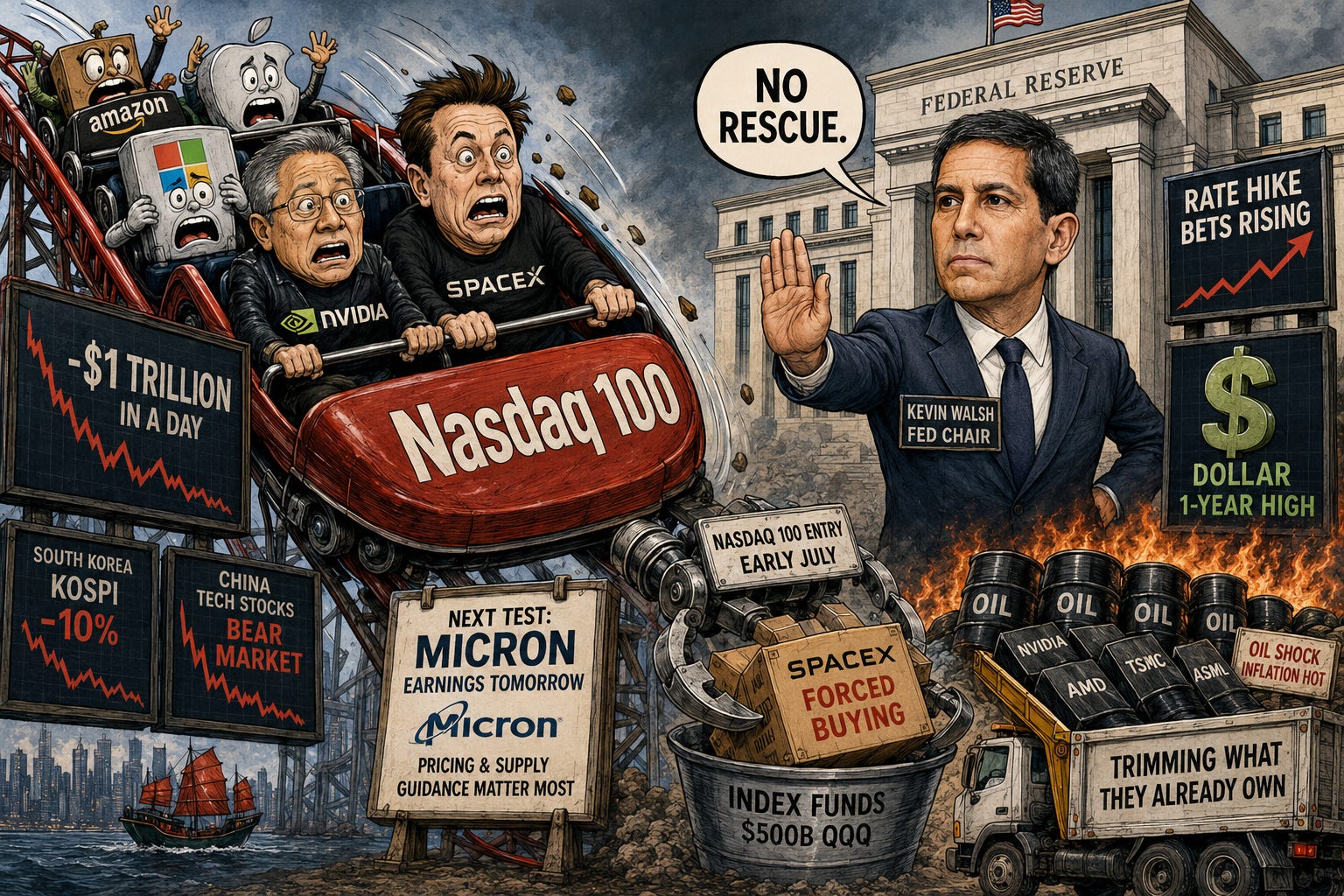
The stocks that led the artificial-intelligence rally are now leading the market down, and the speed is the story. The Nasdaq 100 was on track to lose more than $1 trillion in market value in a single session, with its futures down 2.8%, as the chipmakers and memory-chip stocks that posted triple-digit gains this year took the heaviest losses. South Korea’s Kospi plunged 10% from a record high, with Samsung Electronics and SK Hynix both falling more than 10%, while Hong Kong-listed Chinese shares slid into a bear market. SpaceX, the retail favourite that only listed earlier this month, dropped below a $2 trillion valuation for the first time, having handed back more than $600 billion over three sessions. (Reuters)
What makes this drop different is what’s missing. Through the AI rally, every sharp dip was met with bets that the Federal Reserve would cut rates and cushion the fall. This time the wagers are going the other way: bets on Fed rate hikes are rising and the dollar has climbed to a one-year high, because the energy-price spike from the Iran conflict has kept inflation hot. That removes the floor investors had learned to lean on. The next test comes tomorrow, when Micron reports quarterly results after a rally of more than 300% since January, and traders will be watching its pricing and supply guidance far more closely than whether it beats or misses on the headline number. (Yahoo Finance)
SpaceX shows how stretched the move had become. The shares are now only about 9% above their $135 listing price, meaning most of the post-debut surge that pulled in retail buyers has already unwound. The pressure may not be finished. Under Nasdaq rules revised this year, SpaceX is expected to join the Nasdaq 100 in early July, which would force every fund tracking the index, including the roughly $500 billion Invesco QQQ, to buy the shares automatically. To pay for that, index providers typically trim what they already hold, the same chip and tech names already being sold this week, which could hand the selloff a second leg just as it looks to be settling.
Sensei’s Insight: Every AI dip since 2023 had a cushion underneath: traders betting the Fed would cut. Not this one. Rate-hike bets are rising and the dollar’s at a one-year high because the oil shock keeps inflation hot. No rescue. Micron’s numbers tomorrow are the next test.
🧠 Google’s AI Brain Drain Erases $250 Billion
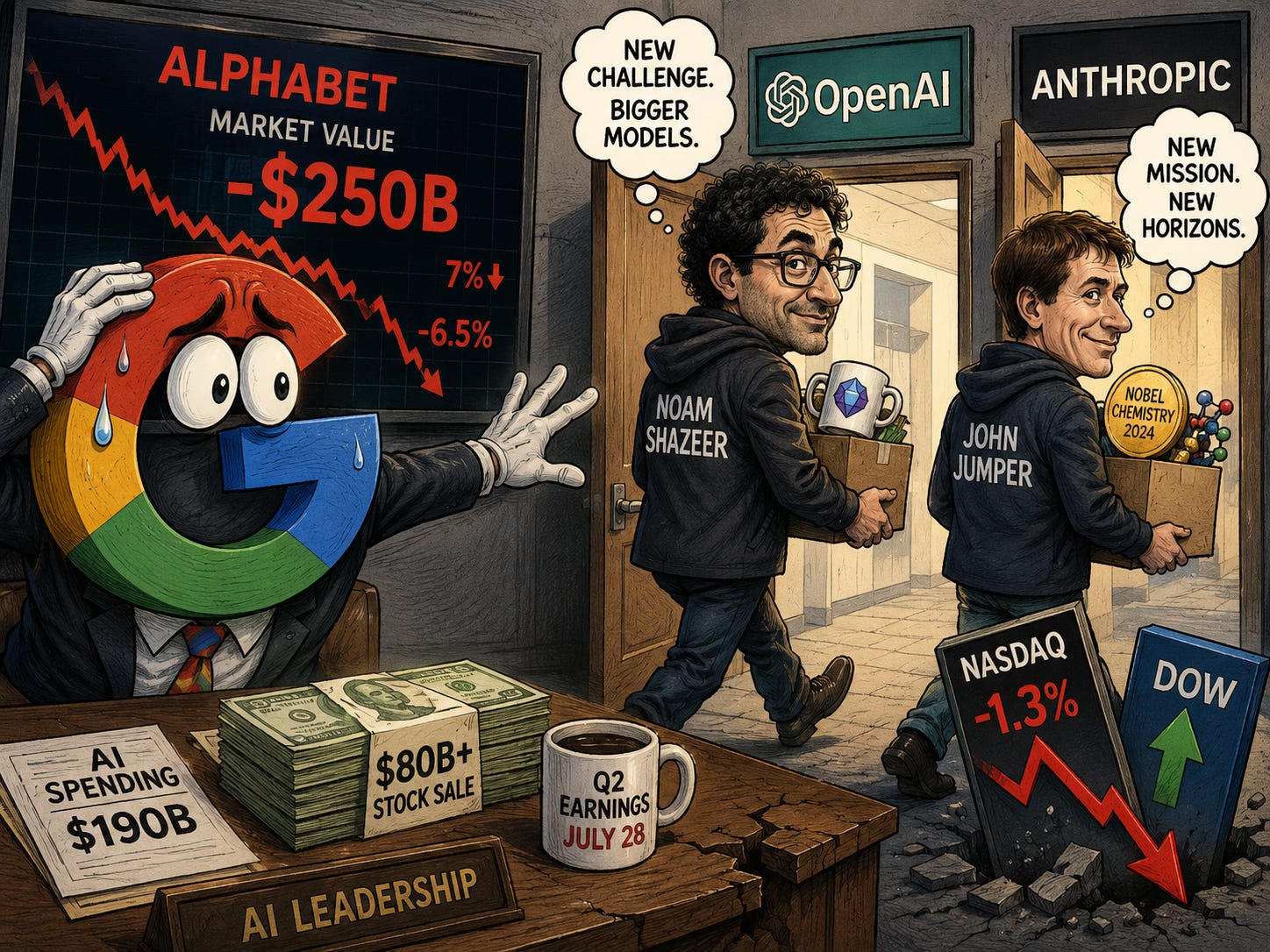
Alphabet had its worst day in over a year yesterday, with Google’s parent falling as much as 7% and closing down about 6.5% near $344, wiping out more than $250 billion in market value. The trigger was the back-to-back exit of two of its most prominent AI researchers. Noam Shazeer, co-lead of the Gemini models and a co-author of the 2017 research paper that underpins today’s large AI systems, left for OpenAI last week. Days later, John Jumper, a Google DeepMind vice president who shared the 2024 Nobel Prize in Chemistry for the AlphaFold protein model, departed for Anthropic. (CNBC)
For anyone who owns an index fund, this matters because Alphabet is one of a handful of mega-caps big enough to move the whole S&P 500 and Nasdaq. Its slide helped pull the Nasdaq down 1.3% yesterday even as the Dow rose. The departures hit a stock already nervous about Alphabet’s plan to spend close to $190 billion on AI infrastructure this year, funded partly by an $80 billion-plus stock sale this month that dilutes existing holders. The next scheduled test is second-quarter earnings on July 28. Until then, every senior AI exit is likely to move the stock. (Bloomberg)
Sensei’s Insight: Google spent years convincing the market its AI lead was structural. Two résumés just punctured that. The thing to watch now isn’t ad revenue, it’s DeepMind’s roster, because the next big-name exit will move this stock more than the quarter does.
🛢️ Iran Oil Returns, and Gas Prices Could Follow
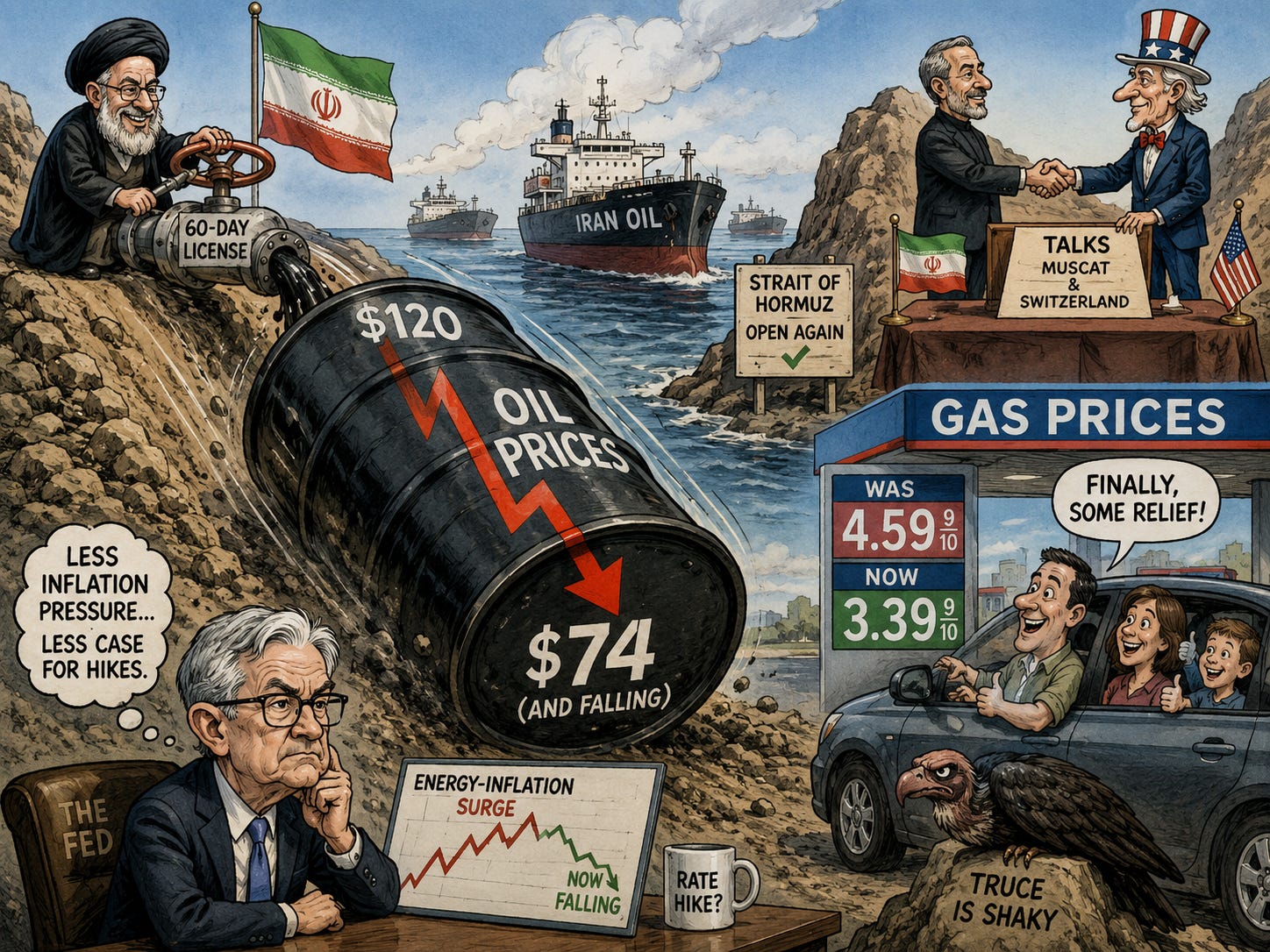
The US Treasury issued a temporary 60-day license yesterday allowing Iran to produce, ship and sell its oil, the biggest easing of sanctions in years and a condition of the deal both sides signed last week to end their war. Crude kept falling on the news: Brent settled near $78 a barrel and US West Texas Intermediate near $74, the lowest since early March and down by roughly a third from the wartime spike above $120. Tankers have started moving through the Strait of Hormuz again, the chokepoint that carries about a fifth of the world’s oil, after Iran briefly declared it closed over the weekend. (Reuters)
Cheaper oil is the cleanest piece of good news households have had in months, because the war pushed US inflation to a three-year high and gasoline was the main culprit. If crude holds near $74, that pressure eases and the case for more Fed rate hikes weakens with it. The risk is that the truce is shaky. Iranian and US negotiators are still hammering out the details, with talks on Hormuz arrangements running in Muscat and Switzerland this week, and more sanctions licenses expected in the coming days. A collapse would put the war premium straight back into the price. (CNBC)
Sensei’s Insight: Oil has given back almost the entire war premium, from $120 to the mid-$70s. That reversal matters most for the Fed, whose hawkish turn was built on energy-driven inflation that’s now falling. If crude holds here, the case for a 2026 rate hike gets thinner.
💊 AbbVie’s $10.9 Billion Deal Sends Apogee Up 47%
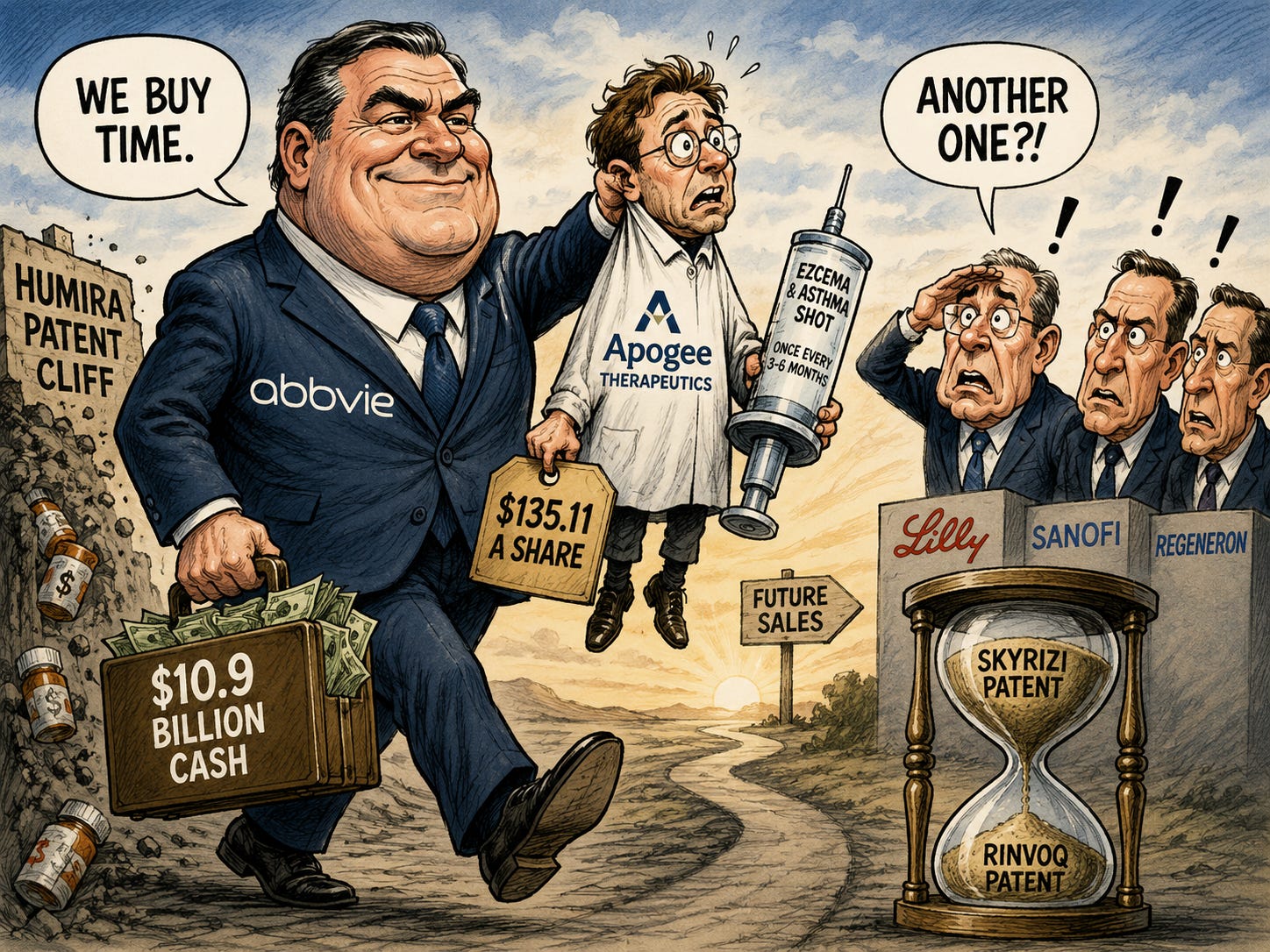
AbbVie agreed yesterday to buy Apogee Therapeutics for about $10.9 billion in cash, $135.11 a share, a nearly 50% premium that sent Apogee stock up about 47% on the day. It is AbbVie’s biggest acquisition since it bought Botox maker Allergan for $63 billion in 2019. The prize is Apogee’s lead experimental drug for eczema and asthma, designed to be injected just once every three to six months, far less often than rivals such as Sanofi and Regeneron’s Dupixent, which is typically given every two weeks. Both boards approved the deal, which is expected to close in the third quarter. (CNBC)
This is a pattern worth knowing: big drugmakers buy smaller biotechs to refill their pipelines before their blockbusters lose patent protection and face cheap copycats. AbbVie is still replacing sales lost from Humira and bracing for eventual expirations on Skyrizi and Rinvoq, its current top sellers. A deal this size, at this premium, tends to wake up the whole group, and small biotechs sitting on a single promising drug often trade higher on takeover hopes once one lands. The names to watch for a competitive response are Eli Lilly, Sanofi and Regeneron, whose eczema franchises Apogee’s drug is built to undercut.
Sensei’s Insight: AbbVie isn’t buying growth here, it’s buying time before Skyrizi and Rinvoq face the same patent cliff that gutted Humira. Deals like this almost always clear regulators, and a 50% premium tells you how badly big pharma needs new pipeline. Expect more biotech bids this year.
🚀 SpaceX Falls 16% After Launching a $20 Billion Bond
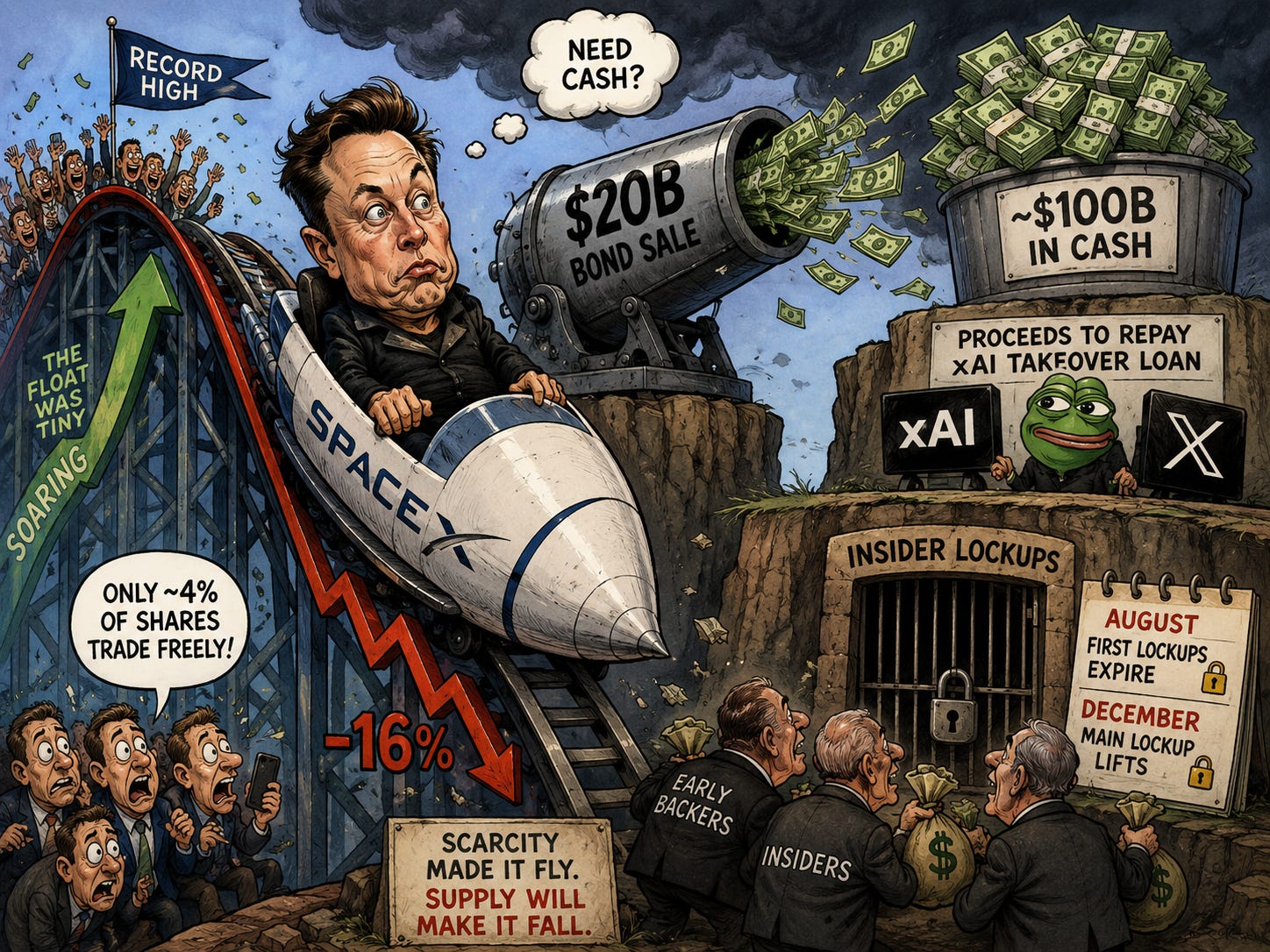
SpaceX fell about 16% yesterday to close at $154.60, its third straight down day, after the company kicked off its first-ever bond sale of at least $20 billion. The stock has now dropped roughly 27% from the record high it set just a week ago, days after completing the largest initial public offering in history. The borrowing surprised some investors because SpaceX also revealed it sits on about $100 billion in cash. The proceeds are earmarked to repay a loan tied to its February takeover of Elon Musk’s AI startup xAI, the deal that folded Grok and the X platform into the company. (CNBC)
SpaceX behaves less like a giant company and more like a meme stock, because only about 4% of its shares trade freely. That tiny float sent it rocketing after the listing and is now amplifying the fall, since even modest selling moves a thinly traded stock several percent. The bigger overhang is ahead: insider lockups, which stop early backers from cashing out, start to expire around the company’s first earnings report in early August, with the main lockup lifting near December and Musk’s own stake locked until June 2027. More shares coming to market tends to pressure a stock that was priced for scarcity. (Yahoo Finance)
Sensei’s Insight: The bond sale is the excuse, not the cause. SpaceX flew because almost nothing traded; now that same thin float is dragging it down. The date that actually matters is August, when the first insider lockups expire and real supply hits a stock built on scarcity.
💾 Memory Chips Are Hot Again, and Micron Reports Tomorrow
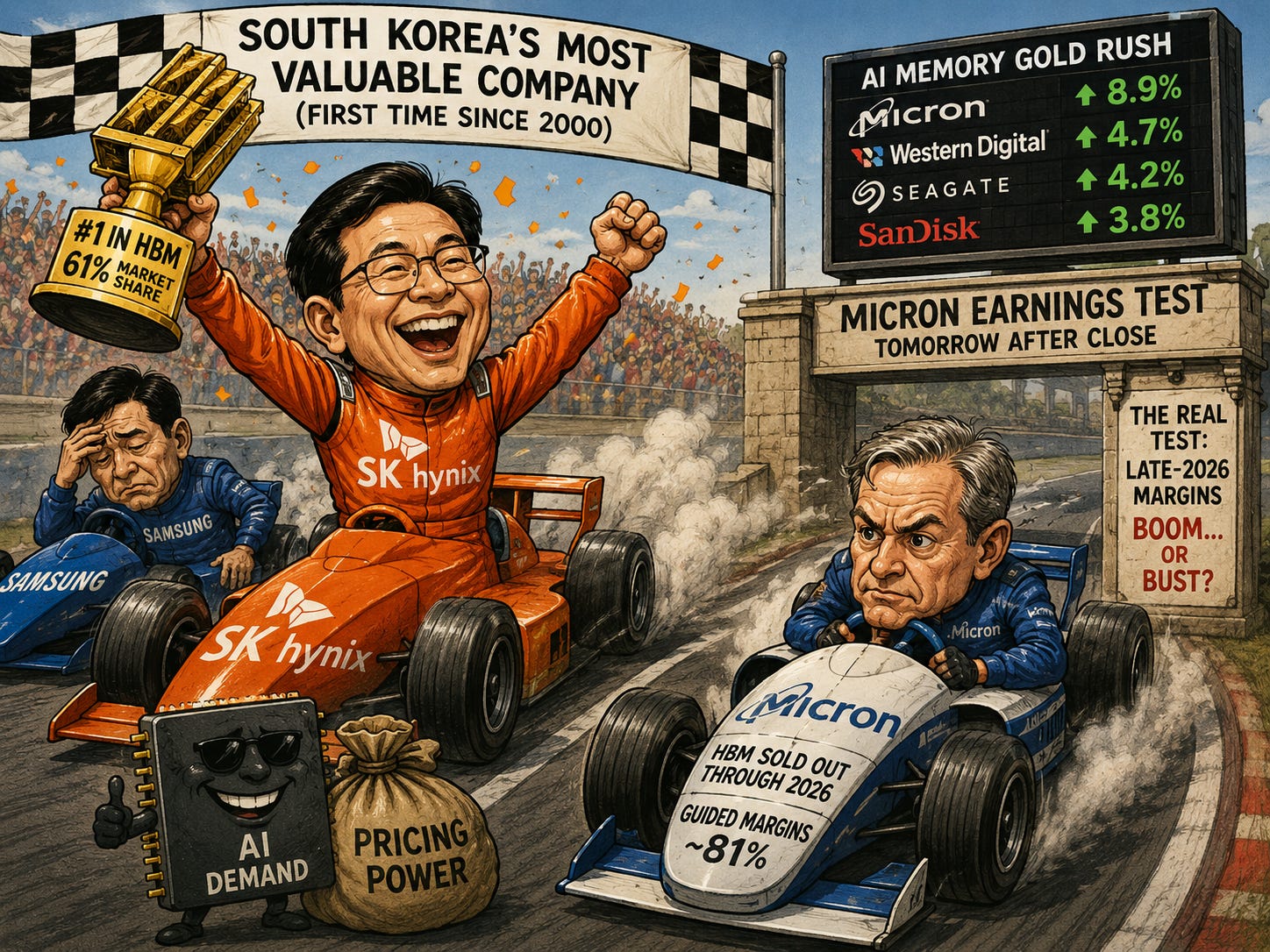
The scramble for the specialized memory chips that feed artificial intelligence just produced a milestone: SK Hynix passed Samsung yesterday to become South Korea’s most valuable company for the first time since 2000, after its shares closed up 5.6%. SK Hynix makes most of the world’s high-bandwidth memory, the stacked chips that sit next to Nvidia’s AI processors, holding about 61% of that market versus Micron’s 21%. The read-through lifted US memory names: Micron rose nearly 9%, and Western Digital, Seagate and SanDisk all gained, bucking a weak day for the rest of big tech. (Yahoo Finance)
For retail investors, memory has become one of the simplest ways to ride AI spending, because a shortage of these chips has handed makers strong pricing power. The proof points keep coming: Micron just signed a supply deal with Anthropic and took a stake in the AI lab, and its stock hit a record. The real test lands tomorrow after the close, when Micron reports earnings. It has said its high-bandwidth memory is sold out through 2026 and guided to profit margins near 81%, and the stock has roughly tripled this year. (Reuters)
Sensei’s Insight: SK Hynix grabs the headline, but Micron’s report tomorrow night is the real test for anyone holding memory stocks. The guide that matters isn’t this quarter, it’s late-2026 margins, because that tells you whether AI demand has broken memory’s old boom-and-bust cycle or just delayed it.
Stories You Might Have Missed
🏛️ Alan Greenspan, the Fed’s ‘Maestro,’ Dies at 100
Alan Greenspan, who ran the Federal Reserve for more than 18 years across four presidents, died yesterday at 100. Markets knew him for the “Greenspan put,” the belief that he would always cut rates to rescue falling stocks, and for his 1996 warning about “irrational exuberance” in asset prices. Hailed as “the Maestro” when he retired in 2006, he was later blamed for keeping rates too low and backing the deregulation that helped inflate the 2008 housing bubble. His death lands at a pointed moment: new Fed chair Kevin Warsh just signaled possible rate hikes, and his stripped-down communication style is already drawing Greenspan comparisons. (CNBC)
⛏️ China Blacklists Two US Rare-Earth Miners
China added 10 US companies to its export-control list yesterday, including MP Materials, which runs the only active rare-earth mine in the country, and USA Rare Earth. The move bars Chinese suppliers from sending them goods with both civilian and military uses, retaliation for Washington expanding its own list of Chinese military firms this month. Rare earths are critical inputs for defense gear, electric vehicles and chips, and China dominates the supply chain. The market shrugged, though: both stocks barely moved, because they say they have already cut off Chinese supplies, and the US makes up only about 10% of China’s magnet exports. (Bloomberg)
⛽ Lawsuit Says AI Software Inflated California Gas Prices
California drivers sued Walmart, Marathon Petroleum, BP and 7-Eleven in federal court yesterday, accusing them of using shared pricing software from a vendor called Kalibrate to push up gas prices in a state where the average already tops $5.50 a gallon. The legal theory is algorithmic price-fixing: rivals allegedly coordinating by feeding the same third-party tool, rather than meeting in a room. It follows a new California law, effective in January, that made these claims easier to bring. The case is an early test of whether common pricing algorithms count as collusion, a question that reaches well beyond gas into hotels, groceries and rent. (Bloomberg)
📈 Small Caps Hit a Record as the Rally Broadens
The Russell 2000, the main gauge of small-company US stocks, closed above 3,000 for the first time ever yesterday, finishing at 3,004.40. It is up about 21% this year, far ahead of the S&P 500’s gain of under 10%, a sign that investors are spreading their bets beyond the handful of mega-cap tech names that have led the market. The move fit yesterday’s split tape: while Alphabet and other giants sank, the Dow rose and small caps jumped. A broadening rally is generally seen as healthier than one carried by a few stocks, though small caps are also more sensitive to interest rates. (CNBC)
🔗 Connect with Us
Stay plugged in across platforms:
Sensei on X: sensei_live_
Martyn Lucas on X: MartynInvestor
Vaz on X: eVTOLHUB
📺 YouTube Channel (Live & Replays): Martyn Lucas Investor