This content is for informational and educational purposes only and does not constitute financial advice. Always do your own research. Not financial advice (NFA).
👀 Today’s Stories at a Glance
🕊️ Trump Pauses Iran Strikes: A five-day halt follows claimed “major agreements,” causing massive market swings and oil volatility.
📈 Fed Reconsiders Rate Hikes: Goolsbee warns that war-driven inflation could force rate increases, shifting from his previous dovish stance.
🇯🇵 Berkshire Buys Tokio Marine: Greg Abel initiates a $1.8 billion strategic partnership with Japan’s largest property-casualty insurer.
🧊 Ecolab Acquires CoolIT Systems: The $4.75 billion deal targets liquid cooling for AI chips, shifting focus to industrial infrastructure.
🍦 Ben & Jerry’s Sues Magnum: The foundation fights to protect its activist identity after the parent company’s recent corporate restructuring.
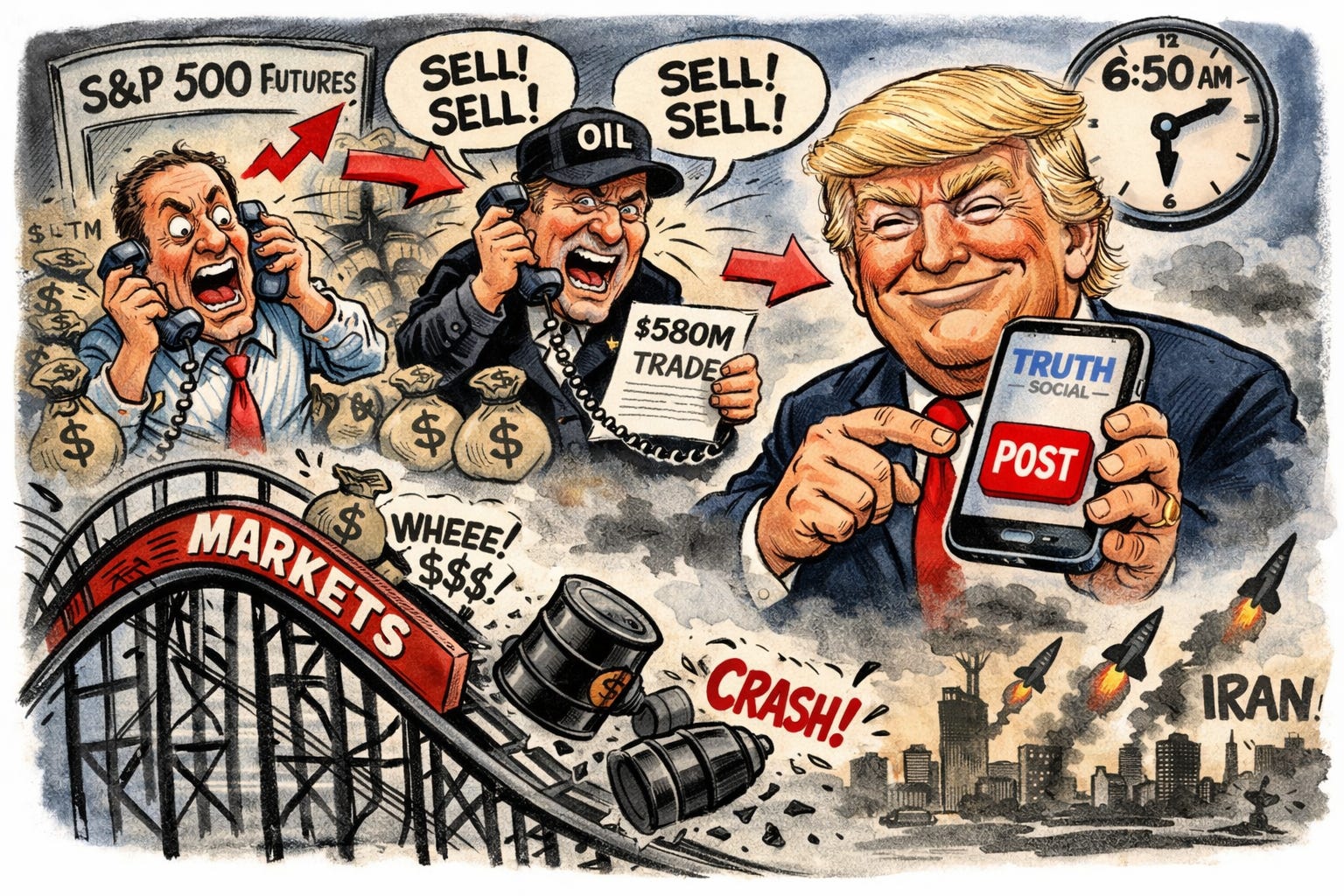
🔍 Suspicious $580M Oil Trade: Massive futures positions were placed 15 minutes before Trump’s market-moving post, sparking insider trading concerns.
🧠 One Big Thing
The “TACO” Trap
A consistent pattern has emerged where market-moving de-escalations follow intense military ultimatums, a phenomenon Wall Street calls Trump Always Chickens Out. Investors saw this play out again when a 48-hour threat to bomb Iran vanished in favor of a five-day pause, sparking a massive 4% swing in equity and oil markets. However, high-volume trades totaling over $2 billion hit the tape just 15 minutes before the announcement, raising sharp questions about information leaks and market manipulation. While the President claims a deal is near, Tehran has categorically denied any negotiations, calling the reports fake news intended to move prices. This tension suggests the “TACO” trade is reaching a breaking point as physical military deployments continue to surge despite the diplomatic rhetoric. For investors, the risk is that the reliable bounce from presidential reversals may fail if a shooting war overrides social media optics.
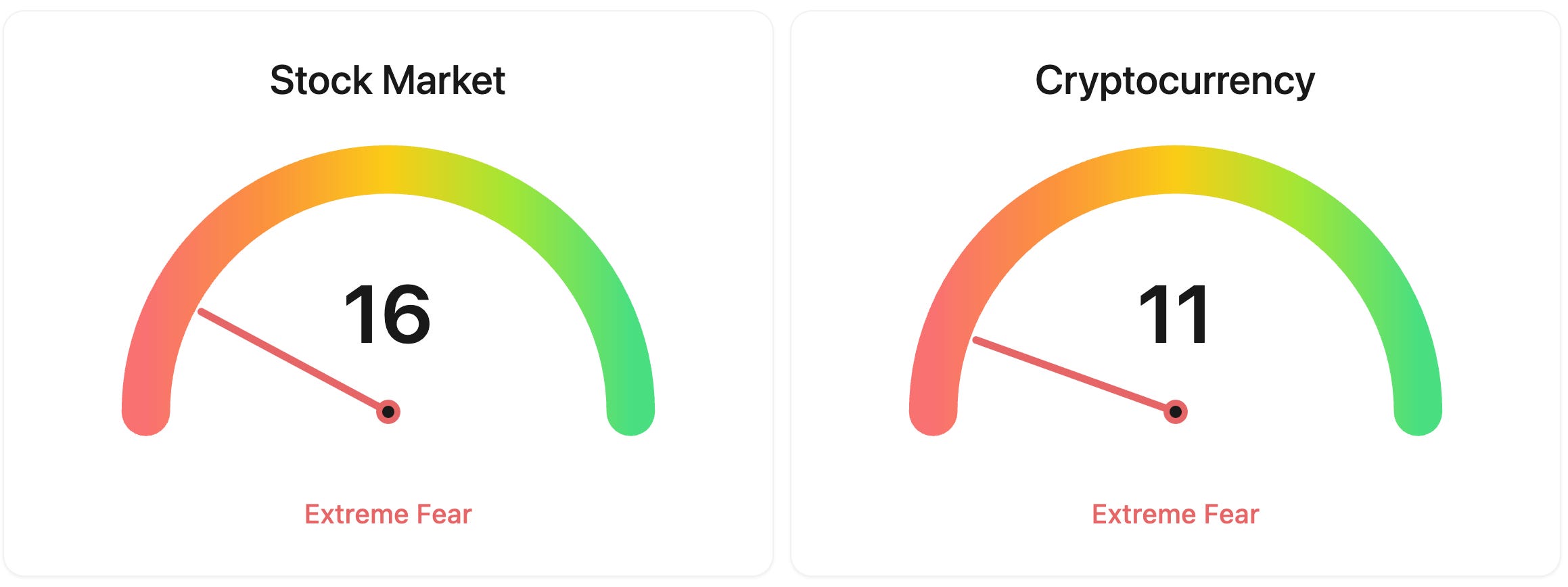
⚖️ Fear & Greed
📉 The Number That Matters
$580 MILLION
Highly abnormal trading activity saw $580 million in oil futures change hands just 15 minutes before a presidential social media post, a volume spike representing nine times the normal activity for that pre-market window. (More in today’s deep dive).
📊 Market Snapshot
Cryptocurrencies:
Bitcoin (BTC): $71062 (▲ 0.25%)
Ethereum (ETH): $2161 (▲ 0.43%)
XRP: $1.42 (▼ -0.85%)
Equity Indices (Futures):
S&P 500: 6574 (▼ -0.10%)
NASDAQ 100: 24381 (▼ -0.11%)
FTSE 100: 9908 (▼ -0.38%)
Commodities & Bonds:
10-Year US Treasury Yield: 4.36% (▲ 0.32%)
Oil (WTI): $91 (▲ 1.88%)
Gold: $4414 (▲ 0.15%)
Silver: $69.97 (▲ 1.25%)
Data as of: UK (GMT) 11:29 / US (ET): 07:29 / Asia (Tokyo): 20:29
✅ 5 Things to Know Today
🕊️ Trump Blinks on Iran Ultimatum, Tehran Calls It Fake News
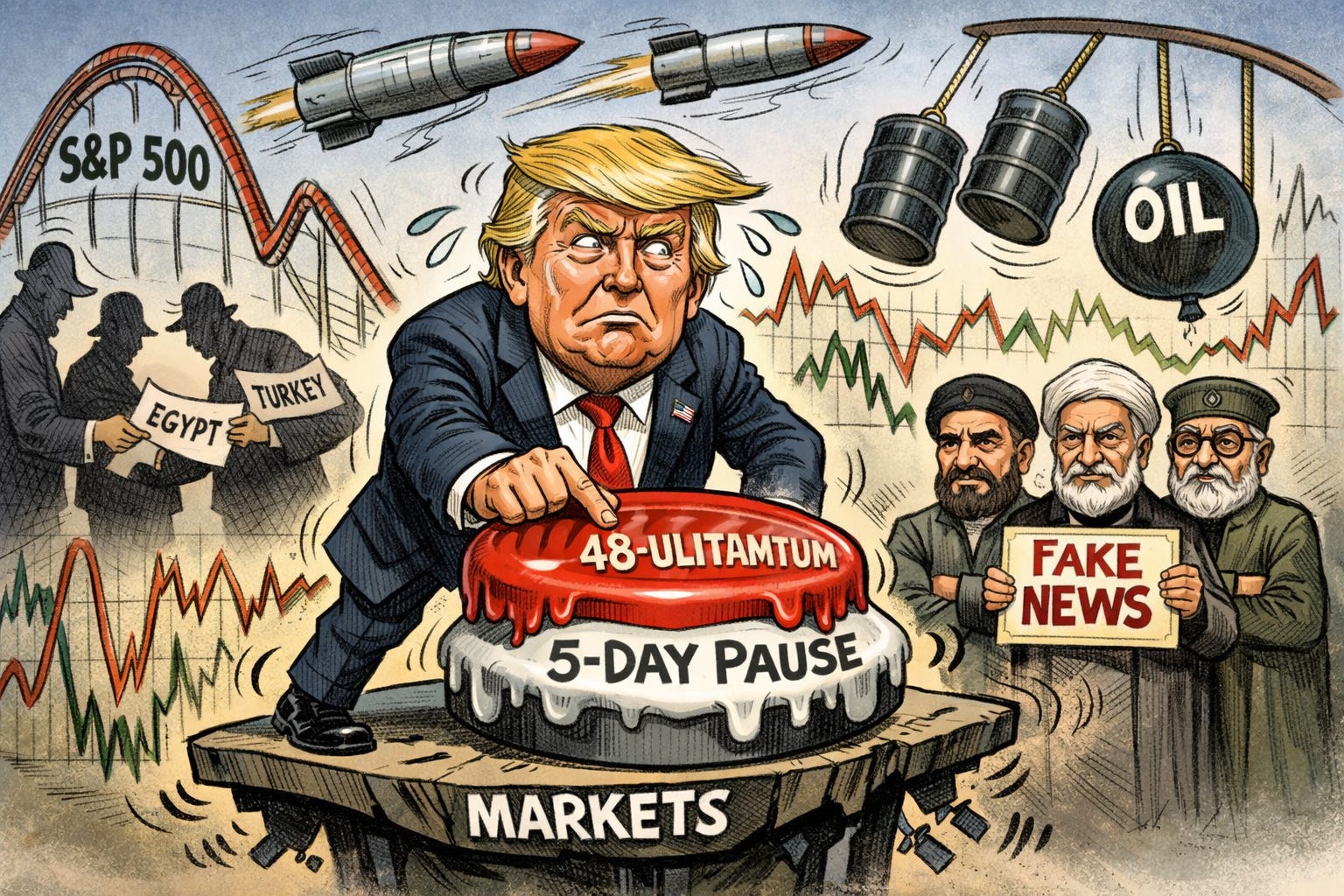
President Trump’s 48-hour ultimatum to Iran expired yesterday. Instead of the threatened “obliteration” of Iranian power plants, he posted on Truth Social that the two sides had reached “major points of agreement” and ordered a five-day pause on energy infrastructure strikes. He claimed envoys Steve Witkoff and Jared Kushner had been communicating through intermediaries in Egypt, Pakistan, and Turkey, with Islamabad floated as a potential meeting venue. Trump told reporters in Palm Beach a deal could come “within five days or less,” and if not, “we just keep bombing our little hearts out.” The market swing was enormous: S&P 500 futures had been pointing to roughly 1% losses before Trump’s post, then surged 2.7% within minutes, a swing of nearly 4 percentage points. Dow futures rocketed 1,100 points. Brent crude plunged as much as 14% intraday. By the close, the indices had pared gains, with the Dow finishing up 631 points and the S&P 500 up 1.15%, but the sheer velocity of the move reflected how much war premium is baked into current prices (CNBC).
Tehran’s response was swift and categorical. Parliament Speaker Mohammad Bagher Ghalibaf, the very person Israeli media had identified as Trump’s interlocutor, posted on X that “no negotiations have been held with the US” and accused Washington of deploying “fake news to manipulate financial and oil markets.” Iran’s Foreign Ministry did acknowledge receiving “messages from some friendly countries” but said these were handled in line with existing positions, suggesting backchannel message-passing occurred but nothing close to formal negotiations. Oil partially recovered after the denials, settling down roughly 7-10% rather than 14%. This morning, the rally is already unwinding: S&P 500 futures are down 0.6% and crude is climbing back toward $103 after the Wall Street Journal reported that Gulf allies are inching toward joining the fight. The war is now in its 24th day, with over 2,300 Iranian civilians killed, 13 or more U.S. service members dead, and the Pentagon seeking $200 billion in supplemental war funding (Bloomberg).
Sensei’s Insight: This is a pattern. Trump set a tariff deadline with China in 2025 and blinked. He set an ultimatum on TikTok and extended it. Now he set a 48-hour deadline on Iran and replaced it with a five-day pause. Markets rallied each time on the retreat, and each time the underlying problem remained. Meanwhile, the Pentagon has submitted ground invasion plans, the 82nd Airborne is being prepared, and another 2,500 Marines shipped out last week. You do not deploy ground forces if you are five days from a deal.
📈 Fed’s Goolsbee Says Rate Hikes Are Back on the Table
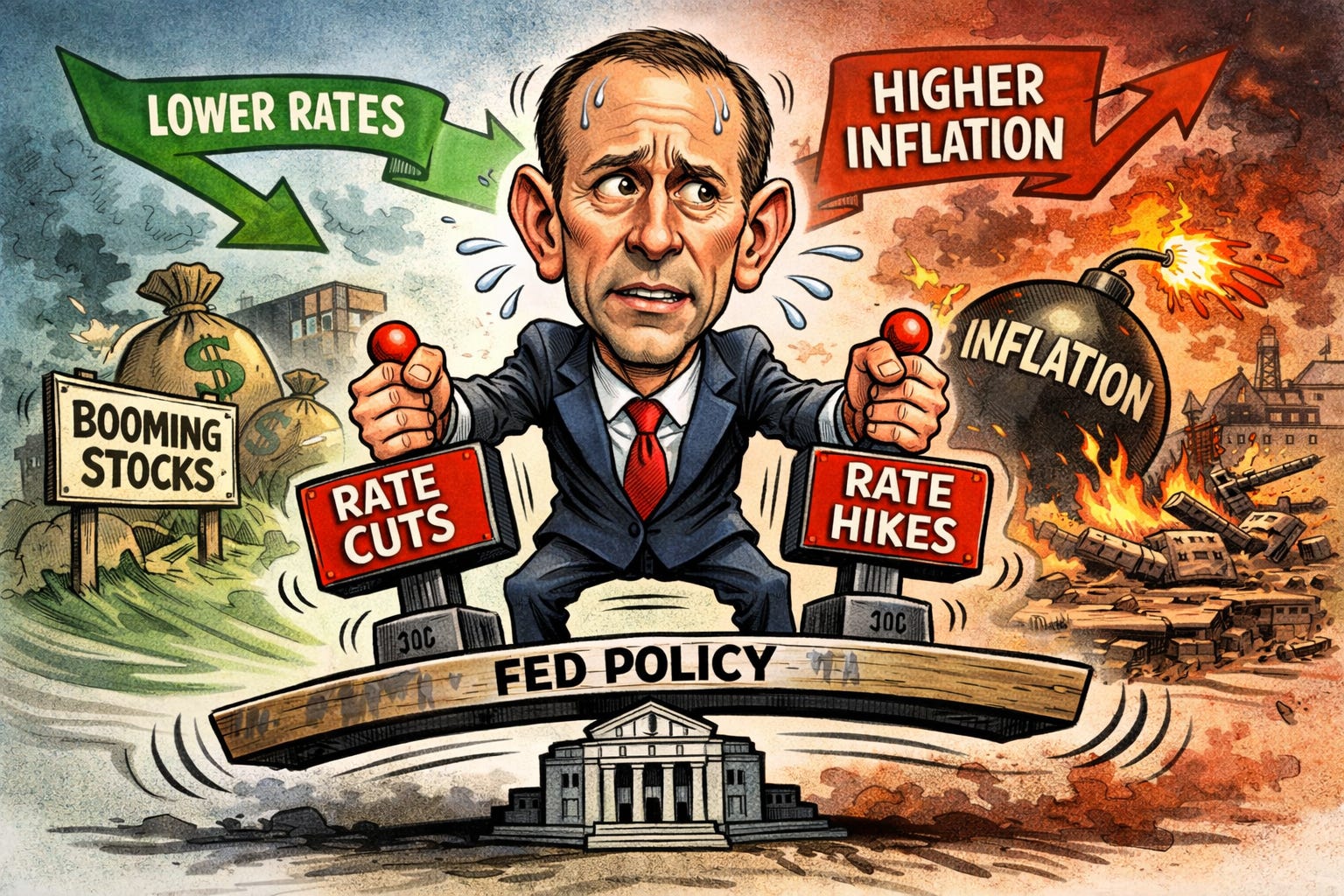
Chicago Federal Reserve President Austan Goolsbee told CNBC yesterday that the central bank could either resume cutting rates or start raising them, depending entirely on how the war in the Middle East shapes inflation. “I could see circumstances where we would need to raise rates if it was going a different way, and inflation was getting out of control,” Goolsbee said, adding that he wanted to avoid repeating “the team-transitory mistake” of 2021, when the Fed badly underestimated inflation’s persistence. He said inflation now ranks above employment as his top policy priority, a striking comment from a traditionally dovish Fed official (Bloomberg).
The Fed held rates at 3.50%-3.75% at last week’s meeting, the second consecutive hold after three cuts late last year. Core Personal Consumption Expenditures (PCE) inflation, the Fed’s preferred measure, is running at 3.1%, well above the 2% target. Seven of 19 Federal Open Market Committee (FOMC) participants now expect no cuts at all this year, up from six in December. Federal funds futures now price a roughly 30% probability of a rate hike by year-end, a figure that was essentially zero a month ago. Goolsbee is not a voting FOMC member in 2026, but his shift in tone reflects a broader internal debate. Ed Yardeni of Yardeni Research raised his stagflation probability to 35%, up from 20%, while Goldman Sachs still sees room for two “normalisation” cuts if the conflict resolves quickly (CNBC).
Sensei’s Insight: The Atlanta Fed’s Market Probability Tracker now shows rate hike odds (roughly 15%) nearly matching rate cut odds (roughly 16%) within three months. That symmetry has not existed since mid-2023. For retail investors, the practical implication is clear: any position built on the assumption of imminent rate relief, from high-multiple growth stocks to leveraged real estate, needs re-examining.
🇯🇵 Berkshire Hathaway Takes $1.8 Billion Stake in Tokio Marine
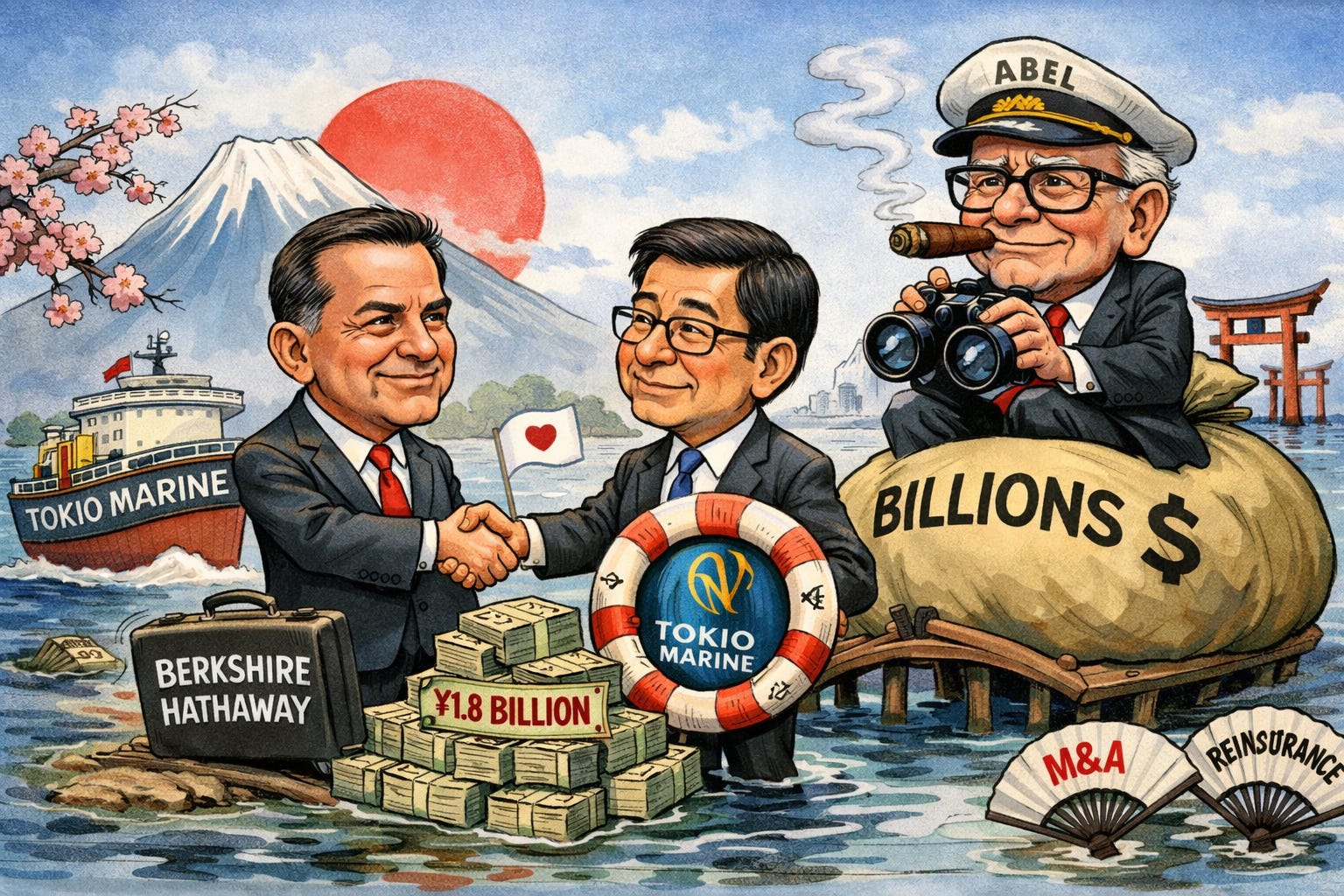
Berkshire Hathaway’s reinsurance subsidiary National Indemnity Company announced yesterday that it will acquire a 2.49% stake in Tokio Marine Holdings, Japan’s largest property-casualty insurer, for approximately $1.8 billion. The two firms will collaborate on reinsurance and pursue joint mergers and acquisitions under a 10-year strategic partnership, with a standstill agreement capping Berkshire’s stake at 9.9% without board approval. To fund the deal, Tokio Marine will sell roughly 48.2 million treasury shares to Berkshire and simultaneously buy back an equal dollar amount to prevent dilution for existing shareholders (Bloomberg).
This is the first major international deal under CEO Greg Abel, who succeeded Warren Buffett on January 1. Berkshire’s Japan thesis has already paid off spectacularly: its roughly 10% stakes in five Japanese trading houses, Itochu, Marubeni, Mitsubishi, Mitsui, and Sumitomo, are now worth $35.4 billion, more than double what the conglomerate paid. Abel wrote in his February shareholder letter that Japan investments are “comparable to our major U.S. holdings in importance.” With Berkshire sitting on a $373 billion-plus cash pile, the Tokio Marine deal signals that Abel intends to deploy capital independently and at scale. The reinsurance partnership is particularly timely as global catastrophe losses intensify and demand for underwriting capacity grows (AP).
Sensei’s Insight: The structure tells the story. Abel didn’t buy a controlling stake; he bought a collaborative partnership with a 10-year horizon. This is Berkshire positioning itself as the reinsurer of last resort for Asia-Pacific catastrophe risk at a time when climate-driven losses are repricing the entire insurance sector. Watch whether Abel moves next on an Australian or Southeast Asian insurer to complete the regional build-out.
🧊 Ecolab Bets $4.75 Billion on AI Data Centre Cooling
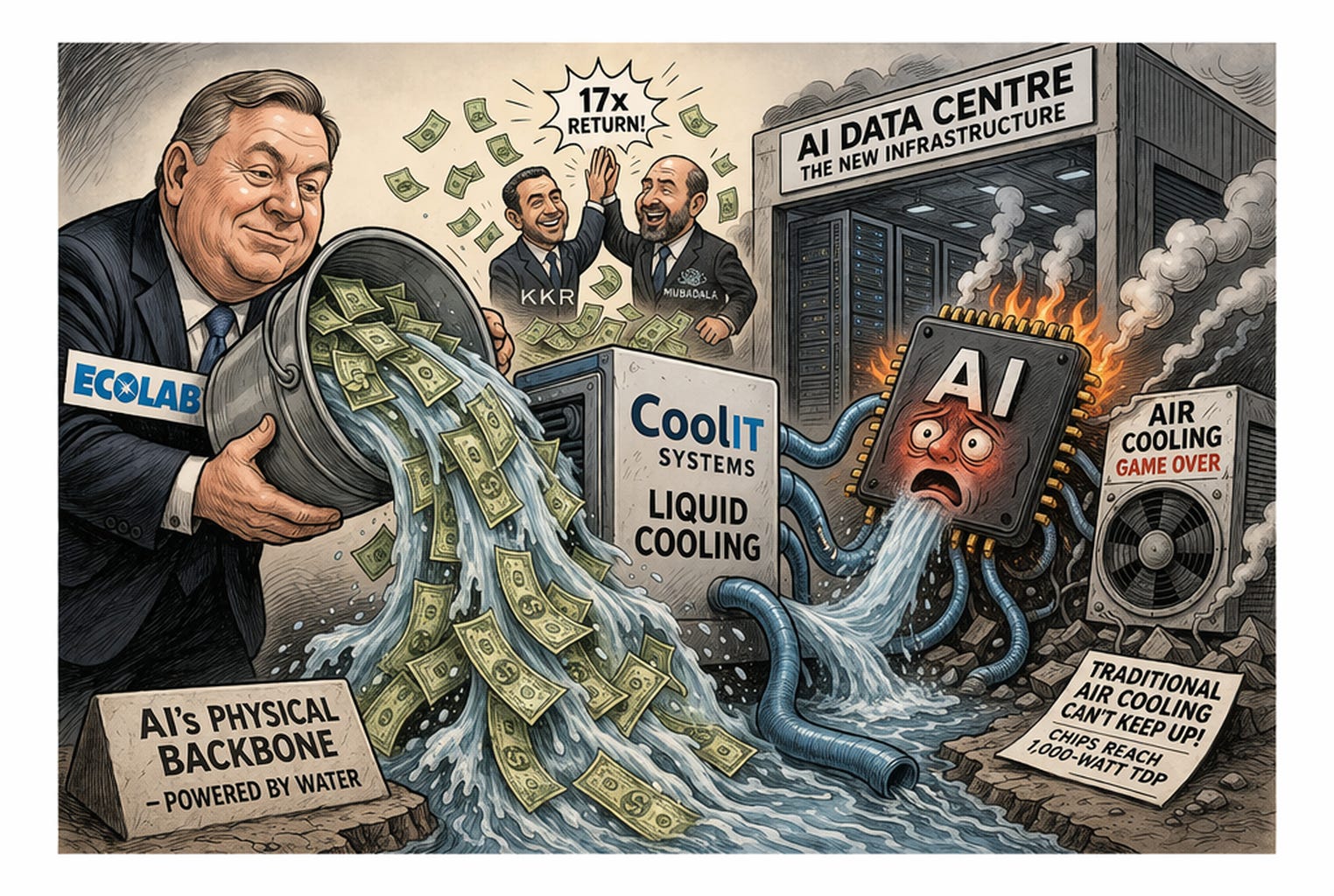
Ecolab, the century-old water treatment and hygiene giant, announced a $4.75 billion all-cash acquisition of CoolIT Systems, a Calgary-based data centre liquid cooling company currently owned by KKR and Mubadala. As artificial intelligence chips approach 1,000-watt thermal design power, traditional air cooling is failing, and liquid cooling is becoming mission-critical infrastructure. CoolIT designs and manufactures direct-to-chip cooling systems used by hyperscale operators including partnerships with Nvidia and AMD. The company is expected to generate approximately $550 million in sales over the next 12 months (Yahoo Finance).
The deal values CoolIT at roughly 29 times forward adjusted operating earnings and will not be accretive to Ecolab’s earnings per share (EPS) until 2028, which partly explains the stock’s initial 3% dip. KKR’s return is remarkable: the private equity firm invested roughly $270 million in early 2023, yielding an estimated 17 times return in under three years. Ecolab CEO Christophe Beck framed the acquisition as a bet on the physical backbone of AI: “Liquid cooling is one of the critical technologies that makes advanced computing possible.” The deal doubles Ecolab’s addressable high-tech market to roughly $10 billion and puts it in direct competition with Vertiv and Schneider Electric in the data centre cooling space (Star Tribune).
Sensei’s Insight: This is the clearest sign yet that the AI trade is migrating from semiconductor stocks into industrial plumbing. Ecolab is a water company buying a cooling company because AI’s real bottleneck is no longer chips but thermals. Investors focused on pure-play AI names may be missing the picks-and-shovels opportunity opening up in facilities management and thermal engineering.
🍦 Ben & Jerry’s Foundation Sues Magnum Ice Cream
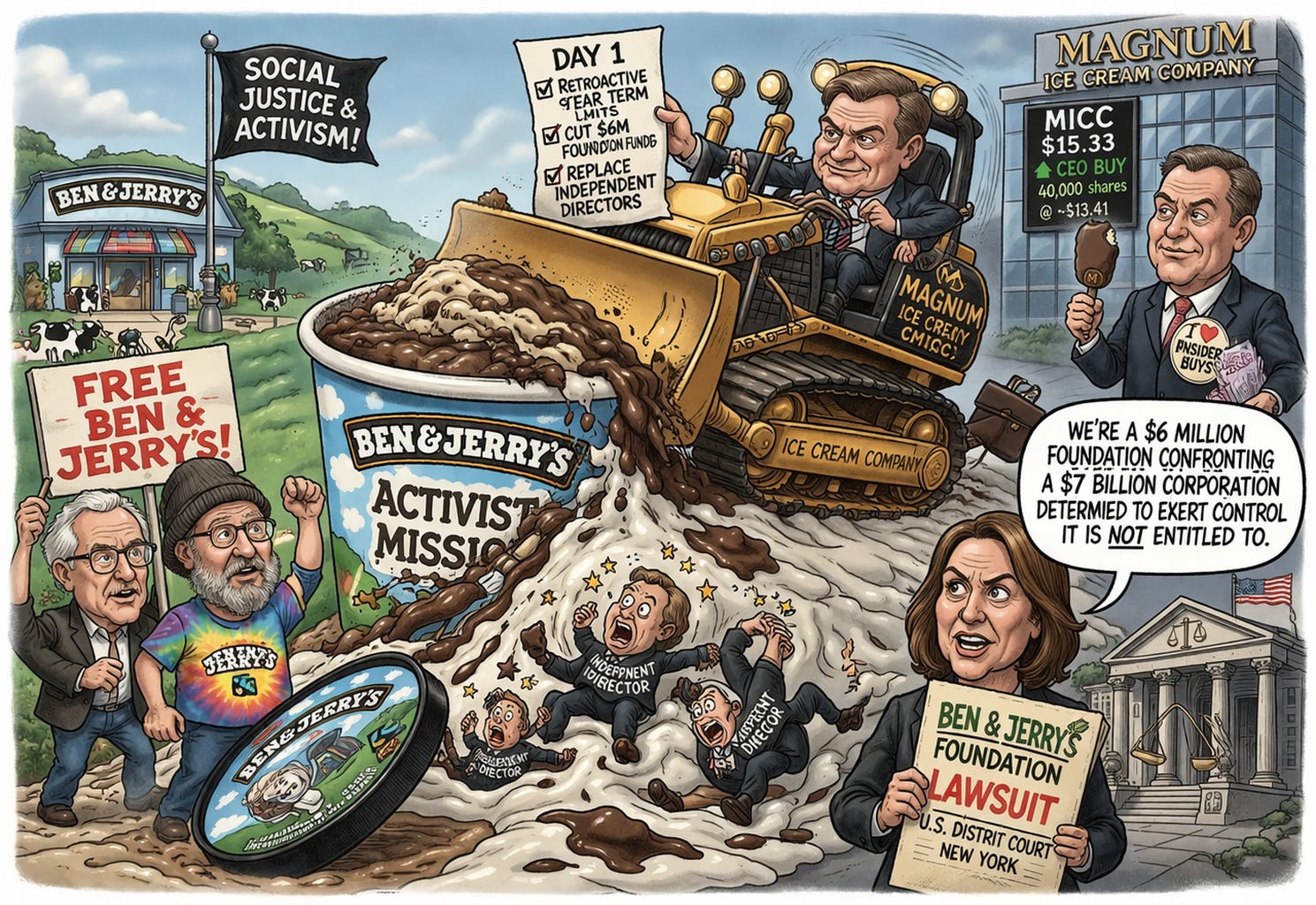
When Unilever bought Ben & Jerry’s for $326 million in 2000, the deal came with strings attached: an independent board would protect the brand’s activist identity, and at least 7.5% of annual profits would flow to the Ben & Jerry’s Foundation for social justice grants. Those protections survived for 25 years. Then Unilever spun off its entire ice cream business into a new publicly traded company called The Magnum Ice Cream Company (MICC) in December 2025, and within one week, Magnum moved to dismantle them. It retroactively imposed nine-year term limits to remove three independent board members, cut the Foundation’s roughly $6 million in annual funding, and by January 1, every independent director was gone. Yesterday a federal court in New York granted the Foundation permission to formally join the existing lawsuit filed by those ousted directors (Vermont Business Magazine).
The fight matters beyond ice cream. Ben & Jerry’s is the leading ice cream brand in America with $951 million in U.S. sales in 2023, contributing roughly 14% of MICC’s total revenue. Co-founder Ben Cohen has been running a public “Free Ben & Jerry’s” campaign since September, lobbying for the brand to be sold to socially aligned investors. Magnum has flatly refused. Foundation president Liz Bankowski framed the stakes plainly: “We are a $6 million foundation confronting a $7 billion corporation determined to exert control it is not entitled to.” MICC shares trade at $15.33, and notably, CEO Peter ter Kulve bought 40,000 shares at roughly $13.41 last week, spending over half a million euros of his own money (Boston Globe).
Sensei’s Insight: That insider buy signals management confidence that the legal fight is manageable. But the real investor risk is not this lawsuit. It is the precedent. If Magnum loses, every future acquirer of a “mission-driven” brand will face harder questions about what independence guarantees actually survive a corporate restructuring. For MICC shareholders, the outcome could either unlock the stock’s 32% discount to intrinsic value or entrench the governance overhang for years.
🔗 Connect with Us
Stay plugged in across platforms:
Sensei on X: sensei_live_
Martyn Lucas on X: MartynInvestor
Vaz on X: eVTOLHUB
📺 YouTube Channel (Live & Replays): Martyn Lucas Investor

🔍Deep Dive: The $580 Million Bet: Inside the Trade That Hit 15 Minutes Before Trump’s Iran Post