

This content is for informational and educational purposes only and does not constitute financial advice. Always do your own research. Not financial advice (NFA).
👀 Today’s Stories at a Glance
🖥️ Huang is back at Nvidia: The board reinstated him 6 days after saying it would not, and the shares jumped 31.48%, adding nearly $1 trillion.
📈 Best day since April 2025: The S&P 500 rose 4.73% and the Nasdaq 6.51%, and traders now give a Fed rise about 95%.
🔐 CrowdStrike buys Zscaler: A $43.9 billion all-stock deal, and CrowdStrike’s 8.9% fall cut what Zscaler holders actually get.
💊 Sanofi buys Insmed: $175 a share in cash, about $41 billion, a 46% premium for the maker of the lung drug Brinsupri.
🤖 Anthropic options open quietly: Volume fell well short of Cboe’s 2 million forecast, and the shares slipped below the $83 IPO price before the bell.
🌏 Taiwan jumps 9%: Asia’s chip markets snapped back today, with TSMC and Foxconn near their 10% daily limits.
🖨️ HPE slips as Dell waits: HPE raised its growth forecast to as much as 35% and was still down about 10% before the bell.
🚫 US blacklists an Alibaba unit: Commerce added Megaspeed and Alibaba’s Singapore arm to its Entity List over suspected Nvidia chip diversion.
🛢️ Oil at a 3-month low: Brent closed at $89.37 yesterday, its lowest since 31 August, despite Iran’s claim that 3 tankers hit mines.
📈 Oil sits on $79 support: Chart of the Day covers the $79 line, the $80 inflation marker and a possible bounce to $90.
🧠 One Big Thing
One board vote moved the whole market. Nvidia brought Jensen Huang back yesterday, its shares rose 31.48%, and the S&P 500 had its best day since April 2025. The rate outlook went the other way. Traders now give a quarter-point rise on 9 December about a 95% chance, up from 89% on Friday, because a rally like that loosens the conditions the Fed is trying to tighten. Tomorrow’s PCE inflation report, at 1:30pm UK, 8:30am in New York, is the last big number before that decision.
⚖️ Fear & Greed
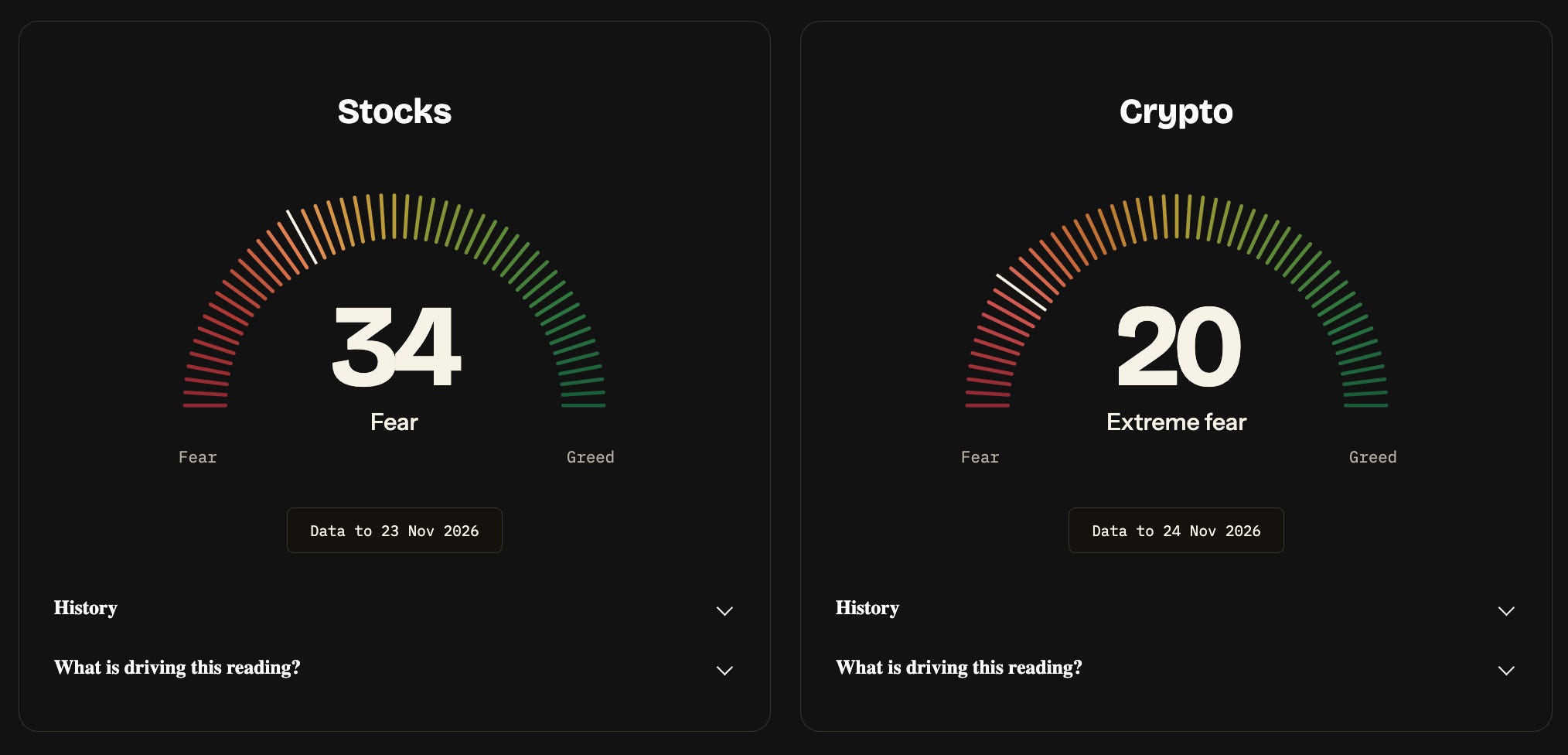
📉 The Number That Matters
6 days
On 17 November Nvidia’s board said it did not intend to reinstate Jensen Huang. 6 days later it voted unanimously to bring him back, and the shares rose 31.48%.
✅ 5 Things to Know
🖥️ Nvidia brings Huang back and adds nearly $1 trillion
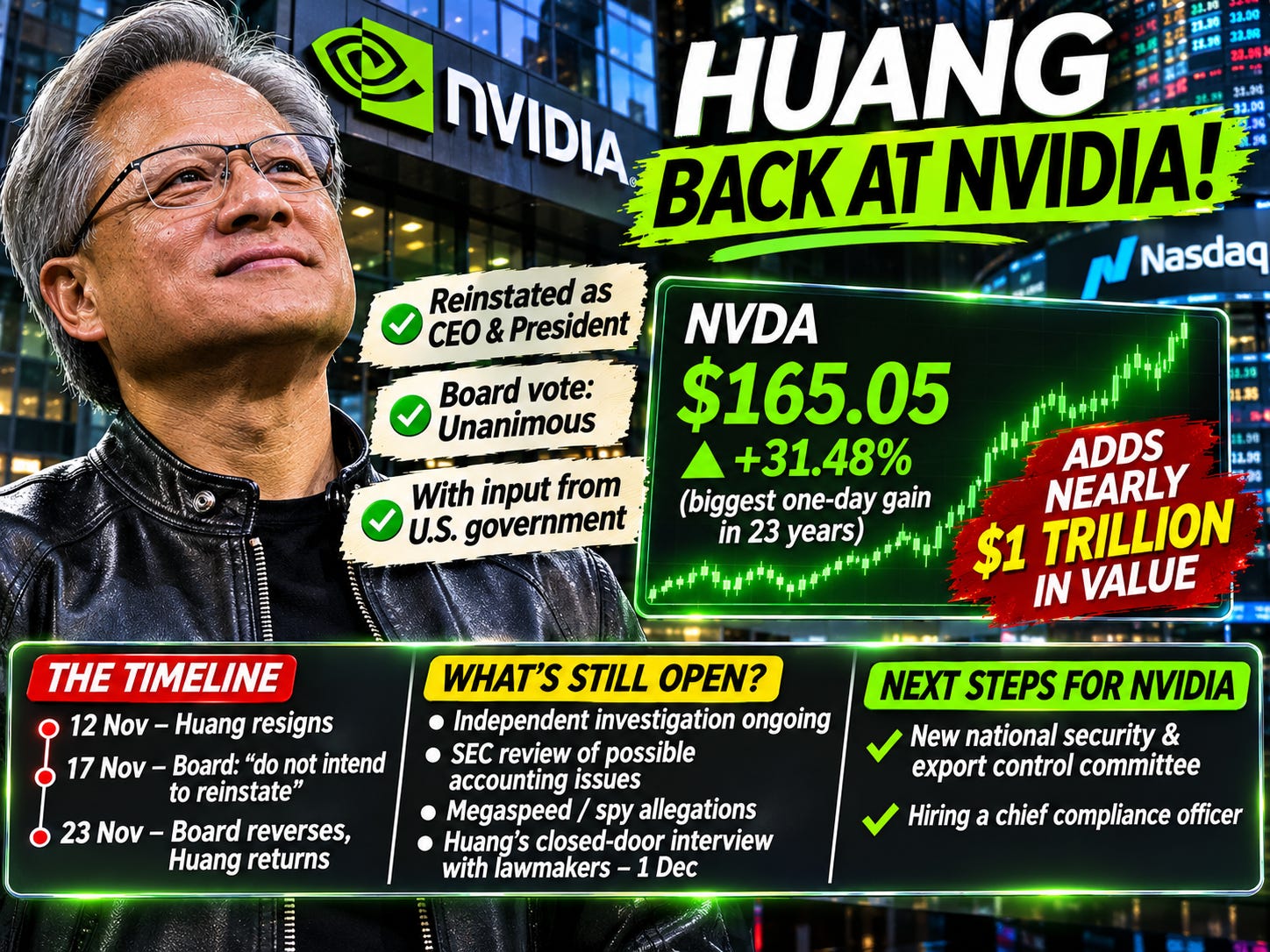
Nvidia’s board voted unanimously yesterday to reinstate Jensen Huang as president, chief executive and board director, effective immediately. The board said it had received “input from senior levels of the United States government” and is “confident that Mr. Huang’s reinstatement poses no national security risk.” Colette Kress goes back to being chief financial officer. Harvey Jones stays as chair. The shares rose 31.48% to $165.05, their biggest one-day gain in 23 years, which added nearly $1 trillion of market value. Nvidia
What changed in 6 days? On the 17 November earnings call, the board said it did “not intend to reinstate” Huang. He had resigned on 12 November after reports of an affair with Alice Huang, a former Megaspeed executive. US authorities suspect her of being a Chinese spy, and China calls the accusation groundless. Donald Trump pushed for Huang’s return in public and told CNBC he spoke with the board “directly and indirectly.” Morningstar’s Lindsey Stewart said the return was “almost as big a shock as his departure.” ABC News
So is the matter closed? No. The board says its independent committee’s investigation “will proceed to conclusion.” Huang sits for a closed-door interview with lawmakers on Tuesday 1 December. Reuters reported on Friday that SEC enforcement staff are examining possible accounting issues at Nvidia. The board has also set up a new national security and export control committee and is hiring a chief compliance officer. Yesterday’s gain priced out the risk of an Nvidia without Huang. The legal questions are still open. The shares were down nearly 4% before the bell this morning, with chip stocks giving back part of yesterday’s jump.
Sensei’s Insight: The board’s no became a unanimous yes in 6 days, with Washington’s input. That bought back nearly $1 trillion in one session. It settled nothing on the SEC, Megaspeed or the investigation. I’m watching Huang’s closed-door interview on 1 December, and whether yesterday’s gain holds into it.
📈 Wall Street’s best day since April 2025 brings Fed bets back
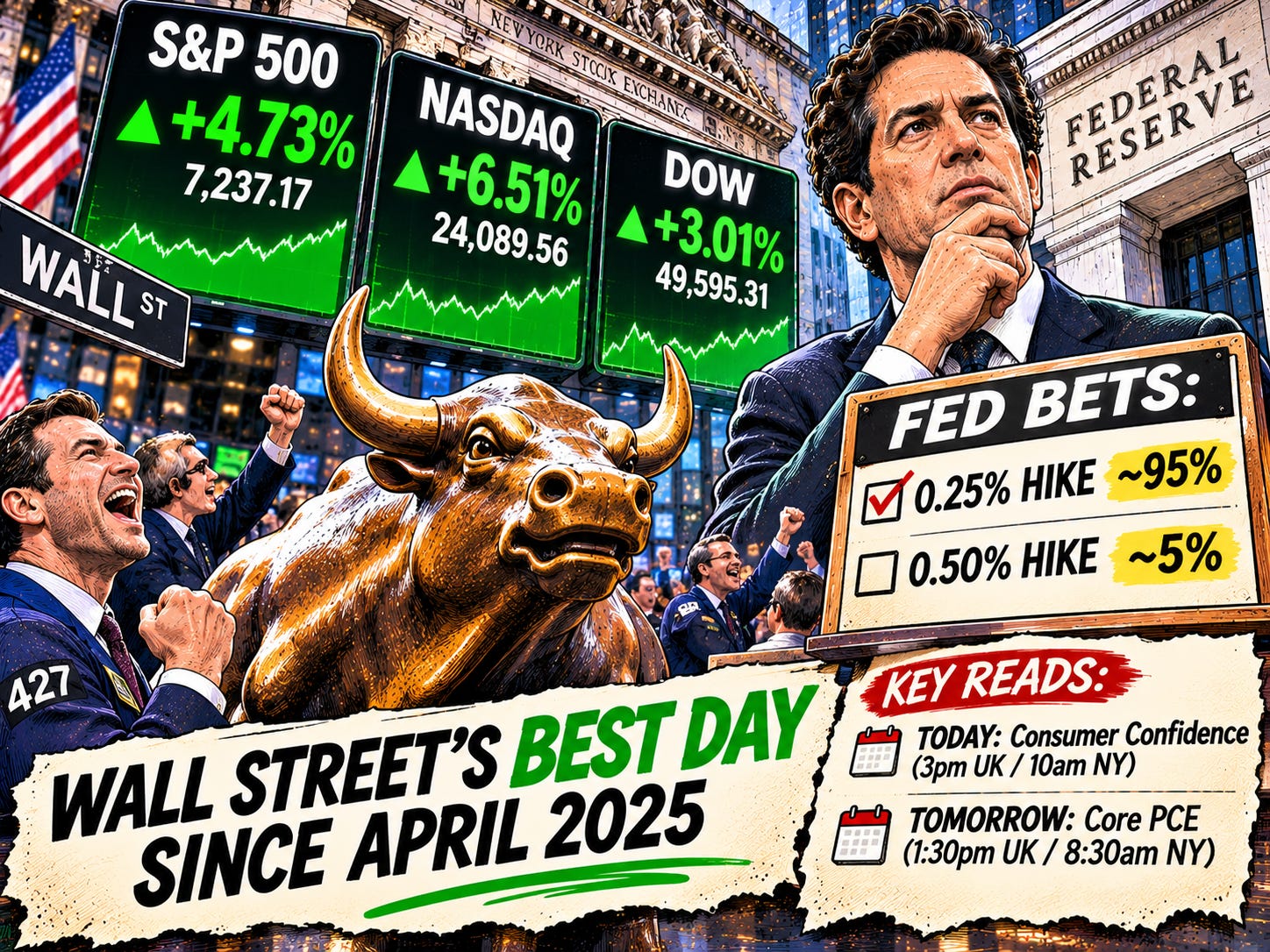
4.73%. That was the S&P 500’s gain yesterday, its best day since April 2025, to 7,237.17. The Nasdaq Composite rose 6.51% to 24,089.56 and the Dow added 1,447.98 points, or 3.01%, to 49,595.31. Technology stocks rose 8.97% as a group. Energy was the weakest sector, down 1.06%. The VIX, Wall Street’s fear gauge, fell 25.83% to 26.62. The S&P 500 now sits 7.4% below its 6 October record, which takes it back out of correction territory. This morning S&P 500 futures were slightly lower and Nasdaq futures were down about 0.9%.
Why would a rally matter to the Fed? Because higher share prices make households feel richer and make it cheaper for companies to raise money. The Fed calls that financial conditions, and loose conditions are what a rate rise is meant to cool. Scott Bessent spent Sunday warning the Fed about tight conditions. One day later they were looser. Traders now give a quarter-point rise on 9 December about a 95% chance, up from 89% on Friday. The half-point bet, which sat at 0% yesterday morning, is back near 5%. New York Fed president John Williams said yesterday that persistently high inflation points towards tighter policy, Reuters reported.
Was it a broad rally? Partly. 417 of the S&P 500’s 500 stocks rose. The equal-weight S&P 500, which gives every company the same say, rose only 2.59%, about half the index’s gain. The main index is weighted by size, so Nvidia and the other chip giants carried it. The tests come quickly. The Conference Board’s consumer confidence survey lands today at 3pm UK, 10am in New York, with 92.1 forecast after 91.7. Tomorrow brings October’s PCE inflation report at 1:30pm UK, 8:30am in New York, with core PCE forecast at 3.2%. US markets are shut on Thursday for Thanksgiving.
Sensei’s Insight: One session took the S&P 500 out of correction territory. It also made the Fed’s job easier, because a rally is exactly the kind of loosening a rate rise is meant to cool. A quarter-point rise on 9 December looks close to settled. I’m watching core PCE tomorrow against 3.2%.
🔐 CrowdStrike buys Zscaler, and its own shares pay for it
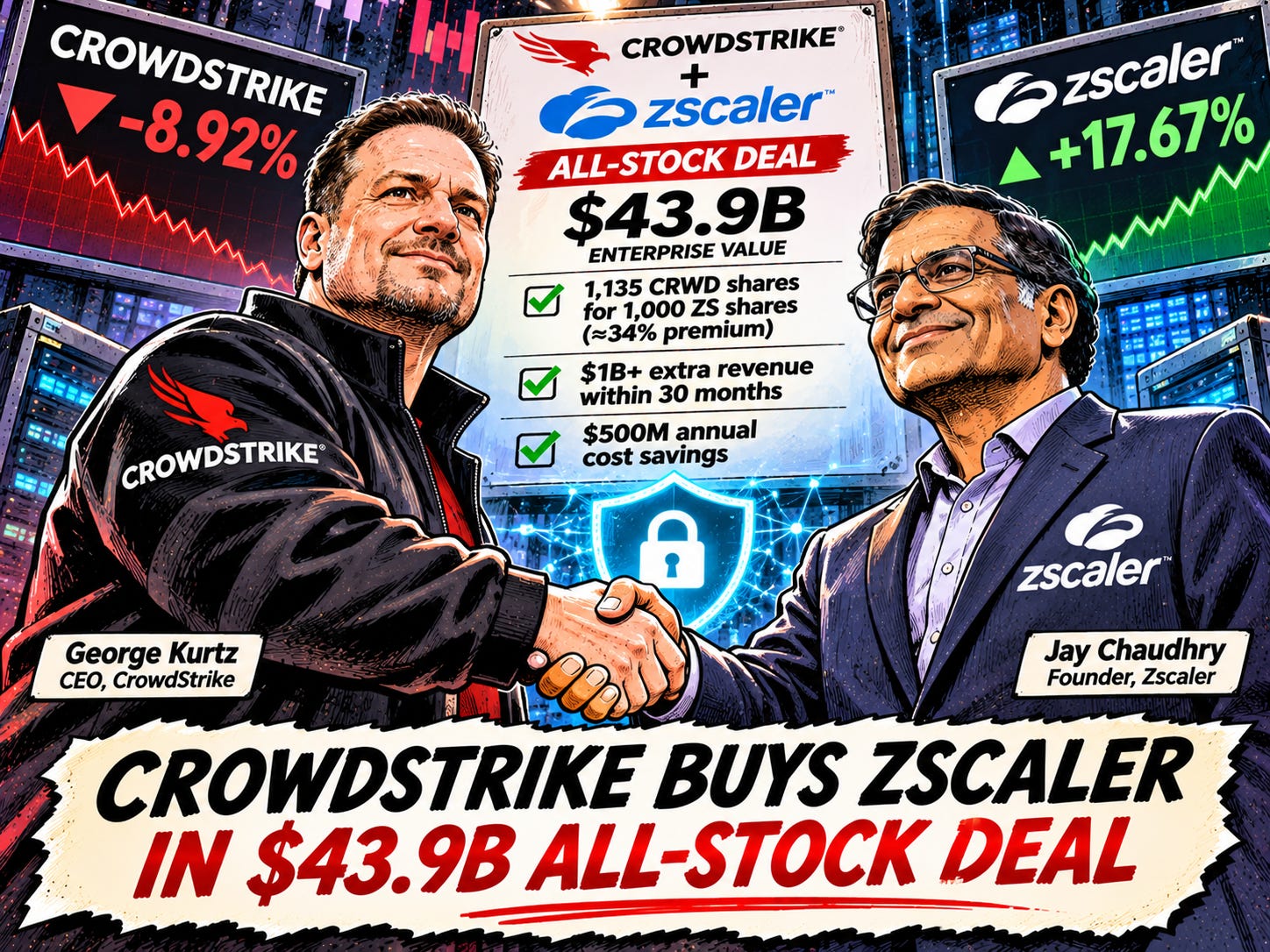
“Security used to be about keeping the adversary out,” said George Kurtz, CrowdStrike’s founder and chief executive, in the deal announcement. CrowdStrike agreed yesterday to buy Zscaler in an all-stock deal with an enterprise value of about $43.9 billion. Zscaler holders get 1,135 CrowdStrike shares for every 1,000 Zscaler shares they own. That was worth $260.41 at Friday’s close, a 34% premium. CrowdStrike holders will own about 84.1% of the combined company. Zscaler founder Jay Chaudhry joins CrowdStrike’s board, and he and his affiliates, with about 34% of Zscaler, agreed to vote for the deal. CrowdStrike
The market took the price down on the day. CrowdStrike fell 8.92% and Zscaler rose 17.67%. Because the payment is in CrowdStrike shares, every dollar off CrowdStrike comes off the offer too. At 3:30pm New York time, with CrowdStrike at $207.45, the offer was worth about $235.45, roughly $25 below the headline, the Motley Fool calculated. Zscaler traded at $227.45 at that point. The companies are targeting about $1 billion a year of extra revenue within 30 months and $500 million of annual cost savings.
Why does Zscaler trade below the offer? Because the deal is roughly a year away and could still fail. That gap is called the spread. It is the discount the market asks for waiting and for the risk that regulators block it. Zscaler shareholders and antitrust regulators still have to approve. The deal is expected to close in the second half of CrowdStrike’s 2028 financial year, which runs from August 2027 to January 2028. Either side can walk away if it has not closed by 23 November 2027, or by 23 February 2028 if only regulatory reviews remain. Zscaler would owe a $1.4 billion fee if it left for a better offer.
Sensei’s Insight: Yesterday’s issue had these as talks. Now it is a deal paid in CrowdStrike shares, and the market took about 9% off CrowdStrike on the day. I’m watching the gap between Zscaler’s price and what the CrowdStrike shares on offer are worth, because that gap is the market’s read on whether regulators let it close.
💊 Sanofi pays $41 billion in cash for Insmed
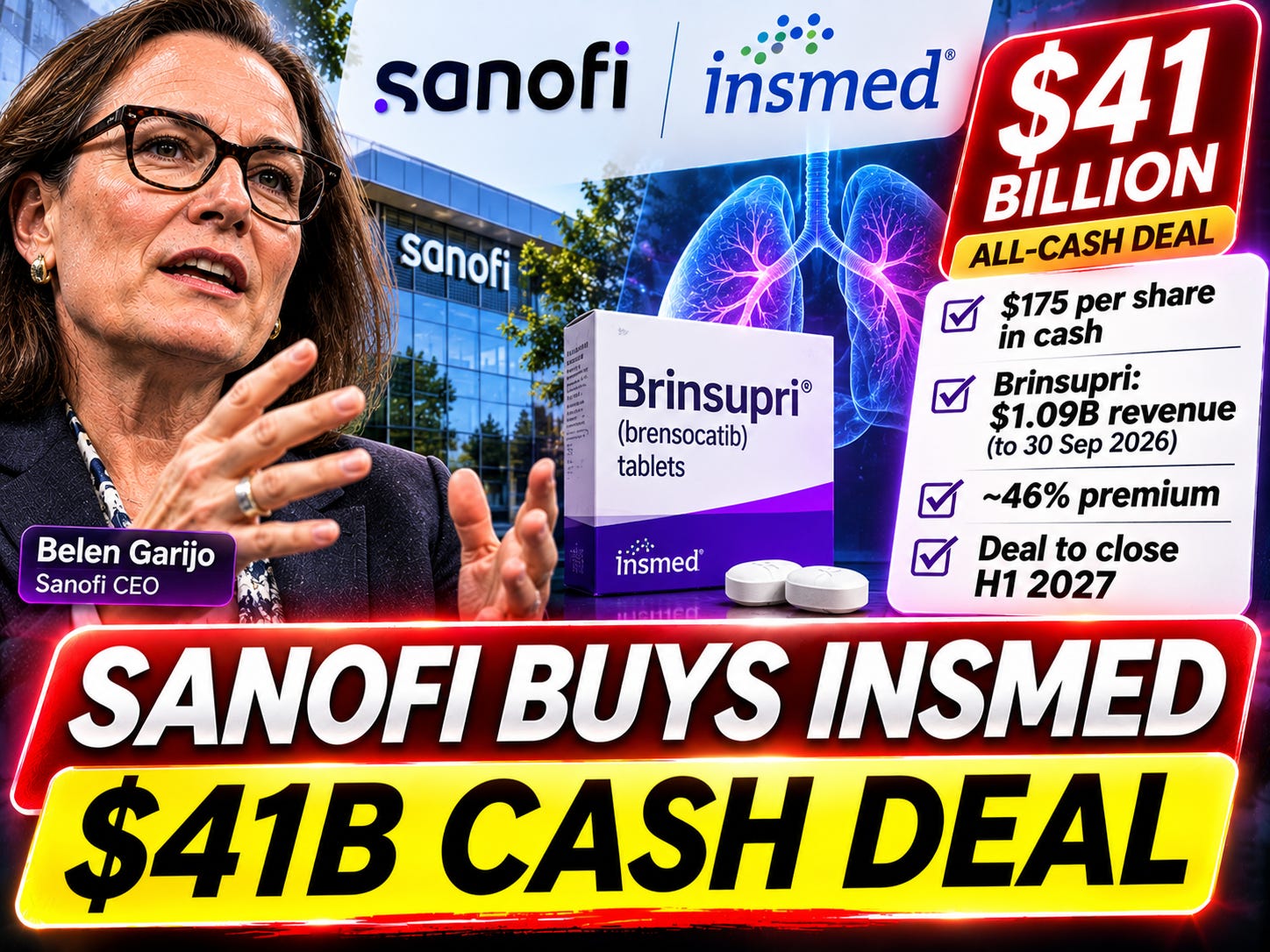
$175 a share, in cash. Sanofi agreed this morning to buy US drugmaker Insmed at that price, valuing it at about $41 billion. Sanofi will pay with new debt and cash on hand, and the financing is already committed. It expects the deal to close in the first half of 2027 and to add to earnings per share by the end of 2028. It says its 2026 guidance is unchanged. Belen Garijo, Sanofi’s chief executive, said she is “delighted to welcome Insmed to Sanofi.” Sanofi
What is Sanofi buying? Mainly Brinsupri, a once-a-day pill for bronchiectasis, a long-term lung condition in which the airways are permanently widened and clog with mucus. It is approved in the US, the EU, the UK and Japan, launched in the US in August 2025, and had brought in $1.09 billion of revenue by 30 September 2026. Insmed also sells Arikayce, an inhaled antibiotic with $433.8 million of sales in 2025. The price is about 46% above Insmed’s close on 18 November, the day before media reports of a deal, Insmed said. Insmed traded around $174.44 overnight, up about 17%. Sanofi’s US shares were 1.65% lower.
Why pay a 46% premium? Because Dupixent, Sanofi’s biggest drug, is heading towards the end of its patent protection. When a drug’s patents expire, cheaper copies arrive and its sales fall fast. Drugmakers call that the patent cliff, and buying medicines that already sell is the usual way to fill the hole. The payment method matters too. Insmed holders get a fixed $175 in cash, so Insmed trades within about 56 cents of the offer. Zscaler holders get CrowdStrike shares, so their payout moves every day. Insmed shareholders and US regulators still have to approve.
Sensei’s Insight: Sanofi paid a 46% premium in cash to buy sales it can already see, with Brinsupri already past $1 billion of revenue. Insmed now trades about 56 cents under the offer. I’m watching Sanofi’s own share price, because in a cash deal the buyer carries the risk.
🤖 Anthropic options open to brisk trade, well short of a record

About 160,000 Anthropic options contracts traded in the first hour yesterday, and about 270,000 by noon New York time, Reuters reported. Mercury Alerts put the day on track for about 550,000. Cboe had forecast about 2 million, which would have beaten the 1.8 million SpaceX traded when its options launched in June. “Calls and puts traded one for one,” said Mercury Alerts founder Harmeet Goindi, and the options were pricing moves of about 6% a day. Anthropic shares fell 1.43% to $87.64 yesterday. Before the bell this morning they slipped below the $83 IPO price for the first time, as chip and AI stocks gave back part of yesterday’s rally.
The leveraged funds told a similar story. 13 funds from 6 issuers started trading yesterday, built to double Anthropic’s daily move or to profit when it falls. Through late morning, more than twice as many shares changed hands in the funds betting against Anthropic as in those betting on it, Yahoo Finance calculated. “We’re not seeing anything close to the sort of speculation in far upside strikes that we saw in the early days of SpaceX,” Interactive Brokers’ Steve Sosnick told Reuters. Yahoo Finance
What does a 2x fund actually do? It resets every day to twice that day’s move. Say a share falls 10% one day and rises 10% the next. The share ends down 1%. A 2x fund falls 20%, then rises 20%, and ends down 4%. In choppy markets that gap compounds. The 5 SpaceX 2x long funds launched on 15 June have lost roughly 60% to 64%, and SpaceX has not closed above its launch-day record since. Anthropic’s first weekly options expire on Friday 27 November, a short session that ends at 6pm UK, 1pm in New York.
Sensei’s Insight: Yesterday’s issue said Cboe expected a record. It did not come. Calls and puts in balance and busier short funds tell me the crowd is hedging more than chasing. The shares slipped under $83 before the bell. I’m watching whether they hold there into Friday’s first weekly expiry.
Stories You Might Have Missed
🌏 Taiwan jumps 9.1% as Asia’s chip markets snap back
Taiwan’s main index jumped about 9% today, with TSMC and Foxconn close to their 10% daily limits. South Korea’s Kospi was up about 7.5% and Japan’s Nikkei about 4.5% in Asian afternoon trading, with Tokyo back from Monday’s holiday. Seoul had closed down 3.3% yesterday before Nvidia’s news landed. Australia’s ASX 200 closed up 1.8% at 8,726, its first daily gain in nearly 2 weeks, with 176 of its 200 stocks higher. “The scale of this rebound is extraordinary,” Billy Leung of Global X ETFs told ABC News.
🖨️ HPE raises its forecast and slips, with Dell up next
Hewlett Packard Enterprise said after the close yesterday that fourth-quarter revenue rose 50% to $14.55 billion, against $14.47 billion expected. Adjusted earnings were $1.43 a share against $1.26. It now expects revenue to grow 27% to 35% this financial year, up from 13% to 17%. The shares rose more than 17% in regular trading, fell more than 6% after hours and were down about 10% before the bell this morning. HPE expects memory, flash and networking parts to stay tight through the end of 2028. Dell reports after the US close today, with its call at 9:30pm UK, 4:30pm in New York. It guided to $49.0 billion of revenue and $6.50 a share.
🚫 US blacklists Megaspeed and an Alibaba unit
The US Commerce Department added Megaspeed and Apex Enterprise Solutions, Alibaba’s Singapore subsidiary, to its Entity List yesterday, along with 6 other companies from Singapore, Malaysia and Thailand. Megaspeed, an Nvidia partner, has been under US investigation since 2024 over whether it diverted AI chips to China. Apex lent money to Megaspeed through a Malaysian subsidiary in 2024. The listing means US exports to them need a licence, which is likely to be denied. Alibaba called Apex’s listing “erroneous,” Reuters reported, and its shares were about 3% lower before the bell. Commerce had not added anyone to the list since October 2025.
🛢️ Oil sinks to a 3-month low despite mine claims
Brent crude fell 3.46% to $89.37 yesterday, its lowest close since 31 August, and US crude fell 3.88% to $80.17. Brent traded near $88.75 this morning. Both topped $100 in October. Iran’s Revolutionary Guards claimed 3 tankers hit mines in the Strait of Hormuz after breaking Iran’s new rules for crossing it, which has not been independently confirmed. Donald Trump told Fox News of Iran’s talks: “all they do is talk, but it’s all BS.” Suvro Sarkar of DBS Bank told Reuters supply conditions “remain benign.” OPEC+ meets on Sunday 29 November.