

This content is for informational and educational purposes only and does not constitute financial advice. Always do your own research. Not financial advice (NFA).
👀 Today’s Stories at a Glance
🛢️ The sanctions landed, China’s banks did not: Treasury named nearly 60 targets and new sectors, then left the big lever alone.
💾 Nvidia’s servers cost 15% more: memory prices have reached the top of the stack, 1 day before Nvidia reports.
₿ Bitcoin cleared $80,000 overnight: gold is heading for its best month since 1999, and the 30-year has barely moved.
🛒 PDD’s advertising engine has stalled: revenue missed, profit fell 12%, and the ad line grew 3.8% while costs rose 13%.
⚗️ Shell’s chemical plants draw 4 bidders: Exxon is among them, at up to $8bn for plants that cost Shell far more.
📉 Alibaba fell 8% on its own share sale: the $10.2bn Hong Kong placing priced at a discount and closes on Wednesday.
🔗 Apple and Nvidia shares go on-chain: Coinbase launched tokenised versions on Base for round-the-clock trading, closed to American users.
🚗 XPeng’s margin rose, its cars earned less: group gross margin reached 20.7% while vehicle margin fell to 12.1%.
🍁 Carney says Washington wants Canadian industry destroyed: he is still weighing retaliation and still open to talks.
📈 I expect a lower high for BTC: Chart of the Day covers bitcoin’s Deep Trend band, the double top, and my levels below.
🧠 One Big Thing
The thing at the centre of the AI trade just got more expensive to build. Nvidia has told some of its biggest customers that servers built around its chips will cost more than 15% extra from early next year. The reason is memory. It has become one of the largest single line items in an AI server, and the 3 companies that make it are effectively sold out. Every AI story this year has been about demand. This one is about cost, and it arrives 1 day before Nvidia reports its own gross margin.
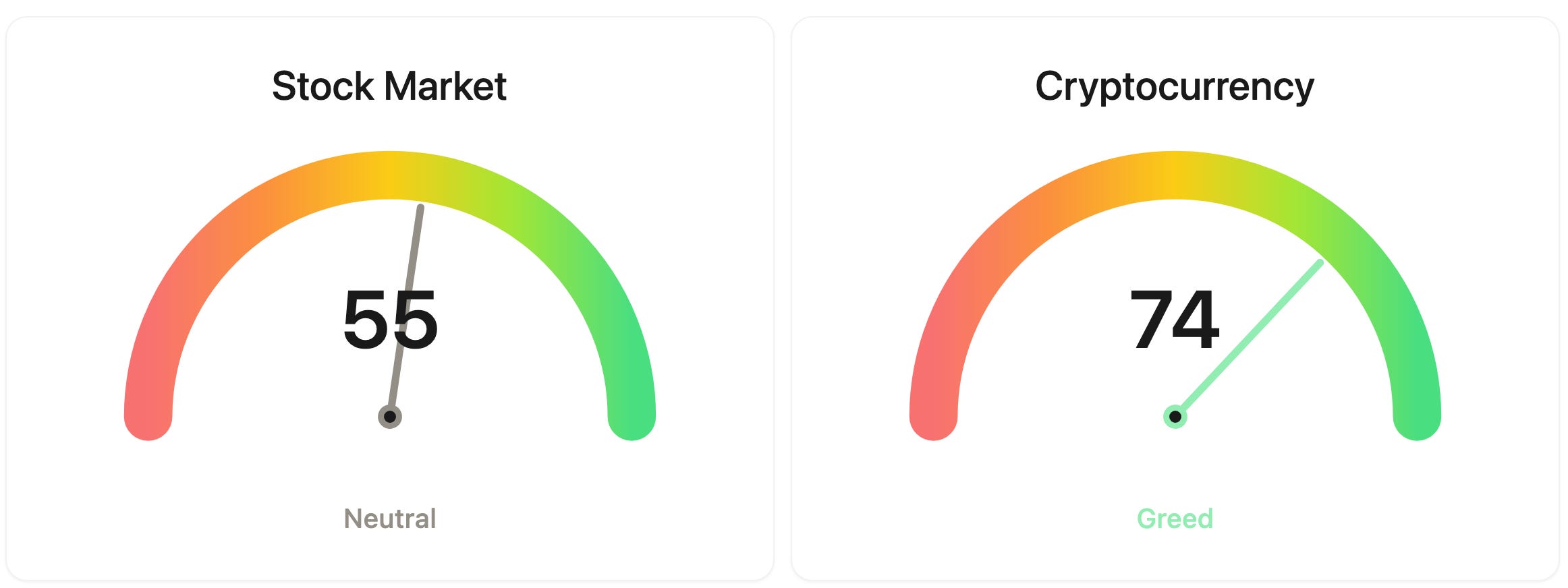
⚖️ Fear & Greed
📉 The Number That Matters
Over 15%
That is the rise Nvidia has told its largest customers to expect on AI server prices from early 2027. Memory costs did it, and Nvidia reports its own margins on Wednesday.
⚔️ Winners vs Losers
Winners
BDRX 0.00%↑ : +24.14% Biodexa Pharmaceuticals plc is squeezing higher on a drastically reduced share count after a 10,000-to-one ordinary share consolidation took effect at the end of July, leaving a thin float that amplifies pre-market moves. The company said last week it had passed the halfway mark in recruitment for its registrational Phase 3 Serenta trial of eRapa in familial adenomatous polyposis.
HVII 0.00%↑ : +21.81% Hennessy Capital Investment Corp. VII is rallying after shareholders met on Monday to vote on its proposed business combination with ONE Nuclear Energy, a developer of gas and advanced nuclear power for data centres that would list the combined company under the ticker ONEN.
BE 0.00%↑ : +7.19% Bloom Energy Corporation is rebounding with the wider onsite power and AI infrastructure trade after shedding roughly 13 percent last week, with buyers stepping back in ahead of Nvidia’s quarterly results on Wednesday.
NBIS 0.00%↑ : +4.69% Nebius Group N.V. is recovering alongside the neocloud group after Monday’s session selloff, having fallen around 20 percent over the past week following the pricing of its upsized 5 billion dollar convertible note offering.
Losers
No major losers so far today.
📊 Market Snapshot
Cryptocurrencies:
Bitcoin (BTC): $79,832 ▲1.08%
Ethereum (ETH): $2,488 ▲0.22%
XRP: $1.49 ▲0.86%
Equity Indices (Futures):
S&P 500: 7,699 ▲0.38%
NASDAQ 100: 29,318 ▲0.73%
FTSE 100: 10,858 ▲0.07%
Commodities & Bonds:
10-Year US Treasury Yield: 4.67% ▼0.55%
Oil (WTI): $82 ▼3.20%
Gold: $4,632 ▼0.40%
Silver: $67.96 ▼1.42%
Data as of: UK: 10:40 BST / US: 05:40 EDT / Asia (Tokyo): 18:40 JST
✅ 5 Things to Know
🛢️ The sanctions landed and China’s banks were spared
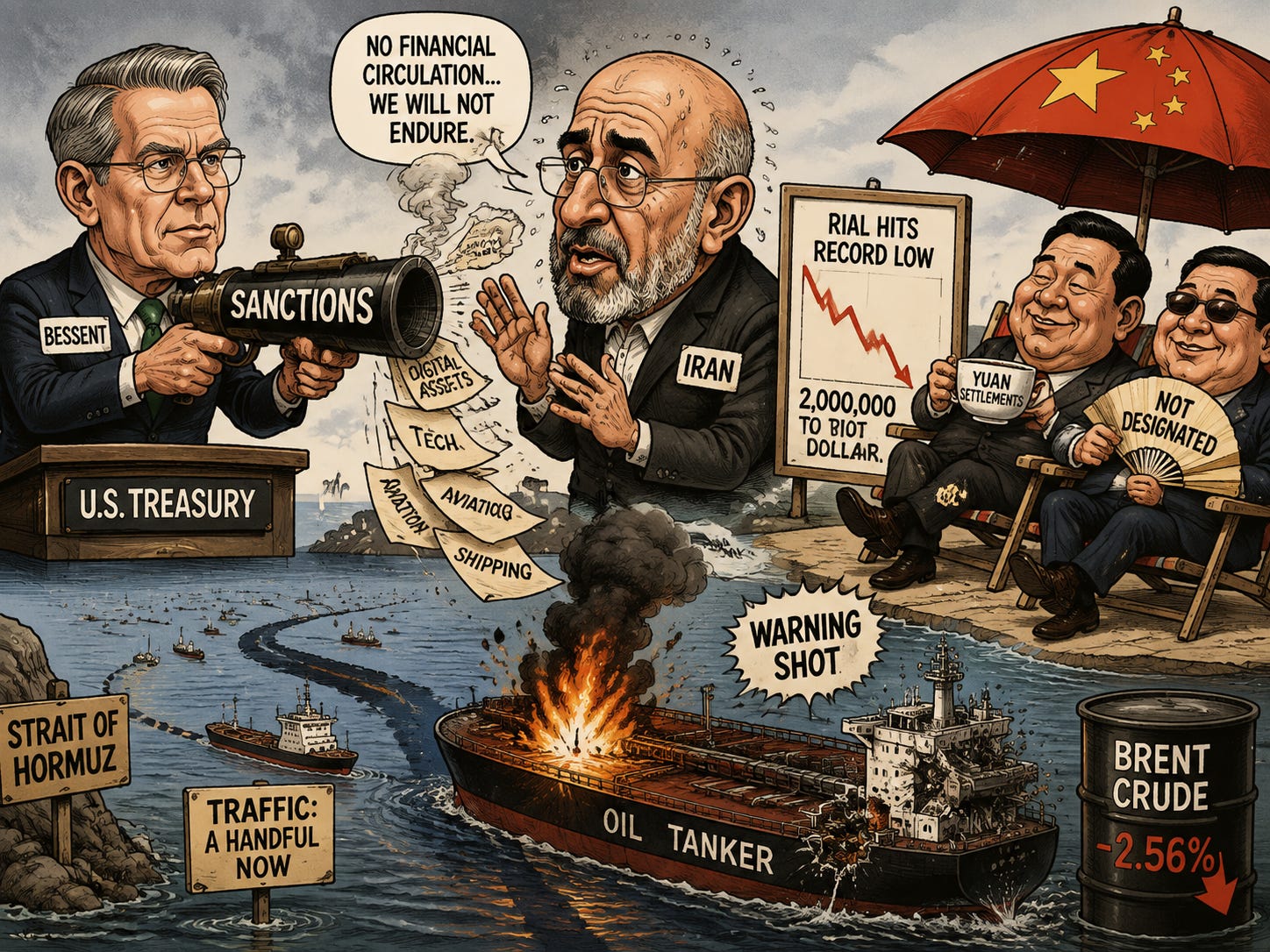
“No matter how much military power we have, if people are hungry and we don’t have financial circulation, economic growth and domestic production, we will not endure.” That is Mohammad Bagher Ghalibaf, speaker of Iran’s parliament and its chief negotiator, talking to businessmen in Baghdad last week. On Monday afternoon in Washington, Scott Bessent gave him more to worry about. The Treasury launched what it calls Operation Economic Outcast, designating nearly 60 individuals, entities and vessels, and opening new sanctions powers over Iran’s digital assets, technology, gold, aviation and shipping. The rial hit a record low of 2 million to the dollar the same day.
Those powers sit on top of ones America already held over Iranian finance, petroleum and petrochemicals, and countries trading with Tehran were given a deadline to stop. The deadline was not published and the countries were not named. China buys more than 80% of Iran’s seaborne oil, and Washington stopped short of designating the large Chinese banks that would settle those purchases. Crude read that omission straight away. Brent fell 2.56% on Monday, a second day down after 2 weeks of gains. Bessent says at least one major financial institution could be designated this week (OilPrice.com).
Then the shooting resumed. An unidentified projectile hit an oil tanker about 9 nautical miles north east of Ash Shishan, Oman, at around 12:25am local time on Tuesday, wrecking the engine room and disabling the vessel. The crew are safe and nobody has claimed it. Hours later the Houthis said they had fired a ballistic missile at a Saudi tanker off Yanbu in the Red Sea. Traffic through the Strait of Hormuz has fallen from about 140 vessels a day to a handful, on the OECD’s own tracking, and US Central Command says its blockade of Iranian ports has redirected 71 commercial vessels since 14 July. Brent still traded below $92 on Tuesday morning (UPI).
Sensei’s Insight: A warning shot is what you fire when you are not ready to fire the real one. The Chinese banks are the lever in this package and they were left alone. A tanker got hit overnight and crude still fell. That tells you what traders think is in this.
💾 Nvidia’s servers get 15% dearer before it reports
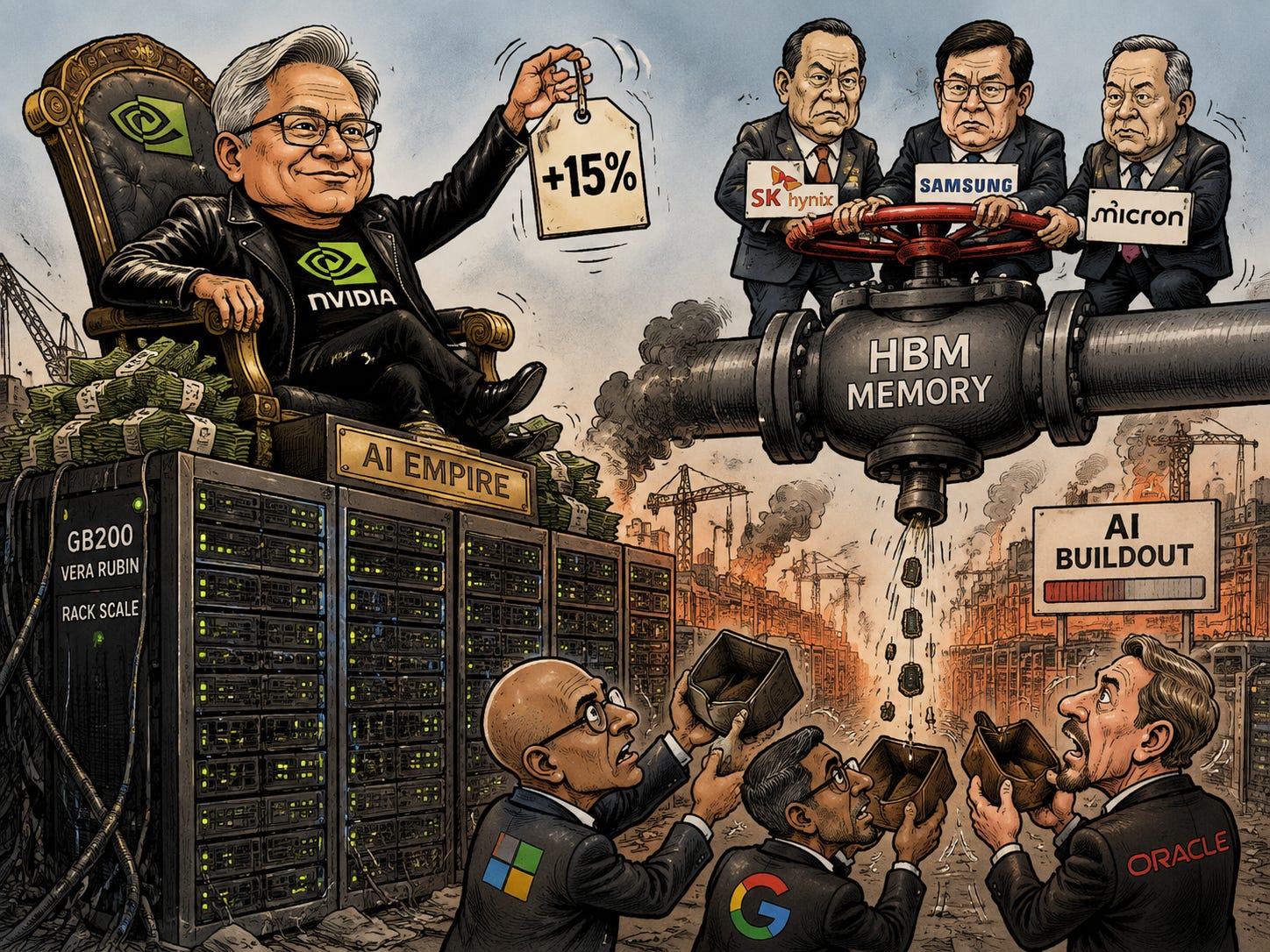
More than 15%. That is the increase Nvidia has told some of its largest customers to expect on servers built around its chips, on Grace Blackwell and Vera Rubin systems shipping from early next year, according to Bloomberg. The size of each rise depends on the chip generation and the memory fitted. Companies that assemble those servers under contract for Microsoft, Google and Oracle have already passed the warning down to their own customers. On a rack-scale system selling for several million dollars, 15% is hundreds of thousands of dollars, across deployments that run to thousands of racks (Tom’s Hardware).
Memory is the reason. Contract prices for ordinary server memory were projected to climb 58% to 63% in the second quarter, after a 90% to 95% jump in the first, because the 3 companies that make it have shifted capacity towards the high-bandwidth memory that AI accelerators need. SK hynix said last October that it had already sold its entire 2026 production. A single Nvidia rack now carries more than 20TB of that memory. Nvidia guides to roughly 75% gross margin and reports on Wednesday after the US close, with the call at 5:00pm Eastern, which is 10:00pm here.
The chip complex sold off into it on Monday.
Micron shed 5.8%, Advanced Micro Devices lost more than 3% and Broadcom more than 2%, while Nvidia itself closed at $208.48, down 2.91% and a seventh straight losing session (CNBC).
Sensei’s Insight: Nvidia is passing a cost on, which tells you it can. That is pricing power and it is worth something. It also tells you the AI buildout now depends on an input nobody can conjure, controlled by 3 companies.
₿ Bitcoin cleared $80,000 and the bond market ignored it
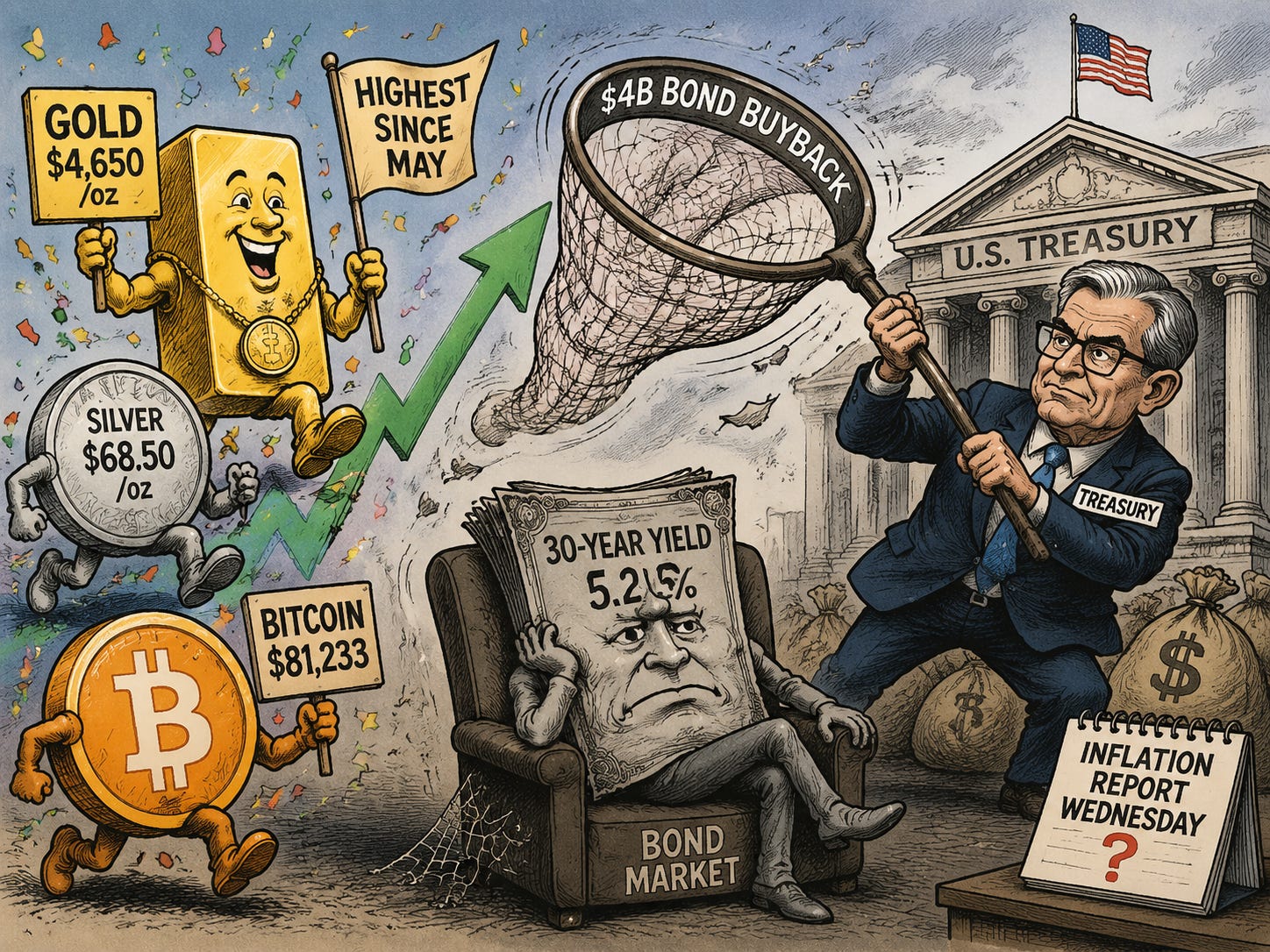
What does a $4 billion bond buyback actually buy? On this evidence, a crypto rally. The Treasury doubled the maximum size of its long-dated buyback operations to at least $4 billion on 19 August, trying to calm a market where 30-year government borrowing costs had reached their highest since 2007. Bitcoin passed $80,000 overnight for the first time since May, reaching $81,233 before easing back under the level, and it is up more than 25% on the week. Gold traded around $4,650 an ounce after touching $4,677.19, its highest since mid-May. Silver sat near $68.50. The 30-year yield is still around 5.25% (CoinDesk).
So 3 hard assets moved and the one thing the policy was aimed at did not. Fabian Dori, chief investment officer at Sygnum, said the buyback is not money printing, because the mechanism sits with the Treasury rather than the central bank balance sheet, and then said this: “managing the cost of US debt has become an active policy priority, and that reignites the currency debasement narrative”. Debasement means letting a currency lose value so that debt gets easier to repay. Gold is up about 14% this month, which UOB says would be its strongest month since September 1999. CoinDesk’s own read has the move running into an overbought signal (CNBC).
Sensei’s Insight: I have watched this trade for a fortnight and the message has not changed. When a Treasury has to step in to hold down its own borrowing costs, gold, silver and bitcoin get bid. That is my read, and Wednesday’s inflation print tests it.
🛒 PDD’s advertising engine has almost stopped growing
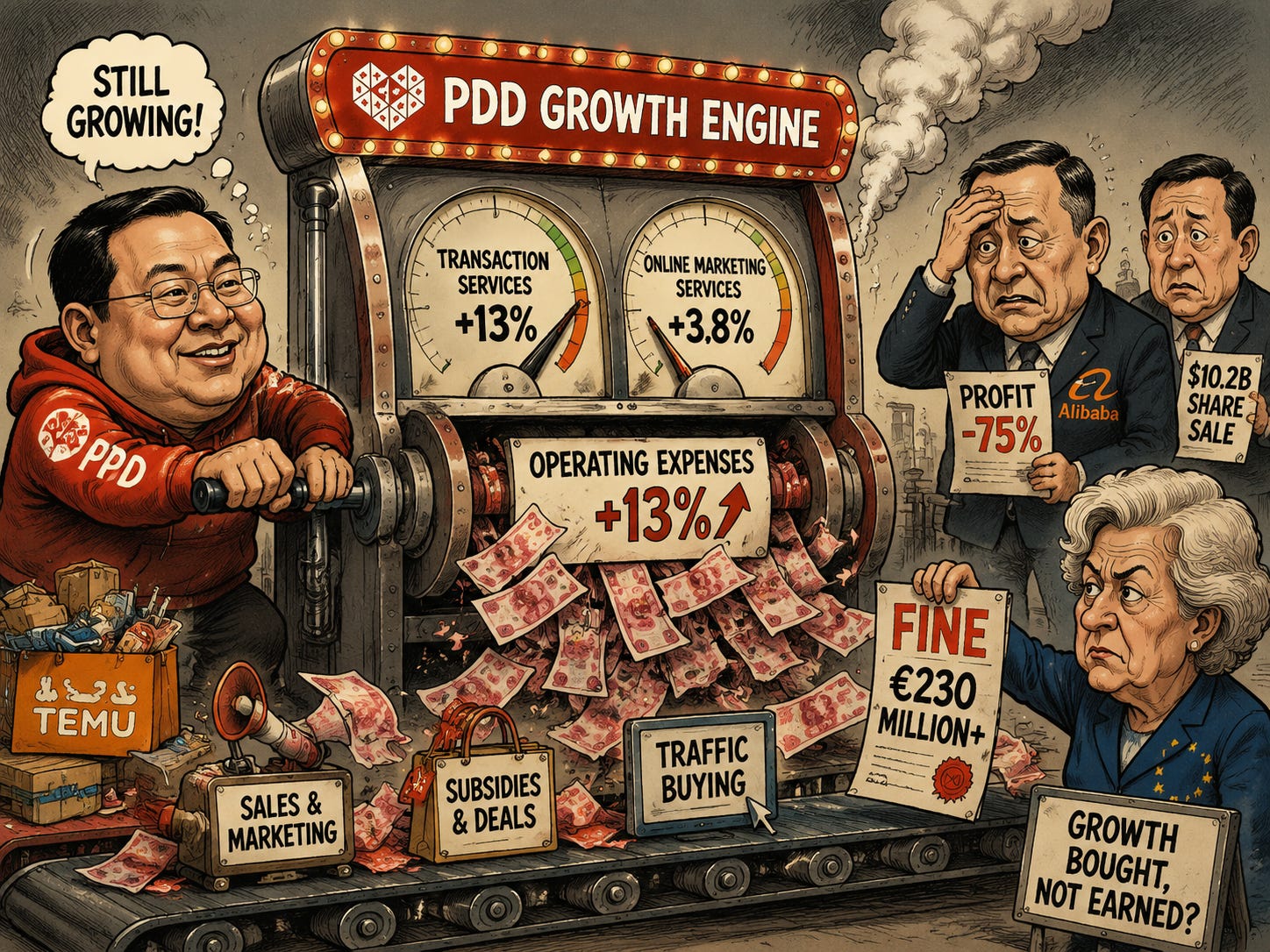
Analysts wanted 115.41 billion yuan of revenue from PDD Holdings. It delivered 112.36 billion, about $16.6 billion, up 8% on the year. That is a miss. Net income came in at 27.18 billion yuan, roughly $4 billion, down 12% on the year and ahead of the 24.4 billion analysts had modelled. Underneath, the 2 halves of the business went in different directions. Transaction services, the fees PDD takes on goods sold across its platforms, rose 13% to 54.7 billion yuan. Online marketing services, the advertising business that built Pinduoduo into a giant, grew 3.8% (BNN Bloomberg).
PDD owns Temu, which is why this print reads across to every Western retailer competing with it on price. Growth is now coming from charging merchants to transact rather than from selling them advertising, and it is being bought with a 13% rise in operating expenses, to 36.58 billion yuan, mostly on sales and marketing. European regulators added a fine of more than $230 million over illegal products appearing on the platform. Alibaba, PDD’s largest rival at home, reported a 75% fall in quarterly profit 5 days ago and is selling $10.2 billion of new shares this week (Yahoo Finance).
Sensei’s Insight: An advertising line growing 3.8% while operating costs grow 13% is a business paying to stand still. Temu is buying its revenue at the moment. Next quarter tells us whether it can charge for the same revenue instead.
⚗️ Shell’s American chemical plants draw 4 bidders
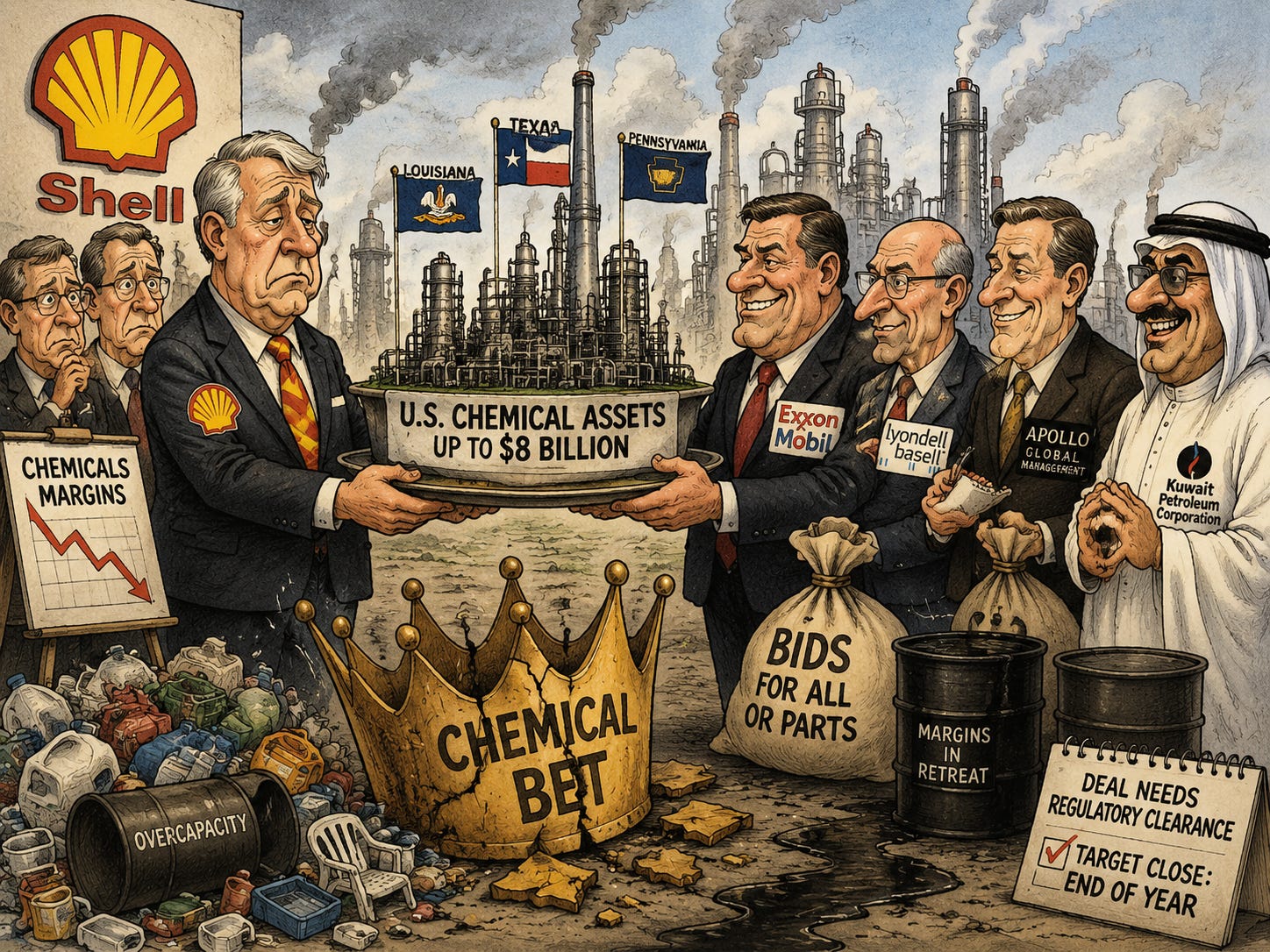
Shell has 4 non-binding offers in front of it for its American chemicals business, and one of them is from Exxon Mobil. LyondellBasell, Apollo Global Management and Kuwait Petroleum Corporation are the others, according to the Financial Times. The assets are 4 plants in Louisiana, Texas and Pennsylvania making the chemicals that go into everything from plastics to detergents. The whole business could fetch up to $8 billion, and the offers range from bids for pieces of it to bids for all of it. Any sale needs regulatory clearance and is expected to complete by the end of this year (OilPrice.com).
That $8 billion sits far below what Shell has put into the plants, on the Financial Times reporting. Petrochemical capacity worldwide has outrun demand for several years and margins have gone with it, so a producer accepting a loss on paper is choosing to stop the cash going out rather than wait for the cycle. Oil majors built chemicals divisions on the theory that the world would keep buying plastic long after it stopped buying petrol. Exxon has spent this cycle buying assets other companies want rid of, and it closed Monday at $164.05, down 0.64% (Business Recorder).
Sensei’s Insight: The hedge against peak oil demand was chemicals, and it has not paid. Shell is calling that. Who ends up owning these plants tells you which of these companies still believes the cycle turns.
Stories You Might Have Missed
📉 Alibaba fell 8% on its own share sale
Alibaba’s Hong Kong shares fell 8% on Monday and were down as much as 10% during the session, after the company priced 710 million new shares at HK$112.70 apiece. That raises HK$80 billion, about $10.21 billion, at a discount of 8.4% to Friday’s close, and it is the largest primary follow-on offering a Hong Kong-listed company has ever done. Every dollar of net proceeds goes into AI infrastructure. The sale comes days after Alibaba reported a 75% drop in June-quarter profit on the AI spending it is now raising money to continue. The placing closes on Wednesday, the same day Nvidia reports (CNBC).
🔗 Apple and Nvidia shares go on-chain at Coinbase
Coinbase launched tokenised versions of Apple, Nvidia, Meta and Alphabet shares on its Base network on Monday, for customers outside America. Each token represents a beneficial interest in a real share held in segregated regulated custody by Alpaca, issued under the B20 standard with Chainlink price feeds, and it can trade around the clock on eligible on-chain venues. The tokens sit under Abu Dhabi Global Market regulation, where Coinbase recently set up its international tokenisation hub. More names follow over the coming weeks. American users are excluded from the launch (CoinDesk).
🚗 XPeng’s group margin rose while its cars earned less
XPeng delivered 103,295 vehicles in the second quarter, inside its own guidance range of 100,000 to 106,000, on revenue of 19.74 billion yuan, up 8% on the year. Group gross margin reached 20.7%, against 17.3% a year earlier. The vehicle margin went the other way, down to 12.1% from 14.3%, which the company put down to a product generation changeover. The gap between those 2 numbers is services and overseas sales doing the work while the cars themselves earn less. Overseas deliveries passed 20,000 in the quarter and made up 25% of first-half revenue, up 81% on the year (Morningstar).
🍁 Carney says Washington wants Canadian industry destroyed
Mark Carney said talks with American negotiators revealed that Washington wants to destroy Canada’s steel, aluminium and car industries on unfair terms, and that his government is still working through its retaliation options. He also said he would keep talking if the United States turns up with the right attitude. The 50% duties that took effect on Saturday cover roughly $28 billion of Canadian goods on Ottawa’s own count, and Carney has promised to match them dollar for dollar in early September. The Canadian dollar was at 1.386 to the US dollar on Tuesday morning, close to where it ended Monday (NBC News).