This content is for informational and educational purposes only and does not constitute financial advice. Always do your own research. Not financial advice (NFA).
👀 Today’s Stories at a Glance
🛢️ Iran threats jolt oil higher: Tehran vows retaliation after fresh US strikes near Hormuz; Brent rebounds 3.4% to $99.
🤖 Huawei plots 2031 chip workaround: New “Tau Scaling Law” design method targets 1.4-nanometer density without advanced lithography access.
🛍️ Mexico exports hit record $72B: April shipments jump 32.6% despite Washington’s sixfold tariff hike, strengthening Sheinbaum’s hand into USMCA review.
🤝 Trump links Iran deal to Abraham Accords: Saudi Arabia repeats Palestinian-state condition; Pakistan rejects bundling outright.
🛒 US consumer mood hits record low: Michigan sentiment slides to 44.8; long-run inflation expectations climb to 3.9%.
🇪🇺 EU readies major Google fine: Digital Markets Act penalty in high hundreds of millions of euros expected before summer break.
💰 AMD commits $10B to Taiwan: Advanced packaging push plants flag on Nvidia’s home turf as Helios system nears launch.
🌐 Mexico-EU trade deal signed: Modernized pact scraps most duties, hands Sheinbaum a second large market beyond the US.
🧠 One Big Thing
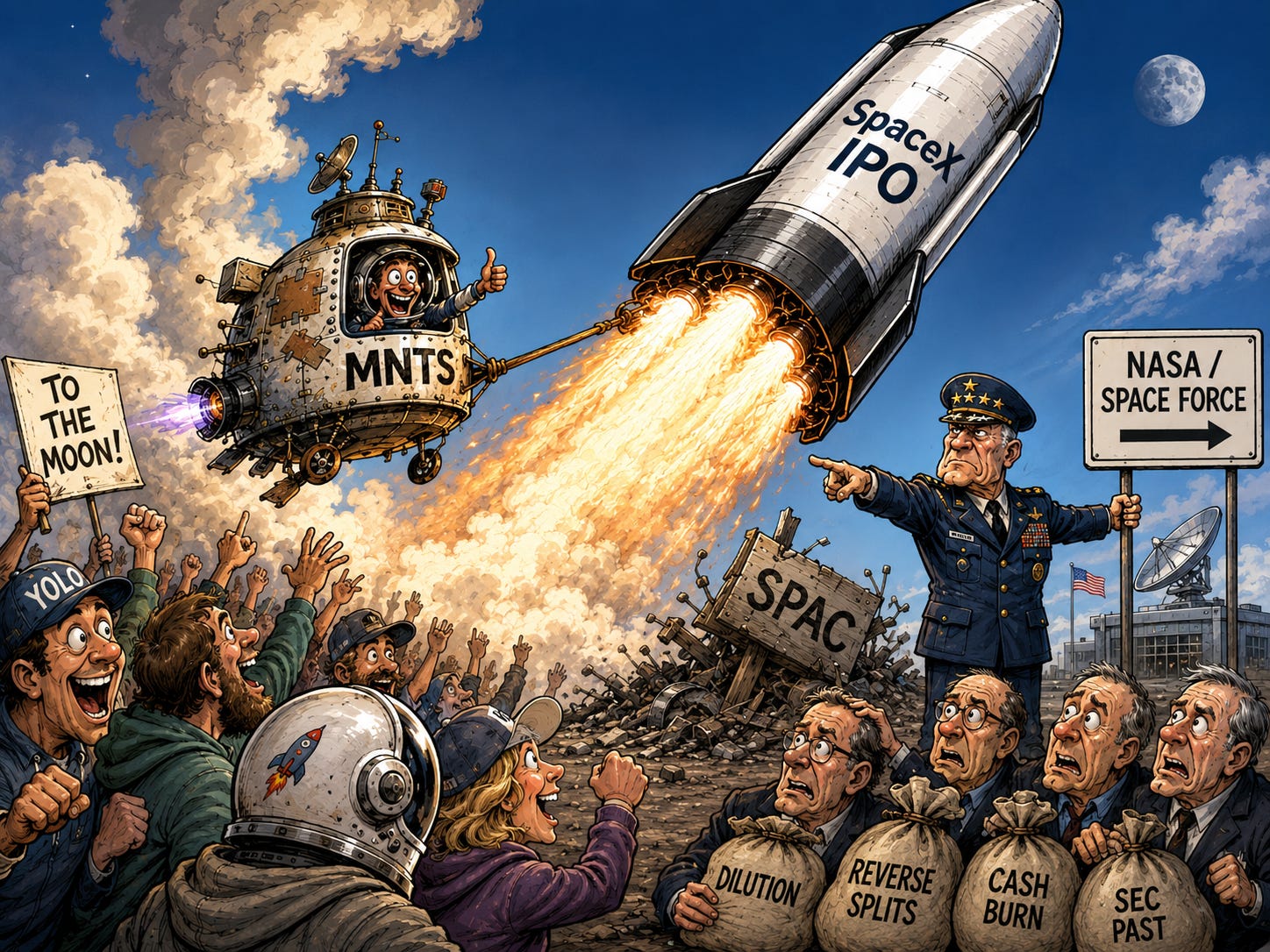
Momentus (MNTS) keeps running, and the move is less about company fundamentals than about where retail capital lands when it cannot reach the headline trade. SpaceX is targeting a $1.75T to $2T valuation with most of the deal allocated to anchor investors like BlackRock, leaving retail to chase the next-best public proxies; the Tema Space Innovators ETF is up over 55% since 31 March 2026. MNTS adds operational linkage on top of theme, plus low float and 15.6% short interest to amplify moves. Below in the Chart of the Day, the full Momentus deep dive lays out the past, the turnaround, and what to watch next.
⚖️ Fear & Greed
📉 The Number That Matters
$10B
AMD)is committing more than $10B across Taiwan's chip ecosystem to scale advanced packaging, planting the $10B bet on Nvidia's home manufacturing turf just as both race for priority at TSMC.
⚔️ Winners vs Losers
Winners
HLIT 0.00%↑: Harmonic Inc. extended Friday’s rally after raising its 2026 broadband revenue target to $475M to $495M and announcing the sale of its Video business, leaving a pure-play broadband story with Q1 rest-of-market revenue up 78% YoY.
RDW 0.00%↑: Redwire Corp. continued its multi-week run after reporting Q1 revenue of $97M (up 57.9% YoY) and a record $498.1M backlog, with recent contract wins including a multi-year NATO Penguin Mk3 UAS deal through the Edge Autonomy acquisition, a $15M US Army Stalker follow-on, and a slot on the Space Force’s $1.8B Andromeda IDIQ.
MU 0.00%↑: Micron Technology Inc. rallied as a read-through to Dell’s $43B AI server backlog and broader AI infrastructure strength rather than any company-specific catalyst.
DELL 0.00%↑: Dell Technologies Inc. extended Friday’s 16.77% surge ahead of Thursday’s Q1 FY27 earnings, with Wells Fargo lifting its price target to $270 from $180 following Dell Technologies World and the company guiding to roughly $50B in AI server revenue for FY27 against a $43B backlog.
Losers
AZO 0.00%↑: AutoZone Inc. fell after Q3 fiscal 2026 net sales of $4.84B came in just shy of the $4.86B consensus and same-store sales rose only 3.9% (4.1% domestic), overshadowing an EPS beat of $38.07 versus $36.17 expected.
📊 Market Snapshot
Cryptocurrencies:
Bitcoin (BTC): $77,211 (▼ -0.01%)
Ethereum (ETH): $2,122 (▲ 0.57%)
XRP: $1.35 (▲ 0.28%)
Equity Indices (Futures):
S&P 500: $7,543 (▲ 0.69%)
NASDAQ 100: $29,855 (▲ 1.00%)
FTSE 100: £10,532 (▲ 0.91%)
Commodities & Bonds:
10-Year US Treasury Yield: 4.49% (▼ -1.56%)
Oil (WTI): $92 (▼ -4.71%)
Gold: $4,532 (▲ 0.52%)
Silver: $76.12 (▲ 0.97%)
Data as of: UK (BST) 12:17pm / US (EDT): 7:17am / Asia (Tokyo): 8:17pm
✅ 5 Things to Know
🛢️ Iran Vows Retaliation as Wall Street Reopens
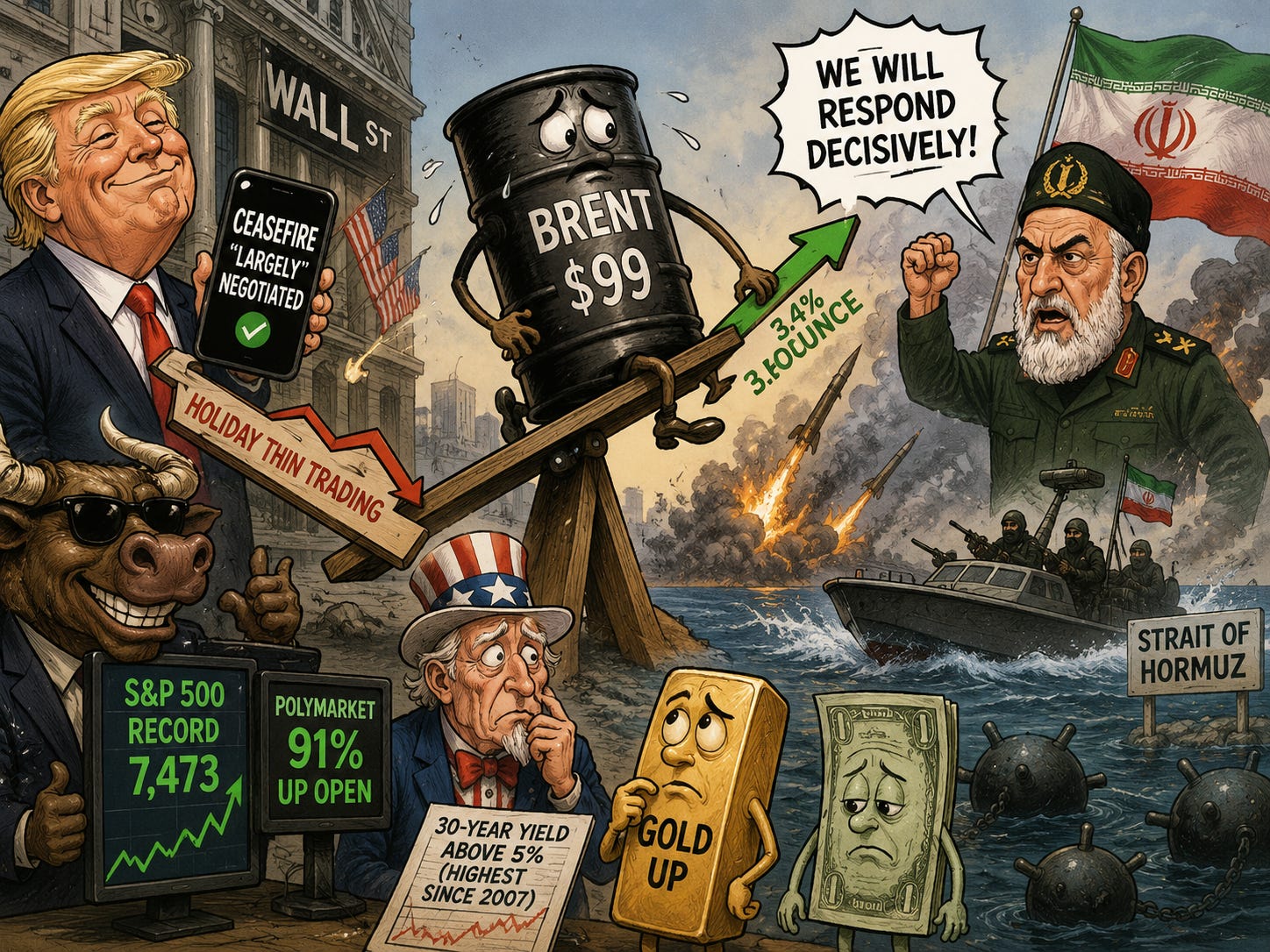
US markets reopen today to renewed uncertainty over the Iran ceasefire. President Trump said on Truth Social over the weekend that an agreement has been “largely negotiated” between the US, Iran and other countries, helping push Brent crude down about 6% on Monday while US cash markets were shut for the Memorial Day holiday. Japan’s Nikkei 225 closed above 65,000 for the first time, the dollar slipped and gold rose. Then overnight, US Central Command said it carried out fresh strikes on Iranian missile launch sites and boats laying mines near the Strait of Hormuz. Iran’s Revolutionary Guard responded this morning, vowing to “respond decisively to any violation of the ceasefire,” and Brent has bounced 3.4% to about $99 a barrel. (NBC News)
For retail investors, oil remains the chain link to everything else in 2026: cheaper crude eases the inflation that pushed the 30-year Treasury yield above 5%, its highest since 2007, and forced the Federal Reserve to shelve rate cuts. The framework under discussion would extend the ceasefire 60 days and give Iran roughly 30 days to clear the mines before traffic flows freely, so supply would not return overnight even on a signed deal. Saudi Aramco’s chief executive has said the market could take months to rebalance. Secretary of State Marco Rubio told television viewers today the deal is hung up on disputes over wording, and Tehran said yesterday no agreement is imminent. (CNBC)
Both sides are testing the ceasefire. The US is treating its overnight strikes as defensive, while Iran has warned it reserves the right to escalate. Every fresh exchange of fire would push back the day actual barrels of oil return to the market and pump prices ease, and that is what determines whether the long-end bond yields shadowing equity gains all year finally roll over.
Sensei’s Insight: Brent has bounced 3.4% to about $99 a barrel after Iran’s Revolutionary Guard threatened today to retaliate against the latest US strikes. A signed framework still gives Iran 30 days to clear Hormuz mines before oil flows, so today’s bounce is the market correcting Monday’s holiday-thin pricing.
🤖 Huawei Claims a Chip Breakthrough Around US Sanctions
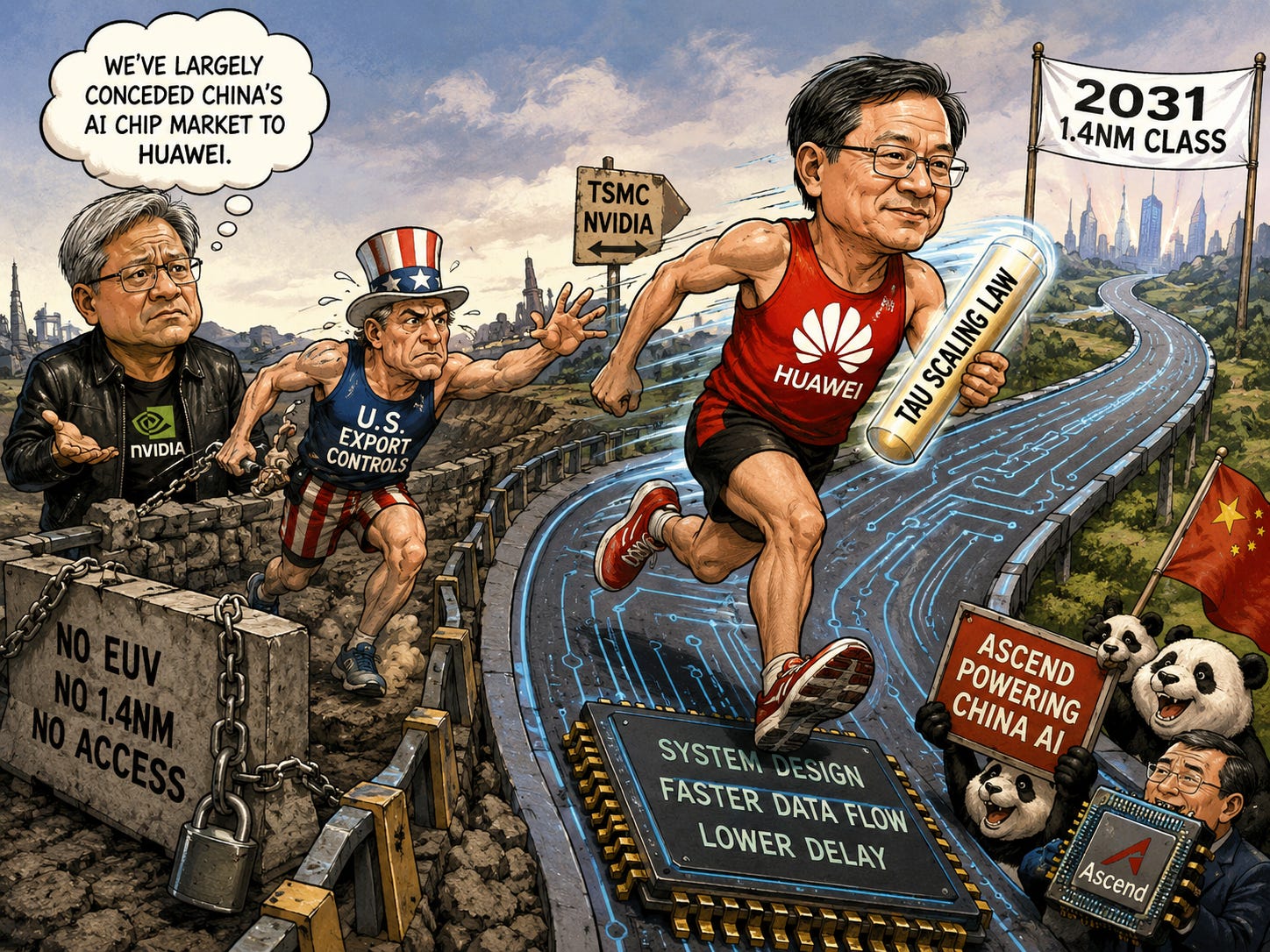
Huawei unveiled what it called a major chip-design breakthrough in Shanghai yesterday, saying it can match the transistor density of 1.4-nanometer chips by 2031, a level of miniaturization it cannot reach through the ultra-advanced manufacturing that US export controls have cut off. Rather than racing to shrink transistors, the company introduced a design method it named the “Tau Scaling Law,” meant to speed data movement and cut delays across a whole system. Huawei said its chip unit has mass-produced 381 chips in six years, and the company booked about $130 billion in revenue in 2025. (Reuters)
For retail investors, the real question is how durable US chip controls are, because that assumption sits under every megacap AI valuation. Huawei is not closing its manufacturing gap with TSMC or Nvidia overnight; it is trying to compete on architecture and system design instead of raw process technology, which over several years could make Chinese AI hardware credible enough to keep Nvidia partly shut out of China. That cuts against Nvidia’s message last week that China remains inside its long-term market, even as Beijing steers buyers toward Huawei’s Ascend chips and not one approved H200, Nvidia’s second-most-powerful AI processor, has shipped. Analysts expect the claim to draw tighter US scrutiny next.
Sensei’s Insight: Nvidia CEO Jensen Huang said earlier this month that the company has “largely conceded” China’s AI chip market to Huawei. The 2031 design target signals that concession could stick, because architectural workarounds buy Huawei a multi-year path around US export controls without ASML’s most advanced lithography machines.
🛍️ Mexico’s Exports Hit a Record Despite Trump’s Tariffs
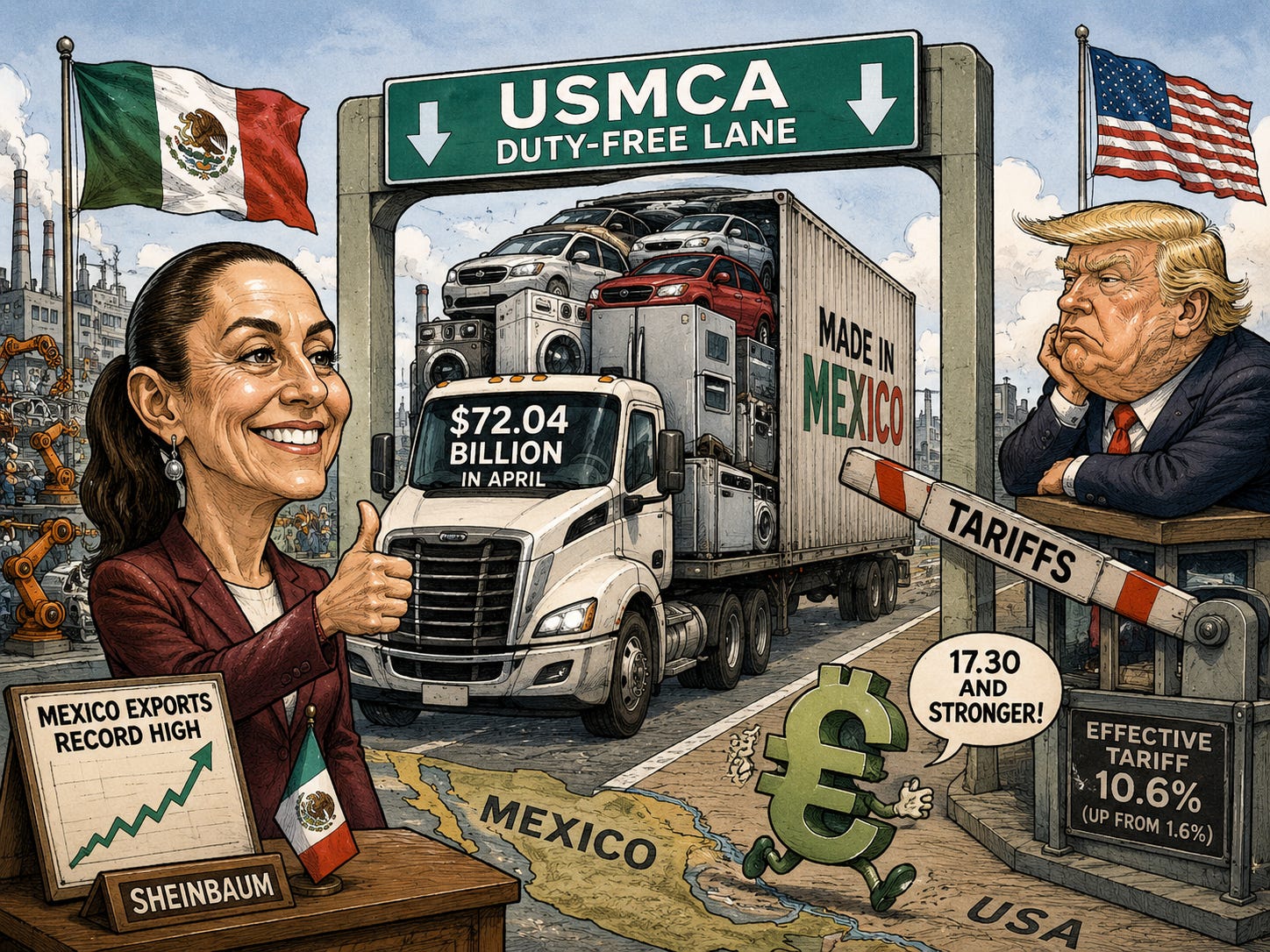
Mexican exports jumped 32.6% from a year earlier to $72.04 billion in April, the highest monthly total since records began in 1980, the national statistics agency INEGI reported yesterday. The trade surplus widened to $4.52 billion, nearly ten times the $476 million economists had penciled in, and the country has swung to a $3.51 billion surplus over the first four months of the year from a small deficit a year ago. Manufacturing did the heavy lifting at $65.69 billion, up 34%, with auto sector exports rising 8.2%. More than 83% of non-oil exports went to the United States. (Bloomberg)
The figure cuts against the claim that tariffs are pulling factory work back to the United States. Even with Washington’s effective tariff on Mexican goods up to about 10.6% from 1.6% in 2024, roughly three-quarters of Mexican exports still cross the border duty-free under the US-Mexico-Canada Agreement, or USMCA, and manufacturers have used that opening to ship more, not less. That sets up the pact’s formal review, due this summer, where a record export run strengthens President Claudia Sheinbaum’s hand. For US investors, the exposure runs through carmakers like General Motors, Ford and Stellantis, appliance maker Whirlpool, the Mexico ETF that trades as EWW, and the peso, which has firmed to about 17.30 per dollar.
Sensei’s Insight: Washington raised the effective tariff on Mexican goods more than sixfold, and exports to the US still set a record, because most enter duty-free under USMCA. That is the leverage Sheinbaum carries into this summer’s trade-pact review, and a reason the peso keeps climbing.
🤝 Trump Ties Israel Recognition to an Iran Deal
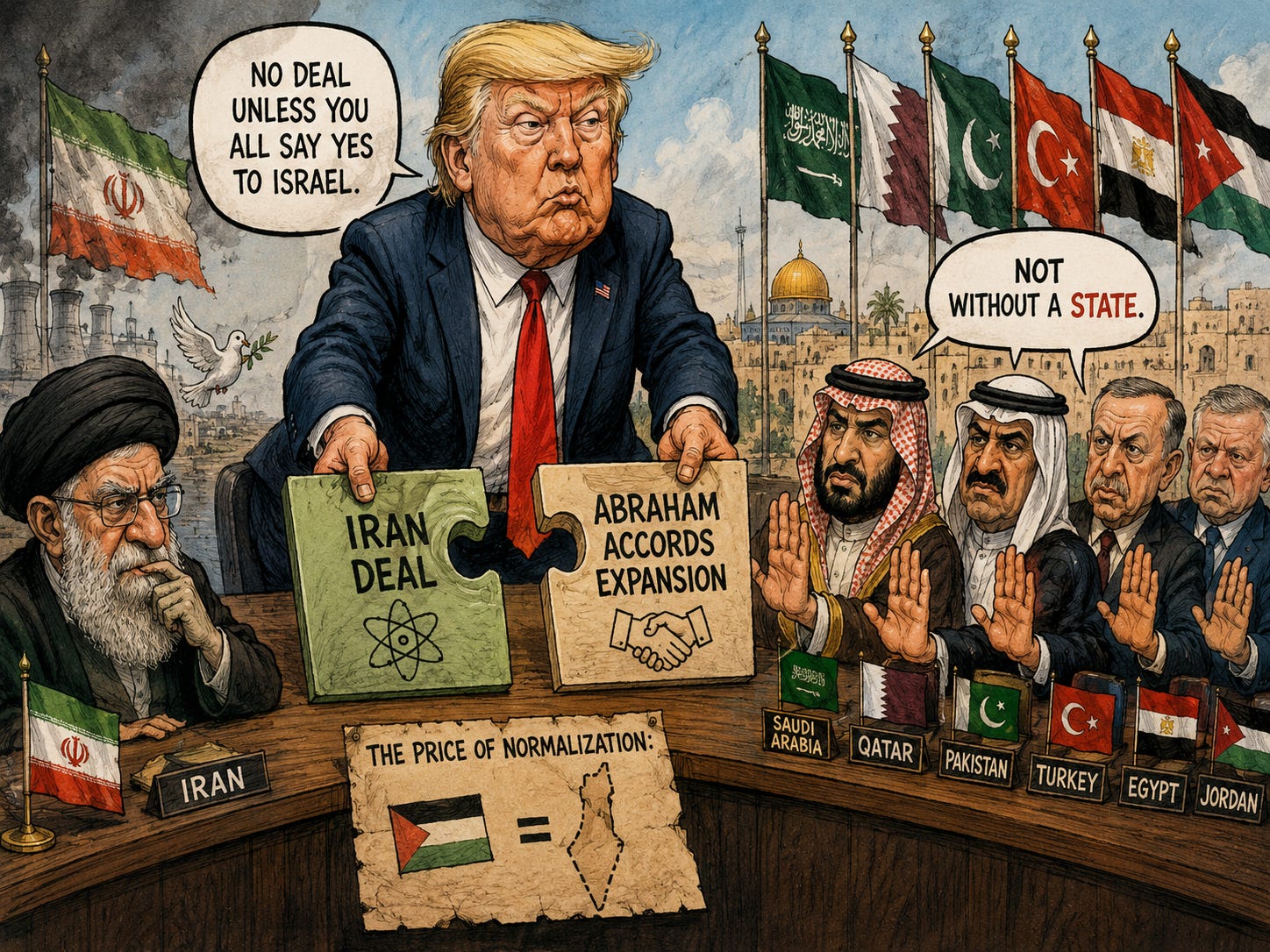
President Trump said yesterday that any final deal with Iran should require Saudi Arabia, Qatar, Pakistan, Turkey, Egypt and Jordan to “simultaneously” join the Abraham Accords, the framework that normalizes relations with Israel, first signed in 2020 by the United Arab Emirates and Bahrain. The demand followed a weekend call in which those leaders backed the Iran deal but, by one US account, fell silent when Trump raised Israel. The early answer was no. Pakistan rejected linking the two, and a Saudi source said Riyadh will not normalize without an “irreversible pathway” to a Palestinian state, a condition its foreign ministry called non-negotiable.
Trump is trying to turn a narrow ceasefire-and-shipping deal into a regional realignment that isolates Iran, and bundling the two raises both the reward and the risk. Success could unlock Saudi money into US technology, a possible US-Saudi defense pact and civilian nuclear cooperation. Failure could make the Iran framework itself shakier by attaching a demand the Gulf is not ready to meet while anger over Gaza stays high. Markets are treating broader normalization as a low-odds bonus rather than a base case, so there was no separate stock reaction yesterday. The names that would move on real progress are defense contractors and Israeli technology firms. (Bloomberg)
Sensei’s Insight: Egypt and Jordan have had peace treaties with Israel for decades, so Trump’s real target is Saudi Arabia, and Riyadh just repeated its price: a path to a Palestinian state. Folding that into the Iran talks hands the deal one more way to break.
🛒 US Consumer Mood Sinks to a Record Low
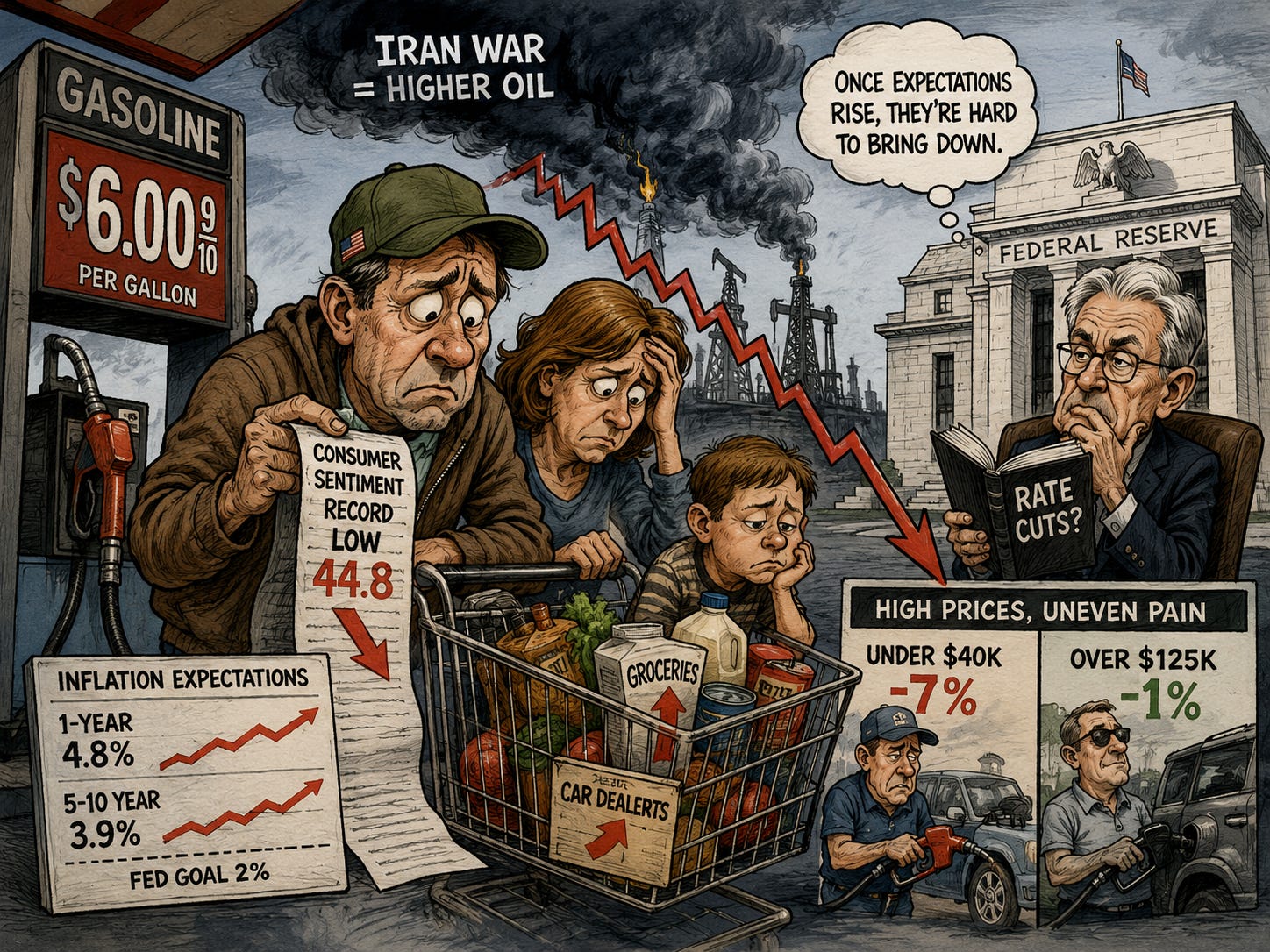
Americans’ view of the economy fell to the worst level on record in the University of Michigan’s final May reading, with the sentiment index dropping to 44.8, below the 48.2 economists expected and a third straight monthly decline. Price fears climbed alongside it: consumers now expect 4.8% inflation over the next year and 3.9% over the next five to ten years, both multi-month highs against the Fed’s 2% goal. The driver is energy. Gasoline has topped $6 a gallon in parts of the country as the Iran war keeps crude elevated, and 57% of respondents said high prices are hurting their finances.
Sentiment tends to lead spending, so a record-low reading warns that the energy shock is starting to change behavior, not just mood. The harder problem for the Federal Reserve is the long-run expectations: once households expect higher inflation five to ten years out, that view is tough to unwind, which complicates rate cuts even if an Iran deal pulls gas prices down. The pain is uneven. A New York Fed study found households earning under $40,000 cut gasoline use about 7% during the spring price spike, while those above $125,000 trimmed just 1%, a squeeze that lands first on discretionary retailers, restaurants and car dealers. Conference Board’s separate confidence reading drops today at 10am ET, the first test of whether the Michigan collapse was a one-off or a trend. (CNBC)
Sensei’s Insight: A record-low sentiment print usually shows up in slower spending a few months out. Watch the 3.9% long-run inflation expectation: if it keeps climbing, even cheaper gas from an Iran deal may not be enough to get the Fed cutting this year.
Stories You Might Have Missed
🇪🇺 EU Prepares a Major Google Antitrust Fine
The European Union is readying a fine in the high hundreds of millions of euros against Google under the Digital Markets Act, or DMA, the bloc’s rulebook for big-tech “gatekeepers,” according to a Handelsblatt report carried by Reuters. The case, opened last year, centers on whether Google favors its own services in search results, and a decision is expected before Europe’s summer break. It would be the biggest penalty yet under the DMA, and the larger stakes are structural: if Brussels forces changes to how Google ranks and bundles its products, the long-run earnings hit could outweigh any one-off fine. The read-through runs to Alphabet and the other designated gatekeepers, including Apple, Amazon and Meta.
💰 AMD Bets $10 Billion on Taiwan to Chase Nvidia
AMD said it will invest more than $10 billion across Taiwan’s chip ecosystem to scale the advanced packaging that links processors together for next-generation AI systems, planting its flag on Nvidia’s home manufacturing turf just as the two race for priority at TSMC. The move landed days after Nvidia’s blockbuster results, with CEO Lisa Su pushing AMD as the strongest challenger in AI. AMD posted first-quarter revenue of $10.25 billion, up 38%, with data-center sales up 57% to $5.78 billion, and its Helios rack-scale system is due to start shipping in the second half of this year against Nvidia’s Vera Rubin platform. AMD shares have more than doubled in 2026.
🌐 Mexico and the EU Sign a Long-Stalled Trade Deal
Mexico and the European Union signed a long-delayed trade agreement before the weekend, with both sides looking to cut their dependence on the United States as tariffs reshape global commerce. The deal modernizes a pact first struck in 2000 and scraps most remaining duties between the two, opening Europe to more Mexican farm and industrial goods and handing Mexican manufacturers a second large market beyond their northern neighbor. For investors, it strengthens the case that Mexico’s factory base can keep expanding even if US trade terms tighten, and it gives President Sheinbaum another card ahead of this summer’s USMCA review.
🔗 Connect with Us
Stay plugged in across platforms:
Sensei on X: sensei_live_
Martyn Lucas on X: MartynInvestor
Vaz on X: eVTOLHUB
📺 YouTube Channel (Live & Replays): Martyn Lucas Investor
🔍 Deep Dive: Meet Momentus (MNTS): The Small-Cap Space Stock Riding the SpaceX Wave