

This content is for informational and educational purposes only and does not constitute financial advice. Always do your own research. Not financial advice (NFA).
👀 Today’s Stories at a Glance
💾 Asia’s chip market cracks: Korea’s Kospi fell 10.8% and halted trading as Samsung and SK Hynix led a punishing global memory selloff.
🔌 Nvidia underwrites its own customer: talks to guarantee $250 billion of OpenAI data centre debt revived circular-financing fears and knocked 5% off the shares.
🏦 The Fed’s hardest week starts: policymakers began a two-day meeting with a hold expected tomorrow, though markets still price 38% odds of a hike.
🛢️ Oil keeps bleeding lower: Brent fell toward $86 and WTI to $82 as the pause in US and Iranian strikes held firm.
🍎 Apple takes back the crown: it closed above Nvidia as the world’s most valuable company for the first time since April 2025.
✈️ Boeing’s turnaround faces its test: results land today with FAA certification powers restored and a backlog worth roughly $695 billion behind it.
₿ Crypto waits on Warsh: Bitcoin slipped near $63,000 and Ethereum toward $1,860 as the Senate shelved the crypto market-structure bill for now.
🥇 Gold fades before the decision: bullion slipped 0.7% to about $4,045 as a firm dollar and Fed nerves kept buyers on the sidelines.
🔍 Is the AI bubble popping?: the Deep Dive takes apart the $250 billion guarantee, the loop it creates, and the one precedent that went wrong.
📈 Nvidia loses the $200 line: the Chart of the Day has the levels I am watching below it and where the 50-week average sits.
🧠 One Big Thing
The rotation has become measurable. Money is moving out of the companies asking to be funded and into the ones already producing cash. Apple has added about 24% this year against Nvidia’s 4%, and the crown changed hands on a session when nothing happened at Apple at all. Microsoft, Meta, Apple and Amazon all report inside the next 48 hours, worth more than eleven trillion dollars between them. Watch what each of them says about its capital spending plans rather than what it earned last quarter, because that is the line the market is currently pricing.
⚖️ Fear & Greed
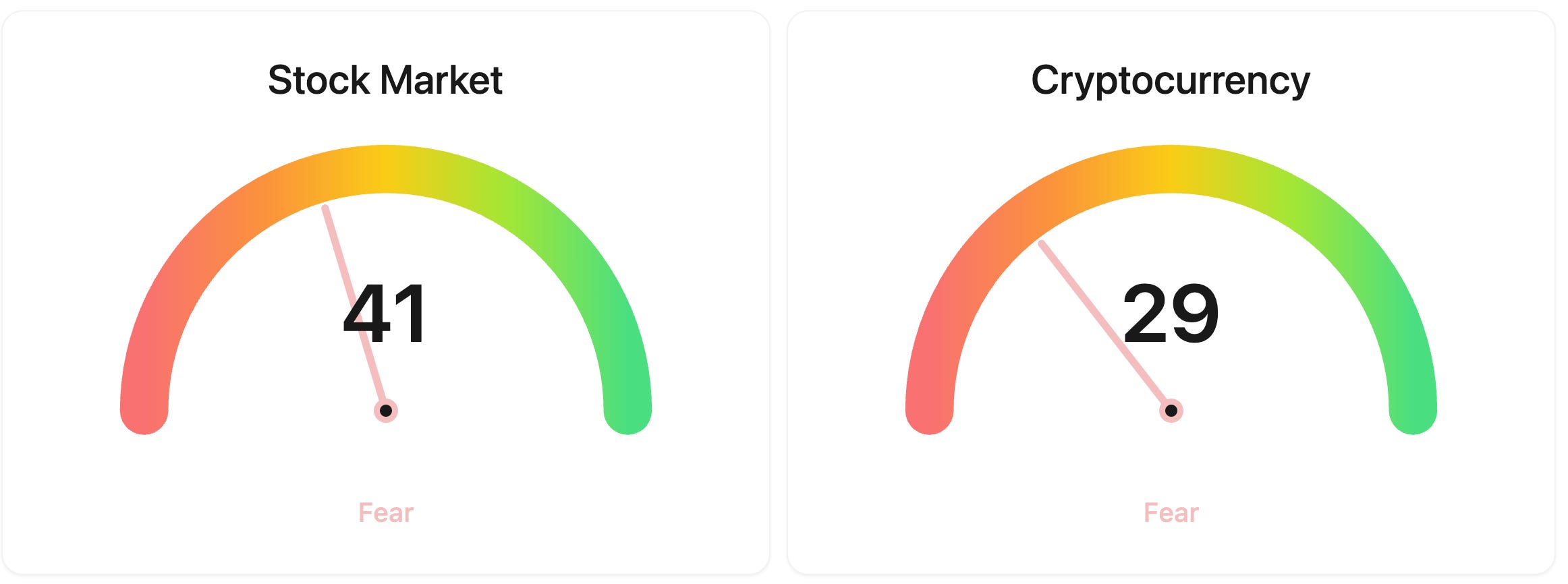
📉 The Number That Matters
$250 billion
Nvidia is in talks to guarantee that much OpenAI data centre debt, enough to let an unprofitable customer borrow on Nvidia’s credit and spend it on Nvidia chips.
⚔️ Winners vs Losers
Winners
GOSS 0.00%↑: +33.70% Gossamer Bio extended Monday’s surge after the company said FDA minutes from a June pre-NDA meeting clear the way for a September submission of seralutinib in pulmonary arterial hypertension, and that it has bought back worldwide rights to the drug from Chiesi. The agency characterised the borderline statistical result from the Phase 3 PROSERA trial as a review issue rather than a barrier to accepting the filing.
ALDX 0.00%↑: +11.04% Aldeyra Therapeutics moved sharply in pre-market with no specific catalyst identified.
LVWR 0.00%↑: +59.90% LiveWire Group added to a violent multi-day squeeze that has lifted the electric motorcycle maker from under a dollar last week, after second quarter revenue rose 55 percent to 9.1 million dollars and electric motorcycle unit sales jumped 386 percent.
OPK 0.00%↑: +9.70% Opko Health rose after second quarter revenue came in at 163.5 million dollars against 156.8 million a year earlier, lifted by intellectual property transfer revenue that jumped to 46.1 million from 15 million.
Losers
AMKR 0.00%↑: -11.74% Amkor Technology extended Monday’s slide after a record quarter was overshadowed by the outlook, with the chip packager posting 1.9 billion dollars in revenue and 70 cents in earnings per share but guiding third quarter communications revenue down by a high single digit percentage on a system-in-package production transfer.
WDC 0.00%↑: -9.25% Western Digital led the storage names lower as a memory rout that began overnight in Seoul carried into US trading, with SK Hynix down close to 15 percent and Samsung off more than 13 percent on reports of Chinese progress in lithography equipment and fresh broker calls that memory pricing peaks in 2027. The company reports earnings later this week into a sharply deteriorating tape.
SNDK 0.00%↑: -15.18% Sandisk extended an 11 percent Monday decline, hit harder than its peers through this pullback because a run of several hundred percent this year has left it carrying the richest multiple in the group.
MU 0.00%↑: -9.05% Micron Technology fell for a second session as investors kept digesting the Shanghai debut of Chinese memory maker CXMT, which closed up 466 percent on Monday to become the most valuable company listed on the mainland after raising 8.6 billion dollars to fund DRAM capacity that competes directly with Micron.
📊 Market Snapshot
Cryptocurrencies:
Bitcoin (BTC): $63,312 (▼0.60%)
Ethereum (ETH): $1,875 (▼0.81%)
XRP: $1.06 (▼0.92%)
Equity Indices (Futures):
S&P 500: 7,440 (▼0.11%)
NASDAQ 100: 27,959 (▼0.82%)
FTSE 100: 10,840 (▲0.49%)
Commodities & Bonds:
10-Year US Treasury Yield: 4.62% (▼0.54%)
Oil (WTI): $81 (▼1.04%)
Gold: $4,020 (▼1.48%)
Silver: $57.17 (▼2.06%)
Data as of: UK: 11:22am BST / US: 6:22am EDT / Asia (Tokyo): 7:22pm JST
✅ 5 Things to Know
💾 Asia’s chip market cracks and the selling spreads
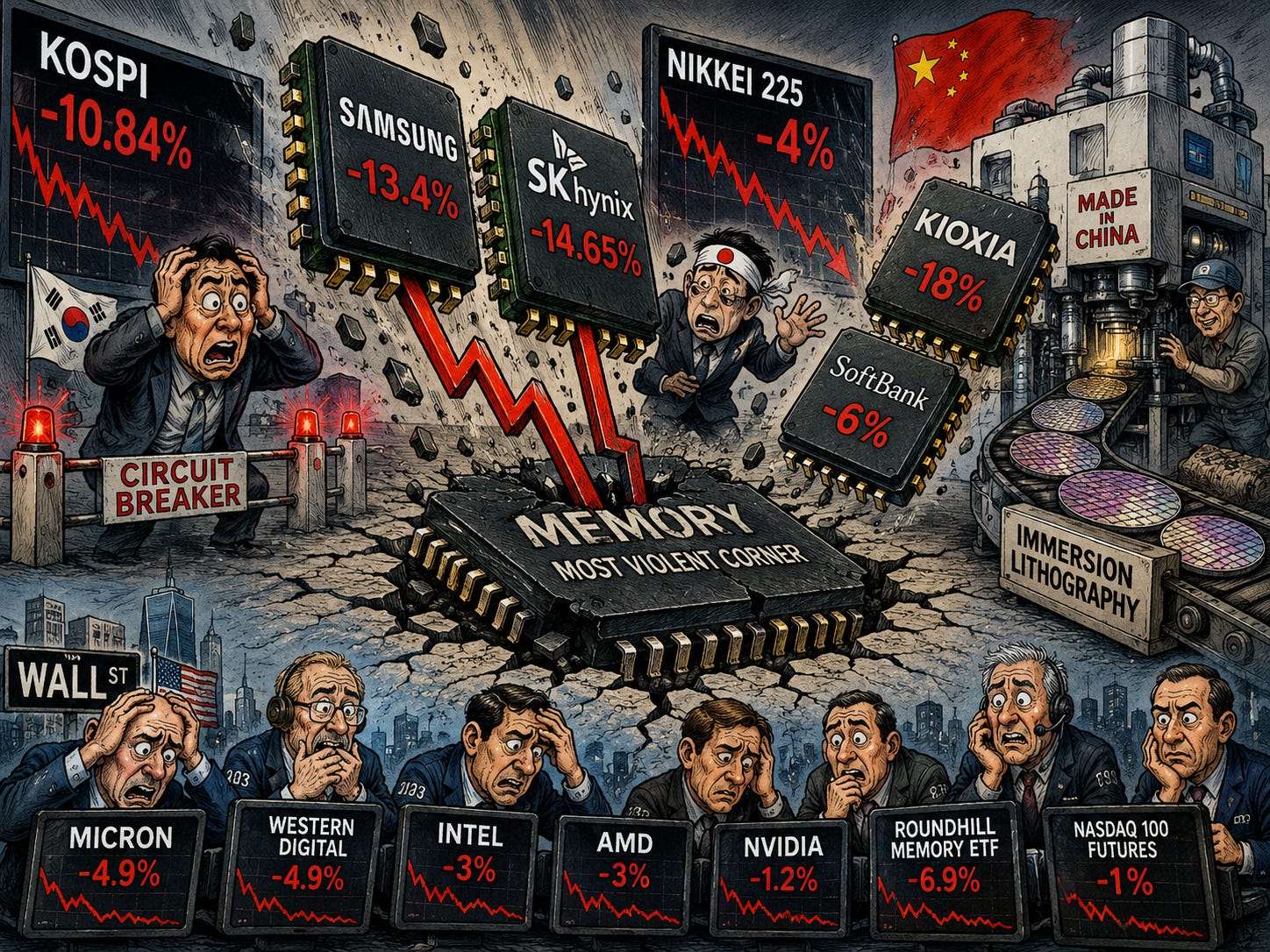
South Korea’s Kospi closed 10.84% lower at 6,023.66, a fall steep enough to trip the exchange’s circuit breaker and halt trading, dropping the index below 6,000 for the first time since April and stretching its July loss to nearly 30%. Samsung Electronics lost 13.4% and SK Hynix 14.65%, and between them those two carry more than half the index. Japan went with it. Kioxia dropped more than 18%, SoftBank shed over 6%, and the Nikkei 225 fell as much as 4% to its lowest level since 22 May (CNBC).
The selling arrived in New York before the bell. Micron and Western Digital were each down 4.9%, Intel and AMD off more than 3%, Nvidia around 1.2% lower, and the Roundhill memory ETF 6.9% weaker, with Nasdaq 100 futures off about 1% while Dow futures edged higher. Two forces are pushing at once. One is the financing question hanging over OpenAI’s build-out, covered below. The other is a report that China has begun mass-producing its own immersion lithography machines, the equipment that prints circuits onto wafers, with the first units going to SMIC, Hua Hong and ChangXin Memory this year (Yahoo Finance).
Sensei’s Insight: Memory is the most violent corner of the chip trade and it always overshoots both ways. SK Hynix’s US shares fell to $139.01, below the $149 they were sold at 17 days ago. That is leverage coming out, not demand disappearing.
🔌 Nvidia offers to underwrite its own biggest customer
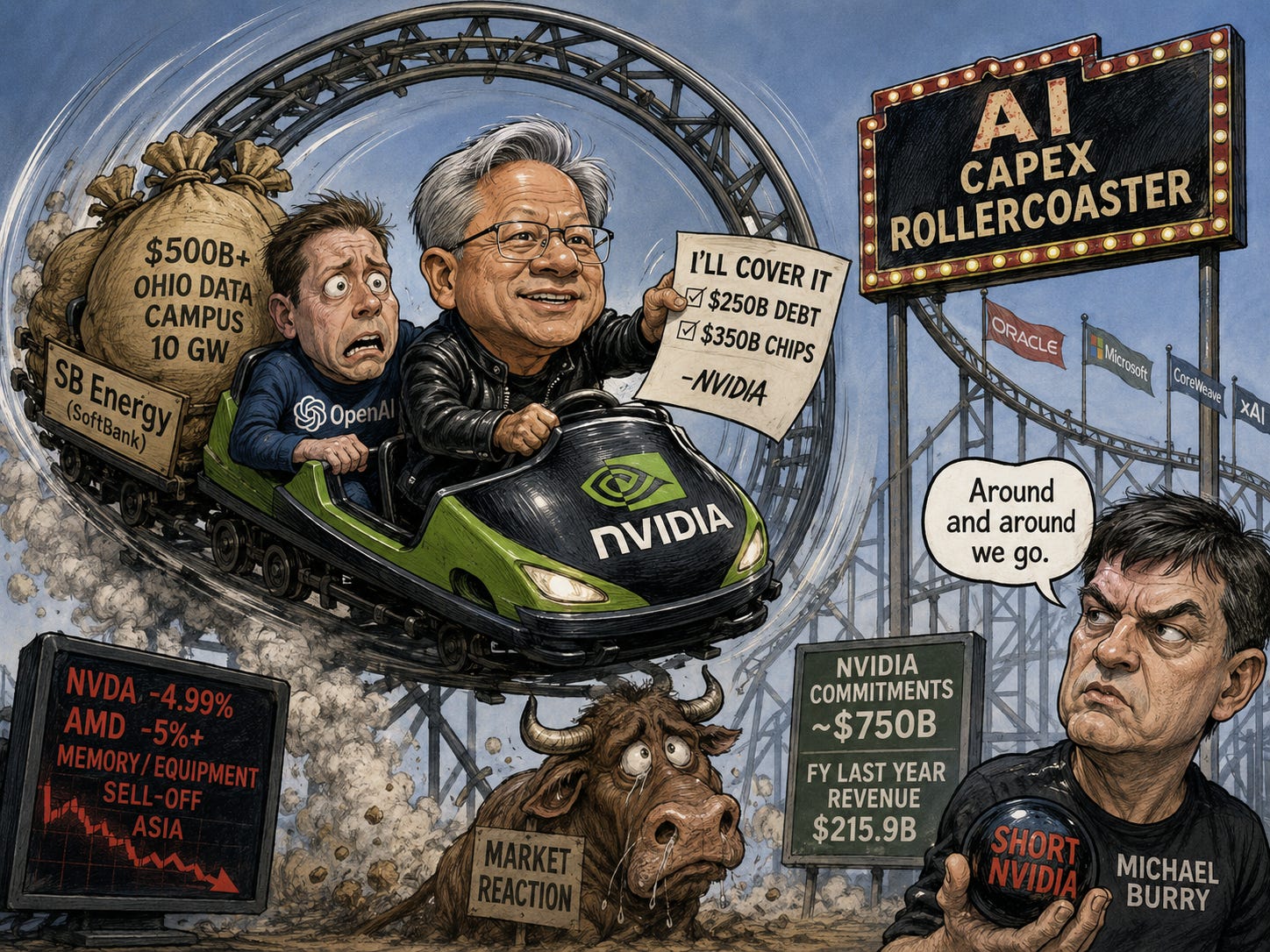
Nvidia is in talks to guarantee as much as $250 billion of the debt being raised for an OpenAI data centre campus in southern Ohio, with a separate discussion covering up to $350 billion of OpenAI’s future chip purchases. The site runs to 10 gigawatts, is being developed by SB Energy, a subsidiary of SoftBank, and carries a reported total cost above $500 billion, with a first phase of roughly 800 megawatts due in 2028. The talks are unfinished and the structure could still change. Nvidia shares fell 4.99% to $196.51, closing below $200 (CNBC).
The reaction arrived faster than the detail. Michael Burry, who has held a short position against Nvidia for months, posted “Around and around we go.” Bloomberg’s running tally of Nvidia’s announced commitments across the AI ecosystem now reaches roughly $750 billion, set against revenue of $215.9 billion for its last full financial year. AMD fell more than 5% alongside it, and by this morning the selling had spread to memory makers and chip equipment names across Asia (Bloomberg).
Sensei’s Insight: Vendor financing is decades old and it is not automatically a scandal. It went badly wrong once at scale, in telecoms, around 2000. I have taken the whole loop apart in today’s Deep Dive, with the numbers and the levels I am watching.
🏦 The Fed opens two days with a harder call than it wanted
The Federal Open Market Committee began its two-day meeting today, with the decision landing tomorrow at 7:00pm BST (2:00pm ET) and new Chair Kevin Warsh taking questions half an hour later. A hold at 3.50% to 3.75% is still the expected outcome, but the market is not treating it as settled: CME FedWatch pricing puts the odds of at least a quarter-point rise at 38%, against 62% for no change. Those odds sat near 10% in mid-July before oil went vertical. There is no fresh set of rate projections at this meeting, so tone carries the whole message (Forbes).
Today gives the committee one more data point. The Conference Board publishes July consumer confidence at 3:00pm BST (10:00am ET), after a June reading of 91.2 in which the share of Americans saying jobs were hard to get climbed to 22.5%, the highest since January 2021. Oil coming off its highs has taken some heat out of the inflation case, and the 10-year Treasury yield eased to about 4.64%. Second-quarter GDP and the June core PCE inflation reading both arrive the morning after the decision, so anything Warsh says tomorrow gets tested within 18 hours.
Sensei’s Insight: A 38% hike probability the day before a meeting is unusual and it is the most interesting number on my screen. Warsh has said he wants to give markets less guidance. If he means it, the press conference moves more than the decision does.
🛢️ Oil slides again as the strike pause holds
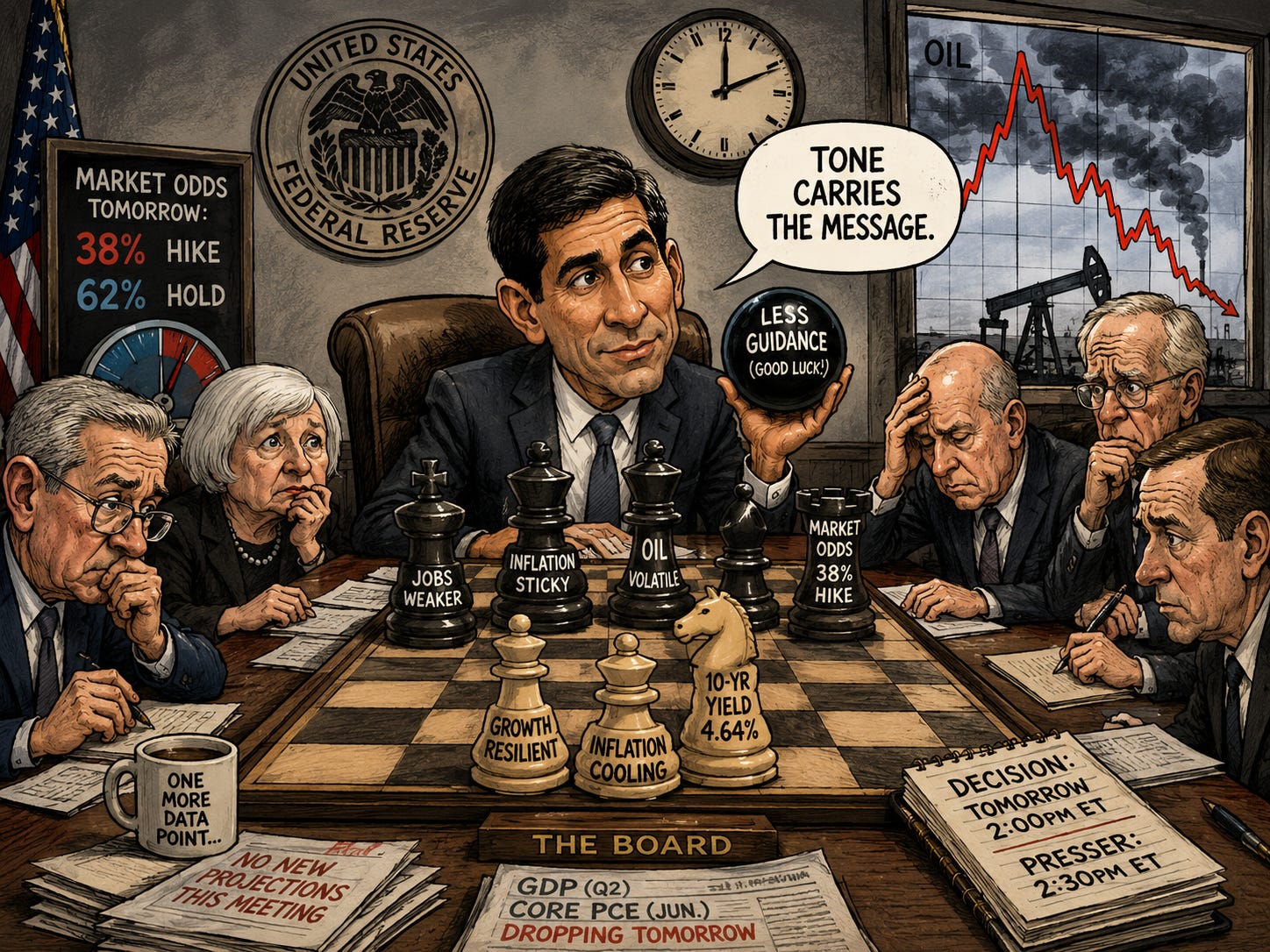
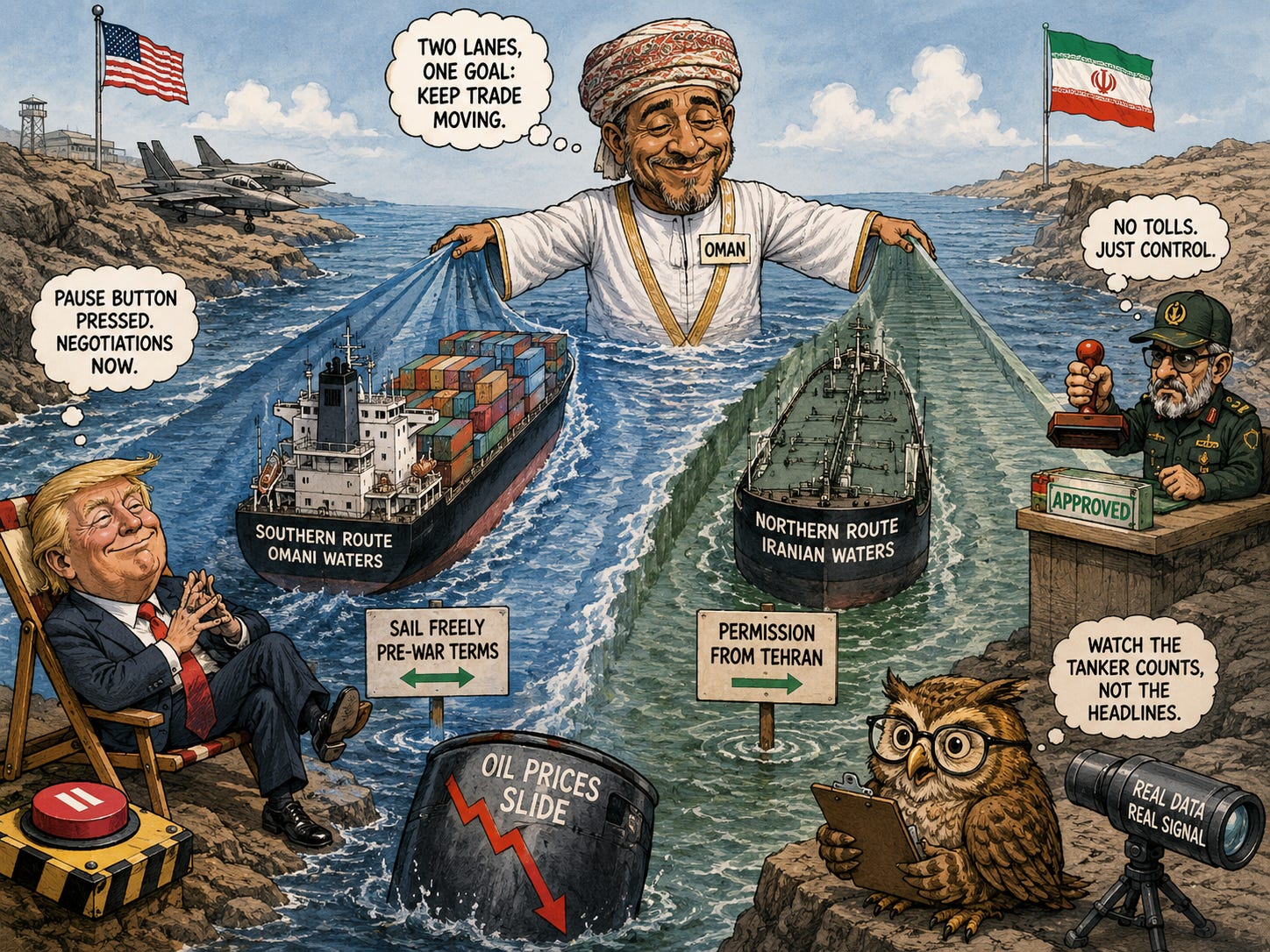
Brent crude for September delivery fell 2.07% to $86.53 a barrel and US West Texas Intermediate dropped 1.72% to $82.19, a second straight session of losses as the halt in fighting between the United States and Iran held. The United States stopped its attacks late last week after nearly a fortnight of strikes, and Tehran stopped hitting American bases in neighbouring countries. President Trump said he suspended the campaign to give negotiations another chance. Brent traded above $100 as recently as the middle of last week (CNBC).
The detail that matters more than the headline is what Oman is brokering. Under the proposal on the table, the Strait of Hormuz would run as two separately managed corridors: ships in the southern route through Omani waters would sail freely on pre-war terms, while vessels using the northern route inside Iranian waters would need permission from Tehran. No tolls would be charged. Traffic through the strait had fallen to a three-week low. Getting cargo moving again is what turns a pause in the fighting into lower petrol prices, and it is the piece the Fed is watching too (Bloomberg).
Sensei’s Insight: A toll-free deal is a bigger win than it sounds. Tolls would have priced permanently into every cargo through Hormuz and stayed in the inflation numbers long after the shooting ended. Watch tanker traffic counts rather than the ceasefire headlines.
🍎 Apple takes the most valuable company title back from Nvidia
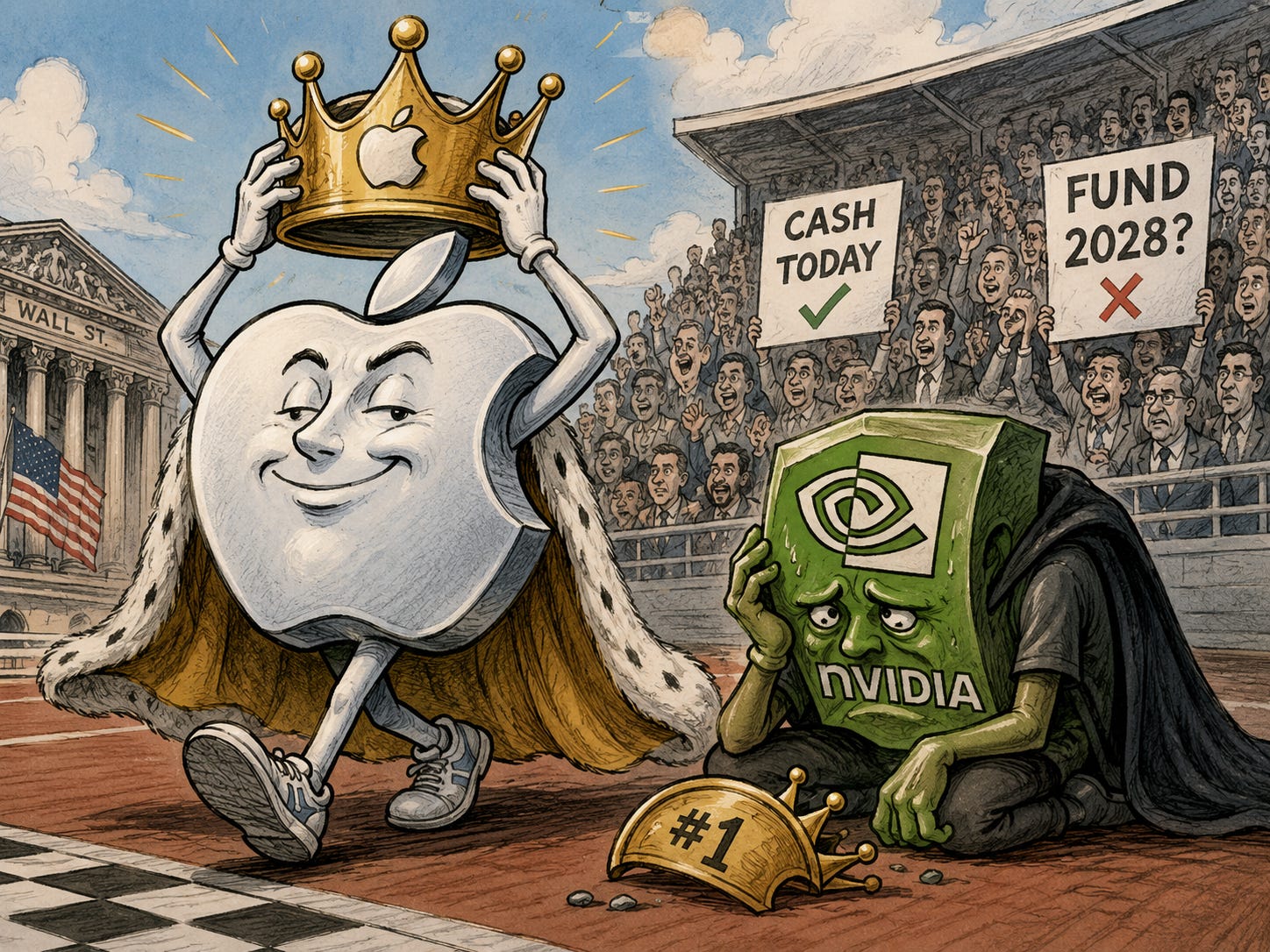
Apple finished yesterday worth more than Nvidia for the first time at a closing bell since April 2025, ending a run at the top that the chipmaker had held for well over a year. It happened because Nvidia fell, not because Apple rose: a 4.99% drop left the chipmaker valued around $4.77 trillion. The gap over 2026 tells the story better than any single session. Apple shares are up roughly 24% so far this year while Nvidia has added about 4% (CNBC).
For most of the past two years, size at the top of the US market was a proxy for AI enthusiasm, so this handover is a reasonable measure of how much of that enthusiasm has drained. Apple has spent the year being marked up for the thing it was criticised for, which is spending far less on AI infrastructure than its rivals. That view gets tested later this week when Apple reports after the close, with revenue expected somewhere near $109 billion to $110 billion. It will be Tim Cook’s final set of results before John Ternus takes over on 1 September.
Sensei’s Insight: Crowns change hands often and mean little on their own. What this one measures is real: the market is paying up for companies that generate cash today and marking down the ones asking it to fund 2028. That preference has held for three weeks now.
Stories You Might Have Missed
✈️ Boeing puts its turnaround on the record
Boeing reports second-quarter results before the US open today, with chief executive Kelly Ortberg and finance chief Jay Malave taking questions at 3:30pm BST (10:30am ET). Analysts expect a loss of about 28 cents a share, a sharp narrowing from the $1.24 loss a year earlier, on revenue up more than 7% to around $24.26 billion. The company handed over 171 commercial aircraft and 35 defence aircraft in the quarter, and its order backlog stands at roughly $695 billion. The bigger development came earlier this month: from 20 July the Federal Aviation Administration restored Boeing’s authority to issue final airworthiness certificates for all newly built 737 MAX and 787 jets, removing a bottleneck that had capped deliveries. Options pricing implies a move of about 6% in either direction (Yahoo Finance).
₿ Crypto marks time as Washington puts the rulebook aside
Bitcoin eased to around $63,300 and Ethereum to about $1,875, with XRP near $1.06 and the total value of the crypto market close to $2.26 trillion, the whole complex a fraction lower over 24 hours. The whole complex is sitting on its hands until the Fed speaks tomorrow, since a hike would hit the high-beta end of risk assets first. July has still been the first month since April with money flowing into both US spot Bitcoin and Ethereum funds, roughly $234 million and $338 million respectively, although a single session late last week saw about $225 million pulled back out. In Washington the Senate set the digital asset market structure bill aside to deal with Russia sanctions and nominations, leaving one working week before the summer recess for any preliminary floor action (CoinDesk).
🥇 Gold drifts lower with the dollar firm
Spot gold fell 0.7% to $4,044.81 an ounce, giving back a gain of as much as 1% from the previous session, as the dollar held near a one-month high and made bullion more expensive for buyers holding other currencies. The metal has been stuck in a range between roughly $3,950 and $4,200 for weeks, which is what tends to happen when two opposing forces cancel out: a rate rise would hurt an asset that pays no income, while the inflation scare that created the rate risk is exactly what drives people to own it in the first place. Tomorrow’s decision breaks the deadlock in one direction or the other, and the reaction in the dollar will matter as much as the rate itself (CNBC).
🔍 Deep Dive - Around and Around We Go: The Nvidia and OpenAI Loop Behind the Chip Crash
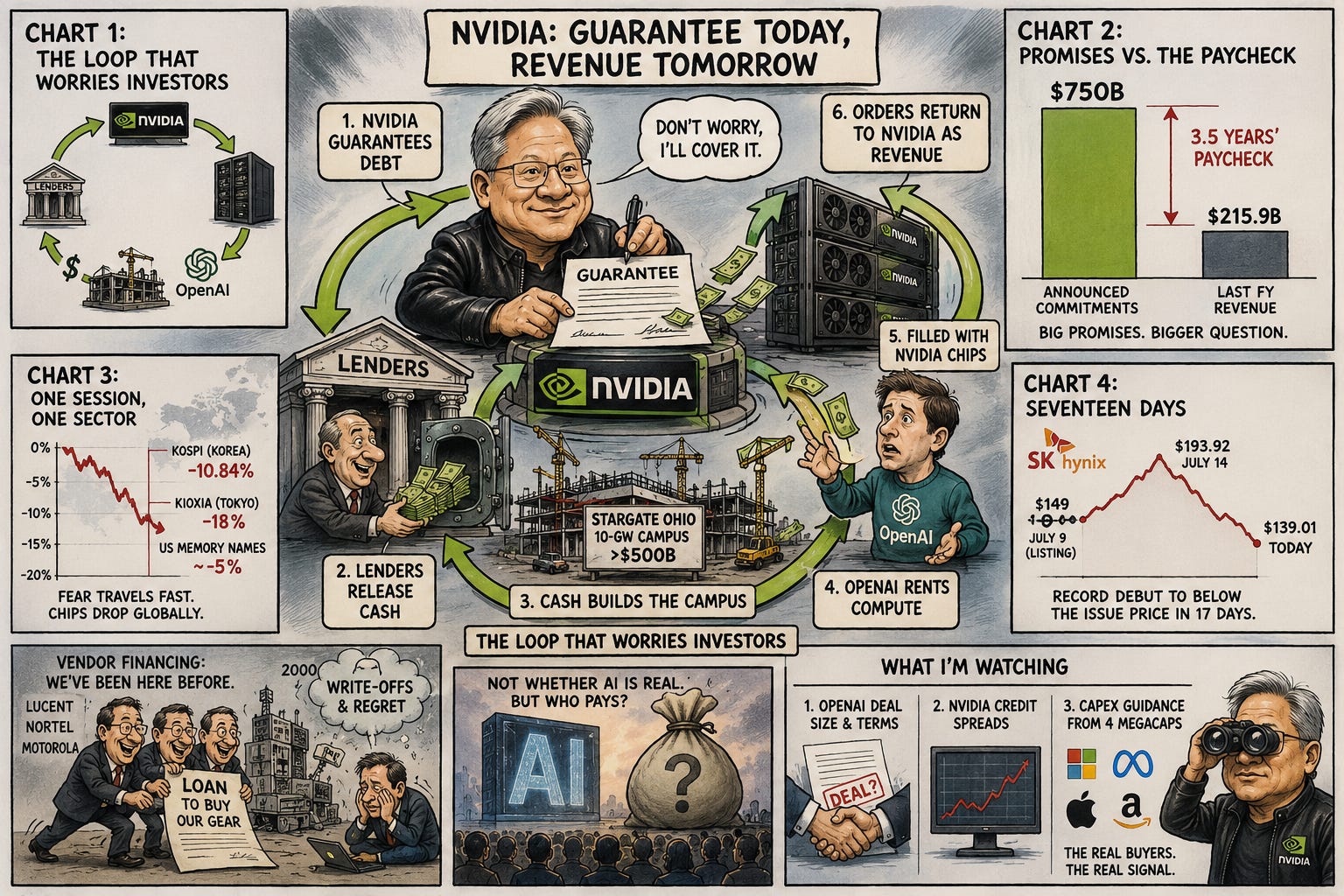
Chip shares fell across three continents today. Korea’s main index dropped 10.84% and the exchange halted trading. Kioxia in Tokyo lost more than 18%. Memory names in New York opened around 5% lower. The trigger was a report that Nvidia is in talks to guarantee up to $250 billion of borrowing, so a customer can build a data centre and fill it with Nvidia chips. Nobody serious is claiming AI demand is fake. The worry is narrower, and it is about who is paying.