This content is for informational and educational purposes only and does not constitute financial advice. Always do your own research. Not financial advice (NFA).
👀 Today’s Stories at a Glance
🚀 Musk merges SpaceX and xAI: Elon combines his ventures into a $1.25 trillion engine to fund orbital AI development.
📈 Metals recover after violent crash: Gold and silver rebound as dip-buyers offset liquidations triggered by Fed chair news.
🇮🇳 Trump and Modi reset trade: New Delhi gets lower tariffs after pledging to swap Russian oil for American supply.
🔌 OpenAI hunts for Nvidia alternatives: The firm seeks specialized chips to fix latency issues and cut high inference costs.
🤝 White House hosts crypto summit: Officials meet with Coinbase to resolve banking disputes over high-yield stablecoin rewards.
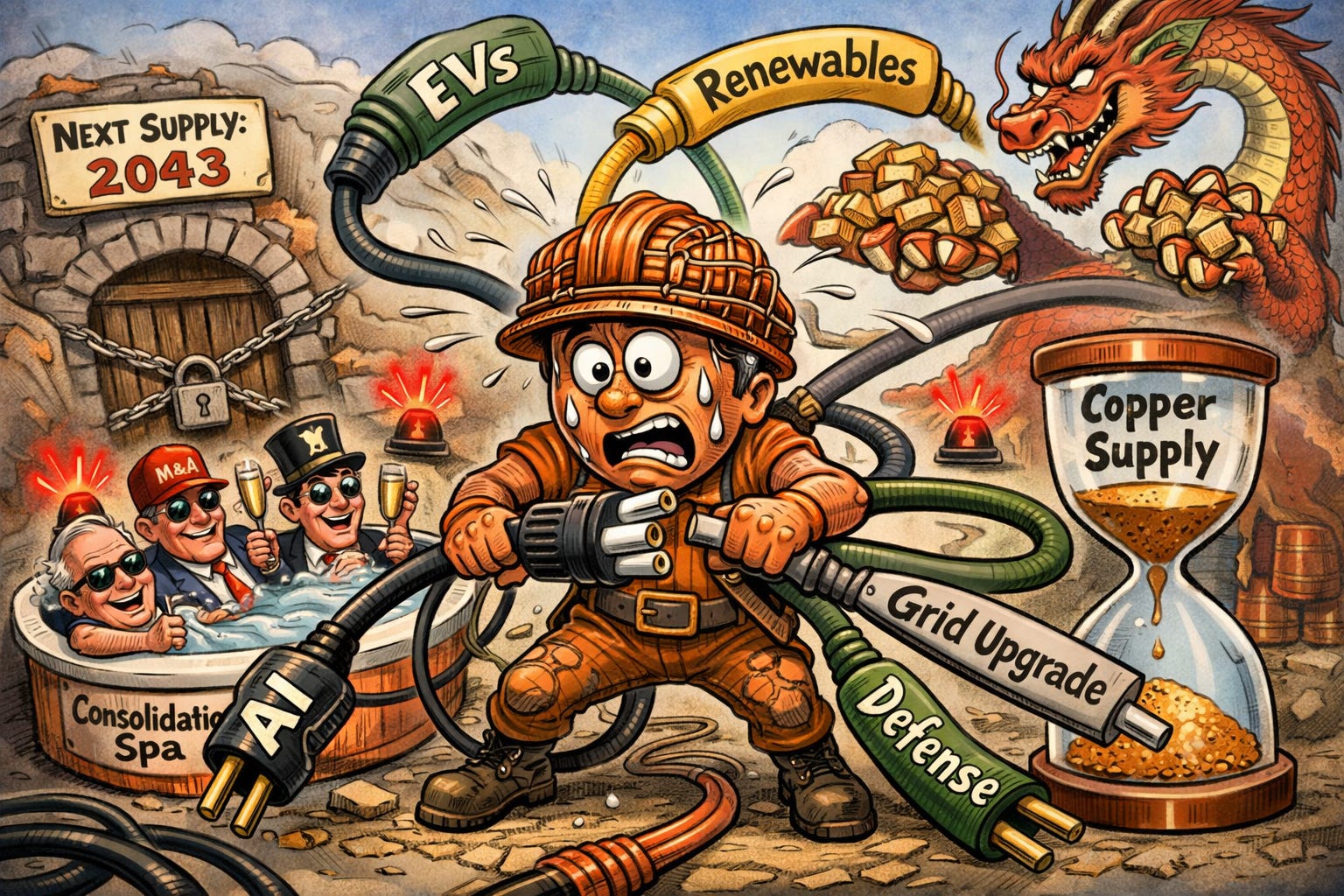
🔍 Copper faces massive supply crisis: Global demand for AI and EVs will soon outpace stagnant mining production and declining grades.
🧠 One Big Thing
The Copper Supply Gap
A severe structural deficit is emerging as global copper demand outpaces stagnant production. Requirements for artificial intelligence, electric vehicles, and power grid overhauls are projected to increase consumption by 50% by 2040. Supply cannot respond quickly because new mines take nearly 18 years to develop and existing ore quality is dropping. Miners are currently spending double the capital just to maintain flat output levels. This mismatch creates a projected 10 million tonne shortfall that endangers the global energy transition. Investors should note that companies are now choosing expensive acquisitions over new drilling to secure dwindling physical reserves.
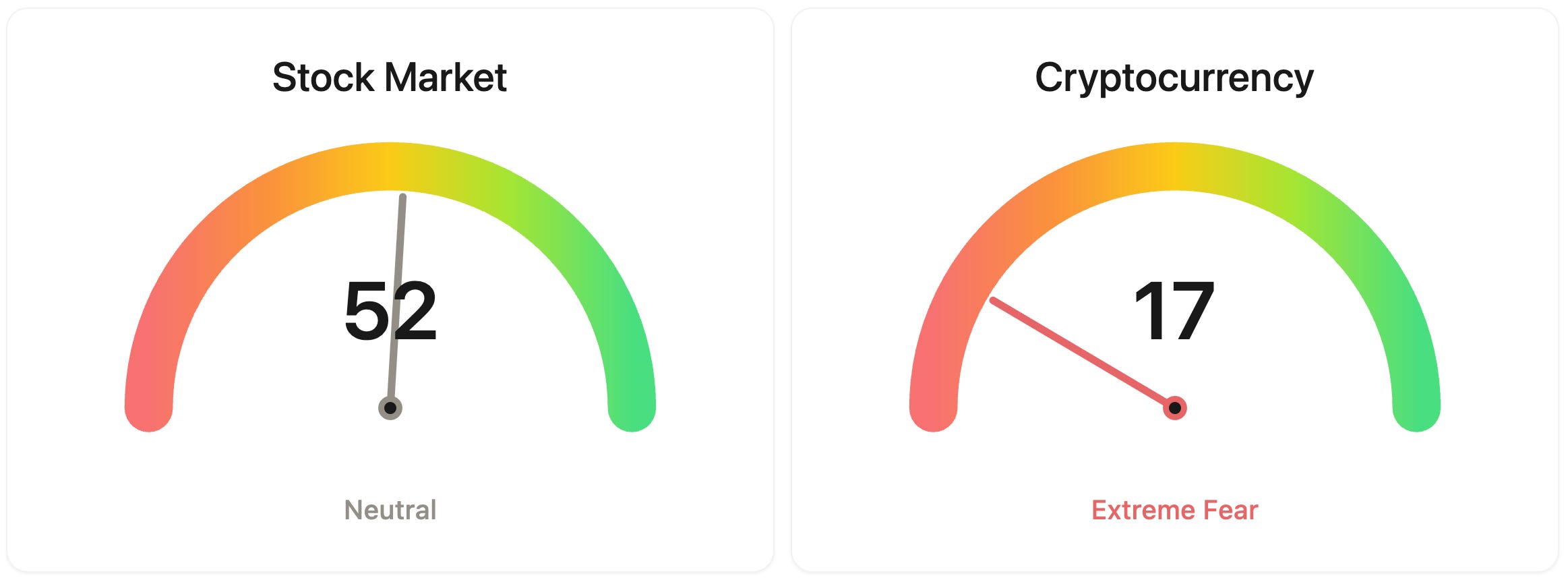
⚖️ Fear & Greed
📉 The Number That Matters
17.9 YEARS
The average lead time from discovering a copper deposit to reaching first production is now 17.9 years. This brutal timeline means new supply cannot quickly respond to price spikes, locking in long-term structural shortages.
⚔️ Winners vs Losers
Winners
SIDU 0.00%↑: Sidus Space, Inc. rose on positive momentum related to defense spending sentiment and the integration of its LizzieSat-4 AI payload.
TER 0.00%↑: Teradyne, Inc. surged after delivering a significant earnings beat and raising guidance well above estimates on strong AI-driven robotics demand.
WWD 0.00%↑: Woodward, Inc. rallied after reporting fiscal first-quarter results that beat expectations and raising its full-year sales and earnings guidance.
WULF 0.00%↑: TeraWulf Inc. moved higher following the announcement of a major capacity acquisition that doubles its infrastructure portfolio to 2.8 gigawatts.
WPM 0.00%↑: Wheaton Precious Metals Corp rose as record-high gold prices and a strategic financing deal for the Hemlo mine boosted investor sentiment.
AEM 0.00%↑: Agnico Eagle Mines Limited gained in sympathy with record gold prices and ahead of its full-year earnings report scheduled for mid-February.
B 0.00%↑: Barrick Mining Corporation shares advanced on record gold prices and anticipation of its upcoming earnings release featuring significant year-over-year growth.
FCX 0.00%↑: Freeport-McMoRan, Inc. climbed as record-high realized copper prices and recent earnings momentum offset a slight reduction in the company’s production outlook.
PLTR 0.00%↑: Palantir Technologies Inc. shares jumped after the company reported an earnings beat and provided 2026 revenue guidance significantly higher than consensus estimates.
NEM 0.00%↑: Newmont Corporation rose on safe-haven demand and record gold prices as the world’s largest gold producer prepares for its February earnings print.
INTC 0.00%↑: Intel Corporation shares moved higher behind a technical bounce and validation of its foundry strategy involving next-generation chipmaking technology.
SCCO 0.00%↑: Southern Copper Corporation gained after reporting record earnings, raising its quarterly dividend, and announcing an upcoming stock split.
Losers
MAMO 0.00%↑: Massimo Group shares plummeted after the company reported a severe revenue miss and announced the resignation of CFO Dr. Yunhao Chen.
ETN 0.00%↑: Eaton Corporation, PLC slipped as investors engaged in profit-taking ahead of today’s earnings release despite a recent announcement to spin off its mobility division.
RMBS 0.00%↑: Rambus, Inc. shares dropped after the company’s first-quarter product revenue guidance failed to meet high investor growth expectations despite a quarterly beat.
SOC 0.00%↑: Sable Offshore Corp. fell due to ongoing legal and regulatory uncertainty surrounding a California pipeline restart following a state attorney general lawsuit.
WIX 0.00%↑: Wix.com Ltd. shares decreased as investors weighed a massive $2 billion share buyback against concerns regarding valuation and long-term growth investment.
📊 Market Snapshot
Cryptocurrencies:
Bitcoin (BTC): $78,000 (▼ 0.85%)
Ethereum (ETH): $2,271 (▼ 3.13%)
XRP: $1.60 (▼ 1.25%)
Equity Indices (Futures):
S&P 500: $6,985 (▲ 0.11%)
NASDAQ 100: $25,959 (▲ 0.42%)
FTSE 100: £10,301 (▼ 0.31%)
Commodities & Bonds:
10-Year US Treasury Yield: 4.29% (▲ 0.19%)
Oil (WTI): $62 (▼ 0.20%)
Gold: $4,902 (▲ 5.20%)
Silver: $85.88 (▲ 8.33%)
Data as of UK (GMT): 11:30 AM / US (EST): 6:30 AM / Asia (Tokyo): 8:30 PM
✅ 5 Things to Know Today
🚀 Musk Merges SpaceX and xAI in $1.25 Trillion Deal
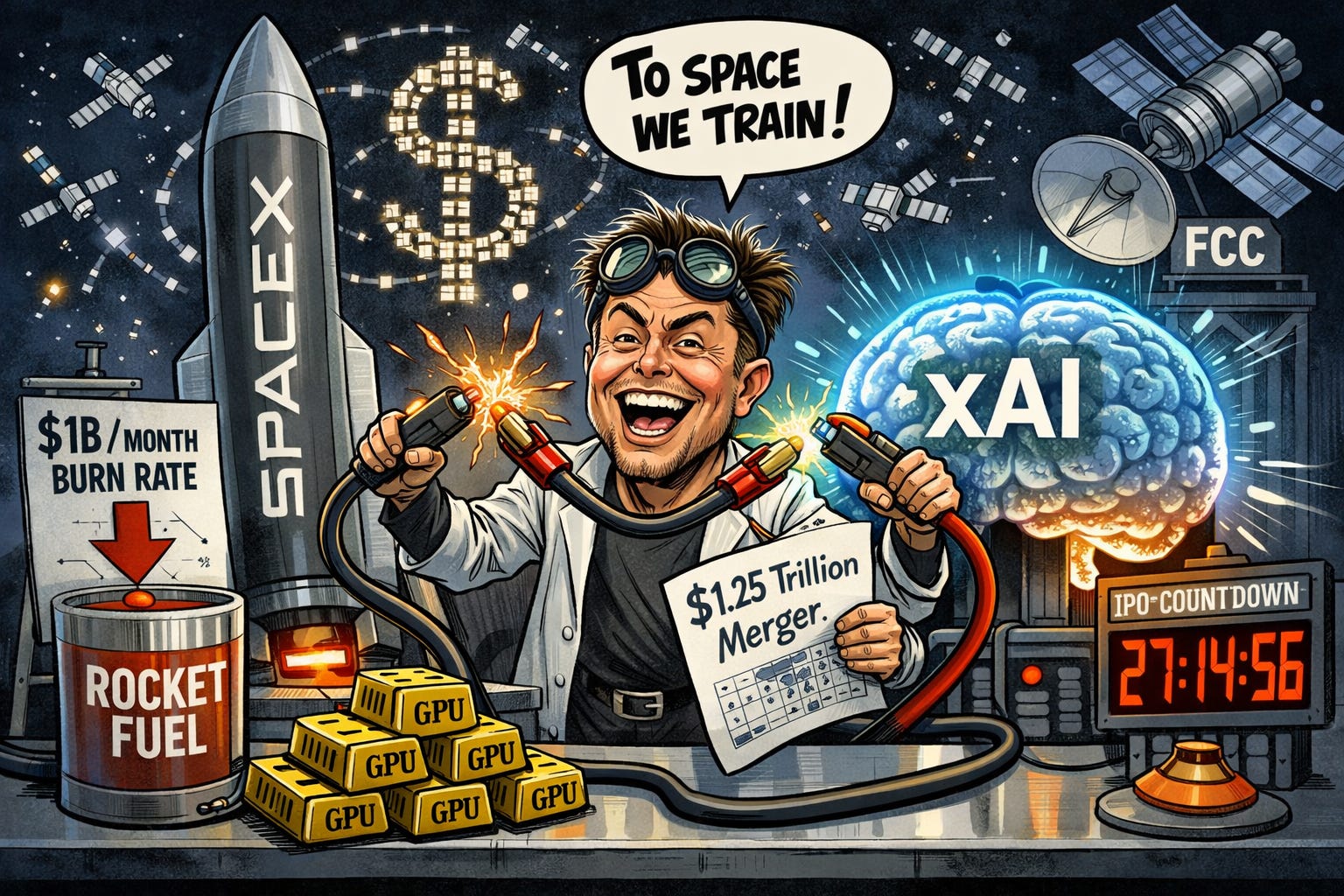
Elon Musk has officially consolidated his empire, merging SpaceX with his AI startup, xAI, in an all-stock transaction. The new entity is valued at a staggering $1.25 trillion, combining SpaceX’s $1 trillion valuation with xAI’s $250 billion. This merger effectively rolls xAI, which was burning roughly $1 billion a month on infrastructure and GPUs, into the cash-generative arms of SpaceX and its Starlink satellite business. The move comes just ahead of a massive IPO planned for later in 2026, where SpaceX aims to raise $50 billion. By folding xAI into SpaceX, Musk is creating a vertically integrated “innovation engine” that covers everything from orbital rockets to large language models like Grok (Bloomberg).
This isn’t just about corporate housekeeping; it’s a strategic play to solve xAI’s massive capital needs. xAI is projected to lose $13 billion in 2025 alone due to the eye-watering costs of Nvidia Blackwell GPUs and supercomputer clusters. By tethering xAI to Starlink, which pulled in $11.8 billion in 2025 revenue, Musk can fund AI development internally without constant dilutive venture rounds. The long-term vision involves “orbital data centers,” with a recent FCC filing for one million satellites. Musk claims space-based compute will be the most cost-effective way to train AI within three years due to unlimited solar power and the vacuum’s natural cooling. It’s a bold bet that the future of intelligence belongs in orbit.
Sensei’s Insight: Watch the Starship launch costs and the FCC’s reaction to that million-satellite filing. If launch costs don’t drop below $100/kg, the “space-based AI” dream remains an expensive, high-latency science project.
📈 The Great Metals Reset: From Crash to Recovery
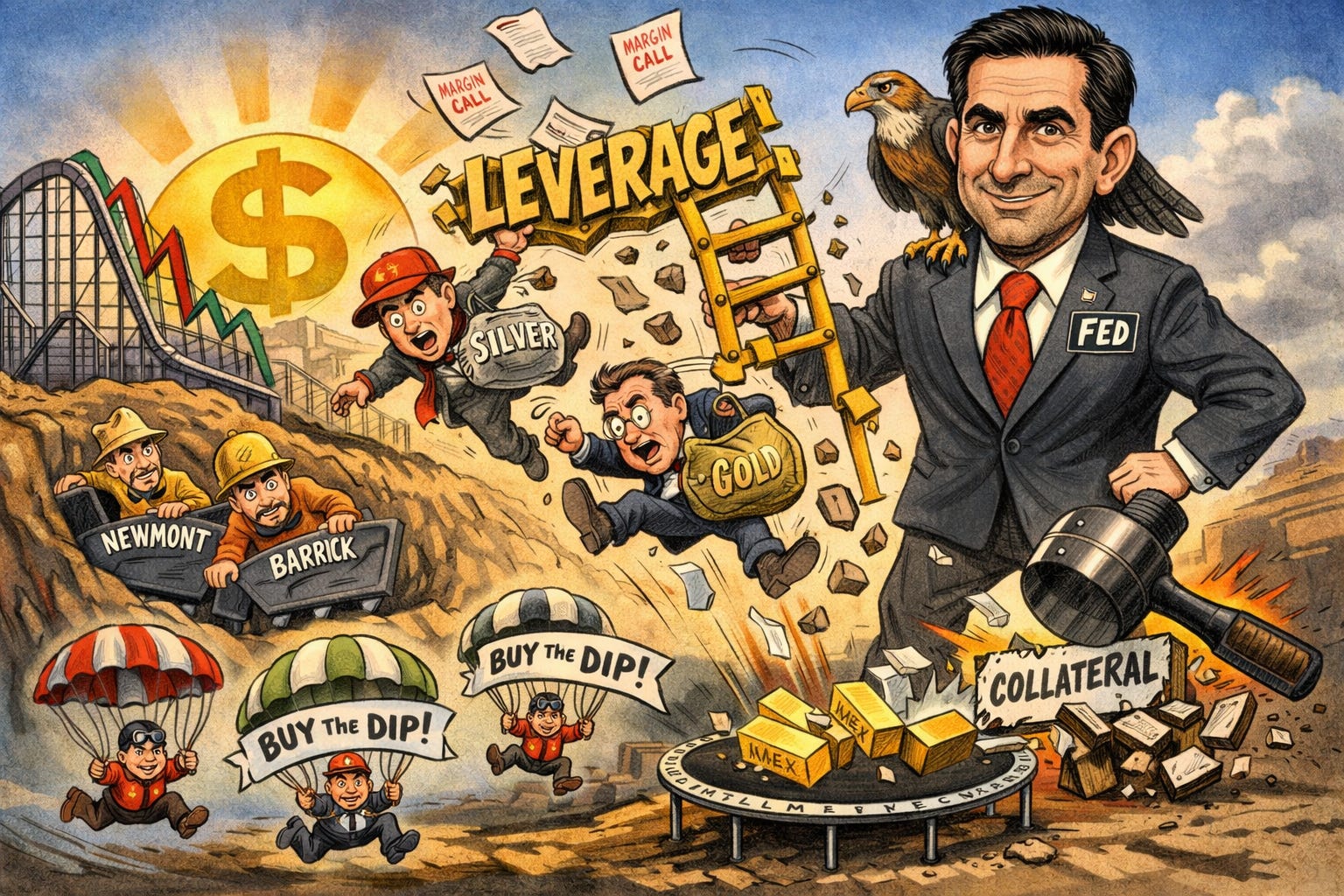
Precious metals just endured a violent boom-bust cycle that wiped out $1.24 trillion in notional value from silver alone in under 48 hours. Gold plummeted 21% from its January 30 peak of $5,595 per ounce to lows near $4,400, while silver suffered a staggering 40% collapse, crashing from $121 to roughly $71. The catalyst was the nomination of Kevin Warsh as the next Fed Chair, which sent the US Dollar Index soaring as markets bet on a more independent, hawkish central bank. This triggered massive liquidations from Chinese speculators and forced margin calls after the CME Group raised collateral requirements. However, the rout proved short-lived: by February 3, gold had climbed back to $4,923 and silver recovered to $87 as dip-buyers stepped in (Bloomberg).
This wasn’t a change in long-term fundamentals, it was a high-speed deleveraging event. The “debasement trade” that fueled gold’s 67% rise in 2025 hit a wall when the Warsh nomination signaled the Fed wouldn’t simply bow to political pressure for easy money. For retail investors, the carnage in mining stocks was even sharper: majors like Newmont and Barrick saw double-digit slides because their profit margins compress far faster than the price of the metal they dig up. Despite the drama, structural support remains. Central banks are still diversifying away from the dollar, and physical demand in China is surging ahead of the Lunar New Year. The fact that gold and silver maintained year-to-date gains of 14% and 15% respectively after such a historic blow indicates that the “buy the dip” mentality is still the dominant force.
Sensei’s Insight: Leverage is a ladder that breaks when too many people climb it at once. Watch the $4,400 gold floor: if it holds, this was just a healthy, albeit painful, flush.
🇮🇳 The Art of the India Deal
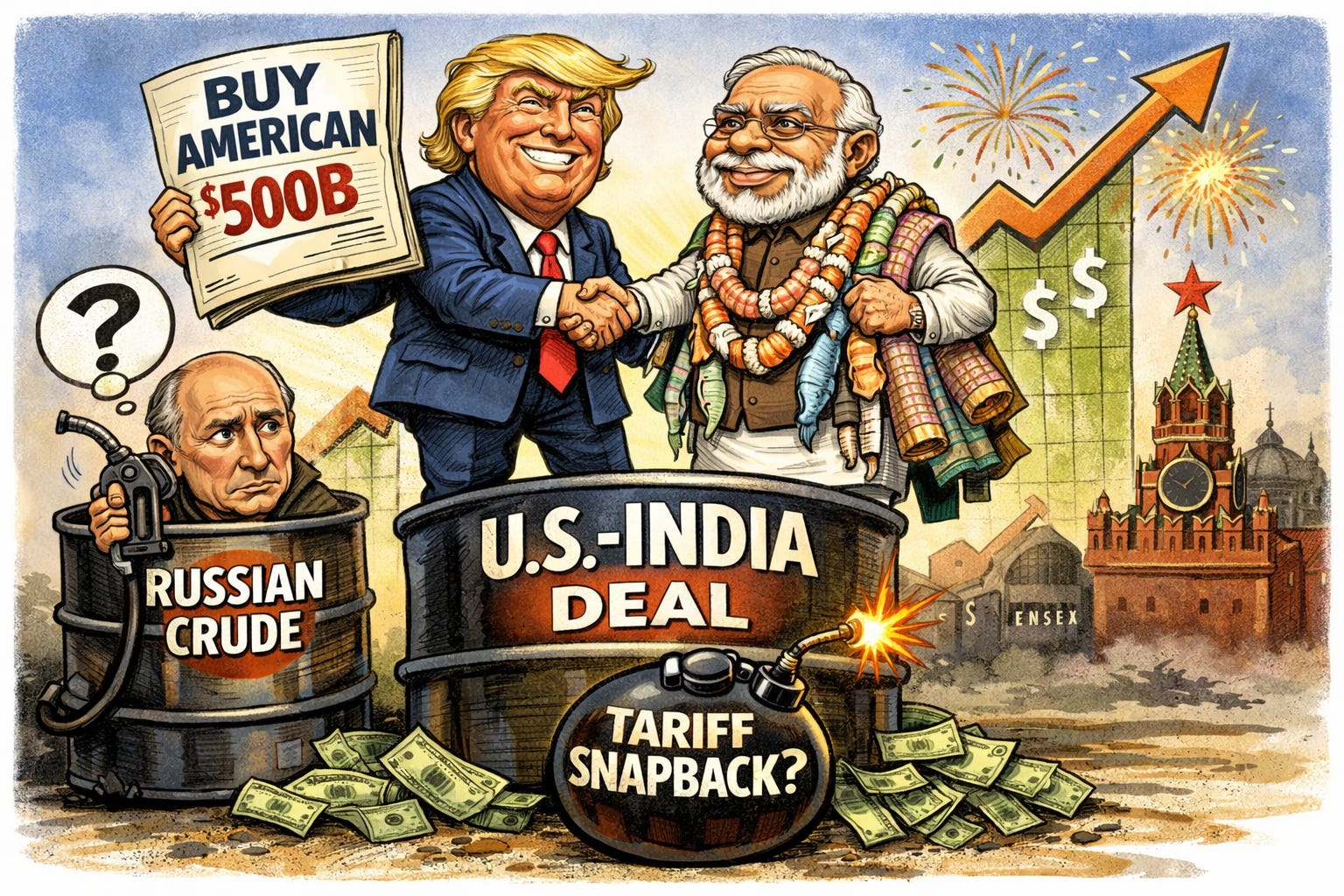
In a massive Monday morning pivot, Trump and Modi announced a trade agreement that drastically resets the economic relationship between Washington and New Delhi. The U.S. is cutting its reciprocal tariff on Indian goods from 25% down to 18%, while also scrapping that punitive 25% “secondary tariff” imposed last August over India’s Russian oil habit. In exchange, Trump claims Modi committed to zeroing out tariffs on American goods and, most significantly, halting all Russian crude oil purchases in favor of U.S. and potentially Venezuelan supply. While Trump touted a $500 billion “Buy American” commitment, the Indian government has yet to independently confirm that specific figure or a timeline for the oil cutoff.
This deal is a massive relief valve for Indian markets, which had been suffocating under the previous 50% effective tariff rate. The 18% level now gives India a competitive edge over Vietnam (20%) and China (34%), which explains why the Sensex surged over 4% and the Rupee saw its best day in three years. For investors, the immediate winners are the labor-intensive exporters: textiles, leather, and seafood. However, there’s a glaring gap between the White House and the Kremlin, as Russia claims they haven’t heard a word about India stopping oil shipments. This suggests we are in a “Phase 1” honeymoon where political signals are outrunning the formal paperwork.
Sensei’s Insight: Watch the Kremlin’s reaction and New Delhi’s silence on the oil ban. If India continues importing Russian crude, those 18% tariffs could snap back faster than they disappeared.
🔌 OpenAI Sparks the Inference Wars
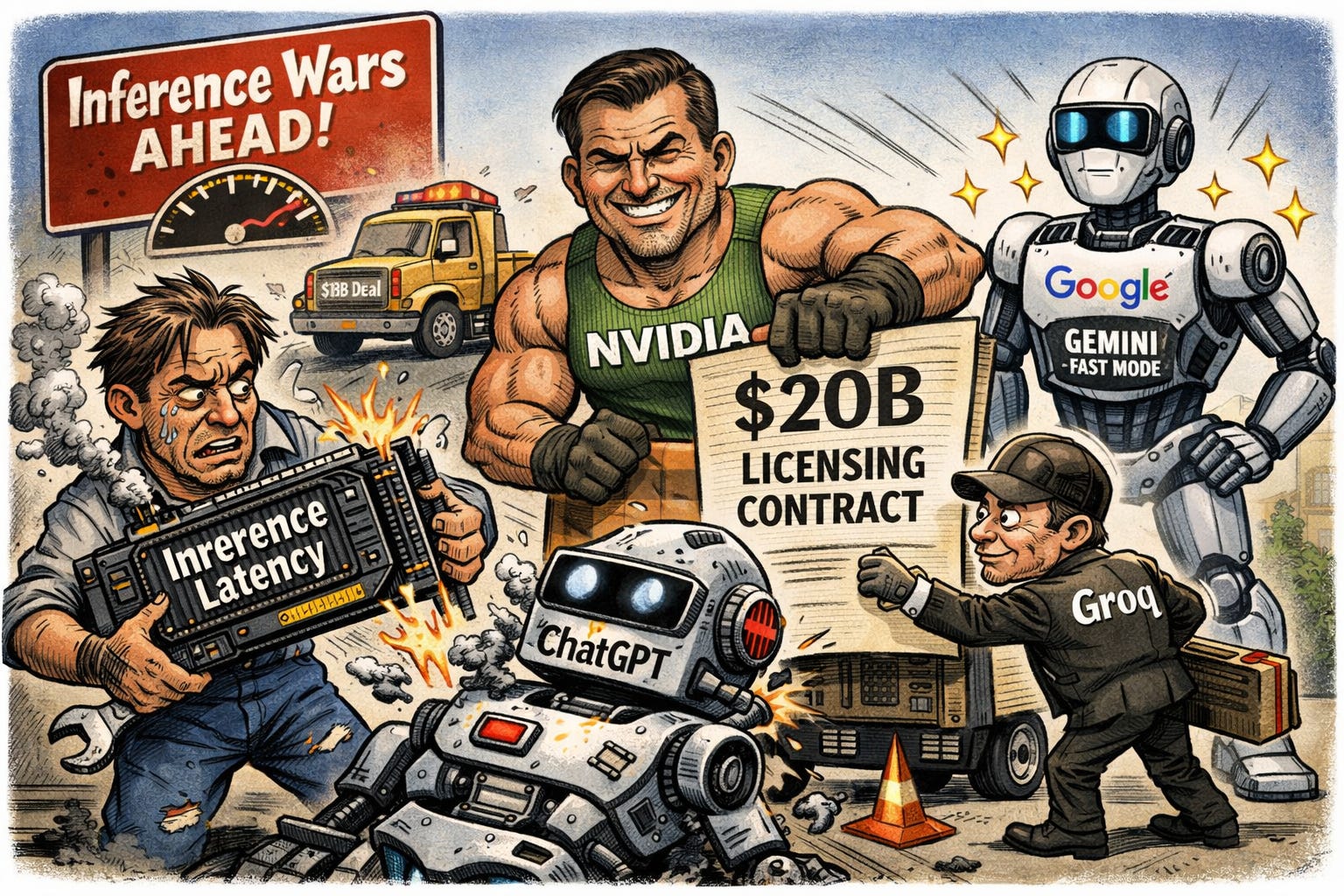
OpenAI is reportedly shopping for alternatives to Nvidia’s hardware, specifically for “inference”—the real-time processing that happens when ChatGPT answers a prompt. According to a Reuters investigation, the company is dissatisfied with the latency of Nvidia’s GPUs when handling specialized tasks like software development. While Nvidia dominates the “training” phase of AI, its external-memory architecture creates bottlenecks that slow down responses. OpenAI’s goal is to eventually shift roughly 10% of its inference needs to specialized chips with high-speed, on-chip memory. This frustration likely fueled OpenAI’s recent $10 billion deal with Cerebras, signaling a move away from total reliance on the Nvidia ecosystem (Reuters).
This shift matters because inference spending is expected to eventually dwarf training costs as AI models move from development to mass daily use. If specialized hardware can deliver answers faster and cheaper, Nvidia’s iron grip on AI margins could start to slip. We’re already seeing the fallout: Nvidia recently blocked OpenAI’s talks with startup Groq by swooping in with a $20 billion licensing deal for Groq’s intellectual property. Meanwhile, Google’s stock rose as investors realized its in-house TPU chips already provide the exact speed advantage OpenAI is hunting for. The era of the “one-chip monopoly” is fading as the industry realizes that one size does not fit all for every AI task.
Sensei’s Insight: Watch the “speed gap” between ChatGPT and competitors like Google’s Gemini. If OpenAI can’t solve its latency issues through hardware diversification, it risks losing power users who prioritize real-time performance over model size.
🤝 White House hosts high-stakes crypto-banking summit
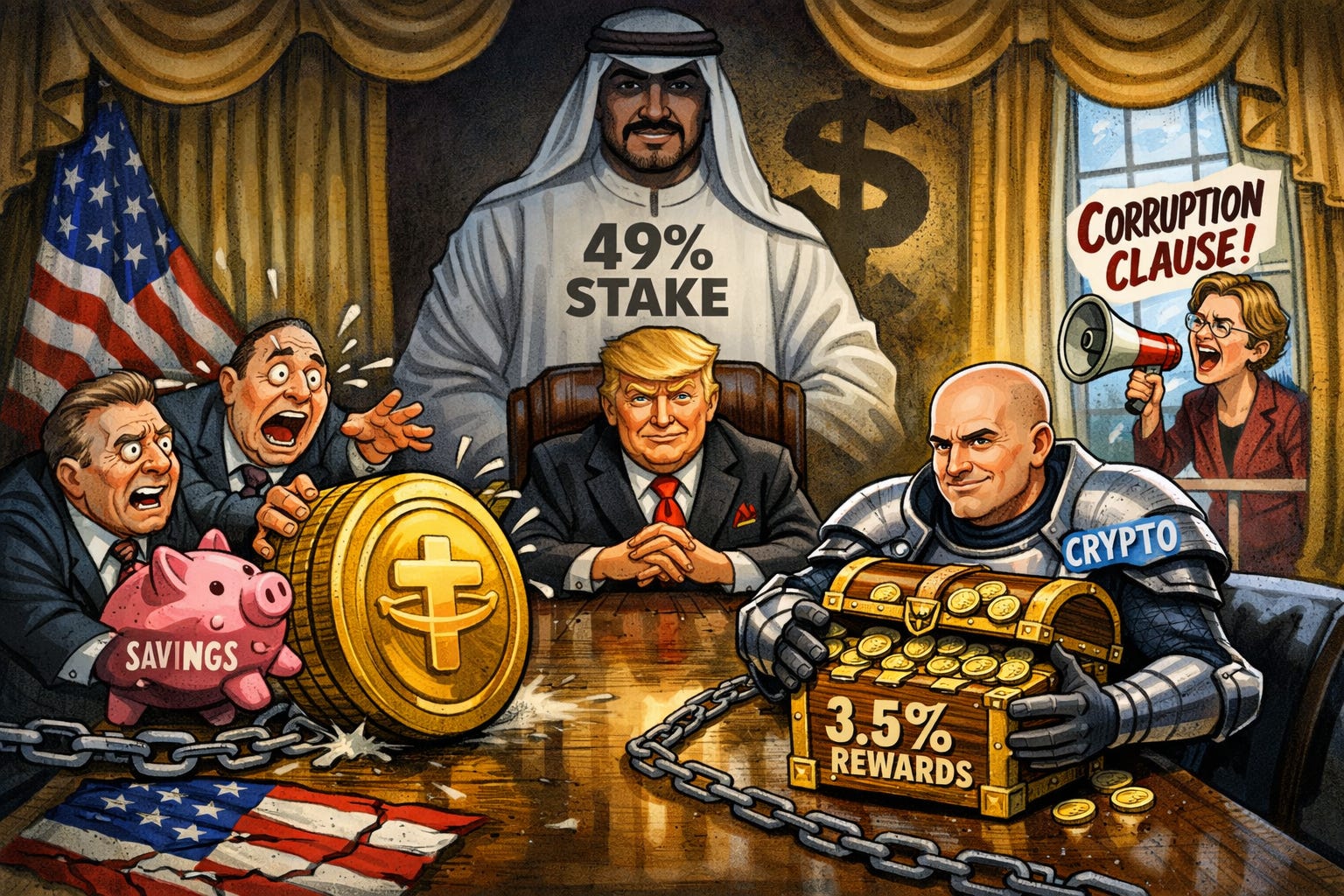
The Trump administration held a closed-door session on Monday, February 2, 2026, to break a legislative stalemate over the CLARITY Act. Led by Patrick Witt of the President’s Crypto Council, the meeting brought together executives from Coinbase and major banking associations to resolve a fierce dispute over stablecoin rewards. Traditional banks want to ban these yields, which currently sit around 3.5% on platforms like Coinbase, fearing they will drain deposits from savings accounts. For Coinbase, the stakes are high: stablecoins and rewards generated over $400 million in revenue in Q4 2025 alone (Barron’s).
This intervention follows Coinbase CEO Brian Armstrong’s January withdrawal of support for the bill, which he claimed allowed banks to “ban their competition.” While some crypto firms suggest a compromise where stablecoin issuers hold reserves at community banks to buy their support, a new complication has emerged. Reports surfaced on February 1 that a UAE-backed firm purchased a 49% stake in the Trump family’s World Liberty Financial for $500 million. This deal has solidified Democratic opposition, with leaders like Elizabeth Warren citing “corruption” and demanding ethics clauses that Republicans have so far blocked.
Sensei’s Insight: Watch the $185 level on Coinbase (COIN). If the White House fails to broker a compromise on yields, expect regulatory gridlock to persist through the 2026 midterms.
🔗 Connect with Us
Stay plugged in across platforms:
Sensei on X: sensei_live_
Martyn Lucas on X: MartynInvestor
Vaz on X: eVTOLHUB
📺 YouTube Channel (Live & Replays): Martyn Lucas Investor

🔍Deep Dive: Copper: The Metal of the Future Is Facing a Supply Crisis