This content is for informational and educational purposes only and does not constitute financial advice. Always do your own research. Not financial advice (NFA).
👀 Today’s Stories at a Glance
🔥 Iran Attacks Saudi Capital: Drones hit the US Embassy in Riyadh as regional conflict escalates and vital oil routes close.
🛢️ Strait of Hormuz Shuts Down: Tanker traffic dropped 70% following drone strikes, sending Brent crude prices surging significantly higher.
⚡ Qatar Halts Global Gas Production: Strikes forced a production stop, causing European gas futures to jump 50% in two sessions.
📉 South Korean Markets Crash Hard: The Kospi index plunged over 7%, marking its largest point drop ever amid regional energy fears.
🤖 US Caps Nvidia China Sales: New export limits of 75,000 AI chips per customer threaten to curb Chinese tech growth significantly.
☁️ Drones Strike Amazon Data Hubs: Impacted Middle East facilities suffered damage, causing bank outages and disrupting critical digital services.
🧠 One Big Thing
The Great Energy Fracture
The closure of the Strait of Hormuz and the halt of Qatari gas production have triggered a systemic dual supply shock. This crisis removes twenty percent of global oil and liquefied natural gas capacity from the market simultaneously. Investors are fleeing growth assets as energy costs surge and manufacturing hubs like South Korea suffer record losses. Digital infrastructure has also lost its status as a safe harbor after drone strikes damaged regional data centers. Markets are now pricing in a stagflationary environment defined by restricted supply and physical vulnerability. The foundational pillars of the 2026 bull market have fractured.
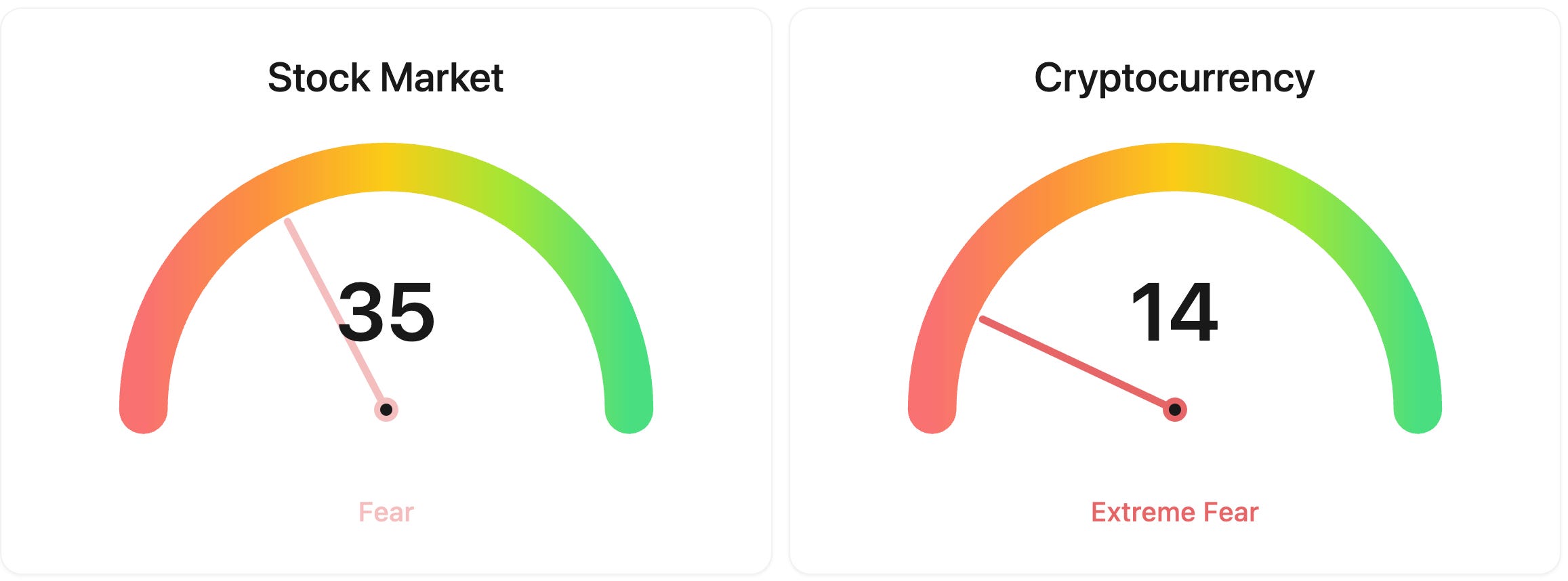
⚖️ Fear & Greed
📉 The Number That Matters
48%
European gas futures surged 48% over two sessions after QatarEnergy declared force majeure. The halt of Qatari LNG production, which accounts for 20% of global supply, has triggered a massive energy price shock across Europe and Asia.
⚔️ Winners vs Losers
Winners
VG 0.00%↑: Venture Global surged after reporting Q4 earnings with EPS of $0.41 beating the $0.35 estimate, exporting a record 128 LNG cargos in the quarter, and announcing a new multi-year supply agreement with Trafigura, with the broader spike in oil prices on Middle East escalation adding further tailwind to the stock.
OUST 0.00%↑: Ouster crushed Q4 estimates with EPS of $0.06 against a projected loss of $0.14, revenue of $62.2M beating the $41.1M consensus by 51%, and delivered its first quarter of positive adjusted EBITDA, capping a year in which annual revenue grew 52%.
PLUG 0.00%↑: Plug Power beat Q4 revenue estimates with $225.2M against the $217.4M forecast and posted a narrower-than-expected loss, with management guiding toward positive EBITDA by Q4 2026 in what it called a pivotal commercial inflection point for the business.
LNG 0.00%↑: Cheniere Energy rallied sharply as escalating Middle East conflict and threats to close the Strait of Hormuz drove a surge in global LNG demand expectations, directly benefiting the largest U.S. LNG exporter.
FANG 0.00%↑: Diamondback Energy climbed alongside a roughly 8% spike in Brent crude prices driven by U.S. and Israeli strikes on Iranian targets over the weekend and fears of supply disruption through the Strait of Hormuz.
Losers
MDB 0.00%↑: MongoDB cratered despite beating Q4 estimates with EPS of $1.65 and revenue of $695M, as investors sold sharply on Q1 FY2027 guidance that came in below consensus and the unexpected departure of the company’s President of Field Operations and Chief Revenue Officer, both effective today.
SGRY 0.00%↑: Surgery Partners plunged after Q4 adjusted EPS of $0.12 badly missed the $0.30 estimate and full-year 2026 sales guidance of $3.35-3.45B fell well short of the $3.56B consensus, with the CEO acknowledging significant and unanticipated headwinds in the quarter.
LIF 0.00%↑: Life360 fell sharply after Q4 results raised concerns about near-term margin compression, with management guiding Q1 2026 adjusted EBITDA margins to low double digits due to front-loaded investment spending and hardware revenue expected to decline roughly 50% with negative gross margins in the quarter, prompting analyst downgrades from Stifel and Canaccord.
SE 0.00%↑: Sea Limited dropped after Q4 earnings showed EPS of $0.63 missed the $0.80 estimate by 21%, disappointing investors despite a strong revenue beat of $6.9B against the $6.49B forecast and net income growth of 73% year over year.
GFI 0.00%↑: Gold Fields fell sharply as mining stocks were caught in a broad equity selloff driven by Middle East escalation, with investors rotating into physical gold rather than producers despite gold prices rallying to $5,270 per ounce.
AU 0.00%↑: AngloGold Ashanti declined alongside peers as the broader risk-off sentiment and energy cost concerns from surging oil prices weighed on the mining sector even as gold hit fresh highs.
FCX 0.00%↑: Freeport-McMoRan fell as the broader equity selloff on geopolitical tensions dragged down materials and mining stocks, with rising energy costs from the oil surge adding pressure to the copper producer’s cost outlook.
NEM 0.00%↑: Newmont dropped despite gold’s safe-haven rally, as mining equities were treated as risk assets and sold alongside the broader market rather than benefiting from the underlying commodity’s strength.
SCCO 0.00%↑: Southern Copper slipped as the combination of a broad equity selloff, energy cost headwinds from surging oil prices, and sector-wide rotation out of mining stocks weighed on shares.
📊 Market Snapshot
Cryptocurrencies:
Bitcoin (BTC): $67,025 (▼ -2.61%)
Ethereum (ETH): $1,963 (▼ -3.14%)
XRP: $1.35 (▼ -2.76%)
Equity Indices (Futures):
S&P 500: $6,766 (▼ -1.59%)
NASDAQ 100: $24,489 (▼ -2.14%)
FTSE 100: £10,489 (▼ -2.78%)
Commodities & Bonds:
10-Year US Treasury Yield: 4.10% (▲ 1.59%)
Oil (WTI): $77 (▲ 8.55%)
Gold: $5,146 (▼ -3.30%)
Silver: $81.33 (▼ -8.88%)
Data as of UK (GMT): 11:50 AM / US (EST): 06:50 AM / Asia (Tokyo): 20:50
✅ 5 Things to Know Today
🔥 Day Four: Iran Hits Riyadh as the War Widens
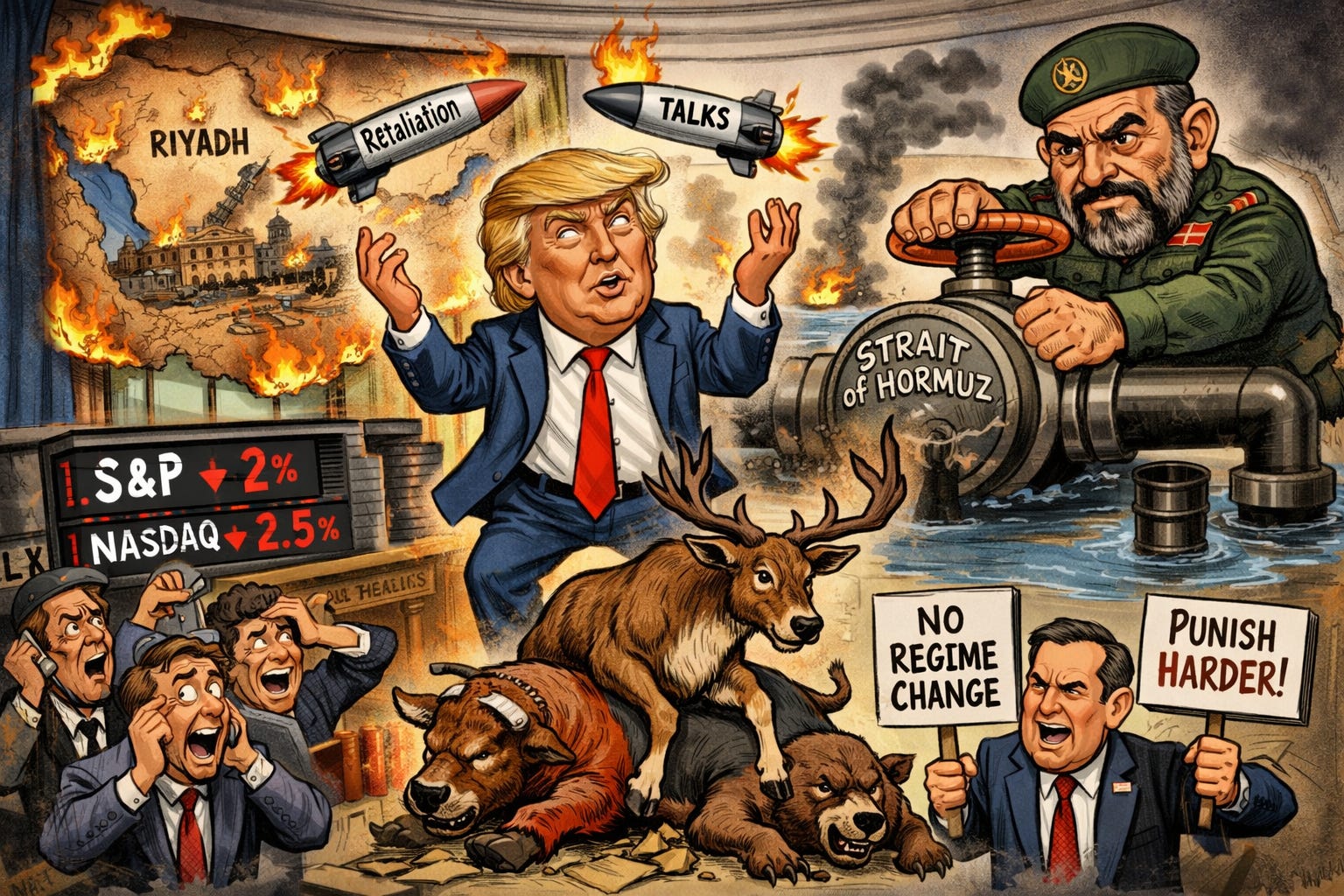
The US-Israel campaign against Iran, now in its fourth day, escalated overnight when two drones struck the US Embassy in Riyadh, Saudi Arabia, marking the first direct attack on the Saudi capital since the conflict began Saturday. President Trump vowed retaliation but gave no timeline. Iran’s Islamic Revolutionary Guard Corps (IRGC) has now struck 27 US military bases across the region, killed six American service members, and declared the Strait of Hormuz, through which roughly 20% of the world’s oil flows, officially closed to shipping. Trump has estimated the campaign will last four to five weeks, though he’s confirmed Iran has requested talks and that he’s open in principle to negotiations (Washington Post).
Markets are pricing in a prolonged conflict, not a quick resolution. The S&P 500 fell 1.1% yesterday and futures point to a further 2% drop at today’s open, with Nasdaq 100 futures down 2.5%. Stocks and bonds are falling together, a pattern historically associated with stagflation, where rising prices and slowing growth hit simultaneously and leave traditional portfolios with nowhere to hide. Defence stocks are the standout exception, with South Korea’s Hanwha Aerospace surging nearly 20% overnight (CNBC).
Sensei’s Insight: Stagflation is the scenario central banks fear most because higher interest rates can cool demand but can’t pump oil through a closed strait. What makes this worse is the White House can’t agree on what winning looks like: Defence Secretary Pete Hegseth rules out regime change while Secretary of State Marco Rubio promises a more punishing next phase. Markets can absorb war. They struggle with wars that have no defined exit.
🛢️ The World’s Most Important Waterway Has Gone Dark
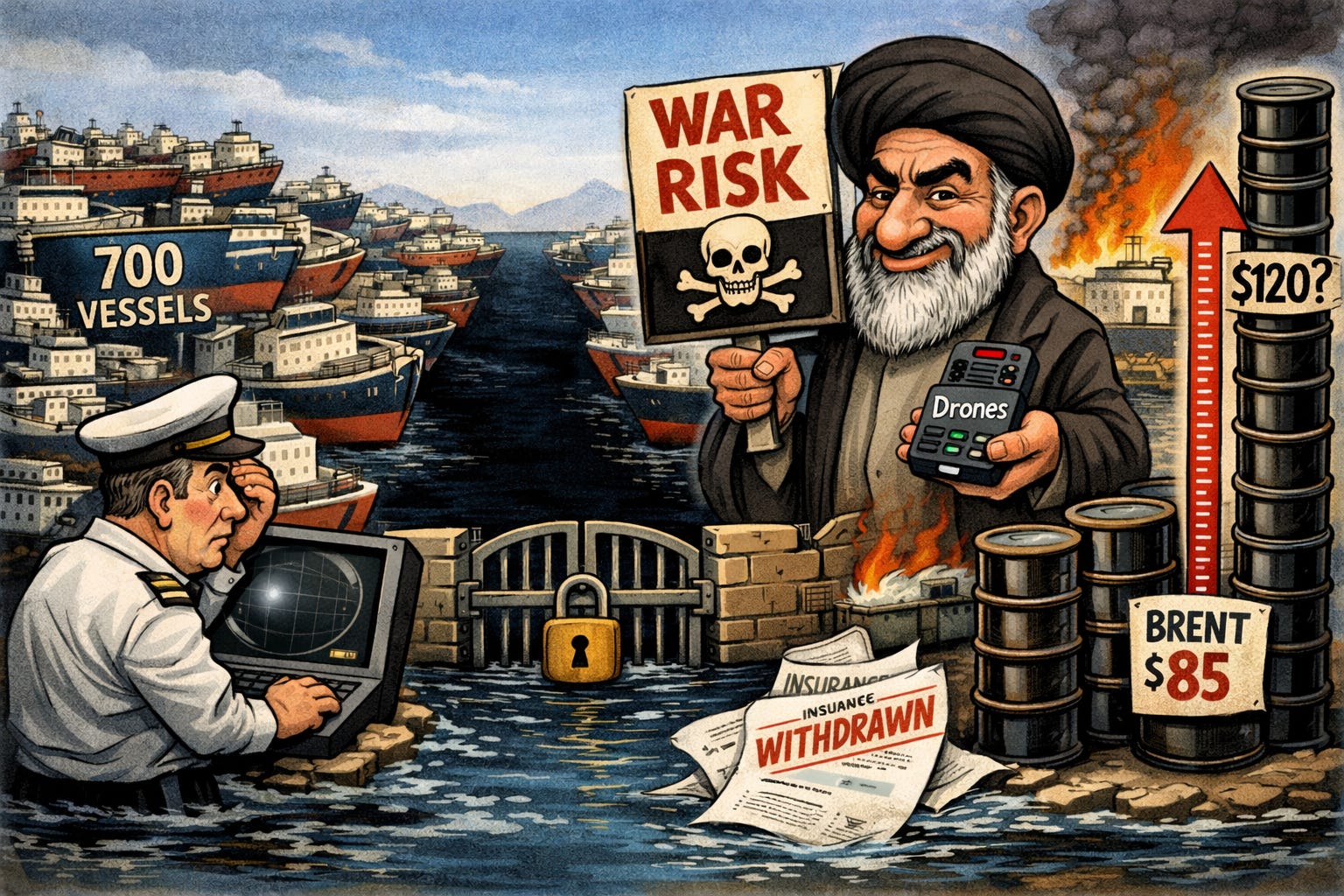
The Strait of Hormuz, a roughly 33-kilometre-wide channel between Iran and Oman through which approximately 20% of the world’s daily oil supply travels, has effectively shut down for commercial shipping. Iran didn’t need to deploy a naval blockade to achieve this. A combination of IRGC warnings, selective drone strikes on vessels, and the near-total withdrawal of war-risk insurance by major marine associations has been enough. Ship-tracking data shows tanker traffic dropped around 70% within the first day of the conflict and has since fallen to near zero, with no vessels currently broadcasting location signals in the strait. Brent crude has risen from roughly $73 a barrel before Saturday’s strikes to above $85 today, a move of over 16% in four days (CNBC).
Around 700 vessels are reported idle on either side of the strait. Overnight, debris from an intercepted Iranian drone caused a major fire at the UAE’s Fujairah oil hub, one of the largest oil storage and trading centres in the Middle East, while Saudi Arabia’s Ras Tanura refinery, which processes 550,000 barrels per day, remains offline. JPMorgan estimates that a 25-day closure could push Brent to $120 a barrel as Gulf producers’ storage fills and they’re forced to cut output. Deutsche Bank puts $200 a barrel on the table in a full naval blockade scenario involving mines and anti-ship missiles. Those are tail risks, not base cases, but they frame what’s possible if this drags on (Al Jazeera).
Sensei’s Insight: Brent at $85 reflects traders betting on a short war, not a long one. That assumption is doing enormous work. JPMorgan’s models put Brent at $120 after 25 days of closure. OPEC+ holds 3.5 million barrels per day of spare capacity, but spare capacity means nothing if the exit route is closed.
⚡ Qatar Pulls the Plug on 20% of the World’s Gas Supply
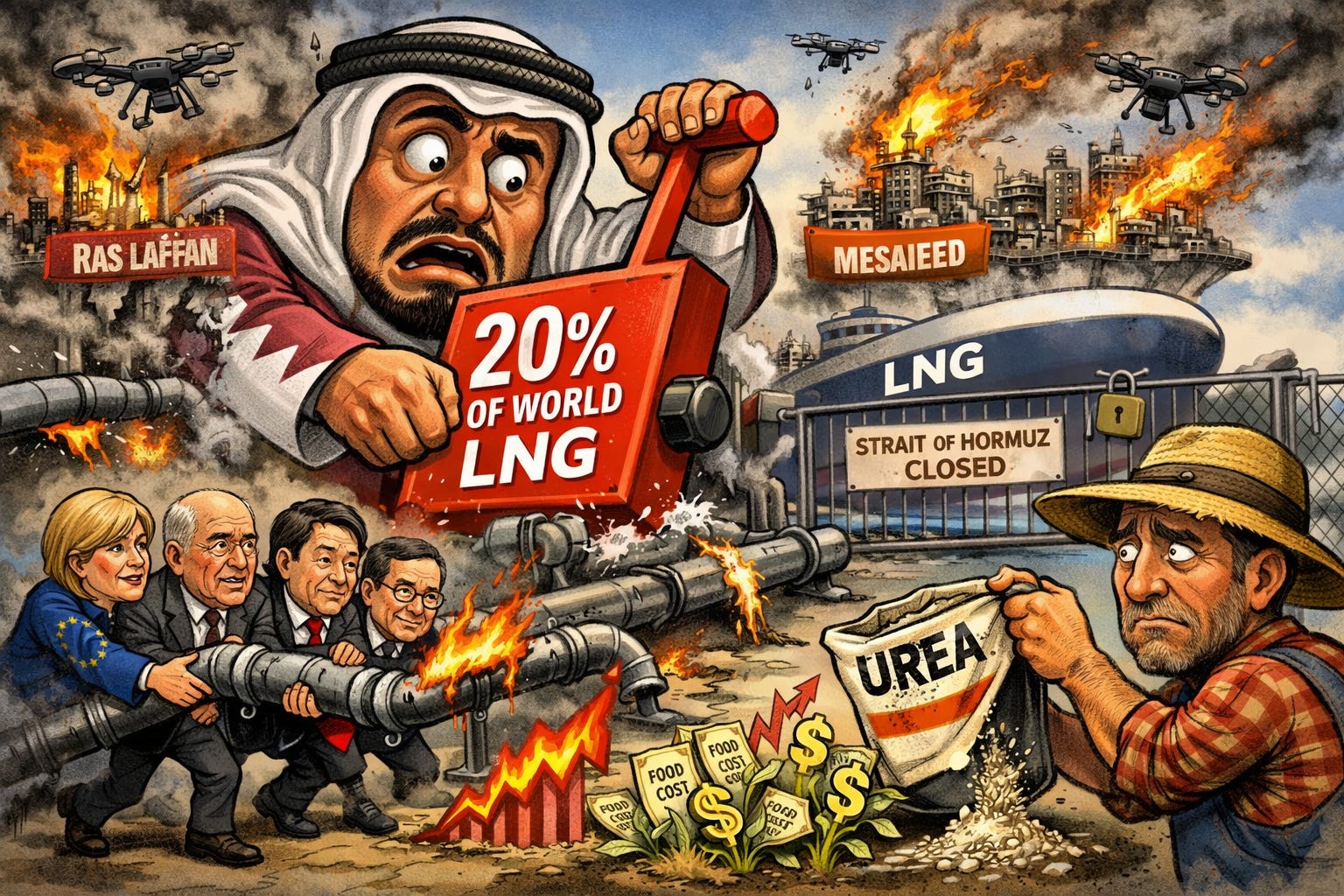
QatarEnergy, the state-owned company responsible for roughly 20% of global liquefied natural gas (LNG) supply, announced a complete halt to production yesterday after Iranian drone strikes damaged two of its key facilities: Ras Laffan Industrial City, the world’s largest LNG export complex, and Mesaieed Industrial City. The company declared force majeure, a legal clause that releases a supplier from its contractual delivery obligations when events outside its control, such as acts of war, make fulfilment impossible. Qatar shipped approximately 81 million metric tonnes of LNG in 2025, supplying long-term contracts to Japan, South Korea, China, and India that are foundational to those nations’ energy security (Al Jazeera).
Today QatarEnergy expanded the shutdown beyond gas. Urea used in fertilisers, polymers, methanol, and aluminium are now also offline, extending the supply shock from energy markets into agriculture and industrial supply chains. European gas futures have surged as much as 48% over the past two sessions to a three-year high, while the Asian LNG benchmark jumped roughly 39% after the initial announcement. The disruption is compounded by the Strait of Hormuz closure: even if Qatar could restart production tomorrow, the exit route for its tankers is effectively shut. The EU’s gas coordination group will hold an emergency meeting tomorrow to assess supply impacts (Bloomberg).
Sensei’s Insight: The energy headlines are dominating, but Qatar’s downstream halt may be the sleeper shock. Urea is the primary input for nitrogen fertiliser. When urea supply tightens, food production costs rise. That means this conflict could be pushing grocery prices higher months after any ceasefire, long after the gas headlines fade.
📉 South Korea’s Market Just Had Its Worst Day Since August 2024
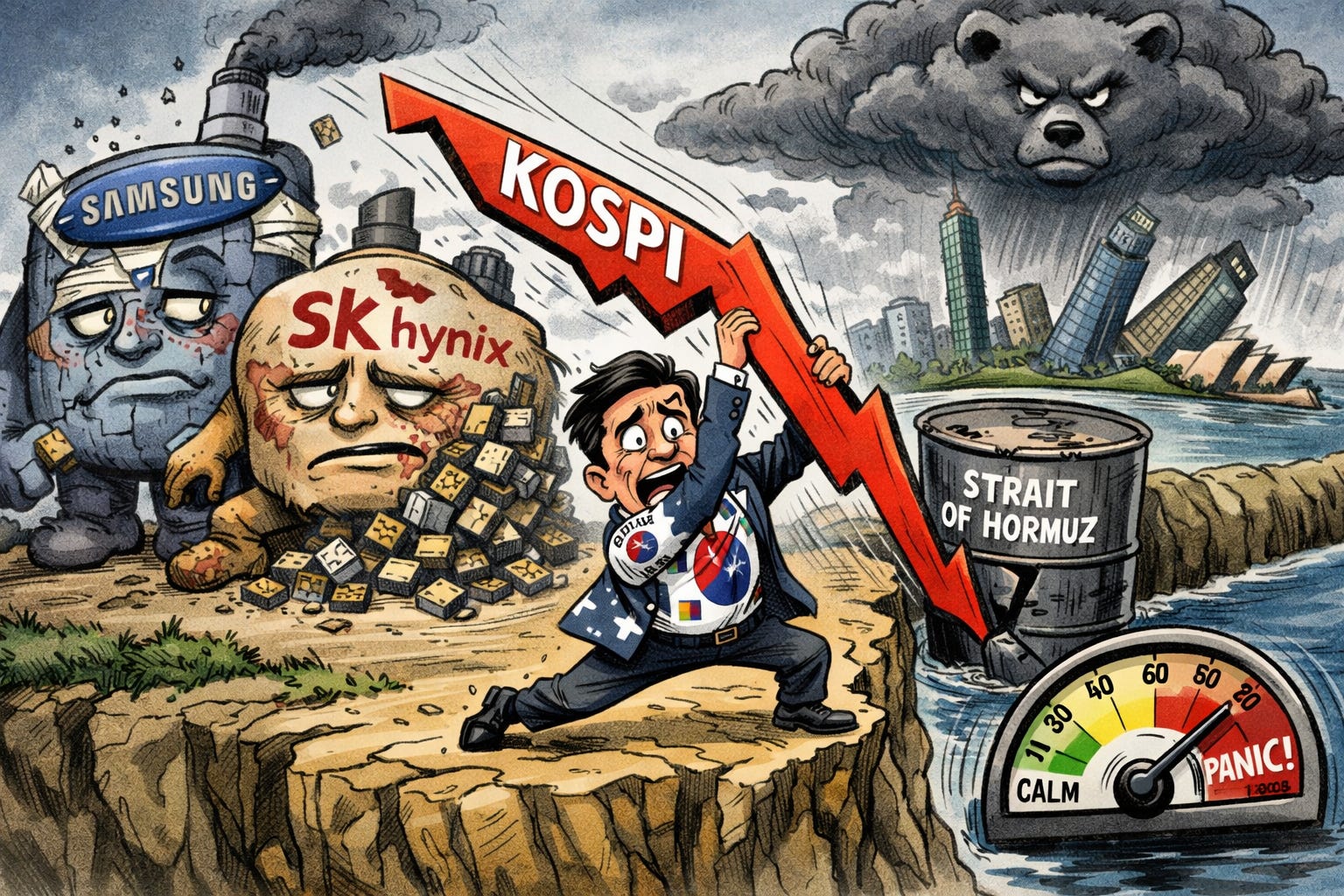
South Korea’s benchmark Kospi index crashed 7.24% today, its steepest single-day drop since the yen carry trade unwind triggered an 8.77% collapse last August. The index closed at 5,791.91, a fall of 452.22 points in absolute terms, the largest point drop ever recorded on the index. The market had been closed yesterday for a public holiday, meaning all of Monday’s global selloff landed in a single session. Samsung Electronics fell 9.88%, crashing back below the 200,000 won level it had only broken above last week. SK Hynix, the world’s leading producer of High Bandwidth Memory (HBM) chips used inside Nvidia’s AI systems, dropped 11.5%. The two companies lost a combined $170 billion in market capitalisation in a single day (Bloomberg).
South Korea imports approximately 70 to 80% of its oil through the Strait of Hormuz, making it one of the most directly exposed major economies to a prolonged closure. Foreign investors sold a net 5.17 trillion won, roughly $3.7 billion, today alone, extending a nine-consecutive-session selling streak. The country’s financial fear gauge, the Volatility Index of Kospi (VKOSPI), surged to 62.97, breaching the 60 level for the first time in its history. South Korea isn’t alone: Japan’s Nikkei fell 3.06% today for the same structural reason, and Taiwan, Hong Kong, and Australia all closed lower. The Asia-Pacific’s bull run of 2026 was built on cheap energy and AI momentum. Today, one of those pillars cracked (CNBC).
Sensei’s Insight: South Korea is the sharpest expression of a broader regional problem. Japan’s Nikkei fell 3% today for the same reason: both economies import the vast majority of their oil through a strait that is now effectively closed. Taiwan and Australia are down too. The Asia-Pacific’s great bull run of 2026 was built on cheap energy and AI momentum. One of those pillars just cracked.
🤖 US Moves to Cap Nvidia Chip Sales to China at 75,000 Units Per Customer
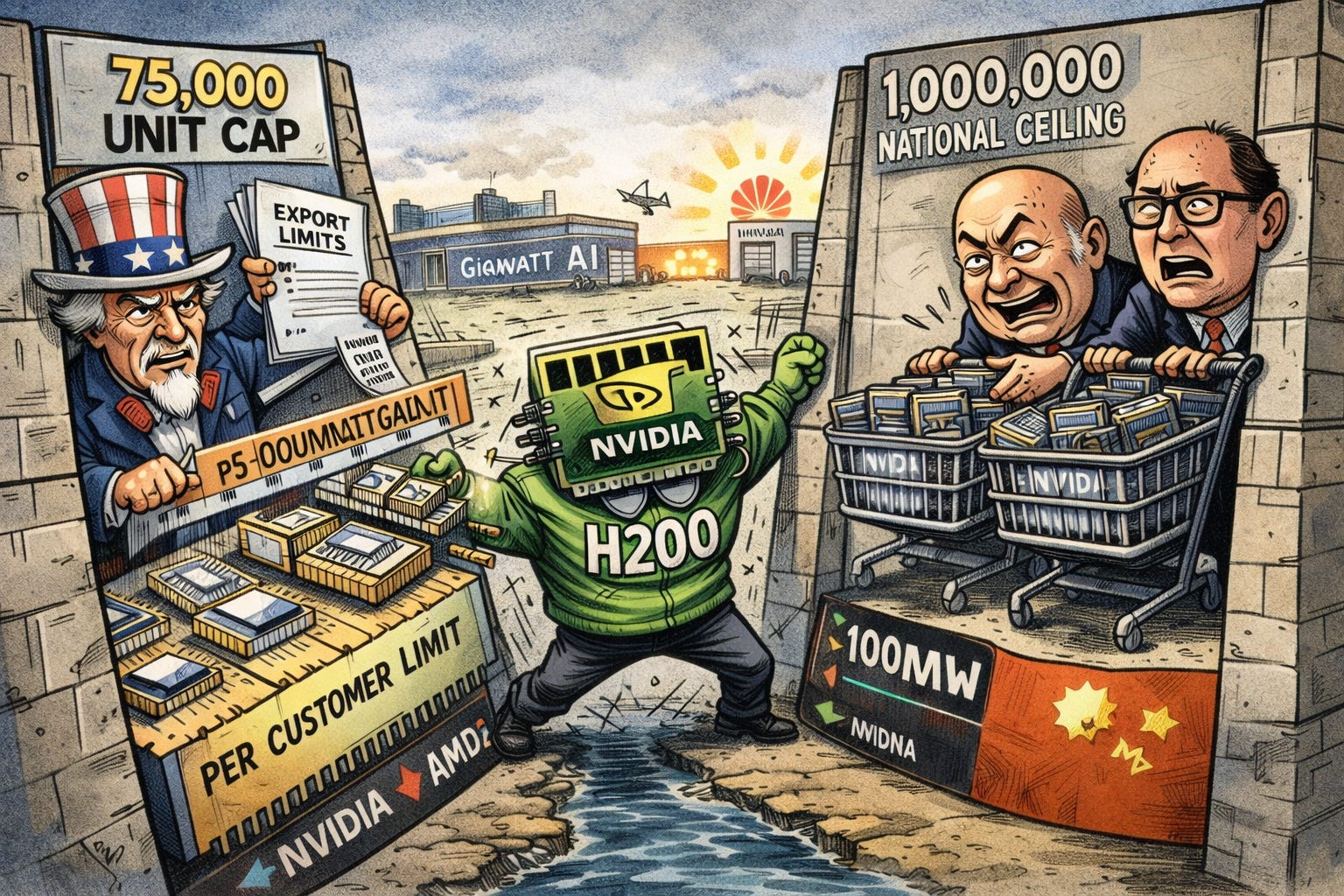
The Trump administration is reportedly considering a per-customer limit of 75,000 units on exports of Nvidia’s H200 artificial intelligence chip to China, with Advanced Micro Devices’ (AMD) comparable MI325 chip counting toward the same cap. The ceiling would dramatically constrain what China’s largest technology companies can actually purchase: Alibaba and ByteDance have each privately indicated they want to buy more than 150,000 units, more than double the proposed limit. A separate national export ceiling of around one million units for China as a whole remains in place. Nvidia and AMD both slipped in after-hours trading on the news (Bloomberg).
The H200 is Nvidia’s previous-generation chip, one step behind its current Blackwell line, but still more powerful than anything Huawei can produce domestically. Trump approved H200 sales to China in December 2025 after years of export restrictions, a deal Nvidia publicly championed. National security officials have since layered on additional restrictions that Nvidia has criticised as undermining the president’s original intent. A planned Trump-Xi meeting in the coming weeks had been seen as the moment the terms would be finalised. The per-customer cap, if confirmed, would limit Chinese tech giants to building data centres of roughly 100 megawatt scale, far short of the gigawatt-scale facilities being constructed in the United States, and gives Huawei more room to develop its domestic chip ecosystem without American competition (South China Morning Post).
Sensei’s Insight: Nvidia is being hit from two directions at once. Its Gulf data centre customers are dealing with damaged infrastructure and a conflict showing no signs of quick resolution. Now its China opportunity, estimated internally at $50 billion a year, is being capped before it ever materialises. The world’s most valuable chip company suddenly has fewer places to sell.
☁️ Drones Hit Amazon’s Data Centres - A First in Modern Warfare
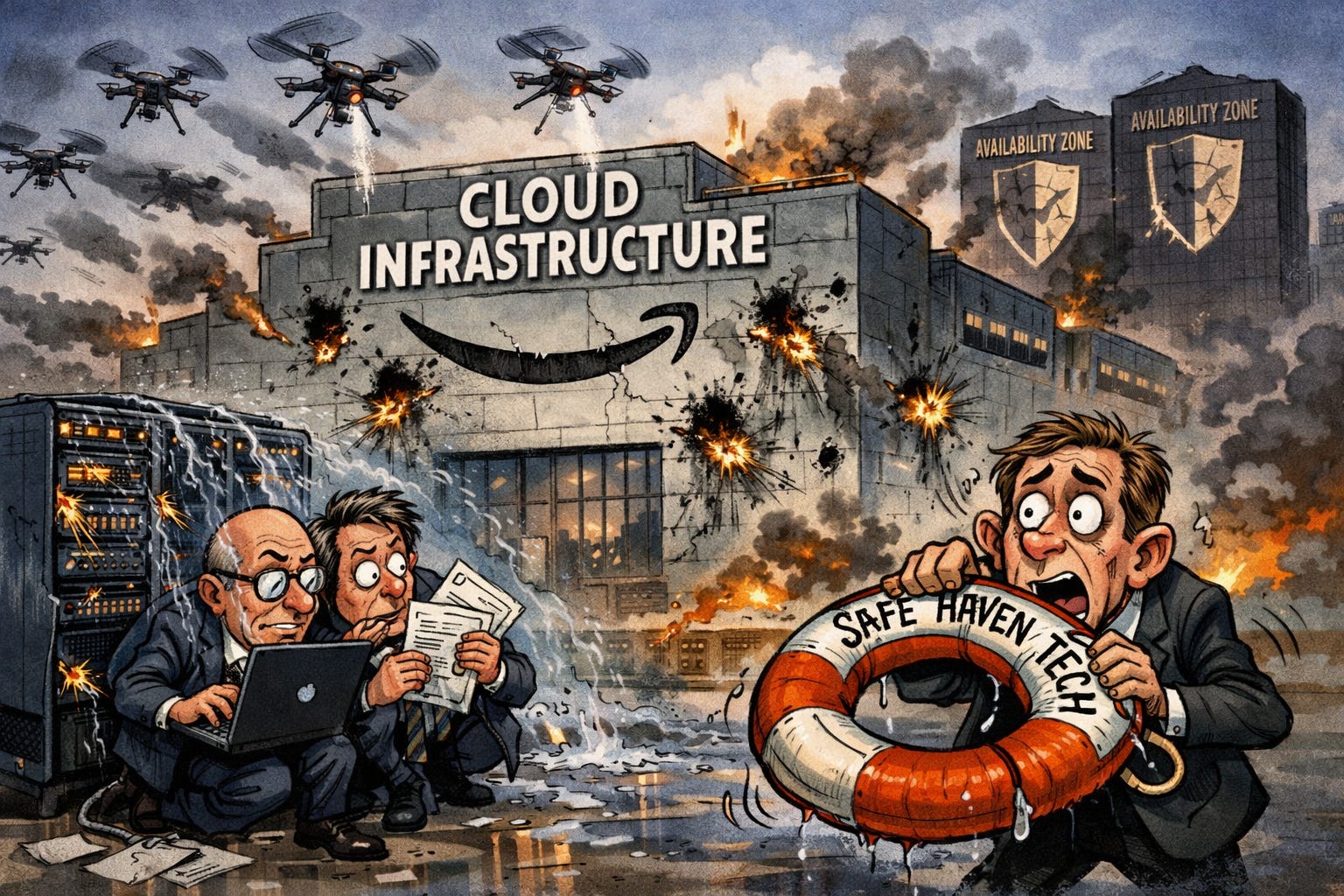
Amazon Web Services (AWS), the cloud computing division of Amazon and one of the world’s largest providers of internet infrastructure, has confirmed that three of its data centres in the Middle East were damaged by drone strikes tied to the Iran conflict. Two facilities in the United Arab Emirates were directly struck, while a third in Bahrain suffered damage when a drone impacted close to the building. AWS acknowledged the strikes caused structural damage, disrupted power delivery, and in some cases required fire suppression that led to additional water damage beyond the initial impact. Two of the three UAE availability zones, the independent data hubs AWS uses to provide backup redundancy, remain significantly impaired as of this morning (CNBC).
AWS was designed to withstand the failure of a single availability zone at a time. Losing two simultaneously overwhelms that redundancy entirely. Twelve or more core AWS services reported elevated error rates, and several major UAE banks including Emirates NBD and Abu Dhabi Commercial Bank reported temporary outages to mobile apps and phone services. AWS has formally advised customers with workloads in the region to back up data immediately and consider migrate to servers outside the Middle East. The wider investment implication is significant: Microsoft has committed $15 billion to UAE technology infrastructure through 2029, and Amazon, Google, and others have comparably large footprints in the Gulf. The question those companies now face is whether a data centre worth billions can be rendered inoperable by a drone costing a fraction of that (The Register).
Sensei’s Insight: Investors rotating into tech to escape the inflation shock just discovered tech isn’t a safe harbour either. Cloud infrastructure, AI data centres, digital banking, none of it is insulated when the physical buildings can be hit by a $10,000 drone. This conflict is rewriting which sectors count as defensive.
🔗 Connect with Us
Stay plugged in across platforms:
Sensei on X: sensei_live_
Martyn Lucas on X: MartynInvestor
Vaz on X: eVTOLHUB
📺 YouTube Channel (Live & Replays): Martyn Lucas Investor