

This content is for informational and educational purposes only and does not constitute financial advice. Always do your own research. Not financial advice (NFA).
👀 Today’s Stories at a Glance
🍎 Apple’s margin guide slips: Apple beat on $114.5 billion of revenue, then guided margin down to 45% to 46% on memory costs.
🛢️ Oil jumps on Qeshm strike: Brent plunged more than 7% yesterday, then rose 2% this morning after US strikes on an Iranian island.
🗳️ Election night, in UK hours: Polls start closing at midnight UK, with prediction markets at 74% to 78% for a Democratic sweep.
🤖 Palantir’s best quarter sinks: Revenue jumped 96% to $2.3 billion, and the shares still fell as the Nasdaq 100 slid 1.4%.
🔐 Binance shows its proof: A cryptographic check says 10 tokens were fully backed on Saturday, before the $3.64 billion outflow.
🇦🇺 Australia hikes, then hedges: The RBA raised rates to 4.85%, an 18-year high, on a 6-3 vote.
🏭 US factories speed up: The ISM manufacturing index rose to 55.5 in October, while construction spending fell 1.9%.
📈 Boston Scientific tests $46: Chart of the Day covers the $46 resistance, the $39.60 low and the $55 level I am watching.
🧠 One Big Thing
Americans vote today, and the AI trade is already in a wobble of its own. Apple and Palantir both beat last night. Both fell after hours. Apple’s problem was the price of memory chips, which is now eating into its margin. Palantir’s problem was a share price that already assumed a near-perfect quarter. The Nasdaq 100 fell 1.4% yesterday, and Seoul’s Kospi fell 3.59% this morning. So the election is landing on a market that is nervous about AI, and AMD reports tonight while the votes are still being counted.
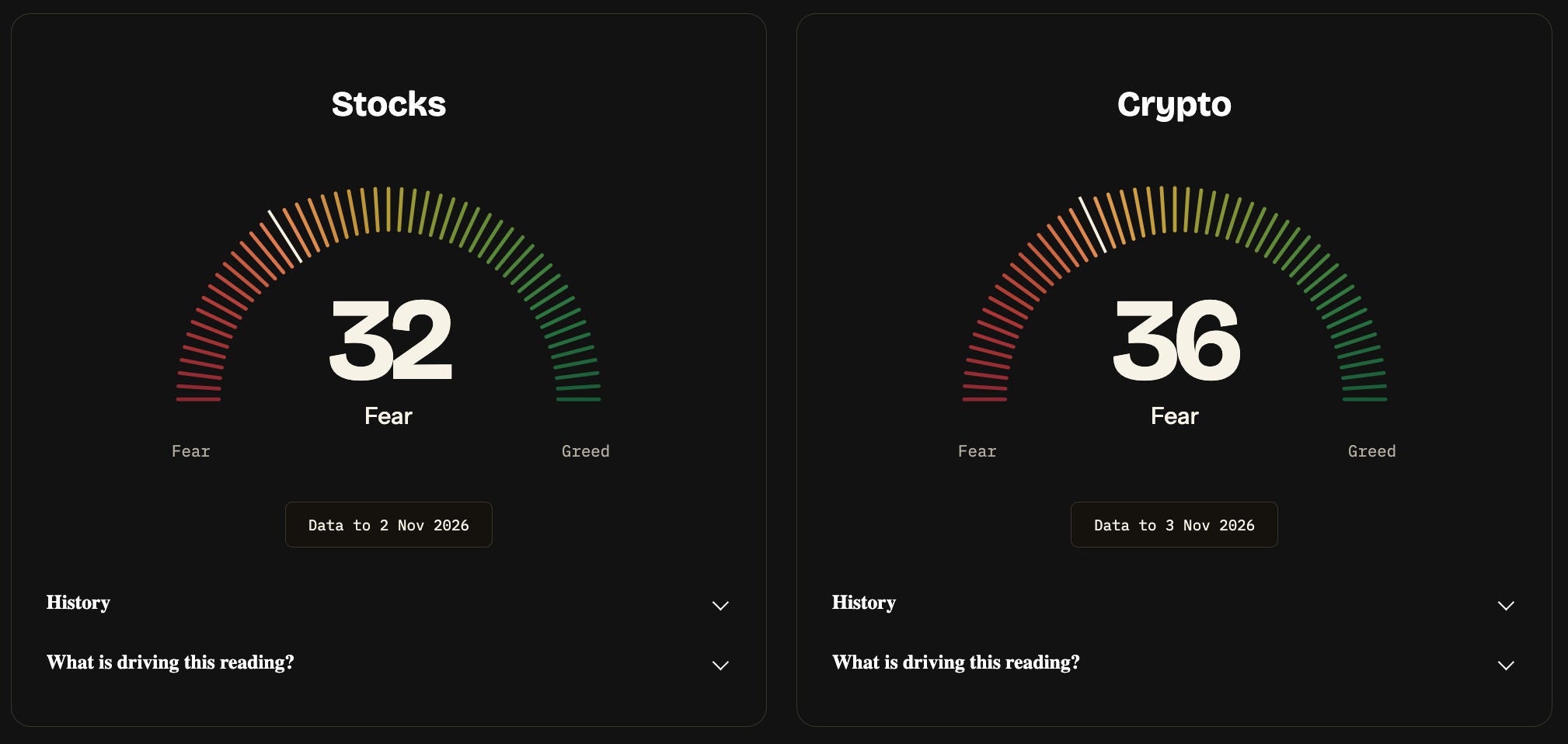
⚖️ Fear & Greed
📉 The Number That Matters
45% to 46%
Apple’s gross margin guide for the December quarter, down from 47.9% last quarter, because memory chips cost more. A record revenue quarter still comes with a thinner cut of every dollar.
✅ 5 Things to Know
🍎 Apple beat on revenue, and memory costs hit the margin guide
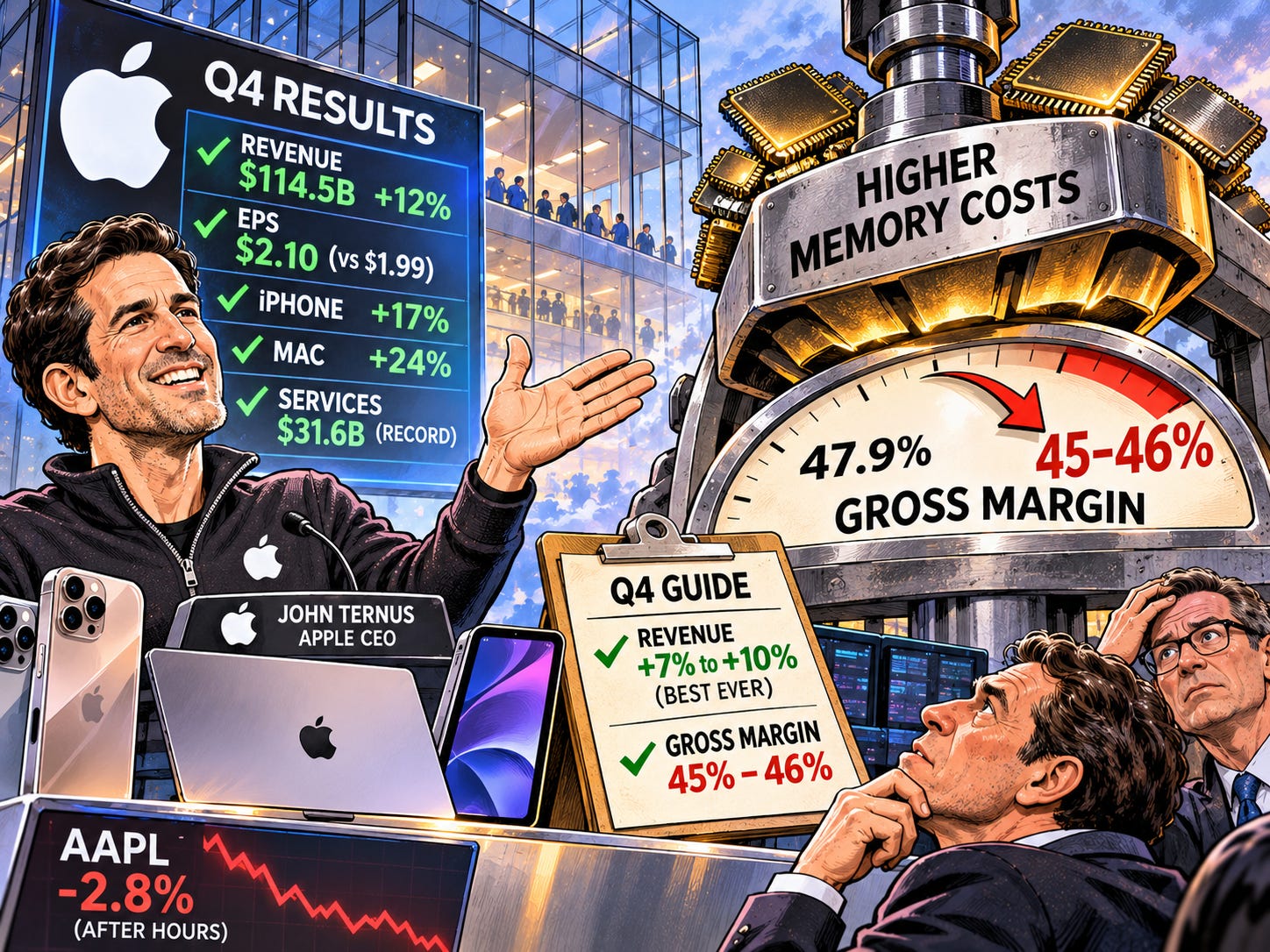
Apple reported revenue of $114.5 billion for its fiscal fourth quarter last night, up 12% and a September-quarter record. Earnings were $2.10 a share against a consensus of $1.99, Investing.com reported. iPhone revenue rose 17% to $57.6 billion and Mac revenue 24% to $10.8 billion. Services hit an all-time high of $31.6 billion. John Ternus, on his first call as chief executive, said Apple has never sold more Macs in a fiscal year. The shares fell 2.8% after hours to $328.85, after closing down 1.83% in the regular session. Investing.com
So why did the shares fall? Look at the guide. Apple expects December-quarter revenue to grow 7% to 10%, and called it the best revenue quarter in its history. It guided gross margin to 45% to 46%, down from 47.9%. Without one-off tariff refunds, margins would already have fallen about 1 point last quarter, “primarily driven by higher memory costs”, chief financial officer Kevan Parekh said. Supply stays tight too. Apple said its guide “reflects our best view of constrained supply”, especially for the Mac and iPad. MacRumors
Sensei’s Insight: Apple had a record September quarter, with iPhone up 17% and Mac up 24%. Then it told us memory chips will take a bigger slice of every sale. What I am watching is whether the supply squeeze eases before the iPhone Duo’s first full quarter is counted.
🛢️ Oil fell 7% on a peace plan, then US strikes surfaced

Brent fell more than 7% yesterday to settle at $104.77 a barrel, and WTI settled at $96.46, The National reported. Then US forces struck Iran’s Qeshm Island last night, The Wall Street Journal reported, citing US officials. Washington called the attacks defensive, aimed at stopping Iran targeting ships in the Strait of Hormuz. The Journal said they were the latest in a series of limited strikes in recent weeks, kept quiet on purpose. Iranian state media reported several explosions on the island. Brent was up 2.03% at nearly $107 by 8:52am UK, and WTI up 1.75% at $98.15. The National
What did yesterday’s fall price in? A deal. Iran said over the weekend that Hormuz could reopen within 2 days if its demands are met. “These demands are reasonable and logical,” Foreign Ministry spokesman Esmaeil Baghaei said, adding that the strait cannot be reopened unless the US naval blockade ends. A draft proposal is being circulated for a follow-up meeting, Oilprice.com reported, citing Reuters. Asked whether strikes would resume after the midterms, Donald Trump said no, Saxo reported. The strikes now on record show they never fully stopped. Oilprice.com Saxo
Sensei’s Insight: Yesterday the market priced a deal. This morning it learnt the US has been striking quietly for weeks. Oil took back about a quarter of the fall. What I am watching is whether the draft proposal gets a meeting date.
🗳️ America votes today, and the night runs on UK clocks
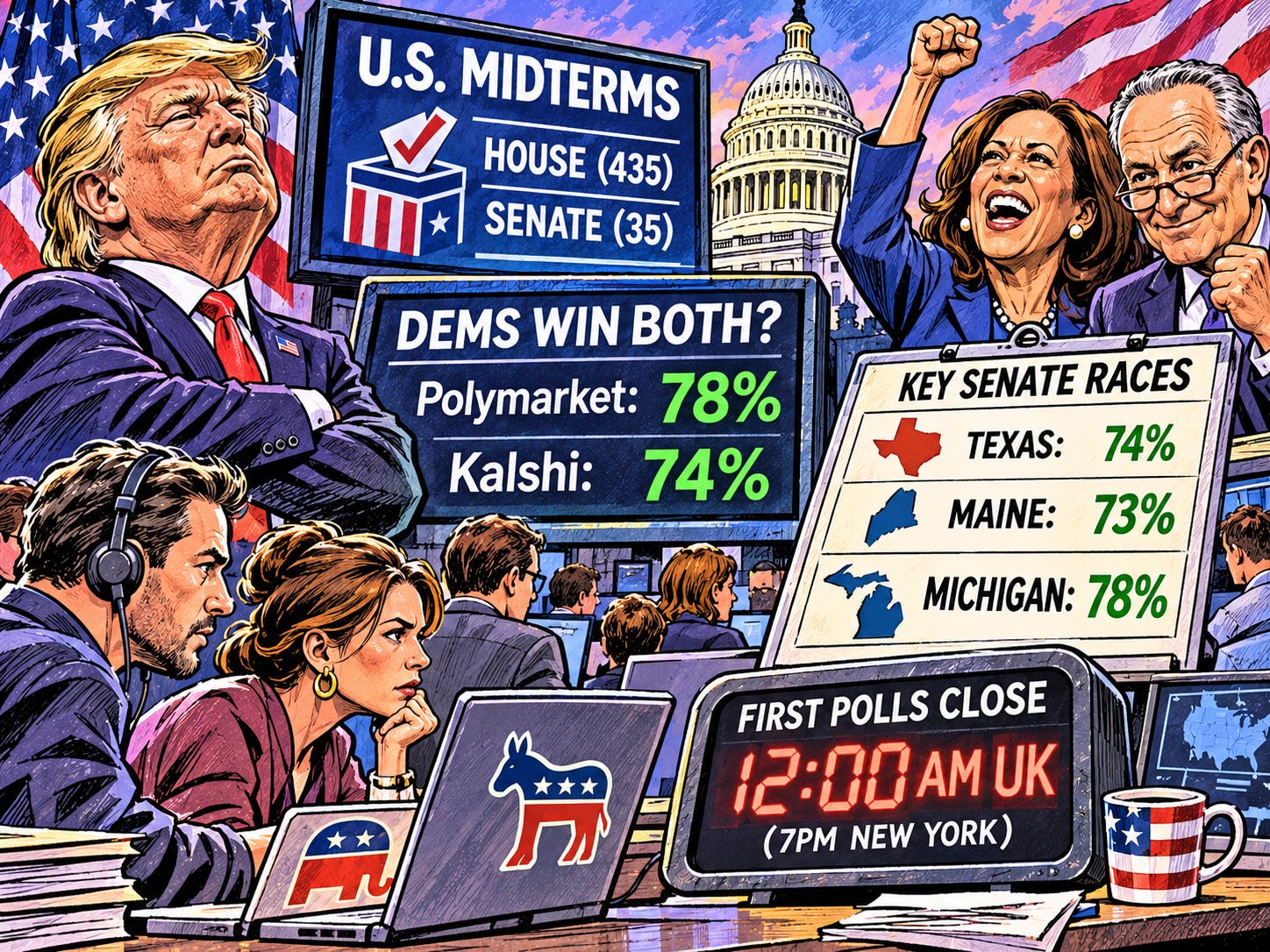
Americans vote today for all 435 House seats and 35 Senate seats. Polymarket put the chance of Democrats winning both chambers at 78% and Kalshi at 74% late yesterday, TokenPost reported, with more than $158 million traded across the two markets. Three Senate races carry the most weight. Prediction markets priced James Talarico at 74% to 76% to win in Texas, Troy Jackson at 73% in Maine and Abdul El-Sayed at 78% in Michigan. TokenPost
When will the UK know? The first polls close at midnight UK, which is 7pm in New York, in Florida, Georgia and Virginia, Saxo said. Ohio and North Carolina follow at 12:30am UK. Maine, Michigan, Pennsylvania and Texas close at 1am UK, 8pm in New York. Those last 4 hold much of the Senate story, so the clearest picture should come in the early hours of tomorrow, UK time. A Senate race inside a few points could take days to call. Saxo
Sensei’s Insight: The House looks settled by the money. The Senate is where a surprise would come from, and Texas and Maine are the races I would watch first. A sweep at 78% still leaves roughly 1 chance in 5 for something else.
🤖 Palantir had its best quarter, and the shares still fell
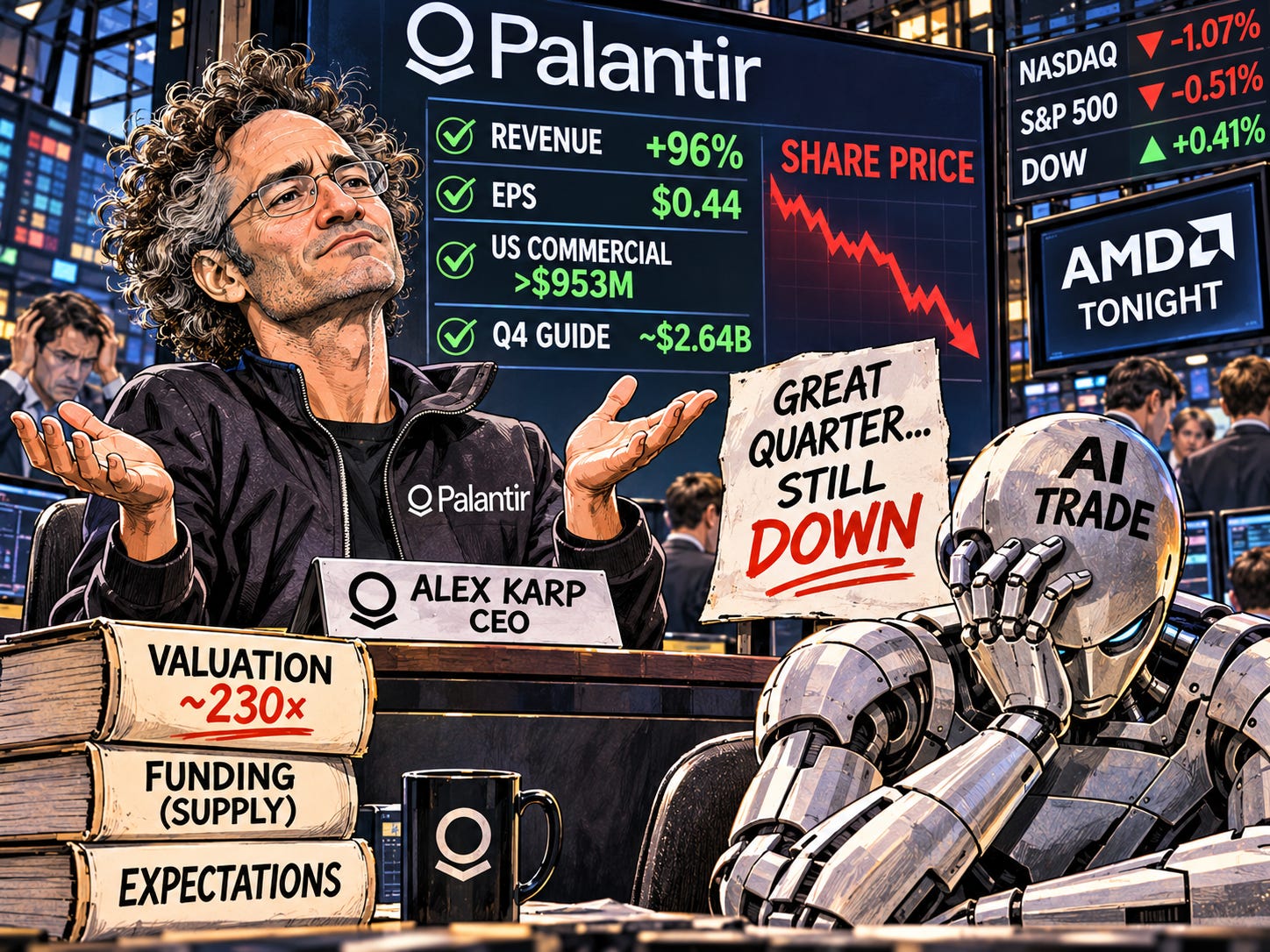
Palantir’s revenue rose 96% to $2.3 billion in the third quarter, against about $2.18 billion expected, Fortune reported. Earnings were 44 cents a share against 41 cents expected. For the first time, US commercial revenue of $984 million beat US government revenue of $953 million. Palantir guided fourth-quarter revenue to about $2.64 billion to $2.65 billion, against roughly $2.46 billion expected. Chief executive Alex Karp wrote that calling the results extraordinary “would be an understatement”. The shares rose about 1.5% after the release, then fell as a wider AI sell-off spread. Fortune
How does a 96% quarter lose money? The price already expected it. Palantir trades at around 230 times forward earnings, Startup Fortune reported, against roughly 35 for the Magnificent Seven. The selling was wider than one stock. The Nasdaq Composite fell 1.07% yesterday to 25,164.36 and the S&P 500 0.51% to 7,541.40, while the Dow rose 0.41%. Marvell fell 12.7% and Oracle 8.8% after a plan to raise $20 billion in debt and equity, Saxo said. In Seoul this morning the Kospi closed down 3.59% at 5,648.79. Startup Fortune Seoul Economic Daily
Sensei’s Insight: Palantir did everything asked of it and the shares still went down. That tells me the selling is about price and funding, more than demand. What I am watching is AMD tonight, with the call at 10pm UK, 5pm in New York.
🔐 Binance’s proof covers Saturday, and the outflow came after

Binance said yesterday it had finished a full zero-knowledge proof of reserves for 10 tokens: BNB, BTC, ETH, RLUSD, SOL, USD1, USDC, USDT, XRP and ZEC. All 10 were backed at least 1:1, Unchained reported. In plain terms, the check lets each customer confirm their balance is included, and confirms the reserves cover what customers are owed, without exposing any single account. “Binance will absorb the financial impact of the stolen funds, not our users,” the exchange said. It has covered about 95% of the more than $6.3 billion stolen, and about $3 billion has been frozen onchain. Unchained
The proof has a date on it. It checks balances at midnight UTC on Saturday 31 October, the start of the day before withdrawals reopened. It does not show Binance’s current position or audit its overall solvency, TechBriefly noted. A net $3.64 billion left in the first 9.5 hours of withdrawals on Sunday. The next snapshot is due tomorrow, with more tokens, and co-chief executive Yi He said a proof takes about 40 to 50 hours after the snapshot. Bitcoin was near $76,800 this morning, Saxo said, and US bitcoin ETFs saw about $399 million of outflows. TechBriefly
Sensei’s Insight: The proof shows Binance was fully backed before the run. That is useful and it is a snapshot. What I am watching is tomorrow’s snapshot, because that one will include the money that has already walked out the door.