

This content is for informational and educational purposes only and does not constitute financial advice. Always do your own research. Not financial advice (NFA).
👀 Today’s Stories at a Glance
🇨🇦 Canada answers dollar for dollar: counter-tariffs of 15% to 50% on $20bn of American goods took effect this morning, covering 700 products.
🏛️ Wall Street reopens pricing a rise: traders put roughly 60% odds on the Fed raising rates when it votes on 16 September.
🛢️ Oil’s recovery slips into 2027: Brent settled at $97.31 and ANZ sees no return to pre-war flows until next year.
🇯🇵 The yen hits a 7-month high: it reached 153.53 per dollar as markets priced a 97% chance of a Japanese rise.
🇨🇳 China’s exports jump 25%: August shipments to America rose 34.4% despite the tariffs, and the monthly surplus hit $119.09bn.
🔩 Copper sets an all-time high: it reached $14,533 a tonne in London on tariff fears, beating the record set in January.
🛍️ British shop sales slow again: like-for-like retail sales rose 0.5% in August, a 4-month low and well under the 1.2% expected.
📱 Apple’s first event under Ternus: the Surprise and Shine launch runs tomorrow at 6pm UK, 1pm ET, and a foldable iPhone is expected.
🎮 GameStop reports after the close: it has already told investors sales fell to $780m to $800m while net income nearly doubled.
📈 I think Bitcoin tops out here and heads lower: Chart of the Day covers 82,000, 70,000 and the 60,000 level below it.
🧠 One Big Thing
The Federal Reserve votes on 16 September, and the market now thinks a rise is more likely than not. Roughly 60% odds, after Friday’s jobs report came in at close to 3 times what forecasters expected. That reaches you even if you own nothing American, because the dollar borrowing rate sets the price of money almost everywhere else. That leaves 2 prints before the vote: producer prices on Thursday and consumer prices on Friday, both at 1:30pm UK, 8:30am ET. A hot Friday number settles it. A cool one reopens the argument.
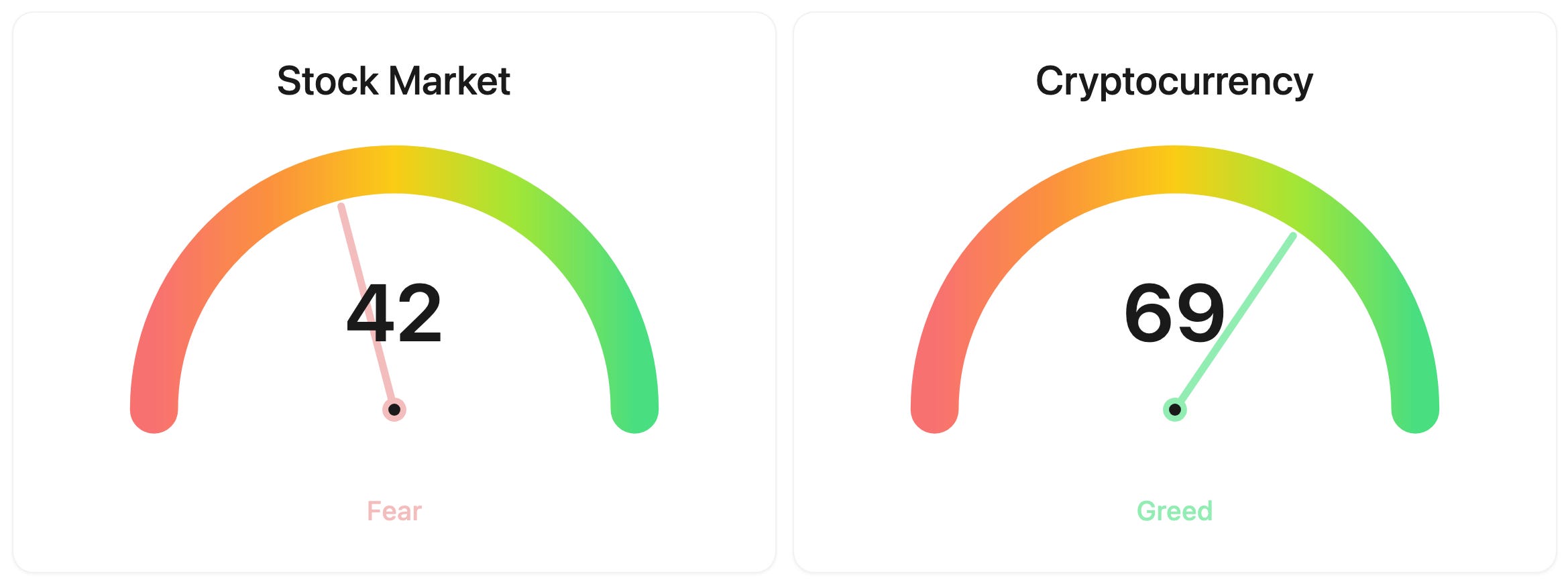
⚖️ Fear & Greed
📉 The Number That Matters
96%
American importers and shoppers absorb 96% of the cost of tariffs, the Kiel Institute for the World Economy found. Canada’s counter-tariffs landed this morning, and the same arithmetic runs in reverse on Canadian shelves.
⚔️ Winners vs Losers
Winners
BNC 0.00%↑ : 39.83% CEA Industries Inc. surged after Four.meme launched BNC4, a tokenised 1:1 version of its shares and the first of its new 4Stock products, drawing speculative flows into the BNB treasury company following Changpeng Zhao’s comments about IPOs moving on chain.
ARBE 0.00%↑ : 36.16% Arbe Robotics Ltd. jumped after it and Chinese tier-1 HiRain were selected by one of the world’s largest automotive groups to supply imaging radar for a Level 3 automated driving programme spanning multiple brands in China. Series-production deliveries are scheduled to begin in Q4 2027.
ROIV 0.00%↑ : 20.15% Roivant Sciences Ltd. rose on positive Phase 2 PHocus topline data from subsidiary Pulmovant for inhaled mosliciguat in pulmonary hypertension associated with interstitial lung disease, with the Phase 3 PHrontier study already enrolling.
PHVS 0.00%↑ : 15.94% Pharvaris N.V. climbed after positive topline data from the CHAPTER-3 pivotal study of deucrictibant XR for prophylaxis of hereditary angioedema attacks.
BE 0.00%↑ : 6.49% Bloom Energy Corporation gained after confirmation it joins the S&P 500 before the open on 21 September, the first energy name added to the index since 2022, with UBS lifting its price target to $325.
ORCL 0.00%↑ : 5.03% Oracle Corporation advanced into its 10 September earnings report as Morgan Stanley raised its price target to $210 and called the setup attractive, with investors focused on a backlog that hit $638 billion last quarter.
INTC 0.00%↑ : 4.37% Intel Corporation rose after Northland upgraded the stock to Outperform with a $120 target on turnaround progress and server CPU shortages, alongside supply-chain reports that Intel will raise PC processor prices by around 10% in early October.
Losers
DYN 0.00%↑ : 27.72% Dyne Therapeutics, Inc. slumped after Novartis said rival myotonic dystrophy drug del-desiran failed its Phase 3 trial, raising doubts over Dyne’s own smaller pivotal study in the same indication.
TRBG 0.00%↑ : 18.79% TurboGen Ltd. moved sharply lower in pre-market with no specific catalyst identified, a week after the Israeli microturbine developer completed its Nasdaq direct listing alongside its Tel Aviv listing.
AMGN 0.00%↑ : 5.98% Amgen Inc. fell after BMO Capital downgraded it to Market Perform on valuation and loss-of-exclusivity risk, following Novartis data showing pelacarsen lowered Lp(a) without cutting cardiovascular events, a negative read-across to Amgen’s olpasiran.
📊 Market Snapshot
Cryptocurrencies:
Bitcoin (BTC): $78,308 (▼ 1.01%)
Ethereum (ETH): $2,471 (▼ 0.77%)
XRP: $1.39 (▼ 0.36%)
Equity Indices (Futures):
S&P 500: 7,698 (▼ 0.31%)
NASDAQ 100: 29,553 (▼ 0.04%)
FTSE 100: 10,835 (▲ 0.19%)
Commodities & Bonds:
10-Year US Treasury Yield: 4.80% (▲ 0.25%)
Oil (WTI): $94 (▲ 2.69%)
Gold: $4,404 (▼ 0.54%)
Silver: $66.20 (▲ 0.01%)
Data as of: UK: 1:00 PM BST / US: 8:00 AM EDT / Asia (Tokyo): 9:00 PM JST
✅ 5 Things to Know
🇨🇦 Canada’s counter-tariffs land on 700 products
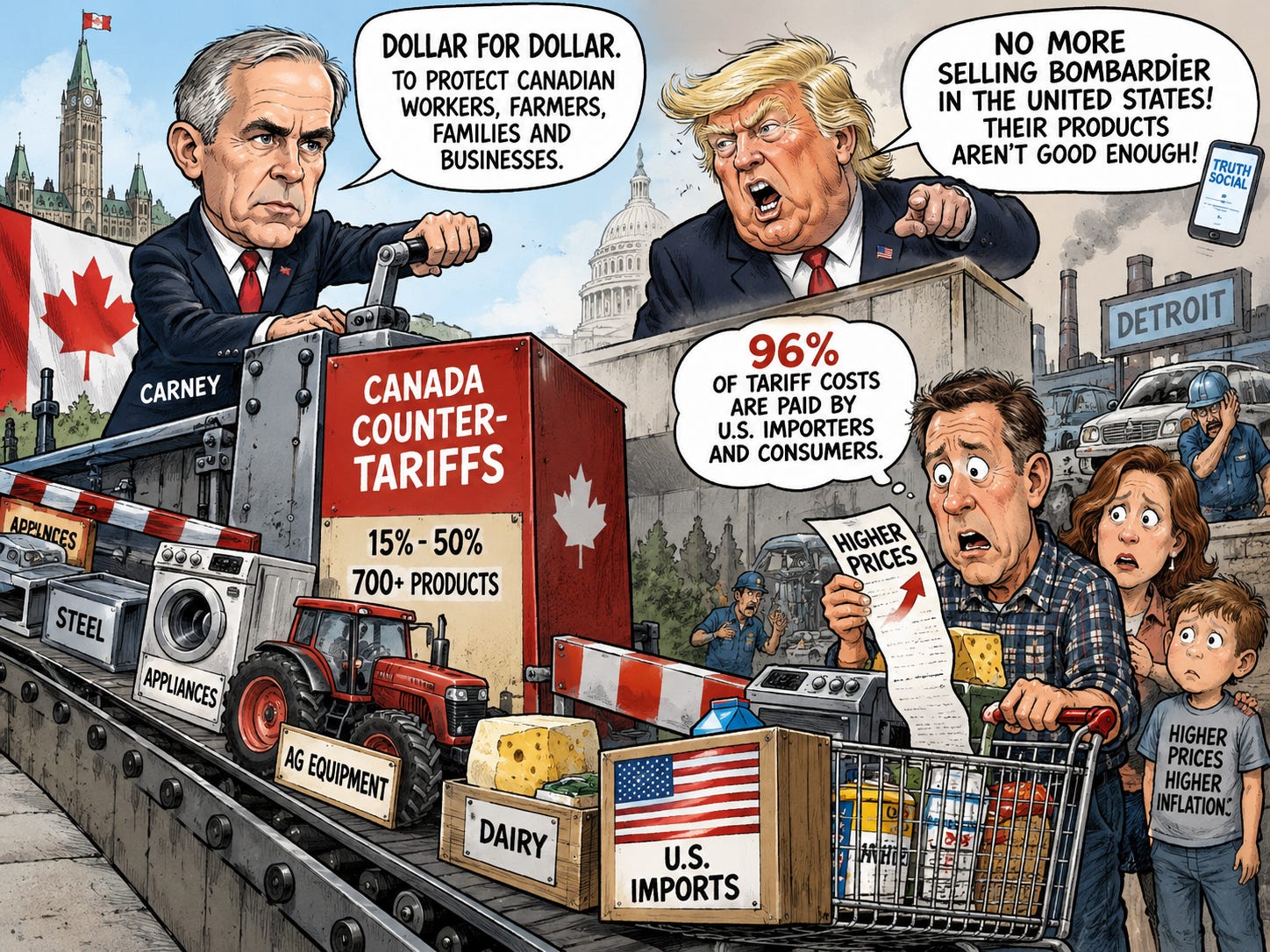
Canada’s retaliatory tariffs are live. They took effect at 5:01am UK, 12:01am ET, run from 15% to 50%, cover nearly $20bn of American imports and touch more than 700 products, among them steel, household appliances, agricultural equipment and dairy. Prime Minister Mark Carney said in late August that Canada would match Washington “dollar for dollar in order to protect Canadian workers, farmers, families, and businesses”. Ottawa is putting $5.42bn behind a support package for the small and medium-sized businesses and workers caught in it. The American duties these answer, 50% on about $20bn of Canadian goods, went live on 22 August after trade talks collapsed. (Al Jazeera)
So who actually pays a tariff? The buyer’s side, mostly. The Kiel Institute for the World Economy puts the share absorbed by American importers and consumers at 96%. That makes this an inflation story before it is a trade story, and it arrives in the same week as 2 American inflation prints. Canada is the largest buyer of American-built cars, so Detroit is directly exposed. On the eve of the deadline the president wrote on Truth Social, “NO MORE SELLING BOMBARDIER IN THE UNITED STATES! Their products aren’t good enough!”, although it is the Federal Aviation Administration that certifies aircraft rather than the White House. (Forbes)
Sensei’s Insight: Tariffs get reported as punishment aimed abroad. The Kiel number says otherwise, because the bill lands at home in the checkout price. Keep that in mind on Friday, since this is the mechanism that puts tariffs into an inflation print.
🏛️ Wall Street reopens with a rate rise as the base case
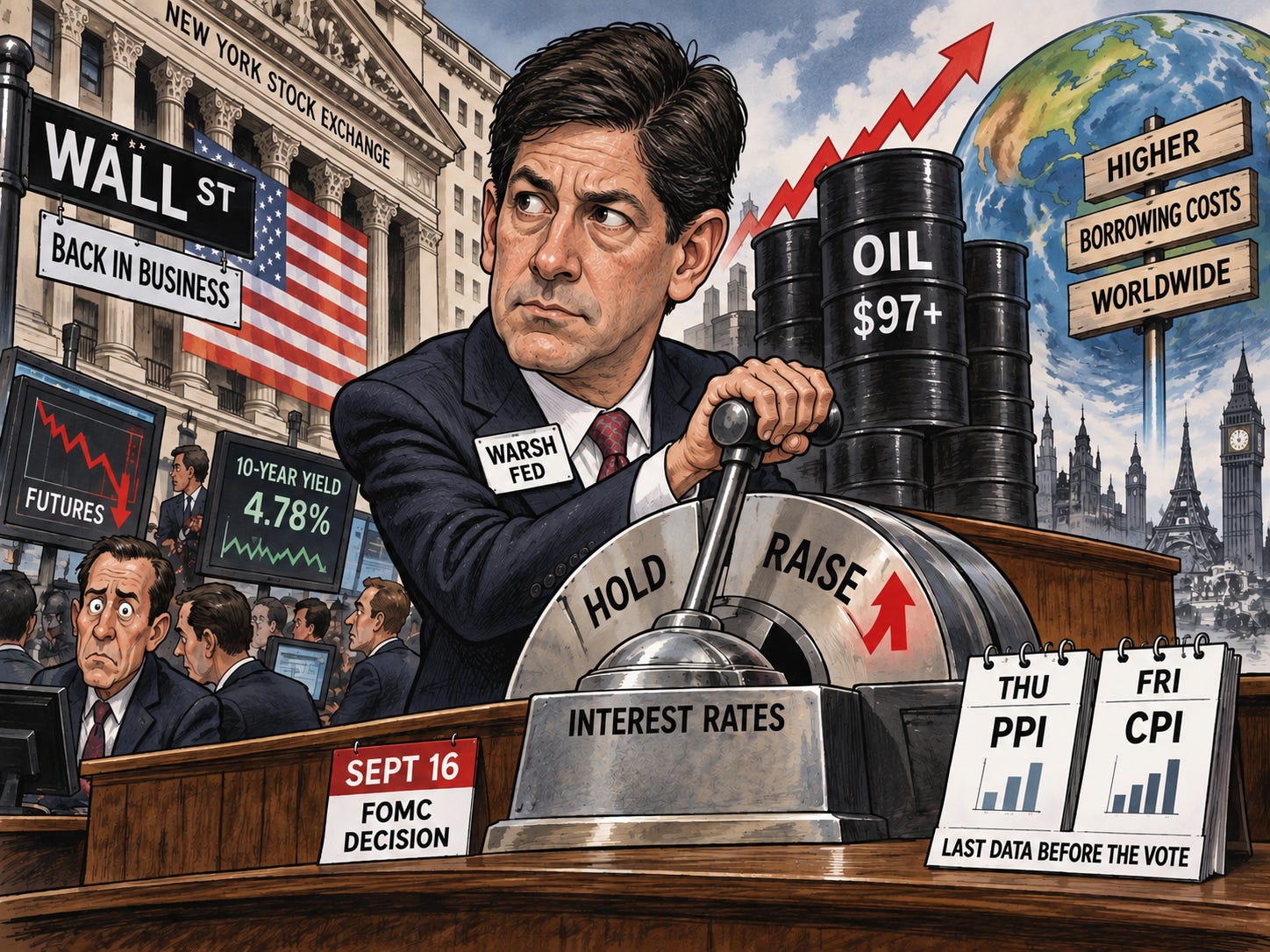
60%. That is roughly what traders were pricing on Tuesday for a quarter-point rise when the Federal Reserve votes on 16 September, at the end of a 2-day meeting starting on the 15th. American markets were shut on Monday for Labor Day, so this is the first session since Friday’s jobs report. That report put payrolls at 162,000 against forecasts near 53,000, held unemployment at 4.1% and revised the 2 previous months higher. The 10-year Treasury yield sat at 4.78% on Tuesday, and stock futures edged lower before the open.
That leaves 2 prints before the vote. Producer prices arrive on Thursday and consumer prices on Friday, both at 1:30pm UK, 8:30am ET, and they are the last major data the committee sees before it decides. Reuters reported that a hot inflation reading would all but seal a September rise, while a cooler one strengthens the case for a hold. Why this reaches beyond America is simple: dollar borrowing costs set the price of risk everywhere, so a rise in Washington turns up in British bond yields and in what companies pay to borrow. Oil above $97 is what makes the inflation half of the decision harder. (Trading Economics)
Sensei’s Insight: Strip out the politics and this is an oil decision. Jobs at 162,000 took away the reason to wait, and crude above $97 keeps pushing the inflation forecast the wrong way. Friday tells us whether the argument is finished.
🛢️ The oil war’s recovery date slides into 2027
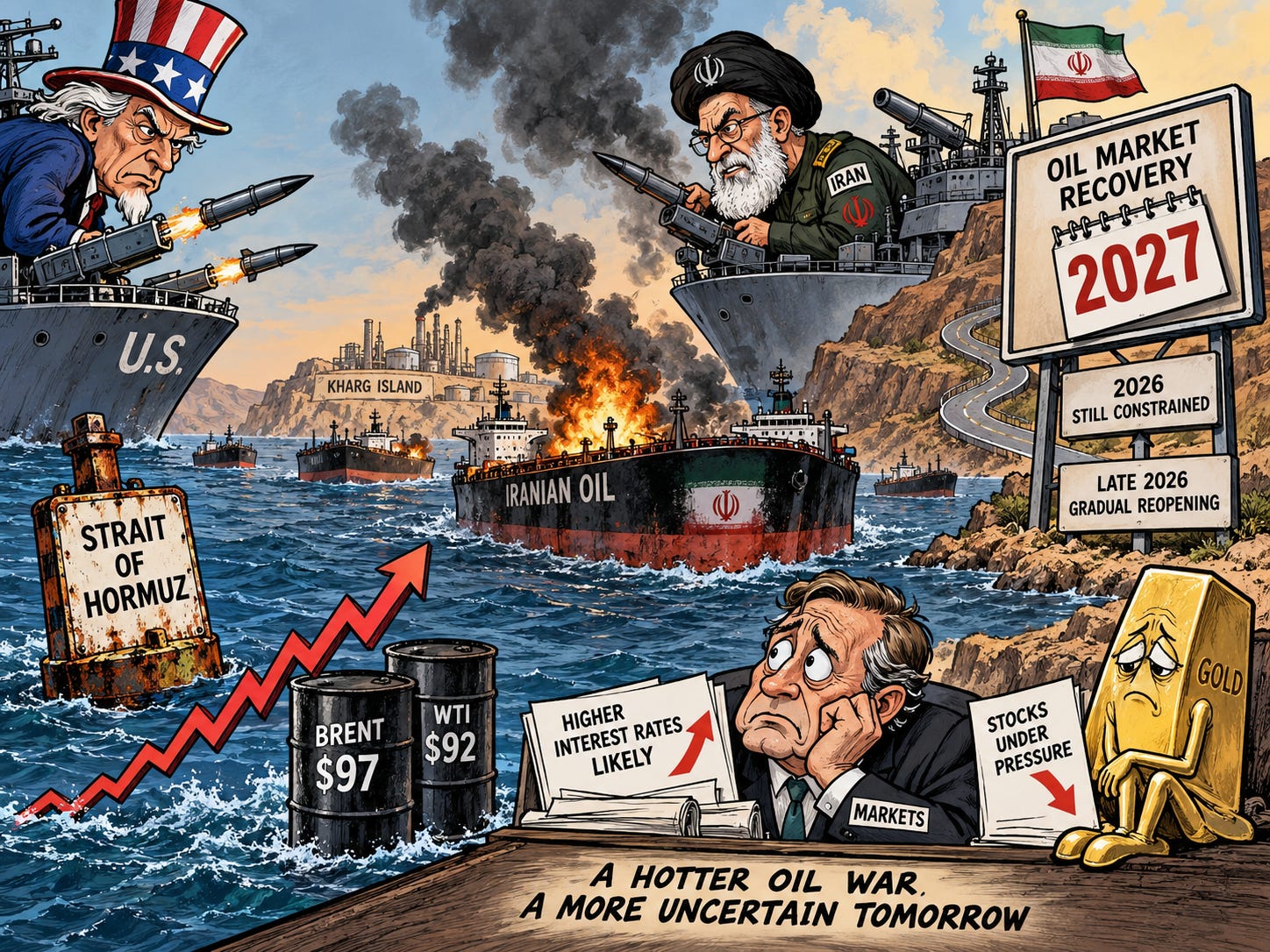
“A major escalation in the maritime conflict.” That is how the maritime intelligence firm Marisks described the weekend. American forces struck 3 Iranian oil tankers, one of them off Kharg Island, Iran’s main export hub. Iran’s Revolutionary Guard navy said it had targeted 3 tankers using what it called unauthorised routes through the Strait of Hormuz, along with 3 American vessels elsewhere. Commercial tankers are now being used deliberately as instruments of reciprocal economic pressure, Marisks added. Brent settled $1.03 higher at $97.31 on Monday after touching $98.06, its highest since 24 July, and WTI added 1.3% to $92.65. Brent gained 7.8% last week. WTI gained close to 10%. (Reuters)
The timetable moved over the weekend. ANZ told clients that a prolonged standoff punctuated by calibrated military action is now the likeliest path. On its numbers exports stay constrained through the rest of 2026, with a gradual reopening late in the fourth quarter. Pre-war throughput does not return until late in the first quarter or early in the second quarter of 2027. Kpler counted an average of 10 commodity ships a day through the strait over the past 10 days, the lowest since May. OPEC+ met on Sunday and left October output exactly where September’s is. The barrels that would settle this are not being offered. (Reuters)
Sensei’s Insight: The longer we stay above $80, the more likely the rate hike will come. Above $90, even if it’s for a short amount of time, rate hikes are more likely. It looks like rate hikes will happen this year based off oil prices, and it’s not looking great for the rest of the market, including gold. Gold doesn’t do well in times of high inflation when you also expect higher interest rates. High interest rates don’t favour gold, and that is why gold is selling off as well.
🇯🇵 The yen’s rally is now everyone’s problem
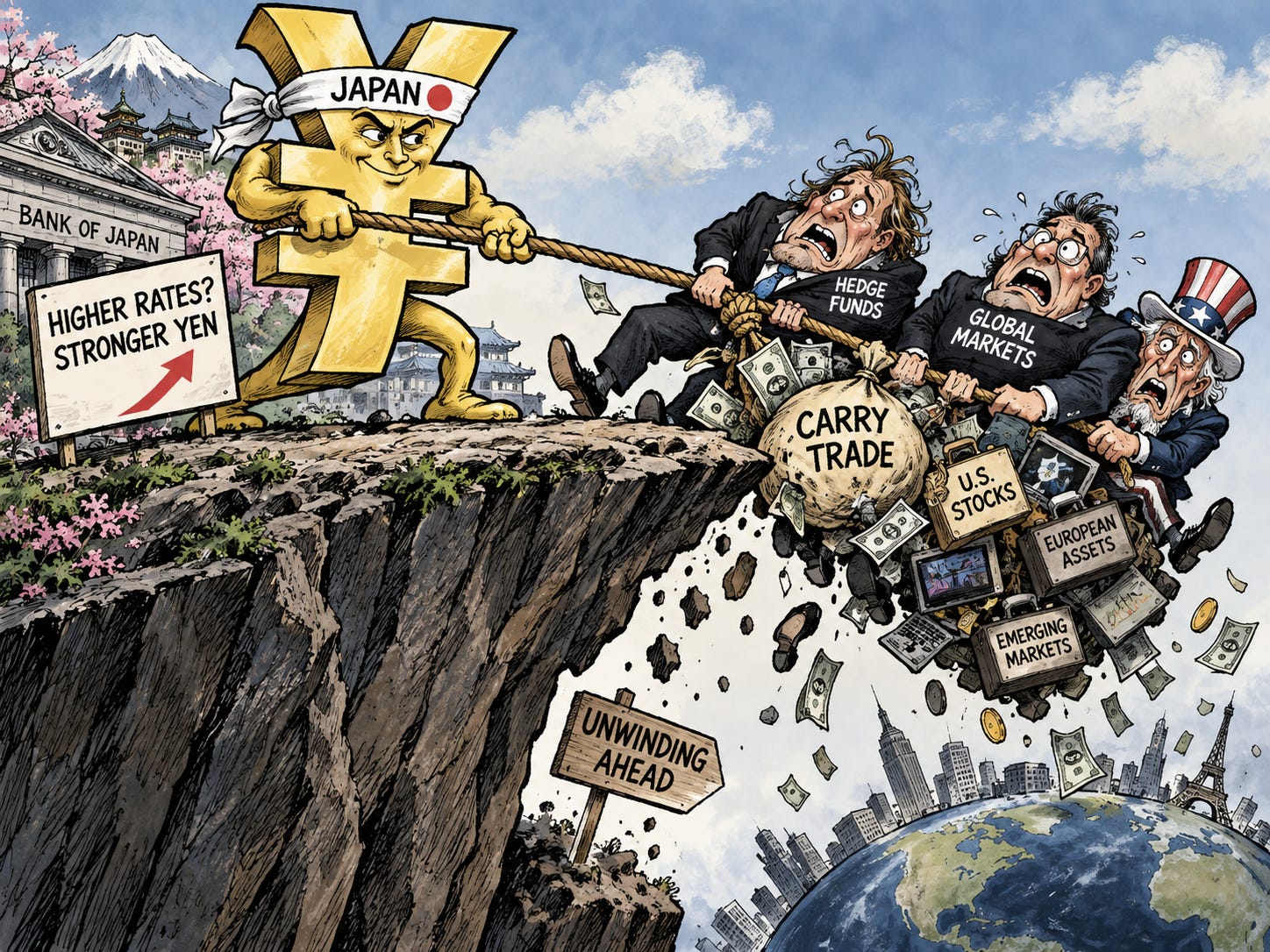
What happens when the world’s cheapest borrowing currency stops being cheap? Everybody finds out at the same time. The yen reached 153.53 per dollar in Tokyo trading on Tuesday, its strongest since February and past the levels Japan intervened to defend in July. It has firmed close to 4% from around 160 in a week. Japan’s second-quarter GDP was revised up to an annualised 1.4% from 1.1%. July’s average cash earnings rose 4.7% against 3.9% expected, a sixth straight month above 3% and the first run like that in more than 34 years. (Reuters)
Overnight index swaps now put roughly a 97% chance on the Bank of Japan raising its policy rate a quarter point at its meeting on 17 and 18 September, against about 75% a week ago. For years investors have borrowed yen at close to nothing and bought assets elsewhere, which works while the yen stays weak and comes apart quickly when it strengthens. Traders are closing those positions now, and that is why the move has been this fast. Japanese money coming home would add to it. The Bank of Japan votes the day after the Fed does. (Nikkei Asia)
Sensei’s Insight: This is the trade nobody mentions until it moves. A 4% currency move in a week forces people to sell things they wanted to keep, and it does not care which market those things are in. I am watching Japanese assets and anything crowded.
🇨🇳 China’s exports jump 25% with the tariffs still on
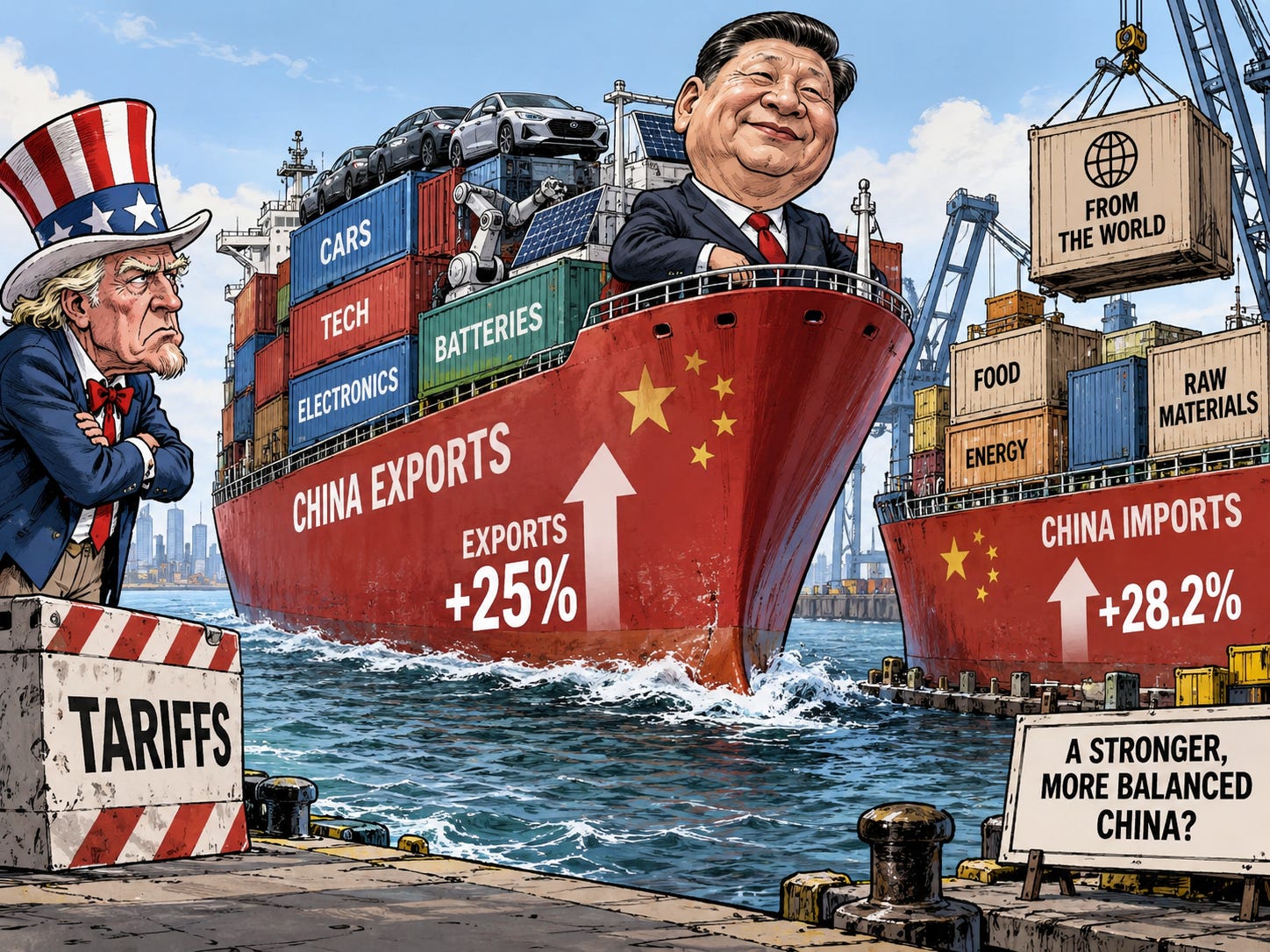
China’s exports rose 25% in August from a year earlier, to $401.44bn, on demand for cars and high-tech goods. Imports grew 28.2% to $282.36bn. The monthly goods trade surplus came in at $119.09bn, up from $112.5bn in July and the latest in a run of monthly surpluses above $100bn. Shipments to the United States totalled $42.5bn, a rise of 34.4% on the year, against $13.3bn going the other way, leaving a bilateral surplus of about $29.2bn. The cumulative surplus for the first 8 months of 2026 stands at $805.51bn. (CNBC)
Tariffs were meant to shrink that American number. It grew by a third instead. Some of that is rerouting, some is price, and some is that American buyers still need what China makes, which is the Kiel finding arriving from the other end of the same trade. The line worth more attention is imports growing faster than exports. Import demand is the part of China’s economy that has been missing for years, and it is what rebalancing would look like if it were real. China publishes consumer and producer prices on Wednesday, and those 2 readings say whether the export machine is running on volume or on discounting. (Associated Press)
Sensei’s Insight: Read the import line. Exports up 25% is a story about the rest of the world still buying from China. Imports up 28.2% is a story about China buying from everyone else, and that one has been missing for 3 years.
Stories You Might Have Missed
🔩 Copper sets a record on tariffs and geology at once
Benchmark 3-month copper futures on the London Metal Exchange reached $14,533 a tonne on Monday, the highest price ever paid for the metal and above the previous record set in January. The rally has 2 engines. Traders expect the president to widen American tariffs to imports of refined metal, which has pulled inventories into the United States and left less of it everywhere else. Underneath that sits a supply problem: an export ban in Congo, weaker output from Chile and Peru, and a Chilean second quarter that was the country’s weakest in at least 19 years. Copper has gained 17% over the past year, with data centres, power grids and renewable projects all pulling on the same wire. (Bloomberg)
🛍️ British shops post their slowest month since April
Like-for-like retail sales in Britain rose 0.5% in August from a year earlier, down from 1% in July and short of the 1.2% economists expected, according to the British Retail Consortium. That is the weakest reading in 4 months. Record heat earlier in the summer pulled spending forward into food, drink, health and beauty, and those categories held up into August while most others could not manage another month of growth. The figure landed the same morning Bank of England policymakers appeared before the Treasury Committee to answer for holding Bank Rate at 3.75%, with gilt yields sitting near multi-decade highs. (Reuters)
📱 Apple’s first launch under a new chief executive
Apple holds its Surprise and Shine event on Wednesday at 6pm UK, 1pm ET, the first product launch run by John Ternus, who replaced Tim Cook as chief executive on 1 September. Bloomberg expects the company’s first foldable iPhone alongside updates to the iPhone 18 Pro and Pro Max, an Apple Watch Series 12 and an Apple Watch Ultra 4. The foldable is the headline. Pre-orders are expected from Friday 11 September with devices arriving around 19 September. September is the launch that sets up Apple’s December quarter, which is the biggest 3 months of its year, and this one carries a new chief executive on stage for the first time. (Bloomberg)
🎮 GameStop reports with the surprise already out
GameStop publishes second-quarter results after the American close tonight, having pre-announced its headline numbers on 31 August. It expects net income of $290m to $310m against $168.6m a year earlier, and operating income of $150m to $170m against $66.4m. Sales are expected to fall to between $780m and $800m from $972.2m. A $238m gain on a 43.4 million share stake in eBay is doing most of the work on the profit line. The shops keep shrinking. Options pricing implies a move of about 9% in either direction once the full report lands. (TipRanks)